















How to Choose the Right Mobile App Development Company?

Developing an app is not easy, and sometimes, your in-house team doesn’t have the right people and expertise aligned with your project. In this case, outsourcing is a perfect choice of many. But what if you choose the wrong partner, leading to significant failures? Don’t worry! This article will offers you the best tips on how to choose a mobile app development company.
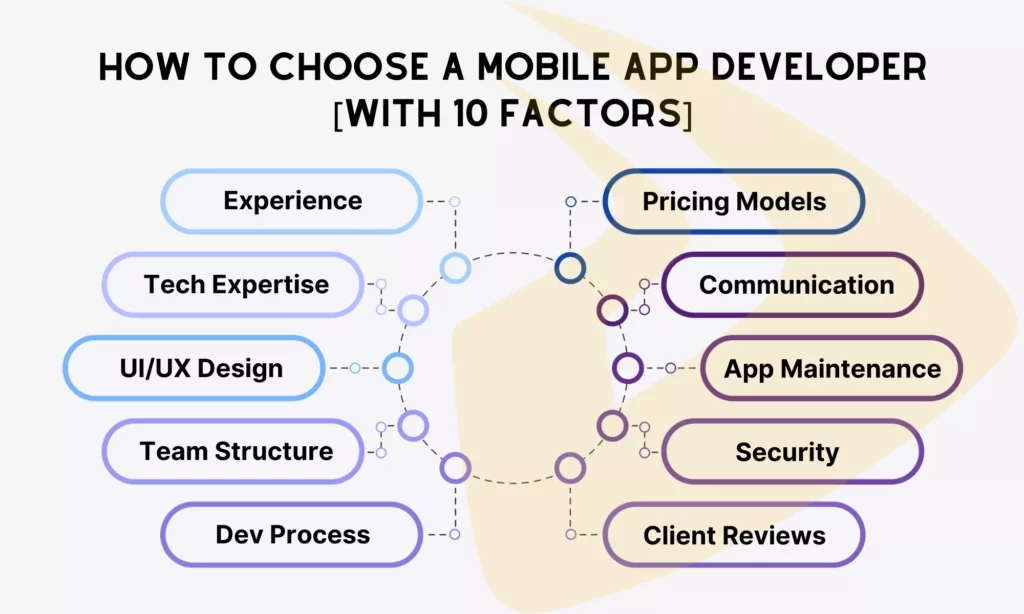
Key Factors to Consider When Choosing a Mobile App Development Company
If you didn’t know already, the mobile app market is booming, and new statistics confirm that. In 2026, in-app spending is forecast to reach $225 billion, and this figure is likely to increase gradually in the upcoming years. Meanwhile, the global mobile app market is worth nearly $664 billion at the same time.
These figures highlight the necessity of building a mobile app to meet growing user demands. But is bringing app ideas to reality that easy? Many say no. That’s why they need to partner with the right mobile app development company.
In this section, we’ll explain important factors that allow your business to make an intelligent choice when selecting a development partner. Keep reading!
1. Experience and Portfolio
When picking a mobile app development company, you’ll need to look through their portfolio first. It tells you their previous work and how their projects were, from the core functionalities developed to the achievements their solutions obtained (e.g., increasing organic traffic or sales).
More importantly, a portfolio can tell you whether a potential partner has experience in your domain – e-commerce, healthcare, or anything else. If the company knows your industry inside out, they can offer you solutions tailored to your specific situation. For example, a healthcare app developer is aware of how to ensure compliance with mandatory regulations (like GDPR and HIPAA)
With industry expertise, the partner can help you make informed decisions on what features your potential app should or should not have.
But looking at only experience is not enough. Think about the complexity and scale of the projects as well. An experienced company that has completed large-scale projects will easily handle your app development needs.
Don’t forget to check for client testimonials or reviews. Positive feedback from previous clients is a clear indicator of the company’s reliability and high-quality work.
Thoroughly inspecting the portfolio and experience, you can decide on the right company that fits your project’s needs and objectives well.
2. Technical Expertise
Another factor to consider is definitely a company’s technical expertise. What do you need to know about their technical skills? Let’s see:
- Programming proficiency is the first consideration. If you target Android apps, developers must be proficient in relevant languages like Java or Kotlin. In case you want a native iOS app, Swift and Objective-C are what they have to excel at. And cross-platform or hybrid apps? Consider whether the company is excellent in React Native and Flutter.
- Experience with development tools is a must. Developers must know Integrated Development Environments (like VS Code or Xcode), version control systems (like git), and other developer tools to build mobile apps.
- Your potential partner needs strong testing and debugging skills. When you talk to your friends about recycling, do you ensure they understand 100% the content? The same to your app. Even with the best developers, your app can perform poorly or have some bugs. So, developers need to test the app carefully to detect and fix bugs effectively, hence ensuring a high-quality product.
- Excellent data management and security are a necessity. Your data can be leaked or poorly organized if developers don’t know how to keep data secure or adhere to industry standards. The result? Weak security measures can let bad guys steal sensitive info and violate your users’ privacy.
Considering these technical skills, you can evaluate a mobile app development company better.
These technical skills help in evaluating a mobile app development company and to make sure they will be able to bring your dream to life.
Recommended reading: Why Should You Develop Mobile Applications in Vietnam?
3. UI/UX Design Capabilities

The first glance gives a lasting impression. If your app has an unappealing user interface and doesn’t align with your brand identity, target users will definitely give thumbs down. Besides, they’re not patient enough to spend time on a hard-to-navigate app and don’t hesitate to abandon such an app.
Therefore, you have to evaluate the UI/UX design capabilities of a potential company. Look at their past work on their own website, tech review sites (e.g., Clutch), or online playgrounds for creative professionals (e.g., Behance or Dribble), and you’ll see how they tackle UI/UX design.
A good company will seriously spend time on wireframing, prototyping, and user journey mapping before writing any line of code. Many companies, like Designveloper, even adopt design principles, typically Google’s Material Design 3, to optimally organize and manage the design system between teams in the same project, ensuring consistency and boosting the design process.
If a company can handle UI/UX design well, it can understand your target audience’s pain points better and design an intuitive, easy-to-navigate interface for your specific case.
4. Team Structure and Skill Set
When outsourcing a mobile app project to a tech company, you can hire a whole team or just a few specialists to augment your in-house team. Regardless of your choice, you still have to know exactly who will do what in your project.
If you intend to hire a dedicated development team, don’t just look at developers who take on frontend, backend, or full-stack development. You need excellent UI/UX designers, dedicated QA testers, and a project manager. If your project involves advanced technologies, like artificial intelligence or IoT (Internet of Things), the team will require AI or IoT specialists.
Remember that you don’t need versatile team members who have a broad knowledge of many technologies, but require a team with specialized depth in the core techs needed for your app. Further, your project requirements may change half-way. So, consider whether your potential company can scale up the team to help you, for example, meet a tighter deadline.
5. Development Process and Methodology
This is another crucial factor you shouldn’t forget when choosing a mobile app development company. Every tech company follows or builds its own process to build apps. Some popular development methodologies include Agile and Waterfall.
In many companies, like Designveloper, Agile is widely adopted due to its flexibility. If your project requirements are unclear initially and may change, applying Agile frameworks (SCRUM, Kanban, etc.) helps you focus only on the most critical features of the app.
Once your app receives feedback from real users or needs updates based on evolving demands, the development team continues to add other crucial functionalities. This approach speeds up time-to-market and ensures your app will meet customer demands.
Therefore, talk with a potential company and see how they can meet your project needs, not only about app functionalities but also about timeline and budget.
Additionally, don’t forget to ask them about how you can get updates about the progress. You can’t just stay still and only see the finished product at the end of the process.
Many companies allow you to access their project management tools – let’s say Jira or Trello – to see how everything is going in real-time. Others can set up frequent meetings to keep you updated and receive your feedback.
6. Pricing and Engagement Models

Money is another important consideration, right? Tech companies often provide different pricing models.
Fixed Price is often for small projects and ensures cost certainty. Time & Materials (T&M) allows you to pay for the actual hours worked, ideal for complex projects with changing requirements. Meanwhile, a dedicated team may require a monthly cost, best for long-term projects and continuous updates.
Regardless of your choice, ask a potential company to estimate the total app development cost. Don’t forget to consider hidden costs, for example, for post-launch debugging, third-party licenses, or App Store submission fees. You don’t want surprise bills, do you?
Recommended reading: How Much Does it Cost to Build Apps like Uber, Tinder, and Instagram?
7. Communication and Collaboration
You have to admit that excellent technical expertise, a well-structured process, and a reasonable pricing model are not enough. Another equally important factor is communication.
Does a potential company truly understand your existing problems? How quickly do they respond to your emails for feedback? Do developers live in a significantly different time zone? Who will take the main responsibility for contacting you and answering all your questions?
Ask these questions, and you’ll evaluate whether they can make clear, timely communication or have cultural alignment with your business. Otherwise, collaboration is hard to succeed, no matter how excellent that tech company is.
8. App Maintenance and Post-Launch Support
Launching an app is not the end, you know. The code may degrade over time, and your customers may demand new features to meet their needs instantly (like having a smarter web-based chatbot to resolve their problems 24/7).
That’s why asking how a potential company supports app maintenance is a must. In other words, you should consider how quickly the company fixes bugs or develops new features, how often, as well as how it charges for this maintenance service.
Ensure this post-launch support will be clarified in the SLA (Service-Level Agreement).
9. Security and Compliance
“How can you ensure superior security and compliance with industry regulations?” Ask the potential company this question to evaluate how it deals with your sensitive data, which is especially related to health, finance, or personal information.
Accordingly, you can see which security measures they adopt and whether they’re experienced with high-level authentication (e.g., MFA or biometric login). If your business works in a highly regulated industry – let’s say finance, law, or healthcare – can the company build a GDPR-compliant app?
If the company lacks the ability to handle security and compliance requirements well, the app it creates can lead to serious consequences, like data leakage or legal penalties.
10. Client Reviews and Reputation
The last thing to consider when choosing a mobile app development company is client testimonials. Don’t just look at client reviews on a potential company’s website. Instead, ask for direct references or dig deep into reviews in reputable third-party platforms, like Clutch or GoodFirms.
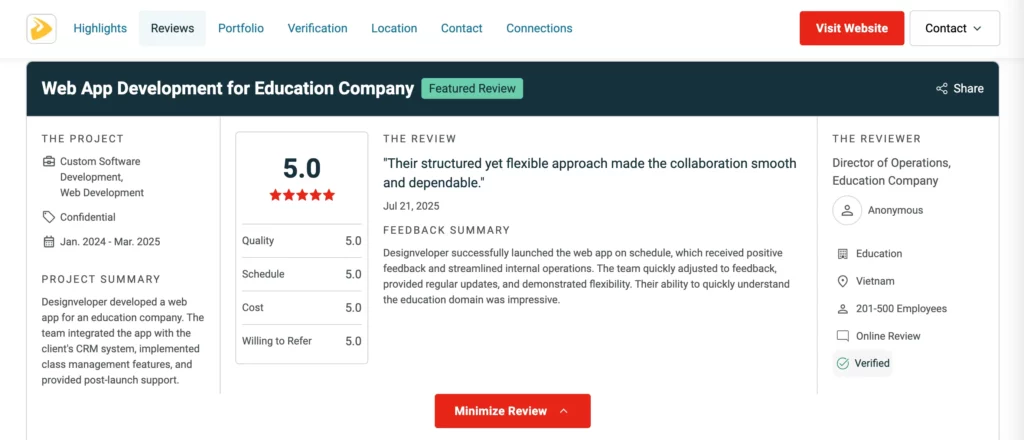
Learning about the company from these resources, you’ll better understand how the company helped their past clients build a mobile app that streamlines their workflows or improves end-user satisfaction. See how one client evaluated Designveloper’s work in Clutch:
Recommended reading: Are Cloud-Native Applications Safe Enough for Businesses?
Step-by-Step Guide to Choosing the Right Mobile App Development Company
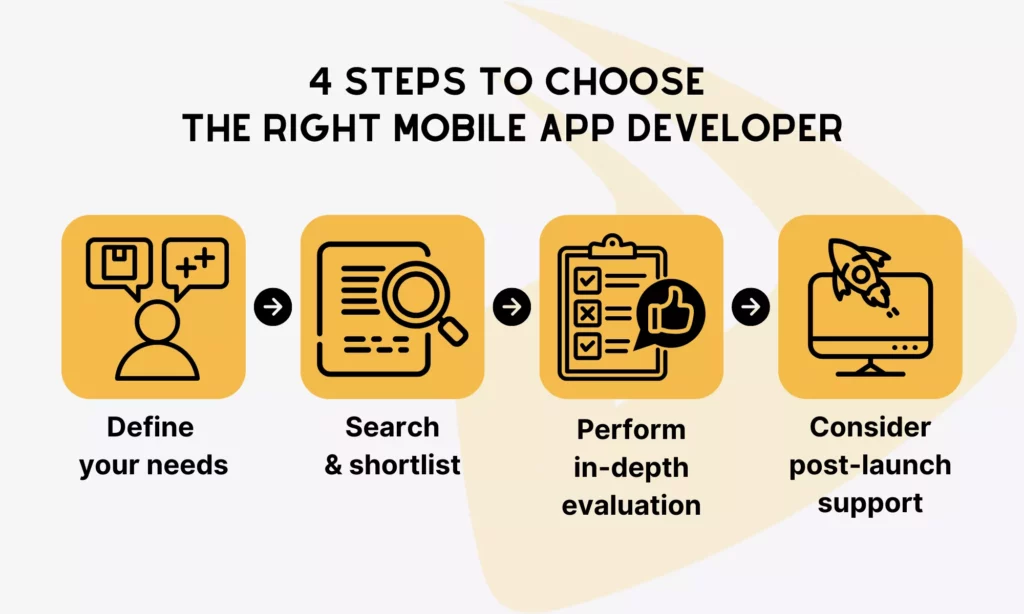
You have understood the key factors to choose the right mobile app development company, right? So, now, let’s take the following steps, integrating these core considerations, to pick the right one. You can adjust this guide to fit your specific situation instead of rigidly following each exact step.
Preparation phase: Defining your needs
To find the right mobile app development company, you should know your needs well. Knowing what you want to create is crucial – if you know what you want, you can hire a developer who specializes in that area. Here are some things to do:
- Clearly Define Project Goals and Scope
This requires you to:
Identify the core functionality. Will your app give information, facilitate transactions, or entertain? For example, a banking app demands secure transactions while a gaming app focuses on user engagement and fun.
Understand your target audience. Happy users are part of the reason your app will be successful. Say you have a fitness app for seniors versus one for tech-savvy millennials – you can have larger text and maybe simpler form navigation.
Set clear goals. Know what your app’s definition of success is. Are they just fixes for the number of downloads, user retention rates, or the revenue generated? A great way to measure your progress against the goals and to see how the developer is doing.
Research market trends. Know the current mobile app development trends. An example is that of cross-platform development which is in demand because it is cost-efficient and gives a wider reach.
- Establish Budget and Timeline
Be clear about how much you can spend as the maximum for mobile app development, and when you expect to release the app.
But be realistic. You can’t just spend $50K for a complex app and wish to make it done within three months. Share your requirements with a potential company, and it may help you calculate more accurate timeline and budget estimates.
Recommended reading: How Much Does It Cost to Make an App for Your Business?
Search and shortlisting phase
Once you have clarified your needs, it’s time to search and shortlist potential partners. Below are some of our tips to help you overcome this phase efficiently:
First, let’s talk about search methods. There are many ways you can count on to look for a candidate.
- Ask for referrals. Asking people from your trust – friends, coworkers, or business clients is the best option if they already developed and deployed successful apps. This way, you can better harness important details about what the potential company built and how it worked to build such apps.
- Conduct online searches. Type focused keywords on search engines (typically, Google), like “mobile app development company in healthcare in Texas.” You’ll find detailed information and avoid the noise.
- Go directly to review platforms, like Clutch, GoodFirms, or TechReview. Typing focused keywords in their search bars (and applying some filters if you want), and you then see a list of excellent candidates with ratings, locations, verifiable case studies, and detailed client reviews.
- Join professional social media like LinkedIn. Search and look at a professional portfolio of several notable companies that have experience in your domain.
Your search is done, and you may pick some companies you find suitable for your project requirements. Now, send them a detailed Request For Proposal (RFP) or make initial discovery calls.
During this initial shortlisting stage, you may apply some important criteria to narrow down the list. Do they focus on mobile app development? Do their pricing models fit your established budget? If they don’t pass these quick filter criteria, you don’t need to proceed with the next evaluation process.
In-depth evaluation phase
In this phase, you’ll perform a deeper evaluation to choose the right mobile app development company for your project. Consider important factors as follows:
- Experience and Technical Expertise
You should review similar projects they have implemented, particularly in your industry. Essentially, you need to evaluate the quality of the UI/UX design, the usability and speed of the apps developed.
Besides, assess whether they are proficient in specialized technologies for your project, like machine learning for image recognition or generative AI for content creation. You also need to evaluate the industry understanding of the shortlisted companies and whether they can communicate well about your specific challenges.
- Workflow and Transparency
Next, you should ask about their development process and communication channels. This allows you to know whether they offer a clear, specific process flow, as well as how and how often they keep you updated (e.g., daily stand-ups).
Further, don’t ignore their QA and testing process. Consider whether it’s rigorous to ensure the whole development process is secure all the time.
- Team and Culture Assessment
Another consideration is the team’s key personnel and work culture. You need to meet team members in person and see who takes on which roles or responsibilities. This meeting also helps you assess whether they can genuinely listen to your needs and integrate your feedback to make app building better.
- Cost and Payment Model
When evaluating a mobile app development company, you should request a detailed quotation that clarifies separate costs for different development parts. Further, you should understand which pricing models they offer, and more importantly, ensure you will fully own the source code and all intellectual property after the project is completed.
Post-launch support
Many often overlook this phase, as they think launching the app is the end of the process. But nope! Technologies always thrive, and your app needs frequent updates to meet market shift.
But before that, you may need the mobile app development company to support deployment and app store optimization. So, ask them how they handle the complex process of sending and getting approval for your app on the App Store and Google Play. Besides, consider whether they support ASO (App STore Optimization) to ensure your target users easily discover your app.
Upon app launch, you may want technical support from the company. Therefore, ask about their policy for bug fixes, like whether there is any free warranty period or what their long-term upgrade services are, plus possible maintenance costs. Further, consider whether they integrate any tools to track performance and gather feedback to make maintenance more effective.
Common Mistakes to Avoid When Choosing a Development Partner

Not all the time can people choose the right mobile app development company for their projects. From our experience, many often make the following mistakes during the selection process:
- Choosing Based on Lowest Price
The cheapest quote often attracts many people, but it can trap them into a low-quality app that leads to costly consequences. Don’t just look at the immediate development costs you have to pay initially. Instead, calculate the app’s ROI (Return on Investment). If a successful app can drive your overall sales, facilitate your business functions, or increase user experiences, the app’s initial investment is worthwhile.
- No Clear Contract or Deliverables
Even when the developers are your acquaintances, it’s crucial to make a contract (like an SLA) that clarifies core features, tech specs, the number of hours worked for each phase, IP (Intellectual Property) stuff, and other things. This puts mobile app development under control, ensuring the final deliverable is released on time and within budget.
- Ignoring Project Management
Some people think that building a mobile app only involves hiring developers. But it’s a myth. Every company or project requires managers to navigate it on the right track. And there’s no exception for mobile app development. Therefore, it’s crucial to pick a company with a transparent process of project management and good communication channels to keep you updated on the progress.
- Not Checking Real Client Reviews
Looking at a company’s portfolio is not enough, as it doesn’t show you whether the company works on time or within budget and communicates effectively. So, don’t skip hands-on experiences from real clients in past projects. These testimonials, especially from third-party platforms, like Clutch or GoodFirms, will give you a detailed review of the company’s budget adherence, timeliness, and problem-solving skills.
How Designveloper Can Be Your Partner in Mobile App Development
When it comes to figuring out how to choose a mobile app development company, partnering with the right team can make all the difference. That’s where we, at Designveloper, come into the picture. As a leading web and software development company in Vietnam, we bring a wealth of experience and expertise to the table.
We understand that every app is unique, with its own set of challenges and opportunities. Our team is committed to understanding your vision, identifying your needs, and delivering a product that not only meets but exceeds your expectations.
Our expertise in mobile app development tools
At Designveloper, we use the best tools to develop high-quality mobile apps. Our toolkit includes Visual Studio Code, Xcode, Android Studio, and React Native among others. We use these tools to build robust and user-friendly apps suited for every need.
For example, we use React Native to build cross-platform apps that feel the same across devices. We also leverage Jira for better task management and Fastlane for ironclad build and deployment processes. These tools were fundamental to our capacity to deliver a successful project like Lumin Mobile.
Impact of our tools on project outcomes
Your tool choice really affects how you will ultimately get in your projects. For example, in the development of Lumin Mobile, our suite of tools allowed us to effectively and quickly deliver features and improvements to the product. Debugging and source control management were kept up to a high standard, partly due to using Flipper for debugging and Sourcetree for source control management.
With the help of such tools, along with all our expertise, we have been able to make mobile app development easy and bring successful outcomes.
Overcoming challenges and limitations
The tools we work with are powerful indeed, but they, too, have their own share of challenges and limitations. For example, Xcode and Android Studio can put a lot of stress on resources.
Some might find that Flipper has stability issues, and some might also agree that Sourcetree currently misses the seamless integration of custom git commands. But at Designveloper, we know how to conquer these obstacles. Our team’s ability to adapt and find solutions is part of what makes us a reliable choice when you’re figuring out how to choose a mobile app development company.
Ready to take the next step? Let us know today, we would love to speak to you about your project and see how we can help you realize this vision.
Also published on

Share post on