















Web Development Cost: How Much to Build a Website?

When building a website, companies often consider costs as one of their top priorities. Whether you’re developing one yourself or outsourcing this project to an external vendor, estimating costs is a must (unless you want to overspend).
So now you may ask: what is a typical web development cost? The answer varies as the cost depends on different factors. And here in this article, we’ll give you a breakdown of what you have to spend on a web development project. Keep reading and find it out!
What Is the Average Cost of Web Development?
This is usually the first question people ask. And honestly, it’s also the hardest one to answer cleanly, as web development cost isn’t like a fixed price tag in a store.
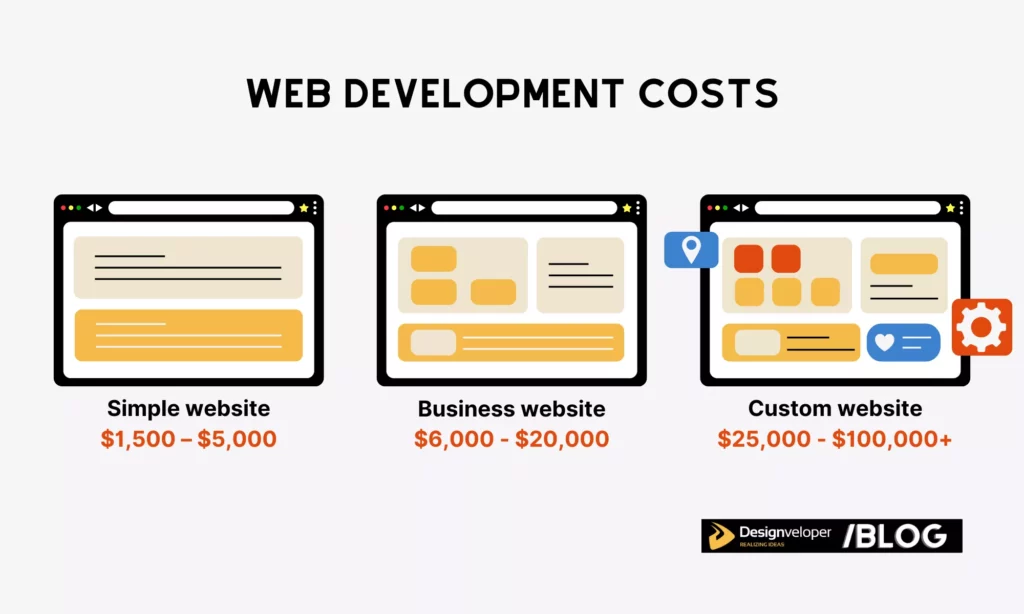
Depending on the project’s scope, feature complexity, tech stacks, the team’s location, and more, the cost may range from under $1,500 to over $100,000. In particular,
- Simple websites with 5 – 10 pages often cost $1,500 – $5,000.
- Business websites with multiple service pages, custom UI components, and other complex features cost $6,000 – $20,000.
- Advanced or custom websites come with advanced features, like marketplaces, SaaS dashboards, booking systems, real-time data handling, or custom API integrations. Therefore, the cost may vary from $25,000 to over $100,000.
Clutch found that the average web development cost worldwide is nearly $66,500, and it takes around nine months to develop a website.
These figures are not the same for all web projects, though. Not to mention that the cost can fluctuate significantly even when you work with the same team all the time. There are various factors impacting this cost variation and even causing big swings:
- Technical complexity (performance, integrations, scalability)
- Design quality (pre-made components vs custom UI)
- Content readiness
- Change requests mid-project
- Team composition (solo developers vs full-stack teams)
Recommended reading: Top 12 Software Consulting Companies
Website Development Cost Breakdown
Where does your budget go in website development? Let’s see:
- Infrastructure
Think of this as your monthly rent and utilities. Accordingly, you need to pay for:
| Domain Name | $10 – $60/year. Most .coms are cheap, but a “premium” address costs more. |
| Hosting | – Shared hosting: $5 – $15/month, ideal for a small blog – VPS or dedicated server: $100 or even $500+ per month, ideal for those requiring actual traffic |
| SSL Certificate | Free or up to $150/year for “premium” versions |
- UI/UX Design
If you choose the template-based design, it’s much cheaper than a custom one. Accordingly, the cost falls between $500 – $2,000 for setup. A custom design reflects exactly your brand, with unique layouts and user journeys. But it absolutely charges you more, $2,000 to $10,000.
- Development
When it comes to truly development costs, consider how much you have to pay for the frontend and backend.
Turning designs into code using HTML, CSS, and JavaScript can require $5,000 to $20,000 for a standard business site. Meanwhile, the cost for backend development may fluctuate from $8,000 to $30,000, depending on the type of website and feature complexity.
QA testing is also crucial to see whether your website works as expected in both technical and usability terms. It may cost around $1,000 to $5,000 or more, depending on how you test the site.
Maintenance is another important phase of web development, but it belongs to, and also occupies the majority part, of your long-term development cost. You should budget 15-20% of your initial development cost every single year for maintenance.
- Content and SEO
If you have the team to cover SEO setup and marketing services (professional copywriting, social media marketing, etc.), you may pay further $500 to $5,000.
Recommended reading: Custom Software Development Cost: 5 Factors to Consider
Factors That Affect Web Development Cost
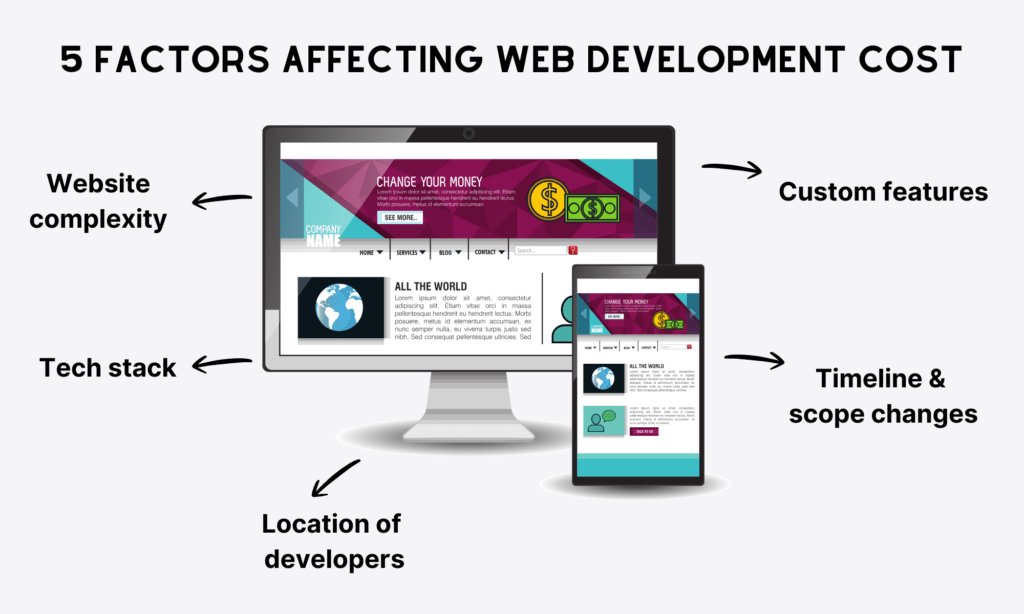
If you’re curious about which factors significantly impact the web development cost, don’t miss this section. Here, we’ll learn about the main determinants behind your overall cost:
Website complexity
The cost of web development can vary widely depending on the website’s complexity.
Suppose you’re developing a simple informational website with a few pages and minimal functionality, the cost can range from $1,000 to $5,000. Meanwhile, a customized CMS for your website may cost from $5,000 to $30,000, depending on the level of customization and functionality needed.
For a custom web application with complex functionality (e.g., data management or custom API integrations), it jumps up from $10,000 to $100,000+.
Technology stack
The tech stack greatly affects the overall web development cost. It often covers front-end technologies (Vue, Angular, etc.), backend technologies (Node.js, Django, etc.), databases, hosting platforms, API integrations, and security measures.
To build a Node.js project, for example, you can spend anywhere between $10,000 and $50,000+. Meanwhile, integrating a SQL database can cost you about $3,000 – $10,000, while a NoSQL database costs around $5,000 – $10,000.
A website cannot survive without security. The implementation of SSL certificates and security audits can be anywhere from $500 to $2,000. The cost for setting up third-party services also depends on customization and complexity levels; for example, a Stripe Integration might be as costly as $1,000 – $5,000.
Custom features
Building custom features (e.g., bespoke animations or advanced booking systems) that fit your brand voice and project requirements may charge you higher than using pre-built plugins. This involves managing databases, handling logic rules, integrating custom APIs, implementing extensive testing, and more.
All this increasing complexity requires more developer time and specialized skills to handle. Therefore, it adds upfront costs.
Timeline & scope changes
Almost every project starts with a plan, a timeline, and a scope document that everyone nods at. But in reality, stakeholders may change their minds due to market shifts or changing user demands.
So, scope and timeline changes. But even small ones can disrupt flow, causing developers to pause their current work and review the codebase from a different view. Not to mention that if deadlines become tighter, more people and longer work hours are added. This can translate to additional costs.
Location of development team
The web development cost also varies depending on where your development team comes from. There are 4 main locations: the USA, Europe, Asia, and Australia. North America and Australia require the highest costs, due to the corresponding high cost of living. Meanwhile, Asia is preferred for its vast talent pool and affordable pricing.
Recommended reading: Mobile Web App Development: 2 Things You Must Consider First
Web Development Cost Calculator (Estimate Your Website Budget)

At some point, reading about costs stops being helpful. You want a number or at least a range for your project. So, you can use a web development cost calculator to estimate your website budget.
Before opening any calculator, you should categorize your website’s functionality into “must-haves” and “would-be-nices.” Besides, answer a few basic questions to have an overview of your potential website:
- What type of website are you building? (Basic site, corporate website, custom platform, etc.)
- How many pages or key screens are we talking about?
- Do you need custom features, or will standard functionality do?
- Will this website need to scale in the next year or two?
Fortunately, online calculators also ask you similar questions. Some commonly used tools your team can rely on include:
- WebFX’s Website Cost Calculator: Good for quick, high-level estimates.
- Calculate Website Cost: A free and simple calculator that estimates a range of web costs.
- Upwork’s Website Cost Calculator: Ideal for quick estimates, but development elements are limited.
These calculators assume clarity, but real projects usually start in a different way. So, if you want a clearer number and a more realistic estimate, talk to people, not just tools.

And if you want to work with an experienced team, Designveloper – a leading web development company in Vietnam – can help you break things down properly without generic quotes nor pressure. And we’ve spent years helping businesses bridge the gap between “we need a website” and “here is a high-performing digital asset.”
Contact us, share a bit about your project, and let our team walk you through the options, the trade-offs, and the budget range that actually makes sense for your goals.
Recommended reading: How to Create a Web Page for Business to Success?
Website Development Cost Team

When people ask about website cost, they often jump straight to features or tech stacks. But there’s another factor that quietly affects the final number: who actually builds the website.
Team choice changes everything. Let’s walk through the main ways to form a development team:
- Hiring freelancers
Freelancers are flexible and often affordable. Hiring a freelance web developer might cost anywhere from $20 to $80 per hour, depending on their experience, location, and specialization.
Freelancers work well for smaller projects with clear scopes and tight budgets. But one freelancer usually means one skill set. Design, development, testing, deployment – sometimes that’s a lot to ask from one person. So, if you want a whole team that can cover different parts of web development, consider the two following options.
- Web development companies
Working with a web development company typically costs more upfront, as it offers you a dedicated team that handles your project from project management to development and testing.
But you can approach a vast talent pool that masters different technical skills, even advanced ones like machine learning. Besides, they have years of hands-on experience in setting up a clearer timeline, creating better documentation, and ensuring more predictable delivery.
Agencies may charge fixed project fees or person-hour costs.
- In-house web development team
Forming an in-house team means hiring developers, designers, QA engineers, and more. The cost lies in salaries, benefits, training, tools, and office costs.
In pure numbers, an in-house web development team is usually the most expensive option. Annual costs can easily reach six figures per developer, depending on region and seniority.
If the website is core to your business (e.g., SaaS platforms or marketplaces) in the long run, having a dedicated team makes sense. But for one-off projects, consider hiring freelancers or an outsourcing team.
Website Development Cost by Location

Location matters more than your team expects. Two websites can look nearly identical on screen. Yet the cost to build them can differ wildly depending on where the development team sits.
Let’s unpack a few common comparisons:
USA vs Europe
Even though pay varies a lot from one place to another, North American web development prices are among the highest. Depending on your budget, the average cost of web design and development in that area is anywhere from $2,000 and up. Web development companies in Australia are paid an hourly rate similar to their American counterparts.
Europe has the most diverse prices for building websites compared to the number of people living there. In western regions, prices for web design are very high, but in the eastern regions, prices are several times lower. It will help to look at the case of a landing page. This kind of website usually starts at $1,000 to build, which is less than half of what it would cost in the United States. Each page can cost up to $6,500.
USA vs Asia
Hiring in the States is expensive. It’s because the cost of living there is high, and those overhead costs get passed directly to you. On the flip side, Asia has basically become the go-to hub for outsourcing, mostly because your dollar just goes so much further there.
According to the World Bank, prices in parts of Asia can be nearly four times lower than what you’d find in the US. We’re usually looking at an hourly range of $20 to $50. Now, that’s a wide range, and it depends on whether you’re hiring a solo freelancer in India or a full-scale agency in Vietnam.
But the talent pool there is massive. They’re working with the exact same modern tech stacks and English-speaking protocols as anyone in Silicon Valley.
Offshore outsourcing
Globalization has made “offshore” feel like more of a standard business move. The industry is projected to grow by over 11% annually over the next decade.
In reality, you can cut your development spend by maybe 30–60% through offshore outsourcing. Sometimes it’s even more, though you have to be careful there. We’ve seen companies get blinded by a low quote and then realize they’re spending all that “saved” money on fixing communication mishaps.
So, don’t just hunt for the absolute lowest number. You have to weigh the budget against long-term goals. The most successful projects aren’t the cheapest, but get the right balance between cost, quality, communication, and other values.
Recommended reading: How Much Will a Website Design or Redesign Cost?
Website Development Cost by Number of Pages

When people start talking about website budgets, the conversation almost always moves toward page count.
“How much does a 3-page website cost?” you may ask. For such a website, you often get a Homepage, an “About” section, and a way for people to get in touch. If you just want a simple Landing Page or Brochure, the cost can range somewhere between $100 – $1,200.
Once you hit four pages, you’re entering what we’d call “Standard Business” territory. Usually, this 4-page website often includes Homepage, About Us, Services, and Contact. The typical cost range? Roughly $600 – $3,000.
You might wonder why adding one page bumps the price up. It’s not just the extra HTML, but also the navigation and the design consistency. Some clients ask if they can just “tack on” pages later. You can, definitely, but it’s almost always cheaper – and less of a headache – to build it into the initial design phase.
Stepping into large corporate sites (20+ pages), you stop counting pages and start managing complexity. In these websites, you’ve got sub-services, case studies, maybe a career portal, and likely a CMS (Content Management System).
For a 20+ page corporate site in 2025, prices usually start around $10,500 and up.
And that “up” is doing a lot of heavy lifting. It could easily be $25k or $40k depending on integrations, complex testing, performance optimization, and many more.
And here’s the thing: Pay numbers are not everything.
We’ve seen two-page sites that cost more than a 15-page “brochure” site, as those two pages have complex animations, custom calculators, or high-level A/B testing scripts running in the background. It happens more often than you’d think.
So, go back to our list of the main factors that impact your overall web development cost.
How Much Does It Cost to Maintain a Website?

It’s essential to keep a website maintained. The expense of website upkeep varies profoundly depending on different components.
In a recent report by Hostinger, the monthly maintenance cost for a personal website is 5$ – 25$, and for professional blogs it is 25$ – 75$. For smaller, medium-sized business websites, you can expect to pay between $35 – $500 per month, and eCommerce websites can cost you between $750 – $5,000 per month.
Keeping a website up and running smoothly requires regular updates and security checks. For example, SSL certificates can run you $0-$1,500 per year, and domain name renewals usually are between $10 – $129 per year. Also, web hosting fees can cost you anywhere from $10 to $200 per month.
The cost is also affected by the decision between hiring a professional or self-maintenance. On the one hand, you can get a sense of peace of mind by hiring a professional. But they’ll also cost you more, and you get a sense of saving your hard-earned money. In turn, you require technical expertise as well.
Take a small business website as an example. It would spend $250 – $1000 a year on maintenance, which includes renewing their domain, backups, SEO optimization, and possibly small design changes.
In conclusion, understanding the specific needs of your website and budgeting accordingly can help manage web development costs effectively. Keeping the website secure, up to date, and performing well is what regular maintenance does to help the success of your business.
Recommended reading: 10 Common Web Security Issues You Might Face
How to Reduce Web Development Costs Without Sacrificing Quality

If you want to cut web development costs without compromising quality, consider the following tips
- Start with clarity
Unclear requirements are expensive. Every vague idea turns into a meeting and a costly revision. This, of course, adds to your cost.
Before development starts, clarify your website’s ultimate goals and project requirements. This helps you identify must-have functionalities that make the website useful, instead of involving too many features that can be developed later.
- Use existing tools instead of reinventing the wheel
You want a custom website that reflects your brand voice exactly? But it doesn’t mean you have to build everything custom and premium.
Custom isn’t always necessary. CMS platforms, UI libraries, payment gateways, analytics tools – many of these already exist and work very well. Using them doesn’t mean your website becomes generic. It means you’re not paying developers to solve problems that were solved years ago.
- Build an MVP
An MVP (Minimum Viable Product) only covers the most crucial features. Instead of spending time on the “full” website from day one, just building an MVP will help control your budget and risks, let alone faster time-to-market.
You can build other “would-be-nice” features later based on ever-changing user demands and market shifts.
- Choose the right team model
Cheaper hourly rates don’t always mean lower total cost. A cheaper team with poor coordination can quietly double the timeline and the cost. So, balance technical skills, experience, communication, budget, and long-term goals when choosing the team.
- Plan for maintenance early
Ignoring maintenance is like buying a car and pretending oil changes don’t exist.
Security updates, performance tweaks, and minor fixes are all inevitable. Planning for them early avoids emergency work later, which is almost always more expensive.
A small monthly maintenance budget often saves large, unexpected bills down the line.
Recommended reading: How to Save Big on eCommerce App Development Cost?
FAQs About Website Development Costs
Is Web Development Cost a One-Time Payment?
Usually no. Browsers often update, security patches become necessary, content changes, and even your business may change direction. That’s why your website always needs ongoing maintenance and regular updates.
Maintenance, as we said, makes up a significant part of your long-term cost. Not to mention that you have to pay monthly hosting fees, annual domain fees, and even marketing service charges.
So, while the initial web development cost is a big chunk upfront, there are ongoing expenses that quietly tag along.
Why is Custom Web Development More Expensive?
Custom work costs more, as you need different specialists to cover bespoke designs and tailored features (e.g., integrations with your current infrastructure or AI-powered chatbots). A template-based website uses many pre-built components that you don’t need to build from scratch. But with custom web development, nothing is copy-pasted blindly.
Is Cheap Web Development Worth It?
Cheap web development might be worth it for very simple needs. Let’s say a landing page, a short-term campaign, or something you don’t plan to grow or rely on heavily. In those cases, low cost aligns with low risk.
The problem starts when “cheap” is expected to handle complex features, high traffic, or future scaling. That’s when something unexpected appears, from slow performance and security gaps to messy code. Fixing those issues often costs more than building it properly in the first place.
Is Offshore Development Really Cost-Effective?
It can be. And sometimes, it isn’t.
Offshore development often lowers hourly rates, which looks great on paper. But cost-effectiveness isn’t just about rates. Communication gaps, time zone delays, and differences in work culture can quietly add friction.
That said, many offshore teams deliver excellent results. The key is management, clarity, and experience working across borders.
When those pieces are in place, offshore development can absolutely reduce web development costs without hurting quality. When they’re not, savings can evaporate pretty fast.
Also published on

Share post on










Related Articles


WebSocket Protocol Vs HTTP: Key Differences And When To Use Each
WebSocket Protocol Vs HTTP: Key Differences And When To Use Each Published August 05, 2026
The Future Of Frontend Web Development: Trends Teams Should Prepare For
The Future Of Frontend Web Development: Trends Teams Should Prepare For Published August 03, 2026
Best Frontend Frameworks For Modern Web Development In 2026
Best Frontend Frameworks For Modern Web Development In 2026 Published August 03, 2026