













What Is Web Design? How It Shapes User Experience And Growth

KEY TAKEWAYS:
- Web design shapes how a website looks, feels, and guides users through layout, visual hierarchy, content, navigation, responsiveness, accessibility, and interaction patterns.
- Good design connects business goals, user needs, brand identity, and technical feasibility instead of focusing only on colors or visual trends.
- Modern web design depends on frontend fundamentals such as HTML, CSS, JavaScript, responsive behavior, performance, accessibility, and maintainable components.
- The best website experience is built through research, wireframes, prototypes, usability checks, content planning, development handoff, and iteration.
- A strong design process reduces rework by aligning UX, UI, SEO, conversion goals, security, and future development needs early.
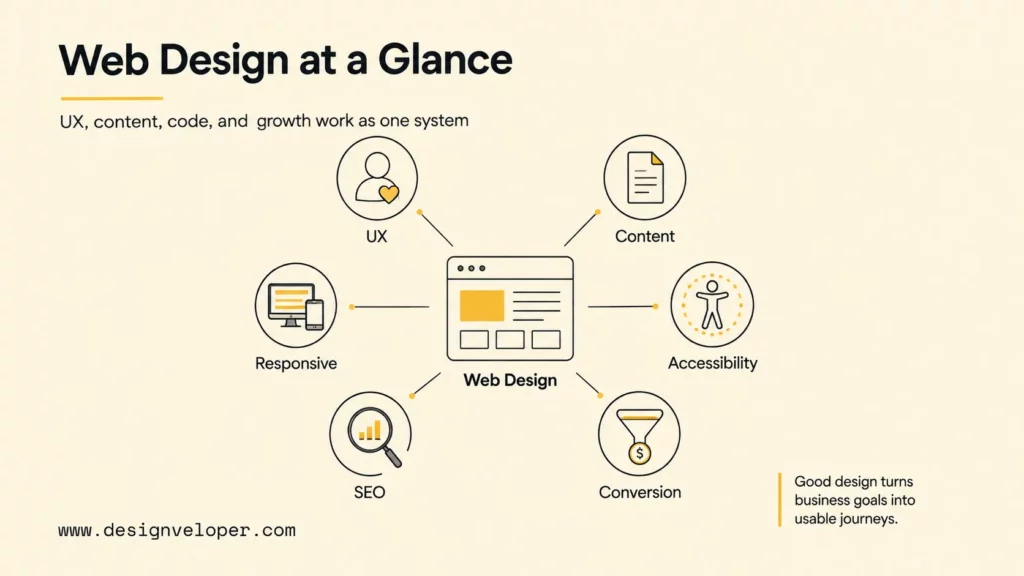
Web design is the planning and creation of a website’s structure, layout, visual system, content presentation, interactions, and user experience. It determines what visitors notice first, how easily they find information, whether they trust the business, and how confidently they complete an action. Effective web design is therefore not decoration added after strategy. It is the system that connects a business goal to a usable digital journey.
That system now has to work across phones, tablets, laptops, assistive technologies, search engines, and different network conditions. A polished desktop mockup can still fail if its mobile navigation is awkward, its text is difficult to read, its forms exclude keyboard users, or its pages shift while loading. The strongest design decisions account for content, code, accessibility, performance, and measurement from the start.
Quick decision guide: Use a template or website builder for a simple, low-risk presence; use WordPress when publishing workflows and editorial flexibility matter; choose custom design when differentiation, integrations, or conversion paths are strategic; and treat a web application as a product when users must complete complex, repeated tasks. In every case, define the audience and primary action before choosing tools or visual styles.
| Business situation | Best starting approach | Primary design priority |
|---|---|---|
| Small informational site with stable content | Website builder or controlled template | Clarity, speed, accessibility, and easy maintenance. |
| Content-led marketing website | WordPress with a reusable design system | Editorial workflows, SEO foundations, and conversion paths. |
| Differentiated service or ecommerce experience | Custom website design | Brand expression, user journeys, integrations, and measurable conversion. |
| Portal, SaaS, marketplace, or operational tool | Web app or product UI design | Task completion, system feedback, permissions, and scalability. |
Recommended for you:
- Web App Vs Website: Key Differences, Use Cases, And Examples
- Web Development Languages: How To Choose The Right Stack
- Frontend Vs Backend: Key Differences For Web Development
What Is Web Design?
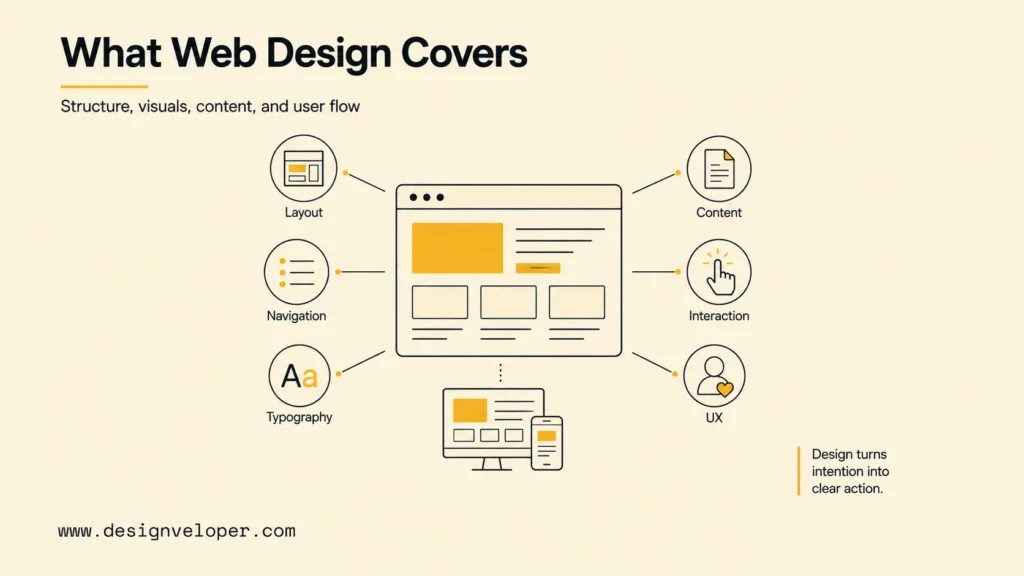
Web design is the process of shaping how a website communicates and behaves. It includes information architecture, page structure, navigation, typography, color, imagery, interaction states, responsive behavior, accessibility, and the placement of calls to action. It also includes less visible decisions: what content appears first, which choices are grouped together, how errors are explained, and what happens after a visitor clicks a button.
A useful way to understand web design is to see it as the bridge between intention and action. A business may want visitors to request a consultation, compare products, book an appointment, or understand a complex service. The designer translates that intention into a sequence of screens and decisions that visitors can understand without inside knowledge. The quality of that translation determines whether the site feels obvious or exhausting.
Modern web design also extends beyond a single fixed canvas. The MDN guide to responsive web design defines it as an approach that lets pages render well across screen sizes and resolutions while preserving usability. That means designers should specify behavior, not just appearance: how columns reflow, navigation collapses, text scales, media adapts, and priority changes as space becomes limited.
Web design succeeds when visual appeal supports comprehension. A beautiful page that hides its purpose, overwhelms users with choices, or breaks on mobile is not effective design. Conversely, a plain interface can perform well if it presents the right information at the right moment, establishes trust, and makes the next step unmistakable. A mature design balances brand character with evidence, usability, and operational reality.
Further reading:
- Web Development Blogs: Best Sources For Developers To Follow
- Web Application Security: Risks, Best Practices, And Checklist
- Web Application Development Cost: Key Factors And Estimates
Web Design Vs Web Development
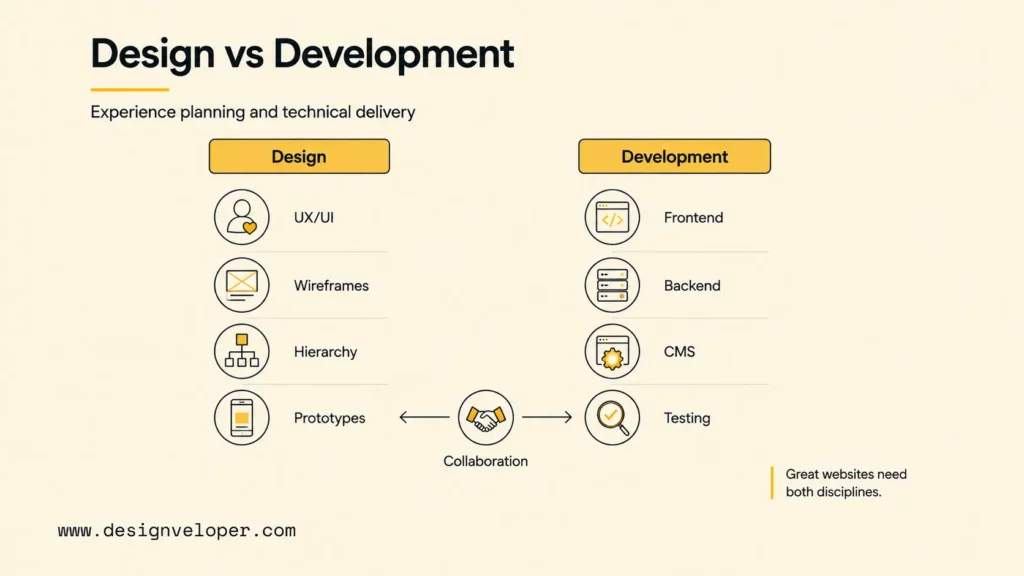
Web design defines the experience; web development implements and operates it. The roles overlap because design decisions affect technical feasibility, while technical constraints shape what the experience can do. Treating them as isolated phases usually creates expensive rework. A better workflow brings designers and developers together while navigation, components, responsive rules, accessibility behavior, data needs, and performance budgets are still being decided.
| Area | Web Design | Web Development |
|---|---|---|
| Purpose | Make information, tasks, and brand expression clear and usable. | Turn approved behavior into a reliable, secure, maintainable system. |
| Primary output | User flows, wireframes, visual designs, prototypes, content hierarchy, and component specifications. | Frontend and backend code, CMS configuration, integrations, infrastructure, tests, and monitoring. |
| Common tools | Figma, FigJam, research tools, analytics, content models, and design systems. | Code editors, frameworks, databases, APIs, version control, CI/CD, and cloud platforms. |
| UX/UI responsibility | Defines interaction logic, hierarchy, states, feedback, and visual language. | Implements those decisions with semantic markup, styling, behavior, and data. |
| Coding | May include HTML/CSS knowledge or prototypes, but coding is not always the primary deliverable. | Requires production code, architecture, testing, security, and maintainability. |
| Performance | Controls complexity, media choices, component behavior, and perceived speed. | Controls delivery, rendering, caching, assets, queries, and runtime performance. |
| Collaboration | Works with stakeholders, researchers, content teams, SEO specialists, and developers. | Works with designers, product owners, QA, DevOps, security, and data teams. |
The handoff is not a moment when design ends. It is a working agreement about components, states, breakpoints, content rules, and acceptance criteria. Developers may discover that a proposed interaction creates accessibility or performance problems. Designers may identify that a technically valid implementation has lost hierarchy or clarity. The best result comes from iterative review in the browser, not from judging code against static screenshots alone. Our guide to web design and web development explores the distinction in more detail.
Web design defines the promise a page makes; development determines whether the real experience keeps it.
Related reading:
- How To Choose A Web Development Company: Key Factors And Questions
- AI Tools For Developers: Practical Options For Modern Software Teams
- AI Code Review: How It Works, Benefits, And Risks
Core Elements Of Effective Web Design
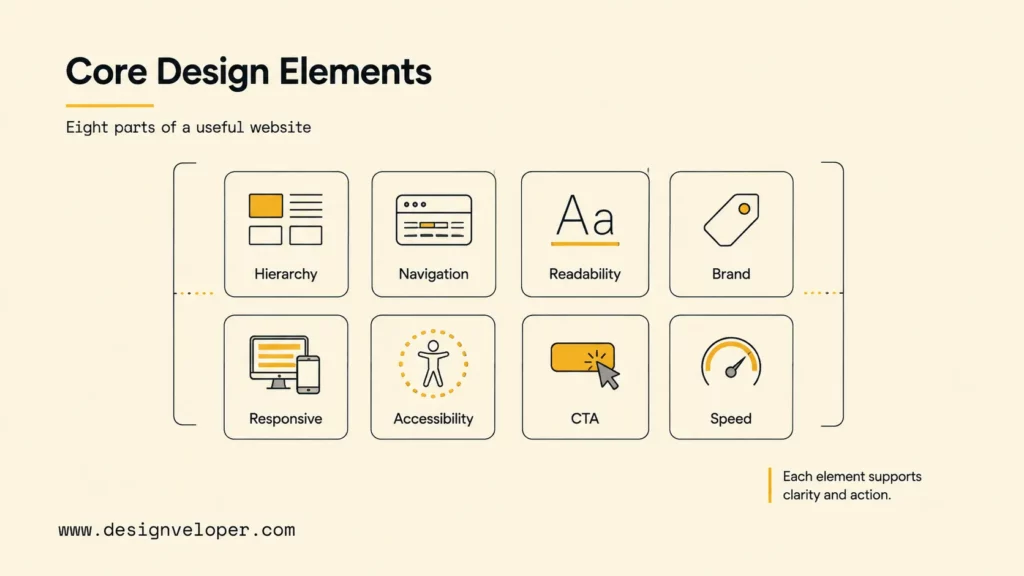
Effective web design is a connected system. Changing one element affects the others: larger media can slow a page, weak content can undermine a clean layout, and an attention-grabbing button can still fail if the user does not understand the offer. The table below connects each core element to its practical role and business impact.
| Element | Practical Role | Business Impact |
|---|---|---|
| Layout and visual hierarchy | Organizes information by importance through position, scale, spacing, and grouping. | Helps visitors understand the offer faster and notice the intended next step. |
| Navigation and information architecture | Groups content into predictable paths and labels destinations in user language. | Reduces abandonment and support effort by making answers easier to find. |
| Typography and readability | Controls type size, line length, contrast, spacing, and scanning rhythm. | Improves comprehension and makes complex services feel more approachable. |
| Color and brand identity | Creates recognition, emphasis, emotional tone, and consistent component states. | Builds trust while preventing every message from competing for attention. |
| Responsive web design | Lets layout, media, type, and interactions adapt to available space and input methods. | Protects usability across devices and simplifies content parity. |
| Accessibility and usability | Supports keyboard access, text alternatives, clear labels, visible focus, and understandable feedback. | Expands access, reduces friction, and lowers avoidable compliance and reputation risk. |
| Calls to action and conversion paths | Connects user intent to meaningful actions with clear wording and low-friction steps. | Improves qualified leads, signups, bookings, purchases, or other key outcomes. |
| Page speed and development handoff | Controls asset weight, component complexity, responsive behavior, and implementation details. | Protects real-world experience, delivery quality, and long-term maintenance. |
Hierarchy should answer three questions at a glance: where am I, what is this page about, and what can I do next? Size alone cannot carry that responsibility. Whitespace creates relationships, contrast separates priorities, repetition builds predictability, and alignment gives the page an underlying order. These principles work together; using each one independently can produce a visually busy page with no clear path.
Accessibility belongs inside every element rather than in a final checklist. The Web Content Accessibility Guidelines 2.2 organize accessibility around four principles: content should be perceivable, operable, understandable, and robust. In practical design work, that means sufficient contrast, keyboard-visible focus, meaningful structure, clear form errors, alternatives for non-text content, predictable interaction, and interfaces that work with assistive technologies.
Performance is also partly a design responsibility. Heavy hero videos, multiple font families, animation everywhere, and unstable late-loading components start as creative choices. Google’s current Core Web Vitals guidance evaluates loading with Largest Contentful Paint, responsiveness with Interaction to Next Paint, and visual stability with Cumulative Layout Shift. Design and development should agree on media budgets, component behavior, and measurement targets before production.
For a more detailed checklist of composition, navigation, usability, and responsive behavior, see our guide to the key elements of good web design.
Why Web Design Matters For Business Results
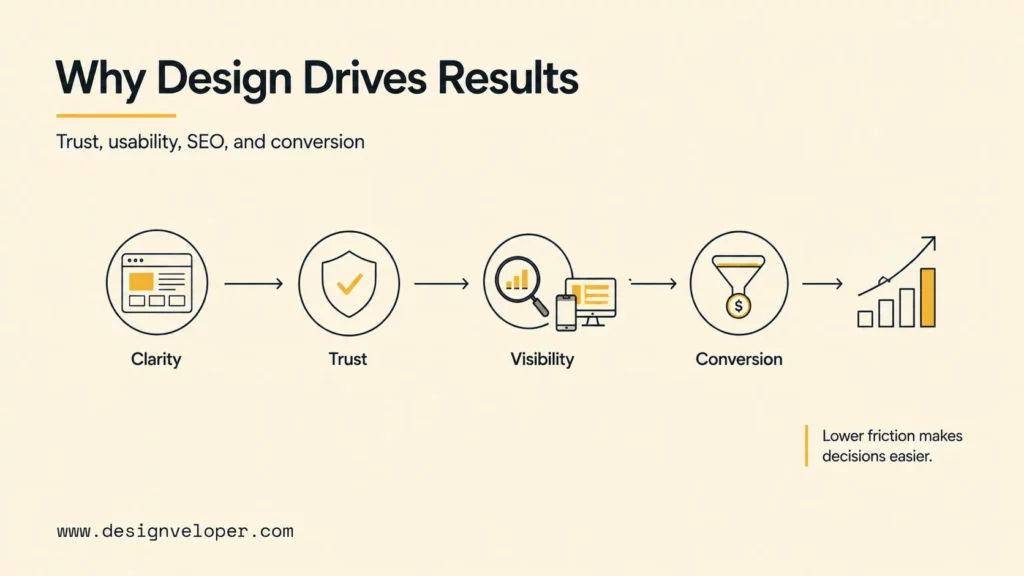
Web design matters because visitors experience a business through the interface before they experience its delivery. A clear page can signal competence by explaining the offer, showing relevant proof, setting expectations, and making contact easy. A confusing page creates doubt even when the underlying service is strong. First impressions are not only about beauty; they are judgments about clarity, credibility, and effort.
Better design lowers friction throughout the journey. Useful navigation reduces searching. Clear comparison content reduces uncertainty. Well-designed forms ask only for necessary information and explain errors in place. Consistent patterns let users transfer what they learned from one page to the next. Each improvement may look small, but together they reduce the cognitive cost of making a decision.
Responsive design connects that experience to mobile visibility. Google’s mobile-first indexing documentation explains that Google uses the mobile version of a site’s content for indexing and ranking and recommends responsive web design as the easiest pattern to implement and maintain. Responsive design is not an automatic ranking boost, but content parity, usability, speed, and crawlability are essential foundations.
Strong design also makes conversion measurement more meaningful. If the page has one clear promise and a deliberate path, a team can identify where users hesitate and test a focused change. If the page contains several competing messages, vague buttons, and inconsistent forms, analytics reveal activity without explaining intent. Design creates the structure that makes behavioral data interpretable.
The longer-term result is consistency. A reusable design system helps marketing, product, and development teams publish new pages without rebuilding decisions each time. Components retain accessible states, brand rules remain coherent, and familiar interaction patterns reduce training for users and editors. That consistency can support trust and retention because the experience feels dependable across visits.
Web Design Process For A Business Website
A practical web design process moves from evidence to structure, then from structure to validated implementation. Skipping directly to visual concepts can make progress look fast while leaving the hardest questions unresolved. The six steps below create decision gates that keep business goals, user needs, content, SEO, accessibility, and development aligned.
The six-step evidence loop
Audience, business goal, and conversion action.
Content, journeys, search intent, and requirements.
Wireframes, hierarchy, components, and responsive behavior.
States, content rules, assets, and acceptance criteria.
Usability, accessibility, performance, and conversions.
Launch, measure key events, learn, and iterate.
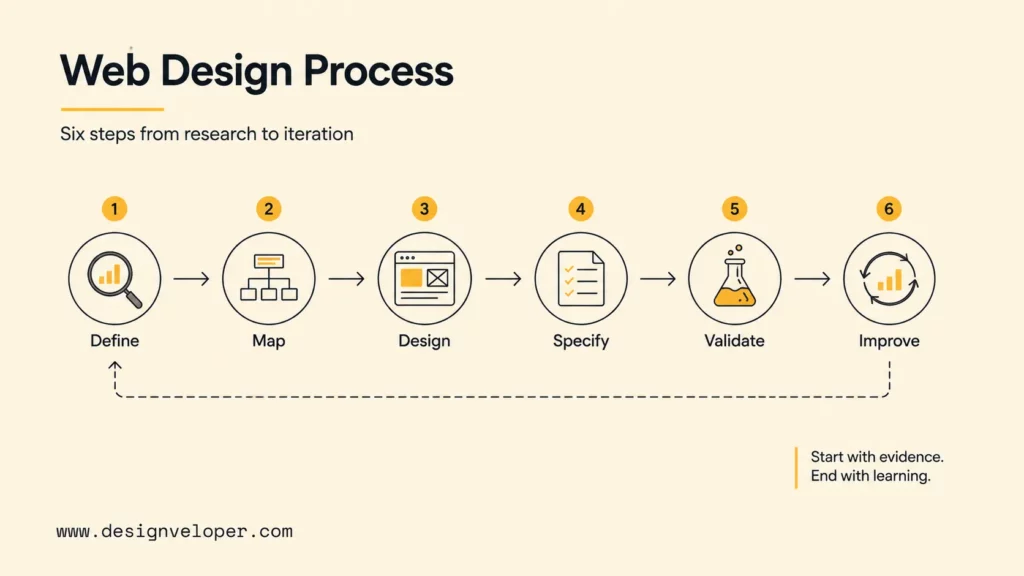
Step 1. Define Audience, Goals, And Conversion Actions
Begin with the audience’s situation, not a preferred visual style. Identify who arrives, what they already know, what problem they are trying to solve, and what could prevent action. Interviews, sales questions, search queries, support records, and existing analytics can reveal language and objections that internal teams overlook.
Then select the primary business outcome for each important page. It might be a qualified enquiry, a purchase, a demo request, an application, or a completed support task. Define the corresponding user action and the evidence needed before a reasonable visitor will take it. A homepage can serve several audiences, but each page still needs a dominant job. This clarity prevents stakeholder requests from turning the layout into a collection of unrelated promotions.
Step 2. Map Content, User Flows, And SEO Requirements
Map the information visitors need before designing screens. Group content into intuitive topics, give navigation labels concrete meaning, and create flows for the main tasks. Include unhappy paths: an empty search result, an unavailable product, a failed payment, a validation error, or a user who needs more proof before contacting sales.
SEO requirements belong in the same map because search intent shapes page purpose. Define the primary query, supporting questions, heading structure, internal-link opportunities, metadata, and any structured data before copy is squeezed into a finished layout. Preserve important content on mobile; Google advises keeping primary content equivalent across mobile and desktop. A content-first plan also exposes missing evidence, such as case studies, pricing explanations, process details, or original visuals.
Step 3. Create Wireframes And Responsive UX/UI Designs
Wireframes test hierarchy and flow without allowing visual polish to hide weak logic. Start with the narrowest practical viewport so the team must prioritize content, then expand the system for wider screens. Choose breakpoints where the content becomes awkward, not from a fixed list of popular devices. MDN recommends flexible grids and relative behavior because the web must accommodate known and unknown screen sizes.
Once the structure works, apply the visual system: typography, color, spacing, imagery, iconography, component states, and motion. Test with realistic copy rather than placeholder text. Long names, translated labels, error messages, and dense product descriptions reveal problems that perfect sample content cannot. Prototype only the interactions that need learning; a clickable prototype should answer a question, not imitate an entire finished site.
Step 4. Prepare Design Handoff For Development
A development-ready handoff describes rules. Define component variants, hover and focus states, loading behavior, empty states, error messages, responsive changes, content limits, image ratios, and accessibility expectations. Record reusable tokens for color, type, spacing, and radius so implementation is consistent rather than manually sampled from mockups.
Invite developers to review complex interactions and integrations before approval. They can identify data dependencies, edge cases, security constraints, or performance costs that alter the design. Agree on acceptance criteria and a review rhythm in the real browser. Our overview of how we work shows why discovery, iterative delivery, testing, and collaboration matter across the product lifecycle.
Step 5. Test Usability, Accessibility, Speed, And Conversion Paths
Test whether representative users can complete priority tasks and explain what they expect at key decision points. Observe behavior rather than asking only whether the interface looks good. A participant who says a page is attractive but cannot find pricing or correct a form error has revealed a design problem.
Accessibility testing should combine automated checks with keyboard review, screen-reader checks, zoom and reflow tests, contrast verification, and human evaluation. Performance testing should use lab tools before release and real-user data after release. Confirm every conversion path from entry page to completion, including validation, confirmation, analytics events, and mobile behavior. Fix severe blockers before polishing minor visual differences.
Step 6. Launch, Measure, And Improve With Analytics
Launch is the start of evidence collection. Establish a baseline for the primary conversion, form completion, task success, search behavior, page performance, and important user segments. Google’s GA4 key-event guidance recommends marking actions that are important to business success as key events. The right events should reflect the page goal, not inflate reports with every available click.
Combine quantitative signals with qualitative context. Analytics can show that users abandon a step; recordings, support themes, usability sessions, and form feedback help explain why. Prioritize changes by user impact, business value, confidence, and effort. Test one coherent hypothesis at a time, document the result, and feed the learning back into the design system so improvement is shared across the site.
A website is not finished when the mockup is approved; it becomes useful when real behavior can improve the next decision.
How AI Can Support Web Design
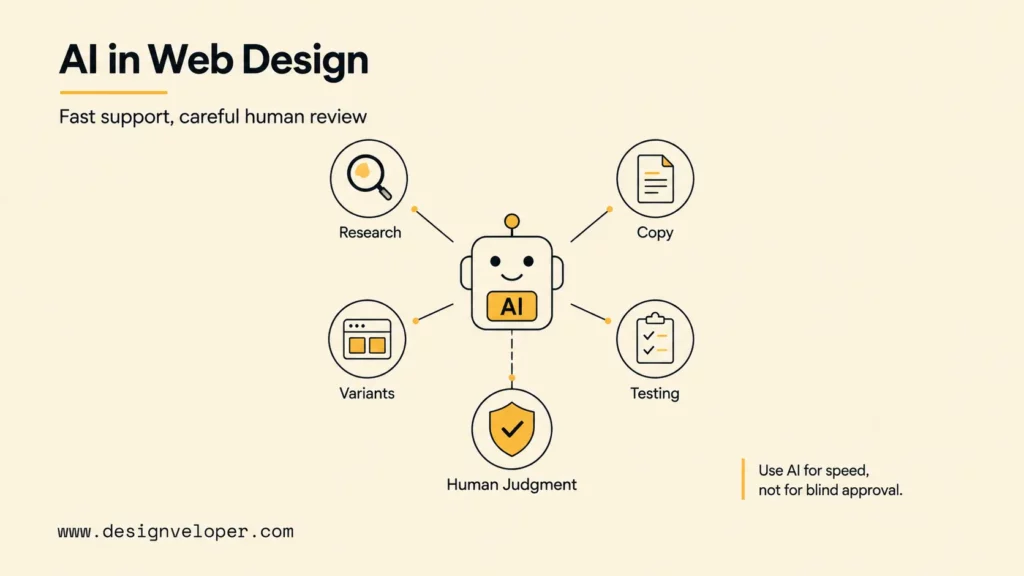
AI can accelerate web design research, exploration, and optimization, but it should support accountable judgment rather than replace it. Teams can use AI to summarize interview notes, cluster support questions, generate alternative content structures, suggest interface copy, explore visual directions, or draft test cases. These uses are strongest when a person defines the question, checks the source material, and decides what is suitable for the audience and brand.
During ideation, generative tools can produce wireframe options, image concepts, component variations, and content alternatives. The speed is useful for widening the option space, but output should be treated as a hypothesis. Generated layouts may reproduce familiar patterns without understanding the business model. Generated copy can invent evidence, flatten brand voice, or create inconsistent terminology. And generated imagery may introduce licensing, representation, or accuracy concerns.
AI can also assist evaluation. It can help draft usability scripts, identify inconsistent labels, flag possible accessibility issues, segment feedback, and propose experiments from analytics patterns. Yet automated checks do not establish that an interface is accessible or understandable. Real users, including people with disabilities, still provide context that a model cannot infer reliably from a screen or component tree.
Responsible workflows need defined ownership and review. The NIST AI Risk Management Framework core calls for policies that define roles and responsibilities for human-AI configurations and oversight. For web design, that means recording where AI was used, protecting sensitive research data, checking factual and visual output, validating accessibility, and assigning a human owner to approve each production decision.
A practical rule is to use AI where fast variation is valuable and errors remain easy to detect and reverse. Keep human judgment central where decisions affect user trust, inclusion, brand strategy, privacy, or production quality. The goal is not more generated screens. It is better evidence, faster learning, and a clearer path to a design that works.
Choosing The Right Web Design Approach
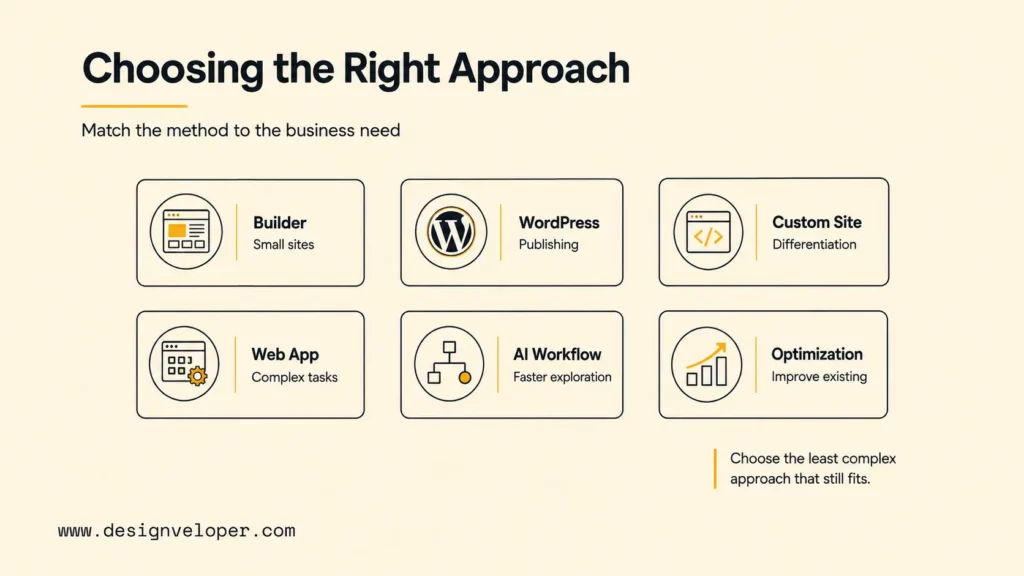
The right approach depends on risk, differentiation, content operations, integrations, and the expected life of the site. A low-cost option is not economical if it forces a rebuild when workflows grow. A custom build is not automatically better if the business needs a clear five-page site that a small team can maintain. Choose the least complex approach that can meet current requirements and credible near-term needs without trapping the organization.
| Approach | Choose it when | Watch for |
|---|---|---|
| Website builder or template | The site is small, content is stable, integrations are limited, and speed to launch matters most. | Generic differentiation, plugin limits, accessibility gaps, and migration constraints. |
| WordPress website design | Editors need flexible publishing, reusable landing pages, SEO control, and a mature plugin ecosystem. | Plugin sprawl, inconsistent page-builder output, security maintenance, and weak governance. |
| Custom website design | Brand, journeys, content models, conversion, or integrations create strategic differentiation. | Higher discovery needs, unclear scope, and maintenance ownership after launch. |
| Web app or product UI design | Authenticated users perform repeatable tasks, manage data, collaborate, or depend on system feedback. | Permissions, edge cases, onboarding, empty states, data integrity, and operational support. |
| AI-assisted design workflow | The team wants faster research synthesis, content variants, ideation, testing support, or asset exploration. | Unverified output, privacy, bias, rights, brand drift, and missing human accountability. |
| Website redesign and continuous optimization | An existing site has traffic and evidence but underperforms in clarity, usability, speed, or conversion. | Redesigning without a baseline, losing useful content, breaking URLs, and changing too many variables at once. |
Evaluate ownership before committing. Who will publish content, review accessibility, maintain integrations, update dependencies, analyze behavior, and approve experiments? A design system, CMS, or AI tool creates leverage only when someone governs it. Include training, documentation, hosting, monitoring, support, and future design changes in the total cost rather than comparing launch prices alone.
For an existing website, begin with an audit instead of assuming a full redesign. Some problems come from navigation and content; others come from slow templates, missing analytics, or inconsistent components. Preserve working URLs, proven journeys, and useful content. Change the parts that evidence identifies, then measure whether the new experience improved the intended outcome.
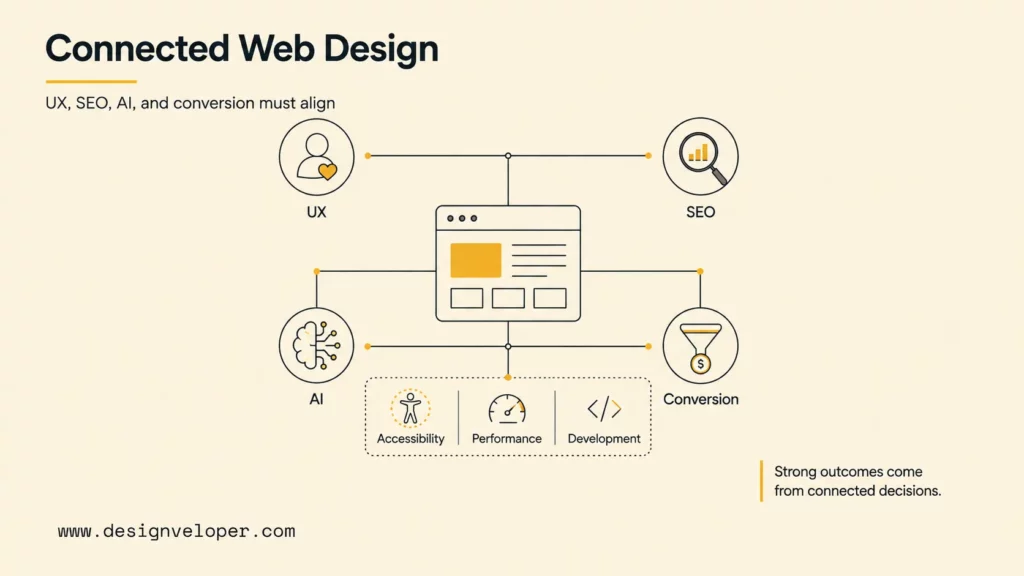
Web Design That Connects UX, SEO, AI, And Conversion
A strong website cannot optimize UX, SEO, AI, and conversion in separate lanes. Search content must remain readable and useful. Conversion elements must match user intent. Responsive layouts must preserve content parity. AI-assisted workflows need review and governance. Development must deliver the accessibility, performance, and interaction quality promised by the design.
A web design becomes expensive to revise when navigation, content structure, component behavior, and data requirements are approved separately. In our projects, the design handoff includes user journeys, responsive component states, CMS rules, accessibility criteria, analytics events, and known integration constraints. That gives developers testable behavior instead of a collection of ideal screenshots. Our web application development services apply the same discipline when the interface must support accounts, permissions, transactions, or other product workflows.
Our Aha ecommerce project illustrates why interface quality depends on the system behind it. Marketplace discovery, CMS-managed content, inventory, transaction rules, and feedback states must remain consistent across the journey. The practical lesson is to review a design against real data states such as loading, empty, unavailable, validation, success, and failure, not only the polished default screen.
Before starting a new website or redesign, prepare four inputs: the business goal, evidence from the current experience, content ownership constraints, and must-have integrations. Those inputs make it possible to scope the work, test the riskiest assumptions early, and design an experience the organization can operate after launch.
FAQs About Web Design
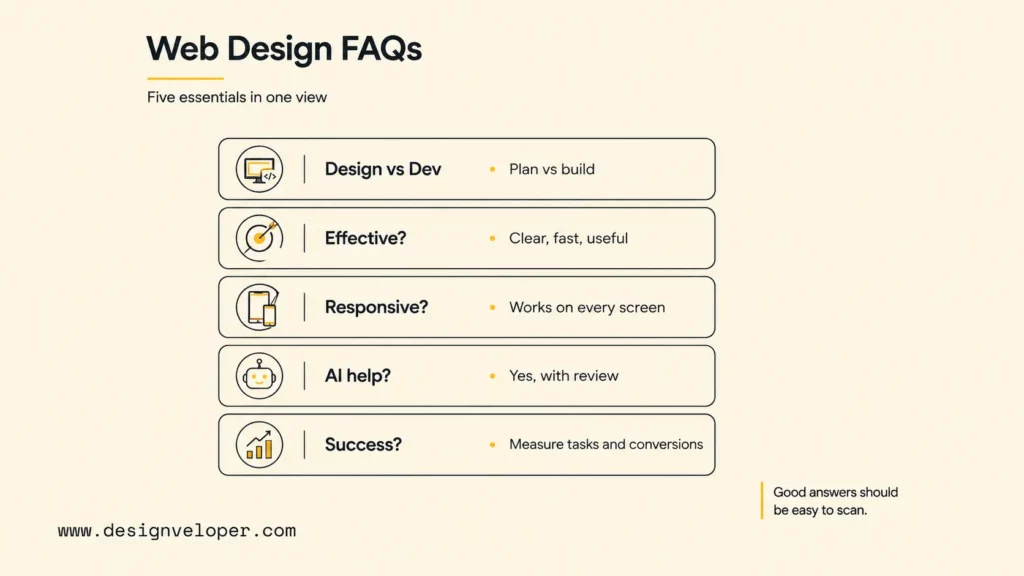
What Is The Difference Between Web Design And Web Development?
Web design defines the website’s structure, hierarchy, visual language, interactions, responsive behavior, and user journey. Web development implements that experience with frontend and backend code, CMS configuration, databases, integrations, infrastructure, testing, and maintenance. The disciplines overlap: designers need to understand constraints, while developers need to preserve usability, accessibility, and intent. Collaborative design and development produces better results than a one-way handoff.
What Makes A Website Design Effective?
An effective website helps the intended audience understand the offer, trust the organization, find relevant information, and complete a meaningful action with minimal friction. It uses clear hierarchy, predictable navigation, readable content, responsive behavior, accessible interaction, fast loading, useful feedback, and measurable conversion paths. Visual quality matters, but it should reinforce those outcomes. Effectiveness should be tested through task success, user feedback, accessibility checks, performance data, and business key events.
Why Is Responsive Web Design Important?
Responsive web design lets one experience adapt to different screens, resolutions, and input methods while preserving content and usability. It reduces the need to maintain separate desktop and mobile sites, supports content parity, and helps users read, navigate, and act without horizontal scrolling or constant zooming. It also aligns with Google’s mobile-first indexing model. Read our complete guide to what responsive web design is for implementation principles and current best practices.
Can AI Help With Web Design?
Yes. AI can help summarize research, organize feedback, generate content and layout alternatives, explore visual directions, draft test cases, and identify possible inconsistencies. It is most valuable as an assistant for variation and analysis. Humans should still verify facts, protect research data, review rights and bias, test accessibility, preserve brand strategy, and approve production decisions. AI output is a starting hypothesis, not evidence that an interface works for real users.
How Do You Measure Web Design Success?
Measure success against the goal defined before design begins. Use business outcomes such as qualified leads, purchases, bookings, applications, or successful support tasks; experience measures such as task completion, error rate, and usability findings; accessibility results; and performance measures including LCP, INP, and CLS. Segment by device and important audiences, combine analytics with qualitative feedback, and compare changes with a baseline. A design is successful when it improves meaningful behavior without creating new accessibility, trust, or operational problems.
Also published on

Share post on










Related Articles


What Is Web Design? How It Shapes User Experience And Growth
What Is Web Design? How It Shapes User Experience And Growth Published August 03, 2026
Web Design Vs. Web Development: What’s the Difference?
Web Design Vs. Web Development: What’s the Difference? Published August 03, 2026
Web Design Process: 7 Steps That You Need to Know
Web Design Process: 7 Steps That You Need to Know Published April 23, 2026