








7 Best Open-Source RAG Frameworks For Production AI Projects

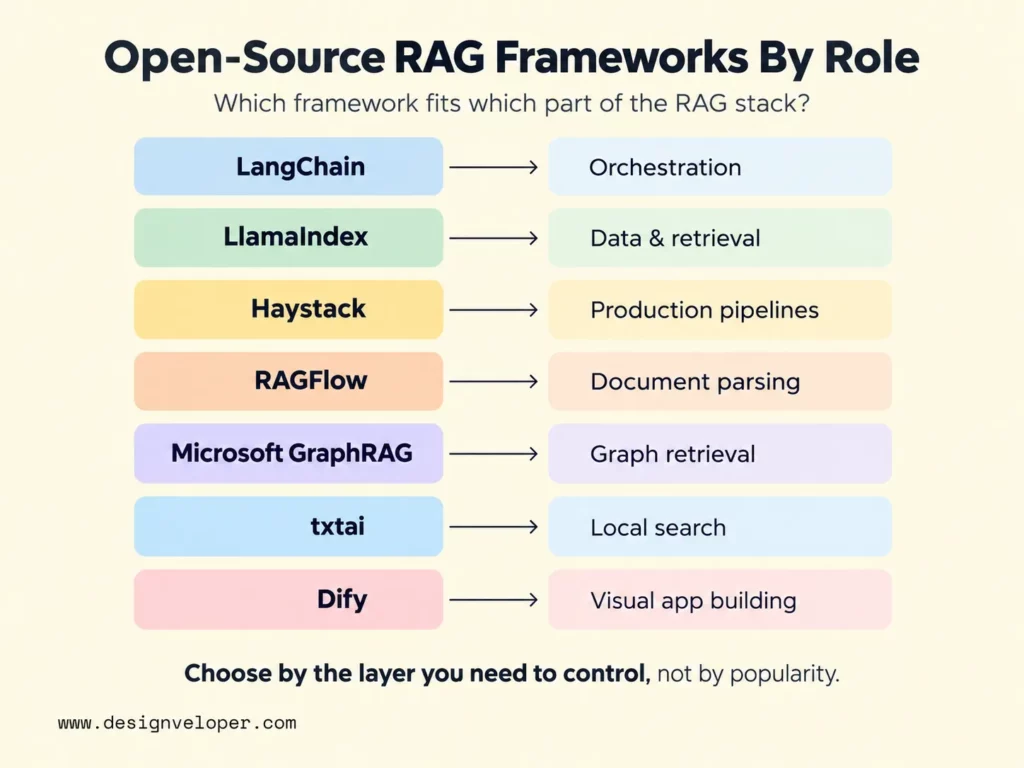
Choosing the best open source RAG framework depends on the part of the RAG system your team needs to control. LangChain suits broad orchestration, LlamaIndex suits data-heavy retrieval, Haystack suits explicit production pipelines, and RAGFlow suits complex documents. Microsoft GraphRAG suits relationship-heavy questions, txtai suits compact local search, and Dify suits visual application building.
This is a focused production shortlist, not a popularity ranking. It covers distinct RAG layers: orchestration, data and retrieval, explicit pipelines, document parsing, GraphRAG, local search, and visual application building. Each option gets a best-fit rule, while narrower evaluation or research tools may fit specialized projects better.
What Is An Open-Source RAG Framework?
An open-source RAG framework is a toolkit for connecting the main parts of a retrieval-augmented generation system: data ingestion, indexing, retrieval, context construction, language models, and answer generation. In practice, the label is broad. It can describe an orchestration framework, a data framework, a RAG engine, a GraphRAG toolkit, or an application platform.
The common purpose is to help an application retrieve relevant information before or during generation instead of relying only on a model’s training data. LangChain provides integrations for building retrieval workflows, including document retrievers. Our guide to retrieval-augmented generation explains how retrieval fits into a complete RAG system.
Open source also does not mean zero production cost. You may still pay for model inference, embeddings, vector or graph storage, servers, observability, backups, and engineering time. License terms matter too. A repository can be publicly available while adding conditions that affect commercial deployment, so review the license of the exact project and version you plan to use.
7 Best Open-Source RAG Frameworks
These seven choices do not all compete at the same layer. LangChain and Haystack help orchestrate pipelines; LlamaIndex focuses on data and retrieval; RAGFlow combines document processing with an application platform. Microsoft GraphRAG addresses relationship-based retrieval, txtai provides a compact search stack, and Dify supports visual application building. Shortlist tools for the layer causing the most work in your system. A team may combine layers, but should test whether each added tool solves a distinct problem.
LangChain
Category and best fit: LangChain is an LLM orchestration framework that works well when a team needs a custom RAG pipeline, agentic retrieval, or many integrations. Its current retrieval documentation treats document loaders, splitters, embedding models, vector stores, and retrievers as modular building blocks. It also documents two-step, agentic, and hybrid RAG patterns.
Main trade-off and example: That flexibility creates more abstraction and dependency surface than a small direct-SDK application needs. A good fit is an internal support assistant that must retrieve company knowledge, call business APIs, and later add agent behavior. If your team is still deciding how much framework abstraction it wants, our analysis of LangChain’s trade-offs explains when the extra layer helps. It also shows when that layer can make debugging harder.
LlamaIndex
Category and best fit: LlamaIndex is a data-centric framework for ingestion, indexing, retrieval, and query workflows. Its framework documentation organizes the RAG path around loading data, indexing it, storing it, retrieving it, and synthesizing responses. That makes it a strong fit for document-heavy knowledge assistants that must connect several private data sources.
Main trade-off and example: The open-source framework can be used independently, while managed parsing and hosted capabilities are offered through separate LlamaIndex services. Decide early which pieces must remain self-hosted. A suitable project is a knowledge assistant that combines PDFs, a database, and internal documentation, then returns answers with source context. Our step-by-step RAG build guide shows why data preparation and retrieval testing should be designed before the chat interface.
Haystack
Category and best fit: Haystack is a modular AI orchestration framework for production RAG, agents, and search. Its pipeline model connects reusable components in directed graphs. Pipelines can include branches, loops, asynchronous execution, and validation steps. This is useful when engineers want the retrieval and generation path to stay explicit rather than hidden behind one high-level call.
Main trade-off and example: Haystack usually asks for more engineering ownership than a visual platform. The benefit is control over components and testing. Its evaluation documentation covers evaluation pipelines and component-level evaluation. A suitable project is enterprise search that must test retrieval quality separately from final answer quality before release.
RAGFlow
Category and best fit: RAGFlow is a document-centric RAG engine and application platform. Its official quickstart describes deep document understanding and citation-backed question answering. Its dataset configuration documentation says DeepDoc can perform OCR, table structure recognition, and document layout understanding. This makes RAGFlow especially relevant when document structure matters as much as semantic similarity.
Main trade-off and example: A broader platform means more infrastructure and configuration than a small code-first RAG service may need. A suitable project is a contract or policy assistant that must preserve tables, page structure, and traceable references.
Microsoft GraphRAG
Category and best fit: Microsoft GraphRAG is a graph-based indexing and retrieval toolkit for questions that depend on entities, relationships, communities, and themes across a corpus. Its query documentation separates local search for entity-focused questions from global search over community reports. That distinction helps when ordinary top-k vector retrieval misses relationships spread across many documents.
Main trade-off and example: Graph extraction and indexing add cost and operational work. Microsoft warns that indexing can be expensive, and its standard method uses LLMs for entity, relationship, and community-report generation. As of September 25, 2026, the GraphRAG repository describes the project as largely in maintenance mode and not an officially supported Microsoft offering. A suitable use case is a research assistant that must connect people, events, organizations, and documents across a large trusted corpus.
txtai
Category and best fit: txtai is an embeddings database and semantic search framework with RAG, LLM, reranking, workflow, and data-processing pipelines. Its embeddings documentation shows vector search with optional content storage, while its pipeline documentation covers text, image, and audio processing. It is a practical fit when a team wants a compact Python stack for local or self-contained retrieval.
Main trade-off and example: The main trade-off is scope. If your project depends on many specialized third-party connectors, verify them before committing to the stack. A suitable project is a local semantic search service over text, images, or audio where the team wants to keep retrieval close to the application.
Dify
Category and best fit: Dify is an AI application platform with visual workflows, knowledge retrieval, agents, APIs, and self-hosting. Its current documentation covers workflow and chatflow orchestration, knowledge retrieval testing, model integrations, REST APIs, and a self-hosted Community Edition. This makes Dify useful for rapid RAG prototypes and business workflows where a low-code interface can shorten iteration time.
Main trade-off and example: A visual application platform gives less low-level control than a code-first framework. Dify’s repository uses a modified Apache 2.0-based license with additional conditions, so review them before commercial deployment. A suitable project is an internal knowledge app with document upload, a visual workflow, API access, and a small team that does not want to hand-build every orchestration screen.
Open-Source RAG Frameworks Comparison
A useful RAG framework comparison is not a feature count. Start with the layer each tool owns, because that determines how much architecture you still need to build around it.
| Framework | Category | Best For | Main Strength | Main Trade-Off |
|---|---|---|---|---|
| LangChain | LLM orchestration framework | Custom RAG and agent pipelines | Broad, modular integration surface | Extra abstraction and maintenance complexity |
| LlamaIndex | Data and retrieval framework | Document-heavy knowledge systems | Strong ingestion, indexing, and retrieval model | Some managed capabilities are separate services |
| Haystack | Pipeline orchestration framework | Explicit production RAG pipelines | Composable pipelines and evaluation | Requires stronger engineering ownership |
| RAGFlow | Document-centric RAG engine and platform | Complex PDFs, tables, and layouts | Deep document parsing with citations | Broader platform footprint |
| Microsoft GraphRAG | GraphRAG toolkit | Relationship and corpus-level questions | Entity, community, and thematic retrieval | Expensive indexing and maintenance-mode status |
| txtai | Embeddings and semantic search framework | Lightweight or local retrieval | Compact search, storage, and pipeline stack | Specialized integrations need early verification |
| Dify | AI application platform | Visual RAG apps and low-code workflows | Fast application assembly and self-hosting | Less low-level control and added license conditions |
A shortlist can therefore contain more than one tool without being redundant. For example, one team might use a data-focused framework for ingestion while using a separate application layer for workflow management. The important question is whether the combination reduces real work or only adds overlapping abstractions.
How To Choose An Open-Source RAG Framework
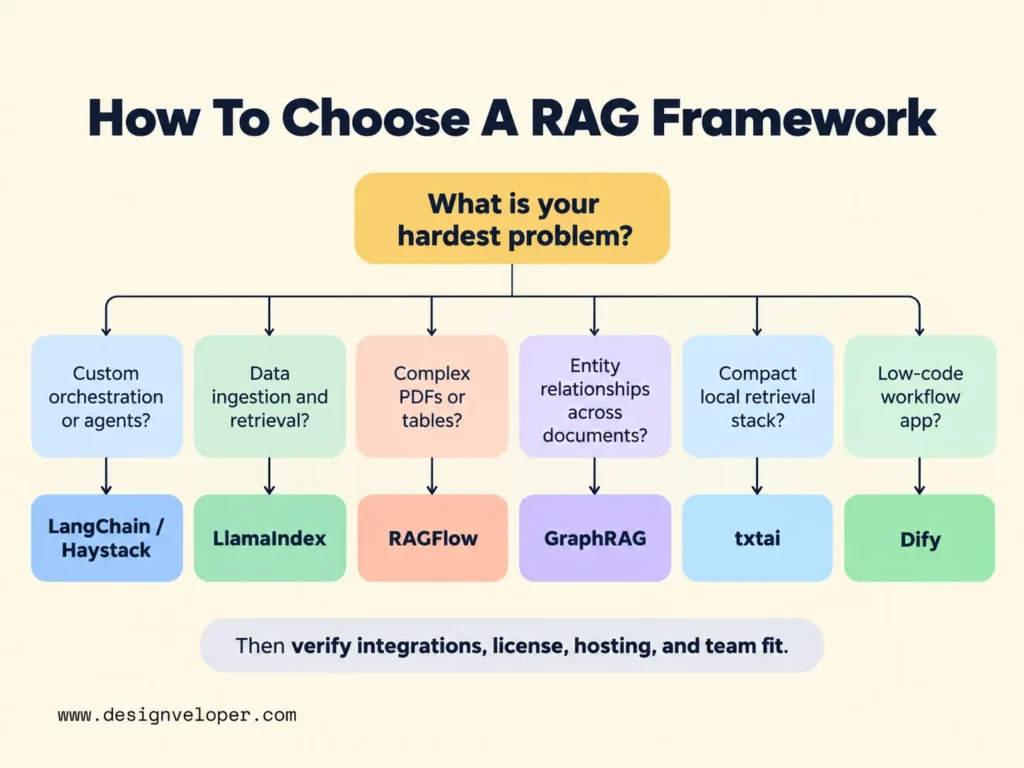
Compare open-source RAG frameworks by matching each option to the hardest part of your project first. If orchestration is the problem, start with LangChain or Haystack. If data ingestion and retrieval design dominate, inspect LlamaIndex. If complex document parsing is the risk, test RAGFlow. If questions depend on graph relationships, evaluate GraphRAG. If you need a compact local stack, test txtai. If visual assembly matters more than low-level control, consider Dify.
Then check the integrations that your actual architecture requires. Verify connectors for source systems, embedding models, vector databases, rerankers, LLMs, authentication, and deployment environments. Do not accept a long integration list as proof of fit. Build one thin end-to-end path with your real data and measure whether the components you need work together cleanly.
Licensing and deployment constraints can eliminate a candidate before performance testing begins. Confirm whether the project can be self-hosted and whether its license permits your commercial model. Check whether essential features depend on a separate hosted product. Also decide who will patch dependencies, migrate breaking changes, operate indexes, and debug failures after launch.
Team skills should narrow the choice further. A Python team that wants explicit code paths may prefer LangChain, LlamaIndex, Haystack, or txtai. A product or operations team may move faster with Dify or RAGFlow’s interface. The framework should reduce the team’s hardest recurring work, not simply add the most features.
A useful comparison project is a private document assistant that ingests real files, enforces access rules, retrieves evidence, returns citations, and is evaluated before production. Keep the model and dataset constant while testing each shortlisted framework. Our advanced RAG guide explains retrieval improvements such as reranking and more structured retrieval when baseline vector search is not enough.
Run A Production RAG Pilot On Your Own Data
Before choosing a RAG tool for production, test two or three shortlisted options on your own documents. Use the same question set, model, permissions, and deployment conditions for each option. Include questions with known answers, questions the documents cannot answer, restricted files, and documents that have been updated or deleted. Agree on the limits below before testing so the team does not move the goalposts after seeing the results.
- Citations: Check each answer against the source passage. Pass if citation accuracy meets the team’s agreed threshold and the system declines to answer without enough evidence. Fail if it invents a source or cites text that does not support the answer.
- Access: Ask the same restricted questions as users with and without permission. Pass only if unauthorized users receive no protected content, citations, or revealing snippets. Any disclosure rules out that configuration.
- Outdated data: Update and delete test documents, then repeat the questions after the agreed indexing window. Pass if answers use the current version and deleted content cannot be retrieved. Fail if old content remains available beyond that window.
- Latency: Measure the time from question to completed answer at the expected number of concurrent users. Pass if the 95th-percentile response time stays within the team’s service limit; otherwise, investigate or rule out the option.
- Cost: Include indexing, storage, model calls, infrastructure, and operating work. Project these costs at expected usage. Pass if the projection fits the approved budget; fail if it does not.
Record the dataset version, test date, limits, measured results, and failure traces for each candidate. Eliminate configurations that disclose restricted data, then compare the remaining options against the other limits. This is a pilot plan, not a claim that any framework has passed these tests. Even a passing system needs monitoring and repeat tests as documents, traffic, and dependencies change.
Production Considerations For Open-Source RAG
Production RAG quality depends on the full system, not the framework name. Test retrieval relevance, citation support, answer faithfulness, latency, cost, and failure recovery separately. A framework can make those tests easier. It cannot compensate for stale source data, weak chunking, poor retrieval settings, or an evaluation set that does not represent real questions.
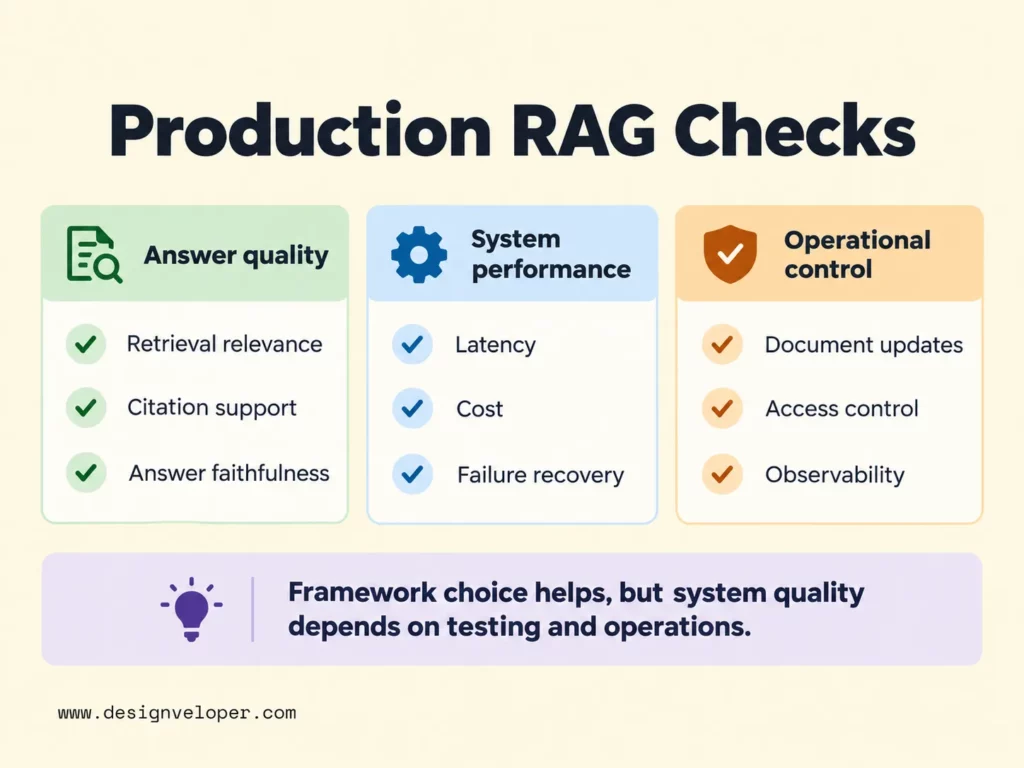
Plan document updates and permissions before scale makes them painful. A production system needs a way to re-index changed content, delete obsolete content, and enforce access control at retrieval time. It may also need tenant isolation and a trace of which sources reached the model. Test these controls with unauthorized and outdated documents, not only happy-path questions.
Observability should separate retrieval failures from generation failures. Log the query, filters, retrieved items, scores when available, model inputs, citations, latency, and errors within your privacy policy. That separation matters because a fluent wrong answer can start with either the wrong evidence or a model that ignored good evidence.
Finally, plan for change. Models, embedding choices, parsers, vector stores, and framework APIs evolve. Keep evaluation cases stable enough to detect regressions when one component changes. Our production RAG chatbot guide covers the operational path from a local prototype to monitored deployment.
FAQs About The Best Open-Source RAG Framework
Which Open-Source RAG Framework Is Best For Production?
There is no single best production framework for every RAG project. Haystack is strong when you want explicit, testable pipelines. LangChain suits broad orchestration and agent integrations, while LlamaIndex suits data-heavy retrieval. RAGFlow can fit better when complex document parsing is the main risk. Production fit should be decided with your data, security model, evaluation cases, and operating constraints.
Can Open-Source RAG Frameworks Run With Local LLMs?
Yes. Many open-source RAG frameworks can connect to local or self-hosted models, but support varies by framework and provider. LlamaIndex documents local-model paths. txtai includes local model and pipeline options, and RAGFlow documents local providers such as Ollama, Xinference, and LocalAI. Local inference still requires enough compute, monitoring, and security work for the workload you expect.
Are Open-Source RAG Frameworks Free For Commercial Use?
Many are commercially usable under permissive licenses, but you must check the exact repository and version. As of September 25, 2026, the core LangChain license, LlamaIndex core license, and Microsoft GraphRAG license are MIT. The Haystack license, RAGFlow license, and txtai license are Apache 2.0.
Dify uses a modified Apache 2.0-based license with additional conditions. Its current license requires a commercial license for specified multi-tenant use without written authorization and restricts removal or modification of certain frontend branding. License terms and project status can change, so verify the exact repository, version, and license before commercial deployment. License permission also does not remove infrastructure, model, storage, or maintenance costs.
When Should You Use GraphRAG Instead Of Traditional RAG?
Use GraphRAG when the question depends on relationships or themes distributed across many documents and ordinary similarity search does not recover enough context. Microsoft GraphRAG’s global search targets corpus-level questions, while local search follows entity-centered context. Traditional RAG is usually simpler when a question can be answered from a few directly relevant passages. Our Graph RAG vs traditional RAG comparison goes deeper into that architecture choice when multi-hop relationships are central.
Also published on

Share post on








Related Articles


Top Agentic AI Companies: 18 Vendors By Product Layer And Fit
Top Agentic AI Companies: 18 Vendors By Product Layer And Fit Published October 07, 2026
Agentic AI Architecture: Components, Patterns, And Workflows
Agentic AI Architecture: Components, Patterns, And Workflows Published October 07, 2026
AI Advantages and Disadvantages for Businesses: 5 of Each Explained
AI Advantages and Disadvantages for Businesses: 5 of Each Explained Published October 05, 2026