













How To Choose A Web Development Company: A Practical Checklist

KEY TAKEWAYS:
- Choosing a web development company starts before outreach: define the business goal, users, must-have workflows, integrations, constraints, timeline, budget range, and decision owners first.
- A strong partner should show relevant delivery evidence, not just attractive screenshots: check case studies, architecture thinking, security habits, testing process, communication rhythm, and post-launch support.
- Company vs freelancer is a risk decision: freelancers can fit narrow tasks, while companies are usually stronger for multi-role builds, integrations, compliance, maintenance, and long-term product ownership.
- Reliable selection depends on specific questions and proof around team roles, estimates, code ownership, QA, security, handover, communication, and what happens when scope changes.
- The safest final step is a small paid discovery or pilot that validates communication, technical judgment, delivery cadence, and decision quality before a larger contract.
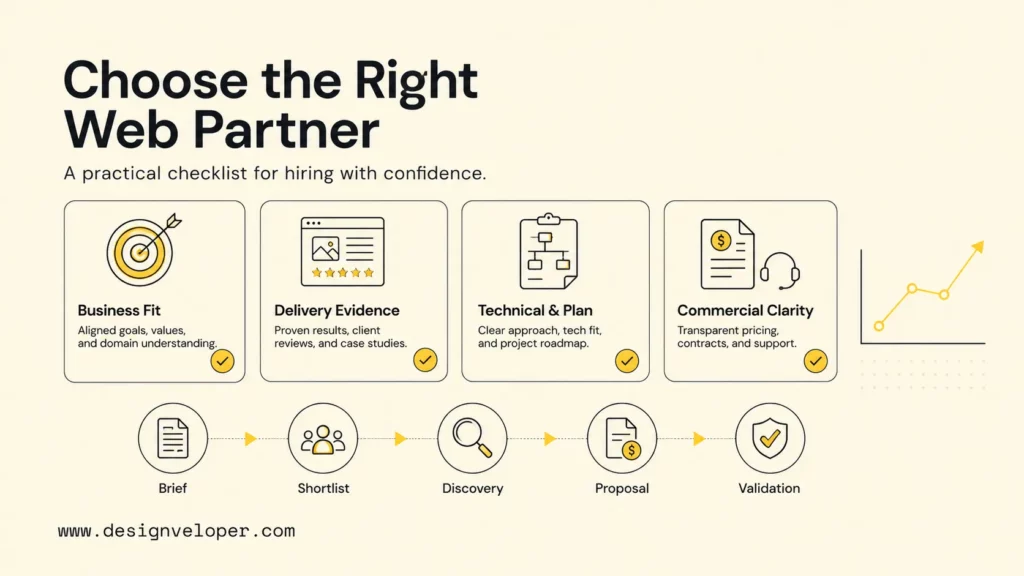
How to choose a web development company comes down to four tests: whether the team understands the business problem, has relevant delivery evidence, can explain a credible technical and project plan, and provides clear commercial and post-launch responsibilities. The lowest quote or most polished portfolio is rarely enough to predict a successful partnership.
Define the product before comparing vendors. A marketing website, ecommerce store, SaaS platform, marketplace, internal application, and AI-enabled web product require different discovery, design, engineering, security, integration, and support capabilities. A useful selection process compares companies against the same written brief and evidence standard.
Quick decision guide: Hire a freelancer for a bounded task with stable requirements and manageable continuity risk. Hire a web development company when the project needs several disciplines, complex integrations, structured delivery, testing, security, deployment, and ongoing support. Shortlist three to five partners, run the same discovery questions, score their evidence, and validate the final choice through references and a paid discovery or pilot.
| Selection stage | What to request | Decision evidence |
|---|---|---|
| Project definition | Goals, users, scope, integrations, constraints, budget range, and timeline | A comparable brief every candidate can respond to |
| Shortlist | Relevant cases, team, process, security, references, and availability | Proof that matches the project type and risk |
| Discovery conversation | Questions, assumptions, options, risks, and proposed first phase | Quality of thinking rather than sales fluency |
| Proposal and contract | Scope, deliverables, exclusions, roles, acceptance, price, change, IP, and support | Clear ownership and controllable commercial risk |
| Final validation | Reference calls, team meeting, technical review, or paid discovery | Observed working behavior before a larger commitment |
Recommended for you:
- Custom Web Application Development Companies: How To Choose The Right Partner
- Web Application Development Cost: Key Factors And Estimates
- How Long Does It Take To Build A Web App?
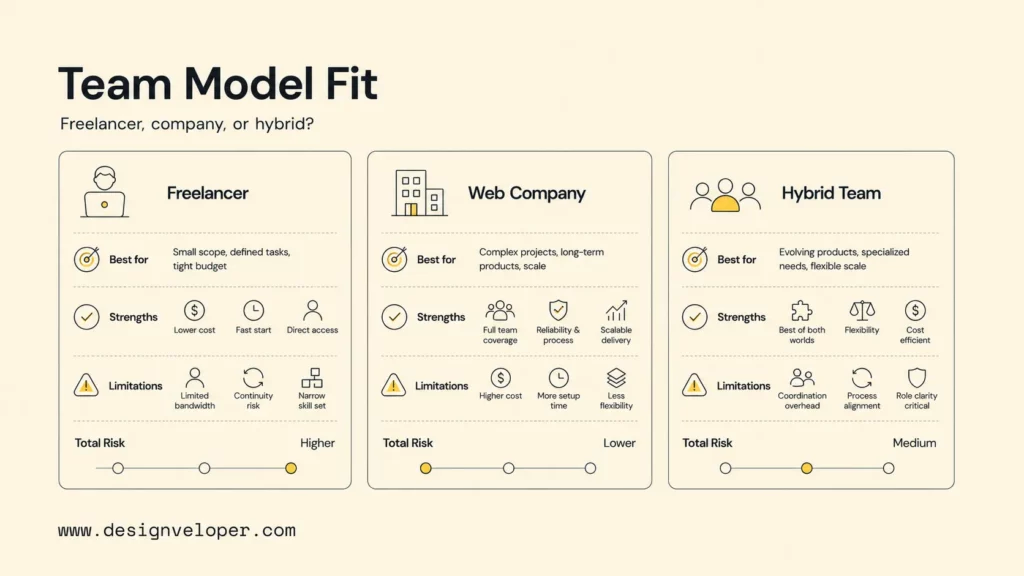
Web Development Company Vs Freelancer: Which Should You Choose?
Choose based on project coordination and continuity, not prestige. A skilled freelancer can outperform an agency on a narrow assignment, while a capable company is usually better equipped for a product that needs design, frontend, backend, QA, DevOps, security, analytics, and support working together.
| Option | Best For | Strengths | Limitations |
|---|---|---|---|
| Freelancer | Small website, landing page, focused feature, specialist review, or temporary capacity | Direct communication, flexible engagement, low overhead, and deep individual expertise | Limited bandwidth, key-person risk, narrower coverage, and less backup during absence |
| Web development company | Complex website, ecommerce, SaaS, marketplace, custom app, modernization, or ongoing product delivery | Multidisciplinary team, delivery structure, parallel work, continuity, QA, DevOps, and support | Higher coordination overhead, potentially higher budget, and quality that varies between assigned teams |
| Hybrid team | In-house product ownership with external delivery or specialist support | Internal context plus scalable skills and capacity | Requires clear decision rights, architecture ownership, communication, and knowledge transfer |
Compare expertise at the team level. A company logo does not guarantee that its strongest case-study developers will work on the project. Ask who is proposed, their allocation, experience, start date, backup, and responsibilities. For a freelancer, ask how handover, review, infrastructure, and emergency support work when that person is unavailable.
Cost should be compared as total delivery risk. A lower hourly rate can become expensive when scope is unclear, work must be redone, testing is absent, or the system is difficult to maintain. A larger team is not automatically faster because dependencies and communication increase. Choose the smallest team that covers the actual work and provides continuity.
Define Your Web Development Project Before Hiring
Further reading:
- Web App Ideas: Practical Projects For Teams And Startups
- Types Of Software Development Services: A Practical Guide For Businesses
- Software Development Outsourcing: Benefits, Risks, And How To Choose A Partner
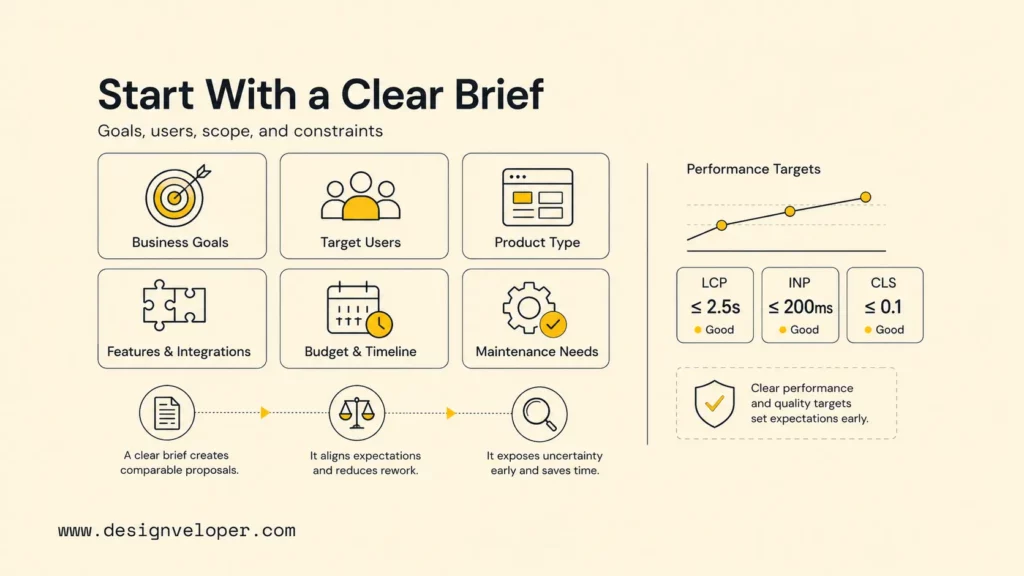
A clear project brief produces more comparable proposals and exposes uncertainty before the contract. The brief does not need to prescribe architecture, but it should explain the outcome, users, workflows, constraints, and what success means.
- Business goals: State whether the project should generate qualified leads, sell products, reduce manual work, launch a subscription service, support customers, replace a legacy system, or create another measurable outcome.
- Target users: Identify buyers, visitors, registered users, administrators, internal teams, partners, and people using assistive technology. Add important geographies, devices, languages, and permissions.
- Website or web app type: Distinguish a content-led marketing site from ecommerce, SaaS, marketplace, portal, dashboard, workflow system, or AI-assisted application.
- Core features and integrations: Map the essential user journey and systems such as CRM, CMS, payment, ERP, identity, search, analytics, email, inventory, or AI services.
- Budget and timeline: Give a realistic range, business deadline, fixed dependencies, and whether delivery can happen in phases. Withholding all budget information often leads to incomparable solutions.
- Content, SEO, and analytics: Define who creates and migrates content, the CMS editing model, redirects, structured data, measurement, consent, search visibility, and reporting.
- Maintenance needs: State expected availability, security updates, monitoring, backups, incident response, content support, enhancement capacity, and internal handover.
Add acceptance criteria for the critical journeys. Instead of “fast website,” require the partner to propose performance budgets and explain how real-user performance will be monitored. Google’s current Core Web Vitals guidance uses LCP, INP, and CLS to assess loading, responsiveness, and visual stability, with evaluation at the 75th percentile of page views.
Document known uncertainty. If content inventory, third-party API access, data quality, or user research is incomplete, ask candidates to price discovery separately and define what it will resolve. A proposal that quietly assumes away uncertainty is not more precise; it is less transparent.
The quality of a web development proposal is limited by the clarity of the problem, users, constraints, and decision criteria it receives.
Key Factors To Look For In A Web Development Company
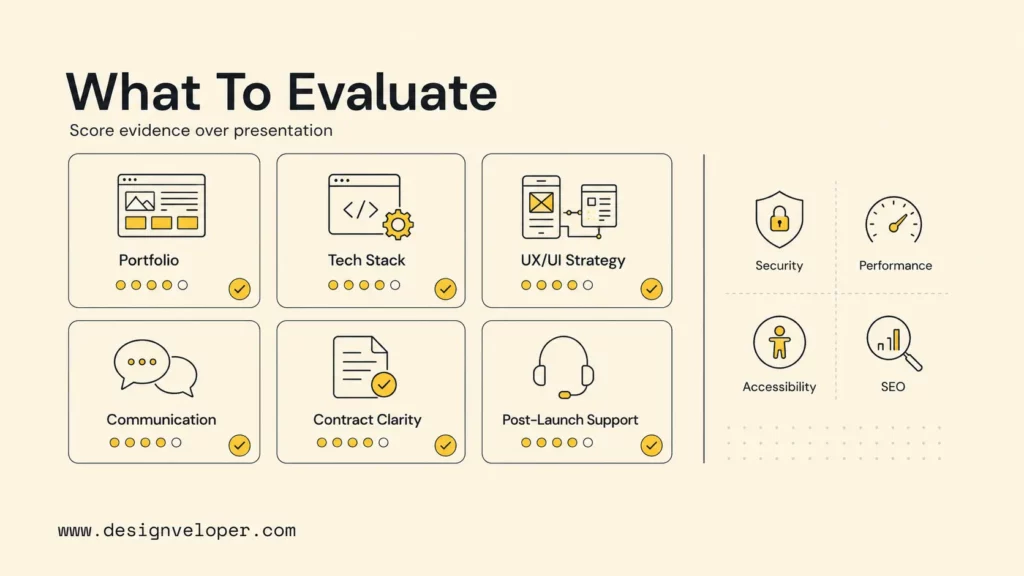
The best partner demonstrates relevant evidence and explains tradeoffs in the context of the project. Score candidates against the same factors, then record the reason for each rating so a charismatic presentation does not overwrite stronger delivery evidence.
| Factor | What To Check | Why It Matters |
|---|---|---|
| Relevant portfolio and case studies | Comparable users, workflows, scale, integrations, constraints, role, and measurable outcome | A visual gallery cannot prove delivery responsibility or product complexity |
| Technical expertise and tech stack | Architecture choices, code quality, CMS or frameworks, APIs, data, cloud, testing, and maintenance | The stack must fit requirements and remain operable after launch |
| UX/UI and product strategy | Discovery, research, journey mapping, prototyping, design system, accessibility, and validation | Building the wrong workflow well does not create value |
| Communication and project management | Cadence, demos, tools, decision log, risk reporting, escalation, and stakeholder roles | Visible progress and early risk reduce surprises |
| Pricing and contract clarity | Assumptions, deliverables, exclusions, acceptance, change, payment, IP, termination, and handover | Commercial clarity protects both parties when reality changes |
| Security, performance, and SEO awareness | Threat model, secure development, accessibility, performance budgets, technical SEO, privacy, and verification | Quality attributes affect risk, reach, conversion, and ownership cost |
| Post-launch support | Warranty, severity levels, response, monitoring, backup, updates, support hours, and enhancement model | A web product continues to change after deployment |
Review portfolio evidence with precise questions: What did the company deliver? Which team worked on it? What constraints changed the plan? How were performance and security tested? What happened after launch? A relevant case is one whose complexity and risk resemble the planned project, even when the industry differs.
Technical expertise should be explained in outcomes and constraints. A partner should be able to compare a managed CMS, headless CMS, website builder, custom frontend, modular monolith, or service architecture without forcing every client into one favored stack. Ask who owns architecture, code review, automated tests, dependency updates, infrastructure, secrets, and production access.
Accessibility and security should be contractible. W3C’s WCAG 2.2 Recommendation provides testable accessibility criteria, while OWASP ASVS 5.0 provides requirements for verifying web application security controls. The appropriate target depends on product risk, jurisdiction, and users, but candidates should explain how requirements become design, code, and tests.
Do not treat reviews as proof by themselves. Look for detailed reviews describing scope, team, communication, outcomes, and problems. Confirm identities and dates where possible. Speak with references whose projects resemble the planned engagement and ask what the client would do differently.
Compare proposals through a leveling sheet before scoring them. Normalize whether UX, content migration, hosting setup, third-party fees, project management, QA, accessibility, security testing, analytics, training, warranty, and maintenance are included. Record the assumed number of templates, workflows, integrations, environments, and review rounds. Two totals that appear close may represent very different products and ownership obligations.
Inspect how the company manages knowledge. The client should receive access to repositories, design files, backlog, architecture decisions, setup instructions, API documentation, infrastructure definitions, credentials under client control, deployment history, test evidence, and support records. Documentation does not need to be lengthy, but it must let another qualified team operate and change the product without reconstructing every decision.
Related reading:
- AI Chatbot Development: Process, Features, And Best Practices
- Cloud Ecommerce Solutions: Benefits, Types, And How To Choose
- B2C Ecommerce Model: Definition, Examples, And How It Works
Questions To Ask Before Hiring A Web Development Company
Explore more:
- Small Business Applications: Practical Software Ideas And Use Cases
- Web Development Languages: How To Choose The Right Stack
- What Is DevOps? A Complete Guide For Software Teams
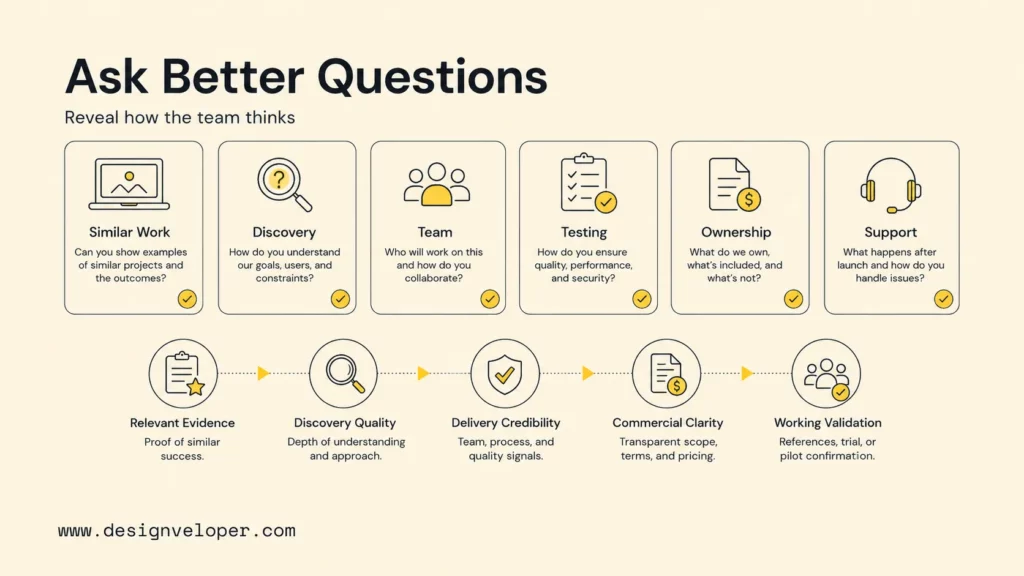
Good questions reveal how a company reasons, not whether it knows the expected sales answer. Ask every shortlisted company the same core questions and follow evidence into specific details.
- Which similar projects have you delivered, and what was your exact role? Ask for the problem, users, scope, team, constraints, architecture, timeline, and outcome.
- How will you discover the business goal and user needs? Listen for research, stakeholder alignment, workflow mapping, analytics review, prototypes, and a way to resolve uncertainty.
- What would you validate before committing to the full build? Strong answers identify risky assumptions, integration proofs, prototypes, content tests, or a phased MVP.
- Who will work on the project? Request names or role profiles, allocation, seniority, responsibilities, time zone, language, availability, replacement policy, and access to specialists.
- How do communication and decisions work? Ask about demos, reports, issue tracking, decision logs, risk escalation, feedback turnaround, and who can accept scope.
- How do you handle change requests? The process should assess impact on value, scope, timeline, architecture, testing, and price before approval.
- What testing is included? Cover unit, integration, end-to-end, accessibility, browser and device, performance, security, content, analytics, and acceptance.
- How will deployment and ownership work? Confirm environments, domain, repositories, cloud accounts, CI/CD, credentials, source code, design files, documentation, data, licenses, and rollback.
- What happens after launch? Ask about warranty, monitoring, incident severity, response times, backups, security updates, support hours, enhancements, and exit handover.
- How was the estimate built? Request team assumptions, work breakdown, dependencies, exclusions, uncertainty, contingency, milestone, and payment schedule.
Ask candidates to critique the brief. A reliable partner should identify missing content, risky integrations, unclear ownership, unrealistic dates, privacy issues, or features that do not serve the stated goal. Agreement with every request is not evidence of understanding.
Use a reference-call script rather than asking whether the client was satisfied. Ask how the estimate changed, whether the proposed team stayed assigned, how risks were reported, what happened when a release failed, how change requests were priced, how much rework occurred, and whether handover was complete. Then ask whether the client would hire the same company for a project with similar complexity.
For a large engagement, meet the delivery lead, designer, technical lead, and QA owner before selection. Give them a realistic scenario such as an unavailable payment API, late content, a security issue, or a new executive request. Evaluate whether the group clarifies impact, protects the product goal, proposes options, and records a decision. The exercise reveals collaboration better than another capability presentation.
The five-gate funnel below turns the conversation into a repeatable decision process.
Reader asset: a candidate passes each gate with evidence; a persuasive pitch cannot compensate for a failed gate.
Red Flags When Choosing A Web Development Company
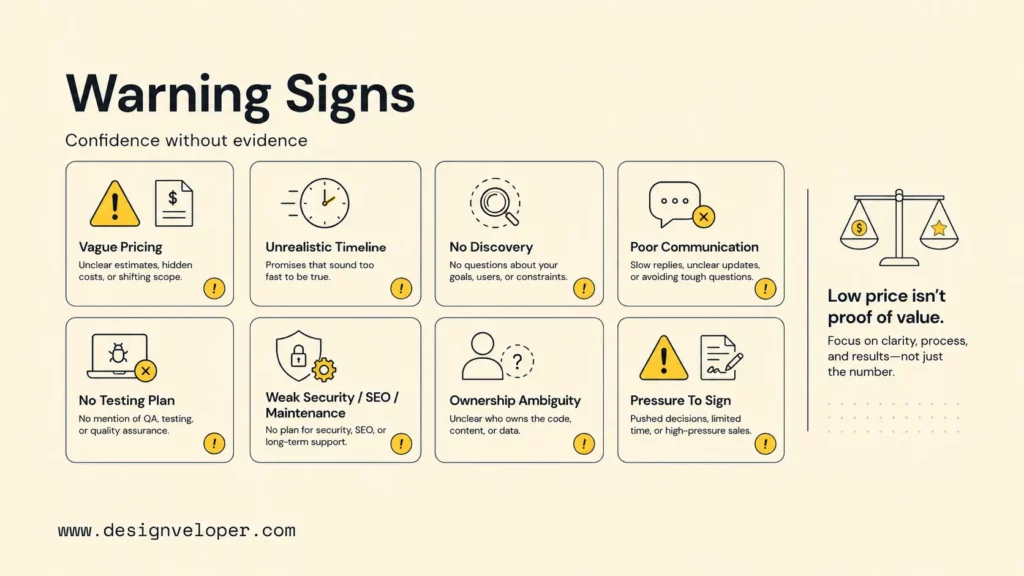
Red flags are gaps between confidence and evidence. One concern may be explainable, but several related concerns usually indicate delivery or commercial risk.
- No clear portfolio or similar work: Generic screenshots, borrowed credit, or cases with no explanation of the team’s contribution make relevance impossible to verify.
- Vague pricing: A single number without assumptions, scope, exclusions, team, acceptance, and change rules invites disputes.
- Unrealistic timeline: Immediate certainty before discovery, external access, content, data, or stakeholder availability is known often means hidden assumptions.
- Poor communication before contract: Missed meetings, slow answers, inconsistent claims, and no written recap preview project behavior.
- No discovery or requirement clarification: A partner that starts from a feature list may build the wrong product efficiently.
- No testing plan: “Our developers test their own work” does not cover independent QA, acceptance, accessibility, security, or production readiness.
- No security, performance, SEO, or maintenance plan: A website can look finished while remaining slow, inaccessible, vulnerable, invisible, or expensive to own.
- Overpromising without technical explanation: Guarantees of first-place search ranking, perfect security, zero defects, or aggressive fixed dates should be challenged.
- Ownership ambiguity: The client should know who owns source code, repositories, accounts, domains, design files, data, analytics, third-party subscriptions, and documentation.
- Pressure to sign before meeting the team: The assigned team and delivery lead matter more than the sales presentation.
Low price is not itself a red flag, and high price is not proof of quality. The warning is a price that cannot be reconciled with the proposed scope, team, quality level, and timeline. Ask what will not be done, what the client must provide, and what could change the estimate.
A credible partner makes risk visible before the contract; an unreliable one hides uncertainty behind confidence, speed, or a suspiciously simple price.
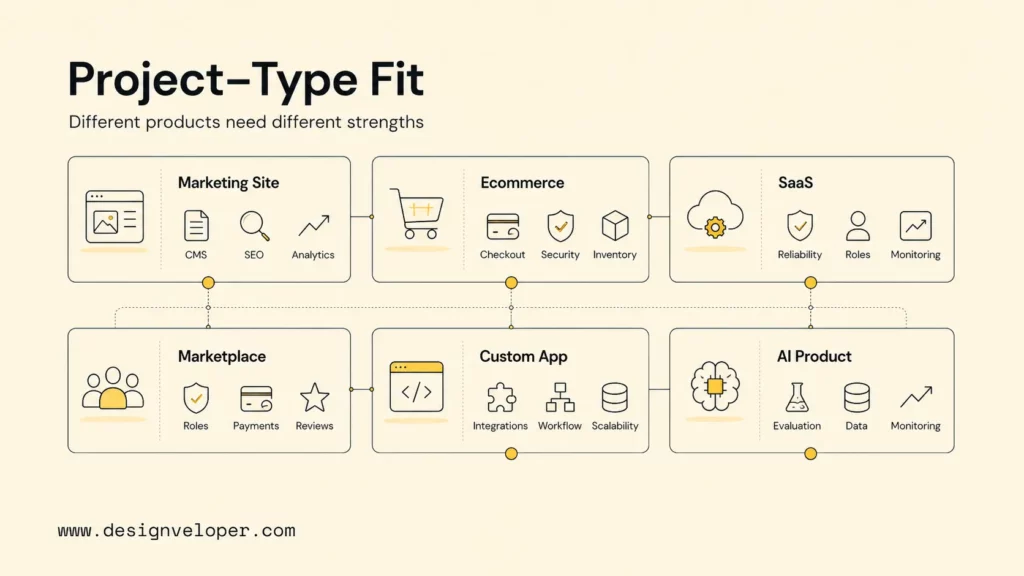
Match The Company To Your Web Project Type
Company fit depends on the product type. Build a shortlist around the capabilities that dominate the project rather than choosing a generalist first and discovering gaps later.
Reader asset: shortlist evidence should match the capabilities that carry the most risk for the specific project type.
A marketing site partner should demonstrate content strategy, reusable CMS components, migration, redirects, accessibility, SEO, analytics, performance, and editor usability. An ecommerce partner needs operational understanding: catalog data, images, inventory, payment, tax, fulfillment, returns, customer service, promotions, approvals, and reconciliation.
A SaaS or marketplace team should explain identity, roles, tenants, subscriptions, data ownership, notifications, audit, integrations, reliability, and admin operations. A custom application requires domain and data modeling, secure workflow, migration, testing, deployment, support, and knowledge transfer. The evidence should include ongoing product evolution, not only launch.
An AI-enabled web product adds model and data boundaries, evaluation cases, grounding, tool permissions, human approval, fallback, privacy, monitoring, model change, and variable usage cost. Ask the company to describe the complete user workflow and how it verifies quality. A chatbot demo alone does not prove production capability.
Matching A Web Development Partner To The Product You Need To Build
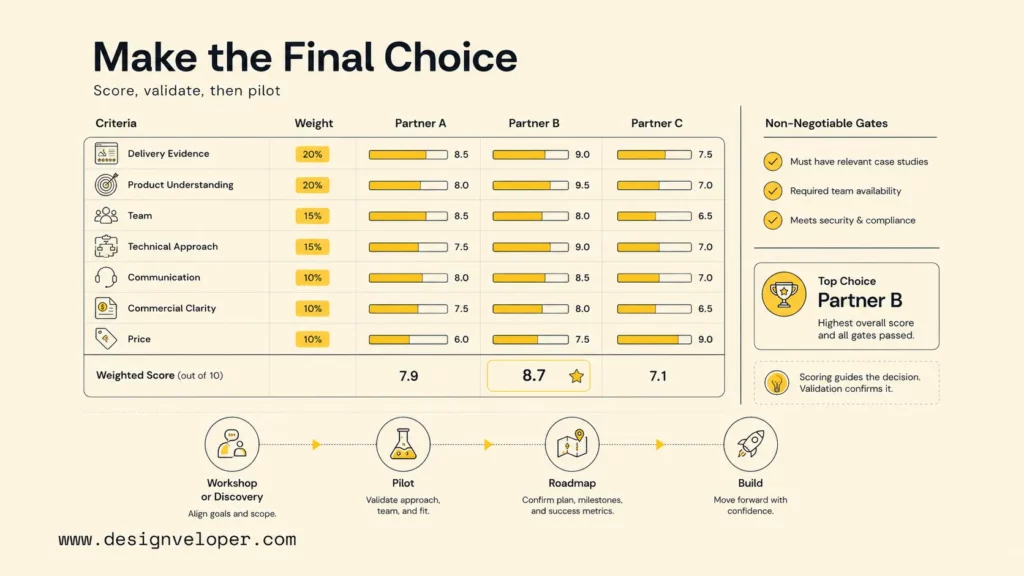
The final choice should connect product strategy, delivery evidence, team fit, technical judgment, commercial clarity, and long-term ownership. Use a weighted scorecard, but keep non-negotiable gates for integrity, security, access, ownership, and required expertise.
A practical weighting might assign 25% to relevant delivery evidence, 20% to discovery and product understanding, 15% to team, 15% to technical and quality approach, 10% to communication, 10% to commercial clarity, and 5% to price competitiveness. Adjust the weights to project risk. For a regulated application, security and compliance may outweigh visual portfolio quality.
Run a paid discovery or pilot when the project is large, uncertain, or strategically important. Ask the team to map one workflow, evaluate an integration, review architecture, prototype the riskiest journey, create an implementation plan, or audit an existing system. Evaluate how the team works, handles ambiguity, documents decisions, and responds to critique.
At Designveloper, we help businesses choose and build web products by connecting business goals, UX/UI, engineering, integrations, performance, security, SEO, and post-launch improvement. Our web and software development services support projects from discovery and prototyping through delivery, deployment, maintenance, and iteration.
We recommend starting with a clear product brief and a working session. The outputs should include target users, critical journeys, scope boundaries, architecture options, content and data responsibilities, integration dependencies, quality targets, delivery phases, risks, and decision points. A good roadmap makes the first release useful without closing off sensible growth.
FAQs About Choosing A Web Development Company
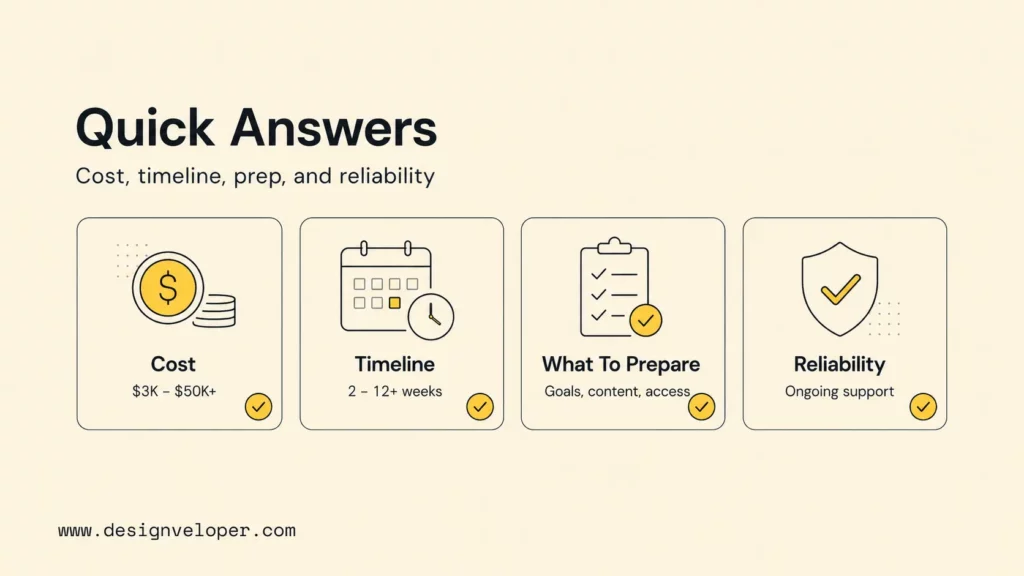
How Much Does It Cost To Hire A Web Development Company?
Cost varies by scope, complexity, design, integrations, team, location, security, content, and support. Clutch’s July 2026 web development pricing guide reports common agency rates of $25-$49 per hour in its reviewed marketplace and a much higher average project value than its typical small project, illustrating how widely scope varies. Use project-specific proposals, not marketplace averages, for budgeting.
How Long Does A Web Development Project Take?
A focused marketing site may take six to twelve weeks, while ecommerce, SaaS, marketplace, migration, or custom web applications often require several months and phased releases. Content readiness, approvals, integrations, data migration, security, testing, and stakeholder availability affect elapsed time. Ask for milestones, dependencies, and a confidence range rather than one date.
Should I Hire A Freelancer Or A Web Development Company?
Hire a freelancer for a bounded task that one person can deliver and support. Hire a company when several disciplines must coordinate, the system is complex, parallel work matters, or continuity and post-launch support are important. A hybrid model works when an internal product owner and technical lead can coordinate external specialists.
What Should I Prepare Before Contacting A Web Development Company?
Prepare business goals, target users, critical journeys, project type, essential features, known integrations, content and data needs, quality or compliance constraints, budget range, deadline, internal stakeholders, and success metrics. Mark assumptions and unknowns. Existing analytics, brand assets, content inventory, technical documentation, and user research also help.
How Do I Know If A Web Development Company Is Reliable?
A reliable company provides relevant evidence, asks precise questions, introduces the delivery team, explains tradeoffs, documents assumptions, makes progress visible, defines testing and ownership, and gives realistic support terms. Validate claims through detailed references, a technical or product workshop, and a small paid phase before committing to a large uncertain build.
Also published on

Share post on










Related Articles


WebSocket Protocol Vs HTTP: Key Differences And When To Use Each
WebSocket Protocol Vs HTTP: Key Differences And When To Use Each Published August 05, 2026
The Future Of Frontend Web Development: Trends Teams Should Prepare For
The Future Of Frontend Web Development: Trends Teams Should Prepare For Published August 03, 2026
Best Frontend Frameworks For Modern Web Development In 2026
Best Frontend Frameworks For Modern Web Development In 2026 Published August 03, 2026