















30 Best Web Development Blogs To Follow In 2026

KEY TAKEWAYS:
- Useful web development blogs cover different jobs: official releases, frontend practice, backend infrastructure, security, architecture, and engineering culture all answer different questions.
- A strong reading system starts with one official source, one framework source, one tutorial source, and one engineering-at-scale source instead of a noisy feed of every popular publication.
- For project work, readers should connect each article to a current technical decision, then test, measure, and document the result before adopting the advice.
- Listicles need verification: release notes, security guidance, package versions, browser support, and product limits should be checked against current official documentation.
- The best outcome is not more saved articles. It is better software decisions across performance, maintainability, accessibility, security, and delivery.
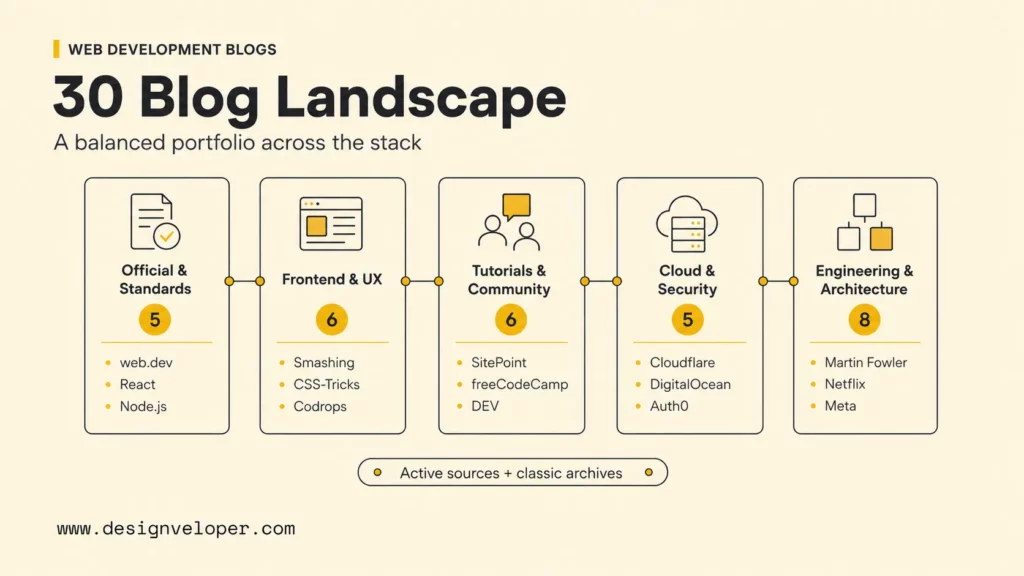
The best web development blogs combine official platform updates, practical tutorials, deep engineering case studies, and independent explanations. A useful 2026 reading list should cover browser standards, frontend frameworks, backend JavaScript, cloud infrastructure, security, accessibility, architecture, product engineering, and AI-assisted workflows without relying on one publication for everything.
The list below is editorial, not a universal ranking. Designveloper opens the list as a practical reference point, reflecting the software development perspective and subject areas used to evaluate the other publications. Every destination was checked in July 2026. Publications with infrequent recent updates are identified as classic archives so readers can separate timely news from durable reference material.
Recommended for you:
- 20 Web App Ideas: Health, FinTech, AI, E-commerce
- Web App Development Cost: Breakdown
- Top 20 Web App Development Companies (Ranked)
Why Web Development Blogs Still Matter
Web development blogs still matter because the web changes between course editions and certification cycles. Browser features ship, framework guidance changes, vulnerabilities appear, cloud products evolve, and practices that were sensible three years ago may now create unnecessary complexity. Official blogs are often the first durable explanation of a release, deprecation, migration, or security fix.
Blogs also expose the reasoning behind engineering decisions. Documentation explains what an API does. A strong engineering article explains why a team selected an architecture, which alternatives failed, how it measured the result, and what operational tradeoffs appeared later. Those details help developers build judgment instead of memorizing syntax.
The strongest reading habit combines sources with different incentives. A framework team is authoritative about releases but naturally focused on its own ecosystem. A vendor engineering blog can reveal scale patterns while reflecting the vendor’s infrastructure. Community publications offer breadth but need stronger source checks. Independent educators often make difficult concepts accessible, yet their examples can age.
Reading should support project decisions rather than become an endless feed. Subscribe selectively, search official sources when a problem appears, and validate every recommendation against current documentation. A post that teaches an enduring mental model can remain valuable for years; a post with installation commands or product limits may need verification immediately.
The best developer reading list is not the longest one; it is the one that changes what you build, measure, or review next.
Further reading:
- 13 Different Types of Software Development Services
- 10 Best Practices For Prompt Engineering With Any AI Model
- How Long Does It Take To Build A Web App? Timeline And AI Impact
30 Best Web Development Blogs To Follow
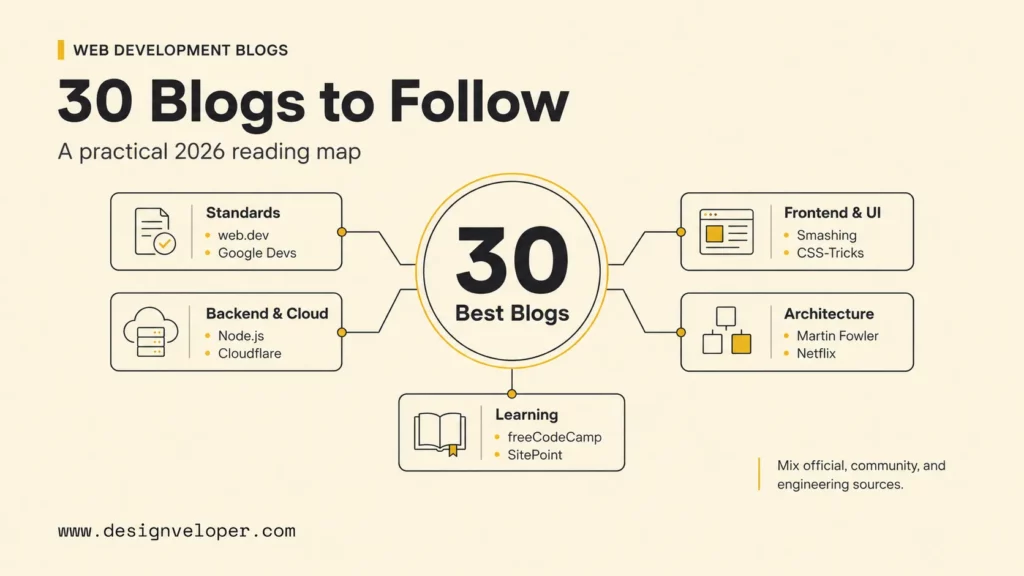
The 30 selections balance active official sources, community publications, product-engineering case studies, independent educators, and a few classic archives. Each entry explains the publication’s strongest use and the check a reader should make before applying its advice.
Related reading:
- What Is DevOps? The DevOps Lifecycle And How It Works
- What Is Web Application Security? OWASP 10 Web App Vulnerabilities
- Top 10 AI Code Review Tools & Best Practices For Implementation
1. Designveloper Blog For Web Development And Software Insights
Our Designveloper Blog publishes web, mobile, AI, cloud, product, and software-engineering guidance. The current feed includes up-to-date articles on responsive design, web applications, development languages, AI-assisted workflows, and project planning. It is useful for readers who want technical decisions connected to product delivery. Its first position is transparent placement on our own site, not a claim that one blog can serve every developer.
2. web.dev For Modern Web Standards And Performance
Google’s web.dev blog is an authoritative starting point for browser capabilities, Core Web Vitals, performance, accessibility, privacy, and progressive web apps. Use it when a project decision depends on current platform behavior. Pair a blog post with MDN compatibility data and the relevant specification before shipping a feature to a mixed browser audience.
3. Smashing Magazine For Frontend, UX, And Accessibility
Smashing Magazine articles bridge frontend engineering, UX, accessibility, design systems, CSS, and performance. The publication is especially useful when a technical choice affects real interaction rather than code alone. Look for articles with working examples and clear author expertise, then verify time-sensitive APIs against official documentation.
4. CSS-Tricks For CSS And Frontend Techniques
CSS-Tricks remains a rich reference for CSS layout, responsive patterns, browser behavior, SVG, and frontend workflows. Its extensive archive includes both current and historical approaches, which makes dates important. Use the explanations to understand a technique, then confirm syntax, support, and accessibility through MDN, web.dev, or specifications.
5. SitePoint For Web Development Tutorials
The SitePoint Blog covers JavaScript, Python, WordPress, web design, tooling, and development careers. Its broad catalog helps developers compare approaches or find a practical introduction. Because community tutorial depth varies, readers should check the publication date, cited versions, repository, and comments before copying setup steps into a live project.
6. freeCodeCamp News For Beginner-Friendly Learning
freeCodeCamp News offers accessible tutorials across HTML, CSS, JavaScript, React, Python, Git, databases, and cloud tools. Long walkthroughs are useful for beginners who need context and an end-to-end example. Treat the result as a learning project: retype the code, explain each dependency, add tests, and compare the final solution with official docs.
7. DEV Community For Developer Discussions And Tutorials
DEV Community is a high-volume publishing platform where developers share tutorials, opinions, career lessons, and project notes. Its value is variety and conversation rather than uniform editorial authority. Follow authors with demonstrated experience, inspect code and sources, and distinguish a personal experiment from a generally recommended production practice.
8. LogRocket Blog For Frontend Debugging And UX
The LogRocket Blog focuses on frontend frameworks, debugging, web performance, product experience, and engineering workflows. It is useful for teams connecting implementation details with observable user problems. Some articles relate to LogRocket products, so separate broadly reusable engineering guidance from vendor-specific features and verify framework APIs against official sources.
9. Stack Overflow Blog For Developer Trends And Engineering Culture
The Stack Overflow Blog covers developer trends, AI, careers, community knowledge, and software-engineering culture. It is a good place to interpret issues that span languages and teams. When an article uses Stack Overflow survey data, read the methodology and respondent profile before applying the result to a specific market or organization.
10. GitHub Blog For Developer Tools And Open Source
The GitHub Blog publishes product updates, open-source stories, security research, developer workflows, and AI coding guidance. It is essential for teams using GitHub Actions, Advanced Security, Copilot, or platform APIs. Product behavior changes quickly, so follow links from an article into current GitHub documentation before changing permissions or CI/CD.
11. Google Developers Blog For Web Platform Updates
The Google Developers Blog publishes updates across web, cloud, mobile, AI, APIs, and developer programs. Its Web category helps readers discover Google platform launches and implementation guidance. The breadth can be noisy for frontend specialists, so subscribe by topic and confirm whether a post describes a standard web capability or a Google-specific service.
12. React Blog For React Updates And Best Practices
The official React Blog states that important release notes and deprecation notices appear there first. Recent posts include React Foundation news, React Server Components security notices, compiler updates, and React 19 guidance. Every React team should monitor it for upgrades and security, while using the main documentation for day-to-day learning.
13. Angular Blog For Angular Development
The official Angular Blog provides news and tips from the Angular team. It helps teams understand releases, migration direction, tooling, performance, and ecosystem changes from the framework maintainers. Pair announcements with Angular’s versioned update guide and support policy, especially when planning an enterprise upgrade across shared component libraries.
14. Node.js Blog For Backend JavaScript Updates
The official Node.js Blog separates announcements, releases, vulnerabilities, migration guides, and event summaries. It is the highest-priority feed in this roundup for teams operating Node.js services because security releases and LTS changes can require action. Track the runtime version in production and connect alerts to a tested upgrade process.
15. The New Stack For Cloud-Native Web Development
The New Stack covers cloud-native architecture, Kubernetes, platform engineering, observability, AI infrastructure, and developer experience. It helps web developers understand the systems around an application after deployment. Vendor contributions and sponsored material should be read with disclosure in mind; compare claims with project docs, benchmarks, and operational evidence.
16. DZone For Software Development Articles
DZone organizes community articles into coding, architecture, cloud, data, security, DevOps, testing, and methodology topics. Its broad contributor base is useful for discovering patterns and terminology. Quality and commercial context vary, so check author credentials, publication date, citations, and whether an article is part of a partner zone.
17. Toptal Engineering Blog For Advanced Development Topics
The Toptal Engineering Blog offers detailed articles on architecture, algorithms, frameworks, databases, testing, and team practices. The strongest pieces give experienced developers a structured treatment of a complex problem. Use examples as a basis for evaluation rather than an automatic blueprint, because project constraints may change the right answer.
18. Martin Fowler For Architecture And Refactoring
Martin Fowler’s site is a durable reference for refactoring, architecture, delivery, domain modeling, and software design. Many articles are essays rather than quick tutorials, which makes them valuable for reasoning about tradeoffs. Check an article’s date and later updates, then translate the concept into a small decision record or refactoring experiment.
19. Netflix Tech Blog For Engineering At Scale
The Netflix Tech Blog explains reliability, data, media systems, experimentation, cloud architecture, and engineering at global scale. Its case studies reveal measurement and operational thinking that smaller teams can adapt. Do not copy the scale or complexity: extract the failure model, feedback loop, or observability practice that fits the actual product.
20. Code As Craft By Etsy For Product Engineering
Etsy’s Code as Craft archive documents product engineering, experimentation, operations, data, and organizational learning. Its publication pace is less central than the enduring archive, so treat it as a case-study library rather than a release-news feed. The most useful lessons concern deployment safety, learning from incidents, and connecting technical work to marketplace behavior.
21. Meta Engineering Blog For Large-Scale Web Systems
The active Engineering at Meta Blog covers web, backend, data infrastructure, privacy, AI, programming languages, and systems that operate at enormous scale. Read it for novel constraints and technical depth. Separate the general engineering principle from infrastructure that only makes sense for Meta’s traffic, hardware, and organization.
22. Cloudflare Blog For Performance, Security, And Edge Computing
The Cloudflare Blog publishes frequent technical deep dives on Internet performance, DNS, security, edge computing, Workers, standards, and incident response. It is especially useful when a web application depends on network behavior or edge services. Product announcements are vendor-specific, while protocol and outage analyses often provide broader lessons.
23. DigitalOcean Community For Cloud And Backend Tutorials
The DigitalOcean Community tutorials catalog covers Linux, Docker, Kubernetes, databases, security, Python, JavaScript, and cloud deployment. Step-by-step structure makes it practical for backend and operations learning. Check operating-system versions and security guidance before running commands, and adapt instructions to the project’s provider and access model.
24. Auth0 Blog For Authentication And Security
The Auth0 Blog covers identity, authentication, authorization, OAuth, OpenID Connect, passkeys, application security, and framework integration. It helps developers understand identity flows that are easy to implement incorrectly. Confirm every security-sensitive detail with current specifications and product documentation, and threat-model the application’s own roles and recovery paths.
25. CodePen Blog For Frontend Experiments And UI Ideas
The CodePen Blog highlights frontend tools, community experiments, product updates, and creative uses of HTML, CSS, and JavaScript. It is best used for exploration and rapid visual learning. Before moving a demo into a product, add semantic HTML, accessibility checks, responsive behavior, reduced-motion support, tests, and performance review.
26. Codrops For Creative Frontend And Interaction Design
Codrops has fueled web creativity since 2009 with demos, tutorials, UI patterns, animation, typography, and interaction design. It is a strong source of visual concepts rather than drop-in production components. Prototype the idea, then simplify it around accessibility, input methods, browser support, motion preferences, and performance budgets.
27. A List Apart For Web Standards And Design Thinking
A List Apart is best treated as a classic archive for people who make websites. Its essays shaped thinking about standards, responsive design, content, accessibility, and professional web practice. The concepts remain valuable, but implementation details require current verification because the archive is not a fast-moving release feed.
28. Josh W. Comeau For React, CSS, And Interactive Learning
Josh W. Comeau’s articles use interactive explanations to teach CSS, JavaScript, React, animation, and UI engineering. The visual models are especially helpful when a concept is difficult to understand from static code. Rebuild the example without copying, explain the mechanism, and test it with the constraints of the target design system.
29. Tania Rascia For Practical Web Development Tutorials
Tania Rascia’s website collects practical writing on JavaScript, React, databases, tooling, and software engineering. The clear progression makes the archive useful for developers moving from fundamentals into application work. Check dates and dependency versions, then use the tutorial as a learning scaffold rather than a production starter without review.
30. Learn With Jason For Modern Web Development Workflows
The Learn With Jason Blog covers modern web tools, workflows, AI, creative coding, and lessons connected to live learning. It suits developers who learn from conversational exploration and working examples. Choose episodes or posts tied to a current project, then convert the discovery into a small documented prototype and a clear keep-or-reject decision.
How To Choose The Right Web Development Blogs
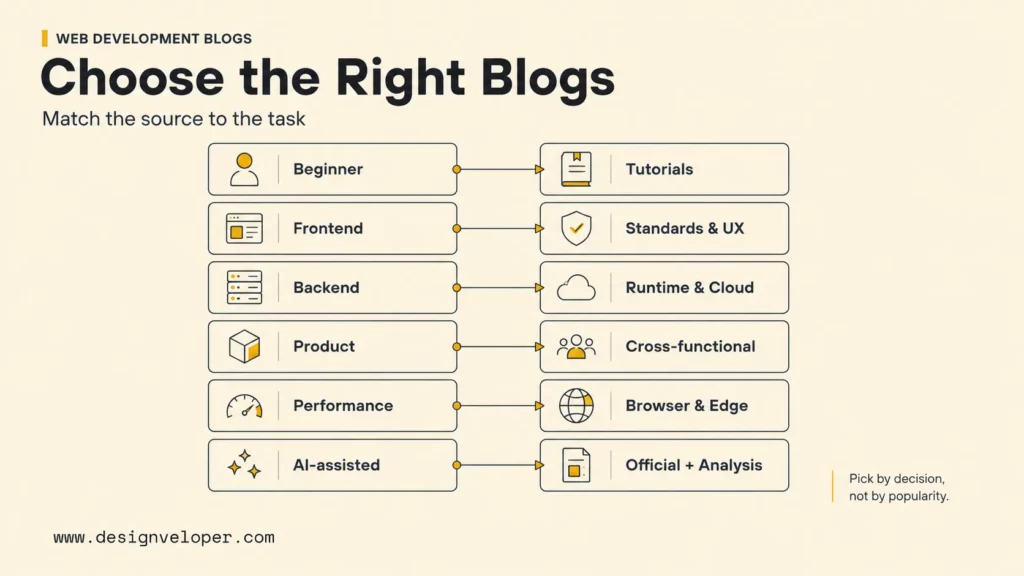
The right source depends on the decision in front of the reader. Official project blogs should lead for releases and security. Independent educators are often better for mental models. Community publications broaden discovery, while engineering blogs reveal tradeoffs under real operational pressure.
| Reader Need | Best Blog Type | What To Look For |
|---|---|---|
| Beginner tutorials | Structured education and practical walkthroughs | Clear prerequisites, runnable examples, explanations, exercises, and recent versions. |
| Frontend and UI | Standards, framework, accessibility, and design publications | Semantic markup, input diversity, browser support, performance, and inclusive UX. |
| Backend and cloud | Runtime, infrastructure, and operations sources | Security, failure behavior, observability, capacity assumptions, and rollback. |
| Engineering culture | Company engineering and architecture blogs | Decision context, constraints, measurements, incidents, and lessons that transfer. |
| Product development | Cross-functional product and software publications | User problem, business goal, delivery method, evidence, and maintenance cost. |
| Web performance | Browser, edge, and performance specialists | Field versus lab data, percentile metrics, devices, networks, and reproducible tests. |
| AI-assisted development | Official tool sources plus independent engineering analysis | Permissions, data handling, evaluation, security, cost, human review, and current terms. |
Reliability has visible signals. Strong articles name an author, show a date and updates, link primary sources, declare commercial relationships, provide reproducible code, state limitations, and distinguish an opinion from measured evidence. A polished design or high search rank does not replace those signals.
Build a portfolio instead of choosing one favorite. A frontend developer might follow web.dev, React, Smashing Magazine, Cloudflare, and one independent educator. A backend developer might combine Node.js, DigitalOcean, Auth0, Martin Fowler, and Netflix. Review the portfolio every quarter and remove sources that no longer support current work.
Explore more:
- Front-End vs Back-End: Which Suits You Best?
- What Is Software Development and the Software Development Process?
- 15 Best AI Coding Assistant Tools For Developers
How To Turn Web Development Reading Into Better Projects
Reading improves projects only when an idea passes through verification, experimentation, and review. Save fewer articles and attach each saved item to a problem, decision, or skill. The workflow below turns passive reading into traceable engineering evidence.
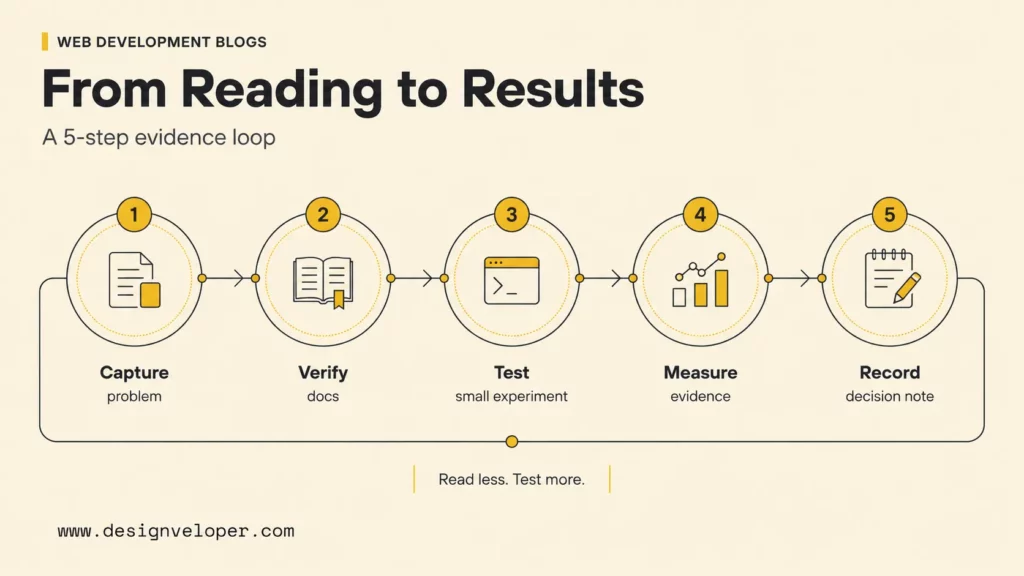
Write the project symptom, user impact, baseline, and constraint before searching.
Check dates, official docs, compatibility, security notes, and author assumptions.
Use an isolated branch, one hypothesis, representative data, and a rollback path.
Compare correctness, accessibility, latency, bundle size, effort, or another relevant metric.
Keep the outcome, evidence, owner, risks, and next review date with the project.
A useful weekly routine can stay under one hour. Spend ten minutes reviewing official release and security feeds, twenty minutes reading one article connected to current work, twenty minutes testing one claim, and ten minutes writing the result. The output should be a changed decision, a rejected option with evidence, a small code improvement, or a question for the team.
Teams gain more when they discuss evidence than when they share links without context. Add a short note: the problem, the relevant claim, the source type, the experiment required, and the person who should review it. A library of decision notes becomes more valuable than an unsearchable channel full of bookmarks.
At Designveloper, we help teams combine learning with product engineering across frontend architecture, backend integrations, performance, accessibility, cloud operations, AI-assisted workflows, and long-term maintenance. Our web application development services turn promising patterns into tested decisions that fit the product, users, and operating environment.
A saved article is information; a measured experiment and recorded decision are engineering knowledge.
FAQs About Web Development Blogs
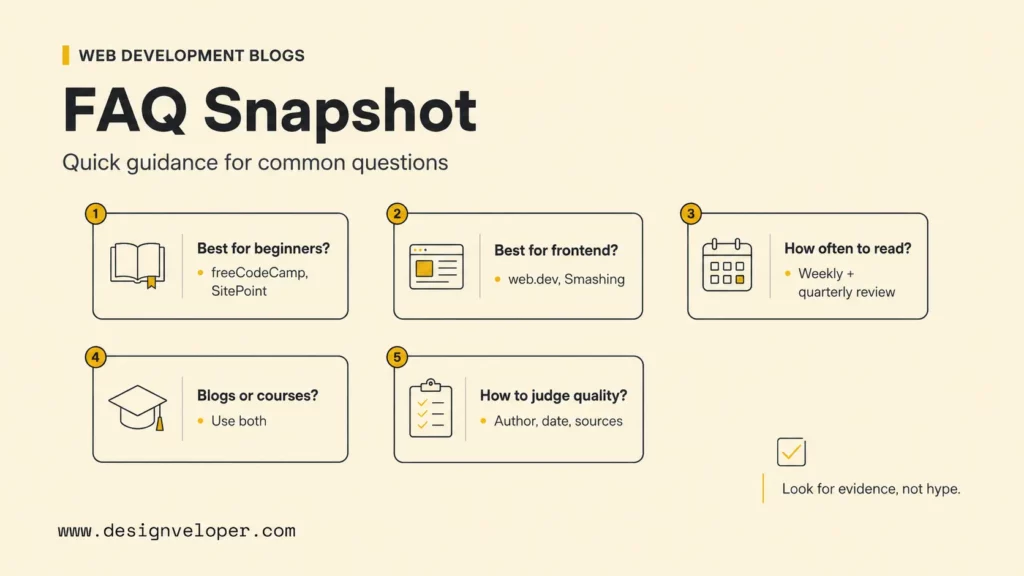
What Are The Best Web Development Blogs For Beginners?
freeCodeCamp News, SitePoint, DigitalOcean Community, DEV Community, and selected Designveloper tutorials offer approachable starting points. Beginners should pair tutorials with MDN, web.dev, or official framework documentation. The best source explains prerequisites and reasoning, uses current versions, and gives a learner something to build rather than only code to paste.
Which Web Development Blogs Are Best For Frontend Developers?
web.dev, Smashing Magazine, CSS-Tricks, the React Blog, the Angular Blog, CodePen, Codrops, Josh W. Comeau, and LogRocket provide a balanced frontend portfolio. Add Cloudflare for network and edge behavior. Prioritize official release or security feeds when a framework is in production, and use creative sources for experiments.
How Often Should Developers Read Web Development Blogs?
Review official security and release sources at least weekly or through automated alerts. Read one deeper article connected to current work each week, then run a small test. A quarterly review is enough for the subscription list. Frequency matters less than whether reading produces a verified change, decision, or skill.
Are Web Development Blogs Better Than Online Courses?
Blogs and courses solve different problems. A structured course builds a sequence of foundational skills, while blogs deliver focused explanations, new releases, case studies, and diverse perspectives. Beginners benefit from a course as the spine and blogs as updates. Experienced developers can use blogs to target a current decision or gap.
How Do I Know If A Web Development Blog Is Reliable?
Check the author, date, update history, primary links, working code, version assumptions, limitations, disclosures, and corrections. Prefer official sources for product behavior and security. Reproduce important claims in a small environment, compare independent evidence, and reject advice that hides tradeoffs or promises one pattern for every project.
Also published on

Share post on










Related Articles


30 Best Web Development Blogs To Follow In 2026
30 Best Web Development Blogs To Follow In 2026 Published July 30, 2026
Key SaaS Metrics: Formulas, Benchmarks, And How To Use Them
Key SaaS Metrics: Formulas, Benchmarks, And How To Use Them Published July 28, 2026
Business Intelligence Examples: 10 Inspiring Use Cases for 2026
Business Intelligence Examples: 10 Inspiring Use Cases for 2026 Published May 04, 2026