
















Best JavaScript Frameworks For Web Development In 2026

KEY TAKEWAYS:
- The best JavaScript framework depends on product context: React, Vue, Angular, Svelte, Next.js, Nuxt, Astro, SolidJS, Qwik, Express.js, and NestJS each fit different frontend, backend, SEO, and team needs.
- Framework choice should consider routing, rendering model, state management, performance, hiring pool, backend integration, testing, deployment, and long-term maintenance.
- React and Next.js remain strong default choices for many product teams, while Vue/Nuxt, Angular, Svelte, Astro, SolidJS, and Qwik can be better when the team values simplicity, enterprise structure, content performance, or fine-grained reactivity.
- Backend JavaScript frameworks such as Express.js and NestJS solve a different problem from UI frameworks: they organize APIs, server logic, authentication, and integrations behind a web application.
- The safest JavaScript stack is one the team can operate in production with clear architecture, security, documentation, performance budgets, and support from experienced developers.
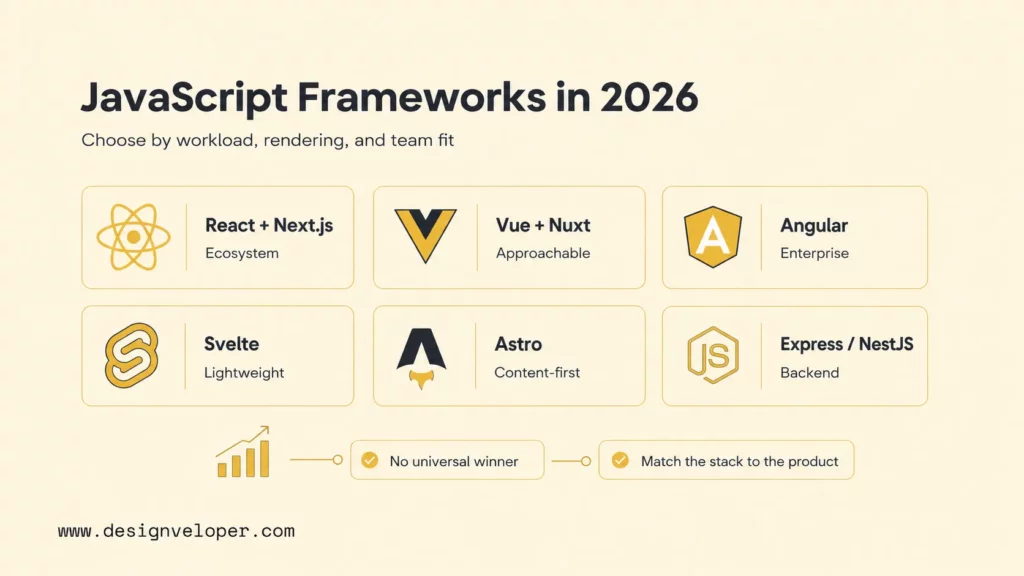
The best JavaScript frameworks in 2026 are React with a production framework such as Next.js for broad ecosystem coverage, Vue or Nuxt for approachable full-stack development, Angular for highly structured enterprise applications, Svelte for compiler-led simplicity, Astro for content-heavy sites, and Express or NestJS for Node.js backends. SolidJS and Qwik offer compelling performance models, but their smaller ecosystems make them more selective choices. The right framework depends on rendering, team, integration, maintenance, and product requirements – not a universal popularity ranking.
Quick decision guide: Choose the workload before the framework. Use React plus Next.js for a large hiring market and flexible product UI, Vue plus Nuxt for a gentler learning curve and progressive adoption, Angular for convention-heavy enterprise teams, Svelte for lean interactive interfaces, Astro for content-first performance, and Express or NestJS for backend APIs. Prototype one critical route, measure it against real performance and maintenance criteria, and approve the stack only after the team can operate it.
| Project Need | Strong Starting Point | Validate Before Committing |
|---|---|---|
| Complex product UI with a broad ecosystem | React with Next.js | Server/client boundaries, state model, caching, and upgrade ownership |
| Approachable application development | Vue with Nuxt | Required integrations, hiring pool, and rendering mode |
| Large enterprise application | Angular | Team readiness for its conventions and release cadence |
| Content-heavy marketing or editorial site | Astro | How much interactivity actually needs client JavaScript |
| JavaScript or TypeScript backend | Express or NestJS | Desired architecture, observability, security, and team size |
Further reading:
- Top 10 Front End Frameworks for Modern Web Development
- 7 Most Popular Frontend Web Development Tools
- Front-End vs Back-End: Which Suits You Best?
What Are JavaScript Frameworks?
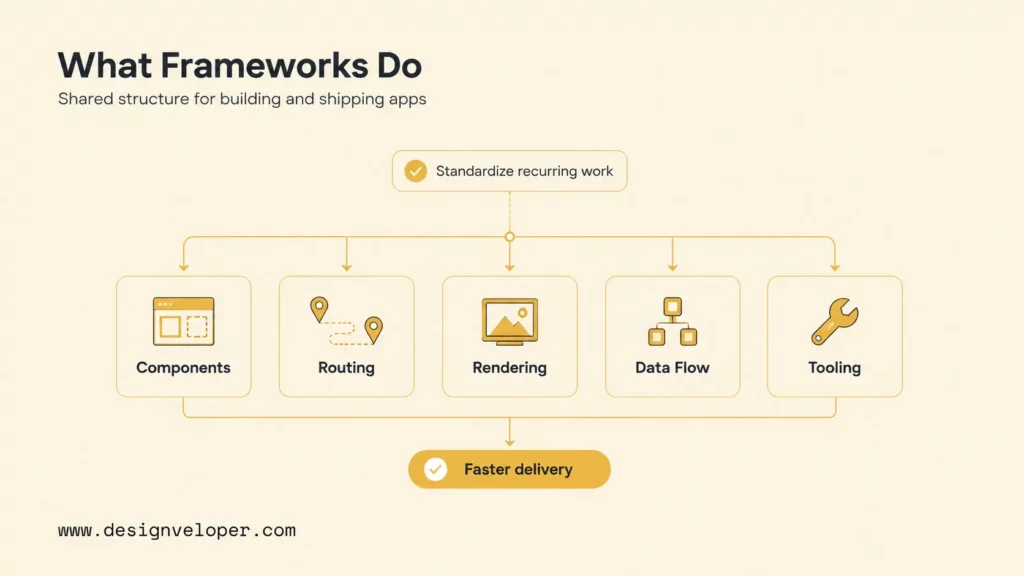
JavaScript frameworks are reusable structures, conventions, and tools that help developers build web interfaces, full-stack applications, APIs, routing, rendering, state management, and product workflows faster. A framework normally makes architectural decisions on the team’s behalf: where files live, how routes work, how data enters a page, when code runs on the server or browser, and how applications are built and deployed.
The term is used loosely. React officially describes itself as a library, while Angular is a complete web framework. Next.js and Nuxt are meta-frameworks that add routing, server rendering, data access, and deployment conventions around React and Vue. Express and NestJS operate on the server. Developers still group all of them under “JavaScript frameworks” when comparing practical stack choices, so this guide makes each category explicit.
A framework does not remove architecture work. It standardizes common decisions so a team can focus on product behavior. The team still owns data modeling, API contracts, authentication, authorization, accessibility, performance budgets, error handling, testing, deployment, monitoring, and upgrades. A mature ecosystem can make those tasks easier, but it can also introduce overlapping libraries and hidden coupling.
- Component model: how the interface is divided into reusable, testable units.
- Reactivity: how data changes update the rendered interface.
- Routing: how URLs map to pages, layouts, and navigation.
- Rendering: whether HTML is produced in the browser, on a server, during a build, at the edge, or through a hybrid strategy.
- Data flow: how components retrieve, cache, mutate, and synchronize data.
- Tooling: how projects are created, built, tested, linted, optimized, and deployed.
The practical benefit is coordinated delivery. A good framework gives developers a shared vocabulary and a supported path through recurring problems. The practical risk is accidental commitment: a convenient default can become expensive when it conflicts with the product’s traffic pattern, user experience, hosting model, security boundary, or team capabilities.
JavaScript Frameworks Vs Libraries Vs Meta-Frameworks
Libraries supply focused capabilities, frameworks define broader application structure, and meta-frameworks combine a UI technology with routing, rendering, data, and deployment conventions. Backend frameworks solve server-side concerns such as HTTP routing, validation, dependency management, and service organization. The distinction matters because it predicts how many architectural decisions the team must make and maintain.
Recommended for you:
- Web App vs Website: Similarities, Differences and Misconceptions
- 10 Best Web App Languages
- Web App Development Cost: Breakdown
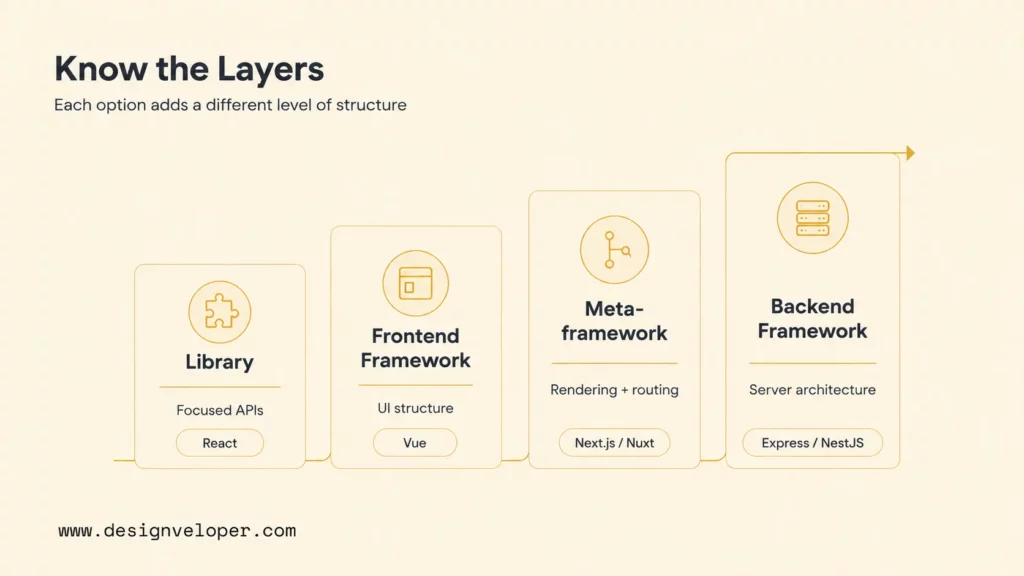
| Type | What It Does | Examples | Best For |
|---|---|---|---|
| JavaScript library | Provides focused APIs while leaving most application structure to the team | React, Redux, TanStack Query | Teams that want composability and can own architecture decisions |
| Frontend framework | Supplies a component and reactivity model plus an organized application ecosystem | Vue, Angular, Svelte, SolidJS, Qwik | Interactive web interfaces and single-page applications |
| Meta-framework | Adds routing, rendering, server features, data conventions, and build/deployment behavior | Next.js, Nuxt, Astro, SvelteKit, SolidStart, Qwik City | Production websites and full-stack applications with mixed rendering needs |
| Backend framework | Organizes HTTP APIs, services, middleware, validation, security, and integrations | Express.js, NestJS | APIs, business services, real-time systems, and server applications |
React demonstrates why the label alone is insufficient. React provides the component model, but its official guidance recommends starting a new application with a framework. A team using React alone must still select routing, data loading, server rendering, bundling, testing, and deployment conventions. Next.js or React Router can supply more of that production structure.
More structure is not automatically better. An internal dashboard that never needs indexing may work well as a client-rendered Vue or React application. A public marketplace may need server-rendered product pages, cache control, image optimization, and structured metadata, making a meta-framework more useful. A stable REST API may need Express’s minimal surface, while a large team may prefer NestJS modules, dependency injection, guards, and standardized testing patterns.
Choose the smallest layer that solves the product’s real constraints, then add structure only where the team can test and maintain it.
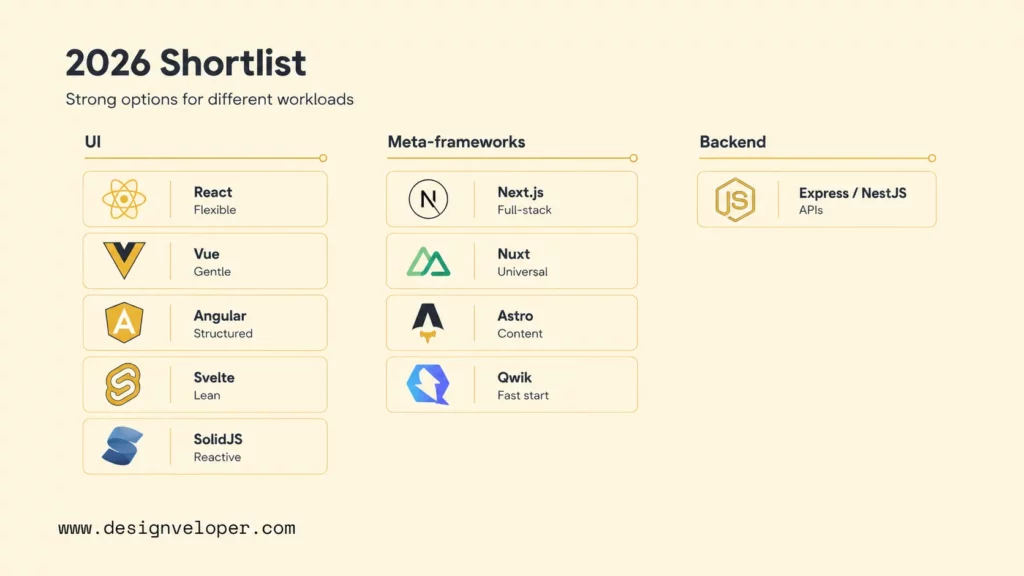
Best JavaScript Frameworks To Know In 2026
The strongest 2026 shortlist combines established ecosystems with frameworks that offer distinct rendering or reactivity models. Popularity reduces hiring and integration risk, but technical fit still depends on the application’s pages, data, interactions, deployment, and maintenance horizon. Each profile below includes a strong use case and the tradeoff that should be tested.
1. React For Component-Based UI Development
React is a library for building user interfaces from components. It remains the safest general-purpose choice when a product needs a large ecosystem, reusable design-system components, complex interaction, cross-platform knowledge, and a broad developer market. React 19.2 is the current documented line in July 2026, and React’s guidance recommends using a production framework for new applications.
React fits dashboards, collaboration tools, marketplaces, SaaS applications, and products with many interactive states. The component model is flexible, and teams can combine it with Next.js, React Router, Vite, TanStack Query, and specialized state tools. The flexibility is also the main tradeoff. Two React applications can use very different routing, data, state, styling, and test conventions, which raises onboarding and maintenance costs when architecture is not documented.
Choose React when ecosystem depth and long-term hiring options matter. Validate a representative workflow with the intended framework, state strategy, accessibility approach, and server/client boundaries. Do not select React based only on popularity if a smaller framework can meet the workload with less operational complexity.
2. Vue.js For Flexible And Beginner-Friendly Web Apps
Vue.js is a progressive framework that can enhance static HTML, power a single-page application, or support server-rendered and full-stack development through its ecosystem. Vue’s templates, single-file components, Composition API, and documentation make it approachable for developers who already understand HTML, CSS, and JavaScript.
Vue is a strong fit for product dashboards, commerce interfaces, content management tools, gradual modernization, and teams that want framework guidance without Angular’s broader commitment. Existing server-rendered pages can adopt Vue for selected interactive areas, while larger projects can use Vue Router, Pinia, Vite, and Nuxt.
The tradeoff is ecosystem and labor-market size relative to React in many regions. Teams should verify critical component libraries, testing support, authentication integrations, and local hiring before choosing Vue for a long-lived product. Vue is beginner-friendly at the component level, but production architecture still requires decisions about data, rendering, caching, and deployment.
3. Angular For Enterprise-Grade Applications
Angular is a Google-maintained web framework with components, signals, routing, forms, dependency injection, server-side rendering, static generation, a CLI, testing support, and update tooling. Angular v22 is current in the official documentation in July 2026. Its integrated platform and predictable release policy make it suitable for large applications and teams that value consistent conventions.
Angular works well for enterprise portals, regulated workflows, complex forms, administrative systems, and multi-team codebases where shared architecture is more important than maximum freedom. TypeScript is central to the experience, and first-party tooling reduces the number of foundational packages a team must select.
The tradeoff is commitment. Angular has more concepts, conventions, and framework-specific patterns to learn than a minimal library. Initial delivery can feel heavier for a small product. Angular becomes valuable when the team actually uses its structure to enforce boundaries, testing, upgrades, accessibility, and consistent components. A pilot should include one complicated form, route protection, data integration, and an upgrade rehearsal.
4. Svelte For Lightweight And Fast Interfaces
Svelte uses a compiler-led approach that transforms components during the build rather than relying on a large client runtime. Svelte 5 uses runes such as $state, $derived, and $effect for reactivity. The syntax is compact, and SvelteKit adds routing, server rendering, data loading, and full-stack application features.
Svelte is attractive for focused web applications, interactive data stories, embedded tools, and teams that value concise components. Less runtime machinery can support small bundles and responsive interfaces, but performance still depends on application code, third-party scripts, data fetching, images, and rendering strategy.
The ecosystem and hiring pool are smaller than React’s, and the Svelte 5 model may require retraining for teams familiar with earlier Svelte patterns. Validate enterprise components, test tooling, deployment adapters, and the availability of developers. Use Svelte when the team appreciates its model enough to maintain it, not only because a benchmark makes it look fast.
5. Next.js For SEO-Friendly React And Full-Stack Apps
Next.js is a React framework for full-stack web applications. The App Router supports React Server Components, Suspense, Server Functions, file-based routing, layouts, server and client components, and multiple rendering and caching patterns. Next.js is a strong default for public React products that require indexable HTML, dynamic routes, authentication, server logic, and interactive UI in one codebase.
Next.js fits commerce, SaaS marketing plus application surfaces, marketplaces, editorial platforms, and customer portals. It can mix static, cached, and dynamic routes, so teams can choose different strategies by workload. SEO still depends on crawlable content, metadata, internal linking, canonicalization, structured data, and performance; using Next.js does not automatically optimize a site.
The tradeoff is framework complexity around server/client boundaries, caching behavior, runtime choice, and upgrades. Teams must know where code runs, how data is invalidated, and how production behavior changes across hosting targets. Prototype the most dynamic and SEO-critical routes rather than evaluating only a static landing page.
6. Nuxt For Vue-Based Universal Applications
Nuxt supplies full-stack structure around Vue. It supports universal rendering by default, client-side rendering, prerendering, and hybrid route rules. File-based routing, auto-imports, server endpoints, data utilities, and deployment adapters make Nuxt a practical choice for teams that want Vue’s component model with production application conventions.
Nuxt works well for content and commerce sites, dashboards, customer portals, and products that need a mix of indexable pages and authenticated application routes. It can reduce setup compared with assembling a Vue stack package by package.
The tradeoff resembles other meta-frameworks: rendering and caching defaults can become confusing when the team does not map them to real routes. Server-compatible code also has different constraints from browser-only code. Validate deployment adapters, module maintenance, cache invalidation, authentication, and observability. Choose Nuxt when Vue is already a good team fit and universal rendering solves a real requirement.
7. Astro For Content-Heavy And Performance-Focused Sites
Astro is designed for content-driven websites and an islands architecture. Astro renders most page content as HTML and loads client JavaScript only for components explicitly marked as interactive. It can use Astro components alongside React, Vue, Svelte, SolidJS, and other UI technologies.
Astro is a strong choice for documentation, blogs, marketing sites, portfolios, editorial publications, and commerce front ends where most content is static but selected widgets need interaction. Client islands let a team hydrate a search box, calculator, carousel, or account widget without turning the entire page into a client application. Server islands can isolate dynamic server-rendered areas.
The tradeoff appears when the product is fundamentally one highly interactive application with shared client state across most of the page. Astro can still host application islands, but another framework may offer a more coherent model. Audit each route by interactivity: if nearly every region requires hydration and shared state, Astro’s principal advantage becomes smaller.
8. SolidJS For Fine-Grained Reactivity
SolidJS uses fine-grained reactivity so state changes update the specific computations and DOM regions that depend on them. Components generally run once for initialization rather than re-executing as the primary update model. The result is a React-like component authoring experience with a different runtime architecture.
SolidJS is well suited to highly interactive interfaces, data-dense tools, and teams interested in signals and targeted updates. The State of JavaScript 2025 survey highlighted Solid as used by about 10% of respondents while holding the survey’s highest satisfaction for five consecutive years. That is a positive developer signal, not proof that Solid is the best commercial choice for every team.
The main tradeoff is ecosystem scale. Verify UI components, testing, accessibility support, hiring, framework adapters, and long-term ownership. SolidStart can add full-stack capabilities, but the team should assess its maturity against the exact deployment. Solid is a strong technical option when performance and its reactive model matter enough to justify a smaller market.
9. Qwik For Edge-Optimized And Fast-Loading Apps
Qwik is built around resumability. The server serializes component boundaries, listeners, and application state so the browser can resume work without replaying a conventional hydration process. Qwik also uses fine-grained lazy loading, downloading code in response to the interactions that need it.
Qwik can be valuable for interaction-heavy public experiences where startup JavaScript is a serious constraint, especially on slower devices and networks. It deserves evaluation for commerce, booking, and large content/application hybrids that must become usable quickly.
The tradeoff is a different mental model and a smaller ecosystem. Resumability places serialization constraints on application design, and teams need to understand server-to-browser execution. The State of JavaScript 2025 results also noted declining Qwik satisfaction rank, so evaluation should be evidence-led. Measure a real route on target devices and confirm integrations, debugging, deployment, and maintainability before adoption.
10. Express.js Or NestJS For Backend JavaScript Applications
Express.js is a minimal Node.js web framework for HTTP applications and APIs. NestJS provides a higher-level architecture with TypeScript support, modules, controllers, providers, dependency injection, guards, validation, testing, and integrations for GraphQL, WebSockets, queues, and microservices.
Use Express when the service is small, the team wants direct control, or an existing architecture already supplies conventions. Use NestJS when multiple developers need consistent modules, dependency boundaries, application lifecycle, testing patterns, and security controls. Nest uses Express by default and can also use Fastify, so the choice is partly about architectural structure rather than only the HTTP engine.
Express can become inconsistent when every team invents middleware, error, validation, and dependency patterns. NestJS can be unnecessarily elaborate for a tiny endpoint or serverless function. Compare the frameworks using one representative service with authentication, validation, data access, errors, logging, health checks, and tests. The backend choice should also reflect runtime operations, not just code organization.
JavaScript Frameworks Comparison
The comparison below is a starting point, not a scorecard. “Best” means the framework’s design aligns with the workload and team. Main tradeoffs should become prototype questions and acceptance criteria rather than reasons for automatic rejection.
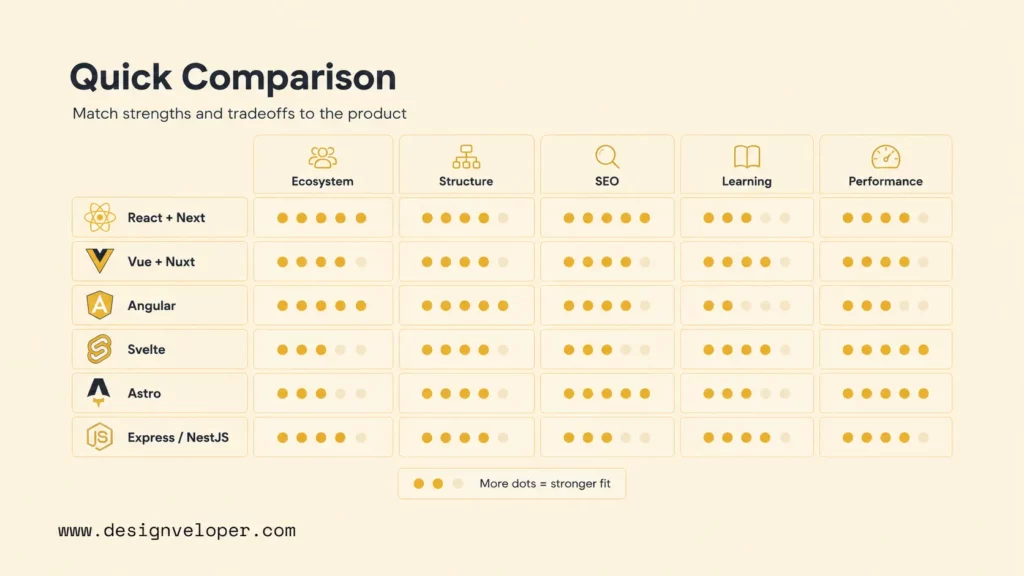
| Framework | Main Use Case | Strengths | Main Tradeoff |
|---|---|---|---|
| React | Complex component-based product UI | Ecosystem, hiring pool, flexibility, framework options | More architecture choices and package coordination |
| Vue | Approachable web applications and progressive adoption | Clear templates, documentation, flexible adoption | Smaller ecosystem and hiring pool in some markets |
| Angular | Large structured enterprise applications | Integrated platform, TypeScript, updates, team consistency | Learning curve and framework commitment |
| Svelte | Lean interactive applications | Compiler model, concise components, small runtime | Smaller ecosystem and Svelte 5 transition knowledge |
| Next.js | React full-stack and public web applications | Mixed rendering, routing, server features, React integration | Caching and server/client complexity |
| Nuxt | Vue universal and full-stack applications | Rendering modes, conventions, server features, modules | Meta-framework behavior and module due diligence |
| Astro | Content-heavy performance-focused sites | HTML-first output, islands, multiple UI integrations | Less natural for one highly interactive shared-state app |
| SolidJS | Fine-grained interactive interfaces | Targeted updates, signals, strong developer satisfaction | Smaller ecosystem and hiring market |
| Qwik | Fast-starting public applications | Resumability and fine-grained lazy loading | Different model, serialization constraints, smaller ecosystem |
| Express/NestJS | Node.js APIs and backend services | Minimal control or structured TypeScript architecture | Express needs conventions; Nest can be heavy for small services |
A team should weight the rows according to business risk. A public publisher may weight crawlable HTML, content build time, and JavaScript cost. A trading dashboard may weight update latency, interaction, and real-time reliability. A regulated enterprise portal may weight predictable upgrades, access control, form validation, and auditability. The same framework can rank differently for each product.
How To Choose The Right JavaScript Framework
Choose a JavaScript framework by converting product requirements into a short technical evaluation, not by comparing feature lists. Define the pages, user journeys, data, integrations, traffic, indexing needs, team, and maintenance period first. Then test the smallest set of candidates against one difficult but representative vertical slice.
Related reading:
- Top 7 Best Resources to Learn React JS for Free
- Top 5 Best Resources to Learn Vue.JS
- WebAssembly vs JavaScript: Key Differences, Performance & Use Case
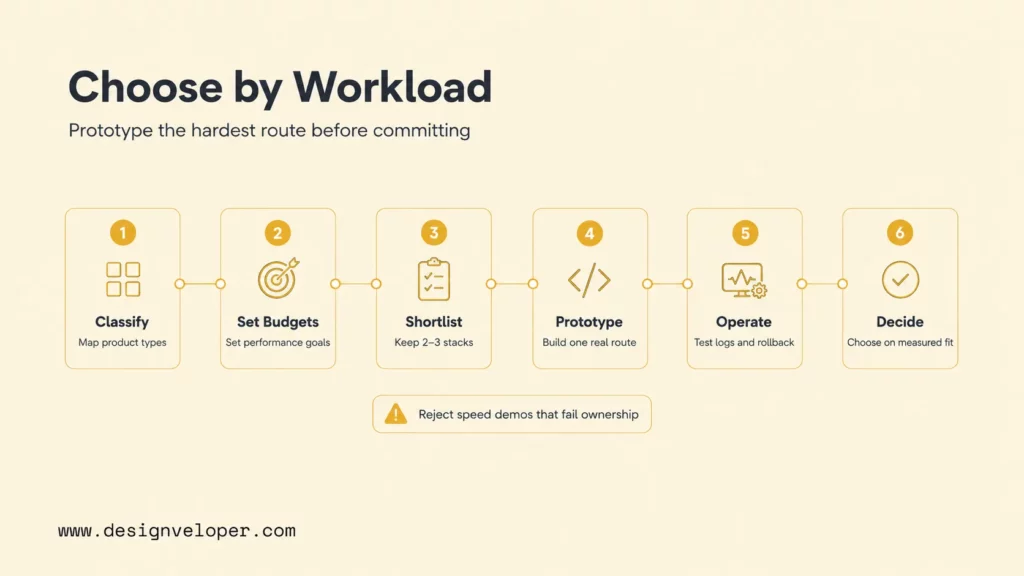
A practical framework decision path
Separate content pages, interactive app routes, APIs, and real-time workflows.
Define performance, accessibility, SEO, security, and delivery thresholds.
Keep two or three stacks whose rendering and team model fit.
Build one route with real data, auth, errors, and deployment.
Test logs, rollback, cache invalidation, updates, and on-call diagnosis.
Choose on measured fit and ownership, then record the reasons.
Reject a framework if the prototype passes a speed demo but fails accessibility, security, deployment, or team ownership.
Project type: distinguish a content website, interactive SaaS interface, commerce platform, internal tool, API, and real-time application. A mixed product may use more than one rendering strategy or framework boundary, but avoid multiplying stacks without an ownership benefit.
Frontend versus backend needs: a UI library does not replace an API architecture. Decide whether the product needs one full-stack repository, separate services, edge functions, background jobs, WebSockets, or existing backend integration. Next.js and Nuxt can handle server work, while NestJS may be better for a large independent business service.
SEO and rendering strategy: map each public route to static generation, server rendering, incremental regeneration, client rendering, or islands. Search engines can process JavaScript, but crawlable HTML, fast delivery, stable links, and complete metadata reduce dependency on client execution. Rendering should follow content freshness and personalization, not a single site-wide rule.
Performance and Core Web Vitals: set budgets for JavaScript, images, fonts, server response, Largest Contentful Paint, Interaction to Next Paint, and Cumulative Layout Shift. Framework benchmarks rarely include the product’s analytics, CMS, authentication, component library, and third-party scripts. Measure the assembled route on representative mobile hardware and networks.
Team skills and hiring availability: count production experience, not tutorial familiarity. The team must be able to debug rendering, caching, state, tests, builds, and deployments. Check the regional hiring market and the cost of training. A theoretically efficient framework can slow delivery when only one person understands it.
TypeScript maturity: examine framework types, router and data types, component library definitions, generated API clients, build performance, and strict-mode support. TypeScript helps large teams when API contracts and domain models remain accurate; it cannot compensate for unclear ownership or poorly designed boundaries.
Ecosystem and community support: verify accessibility libraries, design systems, authentication, internationalization, testing, monitoring, CMS, payments, and deployment adapters. Check release activity and issue handling on the exact packages. Raw package counts do not prove that critical dependencies are maintained.
Long-term maintenance: review release cadence, long-term support, migration tools, security policy, deployment portability, and the ability to replace dependencies. Rehearse one upgrade in the prototype. Record why the stack was chosen, its allowed patterns, and which team owns framework updates.
AI-assisted development compatibility: current coding assistants can generate code for every major framework, but output quality follows available documentation and repository context. Give the assistant the project’s actual version, style rules, component patterns, tests, and framework docs. Require tests, linting, type checks, security review, and human code review; popular training examples may reproduce outdated APIs.
A framework decision is complete only when the team can build, measure, deploy, debug, upgrade, and eventually replace the stack.
JavaScript Framework Trends In 2026
JavaScript framework development in 2026 is less about a new winner and more about rendering, server boundaries, type safety, performance, and production tooling becoming integrated. The State of JavaScript framework results described usage rankings as remarkably stable. Survey respondents had used an average of 2.6 frontend frameworks, while recurring pain points included excessive complexity, performance, state management, choice overload, and breaking changes.
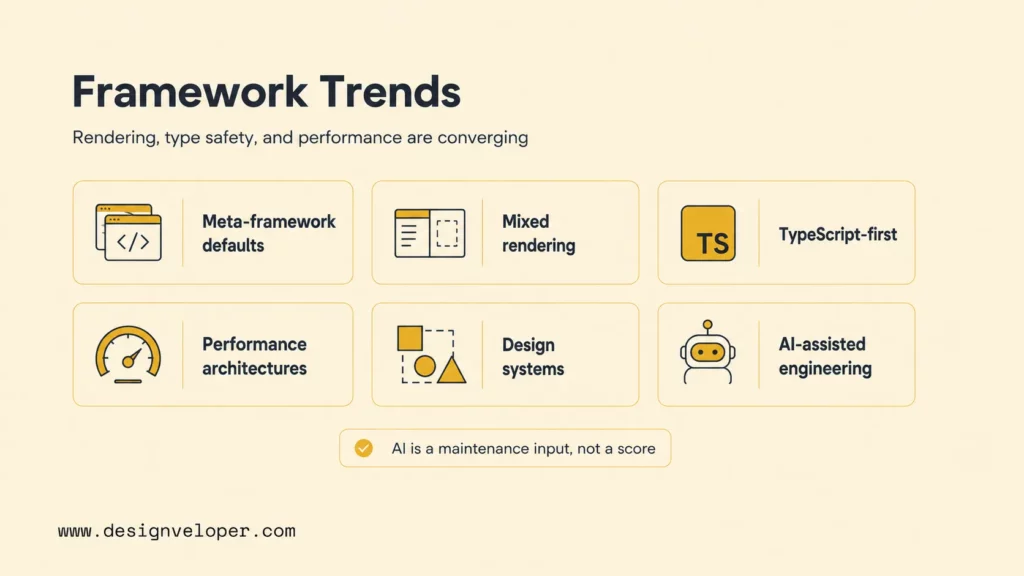
- Meta-frameworks as production defaults: React’s own guidance recommends frameworks for new applications, while Next.js, Nuxt, SvelteKit, Astro, SolidStart, and Qwik City combine UI with routing and rendering.
- Mixed rendering: teams increasingly choose static generation, server rendering, streaming, islands, caching, and client execution per route or component rather than making one global choice.
- TypeScript-first development: framework CLIs, route types, server APIs, and generated clients make type checking part of the default workflow for larger applications.
- Performance-focused architectures: signals, compiler optimization, server components, islands, partial hydration, and resumability target different sources of client work.
- Component-driven design systems: reusable components connect design, accessibility, documentation, visual testing, and product delivery across teams.
- AI-assisted engineering: framework documentation now includes guidance for AI tools, while teams use assistants for scaffolding, tests, refactoring, upgrades, and documentation under normal review controls.
- API-first and headless products: content, commerce, identity, and business services increasingly connect through typed APIs while frontends select the rendering mode that fits each experience.
Server-side features do not eliminate the browser. Frameworks are converging on explicit server and client boundaries, which makes data ownership and serialization more important. Teams must know which code can access secrets, which data enters HTML, which components hydrate, how caches are invalidated, and how failures cross those boundaries.
AI support should be treated as a maintenance input rather than a framework feature score. Mainstream frameworks have more examples in model training data, but that can increase the volume of obsolete patterns. Smaller frameworks may provide cleaner machine-readable documentation. Repository-aware instructions, current docs, automated checks, and measured review quality matter more than whether a framework advertises an AI integration.
Choosing A JavaScript Stack That Survives Real Product Complexity
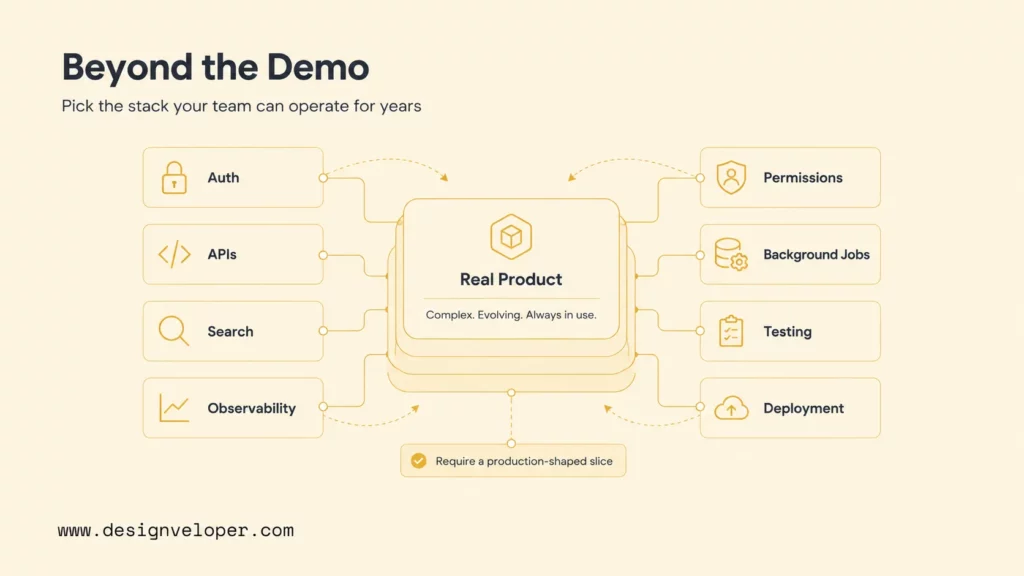
A JavaScript stack survives real product complexity, web application security requirements, and software development services planning when it supports the workload, team, and operating model for years rather than only making the first screen easy to build. Products accumulate user roles, permissions, localization, integrations, background work, search, analytics, error recovery, accessibility requirements, migrations, and support obligations. Framework fit should be assessed against that future pressure.
Continue reading:
- Web Application Development Tutorial: The Ultimate Guide for Beginners
- 16 Real Web App Examples to Inspire Your Next Digital Product
- Choosing Web App Development Services: 5 Essential Tips
A retail workflow illustrates the difference. Reusable CMS components, product images, batch imports, search, approval screens, pricing rules, and marketplace performance require more than a fast product card. The stack must preserve typed data contracts, validate imports, support progressive feedback, restrict approvals, render crawlable catalog pages, and keep operational tools responsive. React/Next.js, Vue/Nuxt, or another stack can work; architecture and ownership determine whether it remains maintainable.
A document productivity application creates a different workload. Large documents, annotations, collaboration, digital signatures, redaction, chat panels, and generated agreements require careful state boundaries, background processing, secure file access, and conflict handling. A component framework must integrate with APIs, storage, real-time communication, and observability without allowing client state to become the system of record.
A JavaScript framework decision should be based on the product’s hardest workflow and the team’s ability to maintain it. In our web application development, we compare candidates with a representative prototype, an architecture decision record, and a three-year maintenance view covering upgrades, hiring, testing, and dependency risk. That process reveals whether a framework improves delivery or merely moves complexity into unfamiliar conventions.
Before approving a stack, require a production-shaped slice: authentication, one complex workflow, one public route if SEO matters, a real API, error states, accessibility, tests, observability, deployment, and rollback. Review the result with product, design, engineering, QA, security, and operations. The best JavaScript frameworks are the ones a team can operate under real change, not the ones that produce the shortest demo.
FAQs About JavaScript Frameworks

What Is The Most Popular JavaScript Framework?
React remains the most widely used frontend option in major developer surveys, although React is technically a library. Vue and Angular retain large communities, while Next.js is a common production framework for React applications. Popularity improves hiring and ecosystem coverage, but it does not make a framework the best fit for every rendering, performance, or maintenance requirement.
Is React A Framework Or A Library?
React is a library for building user interfaces. It supplies components, state, and rendering primitives but does not prescribe a complete application architecture. React’s official documentation recommends starting new applications with a framework such as Next.js or React Router when teams need routing, data loading, rendering, and production conventions.
Which JavaScript Framework Is Best For Beginners?
Vue is often the most approachable starting framework for developers who know HTML, CSS, and JavaScript because its templates and documentation build on familiar web concepts. Svelte is also concise, while React has the largest learning ecosystem. Beginners should learn JavaScript and browser fundamentals alongside a framework so they can debug behavior rather than memorize syntax.
Which JavaScript Framework Is Best For SEO?
Next.js, Nuxt, Astro, and SvelteKit are strong SEO choices because they can deliver rendered HTML and route-level metadata. Astro is especially suitable for content-heavy sites with limited interactivity. SEO results still depend on content, crawlability, canonical URLs, structured data, internal links, performance, and rendering configuration; no framework guarantees rankings.
Should I Use A Frontend Or Backend JavaScript Framework?
Use a frontend framework when the main problem is interface components, interaction, and browser state. Use a backend framework when the product needs APIs, authentication, business logic, databases, queues, or server integrations. Most production applications need both layers, whether they live in one full-stack framework such as Next.js or Nuxt or in separate frontend and backend services.
Also published on

Share post on










Related Articles



Best JavaScript Frameworks For Web Development In 2026
Best JavaScript Frameworks For Web Development In 2026 Published August 05, 2026
Why Learn JavaScript? Career Benefits, Uses, And Learning Path
Why Learn JavaScript? Career Benefits, Uses, And Learning Path Published August 05, 2026
vLLM Tutorial: A Step-By-Step Guide To Deploying And Serving LLMs
vLLM Tutorial: A Step-By-Step Guide To Deploying And Serving LLMs Published June 29, 2026