














Custom eCommerce Web Development: Benefits, Process, Cost

When it comes to web development, there are a lot of interesting trends to think about. This comes with the rise of custom eCommerce websites and online stores all over the world. If a retail company wants to go above and beyond what a standard eCommerce platform can do, it should seriously consider investing in custom eCommerce website development.
In this article, we’ll talk about why it’s good for your business to have a custom eCommerce site made. Additionally, we’ll also talk about a few important steps to set up a custom eCommerce site. Keep reading!
Custom vs Platform-Based eCommerce Development
Creating a custom eCommerce website is a difficult process that starts with planning and designing a unique online store for each company from scratch. Accordingly, you have to take care of everything, including website hosting, security, PCI compliance, and maintenance. This requires deep technical expertise, for sure, and even specialized skills if you want advanced features like AI chatbots or IoT integration.
This makes it different from platform-based eCommerce development. Using eCommerce platforms gives you access to ready-made components that speed up your development. Simply, you don’t need to build some features and functionality from scratch, but use prebuilt components from these platforms.
Such SaaS (Software-as-a-Service) platforms as Wix or BigCommerce handle backend stuff for you. They provide drag-and-drop editors, prebuilt templates, and even AI to build a complete eCommerce website. They have all the essential eCommerce features, even for B2B. So, they’re cheaper and faster, right?
But what they lack is deep customization to develop very custom features or handle very complex workflows. Further, you have to depend heavily on their backend systems. This is a big minus if you want to fully control design and functionality.
That’s why many large enterprises or those planning long-term eCommerce growth choose custom web development. It solves the limitations of platform-based development.
Recommended reading: 9 Necessary Elements of eCommerce Website That Boost Your Sales
When Is Custom eCommerce Website Development the Right Choice?

Custom development isn’t always good. Knowing when it works best helps you build a successful eCommerce website from day one:
- Custom business logic
Do you have a complex checkout process that goes beyond standard functionality? Is your customer journey very unique? Do you need to integrate deeply with your proprietary software? If so, SaaS platforms with standard features can’t meet your demand. Only custom development can.
- B2B eCommerce
The global B2B eCommerce market will surpass $36 trillion in 2026, which makes it a fertile land to invest in. We don’t deny that some SaaS platforms like BigCommerce are offering excellent B2B eCommerce suites. But if your B2B commerce operations require complex features, advanced security, or deep system integrations, we still advise you to opt for custom development.
- Multi-region and multi-currency
Many SaaS platforms support international selling and multi-currency, but just up to a certain level. Do you want to deal with tax shifts, currency fluctuations, or demand changes by regions? Custom development still wins over SaaS platforms.
- High traffic and high concurrency
Custom architectures give you full control and ownership to handle heavy loads and concurrent requests. Building a custom eCommerce website means you can proactively consider scalability in mind from the first day, instead of only depending on SaaS platforms.
- Complex integrations with your ERP, CRM, or OMS
Off-the-shelf allows you to integrate common systems and apps. But for legacy, proprietary, or complex infrastructure, custom development still lets data flow both ways better through custom rules.
Recommended reading: eCommerce Infrastructure That You Should Know
Key Benefits of Choosing Custom eCommerce Development

How can custom builds benefit your eCommerce business? Below are some of its good things:
- Unique brand identity
Your development team can be limited by a platform’s features. But with custom development, you can give your site a unique look and feel. This is done by adding high-quality images, a great user interface, a smooth checkout process, and other custom features.
- Full control over features and user experience
Your eCommerce website works within a platform’s system. The platform controls the source code behind your design and functionality. But when building a custom online store, you can completely control its user experience and features.
- Scalability and flexibility for high traffic and complex operations
This full control also allows you to flexibly add more complex or advanced features to your eCommerce website when your business grows. Meanwhile, SaaS platforms just provide certain scalability. When your eCommerce operations become more complex and traffic gets higher, a platform’s standard functionality may not adapt to them.
- Better performance, security, and compliance
Using off-the-shelf platforms means you have to use the generic source code and suffer from shared vulnerabilities. But with custom development, you can avoid redundant code that inherently exists in platforms and minimize unexpected security holes. This helps your site meet performance and security needs from day one.
- Seamless integration with business systems
Custom builds don’t rely on ready-made integrations like platform-based sites. They can connect seamlessly with the complex or proprietary systems of your business, like ERP, CRM, inventory management software, or specific payment gateways.
- Long-term cost efficiency and ROI
Initial costs of custom development are much higher, sure. But you can avoid hidden costs incurred by less scalability, poorer security, and reliance on maintenance from SaaS platforms. This translates to better cost efficiency and improved ROI in the long term.
Key Features of a Custom eCommerce Site
The features that a custom eCommerce website should have depend on your specific use cases. But below are several key features to consider:
- Advanced product management
A custom build often needs a smart inventory management system to track diverse product variants, dynamic pricing rules, and cross-region inventory logic. This system may need advanced search & filtering, deep integrations with ERP or CRM systems, personalized recommendations, and data-driven optimization.
- Custom checkout flow
Depending on user types, the checkout flow of your site may be simple or structured. But no one wants a complex checkout process with many unnecessary steps.
So, keep your checkout screen simple by focusing only on what encourages users to complete the purchase. Custom development also allows you to integrate guest checkout options, form auto-completion, and real-time validation to speed up the process. After orders, your site should showcase a summary page with product images, quantities, and prices.
- Multi-store and multi-currency
You can customize a website to make it capable of handling various storefronts based on specific regions and brands from a single backend. Still, the site can display local currencies and suitable payout solutions for international customers. It can automatically detect where its users are via IP, update exchange rates, and show prices in their local currency.
- Headless commerce capability
This is another key feature of a custom eCommerce website. This capability separates the frontend and the backend into different building blocks. So, your team can use independent tools to experiment, rebuild, and update more features on one service without worrying that these actions will affect other systems.
- AI-powered personalization and recommendations
A custom online store can integrate AI capabilities to personalize a user’s homepage and suggest products based on their purchase history and browsing habits. This increases the user experience and drives more sales.
Recommended reading: What Are Cloud eCommerce Solutions?
Custom eCommerce Development Process
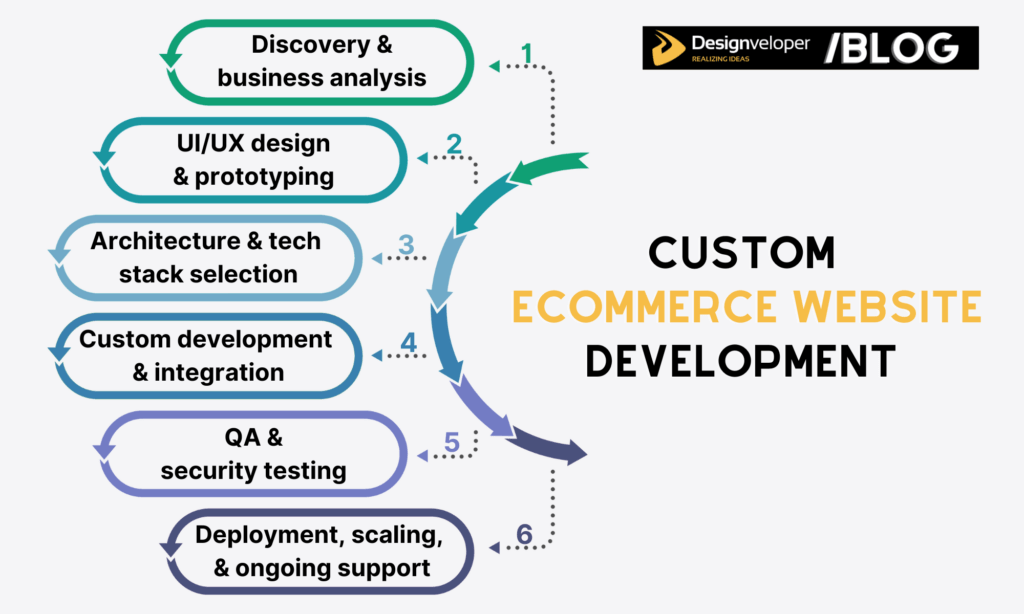
We’ve already talked about when to develop a custom eCommerce website, its potential benefits, and the key features. Let’s begin the process of making a custom eCommerce site, shall we?
Step 1: Discovery and Business Analysis
Before you start building an eCommerce site, you need to carefully analyze the current market and competitors. You also need to know who your target customers are, their tastes, and any important factors that might impact their purchase. This will help you create a better feature list.
Step 2: UX/UI Design and Prototyping
Next, turn your website idea into an intuitive design that gives users a seamless experience. Building the design in forms of wireframes or prototypes helps you know where users may get stuck and whether the functions are feasible.
Step 3: Architecture and Technology Stack Selection
Now, choose the right eCommerce architecture and tech stacks to build a custom eCommerce website. Be it a headless/composable or monolithic architecture, it should meet your UX, performance, security, and scalability requirements. Besides, your technologies should cover frontend development (ReactJS, Angular, etc.), backend development (NodeJS, Python, etc.), database management (SQL & NoSQL options), and hosting & infrastructure (AWS, GCP, etc.).
Step 4: Custom Development and Integration
Once you have the right toolset, let’s code. In this phase, frontend developers will turn the static design into the dynamic interface that aligns with your brand and works seamlessly across devices. Besides, backend developers focus on building the server logic, database structure, and custom features.
Your team also connects the eCommerce website with external systems to ensure smooth data flows. These systems include ERP, CRM, payment gateways, shipping vendors, etc. You even have to develop custom APIs to integrate with your proprietary or legacy software.
Step 5: Quality Assurance and Security Testing
This phase ensures that all of the website’s features work as expected. But we advise your team to perform unit testing, automated testing, and code reviews throughout the production process. This may require more work, but it’ll reduce the time to fix code problems later.
Step 6: Deployment, Scaling, and Ongoing Support
Testing is done, and you now prepare to launch it to the production environment. But that’s not the end. You need a thorough maintenance plan to monitor and improve the site regularly. This will keep the site always running as expected and handling any problems.
How Much Does Custom eCommerce Website Development Cost?

It’s really hard to calculate how much it costs to develop a custom eCommerce website. The answer depends much on your project scope, feature complexity, tech choices, and team structure. But we at least give you rough estimates:
- For a simple or small store, the cost lies somewhere between $2,000 and $20,000. With that money, you can develop a functional store from standard themes. The store, of course, has a simple product catalog, a simple checkout process, basic security measures, and some common integrations.
- For a medium-sized store, the cost may increase to $20,000 – $80,000. This time, your business can create more custom UI components and integrations with third-party services (e.g., payment gateways or shipping vendors). Your store can even come with product filtering, inventory & order management, and subscription to promotions.
- For a highly complex or enterprise-grade store, the cost ranges from $80,000 – $300,000 or more. This time, deep customization is required to build a unique architecture, complex product listings, advanced security, and international selling.
But that’s just the upfront development cost. There are still long-term fees for annual hosting, maintenance, security updates, software licensing, and third-party services. These things are important to keep your site running monthly.
Common Challenges in Custom eCommerce Development
Custom eCommerce website development is not without limitations. Be aware of its challenges, and you’ll be well-prepared if any obstacle intervenes in your development:
- Higher initial cost
A custom build is definitely more expensive than a platform-based eCommerce website. This is because you have to hire some specialists to develop custom features and functionality from scratch, instead of using prebuilt components from SaaS platforms. Not to mention that some advanced features like LLM-based chatbots or IoT integrations can add up to your overall cost.
- Longer delivery times
Customizing an online store also means you have to put more time and effort, around 3 – 12 months. In comparison, platform-based development may take less, 2 – 8 weeks on average. This added time is often attributed to requirement gathering & architecture planning, custom design & development work, integrations, and testing.
- Self-hosting and continuous maintenance
Unlike SaaS platforms that handle the heavy-lifting on your behalf, custom development requires you to take care of web hosting, security, and compliance yourself. You also need to prepare a maintenance plan to track and update your online store, which takes more time and costs.
Custom eCommerce Website Development Services by Designveloper
Since 2013, we at Designveloper have thrived in Ho Chi Minh City, Vietnam, carving a strong presence in the web and software development industry. With a team of over 100 skilled professionals, we drive innovation daily.
Our custom eCommerce website development service stands out among our offerings, helping businesses craft robust online stores tailored to their exact needs. But why should you choose our service? Here are some reasons:
- Our Technological Expertise and Methods
We excel particularly with modern technologies like HTML5/CSS3, JavaScript, Python, React, NextJS, and NodeJS. These are helpful tools that aid us in creating responsive, efficient, and scalable eCommerce websites across devices. We also emphasize mobile-friendly designs as shoppers look into the online space more and more.
We use pair programming, behavior-driven development (BDD), and test-driven development (TDD) to ensure success. Using these approaches means projects do not go over budget or over time. We keep the communication open and are flexible with your feedback.
- Our Success Stories and Client Praise
Our portfolio showcases our ability to deliver standout results. For example, we developed the Aha.is eCommerce platform for Netgengið ehf., founded in 2011, to boost Iceland’s local economy. This project highlights how we create user-friendly, efficient online stores that drive engagement and sales.
- Our Edge in a Competitive Market
Recognized as a cost-effective outsourcing hub with strong work ethics, we offer top-quality services at competitive rates. This appeals to international clients seeking smart budget solutions.
Moreover, we fill a vital market gap with our focus on customization. Without a custom website, businesses risk losing millions of buyers. We meet this demand with precision. Our technical expertise and agile approach make us a top pick for companies aiming to excel online.
So, why don’t you start building a custom eCommerce website with us from now? Reach out to us and bring your idea to life!
Also published on

Share post on










Related Articles



10 Ecommerce Best Practices For Better UX, SEO, And Sales
10 Ecommerce Best Practices For Better UX, SEO, And Sales Published September 21, 2026
B2C Ecommerce Model: Types, Examples, and How to Choose One
B2C Ecommerce Model: Types, Examples, and How to Choose One Published September 18, 2026
What Is B2B Ecommerce? Types, Models, Platform Features, Examples
What Is B2B Ecommerce? Types, Models, Platform Features, Examples Published September 18, 2026