













How To Build An App For Your Business In 10 Steps?

KEY TAKEWAYS:
- Building an app starts with a business problem, not a feature list; validate one valuable workflow before investing in design, code, or app-store release work.
- The right app approach depends on reach, complexity, and ownership: web apps, PWAs, cross-platform apps, native apps, no-code tools, and custom software fit different business constraints.
- A focused MVP reduces cost and launch risk by proving the core task with real users before adding advanced integrations, offline sync, dashboards, payments, or automation.
- Business app delivery needs more than development because UX, security, QA, deployment, analytics, feedback loops, and maintenance determine whether the app becomes useful software.
- Hiring a development partner makes sense when the app needs custom workflows, secure accounts, integrations, scalable architecture, or long-term product ownership beyond a simple prototype.
Learning how to build an app for your business begins with a problem, not a feature list. Define one valuable customer or employee task, validate that people need a better way to complete it, choose the least complex delivery approach, and release a focused first version. The ten steps in this guide move from problem validation to launch, measurement, and continuous improvement.
A business app can support booking, ordering, payments, loyalty, customer service, field operations, sales, inventory, approvals, or internal knowledge. However, an installable mobile app is not always the right answer. A responsive web app, progressive web app (PWA), no-code workflow, or integration between existing systems may solve the problem faster and with lower ownership cost.
Quick decision guide: Start with a web or no-code prototype when the workflow is simple and speed matters most. Choose a PWA when broad web reach and installability matter more than app-store presence. Cross-platform app development when iOS and Android need a shared product roadmap. Native development for demanding platform-specific experiences. And choose custom development when the app requires unique workflows, secure accounts, payments, offline sync, custom APIs, complex integrations, or long-term scale.
| Business situation | Best starting route | Evidence needed before investment |
|---|---|---|
| Validate a simple workflow | Clickable prototype or no-code app | Target users complete the core task and ask to keep using it. |
| Serve users on any device quickly | Responsive web app or PWA | Required device capabilities work reliably in target browsers. |
| Launch on iOS and Android | Cross-platform mobile app | Shared code fits performance, device, and UX requirements. |
| Need deep platform integration | Native iOS and/or Android | Camera, Bluetooth, background, media, or performance needs justify separate work. |
| Build differentiated business software | Custom app and backend | The workflow creates measurable value that packaged tools cannot support. |
Recommended for you:
- What Is Mobile App Development? Definition, Types, Stages
- Which Programming Language Is Best for App Development?
- Android App Development: From Idea To Play Store Launch
Why Build An App For Your Business?
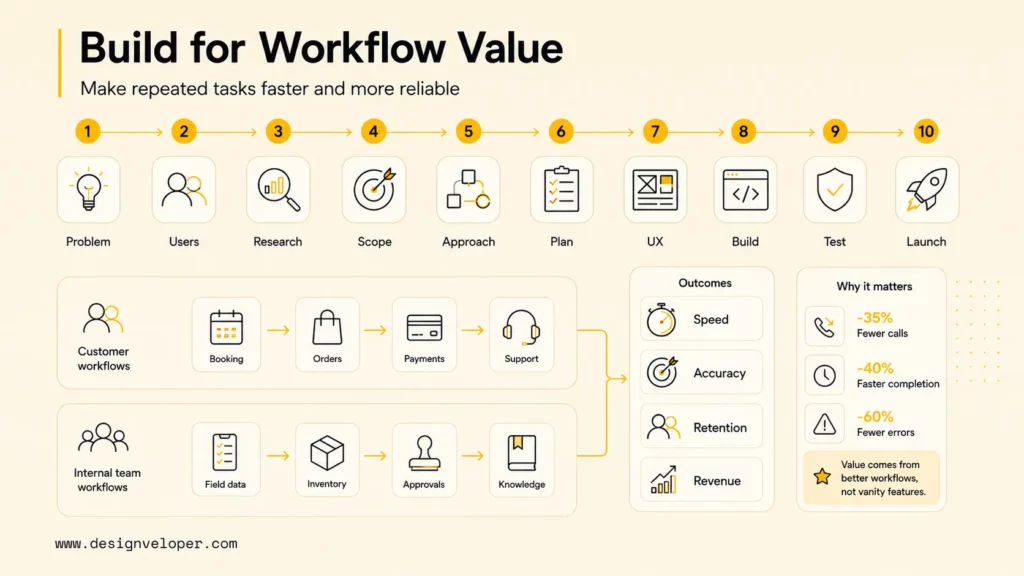
Build a business app when it makes an important task faster, easier, more reliable, or more valuable than the current process. The strongest cases are repeated workflows: customers book appointments, place orders, make payments, track service, receive support, or manage loyalty; employees capture field data, approve requests, update inventory, or access operational information.
Customer access is one benefit, but the real value comes from workflow fit. A restaurant might reduce phone orders. A clinic might combine booking, reminders, forms, and follow-up. A distributor might give account customers contract pricing and repeat ordering. A field-service company might support offline job notes, photos, signatures, and later synchronization.
An app can also connect fragmented systems. A well-designed product can coordinate identity, CRM, payment, ecommerce, scheduling, support, analytics, and internal operations through one user journey. Integration creates value only when data ownership and error recovery are clear. Otherwise, the app becomes another disconnected interface.
Define a measurable reason to build. Useful targets include reducing completion time, increasing repeat orders, lowering support volume, shortening approval cycles, improving data accuracy, or enabling a new paid service. Avoid vanity goals such as “we need an app because competitors have one.” A mobile app development overview should explain how product goals, platform choices, architecture, costs, and lifecycle decisions connect.
A business app earns its place when it removes friction from a repeated workflow, not when it merely adds an icon to a phone.
Before You Build: Choose The Right App Approach
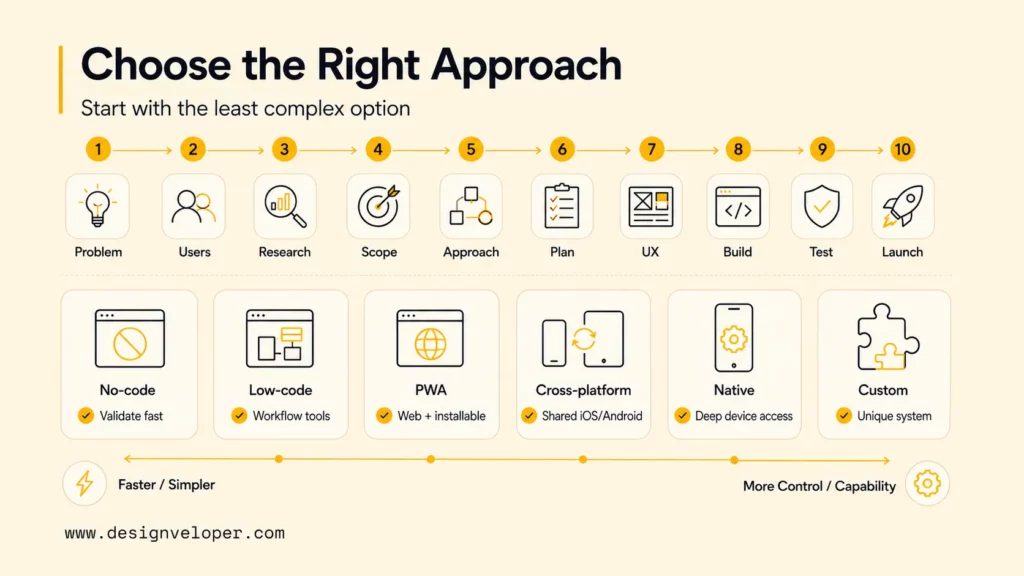
Choose the app approach by matching user context, required capabilities, budget, delivery speed, and long-term ownership. No-code, low-code, web, PWA, cross-platform, and native development solve different problems. The least complex approach that meets the real requirements is usually the best first choice.
| Approach | Best fit | Main limitation to test |
|---|---|---|
| No-code or AI app builder | Simple forms, directories, internal tools, prototypes, and workflow validation. Bubble is one official example. | Platform constraints, pricing growth, data portability, and complex custom logic. |
| Low-code platform | Departmental apps and integration-heavy business workflows with platform governance. | Licensing, vendor skills, extension limits, and environment management. |
| Progressive web app | Installable web delivery with broad reach; web.dev describes PWAs as capable, reliable, and installable. | Browser support for required device APIs, background behavior, and store expectations. |
| Cross-platform mobile | Shared iOS and Android development with frameworks such as Flutter or React Native. | Native modules, platform-specific UX, dependency quality, and performance edge cases. |
| Native mobile | Deep platform integration, demanding performance, rich platform UX, or a single priority ecosystem. | Separate iOS and Android skills, releases, tests, and maintenance. |
| Custom web and mobile system | Unique workflows, roles, integrations, offline data, admin tools, and long-term product evolution. | Higher discovery, engineering, QA, security, and operating responsibility. |
An AI app builder can accelerate scaffolding, screens, content, and routine code, but generated output does not remove product responsibility. The team must still verify data handling, authorization, accessibility, performance, dependency licenses, security, store compliance, and maintainability. If the generated system cannot be tested, exported, observed, or supported, speed at the beginning can become lock-in later.
Decide with one representative workflow. Prototype the hardest path: a payment refund, offline synchronization, multi-role approval, or third-party integration failure. A homepage mockup proves very little. A representative proof of concept reveals whether the chosen approach can support the product’s constraints.
Further reading:
- 15 Best AI No-Code App Builders (No Coding Skills Required)
- POC Vs MVP Vs Prototype: How To Choose The Right Validation Step
- From AI MVP To Product: Why Great Demos Are Not Enough
10 Steps To Build An App For Your Business
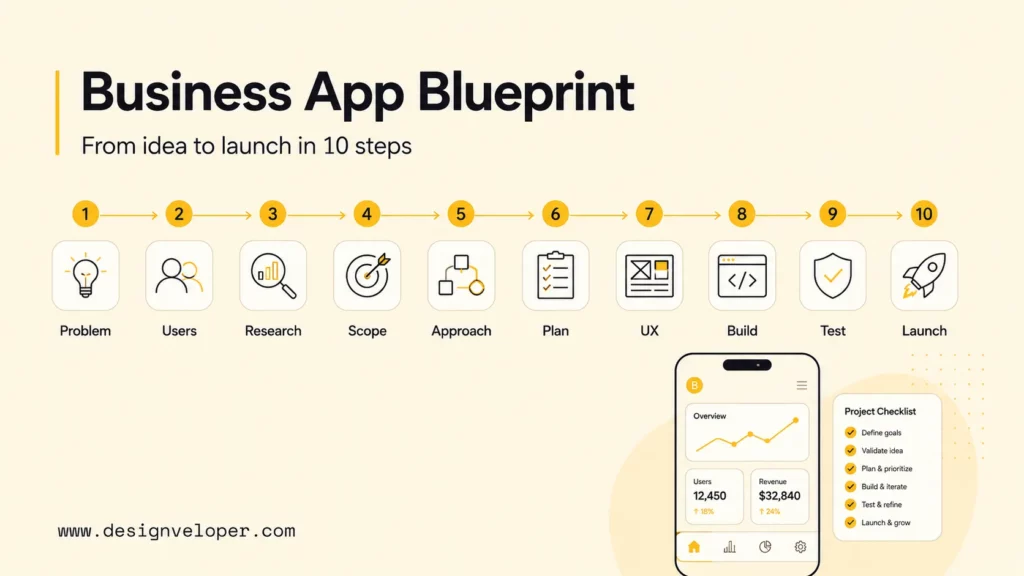
The ten-step process reduces uncertainty in sequence. Each step should produce a concrete artifact, owner, and acceptance criterion before the project advances. Discovery can overlap with design, and development can iterate, but skipping validation usually moves risk into the most expensive phase.
Business app delivery roadmap
The output of every stage becomes evidence for the next decision instead of a document created only for approval.
Related reading:
- 7 Stages of Mobile App Development Process
- How Cross Platform App Development Can Reduce Costs?
- Software Development Life Cycle (SDLC): Guide for Business
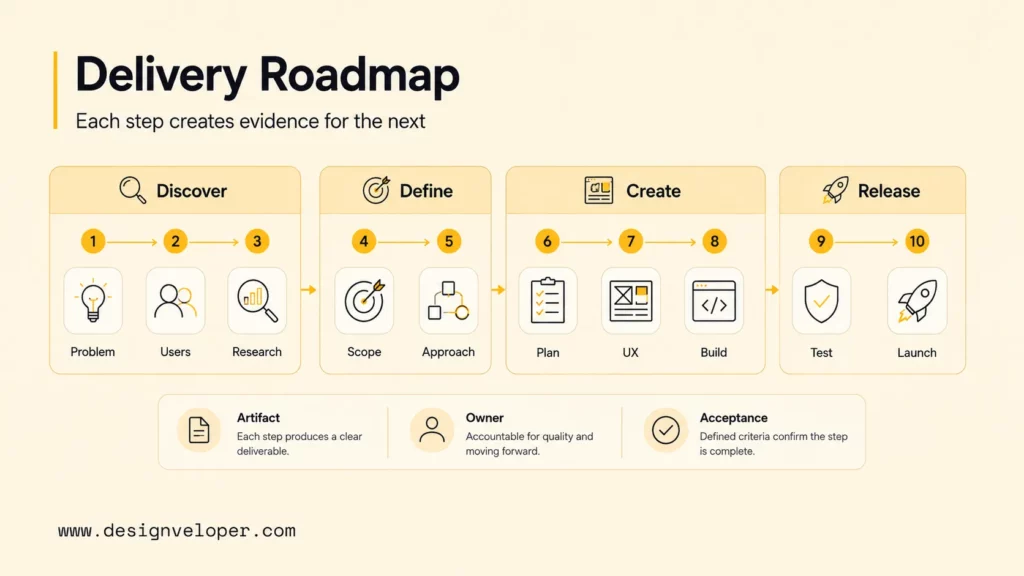
Step 1. Define The Business Problem And App Goal
Write the problem as an observable workflow: who struggles, what they are trying to complete, where friction appears, and what the business loses. “Customers call three times to confirm a booking because availability is not visible” is more useful than “we need a booking app.”
Create a one-sentence product goal and one primary metric. For example: “Let returning customers book and pay for a standard appointment in under three minutes without staff assistance.” Supporting guardrails might include payment failure, cancellation, support contact, completion, and customer satisfaction. The first artifact is a problem statement, baseline, target, and accountable owner.
Step 2. Understand Your Target Users
Interview and observe the people who will perform the core task. Separate buyers, daily users, administrators, support staff, and compliance owners because each group has different needs. Ask users to show the current process, not only describe desired features. Workarounds, spreadsheets, repeated messages, and manual checks reveal the actual opportunity.
Produce a compact user profile and journey. Record context, device, frequency, environment, accessibility needs, trust concerns, triggers, steps, failure points, and success. Recruit five to eight representative users for early usability cycles rather than relying only on internal stakeholders.
Step 3. Research Competitors And Similar Apps
Research direct competitors, substitutes, and the current manual process. Compare onboarding, task flow, pricing, reviews, permissions, support, app-store complaints, and gaps. Competitor research should clarify table stakes and opportunities; it should not produce a copied feature inventory.
Create a matrix with “must match,” “differentiate,” “avoid,” and “unknown.” Verify whether the business can legally use required content, data, brand elements, maps, payments, or APIs. The output is an evidence-backed positioning statement and a list of assumptions that still need testing.
Step 4. List Core Features For The First Version
Define the smallest release that completes the primary journey end to end. A booking MVP in project management might include sign-in, availability, service selection, booking, payment, confirmation, cancellation, staff management, and basic support. Loyalty tiers, social sharing, advanced recommendations, and multiple payment experiments can wait unless they are essential to the value proposition.
Prioritize with three questions: does the feature enable the core outcome, reduce a critical risk, or provide required evidence? Map every feature to a user story, acceptance criterion, analytics event, and owner. Our guide to building an MVP provides a deeper scope-control approach for teams that need to validate before expanding.
Step 5. Choose The App Type And Development Approach
Revisit the approach matrix with confirmed requirements. Select web, PWA, native, cross-platform, no-code, low-code, or a combination. Consider user devices, offline behavior, camera or location use, notifications, app-store distribution, performance, accessibility, integrations, internal skills, release cadence, and five-year maintenance.
Record the decision and rejected alternatives. A cross-platform app may be the right default for common business workflows across iOS and Android, but native development can be justified by specialized platform APIs or performance. A PWA can be ideal for discoverability and low-friction access when the required browser capabilities are supported.
Step 6. Estimate Budget, Timeline, And Team Needs
Estimate by deliverables and risk, not screens alone. Include discovery, product management, UX/UI, mobile or web development, backend and APIs, QA, security, cloud environments, analytics, store work, migration, documentation, launch, support, and contingency. Payments, real-time features, offline sync, AI, multiple roles, compliance, and legacy integrations add effort.
Build a range with assumptions. Define what is excluded, which dependencies belong to the client, how change requests work, and which acceptance tests determine completion. The team may include a product owner, business analyst, designer, mobile/web engineers, backend engineer, QA, DevOps, and security specialists. Smaller projects combine roles, but responsibilities still need named owners.
Step 7. Design The UX/UI And User Flow
Design the complete task before polishing visual details. Start with a flow diagram, low-fidelity wireframes, and a clickable prototype. Include empty states, loading, validation, permissions, failed payment, poor network, cancellation, recovery, and human support. Test the prototype with target users and revise before development becomes expensive.
Use platform conventions and accessible components. Android’s current core app quality guidelines cover user experience, technical quality, privacy, and security across varied devices. Apple reviews apps against safety, performance, business, design, and legal requirements in its App Review Guidelines. Store rules should influence design before submission, not during the final week.
Step 8. Build The MVP Or First App Version
Build in short, testable increments. Establish repositories, environments, CI/CD, coding standards, secrets management, analytics conventions, and a definition of done. Implement the highest-risk technical path early. If the app depends on payment, identity, offline sync, or a legacy API, prove that integration before completing every screen.
Keep architecture proportional to validated demand. Separate the client app, backend, data, authentication, integrations, admin operations, and observability clearly enough to change them safely. Feature flags and staged environments help the team demonstrate progress, test with users, and disable risky behavior without rebuilding the release.
Step 9. Test Security, Performance, Usability, And Devices
Test functional behavior, usability, accessibility, security, API failures, permissions, network conditions, battery use, startup time, memory, background behavior, and supported devices. Automate repeatable unit, integration, API, and UI checks, then add exploratory testing for edge cases that automation does not predict.
Use the OWASP Mobile Application Security Verification Standard to plan controls for storage, cryptography, authentication, network communication, platform interaction, code quality, resilience, and privacy. Test backend APIs separately because mobile-client controls do not cover the entire service. Release acceptance should include zero unresolved critical defects, completed privacy disclosures, representative-device results, and a tested rollback or disable path.
Step 10. Launch, Monitor, And Improve The App
Launch to a controlled audience before broad promotion. Use internal testing, beta distribution, pilot customers, phased rollout, or feature flags. Prepare store listings, screenshots, privacy information, support contacts, review credentials, backend availability, incident ownership, and a communication plan.
Monitor both product and technical outcomes. Track activation, core-task completion, retention, conversion, support demand, crashes, latency, API failures, and cost per successful transaction. Google Analytics for Firebase can capture app events, while Firebase Crashlytics can help teams prioritize stability issues. Other analytics and observability stacks are valid when they meet privacy and operating needs.
Turn failures and feedback into a ranked backlog. Compare behavior with the baseline from Step 1. Improve the primary journey before adding unrelated features. Keep operating-system support, SDK updates, security patches, store policies, data retention, and backend capacity in the maintenance plan.
Launch is the first reliable measurement point, not the moment product responsibility ends.
How Much Does It Cost To Build A Business App?
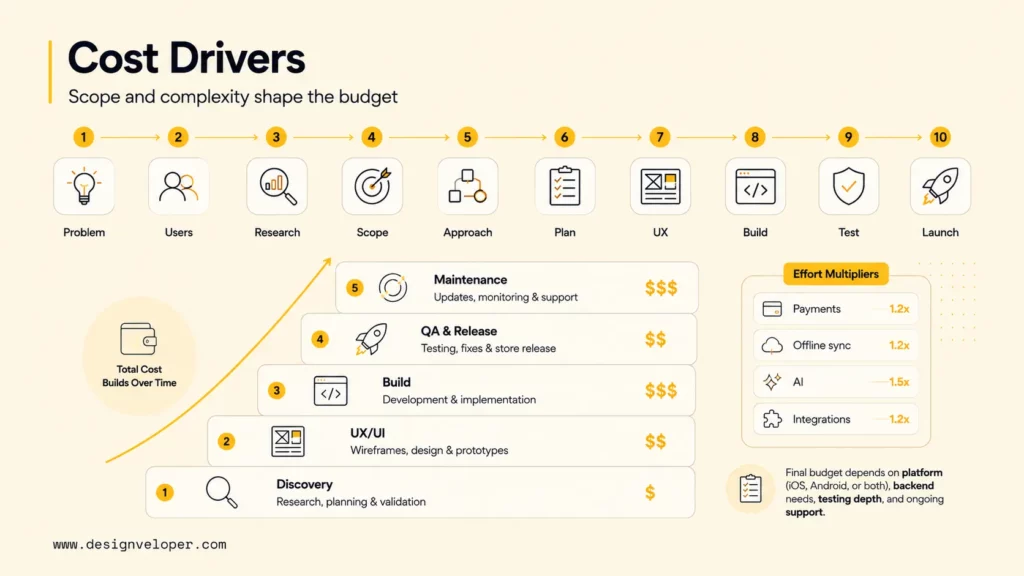
Business app cost depends on scope, complexity, platform, design, backend services, integrations, security, data migration, testing, and post-launch support. No-code subscriptions can support inexpensive prototypes, while custom multi-role products with payments, offline sync, admin systems, and compliance can require substantial six-figure investment.
Public marketplace pricing guides can be useful reference points, but they are not quotes for a particular product. A focused project can be below or above market ranges depending on requirements, region, team model, and evidence quality.
| Cost layer | Typical work included | What increases effort |
|---|---|---|
| Discovery and product definition | Research, workflow mapping, requirements, scope, architecture options | Unclear stakeholders, regulated workflows, legacy constraints |
| UX/UI and prototyping | Flows, wireframes, visual design, prototype, usability testing | Many roles, accessibility, custom interaction, multiple form factors |
| Application and backend | Client app, APIs, database, identity, admin, integrations | Payments, realtime, offline sync, AI, complex permissions |
| Quality and release | Automation, device testing, security, performance, store submission | Wide device matrix, compliance, high availability |
| Operations and maintenance | Hosting, monitoring, support, updates, analytics, improvements | Traffic growth, vendor fees, OS changes, expanding scope |
Control cost by narrowing the primary journey, validating with prototypes, selecting one launch platform when evidence supports it, reusing stable services, and delaying optional features. Do not cut authentication, data protection, recovery, monitoring, or essential QA. Our 2026 app cost breakdown offers a detailed view of cost by stage and common hidden expenses.
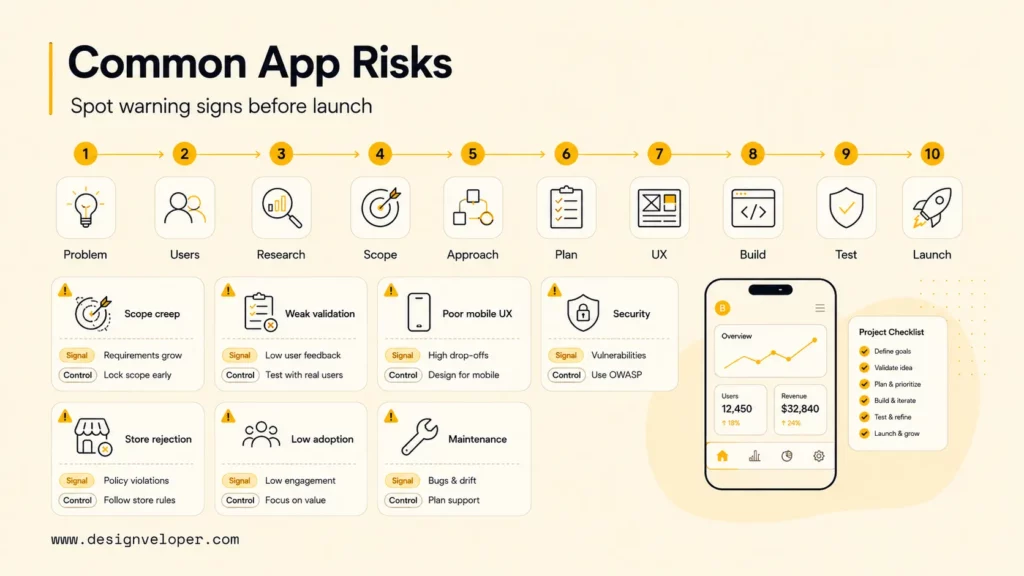
Common Challenges When Building A Business App
The most common failure is building before the problem is clear. Unclear goals produce changing priorities, weak acceptance criteria, and arguments about features. Establish one outcome, one target user, one primary journey, and a decision owner before development starts.
| Challenge | Early warning signal | Control |
|---|---|---|
| Too many first-version features | Every stakeholder labels every request essential. | Require each feature to support the primary outcome, critical risk, or validation evidence. |
| Poor user validation | Requirements come only from executives or internal assumptions. | Run interviews, workflow observation, prototype tests, and pilot use. |
| Weak mobile UX | Desktop layouts are compressed into small screens. | Design mobile flows, interruption recovery, accessibility, and device states explicitly. |
| Security and payment risk | Security review and threat modeling are scheduled after feature completion. | Use OWASP controls, least privilege, secure APIs, test environments, and specialist review. |
| App-store rejection | Privacy, account deletion, purchases, metadata, or review access are unresolved. | Review Apple and Google requirements during discovery and before every release. |
| Low adoption | The launch plan assumes store publication creates demand. | Plan onboarding, customer communication, incentives, support, and success measurement. |
| Maintenance surprise | Budget ends at version 1.0. | Fund monitoring, updates, support, infrastructure, security patches, and iteration. |
Integration failures deserve separate planning. A payment provider, CRM, inventory system, map, identity provider, or legacy API can be unavailable or return unexpected data. Define timeouts, retries, duplicate protection, reconciliation, audit logs, fallbacks, and manual recovery. The user should never be left wondering whether an order, payment, or booking succeeded.
Ownership is equally important. Name who decides product scope, approves content, manages store accounts, responds to incidents, owns customer data, reviews analytics, and funds maintenance. A technically complete app can still fail when no team owns the product after launch.
When Should You Hire An App Development Partner?
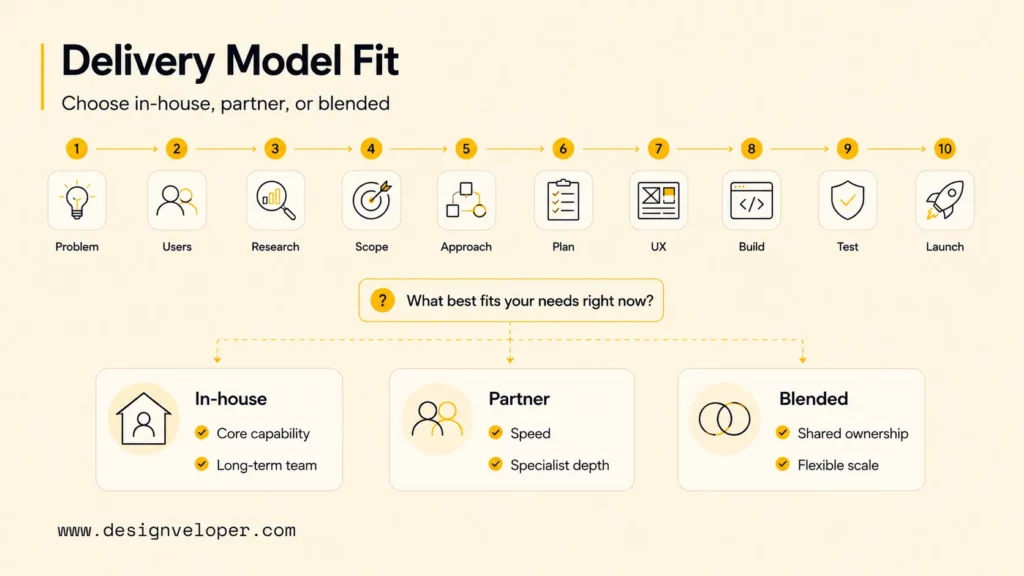
Hire an app development partner when the product requires skills, delivery capacity, or operating discipline that the business cannot sustain internally. Strong signals include custom payments, user accounts, booking logic, ecommerce workflows, AI features, offline synchronization, custom APIs, admin dashboards, role-based access, data migration, regulated information, or long-term scalability.
A partner should contribute discovery and product judgment, not only coding capacity. Ask for the team’s approach to workflow mapping, MVP scope, architecture, UX research, security, QA automation, CI/CD, store release, analytics, monitoring, and maintenance. Request examples relevant to the risk pattern, and meet the people who will actually deliver the work.
- Choose an internal team when the app is a permanent core capability, the business can recruit and lead the required roles, and continuous product investment is expected.
- Choose a development partner when speed, specialist depth, a defined delivery outcome, or external scaling capacity matters.
- Choose a blended team when internal product ownership is strong but design, engineering, QA, security, or DevOps capacity needs reinforcement.
At Designveloper team, we work from business workflow to maintainable product. Our delivery can cover discovery, UX/UI, mobile and web engineering, backend and API integration, testing, CI/CD, store preparation, monitoring, and post-launch iteration. Our software development services are most useful when the app must connect to the systems the business already uses rather than remain an isolated interface.
For practical examples, check out:
- 13 Different Types of Software Development Services
- What Is Software Development Outsourcing?
- Custom Software Development: How It Can Drive Your Business Growth
FAQs About Building An App For Your Business
How Long Does It Take To Build An App For A Business?
A prototype can take days or weeks. A focused no-code workflow may take several weeks. A custom MVP often takes a few months, while a complex multi-platform product with backend services, integrations, migration, security, and compliance can take six months or longer. Timeline depends on decision speed, scope, platform strategy, design, integration readiness, test depth, and store review. Narrowing scope saves more time than skipping discovery or QA.
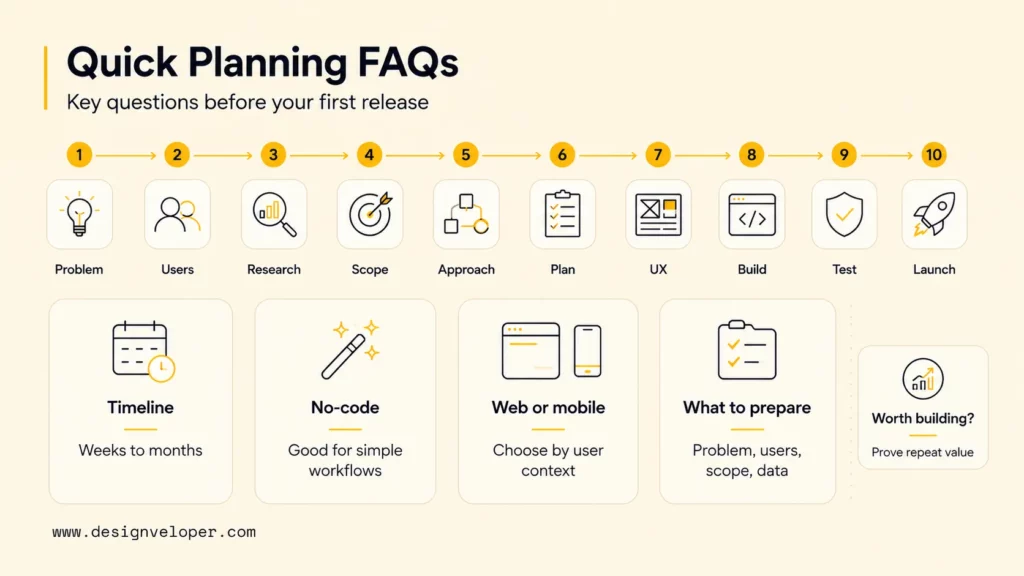
Can I Build A Business App Without Coding?
Yes, no-code and AI app builders can create forms, databases, directories, portals, internal tools, and some customer workflows without traditional programming. Validate platform limits before committing: authentication, payments, data export, integrations, performance, accessibility, environments, automated testing, pricing at scale, and ownership of generated code. Use a prototype to prove value, then decide whether the platform can safely support production.
Should I Build A Mobile App Or A Web App First?
Build a web app first when broad access, search discovery, links, desktop use, and low-friction updates matter most. Build a mobile app first when users need frequent phone access, push notifications, offline work, camera, location, Bluetooth, biometrics, or app-store distribution. A PWA may bridge part of the gap. Choose from observed user context and required capabilities rather than prestige.
What Should I Prepare Before Building A Business App?
Prepare a problem statement, target users, current workflow, primary outcome, MVP feature list, required integrations, data and privacy constraints, platform assumptions, budget range, deadline drivers, internal decision owners, and available brand or content assets. Access to API documentation, test accounts, sample data, policies, and subject-matter experts can remove major delivery delays.
How Do I Know If My Business App Idea Is Worth Building?
An app idea is worth building when a reachable user group has a repeated problem, the proposed workflow is meaningfully better, the business can distribute and support the product, and the expected value justifies total ownership cost. Validate with interviews, a landing page, concierge service, clickable prototype, or no-code pilot. Define a go/no-go threshold such as completed bookings, paid commitments, time saved, repeat use, or a conversion improvement.
The best answer to how to build an app for your business is to make each investment earn the next one. Validate the problem, prove the journey, choose the simplest viable approach, build a focused MVP, test production risks, and launch with measurement and ownership. Expand only when real user behavior shows which improvement deserves the next release.
Also published on

Share post on










Related Articles


Android App Development: Stack, Process, Cost, And Best Practices
Android App Development: Stack, Process, Cost, And Best Practices Published September 17, 2026
Flutter vs React Native: Which Fits Your Mobile App?
Flutter vs React Native: Which Fits Your Mobile App? Published September 17, 2026
SaaS Application Development: Process, Cost, And Architecture
SaaS Application Development: Process, Cost, And Architecture Published September 16, 2026