











How AI Will Affect Software Development: What Teams Should Prepare For

KEY TAKEWAYS:
- AI will change software development by shifting routine work toward assisted workflows, especially coding, testing, documentation, code review, support, and product analysis.
- Developers will still own architecture, requirements, security, tradeoffs, debugging, integration, and release accountability because AI output needs review and context.
- The biggest productivity gains come from workflow design: teams need clear prompts, repositories with good context, automated tests, review standards, and measured adoption.
- AI also increases risks around hallucinated code, insecure dependencies, data leakage, hidden costs, and over-trust, so governance and QA become more important.
- The practical future is not AI replacing every developer. It is developers using AI to ship better software faster when teams pair automation with engineering discipline.
How will AI affect software development? AI will accelerate requirements analysis, prototyping, coding, testing, documentation, debugging, and operations, but faster output will increase the value of architecture, review, security, product judgment, and measurable delivery controls. Teams should prepare for a workflow shift: developers will direct, verify, integrate, and maintain more machine-generated work rather than simply writing every artifact from scratch.
The impact will not be uniform. AI performs well on bounded tasks with clear context, feedback, and tests. It is less dependable when requirements are ambiguous, repositories are unfamiliar, architecture is weak, or correctness depends on unstated business rules. AI therefore acts less like an automatic productivity upgrade and more like an amplifier of the engineering system around it.
Quick decision guide: Start with repetitive, reversible tasks such as documentation drafts, test ideas, code explanation, and small refactors. Add repository context, review gates, automated checks, and measurement before expanding to feature implementation or autonomous agents. Keep humans accountable for requirements, architecture, security decisions, production approval, and incident response.
| AI opportunity | Best first use | Human control |
|---|---|---|
| Planning | Summarize evidence and draft acceptance criteria | Confirm user need, constraints, and tradeoffs |
| Engineering | Explain code, scaffold small changes, and suggest tests | Own design, integration, review, and correctness |
| Quality | Generate test cases and analyze failures | Define risk coverage and release evidence |
| Operations | Summarize telemetry and propose investigation paths | Authorize changes and manage incidents |
| Management | Reduce routine work while measuring outcomes | Protect quality, learning, security, and sustainable pace |
Recommended for you:
- AI Code Review: How It Works, Benefits, And Risks
- Prompt Engineering For Developers: A Practical Guide
- Vibe Coding Vs Traditional Coding: Key Differences, Risks, And Use Cases
Quick Answer: How Will AI Affect Software Development?
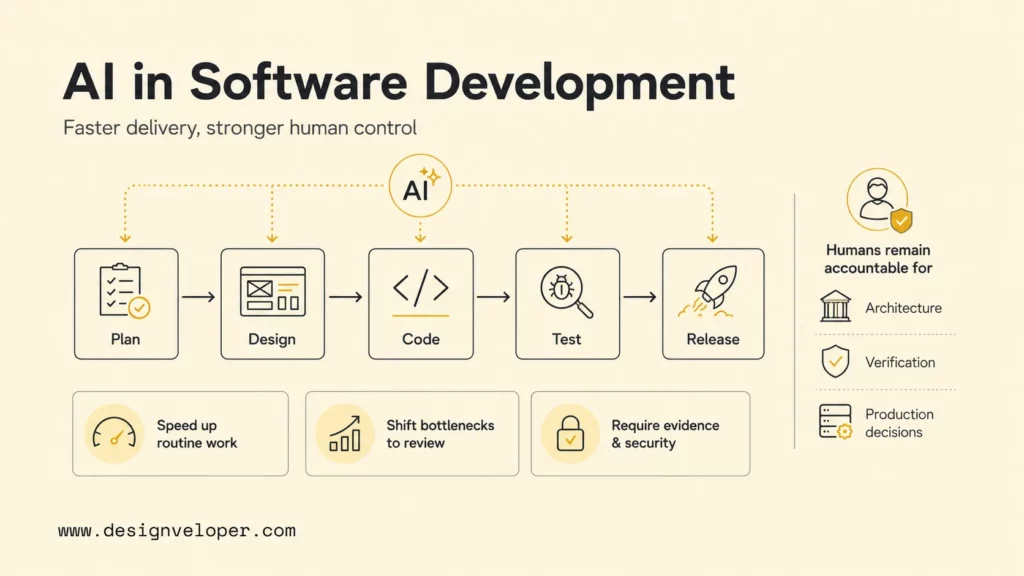
AI will speed up coding, testing, documentation, debugging, prototyping, and delivery, but it will also make human review, architecture, security, and product judgment more important. More code can be proposed in less time, which moves the bottleneck from initial creation toward context, verification, integration, and maintenance.
Evidence already shows why leaders should avoid a single productivity claim. The 2025 DORA research, based on nearly 5,000 technology professionals, characterizes AI as an amplifier that magnifies an organization’s strengths and weaknesses. In a different setting, a randomized METR study of experienced open-source developers found that early-2025 AI tools made participants slower on the selected real repository tasks. METR explicitly frames that result as a snapshot of particular tools, developers, and work, not a universal conclusion.
The apparent contradiction is useful. AI can produce an answer quickly while still increasing the total time needed to understand, correct, and integrate it. Productivity depends on task fit, codebase familiarity, context quality, model capability, developer skill, test strength, review cost, and whether the generated change survives production. A team that measures suggestions accepted or lines generated can miss rework, defects, and delayed maintenance.
- Work will become more parallel: developers can ask AI to explore options, draft tests, or investigate failures while they handle design decisions.
- Changes may become larger and more frequent: review capacity and automated verification must keep pace.
- Repository context becomes infrastructure: standards, architecture records, examples, and tests improve both human and AI decisions.
- Judgment moves upstream and downstream: teams spend more effort defining intent and proving the result.
- Learning changes: developers need to understand generated work rather than accepting output they cannot explain.
AI makes software output cheaper. It does not make responsibility, correctness, or maintenance cheaper by default.
Further reading:
- Vibe Coding Workflow: How To Build Software With AI Assistance
- Generative AI Applications: Use Cases Across Industries
- AI In Product Development: How Teams Use AI To Build Better Products
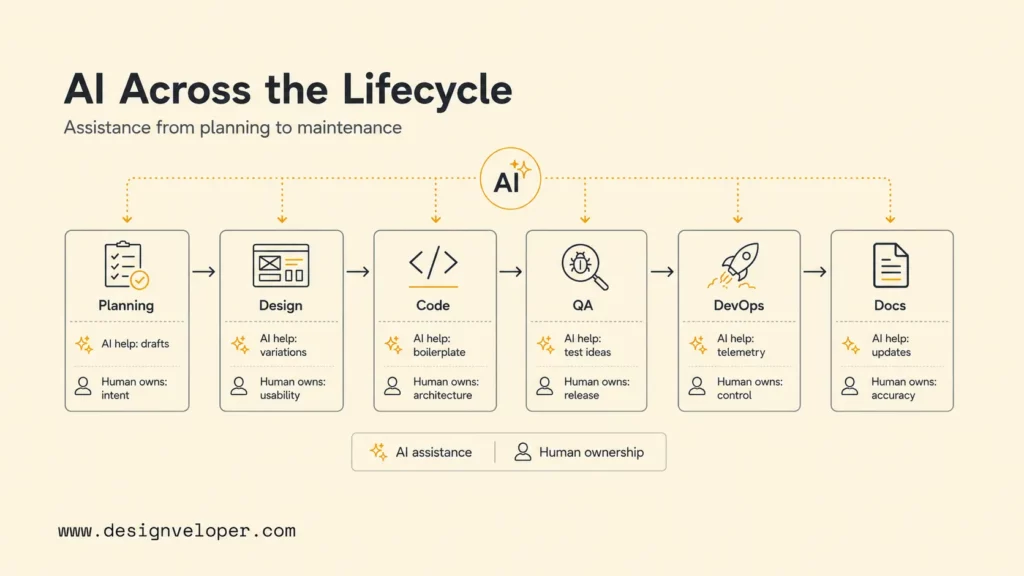
The Software Development Lifecycle Is Becoming AI-Assisted
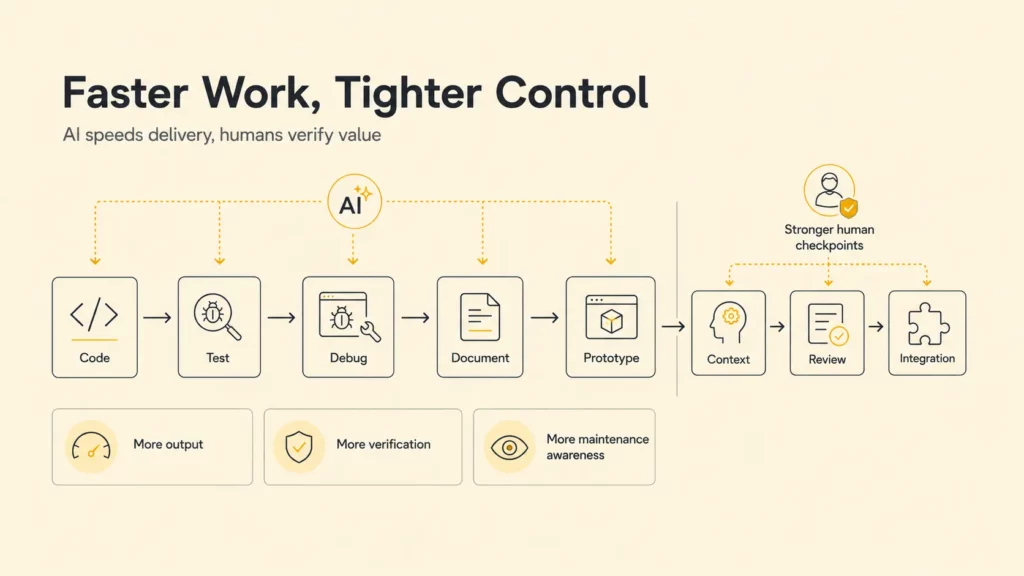
The software development lifecycle is becoming AI-assisted from discovery through maintenance. AI can transform notes into candidate requirements, turn designs into prototypes, propose code and tests, explain failures, summarize pull requests, and search operational evidence. Developers still own the decisions that connect those artifacts to user outcomes and production risk.
| Development Stage | AI Impact | What Developers Still Own |
|---|---|---|
| Requirements and planning | Summarizes research, finds conflicts, drafts stories, acceptance criteria, and plans | User problem, priorities, feasibility, business rules, and tradeoffs |
| UX/UI design and prototyping | Generates variations, interface copy, flows, assets, and prototype scaffolds | Research, accessibility, interaction logic, brand, and usability validation |
| Code generation and completion | Produces boilerplate, functions, migrations, refactors, and examples | Architecture, domain logic, dependencies, integration, and code ownership |
| Testing, QA, and debugging | Suggests cases, writes test drafts, clusters failures, and proposes causes | Risk model, test oracle, environment realism, coverage, and release decision |
| Code review and security | Explains diffs, detects patterns, and proposes fixes | Threat context, exploitability, policy, approval, and accountability |
| DevOps, deployment, and maintenance | Drafts infrastructure, summarizes telemetry, and assists incident investigation | Access, change control, rollback, resilience, cost, and incident command |
| Documentation and knowledge sharing | Creates and updates drafts from code, issues, and discussions | Accuracy, audience, durable decisions, and source-of-truth governance |
The lifecycle will become more iterative because AI lowers the cost of generating alternatives. Product teams can compare several requirement interpretations, architects can explore multiple boundaries, and developers can test more implementation paths. The benefit only appears when the team has fast feedback. Without executable tests, review standards, and user evidence, more alternatives create noise rather than learning.
AWS describes an AI-driven development lifecycle in which AI proposes plans and artifacts while humans clarify requirements and retain critical decisions. The exact method will vary across organizations, but the principle is durable: AI should expose a plan, ask for missing context, and invite verification instead of silently racing from request to production.
AI also changes how teams preserve context. Architecture decision records, domain glossaries, dependency rules, secure-coding guidance, API contracts, test fixtures, runbooks, and examples become inputs to both developers and coding agents. Treating those assets as maintained repository content improves onboarding and reduces the chance that a tool optimizes one file while violating a system-level rule.
AI-assisted delivery control loop
No change advances without evidence
01 Intent
Evidence: problem, constraints, systems, and acceptance criteria.
Stop: no accountable owner.
02 Plan
Evidence: bounded scope, repository rules, and reviewable steps.
Stop: unknown dependencies.
03 Verify
Evidence: tests, static analysis, security checks, and human review.
Stop: unexplained behavior.
04 Release
Evidence: monitoring, rollback, deployment plan, and approver.
Stop: no recovery path.
05 Learn
Evidence: outcome, quality, incidents, cost, and maintenance feedback.
Stop: no outcome signal.
Loop rule: production learning updates the next intent, the repository context, and the verification gates.
Related reading:
- AI Business Process Automation: Benefits, Use Cases, And How To Start
- Enterprise AI Agents: Architecture, Use Cases, And Implementation Tips
- AI Agent Architecture Diagram: Components, Patterns, And Examples
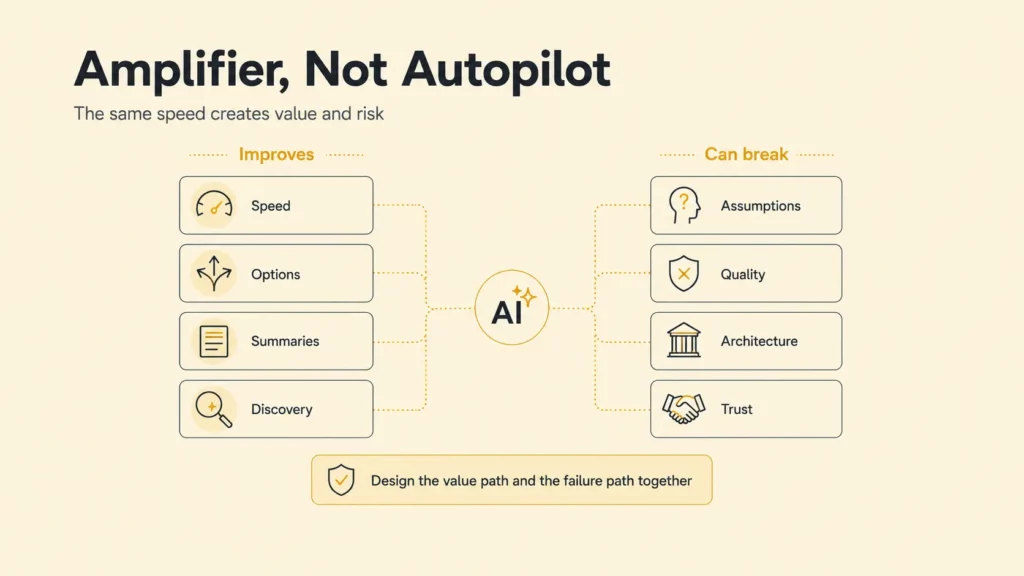
What AI Improves And What It Can Break
AI improves software work when a task is clear, context can be supplied, output can be checked, and failure is reversible. The same speed can break quality when teams accept plausible output without understanding its assumptions. AI adoption therefore needs a paired design: define the value path and the failure path together.
Explore more:
- How To Build RAG: A Practical Guide For Reliable AI Retrieval
- AI Hallucinations: Causes, Risks, And How To Reduce Them
- Software Development Costs: Key Factors, Ranges, And Planning Tips
Where AI Delivers The Most Value
AI delivers strong practical value in faster prototyping, developer assistance, automated test drafting, documentation, debugging support, and legacy software analysis. These uses turn existing evidence into a useful next step. A model can summarize an unfamiliar module, propose a small test matrix, translate a stack trace into investigation hypotheses, or draft migration scaffolding that an engineer can verify.
- Prototyping: generate disposable interface and API options to improve a product conversation.
- Repository navigation: explain call paths, data models, configuration, and likely change surfaces.
- Routine code: draft adapters, serializers, validation, migrations, and repetitive tests from existing patterns.
- Test design: suggest boundary conditions, negative cases, state transitions, and regression candidates.
- Debugging: group symptoms, interpret logs, trace hypotheses, and propose focused experiments.
- Documentation: create first drafts of change summaries, runbooks, API examples, and onboarding guides.
- Modernization: inventory dependencies, explain legacy behavior, propose characterization tests, and translate small modules.
The best early tasks have a strong oracle: tests pass, schemas validate, behavior matches a known example, or a reviewer can quickly identify an error. Teams should give AI a small objective, relevant files, constraints, examples, and the command needed to verify the result. A broad request such as “modernize this system” encourages speculative changes; a bounded request such as “add characterization tests for these three pricing rules without changing behavior” produces a reviewable artifact.
AI can also help teams challenge a first solution. Ask for risks, alternative designs, missing tests, rollback concerns, and counterexamples. The developer remains responsible for evaluating the response, but a structured adversarial pass can reveal assumptions before they become production defects.
The New Risks Behind AI-Generated Code
AI-generated code can introduce incorrect logic, insecure patterns, hidden dependencies, inconsistent architecture, privacy or intellectual-property concerns, and maintenance debt. A model may invent an API, use a stale library pattern, satisfy the visible test while violating an unstated invariant, or produce code that looks familiar enough to escape careful review.
Trust remains a live concern. In the 2025 Stack Overflow Developer Survey, 46% of respondents answering the AI trust question said they distrusted the accuracy of AI tools, compared with 33% who trusted it. The result does not prove that every tool is unreliable, but it supports a workflow where generated output is treated as untrusted until verified.
| Risk | Example | Control |
|---|---|---|
| Hallucinated logic | Invented API, parameter, or business rule | Official documentation, executable tests, and domain review |
| Security weakness | Broken authorization, unsafe parsing, or leaked secret | Threat modeling, scanners, dependency checks, and security review |
| Architecture drift | New patterns bypass established boundaries | Repository rules, architecture tests, and small pull requests |
| Hidden dependency | Unapproved package or service creates supply-chain risk | Allowlist, lockfile review, provenance, and software inventory |
| Privacy or IP exposure | Sensitive code or data sent outside an approved boundary | Tool policy, data classification, access control, and contract review |
| Review overload | More generated code than experts can examine carefully | Change-size limits, risk tiers, automated gates, and ownership |
| Skill atrophy | Developers approve work they cannot debug | Explanation, pairing, rotation, and no-merge-without-understanding rule |
Generated code should enter the same or stronger secure-development process as human-written code. The NIST Secure Software Development Framework organizes practice around preparing the organization, protecting software, producing well-secured releases, and responding to vulnerabilities. For AI-assisted work, teams should also inventory approved models and tools, define allowed data, log material use, test generated changes, review dependencies, and maintain vulnerability response.
If AI increases the rate of change, the organization must increase the quality of evidence attached to each change.
Why AI Will Change Developer Roles, Not Remove Them
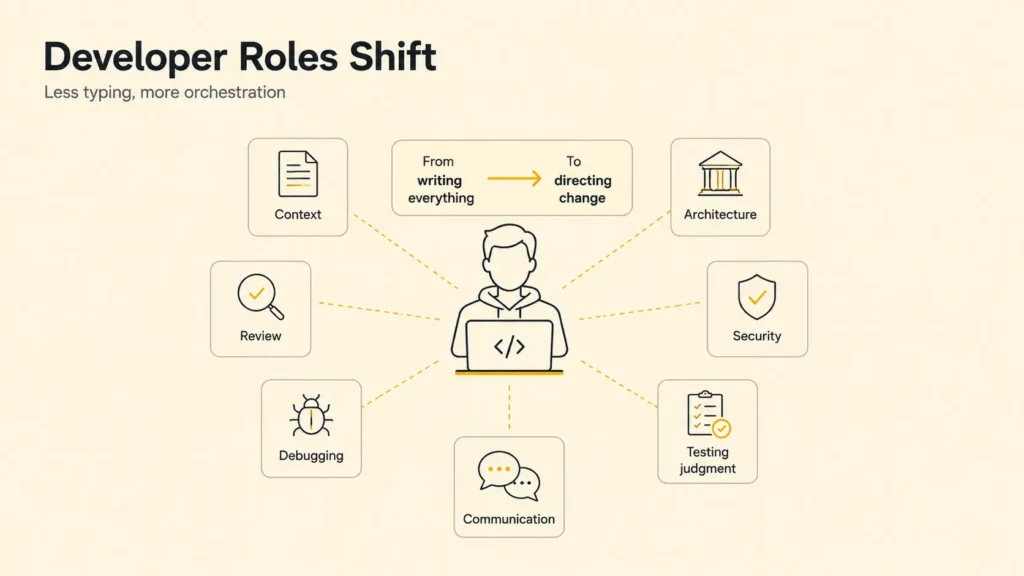
AI will change developer roles by automating portions of repetitive coding, testing, research, and documentation while increasing demand for architecture, product thinking, integration, security, debugging, system design, and business logic. The unit of work shifts from writing a function toward directing and validating a change across the system.
Developers will spend more time framing tasks so machines can act safely. Framing includes defining scope, selecting context, stating invariants, identifying affected systems, choosing verification, and deciding where approval is required. Those are engineering responsibilities, not merely prompt-writing techniques.
| Skill | Why It Becomes More Valuable | Practice |
|---|---|---|
| AI-assisted coding | Teams need to decompose tasks and supply useful context | Compare manual and assisted flows on real work |
| Code review | Output volume can outgrow review attention | Review small diffs and require an evidence summary |
| Debugging | Generated failures may be unfamiliar or indirect | Form hypotheses, reproduce, instrument, and isolate |
| Architecture | Local code generation can violate system boundaries | Maintain decision records, contracts, and architecture tests |
| Security | Tools add data, dependency, and automation risks | Threat-model AI workflows and verify every privilege |
| Testing judgment | AI can generate tests without knowing the right oracle | Define risk coverage and adversarial cases first |
| Communication | Requirements and tradeoffs must be made explicit | Write concise intent, constraints, decisions, and handoffs |
| Continuous learning | Models, tools, policies, and capabilities change rapidly | Run measured trials and share reusable lessons |
Junior development needs deliberate redesign. AI can explain concepts and provide examples, but instant solutions can remove the productive struggle that builds debugging and system intuition. Teams should pair assisted work with code reading, test design, incident analysis, and human mentorship. A developer should not merge a change that they cannot explain, test, and support.
Senior roles also change. Experienced engineers must turn tacit knowledge into explicit constraints that AI and people can follow. They will define platform guardrails, review agent permissions, decide which tasks are safe to automate, improve repository context, and evaluate whether local speed creates downstream complexity.
Management should avoid equating AI adoption with headcount reduction or story-point inflation. If a team produces more changes, it may need more product validation, security analysis, review, platform engineering, observability, and customer support. The goal is better business outcomes and a healthier engineering system, not maximum generated output.
Operationalizing AI Across Software Delivery Workflows
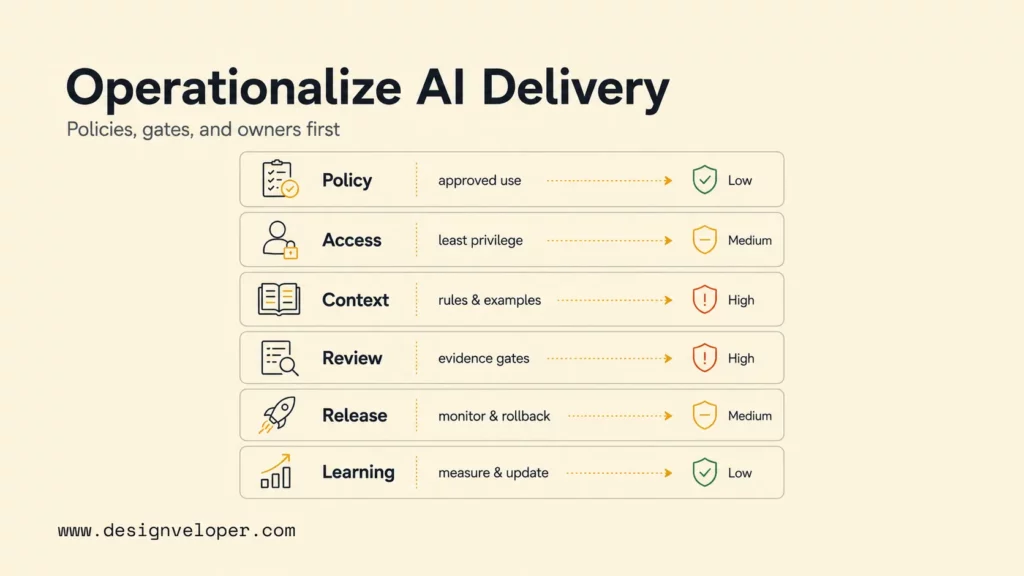
Operationalizing AI requires policies, approved tools, task-specific workflows, review gates, measurement, and accountable owners. A tool license without a delivery design creates isolated experimentation. A good operating model makes it clear what data can be used, what an agent can change, how output is verified, and who approves production impact.
Start with an inventory. Record the tool, model or service, owner, users, data classes, repository access, integrations, retention behavior, contractual terms, approved tasks, prohibited tasks, and incident contact. Reassess material changes in model, permissions, or product behavior. An assistant that only explains selected code has a different risk profile from an agent that can modify repositories, call infrastructure tools, and open pull requests.
- Usage policy: approved data, tools, accounts, repositories, and task types.
- Access model: least privilege, short-lived credentials, environment separation, and logged actions.
- Context model: curated rules, architecture, examples, and protected information boundaries.
- Review workflow: human owner, automated gates, risk tier, and required evidence.
- Release workflow: deployment approval, monitoring, rollback, and incident response.
- Learning workflow: evaluation set, user feedback, defects, cost, and policy updates.
GitHub’s own product behavior illustrates an important boundary: Copilot code review leaves comments rather than approving a pull request or requesting changes, so it does not replace required approvals. Teams can use AI as an additional reviewer, but repository owners should retain independent human approval and security gates for consequential changes.
Use a risk-tiered review model. Low-risk work might include formatting, explanation, documentation drafts, or tests around unchanged behavior. Medium-risk work includes contained feature logic, refactors, dependency updates, and data transformations. High-risk work includes authentication, authorization, cryptography, payments, safety controls, infrastructure privileges, destructive migrations, and incident automation. Higher tiers need stronger expertise, test evidence, environment controls, and approval.
| Readiness Area | Green Evidence | Red Warning |
|---|---|---|
| Purpose | Named workflow, baseline, hypothesis, and owner | Adoption driven only by tool availability |
| Policy | Allowed data, tasks, tools, and escalation are clear | Developers guess what may be shared |
| Context | Repository standards and architecture are maintained | Each user invents instructions independently |
| Verification | Risk-based tests, scans, and human review are enforced | Output is merged because it looks plausible |
| Access | Least privilege, isolation, logs, and revocation are tested | Agents hold broad persistent credentials |
| Measurement | Speed, quality, stability, cost, and outcomes are compared | Only usage or generated volume is reported |
| Learning | Failures update rules, tests, evaluation, and training | The same errors recur without system change |
Measure AI impact across a balanced scorecard. Delivery metrics can include lead time and deployment frequency. Quality metrics can include escaped defects, rework, rollback, review findings, and support incidents. Maintainability can include change failure, dependency growth, complexity, and time to understand or modify generated code. Security can include vulnerabilities, secret exposure, policy violations, and remediation time. Business measures should connect released changes to adoption, revenue, cost, or user outcomes.
Run experiments with a baseline and a comparable task set. Record total cycle time, including prompting, waiting, review, correction, and later rework. Segment results by task type, repository familiarity, experience, tool, and risk. A tool can be valuable for documentation and test scaffolding while slowing expert work on mature, complex code; aggregate averages can hide both effects.
Budget for the control plane as well as the model. AI-assisted delivery may require repository indexing, evaluation datasets, isolated execution, usage monitoring, policy administration, security review, developer education, and support for model or vendor changes. Teams should also define a fallback when an AI service is unavailable, becomes too expensive, changes behavior, or no longer meets data requirements. A workflow that cannot continue without one model is a new operational dependency. Record model and tool versions for consequential work, keep prompts and repository rules under change control when practical, and rehearse how to suspend automation without blocking essential releases.
At Designveloper, we help teams apply AI across software delivery without turning adoption into isolated tool experiments. Our AI development services connect workflow discovery, data and model integration, evaluation, security, monitoring, and product engineering. For broader modernization, we combine AI-assisted engineering with our custom software development services so the resulting architecture remains secure, maintainable, and ready for operational ownership.
FAQs About AI And Software Development
How Can Companies Start Using AI In Software Development?
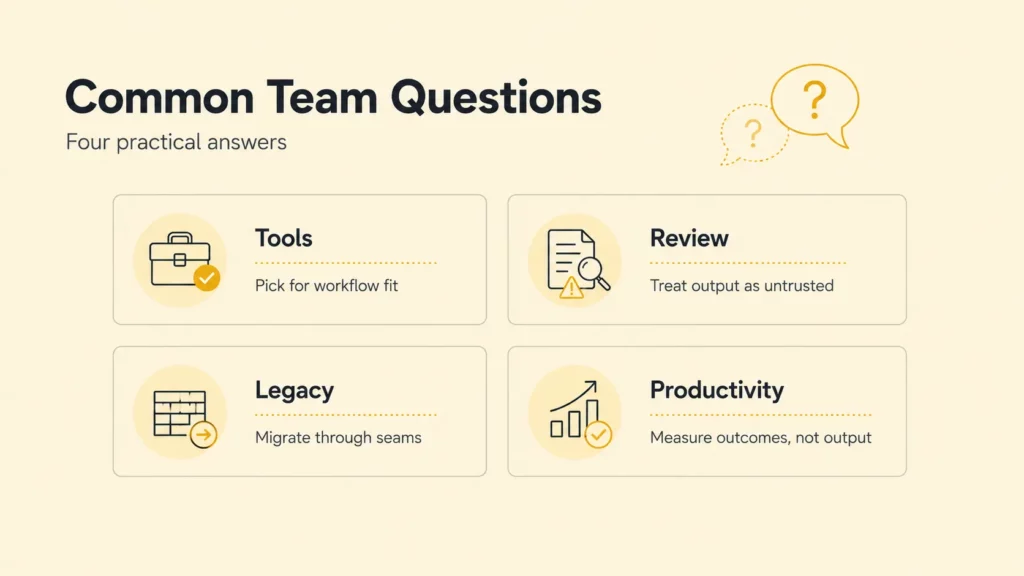
Companies should start with one bounded workflow, such as documentation drafts, code explanation, test suggestions, or small refactors. Establish an owner, baseline, approved tools, data policy, repository context, review gate, and outcome measures. Pilot with a small team, compare total cycle time and quality, document failures, and expand only when the control system works.
What Are Common AI Tools For Developers?
Common categories include IDE assistants, coding agents, command-line agents, pull-request review tools, test generators, documentation assistants, security analysis tools, observability assistants, and cloud operations copilots. Examples include GitHub Copilot, Amazon Q Developer, Cursor, Claude Code, Gemini Code Assist, and OpenAI Codex. Choose tools by workflow fit, model quality, privacy, access controls, repository support, auditability, integration, and total cost rather than popularity alone.
How Should Teams Review AI-Generated Code?
Teams should review AI-generated code as untrusted work. Require a clear intent, small diff, test evidence, dependency explanation, security checks, and an accountable human who understands the change. Inspect authorization, error handling, data exposure, concurrency, migrations, external calls, and rollback. AI review can add another signal, but it should not be the only approval for high-impact code.
Can AI Help Modernize Legacy Software?
AI can help inventory modules, explain unfamiliar code, trace dependencies, draft characterization tests, translate small components, and generate migration documentation. Modernization still needs domain experts, architecture decisions, data reconciliation, performance testing, staged rollout, and rollback. Start by capturing current behavior before asking AI to change it, then migrate through bounded seams rather than attempting a blind full rewrite.
How Do You Measure AI Productivity In Software Teams?
Measure total delivery outcomes, not generated code or prompt volume. Compare lead time, review time, rework, escaped defects, change failure, rollback, security findings, support incidents, maintainability, developer experience, and business impact against a baseline. Segment results by task and team. Include the time spent preparing context, waiting, verifying, correcting, and maintaining AI-assisted changes.
The practical answer to how will AI affect software development is that AI will make capable teams faster at selected work and expose weak processes more quickly. Organizations that pair AI with clear intent, strong architecture, secure access, rigorous review, reliable tests, and outcome-based measurement will gain more than organizations that optimize for generated output alone.
Also published on

Share post on










Related Articles


What Is LangChain and Where Does It Fit in an AI Application?
What Is LangChain and Where Does It Fit in an AI Application? Published August 25, 2026
8 LangChain Use Cases For AI Products That Need More Than Prompts
8 LangChain Use Cases For AI Products That Need More Than Prompts Published August 25, 2026
How Much Does Generative AI Cost? Understanding Generative AI Pricing
How Much Does Generative AI Cost? Understanding Generative AI Pricing Published August 25, 2026