











AI Chatbot Development: Types, Process, Costs, And Use Cases

KEY TAKEAWAYS:
- AI chatbot development starts with a narrow business job, trusted data, clear authority boundaries, and measurable success criteria before model or platform selection.
- Not every chatbot pattern uses AI: menus and fixed rules can stand alone or help route an AI assistant; voice, retrieval, generation, and tools add different capabilities.
- Production quality depends on the whole system, including knowledge pipelines, retrieval, prompts, integrations, permissions, human handoff, monitoring, and rollback controls.
- RAG and tool use need governance because stale sources, weak access control, prompt injection, unsafe actions, and poor fallback design can create business risk.
- A chatbot should be operated as a product with evaluation data, versioning, feedback loops, security review, usage analytics, and continuous improvement after launch.
A customer asks a chatbot where an order is. A convincing answer is not enough: the assistant must check the right account, read the current order status, avoid guessing when the API fails, and pass the case to support without losing context. AI chatbot development turns that kind of bounded task into a system people can trust and operate. For a product owner or engineering lead, the decisions are which parts need AI, what data and actions the bot may access, how to evaluate failed conversations, and how build effort and monthly usage affect cost. The sections below follow those decisions from chatbot patterns to production and budgeting.
Recommended for you:
- How To Build An AI Chatbot With Long-Term Memory?
- How To Train A Chatbot With Your Own Data For Better Business Support
- Best Conversational AI Platform for Enterprise Review
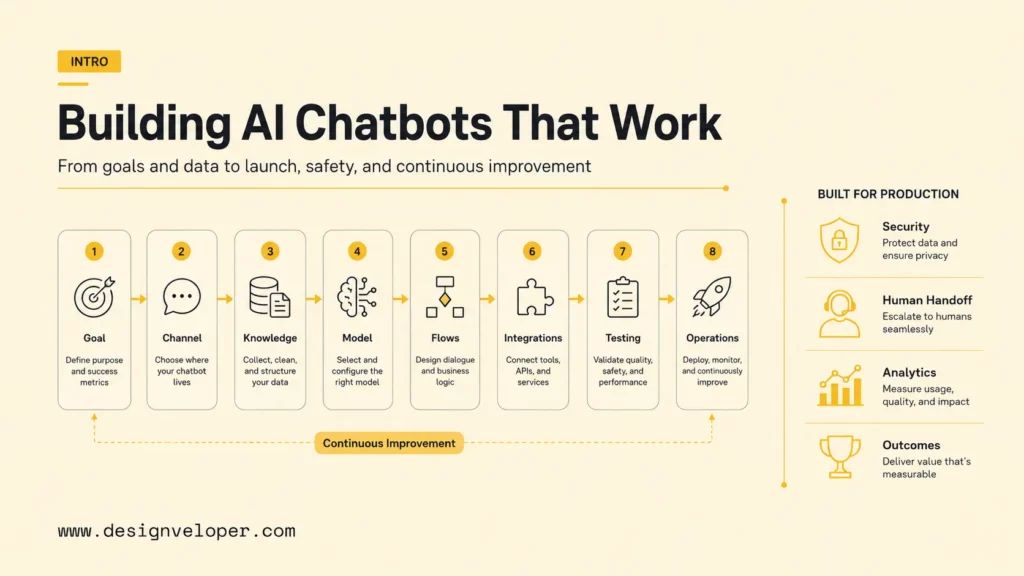
What Is An AI Chatbot?
An AI chatbot is a conversational interface that uses artificial intelligence to interpret a user’s message and decide what to say or do next. It can live in a website, mobile app, collaboration tool, messaging channel, contact center, kiosk, or voice system. Unlike a simple scripted widget, an AI chatbot can recognize linguistic variation, use context, search knowledge, generate responses, and sometimes call approved software tools.
The term covers several architectures. An intent-based bot classifies the user’s goal and fills required fields. A generative chatbot asks a large language model (LLM) to compose a response. A RAG chatbot first retrieves relevant passages from an approved knowledge source and supplies them as context. An agentic system can choose tools and execute multi-step work, such as looking up an order, checking a policy, and opening a support ticket.
A chatbot is not only a model. The complete system includes the channel interface, identity, conversation state, prompts or flows, knowledge sources, retrieval, integrations, safety controls, observability, analytics, and human operations. Our guide to what a chatbot is and how it works explains this product view in more detail.
The most important distinction is between conversation and authority. A chatbot may be allowed to explain a refund policy but not approve a refund. It may draft a CRM note but require a person to confirm the update. Defining those boundaries early prevents a helpful interface from becoming an uncontrolled route into business systems.
Further reading:
- Conversational AI Vs. Chatbot: Key Differences And Use Cases
- AI Model: A Detailed Guide to Understanding & Building
- 10 Best Practices For Prompt Engineering With Any AI Model
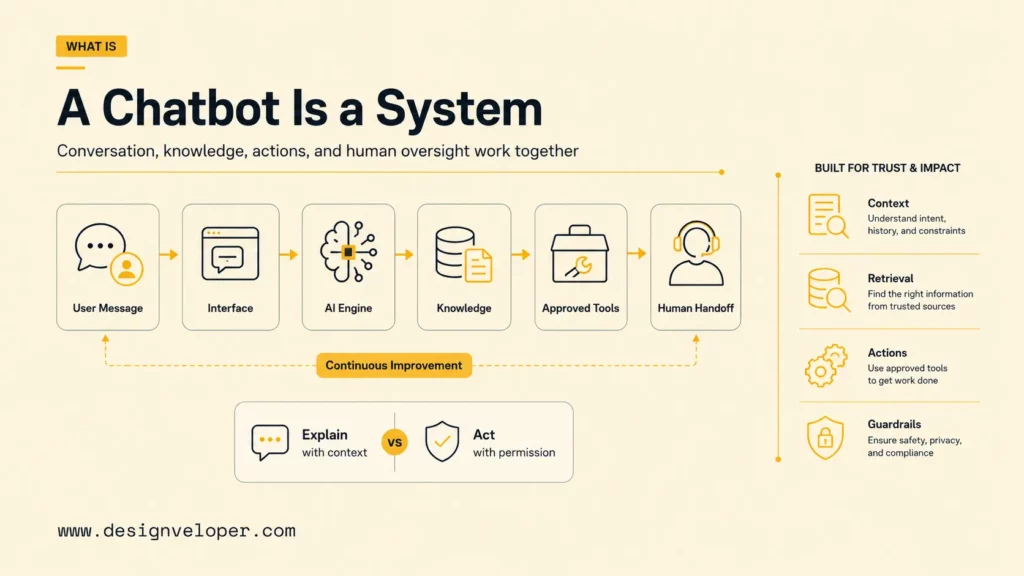
Chatbot Patterns Used In AI Products
Not every chatbot pattern below uses AI. Menu and rule-based bots follow predefined choices or logic; they are useful baselines and can also be combined with an AI assistant. Intent models, language generation, retrieval, voice interfaces, and workflow tools describe capabilities or channels, not mutually exclusive product types. The boundary between an assistant and an AI agent versus a chatbot matters when the system can act on external systems instead of only answering. Choose the smallest mix that handles the task and its risks.
Menu Or Button-Based Chatbots
Menu or button-based chatbots present predefined options such as Track an order, Change a booking, or Speak to support. A menu-only flow is not an AI chatbot: it is a predictable interface suited to a small set of journeys. In an AI product, buttons can still collect consent, route a request, or confirm a consequential action without relying on language understanding.
Their weakness is rigidity. A customer may not see the right option, and long menu trees become frustrating. Keep choices short, show an escape route, preserve context when the user goes back, and offer free-text or human support when the menu cannot cover the request.
Rule-Based Chatbots
Rule-based chatbots follow conditions, decision trees, patterns, or workflow states. Fixed rules alone are not AI. A rule can ask for an order number, validate its format, call an order API, and choose the next message based on status. This works for eligibility, onboarding, troubleshooting, and approved scripts; an AI layer can interpret varied wording while the final business decision remains deterministic.
Rules are transparent, but their maintenance cost rises as exceptions multiply. Document ownership for every flow, version rules, test edge cases, and remove obsolete branches. A hybrid design can keep high-risk decisions deterministic while using AI to interpret the user’s wording.
AI-Powered Chatbots
AI-powered chatbots commonly use natural-language processing to identify intent, extract entities, rank responses, or predict the next action. A user can write “my parcel still isn’t here” instead of selecting Delivery problem. The system maps the sentence to an intent and gathers details such as order number, location, or date.
The development challenge is representative data. Intent labels must be distinct, example utterances must cover real language, and ambiguous messages need clarification. Measure confusion between intents, not only overall accuracy, because a high aggregate score can hide serious failures in a small but important category.
Voice Chatbots
Voice is a channel, not a separate reasoning architecture: a voice chatbot adds speech recognition and speech synthesis to an intent-based, rule-based, or generative assistant. It can support contact centers, appointment lines, field work, accessibility, and hands-free tasks. The flow must account for background noise, accents, names, numbers, interruptions, silence, and the cost of waiting during a spoken interaction.
Voice quality depends on the whole latency budget: audio capture, transcription, reasoning, retrieval, tool calls, response generation, and synthesis. Confirm critical values aloud, avoid long monologues, let people interrupt, and provide a clear transfer route when recognition or task completion fails.
Generative AI And LLM Chatbots
Generative AI chatbots use LLMs to create natural responses rather than selecting only from fixed text. They are useful for explanation, summarization, drafting, translation, and conversations that cannot be enumerated as a decision tree. They can also follow a tone, structure output, or call functions supplied by an application.
Generation introduces variability. The same prompt can produce different wording, and fluent output can still be unsupported. For consistent behavior, record the exact model and prompt versions used in each test, then rerun the same evaluation set before changing either one. Keep results with the release so the team can see whether quality or safety changed. For a broader business framing, compare the chatbot workflow with AI chatbots for businesses before expanding the feature list.
Our overview of generative AI and its business impact is useful when stakeholders need to separate the model’s content-generation ability from the application controls around it.
RAG Chatbots And Workflow-Connected AI Agents
RAG chatbots search an approved knowledge collection before generating an answer. Microsoft describes RAG as a way to make application data available to an LLM without first training the model on that data. The system creates searchable representations, retrieves relevant context for a question, and provides that context to the model. See Microsoft’s RAG architecture explanation for the underlying pattern.
RAG helps with private or frequently changing information, but retrieval quality is its own engineering problem. Documents must be parsed, segmented, labeled, updated, permissioned, and evaluated. The chatbot should show sources when useful and decline to answer when it cannot retrieve sufficient evidence. Our RAG chatbot production guide covers the journey from local prototype to deployed system.
Workflow-connected AI agents go beyond answers. They can call tools to look up records, create tickets, schedule appointments, update a CRM, or trigger an internal process. Each tool needs a narrow contract, least-privilege credentials, input validation, authorization, timeouts, logs, and confirmation for consequential actions. Teams building with a framework can use a LangChain chatbot implementation as a concrete way to separate conversation logic from tool contracts. The model may propose an action; the surrounding application must decide whether it is allowed.
Related reading:
- How To Build A RAG System: Step-By-Step (New Guide)
- What Is A Vector Database? A Practical Guide For AI Search And RAG
- Build A RAG Agent With LangChain: Step-By-Step Tutorial
AI Chatbot Use Cases For Business Workflows
Good AI chatbot use cases combine meaningful demand, accessible data, a tolerable error profile, and a measurable outcome. Customer support is common because teams can start with repetitive questions, knowledge retrieval, ticket triage, and order lookup. Lead qualification can collect needs and schedule a meeting. Ecommerce assistants can guide product discovery, explain policies, and help with orders. Internal assistants can search company knowledge, answer HR questions, summarize documents, and start approved workflows.
| Use case | Useful success measures | Essential control |
|---|---|---|
| Customer support | Containment, resolution, customer satisfaction, reopen rate | Human handoff with transcript and context |
| Lead qualification | Qualified-lead rate, booking completion, sales acceptance | Consent, validation, CRM deduplication |
| Ecommerce guidance | Product discovery, assisted conversion, return rate | Accurate catalog, price, inventory, and policy data |
| Internal knowledge assistant | Answer success, search time, citation use | Document-level access control and freshness |
| HR self-service | Case deflection, completion, employee satisfaction | Privacy, role boundaries, and escalation |
| Document Q&A | Grounded-answer rate, citation accuracy, abstention quality | Source provenance and permission-aware retrieval |
| Booking and workflow automation | Completion, error, cancellation, recovery rate | Confirmation, idempotency, audit log |
The strongest first use case is narrow enough to evaluate and valuable enough to change a real workflow. Use the table to define the outcome and control before choosing a model, then describe the user journey in enough detail to expose failure points.
Customer Support And Service Chatbots
A support chatbot can begin with delivery, returns, account, or troubleshooting questions from approved help content. After authentication, it may look up an order or create a ticket, but exceptions should reach a person with the transcript, user identity, retrieved sources, and completed steps attached. A customer service chatbot should therefore optimize resolution quality and recovery, not only containment.
Internal Knowledge And HR Chatbots
An internal assistant should answer from the latest approved HR, engineering, or operations material while preserving document-level permissions. A useful project can retrieve a policy, cite the source, explain a process, and abstain when documents conflict. HR self-service needs extra care around personal data, role boundaries, employee visibility, and escalation to a human case owner.
Ecommerce, Sales, And Booking Chatbots
Ecommerce and sales assistants can narrow product choices, collect lead requirements, explain trade-offs, or schedule a meeting. Booking assistants should collect only the required details, check availability through a narrow tool, confirm the selected slot, and expose a clear cancellation path. Catalog, inventory, CRM, and calendar data must be current enough for the promised task; the chatbot should not invent availability or make an irreversible change without confirmation.
Must-Have AI Chatbot Features
Must-have features should support the whole conversation lifecycle, not only the first generated reply. The right feature set depends on the use case, but most production assistants need:
- Conversation understanding and state: recognize intent, collect missing values, preserve context, and ask focused clarification questions.
- Grounded knowledge: use an owned knowledge base or RAG layer with citations, freshness rules, source provenance, and permission-aware retrieval.
- Safe actions: expose narrow tools with authorization, input validation, timeouts, idempotency, audit logs, and confirmation for consequential changes.
- Failure recovery: detect uncertainty, avoid repetitive loops, explain limitations, and transfer to a person with useful context.
- Security and privacy: minimize personal data, enforce identity and access controls, protect secrets, filter outputs, and monitor misuse.
- Evaluation and operations: capture traces, retrieval results, latency, cost, feedback, safety events, and business outcomes so the team can improve the system.
Prioritize recovery paths early. A chatbot that recognizes uncertainty, asks a useful question, preserves context, and transfers gracefully is more valuable than one that attempts every request. Google documents human handoff as a deliberate transfer from a virtual agent to a person. Its Dialogflow handoff guidance shows that the application still needs procedures for what happens after the handoff signal.
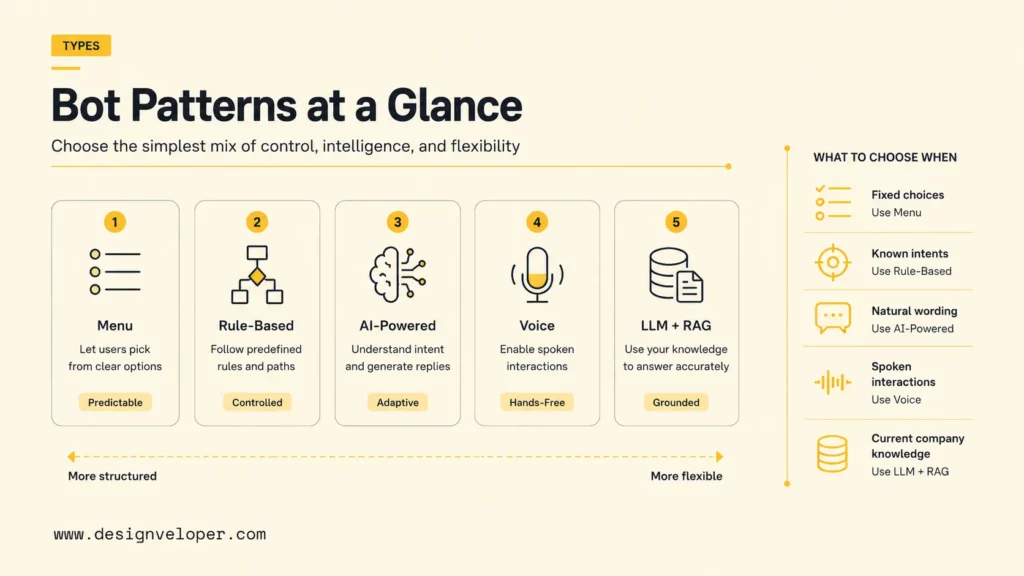
Key Technologies Behind AI Chatbot Development
AI chatbot development combines conversation design with several technical layers. Natural-language processing handles intent recognition, entity extraction, classification, and language normalization. LLMs support flexible generation and reasoning. RAG and vector or hybrid search retrieve relevant knowledge. Document pipelines ingest, clean, split, label, embed, index, update, and delete source material.
- NLP and intent recognition: route predictable requests, extract required values, and identify when the bot needs clarification.
- LLMs and generative AI: produce explanations, summaries, drafts, and structured outputs under application constraints.
- RAG and search: ground responses in selected company sources and return evidence relevant to the current question.
- Knowledge pipelines: preserve ownership, metadata, freshness, permissions, version, and deletion across indexed content.
- APIs and integrations: read or update CRM, helpdesk, ecommerce, booking, HR, payment, and operational systems.
- Analytics and monitoring: capture traces, retrieval results, model use, latency, cost, errors, user feedback, and business outcomes.
Identity and authorization sit across every layer. A user’s access must be checked before retrieval and before any tool call. Microsoft warns that multitenant RAG systems must ensure tenants and individual users can only incorporate grounding data they are authorized to access; the secure multitenant RAG architecture explains this boundary.
The architecture should also support provider change. Keep business rules, evaluation data, prompts, retrieval, and integration contracts outside a single opaque interface where practical. Models and prices change; the organization should be able to test an alternative without redesigning the entire product.
For practical examples, check out:
- Prompt Engineering For Developers: A Guide To Practical Patterns
- RAG Best Practices Start Before Your Model Generates An Answer
- AI Voice Agent For Customer Service: Use Cases, Workflow, And Risks
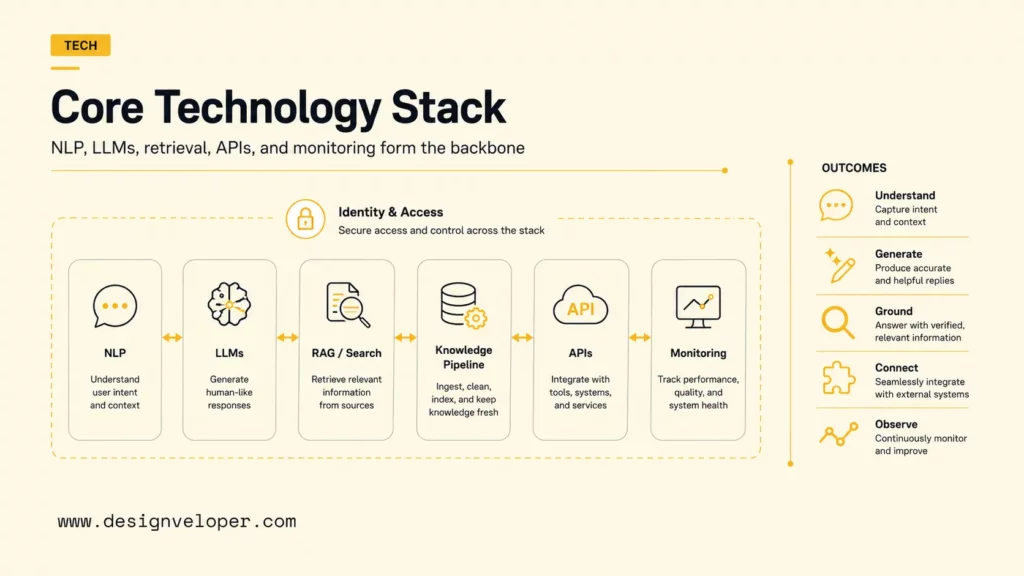
AI Chatbot Development Process
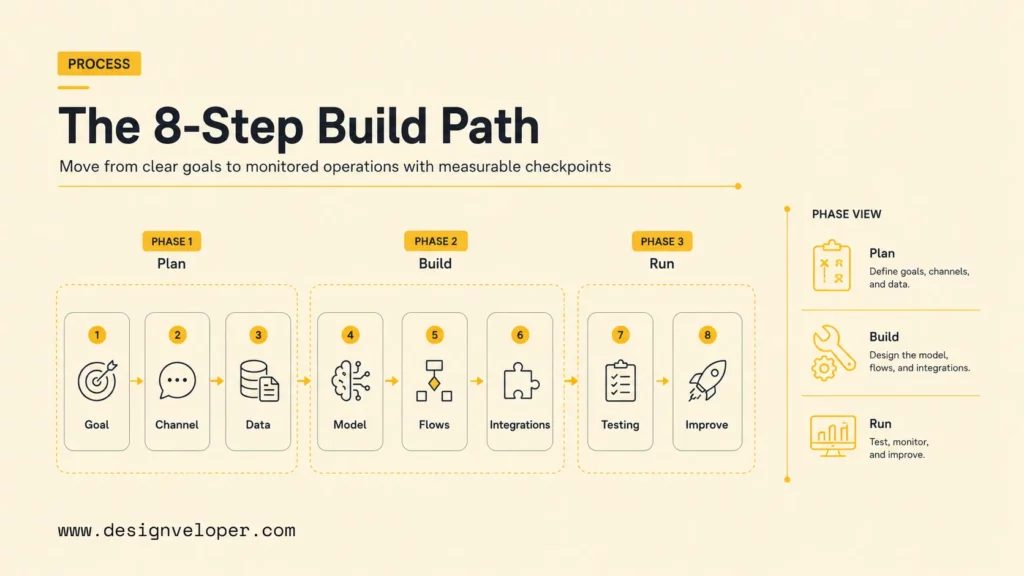
A reliable AI chatbot development process moves from goals to channels, knowledge, architecture, conversation design, integrations, evaluation, and operations. Each step should produce a reviewable artifact and a measurable acceptance criterion. This reduces the risk of an impressive demonstration that cannot survive production.
Step 1. Define The Chatbot Goal And Success Metrics
Every stage produces evidence for the next: a metric, data con…97 tokens truncated…e goal. “Help signed-in customers understand delivery status and solve common delivery problems, while transferring exceptions to support” is specific enough to design and evaluate.
Select outcome metrics and guardrails. Outcome metrics may include task completion, resolution, qualified leads, bookings, search time, or support effort. Guardrails may include grounded-answer rate, unauthorized disclosure, escalation quality, latency, abandonment, cost per conversation, and customer satisfaction. Define baseline, target, owner, and review cadence before development.
Step 2. Choose The Deployment Channel
Choose the channel where the target user already works and where the job can be completed. A website is appropriate for visitors and customers. A mobile app can use signed-in context. Slack or Microsoft Teams can serve internal users.
WhatsApp or other messaging channels may suit service notifications. Voice is appropriate when hands-free access or phone support matters.
Channel choice affects identity, message length, buttons, file support, session duration, notifications, approval, analytics, and handoff. Do not copy the same interface everywhere. Start with one primary channel. Validate the operating model before adding channels.
Step 3. Prepare The Knowledge Base And Data Sources
Inventory every source the chatbot may use: help-center articles, product data, policies, manuals, contracts, tickets, CRM fields, database records, or internal documents. For each source, record its owner, authority, update frequency, sensitivity, access rule, retention requirement, and deletion path. Duplicate or contradictory sources must be resolved before indexing.
Prepare documents for retrieval by cleaning boilerplate, preserving headings, splitting content into meaningful units, attaching metadata, and testing representative queries. Freshness is an operational requirement, not a one-time migration task. Build change detection and reindexing so the chatbot does not keep answering from retired policies.
Step 4. Choose The Model, Platform, Or Development Approach
Evaluate three routes: configure an off-the-shelf chatbot platform, build on a model or cloud platform, or create a custom application. A platform can launch faster for standard support flows. A custom AI chatbot development approach provides more control over identity, retrieval, workflows, user experience, and observability, but requires engineering and long-term ownership.
Test candidate models on your tasks rather than generic leaderboards. Compare answer quality, instruction following, tool use, language coverage, latency, context limits, data-handling terms, regional availability, price, and operational controls. Our review of AI chatbot platforms can help teams form an initial shortlist, but a representative evaluation set should decide the result.
Step 5. Design Conversation Flows, Prompts, And Fallbacks
Map the happy path, missing information, ambiguity, unsupported requests, user corrections, system errors, and escalation. Write prompts that define role, scope, source use, response format, uncertainty, tool rules, and prohibited behavior. Keep business rules in code or configuration when they must be deterministic. Add chatbot automation tools only after the fallback and approval paths are explicit.
A useful fallback does more than apologize. It can ask one focused question, offer valid choices, explain a limitation, show relevant help, or transfer with context. Set loop limits so the chatbot does not repeat the same failed response. Conversation designers, domain owners, support staff, and engineers should review high-volume and high-risk flows together.
Step 6. Integrate Business Systems And Human Handoff
Define each integration as a narrow capability: look up order, create ticket, search customer, book slot, or update preference. Use server-side credentials, validate inputs, check the user’s authorization, apply rate limits, make repeated requests safe, log outcomes, and handle timeouts. Require explicit confirmation before actions that spend money, change records, cancel services, or affect another person.
Human handoff needs routing rules, queue ownership, availability, service level, transcript transfer, customer identity, and a recovery path if no agent is available. A person should see what the chatbot understood, which sources it used, and which steps already occurred. Our AI chatbot integration guide explains how integrations and handoff fit the implementation lifecycle.
Step 7. Test Accuracy, Safety, Latency, And User Experience
Build evaluation sets from real, de-identified questions and expert-designed edge cases. Cover common requests, rare but costly cases, ambiguous language, spelling errors, and multilingual input. Also test unsupported topics, outdated sources, conflicting documents, prompt injection, data-extraction attempts, unsafe requests, integration failures, and adversarial tool instructions.
Score components separately: intent classification, retrieval relevance, source correctness, groundedness, task completion, tool-call validity, safety, latency, and user experience. OpenAI’s evaluation guidance supports repeatable criteria and datasets; the broader lesson is to run regression evaluations whenever prompts, models, retrieval, data, or tools change.
Test with people as well as automated graders. Domain experts find factual and policy errors. Security teams examine misuse. Support staff see escalation problems. Accessibility testing reveals interaction barriers. Load and failure testing expose behavior that a small demo cannot show.
Step 8. Deploy, Monitor, And Improve Continuously
Release gradually with an internal pilot, limited audience, or small traffic percentage. Version prompts, retrieval settings, models, tools, and knowledge indexes. Keep rollback controls. Google recommends versioning, error handling, retries, load testing, and audit logs for production conversational agents in its Dialogflow service best practices.
Monitor user outcomes and system behavior: conversation volume, completion, fallback, escalation, unresolved intents, source use, retrieval gaps, model errors, tool failures, latency, token or inference cost, safety events, and feedback. Review failed conversations with privacy controls, convert patterns into test cases, fix the responsible layer, and prove the change through regression evaluation.
End-to-end test case: a signed-in customer asks where an order is. The chatbot verifies identity, retrieves only that customer’s order, and answers from the latest status record. If the order API times out, it does not invent a delivery date. It offers a retry or creates a support ticket with the order ID, failure reason, and conversation context. The support owner confirms the ticket is accepted; a failed ticket creation must show another contact route. During the pilot, test correct status, wrong-account requests, timeouts, and successful handoffs. Measure resolved cases, reopened cases, and cost per resolved case, not just messages sent.
Explore more:
- A Practical Guide To AI Agent Architecture With Diagrams
- How To Build And Use AI Business Process Automation Effectively
- What Is AI Automation? How It Works, Benefits, Tools, and Use Cases
AI Chatbot Development Cost And Timeline
AI chatbot development cost has two budgets: the work needed to release a safe use case and the monthly expense of operating it. A public FAQ bot and a signed-in order assistant have different data, integration, and support needs. The order-support example above provides a scope for a usable estimate; the worksheet below is a planning method, not a Designveloper quote or a universal market price.
- Scope: number of use cases, languages, channels, user roles, and expected conversation volume.
- Knowledge: document cleanup, retrieval, citations, freshness, permissions, and source ownership.
- Integration: APIs, authentication, authorization, workflow rules, confirmations, reconciliation, and audit logs.
- Operations: model and cloud usage, monitoring, evaluation, incident response, human support, and maintenance.
For a signed-in order-support chatbot, define one channel, one authenticated order lookup, approved help content, an API-timeout response, and a support ticket handoff as the first release. Exclude refunds, payments, multilingual channels, and autonomous account updates unless they are essential. The scope boundary determines whether the estimate includes additional approvals, tools, data cleanup, and test cases.
| Estimate input | Unit and calculation | Source and owner |
|---|---|---|
| Build: discovery, conversation UX, help-content cleanup, order API, identity, evaluation, handoff, security and launch testing | Person-days for each role × contracted day rate; add one-time platform and integration fees | Product and engineering leads approve scope and effort; procurement verifies rates and fees |
| Expected usage in base and peak months | Conversations/month × average turns; retrieval and tool calls/conversation; peak concurrency | Support baseline and pilot telemetry; operations lead owns forecasts |
| Platform, model and knowledge | Current vendor price per model unit, retrieval call, stored GB or indexed document; multiply by measured usage | Vendor quote/calculator and technical owner; record region and rate validity |
| Channel and human support | Channel messages/month + handoffs/month × review minutes × support labor rate | Channel vendor and support lead; include after-hours coverage if promised |
| Recurring ownership | Monthly monitoring, security, hosting, evaluation, maintenance, support and incident allowance | Cloud quote and named operational owners |
Calculate separately: build estimate = sum of role-specific person-days × their agreed rates + one-time vendor and assessment fees + a contingency justified by unknowns. Monthly operating estimate = model/platform, retrieval, storage, channel, cloud, monitoring, human review, and maintenance costs for the same base or peak usage scenario. Divide that monthly total by successfully resolved cases, not raw conversations; record what counts as resolution and whether a reopened ticket still qualifies. Leave currency totals blank until current vendor rates, staff costs, volume, and acceptance criteria are verified. The broader AI app development cost guide can reveal missing cost categories.
Schedule by dependency: estimate discovery, source cleanup, conversation design, model/platform setup, order API access, evaluation, security review, support training, and a controlled pilot as separate work packages. Some work can overlap, but integration testing depends on test accounts and a usable API. Confirm the release date after testing the riskiest data source or integration, and reserve time for approval and pilot feedback. Do not interpret a generic month band as a project commitment.
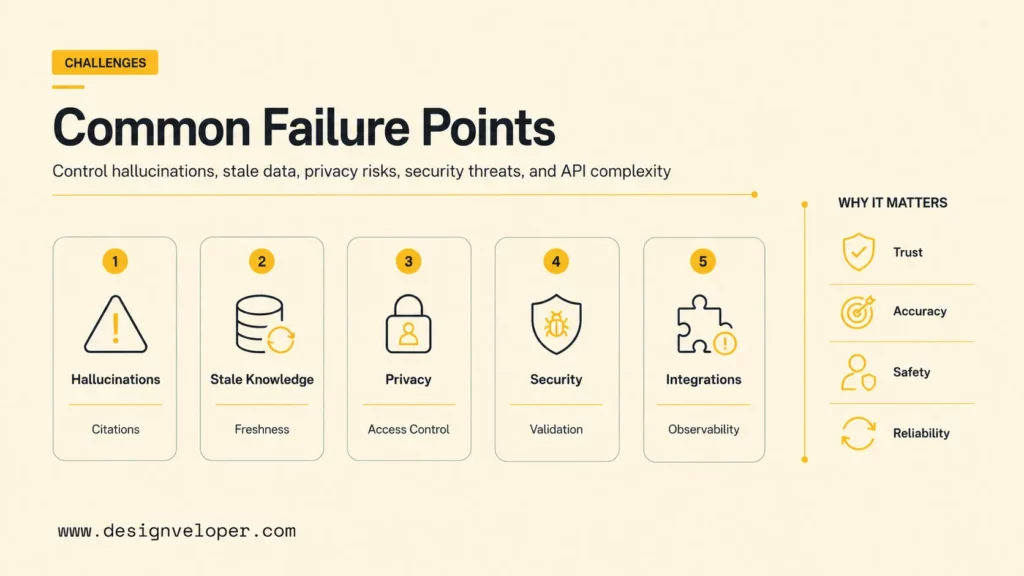
Common Challenges In AI Chatbot Development
The first challenge is hallucination: a model can produce a confident response that is not supported by the available evidence. Ground important answers in controlled sources, require citations where appropriate, set abstention rules, and evaluate unsupported claims. The guide to AI hallucinations is a useful companion for designing those tests. RAG reduces some knowledge problems but does not guarantee correctness when retrieval is poor or source material conflicts.
Outdated knowledge is a pipeline failure. Assign source owners, freshness targets, update triggers, expiry rules, and deletion workflows. Weak fallback design creates another failure mode: the chatbot repeats itself, hides uncertainty, or blocks access to a person. Treat clarification and escalation as primary product journeys.
Privacy and access control must apply before data reaches the model or retrieval context. Minimize personal data, document purpose and retention, and separate users, teams, or tenants. The UK’s Information Commissioner’s Office says its AI and data protection guidance addresses fair, lawful, transparent processing and organizational and technical risk controls. Legal requirements depend on jurisdiction, so involve qualified privacy and legal owners.
Security challenges include prompt injection, sensitive-information disclosure, data or model poisoning, improper output handling, excessive agency, and unbounded resource use. The OWASP Top 10 for LLM Applications 2025 provides a practical threat catalog. Use layered controls: isolate instructions from untrusted content, restrict tools, validate outputs, apply least privilege, limit requests, monitor anomalies, and red-team the complete application.
Integration complexity and quality measurement often arrive late. APIs fail, schemas change, records duplicate, and downstream systems enforce rules the chatbot does not understand. Define contracts, safe retries, reconciliation, ownership, and observable errors. Then connect technical measures to user and business outcomes so improvement does not optimize a model score while harming the service.
What Production-Ready AI Chatbots Need Beyond A Prototype
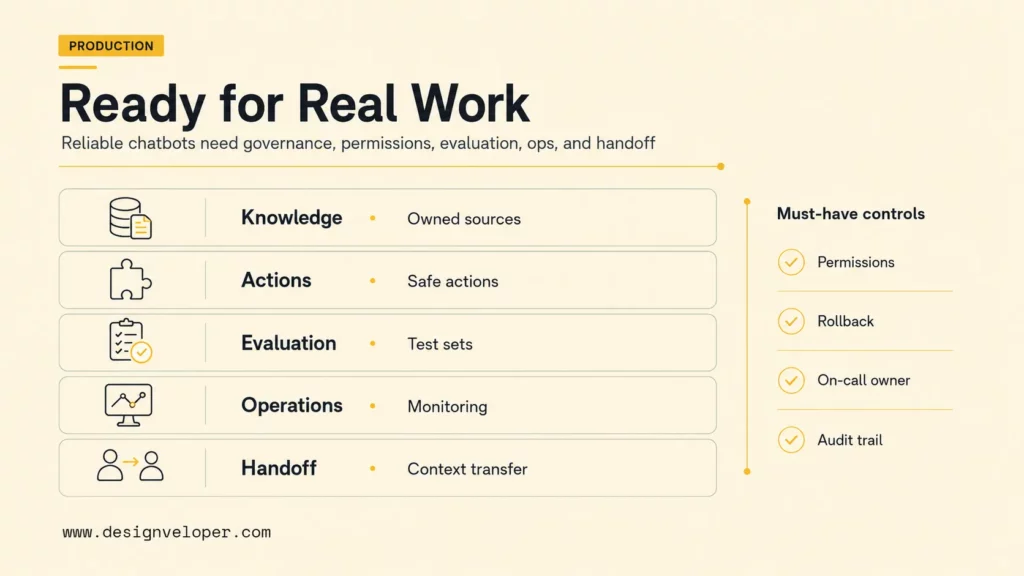
A production-ready chatbot needs reliability around the model. That includes permission-aware retrieval, identity, tool authorization, monitoring, feedback loops, escalation paths, versioning, incident response, and integrations with CRM, helpdesk, ecommerce, HR, booking, or internal systems. It also needs named people responsible for content, product outcomes, operations, security, and support.
NIST’s AI Risk Management Framework organizes AI risk work around governing, mapping, measuring, and managing risk. Its Generative AI Profile extends that approach for generative systems. A practical project can turn those ideas into an operating checklist. Document context and impact, test expected and harmful behavior, assign control owners, record residual risk, and review changes throughout the lifecycle.
Production-readiness scorecard
| Gate | Evidence | Stop signal |
|---|---|---|
| Knowledge | Owned sources, freshness, permissions, citations, deletion | Answers use unowned or stale content |
| Actions | Authorization, validation, confirmation, idempotency, audit | The model can exceed the user’s authority |
| Evaluation | Representative test set, thresholds, regression history | Launch depends on anecdotal demos |
| Operations | Monitoring, on-call owner, rollback, incident and recovery runbooks | Failures are visible only through user complaints |
| Handoff | Routing, context transfer, queue owner, availability, SLA | The chatbot can trap a user in a failed loop |
Architecture decisions should reflect consequences. A public FAQ assistant can use broad content with conservative action scope. An employee assistant needs identity and document permissions. A financial, health, employment, or legal workflow may require stronger review, evidence, human decision-making, and jurisdiction-specific compliance. The safest feature is sometimes a deliberate refusal or transfer.
Designveloper team is a fit when the chatbot is part of a real business workflow rather than an isolated website widget. Our AI development services can connect product discovery, UX, knowledge architecture, RAG, CRM or helpdesk actions, ecommerce support, HR self-service, role-based access, cloud deployment, evaluation, and post-launch monitoring. Our software development services support the broader application and integration work that production AI depends on.
FAQs About AI Chatbot Development
How Long Does AI Chatbot Development Take?
No single timeline fits every AI chatbot. Estimate discovery, data cleanup, conversation design, platform setup, integration, evaluation, security review, support handoff, and pilot feedback against actual team capacity. Vendor access and stakeholder approval affect calendar time even when they add little coding effort. Confirm the schedule after the hardest data source or API has been tested.
How Much Does It Cost To Develop An AI Chatbot?
There is no reliable price without scope, rates, volume, and vendor terms. For the signed-in order-support example, use the worksheet above to add build effort and one-time fees, then model base and peak monthly usage plus human handoff and maintenance. Divide the monthly total by successfully resolved cases. Quote other channels or actions separately and state the exclusions.
What Data Is Needed To Build An AI Chatbot?
Intent-based chatbots need representative user utterances and clear labels. RAG chatbots need authoritative documents or records with ownership, structure, permissions, and freshness. Workflow assistants need API schemas, test accounts, business rules, and safe sample cases. Every project needs an evaluation set containing common, ambiguous, unsupported, sensitive, and adversarial requests. Remove unnecessary personal data and preserve a lawful basis and retention policy where personal data is used.
Can I Build An AI Chatbot For Free?
You can build a small prototype with free tiers, open-source components, or local models, but production is not free. Hosting, model inference, search, storage, channels, monitoring, security, integration maintenance, evaluation, and human support all create costs. A free prototype is useful for proving a conversation and testing data readiness; it should not be treated as proof that the production operating model is affordable or safe.
Which Channel Should An AI Chatbot Run On?
Start where the target user already performs the task. Use a website for public discovery and customer help, a signed-in app for account-specific work, or workplace chat for internal knowledge. Messaging may suit ongoing service, while voice fits phone or hands-free journeys.
Evaluate identity, privacy, interface capability, user expectation, handoff, and channel fees. Prove one channel first, then reuse the underlying conversation and integration services with channel-specific design.
AI chatbot development starts with a narrow job, trusted data, explicit authority, and measurable outcomes. Choose the simplest architecture that meets the need, design human recovery before launch, evaluate meaningful changes, and operate the assistant as a product. When the use case needs custom workflows, secure integrations, RAG, or sustained improvement, our web application development team can help turn the pilot into a maintainable product.
Also published on

Share post on










Related Articles


13 Best Vibe Coding Tools for Building Apps and Editing Codebases
13 Best Vibe Coding Tools for Building Apps and Editing Codebases Published September 30, 2026
Can ChatGPT Create an App? What It Can Build and What to Check
Can ChatGPT Create an App? What It Can Build and What to Check Published September 30, 2026
Is LangChain Bad? Developer Complaints, Pros, And When To Use It
Is LangChain Bad? Developer Complaints, Pros, And When To Use It Published September 30, 2026