













AI Agent Governance: How To Manage Agents In Production

KEY TAKEWAYS:
- AI agent governance is the operating model for managing autonomous systems in production: it defines ownership, risk classification, tool permissions, human approval and AI agent orchestration, monitoring, auditability, and rollback paths.
- Agents are harder to govern than ordinary chatbots because they can call tools, retain context, touch sensitive data, operate across systems, and create runtime behavior that changes with inputs and permissions.
- Core controls include an agent inventory, AI agent architecture diagram, and owner map, data-access rules, least privilege, tool allowlists, approval thresholds, logging, evaluation, agentic AI security review, cost limits, AI agent pricing, and budget alerts, incident response, and lifecycle ownership.
- Governance should be built before launch. Teams need clear policies for design, testing, deployment, monitoring, updates, rollback, retirement, and human escalation.
- The goal is not to slow AI adoption. Good governance helps companies use AI agents safely, consistently, and measurably across real business workflows.
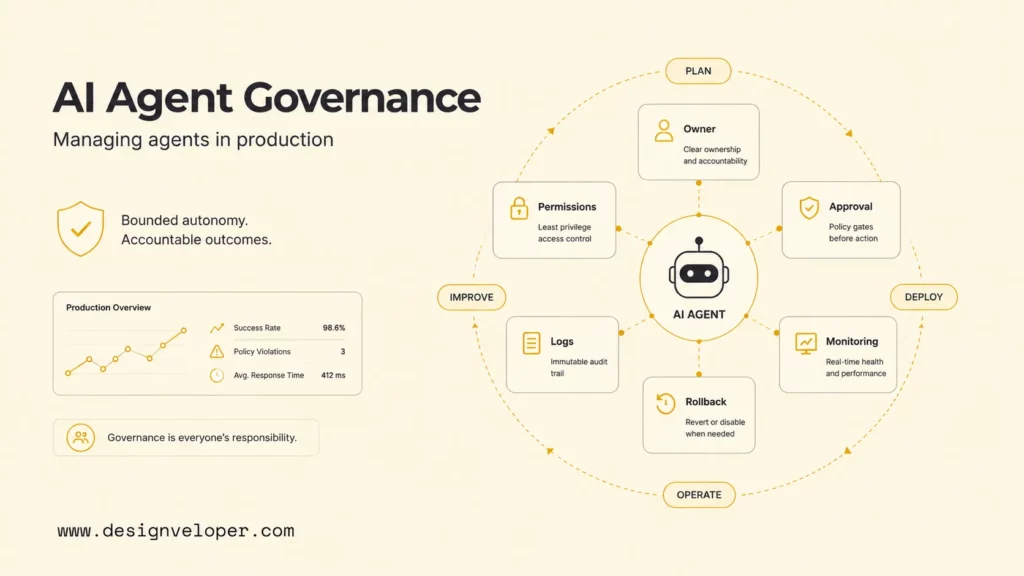
AI agent governance is the operating system a company uses to keep autonomous agents useful, secure, accountable, and reversible in production. It connects each agent to a named owner, approved purpose, risk level, identity, permission set, monitoring plan, human approval rules, and retirement process. The goal is not to eliminate autonomy. The goal is to make every consequential action bounded, observable, and recoverable.
Quick decision guide: Start with an inventory if agents already exist across the business. Start with risk classification if a team is preparing its first deployment. In either case, do not grant production write access until the agent has a dedicated identity, least-privilege permissions, action-level logs, an accountable owner, approval gates for high-impact actions, and a tested pause or rollback path.
| Governance question | Minimum production answer | Evidence to retain |
|---|---|---|
| Who owns the agent? | One business owner and one technical operator | Registry record and escalation contacts |
| What may it do? | Allowlisted tools, data, actions, and limits | Policy configuration and permission review |
| When must a person approve? | Before irreversible, regulated, financial, or external actions | Approval record tied to the action |
| How is behavior reviewed? | Runtime traces, outcome metrics, security alerts, and periodic access reviews | Dashboards, logs, test results, and review history |
| How is it stopped? | Credential revocation, tool disablement, safe mode, and rollback | Tested incident and retirement runbooks |
Further reading:
- How To Build An AI Agent: A Practical Step-By-Step Guide
- AI Agents vs Agentic AI: Differences From Execution to Autonomy
- AI Agent Vs LLM: How They Differ And Why Businesses Need Both
What Is AI Agent Governance?
AI agent governance is a coordinated set of policies, technical controls, roles, and review practices for agents that plan tasks, use tools, retain context, and act across business systems. Traditional AI governance often focuses on models, datasets, fairness, transparency, and acceptable use. Agent governance adds operational questions: which agent identity acted, which user or service authorized the action, which tool was called, what data was available, what changed, and how the action can be reversed.
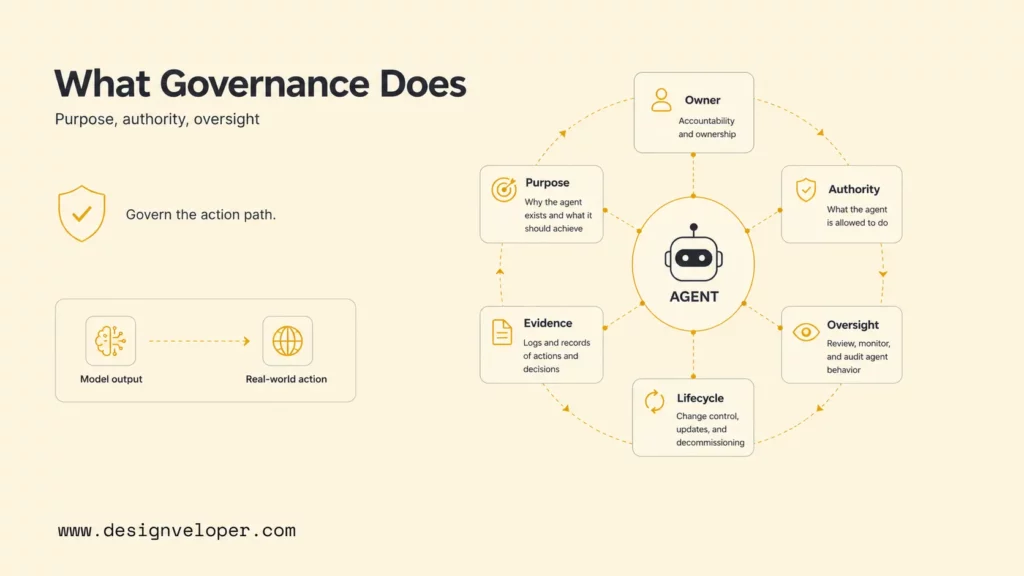
The distinction matters because an agent can turn a model output into an external effect. A customer-service agent may query an order system, draft a refund, update a ticket, and email a customer. Governance must cover the entire chain rather than evaluate only the text the model produced. The NIST AI RMF Core treats governance as a continuous, cross-cutting function across mapping, measurement, and risk management. That lifecycle view is a strong foundation for production agents.
A practical governance system answers six questions for every agent:
- Purpose: Which business outcome and user group does the agent serve?
- Ownership: Who approves the use case, operates the service, and accepts residual risk?
- Authority: Which tools, records, environments, and action types may the agent access?
- Oversight: Which decisions require human review, and who can approve them?
- Evidence: Which inputs, outputs, tool calls, policy decisions, and changes are logged?
- Lifecycle: How is the agent tested, released, changed, paused, rolled back, and retired?
Governance should be proportional. A read-only research assistant using public information does not need the same approval path as an agent that can modify payroll, issue refunds, deploy code, or send regulated communications. Risk tiering keeps controls focused on the possible impact instead of treating every chatbot and autonomous workflow as equally dangerous.
Govern the action path, not only the model. Production risk appears where an agent’s reasoning meets data, tools, permissions, and real-world consequences.
Why AI Agents Are Hard To Manage In Production
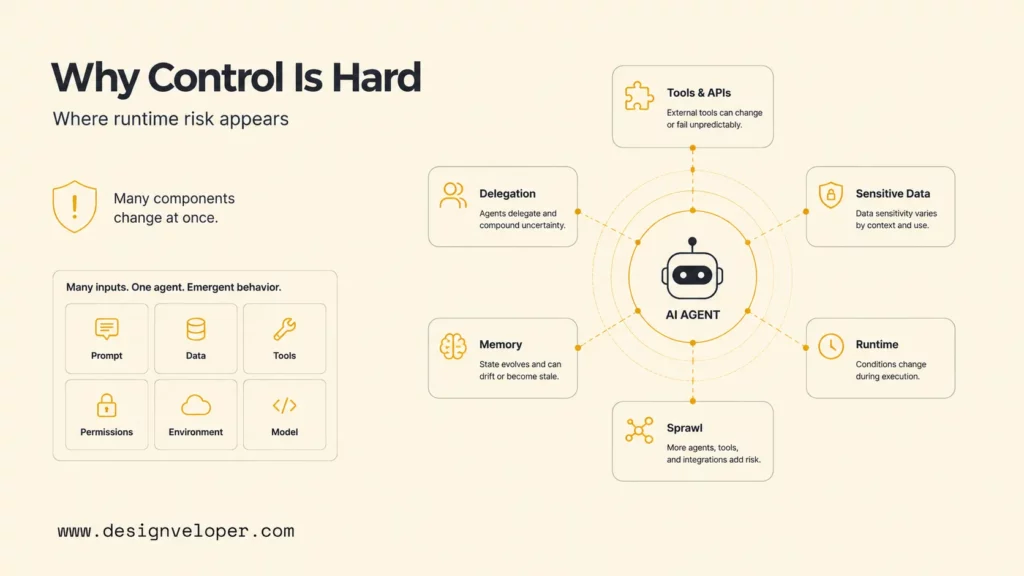
AI agents are hard to manage because their behavior emerges from several changing components at once: model output, prompts, retrieved data, memory, user context, tool responses, orchestration logic, permissions, and environmental conditions. A workflow that behaved correctly in testing can follow a different path when an API returns an unexpected value, a document contains hostile instructions, a model version changes, or stored context is incomplete.
Recommended for you:
- How to Build Agentic AI: Practical Guide with Examples
- Best AI Agent Frameworks For Building Smarter AI Systems
- How To Build AI Agents with LangChain: The Complete Guideline
Autonomous Tool And API Use
Tool use converts probabilistic decisions into deterministic operations. A poorly constrained agent may call the right tool with the wrong parameters, repeat a transaction after a timeout, or treat untrusted content as an instruction. Tool interfaces therefore need strict schemas, allowlisted operations, idempotency where possible, transaction limits, and server-side policy checks. The tool must enforce the rule; a prompt that says “be careful” is not an access-control system.
Delegated Authority Across Systems
An agent may operate on behalf of a user, a team, an application, or the organization itself. Shared credentials make responsibility unclear and expand the blast radius of compromise. A dedicated identity, short-lived credentials, explicit delegation, and action-level authorization preserve attribution. Current Microsoft guidance on least privilege for AI agents recommends a unique identity, named owner, documented purpose, reviewed permissions, auditable action context, and tested revocation paths.
Sensitive Data Access
Agents can combine data from several systems, which may reveal more than any single source. Governance must address classification, minimization, retrieval scope, retention, residency, encryption, and disclosure. A customer-support agent may need an order number and delivery status, but not the customer’s full payment history. Data filters should operate before information enters the model context and before any output leaves the workflow.
Memory And Context Retention
Memory improves continuity but creates a persistent attack and privacy surface. Incorrect or malicious context can influence future actions long after the original interaction. Teams should define which facts may be stored, the source and confidence of each memory item, who can update it, how long it persists, and how a user can correct or delete it. Identity, financial preferences, access decisions, and safety settings should not be silently rewritten from conversational text.
Unpredictable Runtime Behavior
Offline accuracy does not fully predict production behavior. Real users provide ambiguous requests. Tools fail. Latency changes. Models may choose longer plans or retry unexpectedly. Governance needs scenario-based evaluations, policy tests, canary releases, rate limits, timeouts, maximum step counts, fallback behavior, and ongoing outcome sampling. The NIST Generative AI Profile emphasizes pre-deployment testing, documentation, incident disclosure, and additional human review where risk warrants it.
Agent Sprawl And Unclear Ownership
Low-code builders and reusable connectors make agents easy to create. The same speed can produce abandoned pilots, duplicate agents, stale credentials, and unreviewed integrations. An enterprise registry should record the agent’s owner, sponsor, purpose, environment, model, tools, data classes, risk tier, current version, last review, and retirement date. Discovery should also look for unregistered agents rather than assume teams will report every experiment.
Compliance, Security, And Audit Requirements
Compliance depends on the use case, sector, data, geography, and effect on people. A governance program should map applicable obligations to technical evidence instead of keeping policy and engineering in separate documents. Logs should show who requested an action, which agent and version acted, which policy was evaluated, what tool ran, which records changed, whether a person approved, and whether the outcome was later corrected.
Core Controls For Production AI Agents
Production controls should make an agent visible, bounded, reviewable, and stoppable. The following control set covers the minimum operating surface. Higher-risk workflows may also require legal review, independent testing, segregation of duties, formal model-risk management, or regulatory reporting.
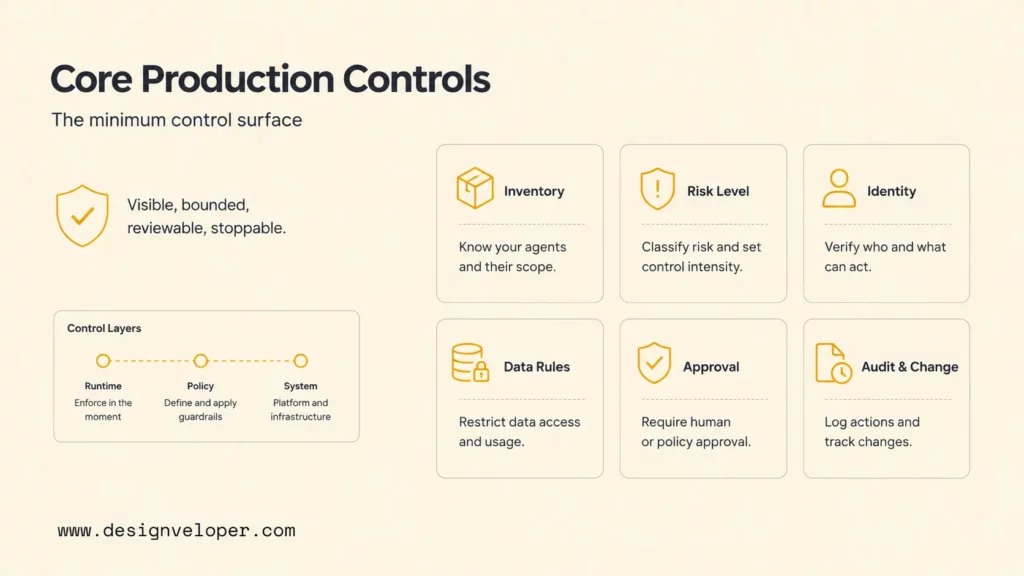
| Control | What To Define | Production Risk Reduced |
|---|---|---|
| Agent inventory and business owner | Purpose, owner, sponsor, operator, environment, model, tools, version, review date | Shadow agents, abandoned credentials, unclear accountability |
| Use-case approval and risk level | Impact, reversibility, affected people, data sensitivity, financial and legal exposure | Excessive controls for low risk and weak controls for high risk |
| Identity, permissions, and least privilege | Dedicated identity, allowed resources, read/write scope, delegation, credential lifetime | Privilege abuse, lateral movement, weak attribution |
| Data access, retention, and compliance rules | Permitted data classes, retrieval filters, residency, retention, deletion, output restrictions | Data leakage, unauthorized processing, persistent sensitive context |
| Human approval for sensitive actions | Action thresholds, approver role, approval expiry, evidence shown, separation of duties | Unauthorized payments, messages, account changes, or irreversible decisions |
| Audit logs, monitoring, and incident response | Tool calls, policy outcomes, changed records, alerts, correlation IDs, containment steps | Undetected abuse, slow investigation, incomplete evidence |
| Versioning, change control, and retirement | Prompt, model, policy, tool and dataset versions; tests; rollback; credential revocation | Silent regressions, stale agents, uncontrolled production changes |
Controls must be enforced at more than one layer. The agent runtime can decide whether to request a tool, but an authorization service should independently allow or deny the call. The connector should validate parameters. The target system should apply its own permissions. Monitoring should detect unusual activity even when the earlier controls pass. Layered enforcement prevents one prompt, model, or integration failure from becoming a complete governance failure.
Human approval also needs engineering detail. A reviewer should see the proposed action, affected record, relevant evidence, policy reason, and expected consequence. Approval should bind to that exact action and expire after a short interval. A vague approval such as “continue” should not authorize a different amount, recipient, attachment, or tool call later in the workflow.
AI Agent Governance Lifecycle
AI agent governance should follow the agent from request to retirement. A lifecycle prevents teams from treating governance as a one-time launch review. It also creates explicit outputs that auditors, operators, security teams, and business owners can inspect.
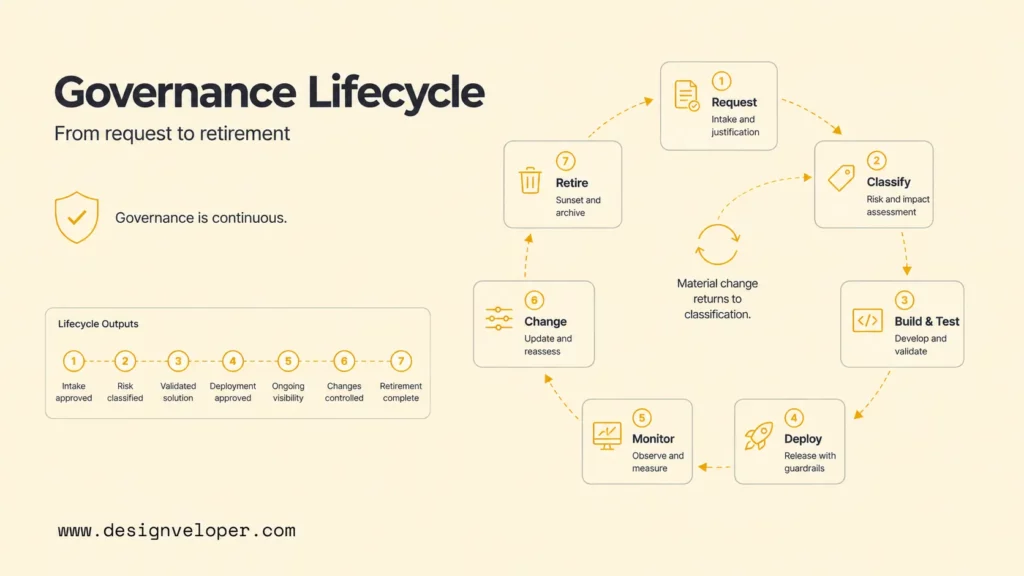
A seven-stage governance loop
State the workflow, users, outcome, and accountable sponsor.
Rate data, authority, impact, reversibility, and regulatory exposure.
Implement boundaries, evaluations, failure paths, and evidence capture.
Release gradually with approved identities, policies, and rollback.
Review outcomes, tool calls, incidents, cost, latency, and drift.
Re-test model, prompt, tool, policy, data, and permission changes.
Disable access, preserve required records, delete data, and confirm shutdown.
A material change sends the agent back to risk classification instead of directly back to production.
| Lifecycle Stage | Governance Check | Output |
|---|---|---|
| Request and approval | Is an agent appropriate, and is the outcome measurable? | Use-case charter and sponsor |
| Design and risk classification | What can the agent access, decide, change, and expose? | Risk tier, control plan, and data map |
| Development and testing | Do normal, adversarial, boundary, and failure cases pass? | Evaluation report and release evidence |
| Production deployment | Are identity, permissions, approvals, monitoring, and rollback active? | Release approval and deployment record |
| Runtime monitoring and review | Is the agent safe, reliable, useful, and within cost and policy limits? | Metrics, samples, alerts, incidents, and review decisions |
| Change management | Does the change alter capability, behavior, access, or impact? | Updated risk assessment, tests, and version record |
| Retirement or offboarding | Are credentials revoked, jobs stopped, integrations removed, and records handled? | Retirement confirmation and retained evidence |
A material change includes a new model family, broader data access, a write-capable tool, a different user population, a new jurisdiction, a revised system prompt, longer memory retention, or a higher transaction limit. A mature program defines these triggers in advance so teams do not debate governance scope during every release.
How To Manage AI Agents In Production Step By Step
Managing AI agents in production begins with visibility and ends with disciplined change. The five steps below can support a single agent or a wider portfolio. Each step produces an artifact that makes the next decision easier.
Related reading:
- Agentic AI in Action: 7 Real Life Use Cases and Examples
- How To Build And Use AI Business Process Automation Effectively
- AI Chatbot Integration: How To Connect Chatbots With Business Systems
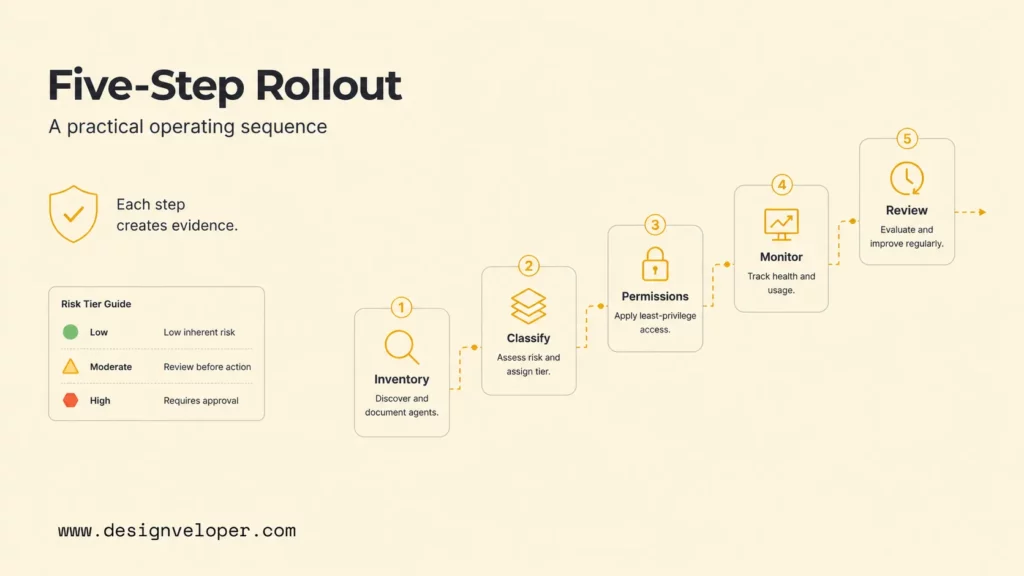
Step 1. Create An Agent Inventory And Assign Owners
Create one registry entry per deployed agent instance or approved agent class. Record its business purpose, environment, owning department, sponsor, technical operator, model and orchestration versions, tools, data sources, identities, users, geographic scope, cost center, risk tier, last review, and planned retirement date. Link the entry to architecture diagrams, evaluations, incident runbooks, and dashboards.
Ownership should be split clearly. The business owner accepts the use case and outcome risk. The technical operator maintains reliability and deployment controls. Security and privacy teams define required safeguards. Legal or compliance teams advise where obligations apply. An executive AI council can resolve high-impact or ambiguous cases, but it should not become the nominal owner of every agent.
Step 2. Classify Agents By Risk, Data Access, And Authority
Classify the agent using impact and capability, not the sophistication of its model. A simple automation that can release money may be riskier than an advanced research agent that cannot change records. Score at least five dimensions: data sensitivity, action authority, affected population, reversibility, and legal or operational consequence.
- Low risk: public or approved internal data, read-only access, easy human verification, and no material external effect.
- Moderate risk: internal workflow actions, limited personal data, reversible writes, and clear exception handling.
- High risk: financial, legal, safety, employment, security, healthcare, identity, production-code, or externally binding actions.
Define control baselines for each tier. A low-risk agent may require an owner, inventory record, basic logging, and annual review. A moderate-risk agent may add scoped identity, approval thresholds, monthly sampling, and formal rollback. A high-risk agent may require independent validation, segregation of duties, continuous alerts, human decision authority, and stricter change approval.
Step 3. Set Permissions, Tool Access, And Human Approval Rules
Give each agent a dedicated identity and only the permissions required for its narrow task. Separate read, draft, and execute capabilities. A finance agent can read an invoice and prepare a payment request while a different service performs the payment after an authorized person approves. Avoid shared administrator keys, broad wildcard scopes, long-lived tokens, and direct production database access.
Use policy gates outside the model. A refund tool, for example, can enforce a maximum amount, eligible order state, permitted currency, customer match, duplicate check, and approval requirement. The agent may recommend a refund, but the tool decides whether the requested operation is valid. Use short-lived or just-in-time privileges for sensitive actions and test revocation before launch.
Human approval is most valuable where an action is hard to reverse, affects a person’s rights, exposes sensitive data, commits money, changes security, deploys code, or communicates externally as the company. Keep routine low-impact decisions automated where monitoring and recovery are strong. Requiring a person to click approve on every action can create rubber-stamping instead of meaningful oversight.
Step 4. Monitor Logs, Performance, Cost, And Policy Violations
Monitor three layers together. Business metrics show whether the workflow creates value. Reliability metrics show whether the service works. Governance and security signals show whether the agent stays within its boundaries.
- Outcome: completion rate, correction rate, escalation rate, user acceptance, and downstream error rate.
- Reliability: latency, timeout rate, tool failures, retry count, loop depth, and fallback usage.
- Cost: model tokens, tool charges, workflow volume, duplicate calls, and cost per successful outcome.
- Security: denied actions, unusual access, new tool sequences, credential failures, prompt-injection indicators, and data-loss alerts.
- Governance: approval bypass attempts, actions outside purpose, expired reviews, unowned agents, policy changes, and missing audit fields.
Logs should capture enough context to reconstruct a decision without storing unnecessary sensitive content. Include timestamps, correlation IDs, user and agent identities, agent version, tool name, effective permission, policy result, action summary, affected resource, approval identity, and outcome. Protect logs from tampering, restrict access, and align retention with investigative and privacy needs.
The OWASP Top 10 For Agentic Applications highlights goal hijacking, tool misuse, identity and privilege abuse, supply-chain weaknesses, unexpected code execution, and memory poisoning. Map those threat classes to concrete alerts and evaluation cases rather than treating the list as a policy-only document.
Step 5. Review, Update, Roll Back, Or Retire Agents Over Time
Set review frequency by risk and rate of change. Review high-risk agents after incidents, material changes, and at short scheduled intervals. Compare current behavior with the approved use case, risk tier, evaluation baseline, permissions, costs, and observed value. Remove unused tools and stale access. Reconfirm the owner and escalation contacts.
A rollback plan should cover more than application code. Teams may need to restore the previous prompt, policy, model, tool schema, retrieval index, memory state, and permission set. A safe mode can preserve read-only assistance while disabling external writes. If an agent no longer creates sufficient value or cannot meet its control baseline, retirement is a governance success rather than a failed experiment.
An agent is production-ready only when the team can explain what it may do, observe what it did, and stop what it is doing.
Production Risks To Monitor Continuously
Continuous monitoring should focus on signals that indicate changing behavior, exposure, or business impact. A single threshold rarely catches every problem, so combine rules, statistical anomalies, sampled review, user feedback, and incident reports.
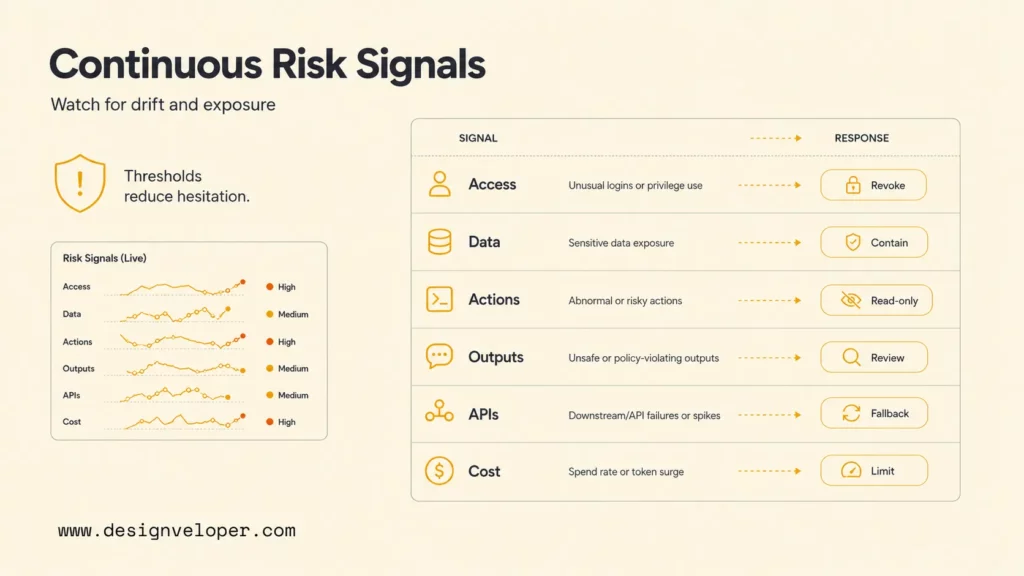
| Risk | Early Signal | Immediate Response |
|---|---|---|
| Unauthorized access | Denied calls, new resources, privilege escalation, off-hours activity | Revoke token, isolate identity, review effective permissions |
| Sensitive data exposure | Restricted fields in prompts or outputs, unusual exports, DLP alerts | Stop output, preserve evidence, contain destination, assess notification duties |
| Incorrect workflow actions | Rising corrections, repeated calls, duplicate records, approval mismatch | Switch to read-only or draft mode and reconcile affected records |
| Unreliable outputs | Lower evaluation scores, unsupported claims, user rejection, inconsistent decisions | Increase human review, roll back change, update tests and retrieval |
| Tool or API failures | Timeouts, schema errors, partial transactions, retry loops | Open circuit breaker, prevent duplicate actions, use fallback workflow |
| Cost, latency, or usage spikes | Longer plans, larger context, higher step counts, abnormal volume | Apply budgets and step limits, investigate loops or abuse |
| Compliance or audit gaps | Missing owner, expired review, incomplete logs, policy drift | Pause affected capability and restore required evidence |
Risk signals need response thresholds. A minor tool timeout may trigger an automatic retry. A burst of denied access may isolate the agent identity. A potential data disclosure may stop the workflow, preserve logs, alert security, and invoke legal or privacy review. Predefined severity levels reduce hesitation during an incident.
Monitoring should also detect governance decay. An agent can remain technically healthy while its owner leaves, its purpose expands, its data source changes, or its approvals become routine. Track ownership, review dates, permission age, tool inventory, version drift, exception volume, and continued business value alongside latency and accuracy.
Build Governance Into The Agent Workflow Before Launch
AI agent governance works when ownership, permissions, approvals, audit logs, monitoring, rollback paths, and lifecycle reviews are part of the production architecture. Policies alone cannot constrain a tool call, revoke a token, prevent a duplicate payment, or restore a previous version. Engineering teams should translate each governance rule into an enforceable control and a piece of evidence.
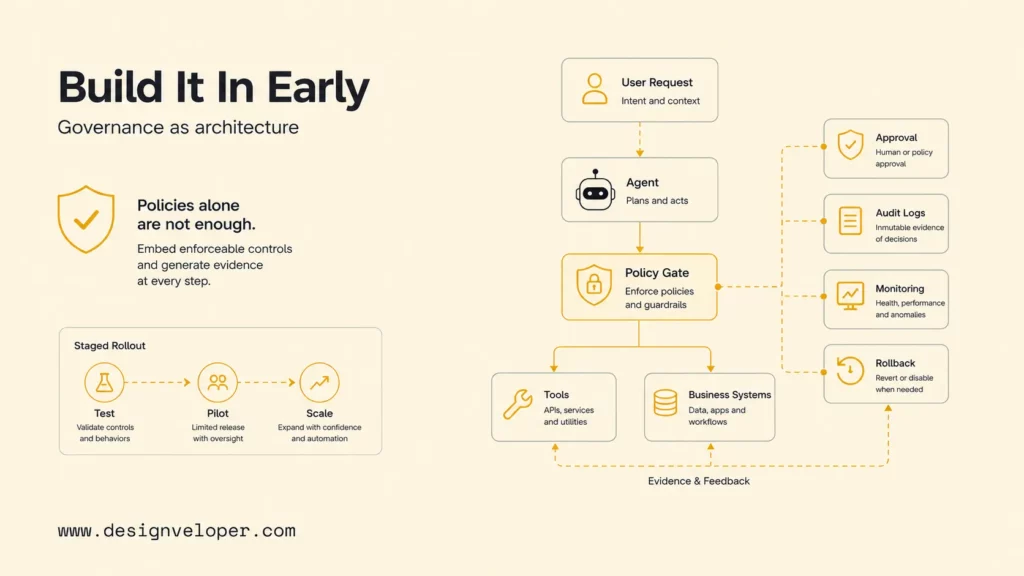
Start with one bounded workflow. Define the success metric, prohibited outcomes, allowed tools, data scope, approval thresholds, maximum cost and steps, fallback path, incident owner, and retirement rule. Test normal tasks, ambiguous requests, hostile inputs, tool failures, permission boundaries, repeated actions, and recovery. Release to a small group, observe real behavior, and expand autonomy only when evidence supports the change.
Governance becomes real when every agent action has an owner, permission boundary, evidence trail, and recovery path. In our AI development services, the starting artifact is a control matrix that separates what the agent may read, recommend, execute, or escalate. That matrix then drives tool permissions, approval thresholds, trace logging, evaluation cases, incident handling, and the staged rollout plan.
The best governance program does not require every agent to be harmless. It requires every agent’s authority to be intentional, proportional, and reviewable. That approach lets a business automate useful work while preserving human decision rights where consequences are high.
FAQs About AI Agent Governance
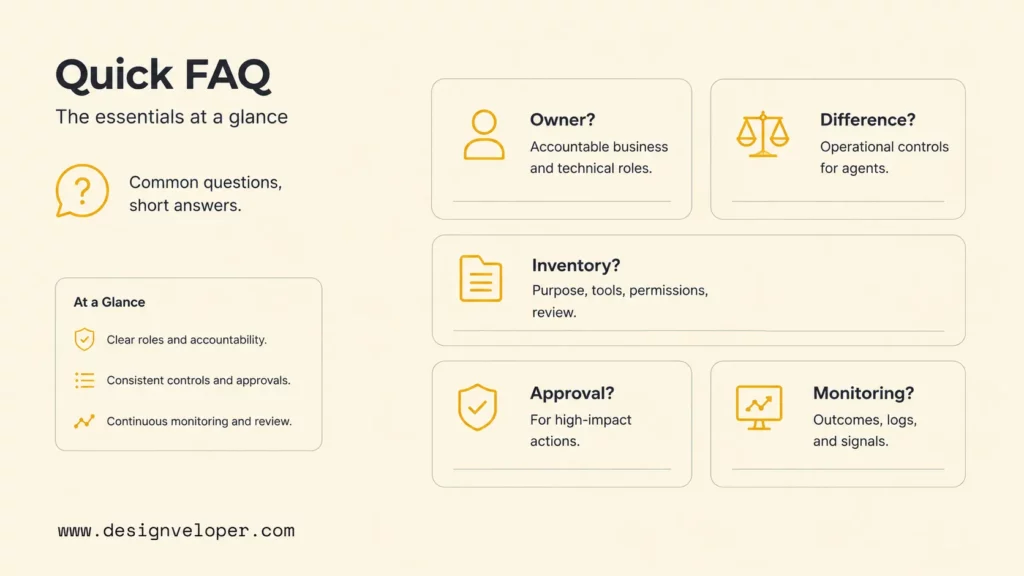
Who Is Responsible For AI Agent Governance?
The business owner should be accountable for the agent’s purpose and outcome, while technical, security, privacy, legal, compliance, and operations teams own specific controls. A cross-functional AI council can set standards and decide difficult cases. Responsibility should never be assigned only to the model provider or to a general committee with no authority over the workflow.
How Is AI Agent Governance Different From AI Governance?
AI governance covers broader organizational management of AI, including policy, data, models, fairness, transparency, and risk. AI agent governance adds controls for autonomous planning, tool use, delegated authority, memory, multi-step actions, runtime monitoring, human approval, and action rollback. Agent governance applies AI governance principles to a system that can produce real-world effects.
What Should Be Included In An AI Agent Inventory?
An inventory should include the agent name, purpose, owner, sponsor, operator, users, environment, risk tier, model, orchestration version, prompts or policy version, tools, data sources, identities, permissions, approval rules, geographic scope, monitoring links, evaluation results, incidents, last review, and retirement date. The record should connect to technical evidence rather than remain a standalone spreadsheet.
When Do AI Agents Need Human Approval?
Human approval is appropriate before actions that are irreversible, legally binding, financially material, safety-critical, privacy-sensitive, externally visible, or capable of changing permissions and production systems. Approval may also be required when confidence is low or policy detects an exception. Low-impact, reversible actions can remain automated when limits, monitoring, and recovery are strong.
How Do You Monitor AI Agents In Production?
Monitor business outcomes, model and tool behavior, security signals, reliability, cost, policy decisions, approvals, and changes. Capture correlated logs for the user, agent identity, version, tool call, permission, policy result, affected resource, and final outcome. Combine real-time alerts with sampled human review, regression evaluations, access reviews, incident exercises, and scheduled reassessment of ownership and value.
Also published on

Share post on










Related Articles


Generative AI Applications: 20 Practical Use Cases Across Industries
Generative AI Applications: 20 Practical Use Cases Across Industries Published September 18, 2026
Machine Learning Vs AI: What’s The Difference?
Machine Learning Vs AI: What’s The Difference? Published September 16, 2026
Enterprise AI Agents: Use Cases, Tools, And Implementation
Enterprise AI Agents: Use Cases, Tools, And Implementation Published September 14, 2026