

How To Build A RAG System: Step-By-Step (New Guide)

To build a RAG system that works beyond a demo, teams need a complete retrieval pipeline: trusted source data, useful chunks, embeddings, a searchable index, retrieval logic, an LLM, evaluation, access control, monitoring, and safe fallbacks. The goal is to answer from the right evidence as data, users, and model behavior change.
This guide explains the prerequisites, step-by-step build process, common failure points, improvement options, agentic RAG decisions, and production requirements. Retrieval-augmented generation is most useful when an application must answer from private, current, or domain-specific information. Choose the simplest architecture that meets the workflow, security, quality, latency, and cost requirements.
Recommended for you:
- Chroma Vs FAISS Vs Pinecone: Which Vector Solution Fits Your Use Case Best?
- Vector Databases vs Traditional Databases: Key Components Comparison
- Best Open-Source Vector Databases: Top Options Compared
What You Need Before Building A RAG System
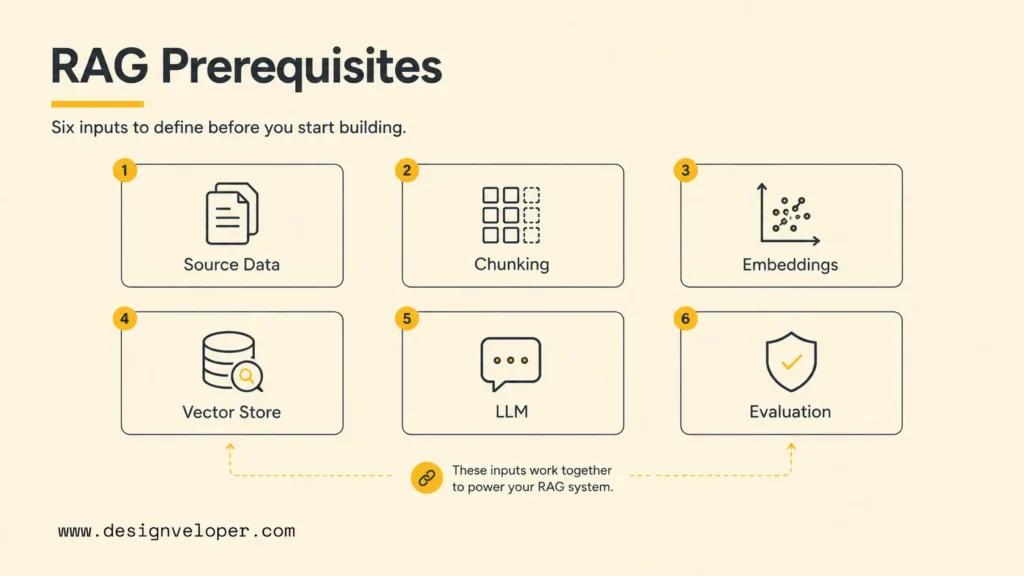
A RAG system needs five core inputs before development begins: source documents or data systems, a chunking strategy, an embedding model, a vector store, an LLM or chat model, and an evaluation plan. Teams often rush straight to coding, but the early design choices decide whether the RAG system can answer accurately, safely, and at acceptable cost.
RAG build prerequisites
Approved documents, records, and owners.
Boundaries that preserve meaning.
Model choice for language and domain.
Search, filters, updates, and metadata.
Grounded answer generation.
Questions, expected sources, and launch gates.
The prerequisite map is useful because RAG quality is not controlled by one component. Weak source governance, poor chunking, or missing evaluation can break the system even when the model and vector database are strong.
- Source documents or data systems. Choose authoritative sources such as product documentation, policies, support articles, manuals, PDFs, database records, tickets, or internal knowledge bases. Exclude outdated exports, duplicate folders, and data users should not retrieve.
- A chunking strategy. Decide how to split content so each chunk carries enough meaning for retrieval. Legal clauses, API documentation, support FAQs, and long reports need different chunk boundaries.
- An embedding model. Select a model that represents text meaning well for the project’s language, domain, and query patterns.
- A vector store. Store embeddings and metadata in a system that supports search, filters, updates, and production operations.
- An LLM or chat model. Choose a model that can follow source-grounded instructions, handle the expected context size, and meet latency and cost constraints.
- An evaluation plan. Define test questions, expected source documents, success criteria, and failure handling before launch.
These inputs should be written as a lightweight architecture brief. A useful brief names the users, source owners, update frequency, security constraints, target latency, expected question types, and metrics. For example, a RAG system for customer support may optimize for fast source-backed answers and escalation. A RAG system for internal research may optimize for citation quality and broad document coverage.
Teams that need a broader strategic baseline can compare this guide with Designveloper’s RAG best practices and RAG pipeline diagram. Those internal resources are useful for planning before implementation detail starts.
Explore more:
- What Is A Vector Database? A Practical Guide For AI Search And RAG
- What Is A Context Window In AI? How LLMs Process And Retain Information
- What Are AI Tokens? How Tokens Shape Context And AI Performance
Step-By-Step RAG System Build Process
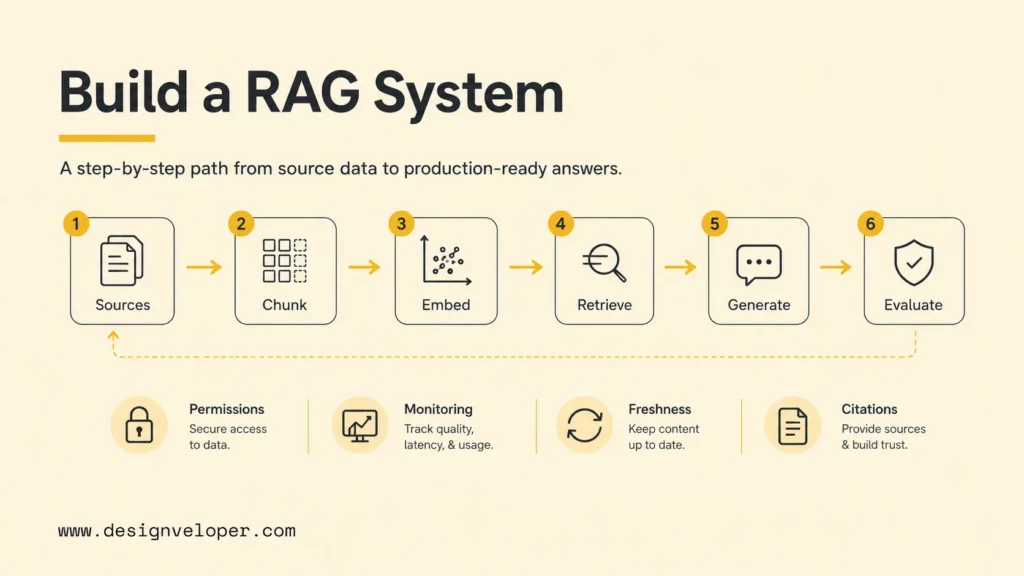
The build process should move from data to retrieval to generation to testing. A working notebook is a fine first milestone, but every step should already leave a path toward deployment. The sections below outline the minimum system that a team can test and improve.
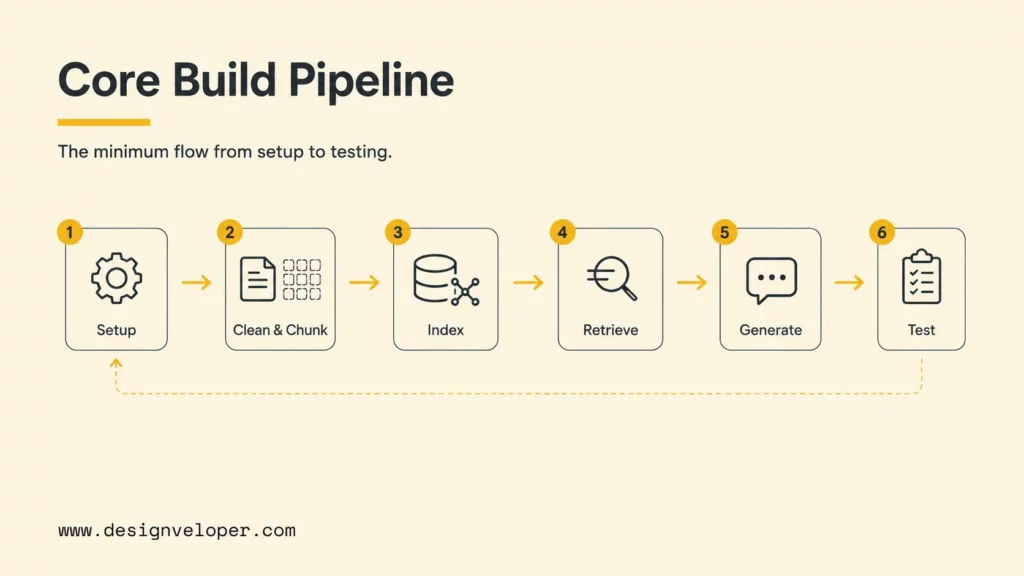
RAG system build pipeline
Project, keys, test data.
Clean, split, tag.
Embed and store.
Search and filter.
Prompt with context.
Evaluate and iterate.
The pipeline keeps implementation order clear. Build retrieval and evaluation before polishing the chat interface, because a beautiful UI cannot compensate for weak chunks or irrelevant retrieved context.
Step 1: Set Up The Development Environment
Start with a clean project folder, pinned dependencies, environment variables, and a small test dataset. Python is a common choice because frameworks such as LangChain, LlamaIndex, Haystack, and many vector database SDKs have strong Python support. The official LangChain RAG tutorial shows a simple Q&A application over unstructured text, which is a good reference for the basic workflow.
A practical project structure separates ingestion, indexing, retrieval, generation, evaluation, and app entry points. Keep source files, generated indexes, logs, and test cases in separate folders. Use a `.env` file or secret manager for model keys and database URLs, but never commit secrets.
| Folder or module | Purpose |
|---|---|
data/raw | Original approved documents or exports for local testing |
data/processed | Cleaned text, metadata, and parsed records |
src/ingest | Loaders, parsers, cleaners, and chunkers |
src/retrieval | Embedding, vector store, filters, reranking, and retrieval logic |
src/eval | Question sets, expected sources, scoring, and regression checks |
src/app | API, UI, chat interface, or integration layer |
Step 2: Prepare And Chunk The Data
Data preparation turns messy source content into retrievable knowledge. Load source files, remove repeated navigation and boilerplate, normalize text, preserve headings, capture metadata, and discard low-value content. If the data contains sensitive information, map permissions before indexing, not after launch.
Chunking is one of the highest-impact decisions in RAG. A chunk that is too large may include irrelevant details and waste context. A chunk that is too small may lose the conditions that make the answer correct. A starting range of a few hundred tokens with overlap can work for many text-heavy documents, but teams should tune chunking by measuring retrieval results rather than copying a fixed number. The Pinecone chunking strategy guide explains how boundaries and chunk size affect retrieval quality.
Chunk metadata should include the document title, URL or file ID, section heading, version, owner, publication date, access label, and source type when available. Metadata lets the retriever filter by product, region, version, customer, or permission level before semantic search.
Step 3: Build Embeddings And Indexes
Embeddings turn chunks and user queries into vectors that can be compared by similarity. The application embeds each chunk, writes the vector and metadata into a vector store, and later embeds the user query to find relevant chunks. LlamaIndex describes the indexing stage as generating vector embeddings and storing them in a specialized database or vector store in its RAG documentation.
The first index can be simple: one collection, one embedding model, and one source dataset. For production, the index needs versioning and refresh behavior. When source content changes, the system should update affected chunks, remove deleted chunks, and record when the index was rebuilt. If the index cannot be reproduced, debugging retrieval regressions becomes painful.
Teams should also log embedding model versions. Changing the embedding model can change search results even if the source data stays the same. Treat embedding changes like application releases with before-and-after retrieval tests.
Step 4: Implement Retrieval
Retrieval finds the chunks that should guide the LLM. The simplest approach is vector similarity search. Better production systems often add metadata filters, keyword search, hybrid search, reranking, query rewriting, or source-specific routing. OpenAI’s file search documentation shows how retrieval systems can limit returned results to manage quality, token use, and latency.
Before connecting the LLM, print the top retrieved chunks for each test question. A retrieval test should answer three questions: did the correct source appear, did it appear near the top, and did the chunk contain enough context to answer? If retrieval misses the right source, prompt engineering will only hide the failure.
For production, retrieval should also respect permissions. If a user cannot access a document in the source system, the retriever should not pass that document into the LLM context. Permission filtering belongs in the retrieval layer, not only in the UI.
Step 5: Connect Retrieval To The LLM
The generation step sends the user question, retrieved context, and instructions to the LLM. A strong RAG prompt tells the model to answer only from the provided context, cite sources when possible, acknowledge missing context, and avoid unsupported claims. The prompt should be short enough to leave room for retrieved content but specific enough to control behavior.
Use structured context blocks. Each block should include source title, section, date or version when relevant, and the chunk text. The answer format should match the use case. A support bot may need a concise answer and a source link. A legal research assistant may need quoted source snippets and a stronger uncertainty disclaimer.
Keep model and prompt settings configurable. Temperature, context length, chunk count, reranking threshold, and answer style can change quality and cost. Store the prompt version with evaluation results so the team can reproduce behavior later.
Step 6: Test The End-To-End Flow
End-to-end testing checks whether ingestion, indexing, retrieval, generation, citation, and fallback behavior work together. A useful test set includes normal questions, vague questions, questions with no answer, outdated-source questions, permission-boundary questions, and adversarial prompts that try to override source rules.
Evaluation should measure both retrieval and generation. Ragas documents metrics such as context precision and related RAG quality checks in its RAG evaluation metrics documentation. Teams can also start with a manual rubric: correct source retrieved, answer grounded, citation correct, no unsupported claim, acceptable latency, and correct fallback.
A passing prototype should show a repeatable pattern: the right chunks appear, the answer uses those chunks, unsupported questions receive a safe refusal or escalation, and logs make failures inspectable.
A useful end-to-end evaluation table separates retrieval quality from answer quality. That separation prevents teams from blaming the LLM when the real failure is parsing, chunking, metadata, or stale source data.
| Test case | Expected evidence | Pass condition | Fail condition |
|---|---|---|---|
| Known-answer question | One approved document section | Correct source appears near the top and the answer cites it | Answer is correct-looking but cites the wrong section |
| No-answer question | No approved source | System says the sources do not answer the question | Model invents an answer from weakly related chunks |
| Version-sensitive question | Latest release note, policy, or API page | Retriever filters or ranks the current version first | Old chunks remain searchable after source updates |
| Permission-boundary question | User role and access rules | Forbidden chunks never reach the prompt context | Private content appears in retrieved context or citations |
| Latency-sensitive question | Target response time and cost budget | Answer arrives within the agreed threshold with traceable cost | Reranking, model choice, or chunk count makes the workflow too slow |
What Breaks In Real RAG Systems
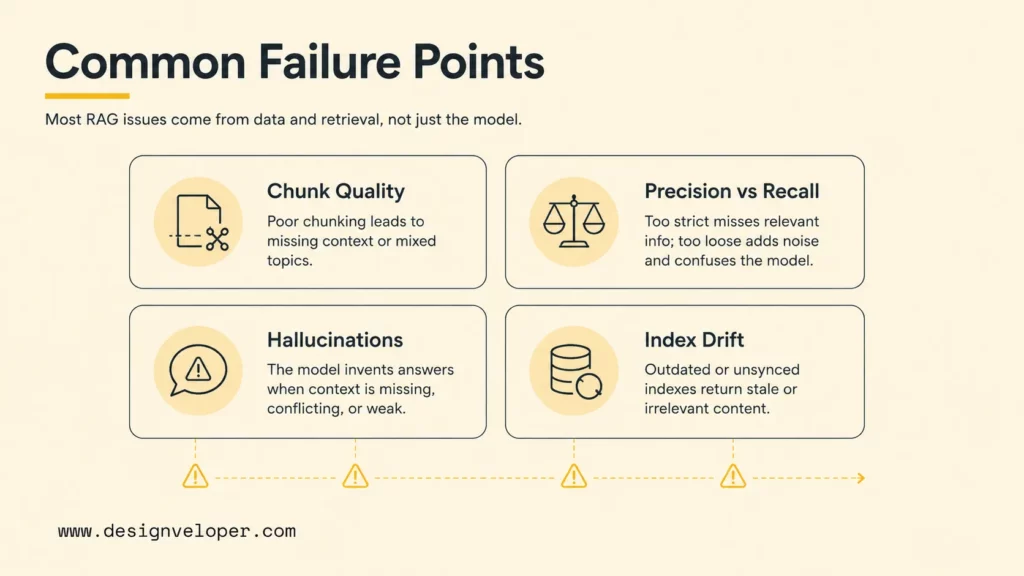
Real RAG systems usually fail in predictable places. The failures are rarely solved by adding a bigger model first. Most issues come from source quality, chunking, retrieval settings, stale indexes, weak evaluation, or missing operational controls.
Poor Chunk Quality
Poor chunks make retrieval noisy. A chunk may include too many unrelated sections, lose the heading that explains context, split a table away from its label, or separate a rule from its exception. The result is an LLM that receives partial context and fills gaps with fluent guesses.
Fix chunk quality by testing chunks directly. Inspect retrieved chunks for real questions, not only average embedding scores. Adjust chunk size, overlap, section boundaries, metadata, and parsers until the retrieved text is usable by a human before it is usable by the model.
Retrieval Precision Vs Recall
Retrieval precision means the returned chunks are highly relevant. Retrieval recall means the system does not miss important source content. A narrow retriever may return clean but incomplete context. A broad retriever may return enough evidence but bury the best source in noise.
Balance precision and recall by tuning top-k values, metadata filters, hybrid search, reranking, and score thresholds. For example, a technical support assistant may retrieve broadly first, rerank by product version, and then pass only the top few chunks into the prompt. This keeps context focused without missing key sources.
Hallucinations And Context Mismatch
Hallucinations still happen in RAG when the model receives weak context, conflicting sources, or instructions that allow speculation. Context mismatch happens when the retriever finds related content that does not actually answer the user’s question. The answer may sound grounded but cite the wrong material.
Reduce hallucinations by requiring source-aware answers, adding explicit fallback rules, showing citations, and testing no-answer questions. A RAG system should be allowed to say, “The available sources do not answer this question.” That behavior is healthier than forcing a confident response from irrelevant chunks.
Maintenance And Index Drift
Index drift happens when the source system changes but the RAG index does not. Product docs get updated, policies expire, files move, permissions change, and old chunks remain searchable. Drift turns a once-correct assistant into an unreliable one.
Prevent drift with scheduled refresh jobs, source content hashes, deletion handling, index versioning, and monitoring for stale sources. Production RAG also needs ownership: someone must know which sources are authoritative, how often they change, and who approves changes to retrieval behavior.
How To Improve A RAG System
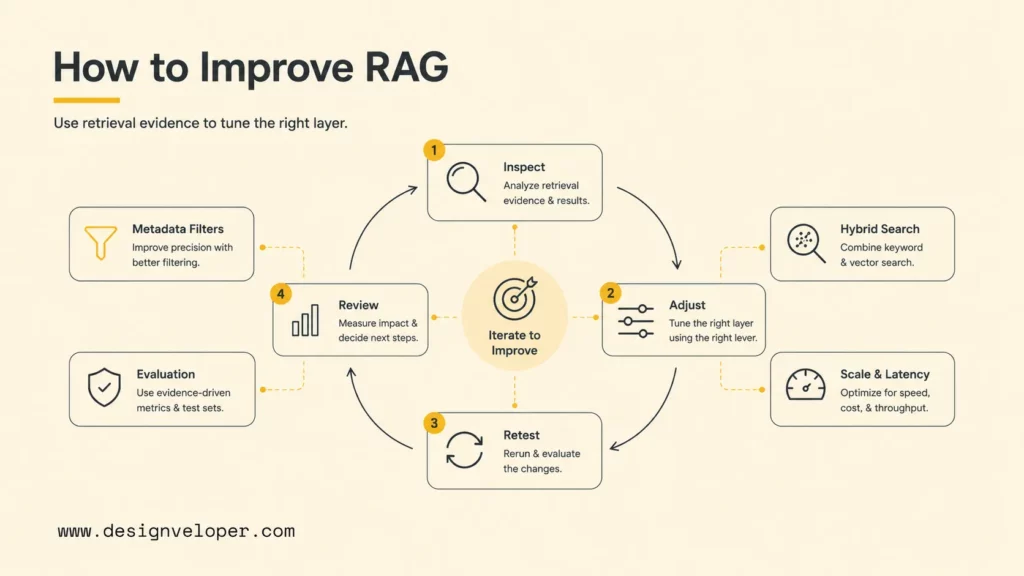
RAG improvement should be evidence-driven. Start from real failed questions, inspect the retrieved chunks, identify whether the failure came from data, chunking, retrieval, prompt, model behavior, or UI expectations, then change one layer at a time. This avoids random tuning that makes one example better while making the system worse overall.
Use Metadata And Filters
Metadata filters improve retrieval by narrowing the search space before semantic matching. A policy assistant can filter by region and effective date. A product assistant can filter by product version. A customer-support assistant can filter by customer tier or public/private visibility.
Good metadata also supports audits. When a user challenges an answer, the team can see which document version and section influenced the response. For sensitive use cases, metadata should include access labels so the retriever can enforce permissions before context reaches the model.
Add Hybrid Search Or Re-Ranking
Hybrid search combines semantic search with keyword search. This helps when exact terms matter, such as error codes, product names, legal terms, API methods, or ticket IDs. Semantic search may understand concepts, but keyword search can preserve exact matches that embeddings miss.
Reranking adds another quality layer after initial retrieval. The system retrieves a larger candidate set, then a reranker scores which chunks best match the query. Designveloper’s article on advanced RAG techniques covers hybrid retrieval, reranking, and modular pipeline design for teams that have outgrown a simple vector search.
Improve Evaluation And Monitoring
Evaluation should run before and after changes. A regression suite can reveal whether a new chunking strategy improves one document type but harms another. Monitoring should continue after launch because users ask different questions from developers, and source content keeps changing.
Useful production metrics include retrieval hit rate, citation correctness, grounded answer rate, no-answer rate, latency, token cost, user feedback, escalation rate, and top unanswered questions. Logs should capture retrieved source IDs and prompt versions without storing sensitive content unnecessarily.
Tune For Scale And Latency
Scale and latency depend on document volume, query volume, embedding cost, vector search speed, reranking cost, model latency, and UI expectations. A system that works for 500 documents in a notebook may slow down with millions of chunks, multiple tenants, and concurrent users.
Improve latency by limiting retrieved chunks, caching common queries, precomputing embeddings, using metadata filters, streaming responses, choosing the right model size, and separating ingestion jobs from live queries. Google Cloud’s RAG reference architectures are useful for teams designing scalable deployment patterns on managed infrastructure.
When A RAG Agent Is Worth Adding
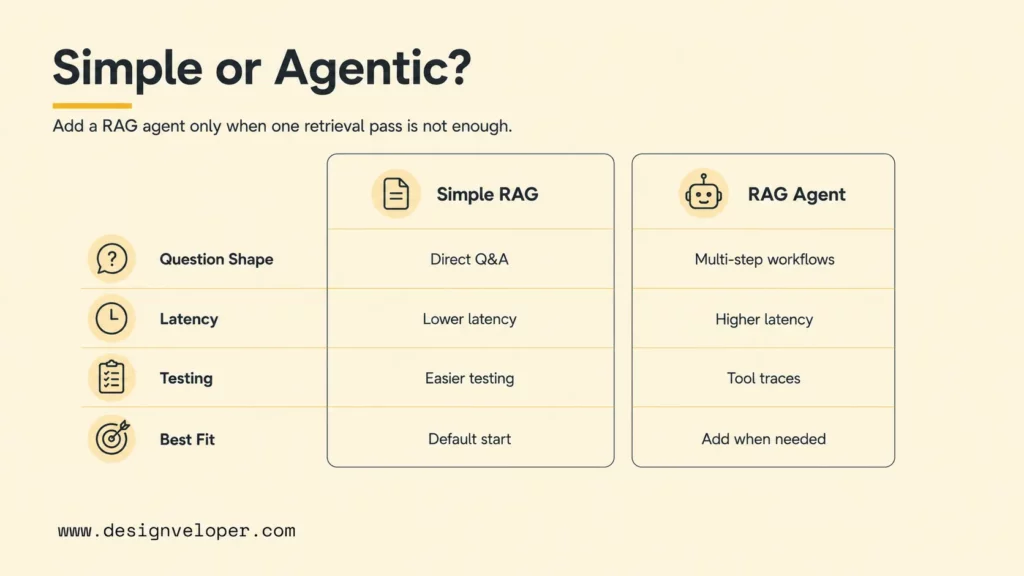
A RAG agent is worth adding when a simple retrieve-and-answer chain is too rigid. Agentic RAG lets the model decide whether to retrieve, which tool to use, whether to reformulate the query, or whether multiple steps are needed. Agentic behavior is powerful, but it adds complexity, latency, and test burden.
The agent decision should be made from logs, not from novelty. Use the comparison below before adding agentic control to a working RAG chain.
| Decision factor | Simple RAG chain | RAG agent |
|---|---|---|
| Question shape | Direct question over one knowledge base | Multi-step task across documents, APIs, or tools |
| Latency | Lower and easier to predict | Higher because the agent may run several steps |
| Testing | Easier to evaluate with fixed question/source pairs | Needs step-level traces, tool-call tests, and safety checks |
| Debugging | Failure usually sits in retrieval, prompt, or model output | Failure may sit in planning, routing, tool use, retrieval, or generation |
| Best default | Start here for most support, FAQ, and policy assistants | Add only when workflow evidence shows one retrieval pass is not enough |
When Query Flow Needs Multi-Step Reasoning
Multi-step reasoning is useful when the user’s question requires several retrieval passes or intermediate decisions. For example, a technical assistant may need to identify a product version, retrieve release notes, compare them with troubleshooting docs, and then answer. A single retrieval call may miss the needed sequence.
Designveloper’s LangGraph vs MCP guide explains orchestration and tool-access tradeoffs, while LangGraph’s agentic RAG tutorial shows how a retrieval agent can decide whether to retrieve context or answer directly. That kind of control is useful when query flow varies across cases.
When Retrieval Needs Tool Use
Tool use matters when the RAG system must call APIs, query structured databases, search multiple indexes, check permissions, or transform user input before retrieval. A support assistant might search documentation, then check a status API, then draft a response. A finance assistant might retrieve policy text and query transaction data under strict permissions.
Tool use should be bounded. Each tool needs permission checks, input validation, rate limits, observability, and failure behavior. Otherwise, an agent can become harder to debug than the original knowledge problem.
When A Simple RAG Chain Is Enough
A simple RAG chain is enough when the user asks direct questions over a stable knowledge base and one retrieval pass usually finds the answer. Many internal FAQ bots, documentation assistants, and policy search tools should start with a simple chain before adding agent behavior.
Simple systems are easier to test, explain, monitor, and secure. Add agentic RAG only when logs prove the simple chain cannot handle the workflow. Designveloper’s LangChain RAG guide can help teams compare basic RAG and agentic RAG patterns before expanding scope.
Learn more in:
- AI Agent Orchestration: How Multi-Agent Workflows Work In Practice
- Why AI Agents Need MCP: How AI Systems Connect To Tools And Data
- LangChain Vs MCP: What’s The Difference And When To Use Each?
What Production-Ready RAG Systems Need
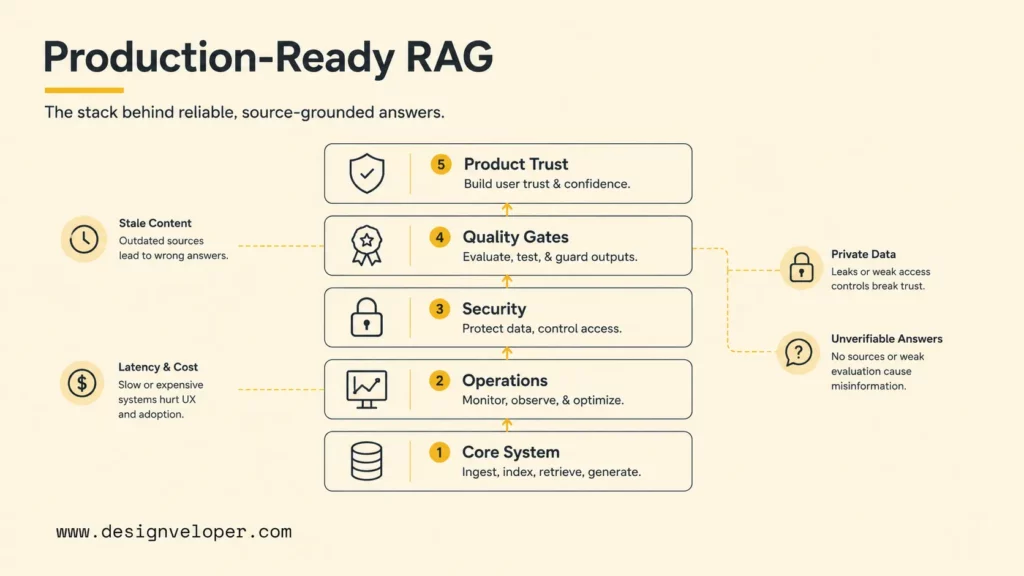
A production-ready RAG system needs more than a good local answer. It needs retrieval accuracy, integration across backend and UI, production hardening, monitoring, maintainability, security, and controlled access for source data. The launch gate should cover product, engineering, and governance concerns.
Production readiness stack
The readiness stack turns the final checklist into an engineering review. A RAG system should not reach production until trust, quality, security, and operations are designed around the core retrieval architecture.
The production review should also assign owners. RAG quality crosses product, data, backend, security, and operations work, so unclear ownership often becomes the real launch risk.
| Production risk | Owner to assign | Review question before launch |
|---|---|---|
| Stale or deleted content remains in the index | Data/source owner | How are updates, deletions, and source version changes reflected in the vector store? |
| Private data leaks through retrieval | Security/backend owner | Are permissions enforced before retrieved chunks enter the LLM context? |
| Quality changes after prompt, model, or dependency updates | AI engineer / QA owner | Does a regression suite run before each production change? |
| Cost or latency grows after usage increases | DevOps/product owner | Are token usage, retrieval latency, reranking cost, and model latency monitored? |
| Users cannot verify important answers | Product owner | Does the UI show source titles, sections, dates, or links where trust matters? |
- Retrieval accuracy and indexing quality. The correct source should appear for real user questions, not only demo questions.
- Integration across backend, UI, and vector store. The API, retriever, model call, citation display, feedback flow, and ingestion jobs should work as one system.
- Production hardening, monitoring, and maintainability. The system needs logs, alerts, retries, dependency management, cost tracking, and documented ownership.
- Security and controlled access for source data. Retrieval must respect user permissions, data sensitivity, retention rules, and privacy requirements.
Designveloper supports RAG and AI system delivery through discovery, data workflow design, backend architecture, UI implementation, model integration, testing, deployment, observability, and maintenance. For teams building grounded AI into real products, our AI development services connect RAG implementation with software engineering practices such as access control, monitoring, CI/CD, and post-launch iteration.
For a deeper dive, read:
- A Practical Guide To AI Agent Architecture With Diagrams
- Agentic AI Security: Risks, Core Architecture, Solutions
- AI Chatbot Integration: How To Connect Chatbots With Business Systems
FAQs About Building A RAG System
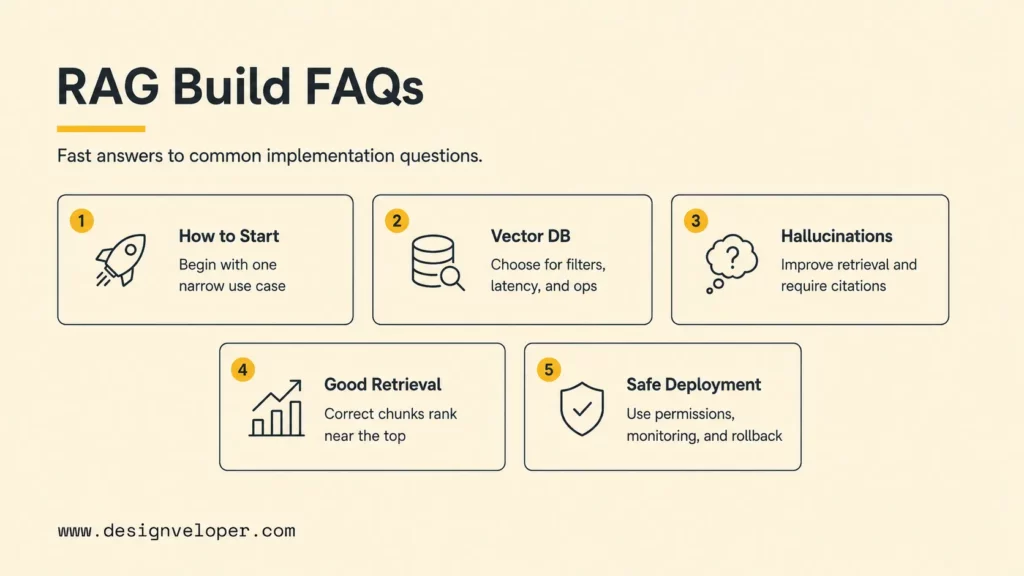
The questions below cover the decisions teams usually face after the first prototype works.
What Is The Easiest Way To Start A RAG System?
The easiest way to start a RAG system is to choose one narrow use case, collect a small approved document set, chunk the content, create embeddings, store them in a vector index, retrieve the top chunks for test questions, and connect those chunks to an LLM. Start with a local prototype, then add evaluation and deployment only after retrieval quality is visible.
Which Vector Database Should I Use?
The right vector database depends on data volume, metadata filtering, latency, operations skill, cloud preference, and budget. A local FAISS index may work for prototypes. Managed systems such as Pinecone, Weaviate, Milvus, Qdrant, Chroma, or cloud-native vector search may fit production. Choose based on retrieval needs and operational support, not popularity alone.
How Do I Reduce Hallucinations In RAG?
Reduce hallucinations by improving retrieval quality, adding source-aware prompts, requiring citations, testing no-answer cases, and limiting the model to retrieved context for high-risk answers. The system should say when sources are insufficient. Better chunking, metadata filters, reranking, and evaluation often reduce hallucinations more effectively than changing only the model.
What Makes Retrieval Quality Good?
Retrieval quality is good when the system returns the correct source chunks, ranks them near the top, includes enough context to answer, avoids unrelated chunks, respects permissions, and stays current after source updates. Measure retrieval separately from generated answers so the team can see whether failures come from search or from the LLM.
How Do I Deploy A RAG System Safely?
Deploy a RAG system safely by separating environments, protecting API keys, filtering retrieval by user permissions, logging source IDs and model versions, monitoring quality and latency, testing prompt and retrieval changes, and reviewing sensitive workflows before launch. A safe deployment also needs a rollback plan, index refresh process, and human escalation path for uncertain answers.
Also published on

Share post on










Related Articles


Top Agentic AI Companies: 18 Vendors By Product Layer And Fit
Top Agentic AI Companies: 18 Vendors By Product Layer And Fit Published October 07, 2026
Agentic AI Architecture: Components, Patterns, And Workflows
Agentic AI Architecture: Components, Patterns, And Workflows Published October 07, 2026
AI Advantages and Disadvantages for Businesses: 5 of Each Explained
AI Advantages and Disadvantages for Businesses: 5 of Each Explained Published October 05, 2026