












Conversational AI Vs. Chatbot: Key Differences And Use Cases In 2026

Businesses now need better digital support, not just faster replies. That is why so many teams keep comparing conversational ai vs chatbot before they invest in automation. The two terms sound similar, but they do not mean the same thing. A chatbot is usually the interface. Conversational AI is the intelligence behind richer and more flexible conversations.
This guide explains the difference in plain language. It also shows where each option fits, how each one works in customer service, and when a business should choose one over the other. That matters more today because 88% report regular AI use in at least one business function, while many teams are now moving from simple automation to agentic and contextual systems.
By the end, you will know whether your company needs a basic chatbot, a full conversational AI chatbot, or a custom conversational ai chatbot solution that connects to your workflows, data, and support stack.
Recommended for you:
- Top 10 Best AI Chatbots We’ve Tried And Tested
- 11 Best AI Chatbot Platforms to Use
- Best AI Chatbots For Businesses: Top Tools Compared

What Is A Chatbot?
1. What Chatbots Are Used For
A chatbot is a software program that talks with users through text or voice. In simple terms, it handles conversations through a predefined flow, a knowledge base, or an AI model. IBM defines it as a computer program that simulates human conversation with an end user. IBM also notes that not all chatbots use AI.
That point matters. Many businesses still use rule-based chatbots today. These bots follow clear scripts. They are useful when the request is simple and the path is predictable.
Most chatbots work best in narrow situations such as these:
- Answering common questions
- Collecting basic customer details
- Routing users to the right team
- Sharing order or booking information
- Triggering a simple workflow in a support system
So, if a company needs speed, consistency, and low-cost automation for routine requests, a chatbot is often enough.
2. Pros And Cons Of Chatbots
Chatbots are useful because they are easy to understand and easy to control. They reduce repetitive work. They also help support teams stay available outside office hours.
Main advantages:
- Fast to deploy for common use cases
- Lower cost than a complex AI rollout
- Easy to govern because flows are fixed
- Reliable for repetitive questions
- Helpful for first-line support and self-service
Still, chatbots have real limits. A traditional bot may fail when a user changes wording, asks a vague question, or jumps across topics. It may also lose context between turns. As a result, it often feels rigid.
Main drawbacks:
- Weak understanding of messy or unexpected inputs
- Limited context and memory
- Hard to scale into complex conversations
- Often needs manual updates to improve
- Can frustrate users when escalation is poor
Therefore, a chatbot is strong when the support path is stable. It is weaker when the conversation needs judgment, nuance, or deeper personalization.

What Is Conversational AI?
1. What Conversational AI Is Used For
Conversational AI is the broader technology layer that helps software understand language, detect intent, keep context, and respond more naturally. IBM describes it as technology that uses machine learning and natural language processing to help imitate human interactions. In other words, conversational AI is not just a chat window. It is the intelligence that makes the interaction feel more useful and less scripted.
Because it is smarter, conversational AI can power much more than a basic support bot. It can work across chat, email, voice, messaging apps, and internal tools. It can also connect with CRMs, order systems, knowledge bases, and workflow engines.
Businesses usually use conversational AI for:
- Intent detection and smart routing
- Context-aware support across multiple turns
- Knowledge retrieval from documents and help centers
- Personalized recommendations and next-best actions
- Voice assistants and omnichannel support
- Agent assistance, summaries, and workflow automation
That wider role explains why conversational AI is becoming part of core service operations, not just a support add-on.
2. Pros And Cons Of Conversational AI
Conversational AI can do more vs chatbot because it understands more. It can recognize intent from different phrasing. It can use past turns for context. Additionally, it can also combine language understanding with business logic and live data.
Main advantages:
- Handles more natural language variation
- Maintains context better across a conversation
- Supports more complex workflows and decisions
- Improves personalization through history and data
- Scales across channels, teams, and use cases
However, the extra power comes with trade-offs. Conversational AI usually needs better data, stronger integration work, and more governance. It also needs clear rules for escalation, privacy, and quality control.
Main drawbacks:
- Higher setup cost than a simple bot
- More integration and testing work
- Needs ongoing tuning and monitoring
- Can create risk if knowledge or guardrails are weak
- Requires stronger operational ownership
So, conversational AI is not always the right first step. Yet it becomes much more valuable when customer journeys are complex, data-rich, or high-volume.
Related reading:
- How To Build An AI Chatbot With Long-Term Memory? (Guide)
- AI Chatbot Integration: How To Connect Chatbots With Business Systems
- AI Agent for Customer Service: Best Use Cases and Examples
What Is The Difference Between Chatbots And Conversational AI?
1. Key Differences
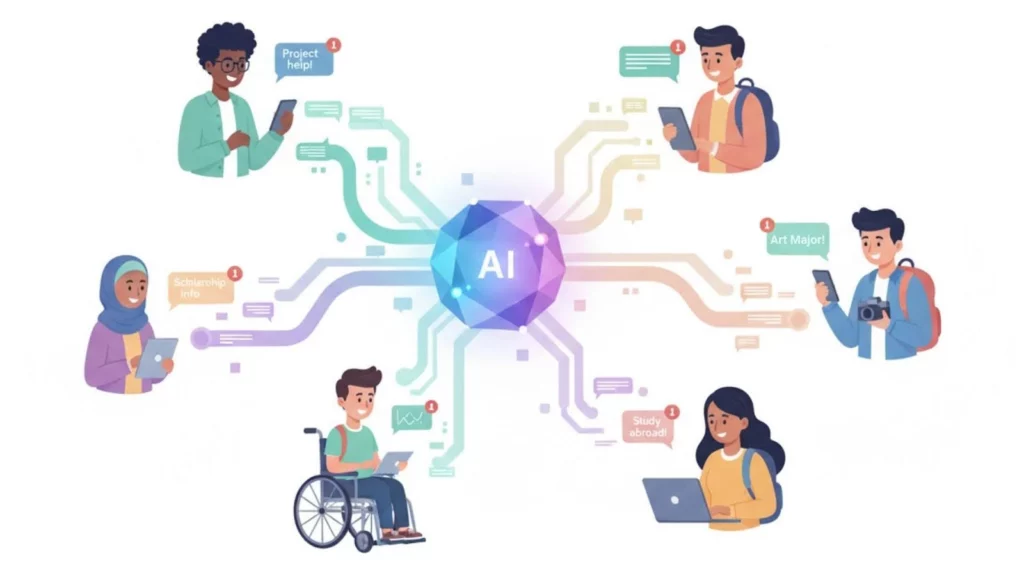
The core answer is simple. A chatbot is usually the conversation channel or application. Conversational AI is the technology stack that powers smarter conversations. Some chatbots are basic. Some use conversational AI. That means the debate around conversational AI vs. chatbot is really a debate about depth, not category.
Intelligence
A traditional chatbot often follows rules, buttons, or narrow intent maps. It works well when users ask known questions in known ways. By contrast, conversational AI can parse natural language, infer intent, and respond with more flexibility. That makes it more useful when customers phrase the same need in many different ways.
Context
Chatbots often treat each message as a separate event. Conversational AI can use history, user profile data, and previous steps in the workflow. As a result, it is better for conversations that evolve over time instead of ending in one turn.
Evolution
Most basic chatbots improve through manual rule updates. Conversational AI can improve through training data, analytics, feedback loops, retrieval layers, and model tuning. That does not mean it improves by itself. It means the system gives teams more ways to improve it at scale.
This shift is already affecting service strategy. Gartner says at least 70% of customers will use a conversational AI interface to start their customer service journey by 2028. That forecast shows why many companies now treat basic bots as a starting point, not the end state.
2. Chatbot Vs. Conversational AI: At-A-Glance Comparison
| Criteria | Chatbot | Conversational AI |
|---|---|---|
| Core role | Conversation interface for specific tasks | Intelligence layer for natural, contextual interaction |
| Typical logic | Rules, menus, fixed flows, narrow intents | NLP, machine learning, retrieval, reasoning, orchestration |
| Language handling | Works best with predictable inputs | Handles varied phrasing and ambiguous requests better |
| Context awareness | Often limited | Usually stronger across turns and channels |
| Personalization | Basic, often rule-based | Richer, often tied to customer history and live data |
| Deployment speed | Faster | Slower, because setup is deeper |
| Cost | Lower upfront cost | Higher upfront investment, greater long-term upside |
| Best fit | Routine, predictable support | Complex, high-volume, omnichannel support |
3. How Chatbots Relate To Conversational AI
Chatbots and conversational AI are not enemies. In fact, they often work together. A chatbot can be the front-end experience, while conversational AI provides the understanding, reasoning, and response layer behind it.
That is why many teams start with a simple chatbot, then add conversational AI later. They keep the same customer-facing channel, but they upgrade the system behind it. This path is practical because it lowers risk. It also lets the team prove demand before investing in richer automation.
So, the better question is not “Which one is real?” The better question is “How much intelligence does this chatbot need?”
Chatbot Vs. Conversational AI: Examples In Customer Service
1. Chatbot Examples In Customer Service
Chatbots shine when the request is simple, high-volume, and repeatable. That is why they remain useful in customer service even as AI systems get smarter. Salesforce says service teams see leading AI agent use cases in customer FAQ, order inquiries, conversation summaries, knowledge retrieval, and personalized recommendations. That list shows a split: some needs are simple and rule-based, while others need deeper AI support.
FAQ Automation
A basic chatbot can answer common questions such as refund policies, shipping windows, password resets, or store hours. This is one of the easiest wins because the answers change slowly and the user intent is clear.
Ticket Routing
A chatbot can ask a few quick questions, classify the issue, and send the case to billing, technical support, or sales. This reduces triage work and shortens response time.
Order Status Updates
A chatbot can check an order number and return a live status from the order system. Customers like this because it is fast and available at any time.
Appointment Scheduling
A chatbot can collect a date, location, and service type, then book or reschedule an appointment. Healthcare, home services, and beauty brands often use this pattern.
These cases work because the customer asks a direct question and expects a direct answer.
2. Conversational AI Examples In Customer Service
Conversational AI fits support journeys that need context, memory, and judgment. It handles cases that do not stay on one track. It also performs better when the system must combine conversation with personalization or business rules.
Personalized Product Recommendations
An AI assistant can look at browsing history, past purchases, budget, and intent. Then it can recommend products in a way that feels consultative, not generic. This matters because 67% of consumers are ready to delegate tasks like tracking orders and receiving personalized recommendations to AI.
Complex Support Conversations
When a customer says, “My order was late, I used the wrong address, and now I also need an exchange,” a basic bot may break. Conversational AI can break the issue into parts, ask follow-up questions, and move through the case step by step.
Multi-Step Troubleshooting
For software or device support, conversational AI can guide users through diagnosis. It can ask what changed, what error appeared, what device they use, and what they already tried. Then it can adjust the next step based on the answer.
Human-Like Virtual Assistance
Some brands use conversational AI to create a more natural support experience across voice and chat. This approach is gaining traction because 51% of consumers say they prefer interacting with bots when they want immediate service. Speed still matters most, but tone and continuity now matter more too.
In short, chatbots handle tasks. Conversational AI handles journeys.

Chatbot Vs. Conversational AI: Which One Should Your Business Choose?
1. Choose A Chatbot If
Your Use Cases Are Predictable
If users mostly ask the same ten or twenty questions, a chatbot is usually enough. You do not need a heavier AI stack just to answer stable requests.
Your Workflows Are Low-Complexity
Simple flows such as FAQ help, lead capture, order lookup, and appointment booking map well to chatbot logic. The fewer branches you have, the more a chatbot makes sense.
Your Budget Is Limited
A simple chatbot often costs less to launch and maintain. That makes it a smart first step for smaller teams or for teams that need to prove ROI early.
You Need Faster Deployment
If the goal is to launch in weeks rather than months, a chatbot wins. It lets teams automate repetitive questions quickly and learn from real traffic before they scale up.
2. Choose Conversational AI If
You Need Smarter, Contextual Interactions
If users describe problems in many different ways, context handling becomes essential. Conversational AI is better at understanding intent across messy language and longer exchanges.
Your Support Flows Are More Complex
Returns, claims, onboarding, technical diagnosis, and service recovery often involve more than one step. They also depend on customer history and business rules. This is where conversational AI creates clearer value.
You Want Better Personalization
Personalization needs memory and data. That is hard to do well with a basic chatbot. It is much easier with conversational AI that can access profiles, previous orders, or past support history.
You Need A More Scalable Solution
Conversational AI often becomes the better long-term choice when support volume is rising fast. Salesforce reports that 30% of service cases were resolved by AI in 2025, and 50% are expected to be resolved by AI in 2027. That trend supports a simple idea: richer AI systems scale better when the service operation grows in volume and complexity.
3. Hire A Technology Partner If
Internal Resources Are Limited
Many companies know what they want, but they do not have the team to design, test, integrate, and govern it. A partner helps close that gap.
The Project Requires Custom Development
Off-the-shelf tools work for common cases. However, businesses with unique processes often need custom orchestration, retrieval pipelines, analytics, security rules, or multilingual support.
You Need System Integrations
The real value appears when the assistant can connect with your CRM, order platform, help center, calendar, billing system, or internal workflow tools. That usually requires engineering, not just configuration.
You Want Faster Delivery With Lower Execution Risk
A good partner reduces rework. It also helps with data design, guardrails, escalation paths, and QA. That matters because the technology is moving fast. McKinsey found that 62% of survey respondents say their organizations are at least experimenting with AI agents, but most are still early in scaling them. Moving early is useful. Moving without a delivery plan is risky.
For a deeper dive, read:
- AI Voice Agent For Customer Service: Use Cases, Workflow, And Risks
- How To Build And Use AI Business Process Automation Effectively
- Enterprise AI Agents: Use Cases, Tools, And Implementation Guide

FAQs About Conversational AI Vs. Chatbot
1. Is Conversational AI The Same As Chatbots?
No. They overlap, but they are not the same. A chatbot is the application or channel that talks to the user. Conversational AI is the wider set of technologies that helps that application understand language, keep context, and respond intelligently.
Some chatbots do not use conversational AI at all. They follow scripts. Other chatbots use conversational AI deeply. So, conversational AI is broader, while chatbot is narrower.
2. Is ChatGPT A Conversational AI?
Yes. ChatGPT is a form of conversational AI because it is built to understand prompts and respond in natural language. OpenAI also presents ChatGPT as an AI chatbot for everyday use, which makes the distinction clearer: it is both a chatbot product and a conversational AI system.
3. Is ChatGPT A Chatbot Or An AI Agent?
By default, ChatGPT is best understood as an AI chatbot. However, when it uses agent features, it moves beyond normal chat. OpenAI explains that ChatGPT agent helps you accomplish complex online tasks by reasoning, researching, and taking actions on your behalf. That means the same product can behave like a chatbot in one mode and like an AI agent in another.
4. What Is True About AI Chatbots?
The true statement is this: AI chatbots are still chatbots, but they use stronger language intelligence than legacy bots. They can understand more natural phrasing, manage context better, and generate more flexible responses. Still, they are not all equal. Some are lightly enhanced rule bots. Others are full conversational AI systems with retrieval, memory, and orchestration behind them.
5. Why Is Conversational AI More Scalable Than Traditional Support?
Conversational AI scales better because it can handle many conversations at the same time, stay available around the clock, and automate steps that used to require manual triage. It also supports smarter routing, agent assistance, summaries, and knowledge retrieval.
That is one reason service leaders are investing more. Salesforce reports that 79% of service leaders say investment in AI agents is essential to meet business demands, while the same research says customers increasingly expect self-service and faster support. At the same time, Zendesk found that 64% of consumers are more likely to trust AI agents that embody traits like friendliness and empathy. Together, those signals show why businesses are moving past rigid support automation toward systems that are both scalable and more human in tone.
Conclusion
When businesses compare conversational ai vs chatbot, the real question is not which label sounds better. The real question is which system fits the workflow, customer journey, and support complexity behind the request. A chatbot works well for fixed and repetitive tasks. Conversational AI creates more value when the conversation needs context, personalization, and deeper problem-solving.
At Designveloper, we have seen that difference firsthand. As a company founded in 2013, we do not treat AI as a surface feature. We build it into real products and real operations. Our teams have delivered 100+ projects across 20+ industries, and we use that experience to help clients choose the right level of automation instead of overbuilding too early.
That is also why our work goes beyond simple bot deployment. We build AI-powered business software, custom software, web apps, mobile apps, and other production-ready systems that connect with how companies already work. Our project Song Nhi shows how conversational AI can support personal finance through natural interactions, OCR, and smart assistance. Meanwhile, Lumin shows how we design document-centered experiences that improve editing, collaboration, and digital signing in practical business settings.
So, if your business only needs quick answers to predictable questions, a chatbot may be enough. But if you want a scalable conversational ai chatbot solution that can handle richer support flows, integrate with your systems, and create better customer experiences, we are ready to help. At Designveloper, we combine AI capability, software engineering, and product thinking to turn ideas into software that works in the real world.
Also published on

Share post on










Related Articles


Is Vibe Coding Legal? Ownership, Copyright, and Release Risks
Is Vibe Coding Legal? Ownership, Copyright, and Release Risks Published October 16, 2026
How to Build a Chatbot with LangChain in Python: 6 Steps
How to Build a Chatbot with LangChain in Python: 6 Steps Published October 16, 2026
Agentic AI Replacing AI: How Workflows Change and When to Switch
Agentic AI Replacing AI: How Workflows Change and When to Switch Published October 16, 2026