











Best Conversational AI Platforms: 12 Enterprise Options In 2026

Choosing a conversational ai platform for enterprise use is harder in 2026 because the market is wider, buyers expect faster time to value, and many vendors now promise both automation and agentic AI. A better buying process starts with one question: does the platform help your team complete real work, or does it only generate good demos?
The category is growing fast. Grand View Research estimates the market was USD 11.58 billion in 2024 and is projected to reach USD 41.39 billion by 2030, growing at 23.7% CAGR. McKinsey reports that 88% of organizations use AI in at least one business function, while only about one-third have begun to scale AI. Buyers therefore need a conversational ai platform that can ground answers, trigger systems, hand work to humans, and stay governed in production.
This review covers how a conversational ai platform works, the capabilities that matter most, the enterprise platforms worth shortlisting in 2026, and how to choose without getting trapped by hype.
Recommended for you:
- Top 10 Best AI Chatbots We’ve Tried And Tested
- 11 Best AI Chatbot Platforms to Use
- Best AI Chatbots For Businesses: Top Tools Compared
What Is A Conversational AI Platform?
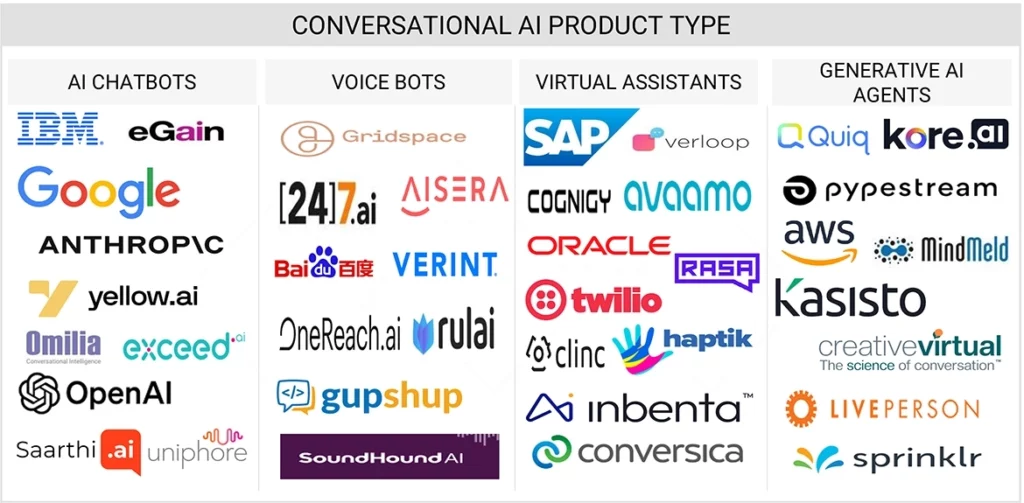
A conversational ai platform is the software layer that lets an enterprise build, deploy, manage, and improve AI-driven conversations across chat, voice, messaging, and internal work tools. It usually combines language understanding, dialogue logic, knowledge retrieval, workflow automation, analytics, and human handoff in one system.
That definition is important because enterprise buyers rarely need conversation alone. They need a platform that can answer policy questions, search internal content, trigger actions in systems of record, route exceptions, and log outcomes for review. In other words, the platform must do more than talk. It must help finish work.
Most enterprise platforms now sit on a spectrum. Some are broad orchestration platforms for employee support, customer service, and back-office workflows. Others are stronger in voice automation, contact center use cases, or cloud-native bot building. As a result, the best conversational ai platform depends less on marketing claims and more on your operating model, channels, and risk requirements.

How A Conversational AI Platform Works
A conversational ai platform usually follows a clear flow.
- First, it receives user input from chat, voice, email, messaging, or an internal work app.
- Next, it interprets intent, entities, and context. Some platforms rely more on structured flows. Others use large language models and retrieval.
- Then, it decides what should happen next. It may answer from a knowledge source, ask a clarifying question, trigger a workflow, create a ticket, update a record, or escalate to a human.
- After that, it connects to enterprise systems such as CRM, ITSM, HRIS, ERP, CCaaS, telephony, or document repositories.
- Finally, it records analytics, confidence, failure paths, handoffs, and user outcomes so teams can improve quality over time.
This is why platform architecture matters so much. A conversational ai platform becomes more valuable when it understands context, respects permissions, and executes approved actions inside existing systems. Without those pieces, even a polished assistant becomes another silo.
Core Capabilities To Evaluate In A Conversational AI Platform
1. Natural Language Understanding And Context Retention
Start here because conversation quality breaks first when understanding is weak. The platform should recognize intent, remember context across turns, and keep track of user state, business rules, and prior actions. This matters in long workflows such as claim status, onboarding, leave requests, order updates, and troubleshooting.
However, language understanding alone is not enough. Enterprise buyers should also test grounding. The platform should pull answers from approved sources, respect role-based access, and avoid confident but wrong responses. Strong context retention reduces rework, but controlled retrieval reduces risk.
2. Workflow Orchestration And Enterprise Integrations
A conversational ai platform becomes useful when it can trigger systems, not just answer questions. So, look for connectors, APIs, event handling, action frameworks, and workflow design tools. The goal is simple: move from “Here is the policy” to “I completed the task.”
This is the dividing line between a lightweight assistant and a true enterprise platform. If your use case includes ticket creation, appointment scheduling, order lookup, approvals, account updates, document intake, or collections, orchestration should be a top buying criterion.
3. Production Readiness And Governance
Production readiness separates serious enterprise platforms from attractive demos. Gartner warned that at least 30% of GenAI projects would be abandoned after proof of concept by the end of 2025. That is why governance must be part of the platform, not a later add-on.
Check for access controls, audit trails, model controls, fallback logic, prompt and tool management, testing environments, observability, analytics, versioning, and policy controls. Also ask how the platform handles sensitive topics, disclaimers, hallucination risk, and data residency. Enterprises do not buy a conversational ai platform only for speed. They buy it for safe scale.
4. Hybrid Support And Human Handoff
No enterprise should expect full automation on day one. A better goal is hybrid support. The platform should know when to answer, when to act, and when to route to a live agent with context attached.
That handoff experience matters because broken escalation destroys trust. If users must repeat everything after escalation, the platform adds friction instead of removing it. Therefore, test handoff rules, transcript transfer, intent carryover, routing logic, and post-handoff reporting before you sign a contract.
Related reading:
- Agentic AI Security: Risks, Core Architecture, Solutions
- A Practical Guide To AI Agent Architecture With Diagrams
- AI Agent Orchestration: How Multi-Agent Workflows Work In Practice

A Quick Look at the Best Conversational AI Platforms
This table gives a fast enterprise view of five widely shortlisted platforms. It focuses on fit, not hype.
| Platform | Best For | Main Strengths | Watch-Out |
|---|---|---|---|
| DRUID AI | Workflow-heavy enterprise automation | Strong fit for AI agents tied to real business processes, document workflows, and low-code design | Better for process automation than pure developer-first bot building |
| Kore.ai | Large enterprises with service, work, and process use cases | Broad agentic platform, prebuilt applications, multi-agent orchestration, and flexible build options | Can feel heavy if you only need one narrow workflow |
| Google Dialogflow CX | Cloud-native bot and IVR teams | Strong flow control, voice and text support, and tight Google Cloud alignment | Usually needs more engineering effort than packaged enterprise suites |
| Amazon Lex | AWS-first builders and embedded conversational interfaces | Good for custom voice and text experiences with backend execution via AWS | More of a build-your-own service than a full enterprise operations suite |
| Cognigy.AI | Enterprise contact center and voice automation | Strong CX focus, hybrid AI control, and mature voice capabilities | Best fit for CX-led teams, not every internal workflow program |
12 Best Conversational AI Platforms In 2026
1. DRUID AI
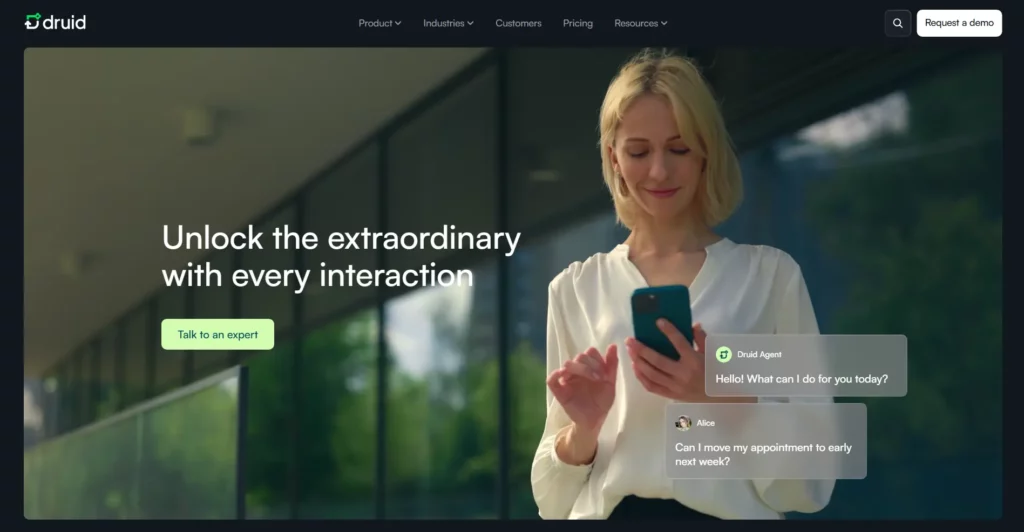
DRUID AI is a strong choice for enterprises that want AI agents connected to real workflows, not isolated chat interfaces. The company positions the platform as an enterprise AI agent layer for complex process automation. Its official documentation also highlights low-code and no-code design, document processing, and extensibility for more technical teams.
This makes DRUID especially relevant for HR workflows, approvals, document-heavy operations, and internal service automation. It stands out when the buying team cares about business process execution and role-based workspaces.
- Best fit: Operations teams, back-office automation, document workflows, and internal assistants
- Why it stands out: Strong workflow focus and practical enterprise framing
- Main trade-off: Less ideal if your main need is a lightweight developer toolkit for custom consumer chat experiences
Related reading:
- AI Chatbot Integration: How To Connect Chatbots With Business Systems
- How To Build An AI Chatbot With Long-Term Memory? (Guide)
- AI Chatbot Development: A Step-By-Step Guide
2. Kore.ai
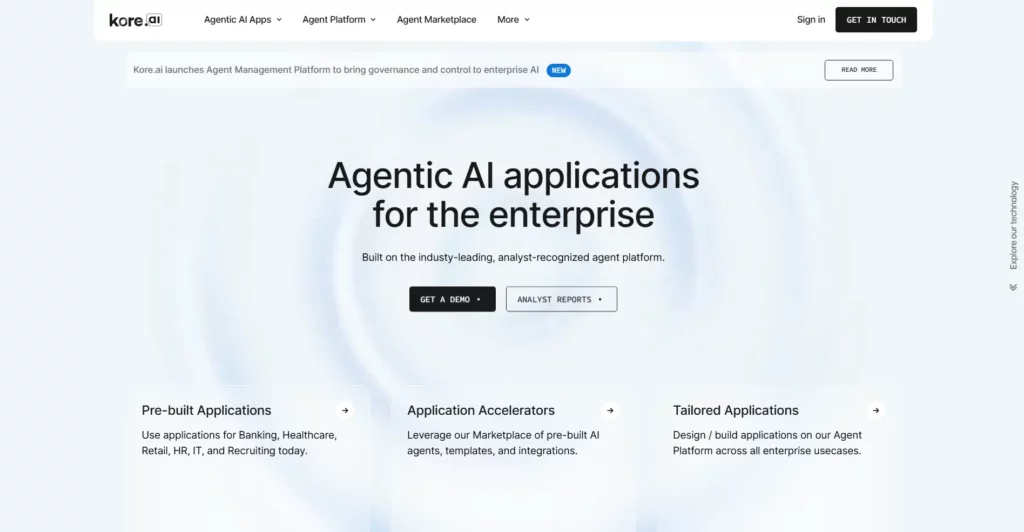
Kore.ai remains one of the broadest enterprise platforms in this category. It targets customer service, employee productivity, and process automation in one stack. It also supports no-code and pro-code development, multi-agent orchestration, memory, tools, and search-oriented retrieval. Kore.ai says teams can use no-code, low-code, and pro-code tools, while its main platform page highlights prebuilt applications and marketplace accelerators.
Kore.ai is often strongest when an enterprise wants one strategic platform for several departments. For example, a buyer may want HR support, IT help, banking workflows, and customer-facing automation under shared governance.
- Best fit: Large enterprises running several AI programs at once
- Why it stands out: Breadth, orchestration, and packaged enterprise use cases
- Main trade-off: Higher platform scope than many mid-market teams need
3. Google Dialogflow CX
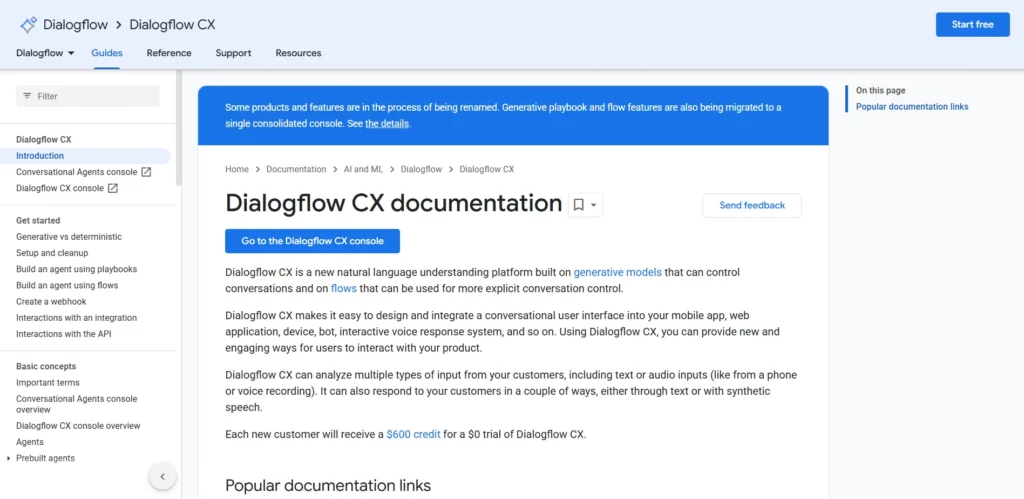
Google Dialogflow CX is still a serious option for enterprises that need structured conversation design, voice support, and strong cloud integration. Google describes it as a platform built on generative models and explicit conversational flows. That combination is useful when teams want tighter control over dialogue logic.
Dialogflow CX works well for customer support bots, IVR modernization, and transactional service journeys. It is also a good fit for engineering teams already committed to Google Cloud. Still, it usually requires more technical design than turnkey enterprise suites.
- Best fit: Cloud-native teams building custom chat and voice journeys
- Why it stands out: Explicit flow control and strong Google ecosystem fit
- Main trade-off: Less packaged for business-led deployments
4. Amazon Lex
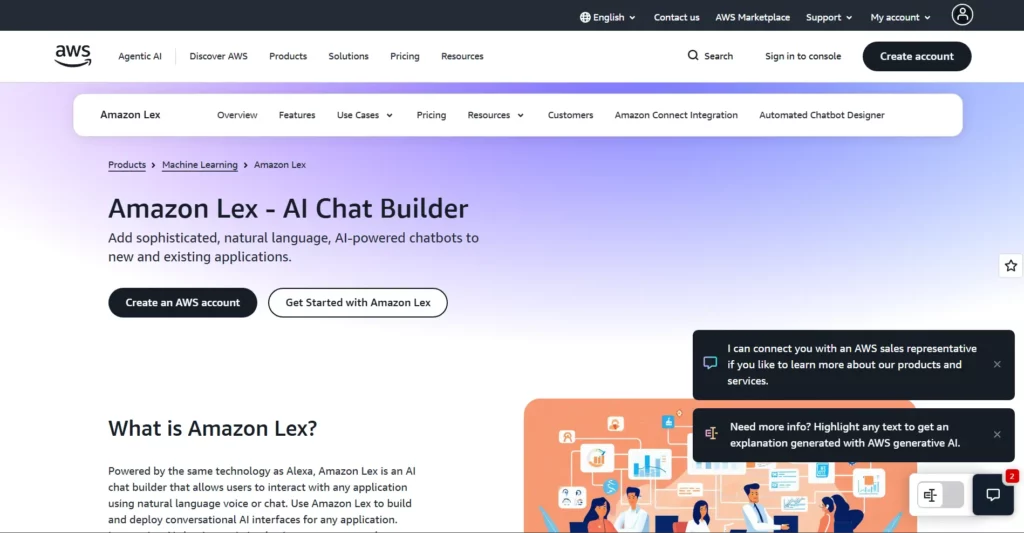
Amazon Lex is a strong AWS-native choice for enterprises that want to build voice and text interfaces directly into applications. AWS describes Lex as a fully managed AI service for building conversational interfaces, with integration to Lambda for backend actions and deployment across contact centers, chat platforms, and devices.
That makes Lex attractive when the buyer already has AWS operations, internal developers, and a clear use case. It is especially useful for teams that want to connect natural language directly to custom business logic.
- Best fit: AWS-first teams building custom conversational experiences
- Why it stands out: Strong backend execution path and cloud-native flexibility
- Main trade-off: You still need to design more of the full enterprise solution yourself
5. Cognigy.AI
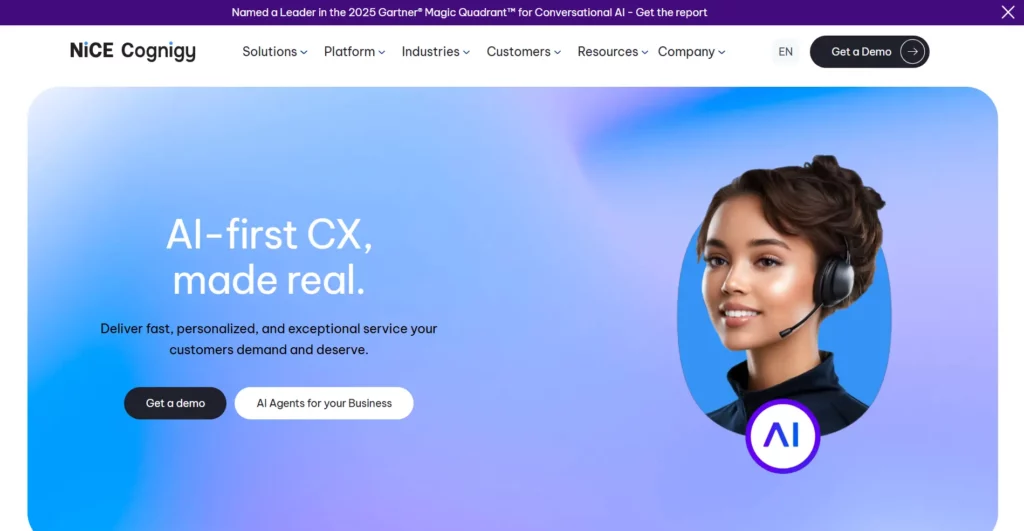
Cognigy.AI is one of the strongest enterprise platforms for contact center automation and AI voice experiences. The company positions the product around full-stack AI agents for CX, with a mix of agentic behavior and deterministic control. Its platform page states support for 25K+ supported concurrent interactions and 110+ prebuilt tools & integrations.
Those capabilities matter in high-volume service environments where reliability, scale, and orchestration all matter. Cognigy is often a better fit for customer-facing support and voice programs than for broad internal enterprise search.
- Best fit: Enterprise contact centers and voice-heavy CX operations
- Why it stands out: Hybrid control model, voice maturity, and enterprise concurrency
- Main trade-off: More CX-centric than some cross-enterprise platforms
6. Retell AI
Retell AI is a specialized voice agent platform. It is built for teams that want phone automation, not a broad enterprise assistant layer. The company focuses on human-like call handling, task execution, and operational scale. Its documentation highlights inbound and outbound support, telephony integration, and testing and monitoring capabilities.
That focus makes Retell attractive for appointment booking, customer service, collections, intake, and phone-based support operations. It is a smart pick when voice quality and call workflow design matter more than omnichannel breadth.
- Best fit: Phone automation and call-center-like workflows
- Why it stands out: Purpose-built voice focus and clean deployment model
- Main trade-off: Narrower than full conversational ai platform suites
7. Synthflow
Synthflow is another strong voice-first platform, but it leans hard into ease of deployment. The company describes its product as a voice AI operating system for designing, launching, and operating voice agents with configurable workflows, telephony, and analytics. It also says agents can escalate to humans when needed.
This makes Synthflow useful for sales calls, support routing, booking, follow-up, and structured service workflows. It is especially appealing to teams that want fast voice automation without building everything from scratch.
- Best fit: Rapid rollout of voice AI for support and sales operations
- Why it stands out: Speed, no-code flow design, and telephony focus
- Main trade-off: Best when voice is the main channel, not just one channel among many
8. Bland
Bland is built for enterprise voice automation with a stronger infrastructure and control story than many newer voice vendors. The company emphasizes self-hosting, low latency, open APIs, testing, and knowledge gap detection. That positioning makes it attractive to teams that care about engineering control and security posture.
Bland is not just for demos. It aims at production-grade phone automation. So, it often fits enterprise buyers that want to own more of the runtime behavior and integration design.
- Best fit: Technical teams that want controlled enterprise voice deployment
- Why it stands out: Self-hosting, API flexibility, and production discipline
- Main trade-off: Better for technically mature teams than for non-technical service departments
9. Sprinklr
Sprinklr is not only a conversational AI vendor. It is a larger AI-native customer experience platform. That matters because many enterprises want conversational automation inside a broader service stack. Sprinklr says its service platform supports 30+ voice, social and digital channels from one unified platform.
So, Sprinklr is strongest when the buyer wants omnichannel service, routing, agent assistance, and AI conversation management in one environment. It is less about building a standalone bot and more about unifying customer-facing operations.
- Best fit: Enterprises with complex omnichannel customer service
- Why it stands out: Unified CX orchestration across digital, social, and voice
- Main trade-off: Broader suite complexity if you only need one assistant
10. Moveworks
Moveworks is one of the clearest leaders for employee support rather than customer-facing support. The company frames its platform as an AI assistant layer for the entire workforce, with deep integrations, workflow automation, and enterprise security. It is especially strong in IT, HR, and internal operations.
That makes Moveworks a better choice for internal help, knowledge access, and workflow completion than for public contact-center voice automation. Enterprises that want one conversational layer across apps for employees should keep it on the shortlist.
- Best fit: Internal employee support, IT, HR, and enterprise knowledge access
- Why it stands out: Workforce focus, integrations, and strong governance story
- Main trade-off: Not the best primary choice for public-facing service channels
11. Mosaicx
Mosaicx focuses on enterprise voice recognition and digital messaging for customer interactions. Its messaging is clear: help users find information quickly and resolve issues without an agent. That focus is valuable for high-volume service environments, especially where voice and outreach still matter.
Mosaicx also fits organizations that need proactive messaging, reminders, alerts, and automated support across voice and text. So, it is a strong operational platform for service-heavy environments, though not the first name most buyers choose for cross-enterprise internal assistant programs.
- Best fit: Voice and messaging automation in enterprise customer operations
- Why it stands out: Practical service automation and strong enterprise CX fit
- Main trade-off: More focused on CX operations than broad internal orchestration
12. Yellow.ai
Yellow.ai has kept its place on many enterprise shortlists because it blends customer experience, employee experience, analytics, and no-code build tools in one platform. Its platform page highlights over 97% intent accuracy, 100+ out-of-the-box integrations, 35+ channels, and voice AI in 135+ languages.
That breadth makes Yellow.ai a flexible option for enterprises that want one platform for several channels and use cases. However, breadth can also create rollout sprawl. So, buyers should still anchor the program around a few high-value workflows first.
- Best fit: Omnichannel enterprises that want CX and EX automation together
- Why it stands out: Broad channel support and accessible platform design
- Main trade-off: Needs disciplined scoping to avoid overextension
Enterprise Use Cases For Conversational AI Platforms
1. IT Service Management
ITSM is one of the fastest ways to prove value because request volumes are high and tasks are repetitive. A conversational ai platform can answer device questions, reset passwords, route issues, check ticket status, create incidents, and guide troubleshooting inside collaboration tools.
The strongest platforms do not stop at FAQ responses. They connect to ITSM systems, apply routing logic, and escalate with context. As a result, they reduce ticket noise while improving user experience.
2. HR And Employee Services
HR is another strong fit because employees constantly ask about leave, policies, payroll, onboarding, benefits, approvals, and internal processes. These journeys are often fragmented across portals and systems. A conversational ai platform can unify that experience.
Microsoft’s own deployment is a useful signal here. The company reported up to 31% fewer support tickets and a 25% increase in response accuracy from early Employee Self-Service Agent results. That does not mean every buyer will see the same outcome. Still, it shows why employee-service automation has become a top enterprise use case.
3. Enterprise Knowledge Access
Knowledge access looks simple, but it is often one of the highest-value use cases. Teams lose time jumping between SharePoint, intranets, policy libraries, ticket systems, wikis, and document repositories. A conversational ai platform can reduce that search friction.
However, enterprise knowledge access only works well when the platform respects permissions, retrieves from trusted sources, and shows clear grounding. Otherwise, speed creates risk. That is why retrieval quality and access control matter as much as language quality.
4. Workflow Automation
This is where many enterprises get the biggest long-term return. Workflow automation includes claims intake, appointment scheduling, billing actions, document collection, collections, service updates, approvals, and case routing. These are not just conversation problems. They are execution problems.
Therefore, the right conversational ai platform should orchestrate actions across systems, not just deliver polished answers. If the platform can understand, decide, act, and escalate, it becomes part of the operating model instead of another interface layer.
Explore more:
- Enterprise AI Agents: Use Cases, Tools, And Implementation Guide
- How To Build And Use AI Business Process Automation Effectively
- AI Agent for Customer Service: Best Use Cases and Examples
How To Choose A Conversational AI Platform For Enterprise
Choose a conversational ai platform by use case first, then by vendor. That order prevents expensive mistakes.
- Start with one measurable workflow. Pick a journey with clear volume, clear pain, and clear data. Good examples include HR policy support, ticket triage, appointment booking, or order status.
- Map the systems of record. List the tools the platform must read from and write to. A great demo means little if the platform cannot connect cleanly to your real environment.
- Choose the primary channel. Some platforms are strongest in chat. Others are built for voice or contact center use. Your main channel should shape the shortlist.
- Test grounding, permissions, and failure paths. Ask vendors to show source attribution, role-aware answers, fallback behavior, and human handoff. This is where production risk appears.
- Check governance early. Review admin controls, audit trails, testing, analytics, policy controls, and model strategy before procurement moves too far.
- Measure outcomes that matter. Track containment, response accuracy, ticket deflection, handle time, completion rate, escalation rate, and user satisfaction.
- Scale only after one workflow works. Enterprises often fail because they launch too many use cases at once. Expand after the first workflow proves value.
One more point matters. Buyers should not only compare platform features. They should also compare delivery complexity. A platform that looks cheaper may cost more if it needs heavy custom integration, prompt tuning, governance work, or operations support after launch.
For a deeper dive, read:
- Best AI Voice Agents: Top Platforms For Real Business Workflows
- AI Agent Pricing Framework: Cost Models, Hidden Fees, And ROI Tips
- Top AI Agent Companies: Industry Leaders to Watch

FAQs About Conversational AI Platform
1. What Are The Key Features Of A Conversational AI Platform?
The key features usually include natural language understanding, context handling, knowledge retrieval, workflow orchestration, API and system integrations, analytics, multilingual support, voice or chat channel support, governance controls, and human handoff. Enterprise buyers should also look for testing, observability, fallback logic, and permission-aware search.
2. Is There A Free Conversational AI Platform?
Yes, but free options are usually best for evaluation, not full enterprise deployment. Google Cloud offers $600 in Conversational Agents Flows credits and $1000 in Playbooks credits for new users. AWS also offers 10,000 text requests and 5,000 speech Lex requests per month for 12 months through its free tier. These are useful for prototypes, basic tests, and small proofs of concept. However, enterprise rollout still requires integration work, governance, analytics, and operations planning.
3. How Much Technical Skill Do We Need To Deploy Conversational AI Platforms?
It depends on the platform and the use case. No-code and low-code tools reduce effort for conversation design and workflow setup. Yet enterprise deployment still needs business owners, integration support, security review, content governance, and operations monitoring. In short, a low-code platform lowers the build barrier, but it does not remove enterprise delivery work.
4. Who Is A Leader In Conversational AI?
There is no single leader for every use case. In 2026, the strongest names usually vary by need. Kore.ai, DRUID AI, and Yellow.ai are common choices for broader enterprise orchestration. Google Dialogflow CX and Amazon Lex are strong for cloud-native build programs. Cognigy.AI, Sprinklr, and Mosaicx are strong for CX and contact center scenarios. Moveworks stands out for employee support. Retell AI, Synthflow, and Bland are strong when voice automation is the main priority.
So, the better question is not “Who is the leader?” It is “Who leads for our workflow, channel, governance model, and integration stack?” That question produces better buying decisions.
The best conversational ai platform is the one that fits your real operating model. Enterprise buyers should look past glossy demos and test how well a platform understands context, connects to systems, completes actions, and hands work to humans when needed. Teams that do that usually shortlist faster and deploy with less rework. If your organization needs help turning AI from pilot ideas into production-ready workflows, Designveloper can help scope the use case, map the delivery path, and build the software, integrations, and governance layer around the platform you choose.
Conclusion
The best conversational ai platform is not the one with the loudest pitch. It is the one that fits real workflows, integrates with core systems, and scales safely across the business. That is also how we approach AI at Designveloper. We do not treat enterprise AI as a standalone demo. We turn it into production-ready software, intelligent workflows, and digital products that solve real operational problems.
At Designveloper, we bring that mindset from years of software delivery. We were founded in 2013 and have delivered 100+ projects across 20+ industries, supported by a 100+ person team working across 50+ technologies. Today, our services span AI-powered business software, custom software development, web development, mobile app development, and VOIP solutions. More importantly, we already have practical AI proof points. Our work includes Song Nhi for AI financial assistance, Lumin for document intelligence, Aha for operational automation, Lodg for finance and accounting support, and HRM for internal workflow assistance.
So, when enterprises evaluate a conversational ai platform, we look beyond feature lists. We focus on business fit, workflow design, system integration, governance, and long-term value. That is where real ROI comes from. If your team wants to move from AI ideas to usable products and workflows, we can help you choose the right platform, shape the right use case, and build the software around it.
Also published on

Share post on










Related Articles


How To Build A RAG System: Step-By-Step (New Guide)
How To Build A RAG System: Step-By-Step (New Guide) Published October 19, 2026
8 Best AI Onboarding Tools For Faster Employee Ramp-Up In 2026
8 Best AI Onboarding Tools For Faster Employee Ramp-Up In 2026 Published October 19, 2026
Is Vibe Coding Legal? Ownership, Copyright, and Release Risks
Is Vibe Coding Legal? Ownership, Copyright, and Release Risks Published October 16, 2026