














What Is B2B Ecommerce? Types, Models, Platform Features, Examples

Business buyers expect an efficient online purchasing experience, but B2B transactions have rules that consumer stores rarely need to handle. What makes B2B ecommerce different, and how can a business choose a model and platform that supports its buying process? This guide explores the answers.
What Is B2B Ecommerce?
B2B ecommerce, or business-to-business electronic commerce, is the digital exchange of goods, services, and payments between companies. Instead of selling to an individual shopper, a B2B seller serves organizations that buy for operations, resale, production, or professional use. It includes customer-facing activities such as account registration, catalog browsing, quoting, ordering, and payment, as well as the back-office processes that make an order possible.
A manufacturer selling components to a distributor, a wholesaler supplying retailers, and a software company selling annual subscriptions to an enterprise are all B2B ecommerce examples. The term can also cover a self-service customer portal, an online wholesale store, a procurement integration, or a marketplace.
The word ecommerce can make B2B sound like a standard online store. In practice, the buying process is often more involved. Buyers may need company-specific prices, approval from a manager, a purchase order, repeat ordering, credit terms, or a connection to the seller’s ERP and inventory systems. A good B2B ecommerce experience makes those requirements easier to complete online without forcing buyers to email or call for routine transactions.
For example, a restaurant group may log in to a food-service supplier’s portal, see contract prices for its locations, add products to a recurring order, submit a purchase order, and track delivery. The transaction is completed online, but the portal must still use the customer’s approved assortment, delivery rules, payment terms, and account structure.
B2B ecommerce is broader than a branded website. It can include:
- A self-service customer portal for existing accounts.
- An online wholesale store for approved retailers.
- A procurement integration that lets a buyer order through its purchasing system.
- A marketplace that connects multiple business sellers and buyers.
- A sales-assisted commerce experience where buyers request a quote online and a representative finalizes the deal.
The main goal is not simply to move a paper order form to the web. It is to give buyers a reliable digital path through the way their organization already purchases.
How B2B Ecommerce Works
A B2B ecommerce transaction usually begins when a buyer is identified as part of a company account. That account controls what the buyer can see and do, including available products, negotiated prices, spending limits, delivery locations, and payment methods.
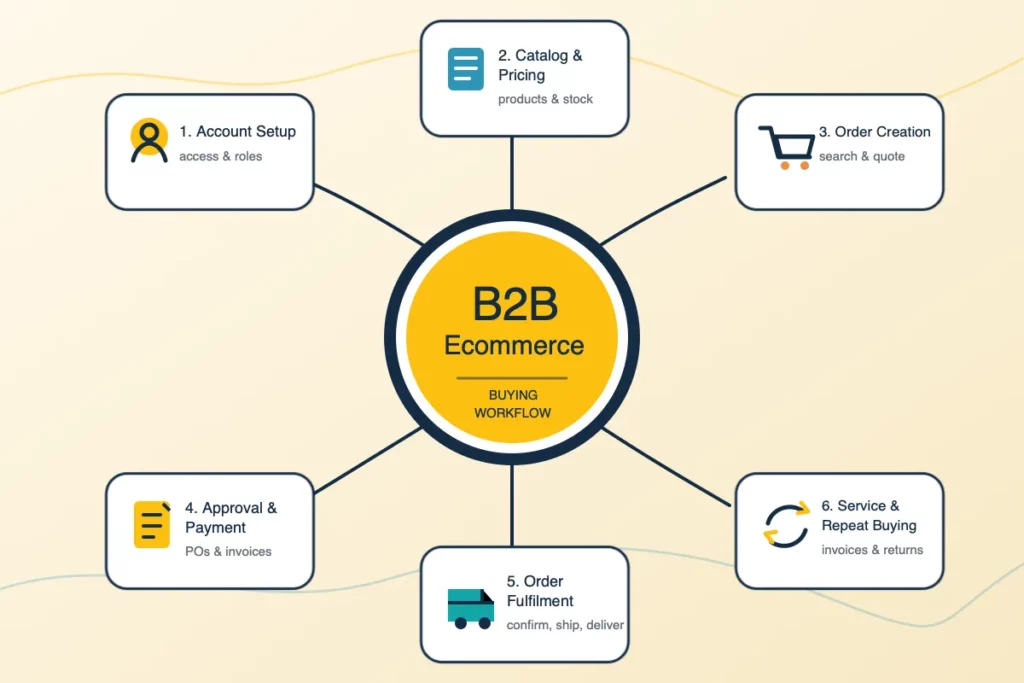
The exact flow differs by industry, but most B2B commerce operations follow these stages:
- Account setup and access. The seller creates or approves a company account, then assigns users and roles such as purchaser, approver, or account administrator.
- Catalog and price presentation. The platform shows the products, specifications, stock information, and price rules that apply to that customer or customer group.
- Order creation. A buyer searches by product name, SKU, or part number; uploads an order list; reorders past purchases; or requests a quote for a large or configurable order.
- Approval and payment. The order may pass through an internal approval rule, use a purchase order number, or be paid by card, bank transfer, invoice, or an agreed credit arrangement.
- Order fulfilment. The commerce platform sends the order to the ERP, warehouse, manufacturing, or fulfilment system. The seller confirms availability, ships or schedules delivery, and provides status updates.
- Service and repeat buying. Buyers retrieve invoices, manage returns, place recurring orders, and use their order history to purchase again.
The platform is only one part of this process. A simple storefront that does not reflect the seller’s inventory, customer records, tax logic, or order management rules can create more work rather than less. The most useful B2B implementations connect the buyer-facing experience to the systems employees use to price, fulfil, invoice, and support orders.
Related article: Best Examples of B2B eCommerce Website Development
B2B Ecommerce Vs B2C Ecommerce
B2B and B2C ecommerce share basic functions such as product discovery, carts, checkout, and order tracking. Their buying contexts are different. B2C usually optimizes for an individual who can decide and pay within minutes. B2B often supports repeat purchases made on behalf of a company, with multiple people, policies, and systems involved.
The table below compares the decisions a B2B platform must usually support with a typical consumer purchase journey.
| Area | B2B ecommerce | B2C ecommerce |
|---|---|---|
| Buyer | An organization with several users and roles | An individual consumer |
| Decision process | May involve procurement, budget owners, and approvers | Usually completed by the shopper |
| Pricing | Contract, tiered, volume-based, or customer-specific | Usually public and consistent |
| Order size and frequency | Often larger, recurring, or planned | Often smaller and less predictable |
| Payment | Purchase orders, invoices, credit terms, bank transfer, or card | Usually card, wallet, or pay-later service |
| Product data | Requires SKUs, technical specifications, compatibility, and documents | Focuses more on benefits, images, reviews, and convenience |
| Service model | Account management, quotes, custom terms, and operational support | Customer support, delivery, and returns |
| Integrations | Often connects to ERP, CRM, PIM, OMS, and procurement tools | Often connects to payments, fulfilment, marketing, and support tools |
These differences do not mean B2B sites should feel difficult to use. Buyers increasingly expect clear search, useful product information, fast reordering, and transparent order status. The design challenge is to combine that convenience with business rules that a consumer checkout rarely needs.
See more: Ecommerce best practices that improve online shopping experiences across the customer journey.
Common Types And Examples Of B2B Ecommerce
B2B ecommerce can describe several commercial relationships. The relationship determines the catalog, account model, pricing logic, and fulfilment process the business needs.
The software and digital-services model shares several requirements with SaaS application development, including tenant access, subscriptions, security, integrations, and ongoing operations.
| Type | What it involves | Illustrative example |
|---|---|---|
| Manufacturer-to-distributor | A producer sells parts, materials, or finished goods to distribution partners. | An industrial equipment maker lets distributors order spare parts, check availability, and access technical documents. |
| Manufacturer-to-business | A producer sells directly to companies that use its products. | A packaging manufacturer provides an ordering portal for food and cosmetics brands. |
| Wholesaler-to-retailer | A wholesaler sells inventory to retail stores, dealers, or resellers. | A beverage wholesaler allows stores to place recurring stock orders and schedule delivery. |
| Distributor-to-business | A distributor supplies operating goods to organizations. | An office-supply distributor gives corporate customers account-based catalogs and approval controls. |
| Software and digital services | A provider sells subscriptions, licenses, usage, or professional services to organizations. | A SaaS vendor offers team plans, role management, invoices, and annual contract renewal. |
| B2B marketplace | A platform enables multiple sellers to offer products to business buyers. | A marketplace helps procurement teams compare qualified suppliers for industrial goods. |
Well-known businesses such as Amazon Business, Alibaba.com, and Grainger illustrate different parts of the category: business purchasing, supplier discovery, and industrial distribution. Their models should not be copied blindly. A regional distributor with contract customers may need a focused portal and ERP integration, while a marketplace must also solve seller onboarding, product normalization, commissions, and trust.
See more: Ecommerce business ideas for evaluating different online commerce opportunities.
Key Features Of A B2B Ecommerce Platform
A B2B platform should be selected or designed around the work buyers and internal teams need to complete. Feature lists are useful, but a feature only creates value when it supports a real policy or removes a manual step.
- Company accounts and roles.
The platform should let one organization have multiple users, locations, and permissions. Typical roles include buyer, approver, finance contact, and administrator. The account model should support a buyer who can order for one branch but not another, or an approver who can review an order without changing the catalog.
- Customer-specific catalogs and pricing.
B2B sellers commonly need price lists by account, customer segment, quantity, contract, geography, or currency. The system should also handle minimum order quantities, pack sizes, product eligibility, discounts, and promotions without exposing confidential terms to the wrong account.
- Search and detailed product information.
Buyers often know the part number or need to compare technical attributes. Strong search, filters, product specifications, compatibility data, stock visibility, downloadable documents, and bulk-order entry reduce the time needed to find the right item.
- Quotes, purchase orders, and flexible payment.
Not every B2B sale ends in a card payment. The platform may need quote requests, negotiated carts, purchase order capture, invoice payment, credit-limit checks, tax handling, and payment status visibility.
- Reordering and order management.
Order history, saved lists, recurring orders, quick order forms, CSV upload, and real-time order status make routine purchasing faster. Internal teams need tools to amend orders, handle exceptions, and communicate changes before fulfilment fails.
- System integrations.
The platform should exchange dependable data with the ERP, product information management (PIM), customer relationship management (CRM), order management system (OMS), warehouse system, tax service, and payment provider where relevant. The integration design needs clear ownership of data such as prices, stock, customer accounts, and order status.
For a wider view of the infrastructure, data, security, and operating decisions behind a connected platform, see this guide to cloud application development.
- Security and administration.
Business accounts require secure authentication, role-based access, audit trails, account approval controls, and protection of commercial data. Teams should also define who can update catalog data, approve price changes, and resolve integration errors.
See more: The essential elements of an ecommerce website and how they shape a usable shopping experience.
Benefits And Challenges Of B2B Ecommerce
B2B ecommerce can improve the buying experience and make sales operations easier to scale. Its value comes from reducing friction in repeatable work, not from replacing every conversation with a checkout page.
Common benefits include:
- Faster self-service purchasing. Customers can order, retrieve documents, and check status outside a sales representative’s working hours.
- More consistent commercial rules. The platform can apply approved catalogs, price lists, eligibility rules, and payment terms consistently.
- Lower administrative load. Digital order capture can reduce manual rekeying, order-status calls, and repeated requests for invoices or product information.
- Better customer visibility. Search behavior, abandoned carts, purchase history, and quote activity can reveal product demand and account needs when handled responsibly.
- A scalable route to new channels. A seller can support direct ordering, partner portals, and procurement integrations without building separate manual processes for each account.
The same initiative can introduce real challenges:
- Messy commercial data. Incorrect product attributes, duplicate customer records, or outdated price lists quickly undermine buyer trust.
- Complex pricing and exceptions. Legacy agreements, sales discretion, and local tax rules can be difficult to translate into clear digital rules.
- Integration dependencies. Inventory, order, credit, and fulfilment data may live in systems that were not designed for real-time exchange.
- Adoption by customers and sales teams. Customers need a reason to change familiar ordering habits, while sales teams need visibility and a clear role in the new process.
- Operational ownership. A site launch does not settle who maintains product data, resolves failed orders, approves accounts, or prioritizes improvements.
Treat these challenges as design inputs. A phased release that starts with a high-volume, low-exception ordering path often produces more useful learning than trying to digitize every account and exception at once.
Building B2B Ecommerce Around Connected Buying Workflows
The most important planning question is not, “Which storefront features do competitors have?” It is, “What must happen from a buyer’s request to a fulfilled, paid order, and where does that process break today?”
Map one complete buying workflow before deciding on a platform. For a distributor, that could be: buyer searches a contract catalog, selects items in approved pack sizes, submits a purchase order, receives budget approval, gets a credit check, confirms stock, schedules delivery, and receives an invoice. Each step has an owner, a system of record, a rule, and a possible exception.
Use a workflow map to make platform decisions concrete:
| Workflow question | Why it matters | Example decision |
|---|---|---|
| Who can place and approve an order? | Defines account roles and approval logic. | A branch buyer can create a cart; a regional manager approves orders above a threshold. |
| Which products and prices apply? | Determines catalog segmentation and pricing rules. | Contract customers see a negotiated assortment and quantity pricing. |
| Where does inventory truth live? | Prevents promises the fulfilment team cannot keep. | The ERP publishes available-to-promise stock to the commerce platform. |
| How is payment authorized? | Shapes checkout and order-release rules. | A valid purchase order and available credit release an order for fulfilment. |
| What happens when the normal path fails? | Defines exception handling before launch. | Out-of-stock items trigger a substitution request or partial-shipment choice. |
This approach exposes whether the business needs a commerce platform, a customer portal, a procurement integration, or a combination. It also prevents a common failure mode: launching a polished catalog that creates a manual queue for pricing, availability, and order changes behind the scenes.
A practical implementation sequence is to choose one segment with repeat demand, normalize its product and customer data, connect the minimum systems needed for a reliable order, and measure completion rate, order accuracy, support contacts, and repeat usage. Expand only after the team can operate that workflow consistently.
See more: How to choose an ecommerce website builder when evaluating a prebuilt platform for a simpler commerce use case.
FAQs About B2B Ecommerce
What Is An Example Of B2B Ecommerce?
An industrial supplier that lets a manufacturing customer log in, see its contract prices, order replacement parts by SKU, submit a purchase order, and track delivery is a B2B ecommerce business. The same model applies to wholesale portals, corporate procurement sites, and SaaS subscription portals.
Is B2B Ecommerce Only For Wholesale Businesses?
No. Wholesale is one common B2B model, but manufacturers, distributors, service providers, software companies, and marketplace operators also use B2B ecommerce. Any business that sells products or services to other organizations can use digital commerce to support part of its sales process.
What Features Should A B2B Ecommerce Website Have?
The core features depend on the buying workflow, but most B2B sites need company accounts, role-based permissions, customer-specific catalogs and prices, product search, quick ordering, order history, quote or purchase-order support, payment options, and reliable integrations with operational systems. Start with the features required to complete a real order accurately.
How Is Pricing Handled In B2B Ecommerce?
B2B pricing can be assigned by customer account, segment, contract, product quantity, location, or currency. A platform may display a negotiated price after login, calculate a volume discount in the cart, or route a non-standard order to a quote process. Price data should have a clear source of truth and approval process so customers do not see outdated or unauthorized terms.
What Is The Difference Between B2B Ecommerce And B2B Marketplace?
B2B ecommerce is the broader practice of selling business products or services online. A B2B marketplace is one model within it: the marketplace operator provides a platform where multiple independent sellers offer products to business buyers. A single supplier’s customer portal is B2B ecommerce, but it is not usually a marketplace.
Turn B2B Commerce Into A Better Buying Process
B2B ecommerce works best when it reflects the way customers actually buy and gives internal teams dependable data to fulfil each order. Start with the account, pricing, approval, and fulfilment rules that create the most friction today. Then build a connected workflow around them instead of treating the project as a catalog redesign.
If your organization is evaluating a B2B portal, marketplace, or custom commerce platform, Designveloper’s web application development services can help define the buying workflow, integration scope, and delivery plan before development begins.
Also published on

Share post on










Related Articles


10 Ecommerce Best Practices For Better UX, SEO, And Sales
10 Ecommerce Best Practices For Better UX, SEO, And Sales Published September 21, 2026
B2C Ecommerce Model: Types, Examples, and How to Choose One
B2C Ecommerce Model: Types, Examples, and How to Choose One Published September 18, 2026
What Is B2B Ecommerce? Types, Models, Platform Features, Examples
What Is B2B Ecommerce? Types, Models, Platform Features, Examples Published September 18, 2026