















Ecommerce Website Development Cost: 2026 Breakdown

Some of the best ways to make money on the Internet are through eCommerce websites. To get one up and running, though, you’ll need to spend money on things like a professional eCommerce website design, web hosting, and maybe even more. When making a budget for the creation of an eCommerce website, pricing can be a little confusing. This is because there are so many different things to think about. So, how much does eCommerce website development cost?
In this article, we’ve put together a guide that tells you how much an eCommerce website costs. In addition, you can also find info on what factors affect the cost. But first, let’s look into the average cost of building an eCommerce website:
What Is the Average Cost of Ecommerce Website Development?
If you ask ten agencies this question, you’ll probably hear ten slightly different answers. And, honestly, that already tells you something important. Ecommerce website development cost isn’t a fixed number, but varies depending on what you’re about to build.
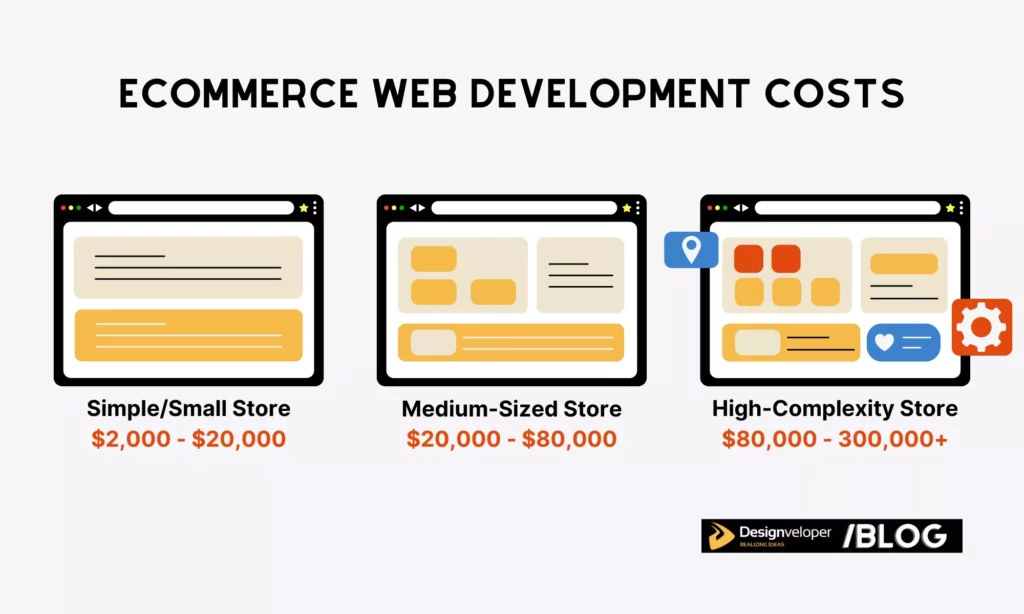
- Simple/Small Store: The typical cost ranges around $2,000 – $20,000. This money lets you build a functional store that has standard themes, basic checkout, and product catalogues. The store can exchange data with your CRM and order management systems, have basic security measures, and enable SEO optimization.
- Medium-Sized Store: The cost tends to jump to $20,000 – $80,000. Here, your business wants more control, with custom UI components and integrations with third-party services (e.g., payment or shipping vendors). The store enables users to search their favorite products, track orders, and subscribe to promotions.
- High-Complexity/Enterprise-Level Store: Costs can be $80,000 – 300,000, and sometimes way beyond that. It has fully custom architecture, complex product catalogs, advanced security, and global payment systems.
When calculating the costs of building an eCommerce website, you need to consider one-time and ongoing costs. Development is usually a one-time investment. But hosting, maintenance, security updates, and any third-party tools that keep your site running month after month adds up.
Despite the rough estimates we gave above, eCommerce costs may vary widely for many reasons. Scope, feature complexity, technology choices, and other project requirements significantly affect the overall cost.
Recommended reading: 6 Best eCommerce App Development Companies
Fixed Costs to Develop Ecommerce Website
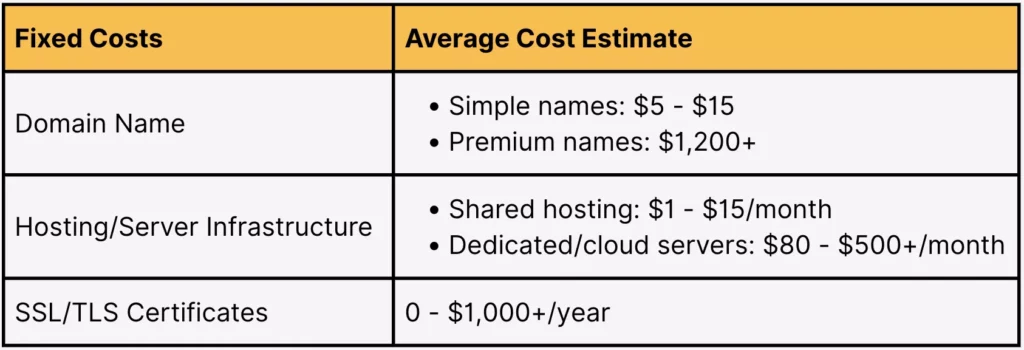
Fixed costs here mean unavoidable expenses you have to pay when building an eCommerce website, regardless of its scope. They often lie in a domain name, hosting/server, SSL/TLS certificates, and PCI compliance. They’re must-haves to operate your eCommerce website. Of courses, these costs may vary depending your site’s complexity.
- Domain Name: This is your online address. You normally pay for domains on a yearly basis through domain providers like GoDaddy, Namecheap, and Cloudflare. They may range $5 – $15 for simple names, but up to $1,200 or more for premium names. Remember that this is just a range for the initial registration. Domain renewal may cost you differently, for example, $14.70 for .com (OVH) and $15.98 for .org on average.
- Hosting or Server Infrastructure: This hosts your eCommerce website and keeps it working 24/7. Shared hosting is, of course, cheaper but less secure with a monthly range of $1 – $15. Dedicated or cloud servers cost more, often $80 – $500 or more for large, high-traffic websites.
- SSL/TLS Certificates: These are another must. They encrypt data, including passwords, payments, personal details, and more to ensure that the data stays safe during transactions. The price varies, from free to more than $1,000 per year.
Recommended reading: How to Build an eCommerce Website Fastest
Key Factors That Affect Ecommerce Website Development Cost
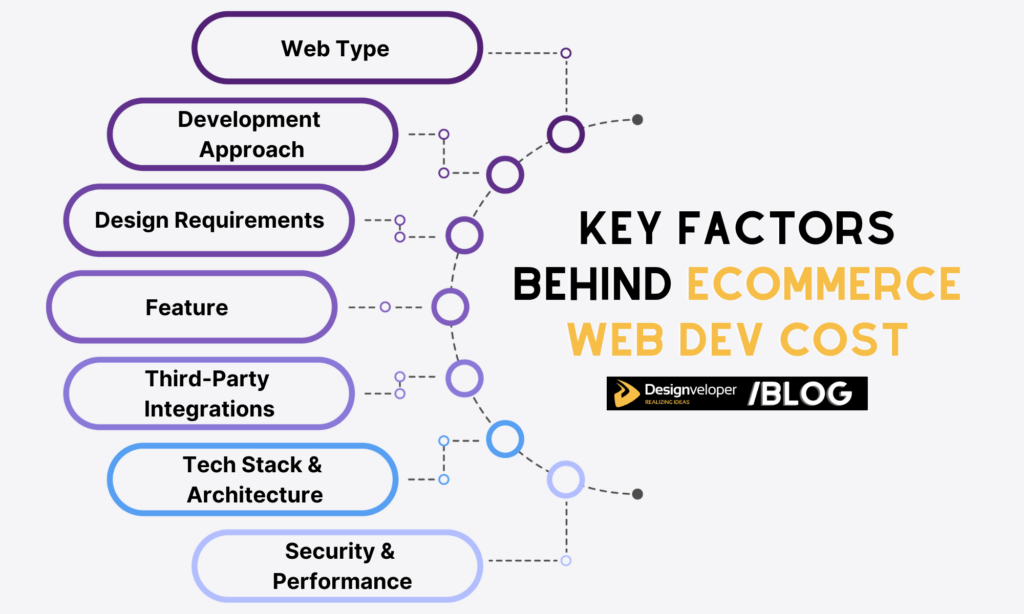
Before truly calculating the cost for your eCommerce website development, you may want to know which factors affect it. If so, don’t miss this section. Here, we’ll analyze the seven determinants behind the cost:
Type of Ecommerce Website
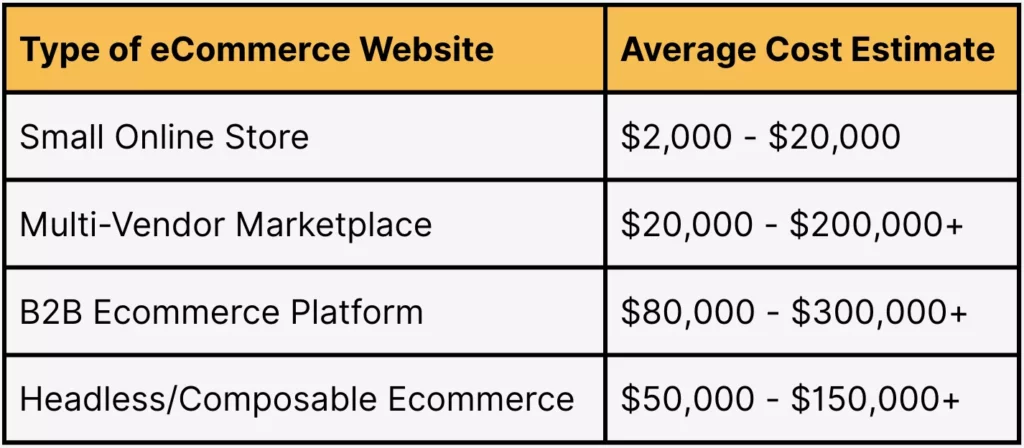
Of course, what you’re trying to build is the first factor impacting your overall cost. This is mainly due to the differences in design customization, functionality, and even platform license.
- Small Online Store
This definitely costs you the least, as it only requires a limited product catalog, simple checkout, and standard features. Basic security measures are still necessary to protect your data from bots, and the site still need simple integrations with some services. Due to lower complexity, a small online store roughly costs $2,000 – $20,000.
- Multi-Vendor Marketplace
This type of eCommerce website is much more complex. Multiple sellers, commissions, dashboards, disputes, payouts, and more land on the site. Running many stores in one place demands a stronger server infrastructure, more custom features, and more advanced integrations. So, development can cost up to $200,000, sometimes more if scaling is a must.
- B2B Ecommerce Platform
B2B sites behave somehow similarly to their B2C counterparts. But they require custom pricing, bulk orders, account roles, and ERP ties. This may make the cost start around $80,000 and possibly surpass $300,000.
- Headless/Composable Ecommerce
With headless or composable setups, you’re dealing with smaller pieces (usually microservices) that talk to each other through APIs instead of handling one big system doing everything. In reality, the cost for this often creeps up because of integrations, data migration work, and scale. If you’re plugging into a CRM, ERP, PIM, or some home-grown legacy tool, costs start to increase.
From what we’ve seen, initial development usually starts somewhere around $50,000 and can easily exceed past $150,000 or more, depending on how complex the setup is.
Development Approach
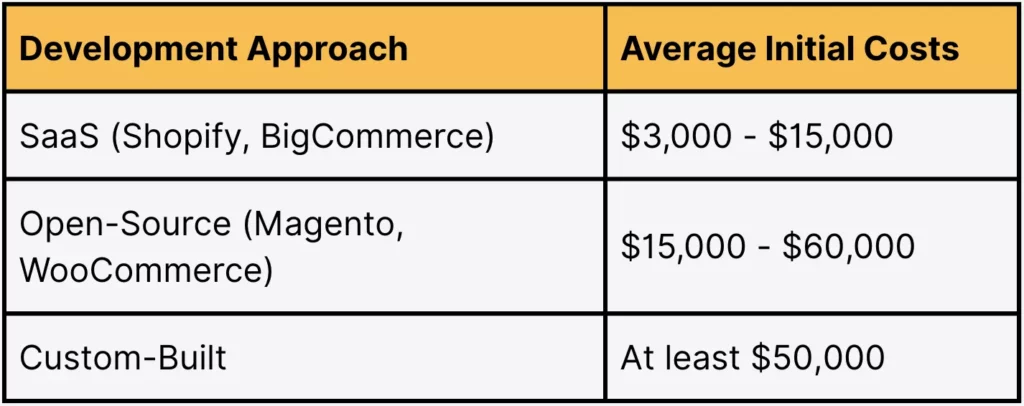
Development approaches here include using prebuilt templates or hiring developers to build your eCommerce website.
- SaaS (Shopify, BigCommerce)
SaaS platforms offer available templates and reusable UI components to develop an eCommerce website. Besides, these platforms handle hosting, security, updates, and other technical stuff on your behalf. No need to build everything from scratch.
So, your business can launch a website faster. Using these platforms also allows you estimate the cost more easily, around $3,000 – $15,000 for initial development, and then monthly subscription fees (e.g., $19 – $2,300/month for Shopify) plus possible transaction fees.
- Open-Source (Magento, WooCommerce)
Open-source platforms are free to download and use. But you have to pay for a domain name, hosting, security, and development costs. The cost is initially around $15,000 – $60,000 or more if you want complex customizations, premium extensions, and specialized developers. There are annual ongoing fees as well. They often fall around $8,000 – $15,000, mainly for hosting, security, third-party extension licenses, and regular maintenance.
- Custom-Built
This development approach requires you to build a platform from zero. The initial development cost, however, is very high, usually starting at $50,000 and more depending on your project’s complexity. Besides, you have to consider ongoing costs for hosting, security, and continuous maintenance.
Design Requirements
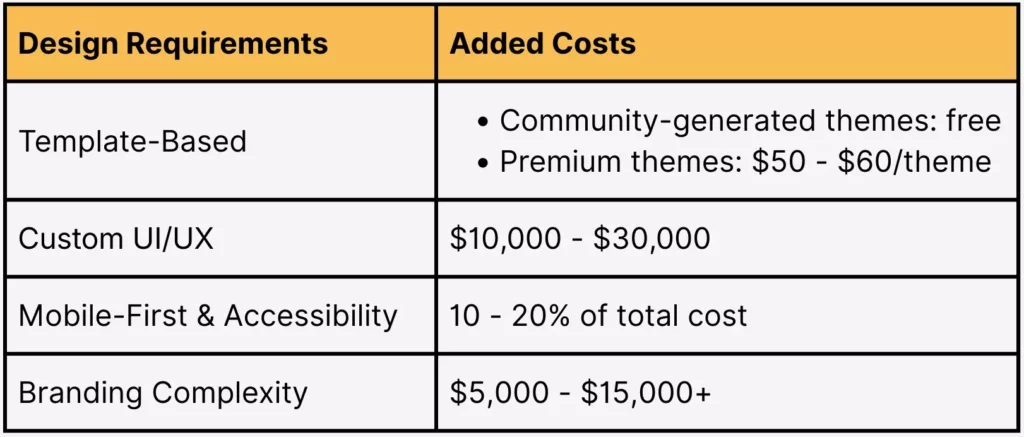
A website design also impacts the total cost in different ways, mainly in its complexity and customization.
- Template-Based vs Custom UI/UX
Community-generated templates are often free to use, but eCommerce website builders still offer premium themes at $50 – $60 on average. Customizing these templates can add up the cost to around $1,000 – $3,000. But a template-based design still saves more cost and time than a custom one. In comparison, custom UI/UX can reach $10,000 to $30,000 or more.
- Mobile-First & Accessibility
Designing for thumbs, screen readers, and real-world users takes time. This may add 10 – 20% to the total cost.
- Branding Complexity
Designing for simple brands is faster. Meanwhile, complex ones require careful planning, exploration, revisions, and alignment with the brand voice. Therefore, branding-heavy projects often add $5,000 – $15,000 or higher to the budget.
Features and Functionality
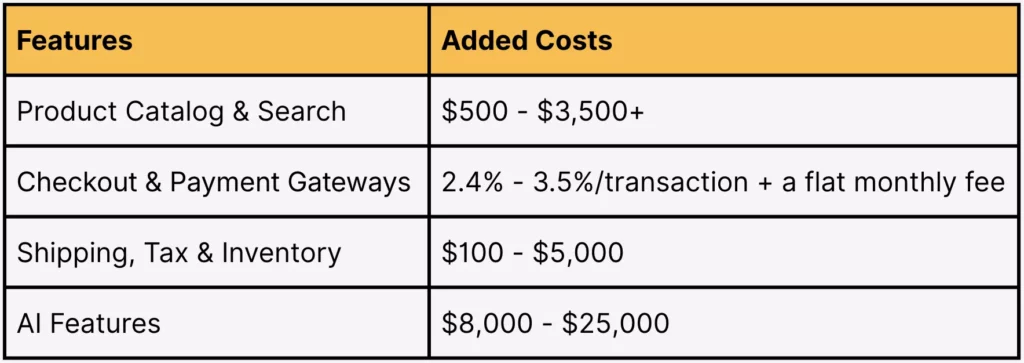
The amount and complexity of features contribute to increasing the overall eCommerce website development cost. Below are several common features, coupled with their estimated pricing:
- Product Catalog & Search
A small catalog is always cheaper, as it requires less time and effort to set up basic categories and a few filters. The cost for basic initial setups falls into $500 – $3,500.
A larger, more complex catalog with diverse variants and advanced search functionality (e.g., faceted or image-based search) definitely costs more. The integration of third-party AI search tools, like Algolia, Constructor.io, or Elasticsearch, can increase the cost.
- Checkout & Payment Gateways
Your eCommerce website needs a checkout screen and payment gateways to process the orders of your customers. For this functionality, you mainly pay transaction fees from 2.4% to 3.5% per transaction plus a flat monthly fee.
Further, consider setup labor if you hire developers to build a checkout screen and integrate payment services. Any added actions like fraud checks, local rules, and testing increase the cost up to $10,000. All depends on regions, complexity, and hourly rates.
However, SaaS platforms like Shopify and BigCommerce cover checkout and payment integration in their platform fees. So, you may not need to care about developer costs if the setup isn’t too complex.
- Shipping, Tax & Inventory
Real-time shipping rates, tax rules, and inventory syncing also significantly affect your total cost. Especially if you operate across borders, the cost for this functionality may be higher due to its increasing complexity. Costs, therefore, often vary from a few hundred to even $5,000 or higher for complex, custom-built operations.
- AI-Powered Features
Artificial intelligence adds complexity to your eCommerce website, hence increasing the cost. It enables smart search, product recommendations, customer support, performance analytics, and more. These features may add $8,000 – $25,000, depending on whether you’re using tools or building custom logic.
Integrations and Third-Party Services

Integrations are must-haves for any eCommerce website, regardless of its scope. However, the cost changes based on the number of integrations and their compatibility with your site. Some third-party apps are free to integrate, but connecting your site with legacy, unique software requires may add up to $10,000.
No matter what you’re trying to build, below are some must-have integrations:
- ERP, CRM, OMS
Integrating with these systems is crucial to sync customer data, orders, and stock levels. This avoids mismatches between systems, ensures seamless eCommerce operations, and keeps you from overselling. The higher complexity of these systems require more effort and money to sync data seamlessly both ways, handle failures, and keep things clean.
- Payment & Logistics APIs
Your eCommerce website needs to work smoothly with payment gateways and logistics tools to manage transactions and supply chain effectively. Similarly, custom rules and edge cases can increase your budget.
- Marketing & Analytics Tools
You definitely want to advertise the site and measure its performance regularly. Therefore, integrating with email services, analytics tools, ads providers, and CDPs (Customer Data Platforms) is a must. But the more complex your marketing and tracking needs, the higher the cost.
Technology Stack and Architecture
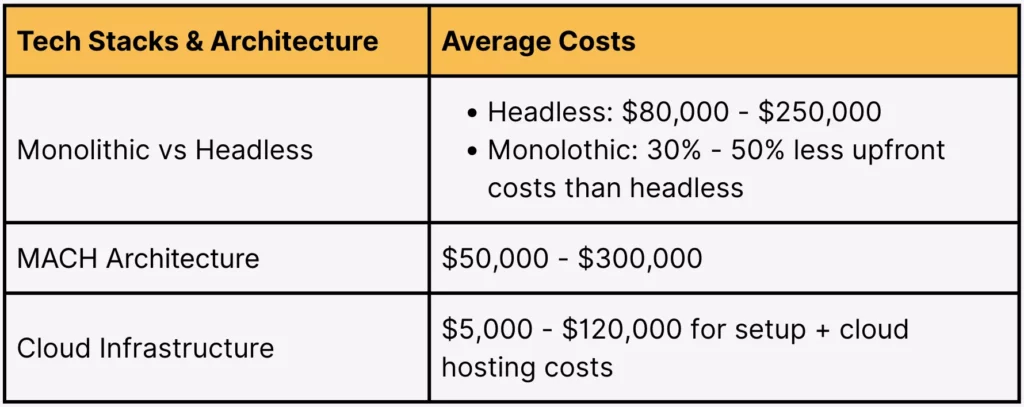
Your tech and architecture choice is another determinant behind the eCommerce website development cost. The wrong choice can increase the overall cost by up to 40%. Below are some common website architectures you need to consider:
- Monolithic vs Headless
Monolithic combines both frontend and backend in a single setup. So it costs 30% – 50% less upfront than headless. This makes monolithic ideal for MVP development.
Headless, of course, offers flexibility and speed but that freedom has a price of around $80,000 – $250,000. However, scaling in a headless architecture may be lower in the long term because you only need to upgrade individual components instead of the entire eCommerce website.
- MACH Architecture
The MACH architecture is quite expensive, because it requires diverse talents to cover different parts (design, frontend development, and backend integrations). The initial investment often ranges between $50,000 to $300,000 or more. So this architecture is more ideal for large-scale, enterprise-level, and high-growth businesses that prioritize scaling and flexibility over fast time-to-market.
- Cloud Infrastructure Choices
What if you want to reduce upfront hardware costs and dependence while ensuring reliable performance and rapid scalability? Cloud infrastructure from AWS, Azure, GCP, and other popular cloud providers is the answer you need.
The initial investment in cloud services include initial setup & development costs ($5,000 – $120,000 or higher) plus cloud hosting costs (e.g., $10 – $250/month for small and growing sites).
Security, Compliance, and Performance Requirements
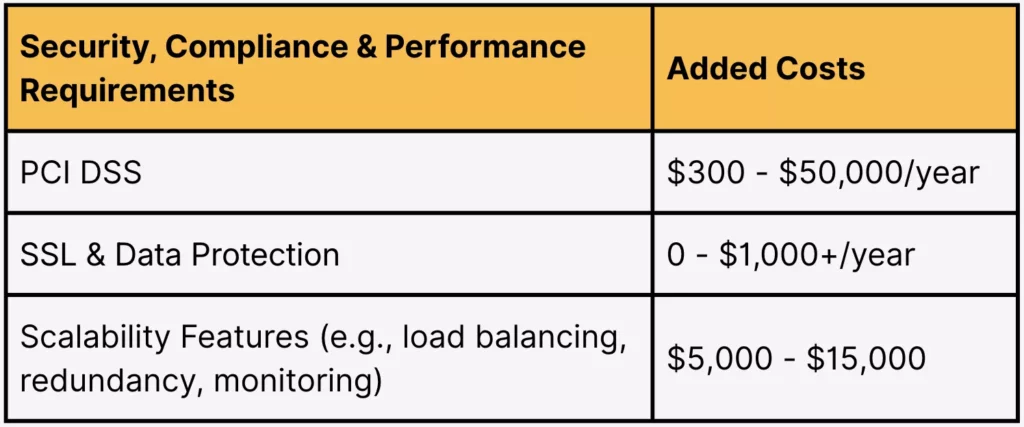
Adopting robust security measures, ensuring regulatory compliance (GDPR, PCI DSS, etc.), and optimizing for high performance often increase the initial costs 15% – 20%. Not to mention that continuous security inspections and updates can add up to $5,000 for small online stores and up to $70,000 for enterprise-level websites.
When learning about security, compliance, and performance requirements, you need to know:
- PCI DSS
This compliance regulates how your business should handle and secure card data. A small store with under 20,000 yearly transactions often gets charged $300 – $2,500 in PCI compliance, while that of a large-scale site (with 1 – 6 million transaction) can be up to $50,000.
- SSL & Data Protection
This covers encryption, access controls, and backups. As mentioned, SSL certificates and data protection measures may be free or cost up to $1,000 (or more) annually.
- High Availability & Scalability
When traffic spikes happen, such features as load balancing, redundancy, and monitoring become more important. If uptime is mission-critical, adding these features to ensure your site will work well even under heavy load can add $5,000 – $15,000.
Ecommerce Website Development Cost by Platform Type
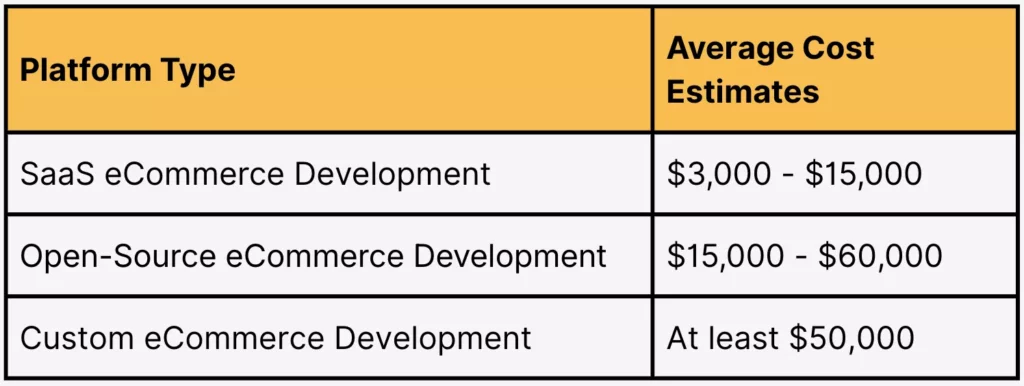
The initial cost of developing an eCommerce website varies based on your platform choice. Whether you choose SaaS solutions, open-source platforms, or custom builds, it all impacts your time-to-market, control, and budget for sure. How? Let’s find out:
SaaS Ecommerce Development Cost
SaaS platforms like Shopify or BigCommerce provide prebuilt templates and a visual editor for you to move UI components around without deep technical skills. They handle technical stuff behind the scenes on your behalf, without the need to touch the codebase.
So, what you pay for them is not developer costs, but monthly platform fees. The more premium plan you choose, the more benefit packages you get. However, there are still developer costs here if you want some specialists to do setup, customize themes, configure payment gateways, and integrate third-party services. These actions cost you around $3,000 – $15,000.
Remember that some SaaS platforms offer some free external extensions, but charge further for other premium services. Your cost may increase if your online store integrates with those paid integrations.
Open-Source Ecommerce Development Cost
Open-source platforms like WooCommerce or Magento are free to download and use. You can save some money by using these platforms, but just that.
You still pay developer costs to develop an eCommerce website on these open-source tools. The initial cost lands somewhere $15,000 – $60,000, depending on how complex your store is. This cost often covers custom features, server setup, security handling, and performance tuning.
When traffic grows and your store scales, costs rise for sure. This time, you may pay more for stronger servers, more integrations, custom checkout flows, and continuous monitoring.
Custom Ecommerce Website Development Cost
Custom eCommerce website development often costs at least $50,000 because this time, you have to do everything from scratch. From architecture planning, custom UX, and complex integrations to security and scalability, your team has to cover them all.
For those with unique workflows, high traffic, or long-term growth plans, custom builds bring better ROI. They’re expensive upfront, for sure, but potentially cheaper over time if done right.
Ecommerce Website Development Cost Breakdown by Phase
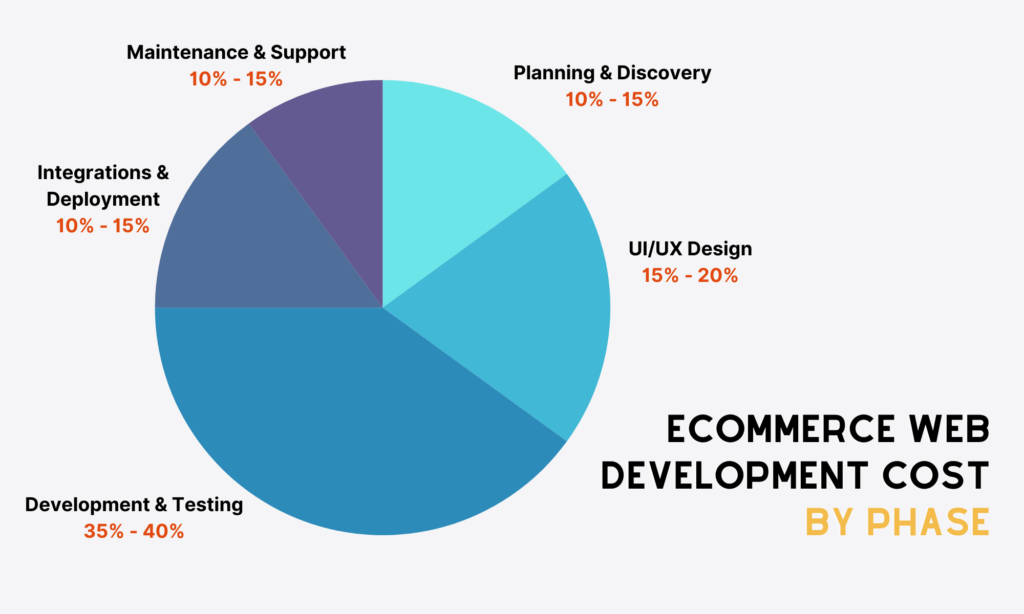
You can divide the development cost into different phases as follows:
- Planning & Discovery
In this phase, your team, product owners, and stakeholders perform market research, clarify requirements, map user flows, and make tech decisions. Any wrong decision in this stage can mislead the later development work and result in expensive rework. Normally, you should distribute 10% – 15% of your budget to this phase.
- UI/UX Design
This is where you turn your paper ideas into something visible – wireframes, prototypes, or visual systems, you name it. The cost varies depending whether you adopt a template-based or custom approach and whether you prioritize mobile-first designs and accessibility. But the cost here should account for 15% – 20% of your budget.
- Development & Testing
This phase occupies the majority of the overall eCommerce website development cost. It covers frontend development, backend development, database management, and testing. Using SaaS solutions and open-source platforms may reduce the cost significantly. But you still should spend around 35% – 40% on this phase.
- Integrations & Deployment
Third-party integrations with payments, shipping vendors, etc., plus deployment setup should make up 10% – 15% of the total development cost. The cost for this stage depends heavily on how many systems need to talk to each other and how complex integrations and deployment are.
- Maintenance & Support
Maintenance and support is excluded from the initial cost of developing an eCommerce website, but belongs to long-term ongoing costs. Experts said that you should plan 10% – 15% of the initial investment for maintaining and updating your online store. This often covers regular updates, bug fixes, performance monitoring, and feature enhancements.
How AI and Advanced Technologies Impact Ecommerce Development Cost
Like other industries, eCommerce has also integrated AI and advanced technologies to streamline operations and improve the user experience. Precedence Research stated that AI in eCommerce will record an estimated $11.21 billion in 2026. This global value is expected to increase by nearly 23.6% annually in the next decade.
The development cost varies between $10,000 and over $500,000. This depends on which AI features you’re trying to build and whether you’ll use prebuilt AI integrations or fully customized ML models.
Here are rough estimates by implementation level:
| Implementation Level | Typical Features | Cost Range |
| Basic AI integrations | Pre-trained APIs (like simple product recommendation plugins or ChatGPT-based support bots) | $5,000 – $20,000 |
| Mid-level AI and advanced technologies | AI-powered smart search, voice search, personalized recommendations, and dynamic pricing | $20,000 – $100,000 |
| Enterprise or custom AI | Custom ML models, advanced computer vision, and predictive inventory forecasting | $100,000 – $500,000+ |
Besides, you can estimate the additional cost by AI functionality:
| Smart search | $20,000 – $45,000 |
| Product recommendation engines | $15,000 – $50,000+ |
| AI-powered customer support | $5,000 – $40,000 |
| Predictive analytics for inventory management and sales | $25,000 – $120,000 |
| Image recognition or computer vision | $25,000 – $180,000 |
In addition to these costs, you should be aware of hidden or recurring fees when integrating AI into your online store. Those fees may cover data preparation & labeling (if AI accuracy matters a lot to your business), cloud infrastructure & API usage, maintenance & retraining, and labor costs.
Ecommerce Website Development Cost: In-House vs Outsourcing
In eCommerce website development, some questions arise: “How much does it cost if I employ an in-house development team or outsource the project to external experts? Which one brings better ROI?” The answer, of course, depends on different use cases.
In-house development gives you more control over your online store. And the cost? An eCommerce website developer gets paid around $80,000 – $129,000 per year.
But your internal team may require more than one developer, UI/UX designers, QA engineers, project managers, and other specialists (if necessary). This adds up salaries. Not to mention that you have to ponder onboarding, employee benefits, tools, and even hidden costs incurred by turnover.
And what if your eCommerce website development requires specialized skills that your existing team doesn’t have, like AI? These specializations increase your budget, whether you decide to hire more specialists or outsource that specialized part.
Outsourcing is more elastic. Agencies or development partners charge per project or in-person hour. For eCommerce builds, outsourcing typically ranges from $2,000 to $100,000+, depending on scope and complexity. Here, you’re not paying for annual salaries, but for experience, established processes, and speed. No hiring cycles and HR overhead get involved. That said, communication gaps can happen, causing hidden costs.
Ecommerce Website Development Services and Cost Estimation by Designveloper
Once again, we just want to say that all what we analyzed is just a rough estimate. Each website project has its specific requirements and complexity levels, hence requiring different costs.
If you want to outsource the eCommerce website project, finding a reliable, experienced partner is a must. Designveloper, a leading software and web development company in Vietnam, is an excellent partner to work with.
We have 13 years of hands-on experience in eCommerce website development. From building the entire eCommerce system from scratch to modernizing legacy websites and integrating AI chatbots, we have the right expertise and people. Our typical projects like Aha.is and Chloe Ting Hub, showcase our top-notch services and outstanding technical skills.
Here at Designveloper, we adopt cutting-edge technologies, like React, NodeJS, MongoDB, TypeScript, Docker, and AWS, to build scalable, high-performance websites for your specific use case. We offer the following services to meet your demand:
- SaaS development
- Custom website development
- Website maintenance and support
- AI integration
We also adopt professional techniques to estimate your project’s cost nearly accurately. They include analogous estimation, Planning Poker, and Pomodoro. Further, we’ve built a curated list of features based on our previous projects. This list allows us to know exactly what your potential eCommerce website needs.
Come with us and receive cost estimations from now!
Also published on

Share post on










Related Articles


What Is B2B Ecommerce? Types, Models, Platform Features, Examples
What Is B2B Ecommerce? Types, Models, Platform Features, Examples Published August 05, 2026
Cloud Ecommerce Solutions: How To Choose The Right Platform
Cloud Ecommerce Solutions: How To Choose The Right Platform Published July 15, 2026
Ecommerce Business: How To Start, Grow, And Use Technology
Ecommerce Business: How To Start, Grow, And Use Technology Published June 30, 2026