











13 Different Types of Software Development Services in 2026

Software development services help businesses plan, build, integrate, test, and maintain software aligned with specific goals. Unlike off-the-shelf tools, these services are tailored to a company’s workflows, users, product model, and growth stage. They also go far beyond coding, often covering discovery, architecture, UX/UI design, application development, cloud infrastructure, API integrations, QA, deployment, and long-term support.
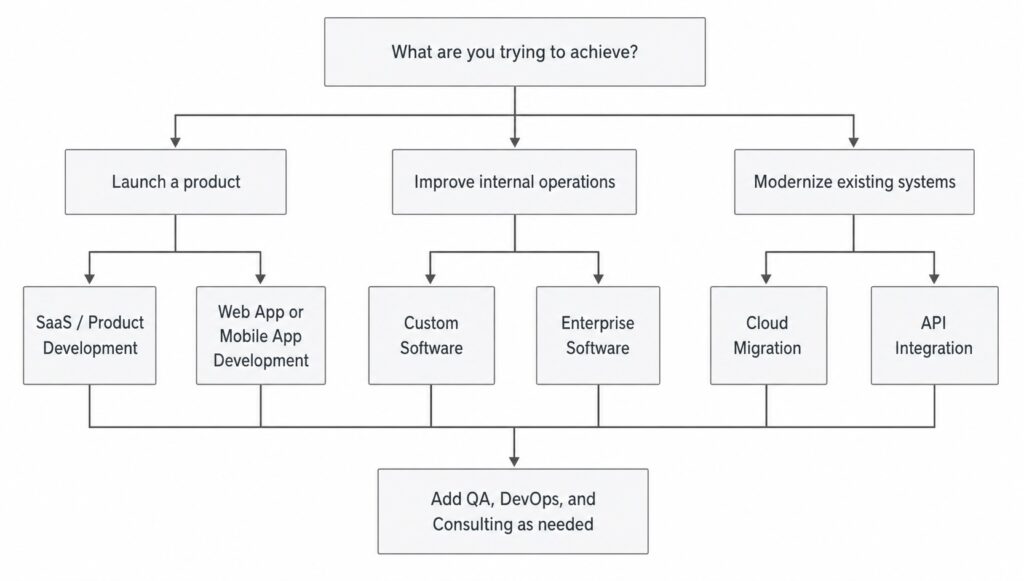
Not every business needs the same service mix. A startup launching an MVP may need product development, web application development, and DevOps, while an enterprise modernizing operations may need custom software, integrations, cloud migration, and security support at the same time. Understanding the main types of software development services makes it easier to choose the right path.
Recommended for you:
- Types of Web Development Services That You Should Know
- Tips for Choosing the Right Web App Development Services
At a Glance: How to Read This Guide
If you are evaluating software development services for a real project, do not treat every category in this article as an isolated purchase. In practice, companies usually make three linked decisions:
- what kind of software they need to build
- how the software should be architected and operated
This guide covers all three so readers can move from broad service categories to a more realistic sourcing decision.
What Are Software Development Services?
Software development services are professional services used to design, build, improve, and maintain software systems. These services help companies solve operational problems, launch digital products, support users, and create better internal or customer-facing experiences.
In practice, software development services can include business analysis, solution architecture, front-end and back-end engineering, mobile app development, cloud deployment, testing, integration work, and ongoing support. Some businesses use these services to build new products. Others use them to replace manual processes, modernize legacy systems, or connect disconnected platforms.
The main reason companies invest in software development services is simple: packaged software does not always fit the way they work. When business requirements become more complex, tailored software often becomes the more practical option.
Software Development Service Taxonomy
One reason this topic confuses buyers is that the phrase software development services often mixes together product types, technical disciplines, architecture decisions, and engagement models. These are related, but they are not the same thing.
The table below separates them into clearer layers.
| Layer | What It Covers | Typical Examples | Why It Matters |
|---|---|---|---|
| Service category | The kind of software or engineering service you are buying | Custom software, web apps, mobile apps, QA, DevOps | Helps define project scope |
| Architecture model | How the solution is designed to run and scale | Cloud-native, monolithic, microservices, edge + cloud | Affects long-term cost and resilience |
| Delivery stage | Where the work sits in the software lifecycle | Discovery, design, development, deployment, maintenance | Determines what expertise is missing now |
| Engagement model | How the delivery team is staffed and managed | Project-based, staff augmentation, dedicated team | Affects control, speed, and governance |
For most business leaders, the mistake is not choosing the wrong programming language. It is choosing the wrong combination of these four layers.
Why Businesses Need Different Types of Software Development Services
Businesses need different types of software development services because software problems are not all the same. A company building a SaaS platform has very different needs from a manufacturer connecting smart devices or an enterprise replacing outdated internal systems.
The right service type usually depends on five factors:
- the business goal
- the platform users rely on
- the number of systems that need to be integrated
- compliance or security requirements
- budget and delivery timeline
For example, a startup may prioritize web application development because it needs speed, user feedback, and lower distribution friction. A healthcare company may need enterprise software, API integrations, QA, and strong security controls from the beginning. Choosing the right service early helps teams reduce delivery risk and invest in the capabilities that create the most value.
Some common examples:
- A startup building an MVP may prioritize product development, web application development, and DevOps.
- A healthcare platform may require enterprise software, secure integrations, QA, and compliance-aware architecture.
- A logistics company may need custom software, mobile apps for field teams, and real-time API integrations.
- A manufacturer may need embedded software, edge data processing, cloud dashboards, and analytics.
Here’s something worth exploring: Future Trends in Software Development You Should Know
The Software Development Lifecycle Is a Service Portfolio
Software development is not a single execution step. It is a sequence of specialized services that convert business goals into a live system. This matters because many projects fail when companies buy only the coding phase and underinvest in planning, architecture, or post-launch operations. For more details, see our guide on the Understanding Software Development Life Cycle (SDLC).
| SDLC Phase | Core Activities | Key Deliverables | Common Risks if Understaffed |
|---|---|---|---|
| Requirement analysis | Stakeholder interviews, feasibility checks, workflow mapping | Requirements document, scope boundaries, roadmap | Scope creep, wrong priorities, missing user needs |
| Architecture and design | System design, data modeling, API planning, UX flows | Wireframes, architecture diagrams, schemas | Scalability issues, poor usability, weak interoperability |
| Development and testing | Coding, integration, manual QA, automated QA | Working code, test coverage, release candidates | Defects, security gaps, unstable releases |
| Deployment | Infrastructure setup, migrations, CI/CD, launch planning | Production environment, release process, rollback plan | Downtime, bad cutovers, configuration failures |
| Maintenance and optimization | Monitoring, bug fixing, support, performance tuning | Patches, reports, updates, improvements | Technical debt, security exposure, poor retention |
For buyers, this means one useful question is: Which part of the lifecycle is weakest in our current setup? The answer often determines which service you need first.
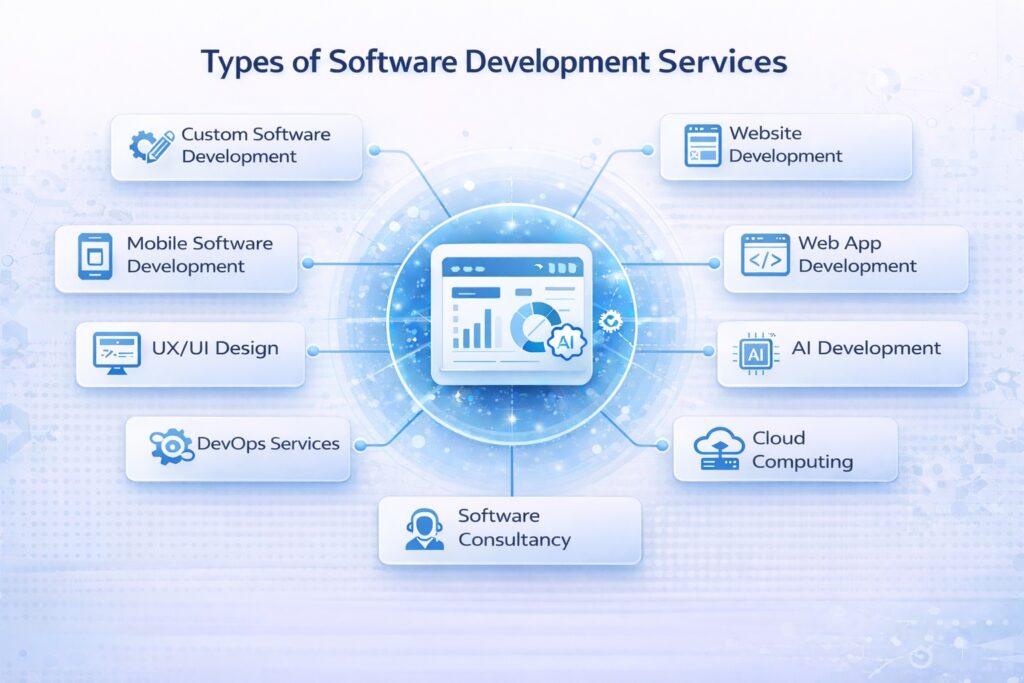
13 Different Types of Software Development Services
There is no single software development service that fits every project. Most modern products and systems use several capabilities together, from application engineering and infrastructure to integrations and testing.
Still, the landscape becomes much easier to understand when grouped into clear categories. Below are the main types of software development services businesses commonly use, along with when each one makes sense.
1. Custom Software Development Services
Custom software development services focus on building software around a company’s exact requirements instead of forcing teams to adapt to prebuilt tools. This is the right option when workflows are unique, integrations are complex, or software itself creates a competitive advantage.
Businesses often choose custom software development services for internal platforms, workflow automation, partner portals, logistics systems, customer-facing platforms, claims management, and industry-specific solutions. The biggest benefits are flexibility, ownership, integration control, and the ability to scale the software around real business needs.
This service is especially valuable when off-the-shelf software creates too many workarounds or limits how a company operates. If the business process is a differentiator, custom software is often the strongest long-term choice.
Related Guide:
- Best Custom Software Development Companies in Vietnam
- How to Choose a Custom Software Development Company
- Key Benefits of Custom Software Development for Businesses
2. Web Development Services
Web development services focus on building and maintaining browser-accessible digital experiences. This category can cover corporate websites, landing pages, content platforms, eCommerce sites, portals, and lighter browser-based products that do not require the full complexity of a web application.
For many businesses, web development is the first digital service they invest in because it supports visibility, lead generation, customer education, and online transactions. It is also a practical starting point when the main goal is to establish a strong web presence before expanding into more advanced software products.
Compared with web application development, web development services are often more content-driven and marketing-oriented, though they can still involve performance optimization, CMS integration, SEO foundations, and responsive front-end engineering.
Further reading:
- Best Countries to Outsource Web Development
- Top Web App Development Companies in Vietnam
- How Much Does It Cost to Build a Website
3. Web Application Development Services
Web application development services help businesses build browser-based software such as customer portals, admin panels, dashboards, marketplaces, and SaaS products. Unlike a basic marketing website, a web app supports user actions, workflows, authentication, stored data, and system logic.
Many companies should start with web application development services before investing in mobile apps. Web apps are easier to distribute, faster to update, and often better suited to products used across devices by customers, employees, or partners.
This service works well for B2B platforms, internal tools, subscription dashboards, booking systems, and collaboration products. When accessibility, speed of iteration, and cross-device usage matter, web application development is often the most practical starting point.
4. Mobile App Development Services
Mobile app development services are designed for businesses that need strong smartphone-based experiences on iOS, Android, or both. Depending on the product goal, these services may include native development for platform-specific performance or cross-platform development for faster delivery across multiple devices.
For some products, mobile is not just an extension of the platform. It is the primary channel. In those cases, mobile app development services require dedicated planning around user experience, performance, device behavior, and release management.
Mobile should be the priority when user engagement depends on push notifications, location services, camera access, offline support, or frequent in-app behavior. Common examples include consumer apps, delivery apps, loyalty apps, fintech apps, health tools, and field-service applications.
The market size reflects that demand. Grand View Research values the global mobile application market at USD 252.89 billion in 2023 and projects it to reach USD 626.39 billion by 2030, growing at a 14.3% CAGR. For businesses, that scale helps explain why mobile often remains a priority when retention, engagement, and device-native functionality directly affect growth.
Continue with these:
- Top Mobile App Development Companies in Vietnam
- Best Mobile App Development Frameworks
- Best Practices for Successful Mobile App Development
5. Enterprise Software Development Services
Enterprise software development services focus on large-scale systems that support complex organizations. These systems may include ERP platforms, CRM environments, supply chain systems, internal data hubs, HR systems, approval workflows, and multi-department business applications.
This category overlaps with custom software development, but it usually involves greater scale, deeper governance, more stakeholders, and stricter operational requirements. Enterprise projects often require role-based access control, reporting, auditability, high reliability, and integration with existing infrastructure.
Businesses usually need enterprise software development services when they are trying to streamline operations across teams, reduce fragmentation between internal systems, or replace aging tools that no longer support business complexity.
6. SaaS and Software Product Development Services
SaaS and software product development services are built for companies creating software products to sell or license to the market. Unlike internal business software, this category focuses on product strategy, MVP planning, feature prioritization, user experience, retention, roadmap execution, and long-term scalability.
This is a strong fit for startups, vertical SaaS companies, subscription platforms, B2B software vendors, and businesses launching a new product line. Teams in this category often need product thinking as much as engineering execution.
Software product development services are especially useful when a company needs to move from concept to market with a structured delivery process. That includes validating the product idea, building the first usable version, measuring adoption, and iterating based on user behavior.
Recommended reading: 6 Key SAAS Metrics Every Tech Startup Must Know
7. Cloud Application Development Services
Cloud application development services help businesses build, migrate, or modernize software that runs in cloud environments such as AWS, Microsoft Azure, or Google Cloud. This can include cloud-native applications, backend services, storage architecture, deployment pipelines, and infrastructure designed for scale.
Businesses often need cloud application development services when they want stronger reliability, more flexible scaling, faster deployment, better cross-location access, or lower infrastructure friction. Cloud development also matters when legacy systems need modernization without rebuilding the entire environment at once.
For companies operating across teams, markets, or high-demand user scenarios, cloud architecture is not only a technical choice. It directly affects speed, resilience, and operating cost.
One useful distinction is the difference between cloud-enabled, cloud-based, and cloud-native systems:
| Model | What It Usually Means | Strengths | Limits |
|---|---|---|---|
| Cloud-enabled | A traditional app with limited cloud add-ons | Easier short-term transition | Often keeps monolithic constraints |
| Cloud-based | An app hosted in the cloud, often on virtual machines | Better hosting flexibility | May still scale at the server level rather than service level |
| Cloud-native | A system designed for containers, automation, and service-level scaling | Better resilience, faster releases, more efficient scaling | Requires stronger architecture and DevOps maturity |
Cloud-native services usually go together with:
- microservices or modular service boundaries
- containerization for consistent deployment
- CI/CD automation for faster and safer releases
- observability and monitoring from the start

8. API Development and Integration Services
API development and integration services connect software systems so information can move reliably between products, teams, and third-party platforms. In modern software environments, this service is often essential because businesses rarely run on a single standalone tool.
Typical projects include connecting ERP and CRM systems, payment gateways, logistics tools, analytics platforms, customer support software, identity providers, and internal databases. When systems do not communicate well, businesses often suffer from duplicated work, poor visibility, and manual process bottlenecks.
Strong API development and integration services improve data flow, reduce operational friction, and make it easier to scale software across departments and user journeys.
High-value integration use cases often include:
- connecting CRM, ERP, and finance tools
- syncing product, customer, or order data across platforms
- embedding payment, logistics, identity, or messaging services
- exposing internal capabilities for partner ecosystems or mobile apps
9. DevOps and Infrastructure Automation Services
DevOps services focus on release reliability, deployment speed, infrastructure automation, monitoring, and environment consistency. Instead of treating delivery as a final step, DevOps turns deployment and operations into a controlled, repeatable part of the software lifecycle. For full definition, read this article What Is DevOps? The DevOps Lifecycle And How It Works.
This service usually includes CI/CD setup, containerization, environment management, observability, incident response support, and infrastructure-as-code practices. It becomes especially important when products scale, uptime expectations increase, or release cycles become more frequent.
If developers are spending too much time fixing environment issues, handling fragile deployments, or manually managing infrastructure, dedicated DevOps and infrastructure automation services can remove those bottlenecks and improve delivery quality.
10. QA and Software Testing Services
QA and software testing services make sure software works as expected before and after release. They can include manual testing, automated regression testing, performance testing, compatibility validation, usability checks, and security-focused quality reviews.
Businesses should not treat QA as a minor support step. In many projects, testing protects revenue, customer trust, compliance, and release confidence just as much as development itself. This is especially true for enterprise systems, payment workflows, SaaS products, and customer-facing platforms.
As software becomes more integrated and release cycles become faster, structured QA and software testing services become even more important for reducing defects and maintaining quality over time.
11. AI Software Development Services
AI software development services help businesses build features and systems that use machine learning, language models, prediction, intelligent search, or workflow automation. Common use cases include AI copilots, recommendation engines, document processing, support automation, forecasting, fraud detection, and internal knowledge assistants.
This service can create real value when the business problem involves large volumes of data, repeated decisions, content-heavy operations, or opportunities for process automation. However, not every product needs AI. The best AI projects begin with a clear business case rather than a trend-driven requirement.
For companies exploring AI software development services, the most important question is not whether AI is available. It is whether AI improves cost, speed, accuracy, user experience, or decision quality in a measurable way.
Discover more here:
- Top AI Development Companies in Vietnam to Watch
- 9 Step Process of AI Software Development
- How Much Does It Cost To Develop an AI App
12. Embedded and IoT Software Development Services
Embedded and IoT software development services are used for connected devices, sensors, industrial equipment, wearables, smart appliances, and other products where software runs inside physical systems.
These projects often combine firmware, device communication, cloud connectivity, data processing, dashboards, and user-facing applications. That makes them more complex than standard application projects, especially when reliability and hardware constraints matter.
Businesses usually need embedded software development services when they are building smart products, automating physical environments, or collecting real-time data from connected systems. This category is especially relevant in manufacturing, logistics, healthcare, mobility, and industrial operations.
In many IoT environments, architecture is split across three layers:
- device layer: sensors, controllers, and physical hardware
- edge layer: local gateways or edge servers that filter and process data close to the source
- cloud layer: centralized storage, analytics, fleet monitoring, and model training
That layered approach reduces latency, lowers bandwidth costs, and makes real-time operations easier to manage.
13. Software Consulting Services
Software consulting services help businesses define what should be built, how it should be structured, and which technical path makes the most sense before major delivery begins. This may include discovery workshops, architecture planning, modernization strategy, technical audits, roadmap design, and vendor evaluation.
Consulting is often the right starting point when requirements are unclear, stakeholders disagree on scope, or the company needs an expert view before committing development budget. In many cases, strong consulting prevents expensive rebuilds and misaligned delivery later.
For businesses comparing several software development services at once, consulting can also clarify which service mix fits the problem best.
You might also like:
- Best Software Consulting Companies in the World
- Why Choose an IT Consulting Company is Necessary for Your Business
Specialized Software Development Services
Beyond the most common service categories, some businesses also need specialized software development services tied to narrower technical or commercial use cases. These services matter, but they usually sit outside the core mix most companies evaluate first.
Blockchain Development Services
Blockchain development services focus on decentralized applications, smart contracts, token-based systems, and ledger-driven transaction logic. This service is relevant only when decentralization, shared transaction trust, or blockchain-native product logic is a real requirement.
Game Development Services
Game development services cover interactive entertainment products across mobile, desktop, console, or web platforms. These projects often require specialized expertise in gameplay systems, graphics performance, monetization, live operations, and user retention loops.
Related reading:
- Best Game Development Software Tools
- Top 10 NFT Game Development Companies
- How to Make a AAA Game from Concept to Launch
Cybersecurity and Security Engineering Services
Cybersecurity and security engineering services help businesses design safer systems, reduce vulnerability exposure, and strengthen application resilience. This work may include secure architecture reviews, access control design, penetration testing support, compliance preparation, and security automation.
Comparison Table: Which Software Development Service Fits Which Business Need?
Not every reader wants to compare service categories one by one. The table below gives a faster way to understand which type of software development service fits which business situation.
| Service Type | Best For | Typical Timeline | Budget Level | Example Use Case |
|---|---|---|---|---|
| Custom software development | Unique workflows and tailored internal or external platforms | Medium to long | Medium to high | Internal operations system |
| Web application development | Browser-based platforms and SaaS products | Medium | Medium | Customer portal |
| Mobile app development | Smartphone-first experiences | Medium | Medium to high | Delivery app |
| Enterprise software development | Large organizations with complex operations | Long | High | ERP replacement |
| SaaS/product development | Market-facing software products | Medium to long | Medium to high | B2B SaaS platform |
| Cloud application development | Scalable modern infrastructure and app modernization | Medium | Medium | Cloud-native backend |
| API/integration services | Connected systems and data flow | Short to medium | Medium | CRM and ERP integration |
| DevOps services | Release automation and stable infrastructure | Short to medium | Medium | CI/CD and monitoring setup |
| QA/testing services | Risk reduction and quality assurance | Ongoing | Low to medium | Regression testing |
| AI software development | Automation, prediction, intelligent features | Medium | Medium to high | AI support assistant |
| Embedded/IoT development | Connected physical devices | Medium to long | High | Smart sensor platform |
| Software consulting | Early planning and technical decision-making | Short | Low to medium | Discovery and architecture audit |
Designveloper’s Software Development Services
Choosing the right software development service is only part of the decision. The bigger challenge is finding a partner that can turn technology into measurable business outcomes. That is where Designveloper stands out.
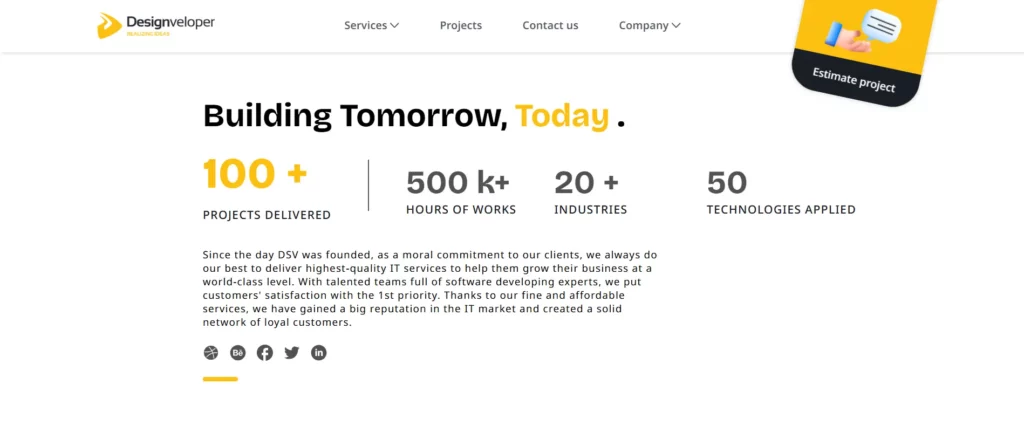
Since 2013, Designveloper has helped startups, SMEs, and enterprises build digital products, internal systems, and scalable platforms that support long-term growth. Our strength is not only in delivering software, but in shaping the right service mix around each client’s business model, product stage, operational needs, and technical constraints.
Our capabilities cover a broad range of software development services, including:
- Web Application Development Services for SaaS platforms, portals, dashboards, and business systems
- Mobile App Development Services across iOS, Android, React Native, and Flutter
- Custom Software Development Services tailored to unique workflows and industry-specific requirements
- UX/UI Design Services that improve usability, engagement, and product clarity. Explore Designveloper’s UI/UX projects.
- AI Development Services for intelligent automation, AI-powered workflows, data-driven products, recommendation systems, internal copilots, document processing, and other applied AI use cases
- SaaS Development Services for scalable subscription-based products
- Cybersecurity Services to strengthen resilience and reduce operational risk
- Third-Party Verification Services to support product quality and delivery confidence
- Support and Maintenance Services for long-term performance, stability, and continuous improvement
- VoIP Application Development Services for better communication and collaboration systems
One of Designveloper’s key advantages is our ability to apply AI in practical business contexts, not just as a trend-driven add-on. We help companies identify where AI can create real value, whether that means automating internal operations, improving decision-making, enhancing customer experience, or building new AI-enabled product features. Our approach focuses on business outcomes first, then selects the right technologies to support them.
Our credibility is also reflected in the quality of our client relationships. Long-term partnerships, including clients who have stayed with Designveloper for nearly 10 years, show the consistency of our service, delivery discipline, and ability to grow with a client over time. That kind of retention is difficult to earn without reliable execution, strong communication, and sustained product support.
Rather than applying the same model to every engagement, we adapt our delivery approach to the realities of each project. That is especially valuable for companies building SaaS products, customer-facing platforms, AI-powered solutions, and modern internal business systems.
If you are evaluating which software development services best fit your business, Designveloper can help you define the right approach, prioritize the right capabilities, and build a solution that delivers long-term value.
Looking for a trusted software development partner in Vietnam? Contact Designveloper to discuss your goals and find the right mix of software and AI development services for your business.
Conclusion
The main types of software development services range from custom software and web apps to enterprise systems, cloud development, integrations, QA, DevOps, AI, and embedded solutions. The right choice depends less on trends and more on what the business is trying to achieve, how the software will be used, and how complex the delivery environment is.
For many businesses, the best result comes from combining several services in the right order. If you are planning a new software product, modernizing an internal system, or evaluating where to invest next, the next step is to identify the service mix that matches your goals, constraints, and growth plans.
If your team is still unsure where to start, begin with a simple audit:
- Define the business outcome.
- Identify the primary software category you need.
- Map the supporting services required across architecture, testing, and operations.
- Add the supporting services needed across architecture, testing, integrations, and operations.
That sequence usually leads to better decisions than comparing vendors on hourly rates alone.
FAQs About Types of Software Development Services
What is the difference between custom software and enterprise software?
Custom software is built around a company’s unique requirements. Enterprise software usually refers to larger systems used across departments, with more complex governance, integrations, reporting, and operational requirements. Enterprise systems can also be custom-built, but they typically involve greater scale and stakeholder complexity.
Should a startup choose web app development or mobile app development first?
In many cases, startups should begin with web application development because it is easier to distribute, update, and test across devices. Mobile app development should come first only when the user experience depends heavily on smartphone behavior such as push notifications, location, offline access, or camera usage.
When do businesses need cloud development services?
Businesses usually need cloud application development services when they want better scalability, stronger reliability, easier deployment, lower infrastructure friction, or a path to modernize legacy systems.
Can one project require multiple software development services?
Yes. Most modern projects require a combination of software development services. A single project may need application development, QA, integrations, cloud infrastructure, and consulting at the same time, depending on business goals and technical complexity.
Also published on

Share post on










Related Articles


Cloud Application Development: Architecture, Process, And Cost
Cloud Application Development: Architecture, Process, And Cost Published September 25, 2026
Android App Development: Stack, Process, Cost, And Best Practices
Android App Development: Stack, Process, Cost, And Best Practices Published September 17, 2026
How Gitignore Works: Rules, Patterns, Examples, And Debugging Tips
How Gitignore Works: Rules, Patterns, Examples, And Debugging Tips Published August 05, 2026