












Is Vibe Coding Legal? Ownership, Copyright, and Release Risks

Is vibe coding legal? In general, yes: using natural-language prompts and AI coding tools to write or change software is not illegal by itself. The legal questions concern the inputs, the provider’s terms, and the final product. Did the prompt include code or data the user could not share? Does the output copy protected material or break a license? Does the release meet obligations to clients and users? Contractual ownership, copyright protection, and permission to use code are separate issues. The rules also vary by country and account plan. This article explains the checks developers and companies should complete before releasing AI-assisted code. Legal and provider terms were checked on October 16, 2026.
What Can Make Vibe-Coded Software Legally Risky?
The prompt-driven method is not usually the source of a legal problem. Risk comes from the inputs, generated code, contracts, data practices, and decisions made before release. A useful vibe coding workflow should make those checks visible instead of treating a working preview as approval to ship.
Copyright, Code Reuse, and Open-Source Licenses
An AI tool can return code that resembles existing material. Copyright risk depends on the code, the source material, the similarity, and the law that applies; a generated label does not decide those questions. A provider may give a user rights it has in an output, but that does not clear a third party’s rights or prove that every line is new.
Open-source software is not the same as code with no conditions. Licenses can require copyright notices, attribution, license texts, patent terms, or source-code access in certain distribution settings. Dependency scanners can identify known packages and licenses, but they may not identify an AI-generated fragment that resembles code from a public repository. GitHub’s Copilot code-referencing documentation describes a way to surface some public-code matches; it is not a complete provenance or legal-clearance check.
Confidentiality, Privacy, and Prompts
A prompt can disclose information to a service. Before pasting private source code, customer records, credentials, product plans, or security findings, check whether the account and tool are approved to receive them. Review the controlling terms, retention settings, model-training controls, subprocessors, access permissions, and any data-processing agreement. A personal account can have different protections from a business workspace.
Do not place passwords, API keys, or production secrets in prompts or generated frontend code. Use synthetic data for early tests and limit repository access to the files needed for the task. If personal or regulated data is involved, confirm that the team has a lawful basis and the required notices, safeguards, and contractual authority before processing it through an AI service.
Client, Employer, and Release Duties
A client agreement, employment policy, procurement rule, or statement of work may restrict which tools a team can use. It may require approval before sharing code with a service or require disclosure of third-party components. It may also promise ownership, confidentiality, security, or originality in a way that affects an AI-assisted workflow. Check those terms before using client material as input, not after a product has been built.
Responsibility for a released product does not disappear because an AI tool wrote part of it. A team can still face contractual, privacy, consumer-protection, patent, or security issues if the software fails or mishandles data. Keep patent and trade-secret questions separate from copyright. The right to use code does not settle whether a product function can be patented or whether a prompt exposed confidential know-how.
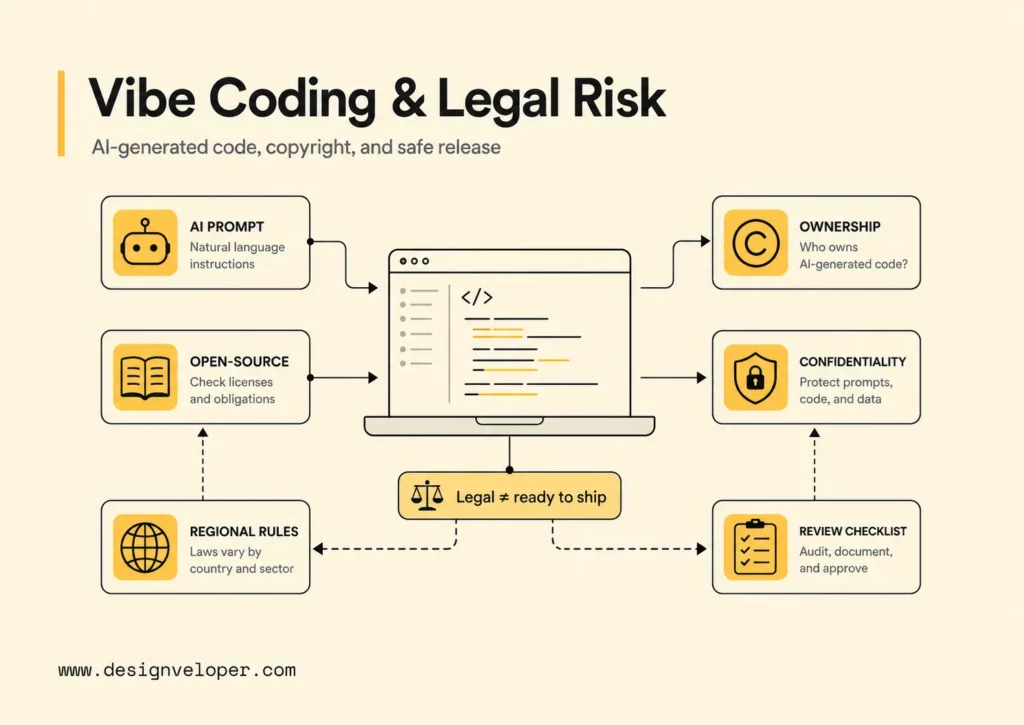
Trace each change from prompt to repository to release. The next sections separate copyright and code reuse, data handling, and contractual duties because each raises a different review question.
For a deeper look at tool choice, prompting, and the difference between AI-assisted and conventional coding, see these related guides:
- 13 Best Vibe Coding Tools for Building Apps and Editing Codebases
- Prompt Engineering Best Practices: 10 Tips, Examples, And Evaluation
- Vibe Coding Vs Traditional Coding: Where Fast AI Coding Helps And Where It Hurts
The workflow and prompting guides above can help teams document how code moves from request to reviewed change.
Who Owns AI-Generated Code, and Can It Be Copyrighted?
There is no single ownership answer based only on who typed the prompt. A developer or company should separate rights in the input, the agreement with the AI provider, copyright in human-authored expression, and any assignment to an employer or client. One layer can be clear while another remains uncertain.
| Rights layer | What it answers | What to check |
|---|---|---|
| Input material | Can the user submit the prompt, source code, files, or data? | Repository ownership, client approval, privacy rights, and confidentiality terms. |
| Provider contract | What rights does the provider grant or keep between the parties? | Plan, current agreement, model provider, output clauses, and data-use settings. |
| Copyright | Does the code contain protected human authorship or third-party expression? | Human choices, modifications, code sources, applicable law, and evidence of review. |
| Employer or client contract | Who receives rights in the delivered product? | Work-assignment terms, approved tools, disclosure duties, warranties, and open-source rules. |
In the United States, the Copyright Office’s 2025 report on AI copyrightability says protection depends on a human author determining sufficient expressive elements. Human-created expression, or a creative selection, arrangement, or modification of AI material, may qualify. Merely providing prompts does not by itself establish human authorship under the Office’s analysis. AI assistance does not automatically prevent copyright in a larger work that contains human-authored expression.
A provider’s output clause is a contract between the provider and the user; it is not a copyright ruling. If ownership or exclusivity matters, keep version history, design decisions, meaningful edits, review notes, and tests. These records can show what people contributed, but they do not guarantee that a court or registration authority will find a particular output copyrightable.
How Do Coding Tool Terms Differ by Account?
A product name is not enough to determine output rights or data handling. The applicable terms can change with the account tier, customer agreement, model provider, and settings. The examples below show why teams should review the exact plan they use. They are snapshots checked on October 16, 2026, not a guarantee that later versions will say the same thing.
| Account or plan | What the checked terms say | Practical check |
|---|---|---|
| Replit standard account | The Terms of Service say users retain rights to content they submit, post, or display and remain responsible for it. This does not establish copyright in every generated line or clear third-party rights. | Check the rules for the app, its visibility, any selected license, and the AI or third-party services used. |
| Replit Pro | The Pro Agreement defines prompts and AI outputs as Customer Content. It allows use to operate, maintain, and improve the service, including model training, unless the customer opts out in settings. | Confirm the account’s training setting and data permissions. Do not assume the Enterprise ownership language applies to Pro. |
| Replit Enterprise | The Enterprise Agreement, updated September 9, 2026, says the customer owns output as between Replit and the customer. It also warns that outputs may resemble those given to others and requires customer review. | Check the signed order and exceptions. Contractual ownership does not guarantee copyrightability or non-infringement. |
| GitHub Copilot individual plans | GitHub’s current Terms of Service say GitHub does not claim input or output. Since April 24, 2026, interaction data from Copilot Free, Pro, and Pro+ can be used to train and improve models unless the user opts out. The policy update says Business and Enterprise users are not covered by that individual-plan change. | Review account settings and the controlling customer agreement. Private-repository code provided to an AI feature is different from repository content that is not sent as input. |
These examples do not cover every coding service or underlying model. For any other product, identify the contract that governs the specific account, what happens to prompts and outputs, whether training can be disabled, and what responsibility the user keeps. Save the terms and settings reviewed for a commercial release, then recheck them if the provider changes the service or plan.
How Do U.S., EU, and UK Rules Differ?
There is no single global rule that makes every AI-generated codebase lawful or unlawful. Copyright rules, AI transparency duties, and provider contracts answer different questions. The table gives a dated orientation; a team should check the law where it operates, the market where it releases software, and the role it plays.
| Region | Current legal point | What it means for a team |
|---|---|---|
| United States | The Copyright Office’s 2025 analysis focuses on human authorship. AI-assisted works may still contain protectable human expression; prompts alone are not enough under that analysis. | Record meaningful human selection and changes. Assess copying, license terms, contracts, and data separately. |
| United Kingdom | Section 9(3) of the Copyright, Designs and Patents Act 1988 names the person who made the necessary arrangements as author of a computer-generated literary, dramatic, musical, or artistic work. The March 2026 government report notes uncertainty about how this rule fits the human-focused originality test. It proposes continued monitoring and, without evidence of ongoing value, removal of protection for wholly computer-generated works while retaining protection for AI-assisted works. This is a proposal, not a change to the current statute. | Section 9(3) remains in force. Do not assume that entering a prompt settles authorship or ownership; check current law and separate copyright from provider, employer, or client contract rights. |
| European Union | Article 50 transparency rules began applying on August 2, 2026. The Commission’s Article 50 guidance says source code is outside the Article 50(2) marking obligation. For systems already on the market before August 2, providers have until December 2, 2026, for that marking and detection duty. | Article 50 is not a general software-ownership rule. Other duties can apply to covered AI systems or public-interest text. Separate Article 53 duties concern general-purpose AI model providers; the Commission describes those provider obligations as applying from August 2, 2025. |
The EU distinction matters: a team using an AI assistant to write ordinary source code is not automatically a general-purpose model provider. If the product itself uses AI, or if the team supplies an AI system to others, its role and system features may bring separate rules into scope. The source-code exception is narrow; it does not exempt the product from privacy, consumer, security, copyright, or contract obligations.
How to Use Vibe Coding Safely and Legally Before Release
Set review depth by the data, users, and impact of the proposed change. A local mock-up with synthetic records is different from an app that stores employee data, processes payments, or gives customers access to business records. The following example shows how the release decision can change as a prototype moves toward a live pilot.
Example 1: A Shift Planner Moves From Demo to Pilot
Illustrative scenario, not a reported case: A small software company asks Replit Pro to help build an employee shift planner. The developer starts with fake names, sample schedules, and test credentials. Before a real pilot, the team checks the Pro Agreement. It sees that prompts and outputs count as Customer Content. The agreement allows model training unless the account opts out. The product owner also checks client terms, the data-processing agreement, retention settings, and whether the company is allowed to submit employee information.
During review, an engineer notices that the prototype hides some records in the browser interface but has not yet proved that the server blocks unauthorized requests. The team keeps the app private and tests access with separate employee and manager accounts. It records the generated changes, checks dependencies, and asks the client to approve the data flow. If the team cannot confirm approval or server-side access controls, it continues using synthetic data and does not open a live pilot. A training opt-out alone would not settle the privacy, contract, or security questions.
A Prompt-to-Release Checklist
Use one review path for each AI-generated change rather than relying on a single final scan. A lightweight process can still preserve the decisions a team needs to explain later:
- Classify the work. Identify the user impact, data sensitivity, repository scope, and whether the change can be reversed. Use synthetic data for early tests.
- Approve the input and account. Confirm the team may share the code or data with the selected service. Check the plan, underlying model, retention, training controls, and any client or employer limits.
- Review provenance and licenses. Inspect the code diff and dependency changes. Check any public-code references and license obligations; do not treat a clean dependency report as proof that all generated code is original.
- Record human decisions. Keep the requirements, meaningful edits, rejected suggestions, tests, and reviewer approval in the project history when authorship or delivery rights matter.
- Test the actual behavior. Check permissions, failure cases, data access, and the security properties that match the app’s risk. A successful demo is not a security or legal review.
- Name the release owner. Assign someone to accept the change, confirm contract and policy fit, and own monitoring, rollback, and incident response.
For practical follow-up on review and delivery, see these guides:
- Top 10 AI Code Review Tools & Best Practices For Implementation
- DevOps Best Practices: 10 Ways To Improve Speed And Reliability
- AI In Software Development: Changing How Software Gets Built
The linked guides add practical context on code review, delivery controls, and the broader role of AI in software development.
What Must Change Before a Vibe-Coded Prototype Goes Into Production?
Passing a rights and policy review does not make a prototype ready to operate. Production readiness asks whether another engineer can understand the system, restore it after a failure, and change it without breaking user data. These engineering tasks are different from checking who owns the output or whether a prompt was allowed.
Before launch, map the application’s components, data stores, external services, authentication flow, and deployment environment. Decide where secrets live, how database changes are applied, and what happens when an AI or payment provider is unavailable. If the generated structure is difficult to explain, refactor it before adding more features.
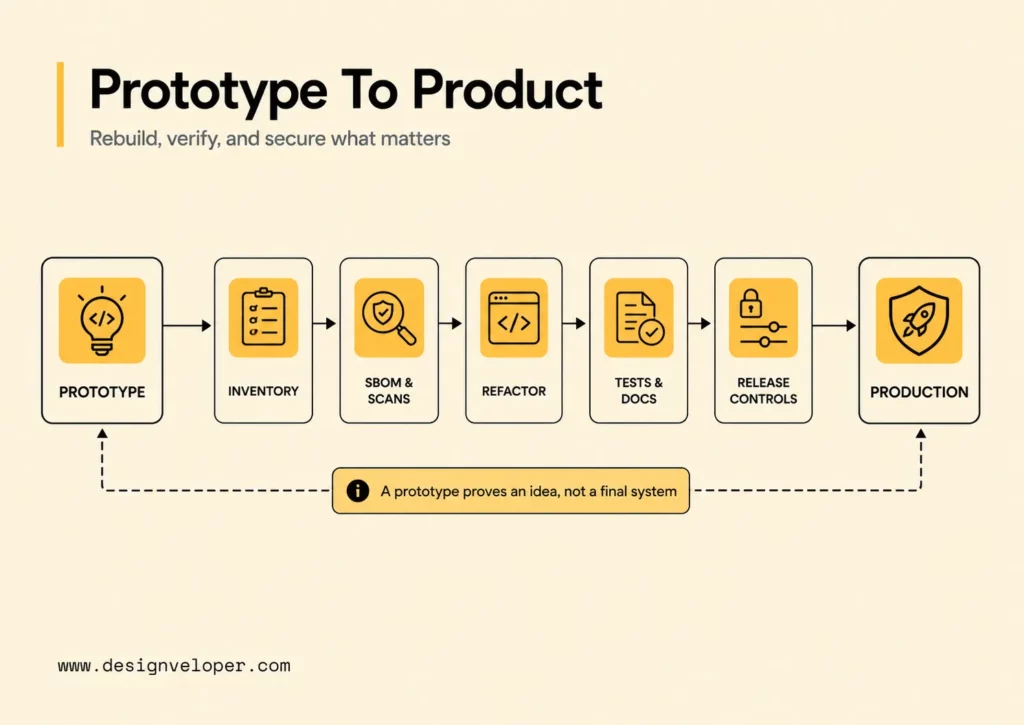
Test expected behavior and failure paths, not only the successful demo. Include permission checks, invalid input, duplicate requests, timeouts, and recovery from a failed deployment. Keep automated tests and dependency updates in a repeatable build process so that future changes do not depend on one person remembering the prompts that created the first version.
Assign ongoing owners for releases, logs, alerts, backups, restore tests, and maintenance. A prototype can be disposable; a live service needs a support path and a rollback plan. Track model usage, hosting, and external-service costs during a limited pilot, then decide whether the team can maintain the product with its available skills and budget.
FAQs About Vibe Coding Legality
These questions cover practical disclosure, evidence, and release decisions that remain after the legal and plan-specific checks above.
Should I Tell a Client or Employer That I Used AI?
Check the contract, workplace AI policy, procurement rules, and any sector requirements. If they require disclosure or approval, follow them before using the tool or delivering the code. When the terms are unclear, ask the client or employer rather than assuming that AI use is allowed.
What Evidence Should I Keep of Human Contribution?
Keep version history, design choices, meaningful code edits, review comments, test results, and release approvals. These records can explain how people shaped the final work. They do not guarantee copyright protection, and prompt logs alone may not show enough human expression.
Can a Clean License Scan Prove AI Code Is Safe to Use?
No. A scan can find known dependencies or matches within its coverage. It cannot prove every generated line is original, licensed for your use, secure, or compatible with your contracts. Review the code, references, dependencies, and release context separately.
Does the EU AI Act Require a Label on AI-Generated Source Code?
The European Commission’s guidance says source-code outputs fall outside Article 50(2)’s machine-readable marking obligation. Other Article 50 duties can apply to covered AI systems and certain public-interest text, so the source-code exception is not a general exemption from the AI Act.
This article provides general information, not legal advice. Ask qualified local counsel to review a high-value release, regulated product, ownership dispute, or contract that affects your rights.
If an AI-assisted prototype needs a maintainable path to launch, Designveloper’s AI development services cover product engineering and integration work alongside the review and delivery controls a production system requires.
Also published on

Share post on










Related Articles



How To Build A RAG System: Step-By-Step (New Guide)
How To Build A RAG System: Step-By-Step (New Guide) Published October 19, 2026
Agentic AI Single Vs. Multi-Agent Systems: When To Use Each One
Agentic AI Single Vs. Multi-Agent Systems: When To Use Each One Published October 19, 2026
Is Vibe Coding Legal? Ownership, Copyright, and Release Risks
Is Vibe Coding Legal? Ownership, Copyright, and Release Risks Published October 16, 2026