













Top 10 AI Code Review Tools & Best Practices For Implementation

KEY TAKEWAYS:
- AI code review helps teams catch bugs, security risks, style issues, missing tests, and maintainability problems before code reaches production.
- The best AI code review tools should fit the team workflow: pull requests, IDE use, repository context, security scanning, team rules, and human approval paths.
- Toplist tools are useful as a shortlist, but teams should compare them by signal quality, noise level, integrations, privacy controls, and review impact.
- AI review should automate basics first while keeping humans responsible for final engineering decisions, especially for architecture, product behavior, and security-sensitive code.
- Successful rollout requires team-specific rules, test validation, monitoring, and feedback loops so AI comments improve quality instead of adding review noise.
AI code review uses artificial intelligence to inspect pull requests, detect bugs, flag security risks, summarize changes, suggest fixes, and help reviewers focus on the issues that matter most. The best AI code review tools in 2026 do not replace senior engineers. They automate repetitive checks, surface context, and give teams a faster first-pass review while humans keep ownership of architecture, business logic, security, and release decisions.
AI-assisted code review is becoming more important because AI coding tools can generate larger volumes of code faster than traditional review habits can absorb. GitHub now offers GitHub Copilot code review, Anthropic documents Claude Code code review, and specialist platforms such as CodeRabbit, Qodo, and Greptile now focus on pull-request review workflows. The opportunity is real, but the review system still needs rules, metrics, and human judgment.
This guide explains what automated code review means in the AI era, what capabilities matter, which AI code reviewer tools deserve attention in 2026, and how teams can implement AI review without adding noise, security risk, or misplaced trust.
Explore more:
- AI In Software Development: Changing How Software Gets Built
- From Vibe Coding To Production: Turning AI Code Into Reliable Products
- What Pair Programming Means In The Age Of AI Pair Programmers
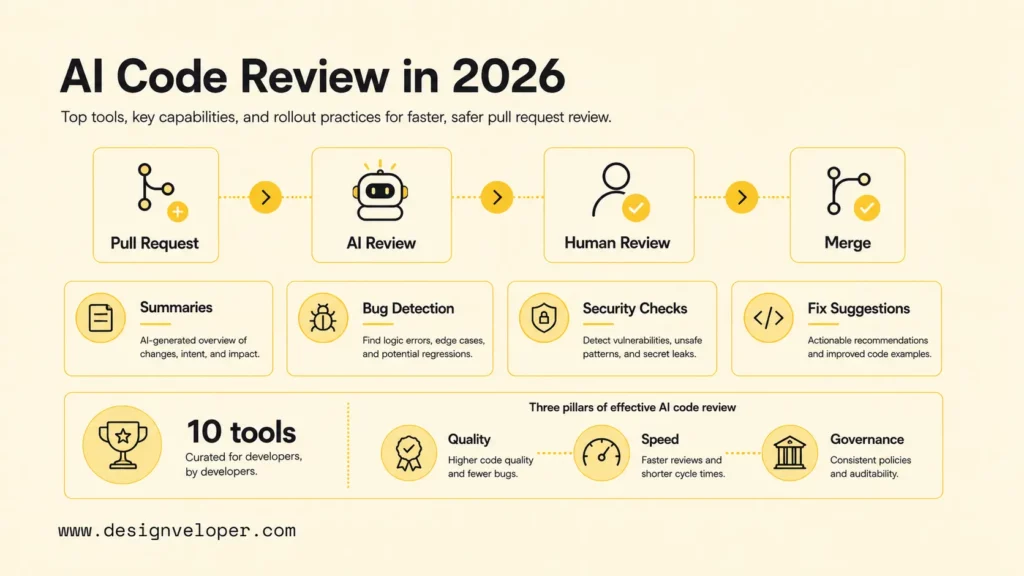
What Is AI Code Review?
AI code review is the use of AI models, static analysis, repository context, security intelligence, and workflow automation to review code changes before they are merged. An AI code reviewer can inspect a diff, read surrounding files, compare the change with team guidelines, summarize the pull request, flag likely bugs, and suggest improvements.
For teams asking what is automated code review, the answer starts before generative AI. Automated code review existed before generative AI. Linters, formatters, type checkers, static-analysis tools, dependency scanners, and security scanners have long caught style issues, syntax problems, vulnerabilities, and maintainability risks. AI-assisted code review adds natural-language reasoning, broader repository context, generated explanations, and sometimes automatic fix suggestions.
The strongest teams treat AI review as a review layer, not a review replacement. AI can catch repeated patterns, missing tests, inconsistent conventions, risky dependencies, and suspicious edge cases. Human reviewers still need to judge product behavior, domain logic, architecture, user impact, and whether the suggestion fits the team’s standards.
A useful AI code review workflow answers four questions: What should machines check automatically? What should AI summarize or suggest? What must a human approve? And what metrics show that review quality improved rather than merely became faster?
Recommended for you:
- Software Development Life Cycle: A Practical Guide
- What Is Software Architecture?
- Software Development Tools: Practical Options For Modern Teams
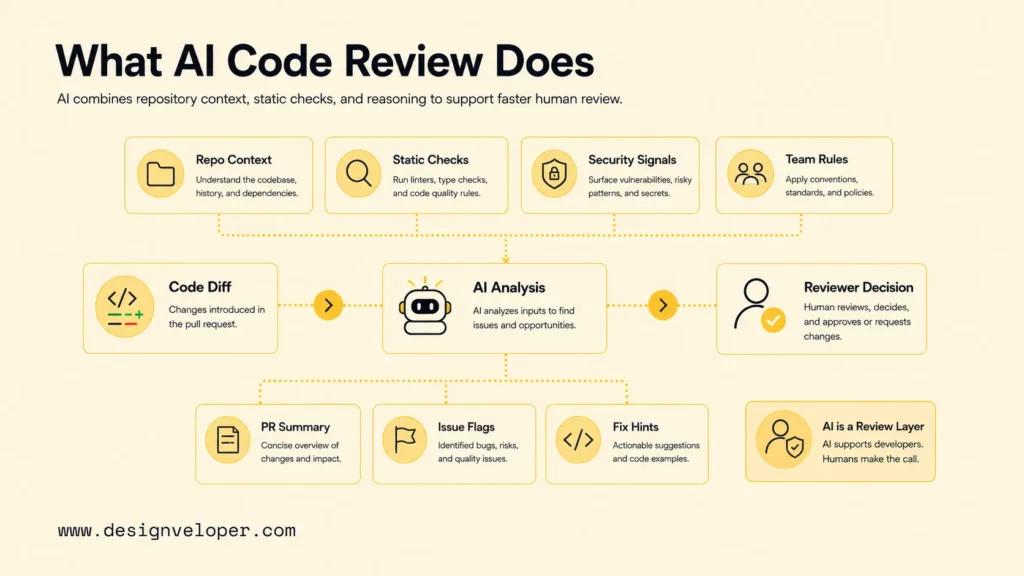
Key Capabilities Of AI Code Review
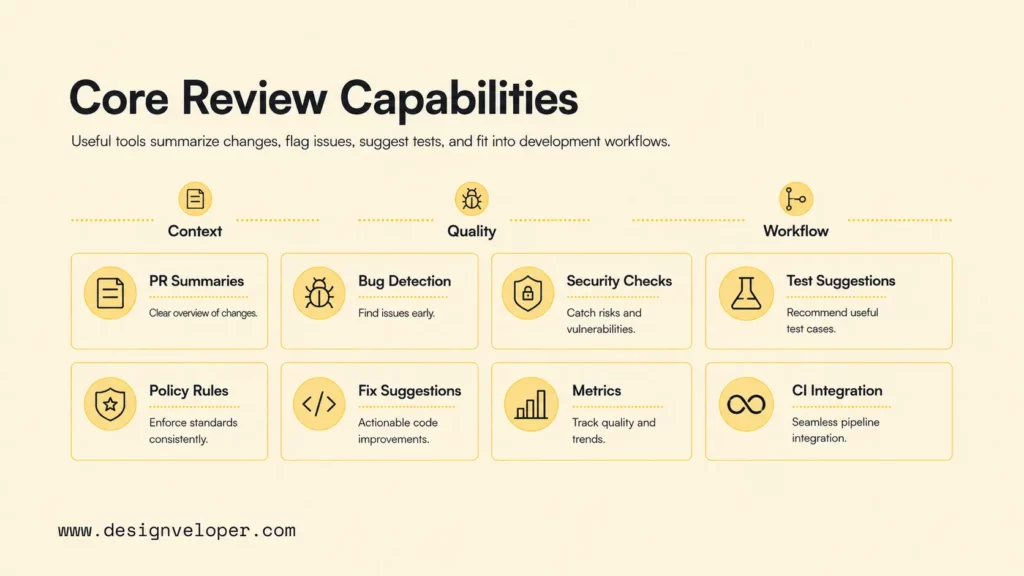
Strong AI code review tools combine several capabilities: pull-request summaries, bug detection, security checks, style and maintainability feedback, test suggestions, repository-aware context, policy configuration, and workflow integration. The right mix depends on team size, codebase risk, compliance needs, and existing CI/CD maturity.
- Pull-request summaries: AI can explain what changed, which files matter, and where reviewers should look first.
- Bug and logic detection: AI can flag null-handling mistakes, race conditions, missing validation, broken edge cases, and suspicious control flow.
- Security feedback: AI can surface hardcoded secrets, injection risks, unsafe dependencies, weak authorization checks, and risky data handling.
- Test suggestions: AI can identify missing tests and generate candidate cases for unit, integration, or regression coverage.
- Policy alignment: AI can apply repository guidelines, coding standards, and custom review rules when tools support configuration.
- Fix suggestions: Some platforms can produce patch suggestions or autofix workflows that developers can accept, edit, or reject.
- Metrics: Mature tools help teams track review time, comment quality, false positives, severity, and developer adoption.
The capabilities are useful only when they fit the development workflow. A tool that posts too many generic comments can slow reviewers down. A tool that misses domain-specific bugs can create false confidence. Teams should evaluate AI review with real pull requests, not only vendor demos.
A practical evaluation should include easy and hard pull requests. Easy pull requests show whether the tool can summarize and apply conventions without noise. Hard pull requests show whether the tool notices missing authorization, incomplete error handling, hidden migration risk, weak tests, or subtle state changes. The second category matters more because senior reviewers need help with high-risk reasoning, not another style-comment generator.
Discover more here:
- Best AI For Python Coding In 2026: Top Picks For Every Workflow
- Python Best Practices For Writing Clean, Maintainable Code
- How To Improve Developer Productivity With Better Engineering Workflows
 testing, metrics, and CI integration.” class=”wp-image-55423″/>
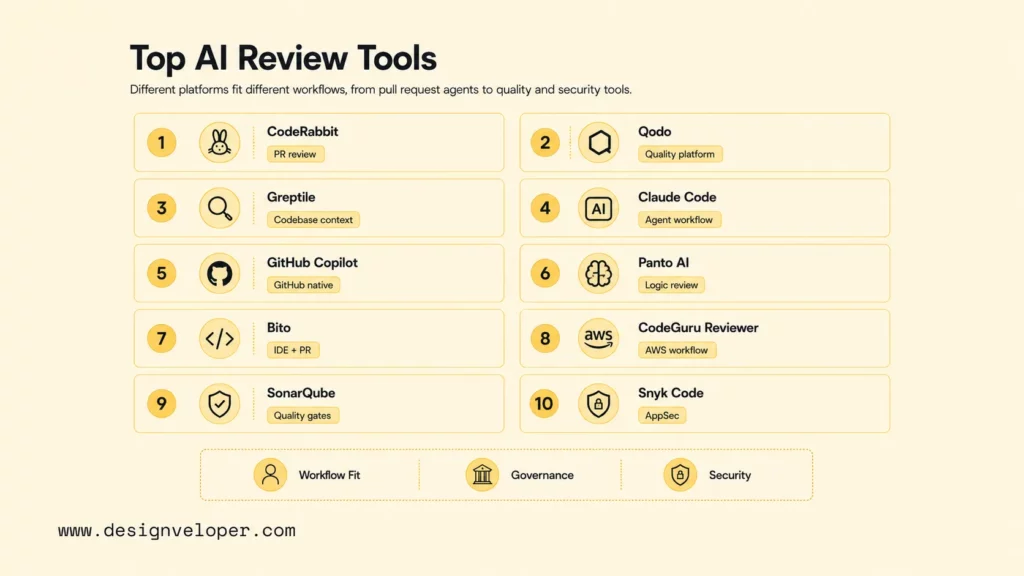
Best AI Code Review Tools In 2026
The best AI code review tools in 2026 differ by workflow depth. Some specialize in pull-request review. Others focus on secure code analysis. And others work as coding agents that can review, explain, and modify code. The right choice depends on repository size, compliance needs, Git provider, privacy requirements, and how much automation the team is ready to govern. A small startup may prioritize low setup time and concise comments. A regulated enterprise may prioritize private deployment, audit logs, role-based access, model controls, and integration with existing SAST and SCA gates.
1. CodeRabbit
CodeRabbit is an AI-powered code review platform for pull requests, IDE, and CLI workflows. It is built for teams that want an always-on reviewer inside GitHub, GitLab, Azure DevOps, or related development flows.
Best For: Engineering teams that want AI pull-request summaries, inline comments, configurable review rules, and review automation tied closely to repository workflows.
Strengths: CodeRabbit focuses deeply on code review rather than general chat. Its docs include pull-request commands, review modes, data exports, CLI workflows, and automation features. The platform is especially relevant when teams need codebase-aware comments and consistent first-pass review coverage.
Limitations: Teams still need to validate noise level, privacy settings, model usage, and fit with existing review habits. CodeRabbit’s own FAQ notes that code may be shared with OpenAI or Anthropic for review purposes depending on configuration, so security-sensitive teams should review data-handling terms before rollout. Teams should also verify which comments are actionable enough to become required fixes and which comments should stay advisory.
2. Qodo
Qodo, formerly associated with Qodo Merge, provides AI code review agents for pull requests and Git workflows. It is positioned around code quality, testing, compliance, and deploy confidence.
Best For: Teams that want an AI-assisted code quality platform across pull requests, IDEs, CI/CD, and Git providers.
Strengths: Qodo’s documentation describes Git integration, ticket context in reviews, customization, and code-review workflows. The platform is useful for teams that want context-aware review plus commands for improvement, documentation, compliance, or analysis.
Limitations: Qodo should be evaluated against the team’s existing static analysis, test coverage, and security tools. AI feedback can be valuable, but teams need to check whether Qodo comments reduce reviewer effort or simply add another comment stream. Teams should define which Qodo findings block merges, which require discussion, and which are optional improvement notes.
3. Greptile
Greptile is an AI code review agent that reviews pull requests with codebase context. The product emphasizes understanding the repository rather than inspecting only the changed lines.
Best For: Teams with complex repositories where review quality depends on cross-file context, architectural conventions, and codebase-specific behavior.
Strengths: Greptile’s positioning around complete codebase understanding is useful for monorepos, shared libraries, and systems where a small diff may affect behavior elsewhere. It can help reviewers spot missing context and hidden dependencies.
Limitations: Codebase-aware review requires strong repository indexing, access controls, and trust in the tool’s context retrieval. Teams should test Greptile on real pull requests that include subtle business logic, not only style or syntax problems. If a repository has sensitive modules, generated clients, or large vendor directories, teams should configure what the reviewer can inspect and what it should ignore.
4. Claude Code
Claude Code code review brings Anthropic’s coding agent into GitHub pull-request review workflows. It can analyze changes, produce findings, and support custom automation through GitHub Actions.
Best For: Teams already using Claude Code for repository-aware development and looking to add code review automation into GitHub workflows.
Strengths: Claude Code is useful when teams want a flexible coding agent that can review, reason about context, and support custom development workflows beyond review. Anthropic’s docs also show CLI and automation patterns that teams can adapt.
Limitations: A general coding agent needs strong guardrails. Teams should define repository permissions, GitHub Action scopes, review triggers, cost controls, and human approval rules. Claude Code can assist review, but production changes still need normal CI, security checks, and human sign-off.
5. GitHub Copilot
GitHub Copilot code review provides AI feedback inside GitHub pull requests and related developer workflows. It also documents how to request Copilot reviews from GitHub.com, Visual Studio Code, and supported flows.
Best For: Teams already standardized on GitHub that want AI review inside the same platform where pull requests, branch protection, checks, and comments already live.
Strengths: Copilot has the advantage of deep GitHub integration. GitHub’s 2026 changelog notes that Copilot code review runs on an agentic architecture using GitHub Actions, which makes it relevant for teams building automated review workflows.
Limitations: Copilot code review should not be treated as a complete quality gate. Teams still need branch protection, required tests, static analysis, dependency scanning, and human review for architecture and business logic. GitHub-native convenience can make adoption easy, but it does not remove governance work.
6. Panto AI
Panto AI is positioned as an AI code review tool for deeper pull-request feedback. It appears in AI code reviewer comparisons because teams are looking for tools that go beyond style comments and inspect logic, security, and workflow fit.
Best For: Teams comparing newer AI code review platforms and looking for business-logic-oriented feedback in pull requests.
Strengths: Panto AI’s appeal is its focus on AI review rather than generic assistant use. It may be useful for teams that want to test whether a specialized reviewer can catch issues manual reviewers miss.
Limitations: Public technical documentation is less visible than for CodeRabbit, Qodo, GitHub, Anthropic, AWS, Sonar, or Snyk. Teams should ask for security documentation, data-retention details, Git provider support, model usage, SOC 2 or compliance status, and real trial results before committing.
7. Bito
Bito AI Code Review Agent reviews pull requests in Git workflows and can use repository context to provide analysis and suggestions. It also documents IDE-based review workflows for developers who want feedback before code reaches the repository.
Best For: Teams that want AI code review both in Git pull requests and inside developer IDE workflows.
Strengths: Bito’s docs describe repository-aware review, pull-request suggestions, and IDE review commands. The tool can help teams catch issues earlier by moving some review feedback closer to the developer’s coding environment.
Limitations: Teams should decide whether IDE feedback and PR feedback overlap too much. Bito may be strongest when used with clear review stages: local suggestions first, CI checks second, pull-request review third, human approval last.
8. Amazon CodeGuru Reviewer
Amazon CodeGuru Reviewer analyzes code reviews and provides recommendations for code quality and maintainability. AWS documentation also describes repository association, incremental reviews, full repository scans, and pricing for review analysis.
Best For: AWS-heavy teams that already use AWS developer tooling and want automated review recommendations integrated with cloud workflows.
Strengths: CodeGuru Reviewer has a long-standing connection to automated code review, static analysis, and AWS workflows. It can be useful for teams that want review recommendations inside an AWS-centered delivery environment.
Limitations: Teams should verify current product direction, language support, repository support, and pricing against their stack. AWS also points some developer review capability toward Amazon Q Developer, so teams should compare the current AWS path before adopting CodeGuru Reviewer for a new rollout.
9. SonarQube With AI-Assisted Workflows
SonarQube is a code quality and security platform rather than a pure AI code reviewer. In 2026, Sonar’s positioning includes code verification for the AI era, quality gates, and agent-connected workflows.
Best For: Teams that want deterministic code quality gates, security checks, coverage visibility, and maintainability rules as the foundation under AI-assisted review.
Strengths: SonarQube is strong for rule-based analysis, quality gates, code smells, vulnerabilities, duplication, and CI integration. It is a good partner to AI review because it handles repeatable checks that should not depend on LLM judgment.
Limitations: SonarQube is not a replacement for conversational AI review. It may not explain business logic tradeoffs like a general LLM reviewer. The best implementation uses SonarQube for reliable gates and AI tools for contextual summaries, edge cases, and reviewer acceleration.
10. Snyk Code
Snyk Code is a semantic, AI-based static application security testing tool that analyzes source code for vulnerabilities. Snyk’s product page positions it around code security analysis and AI-assisted fixes.
Best For: Teams that care most about secure code review, vulnerability detection, and developer-friendly remediation workflows.
Strengths: Snyk Code is security-focused, which makes it useful when AI code review needs to support AppSec and DevSecOps. It can complement general reviewers by focusing on vulnerabilities, insecure patterns, and fix guidance.
Limitations: Snyk Code should be considered part of the security review stack, not the only code reviewer. Teams still need maintainability checks, business logic review, architecture review, tests, and human security review for high-risk changes.
Best Practices For Implementing AI Code Review Tools
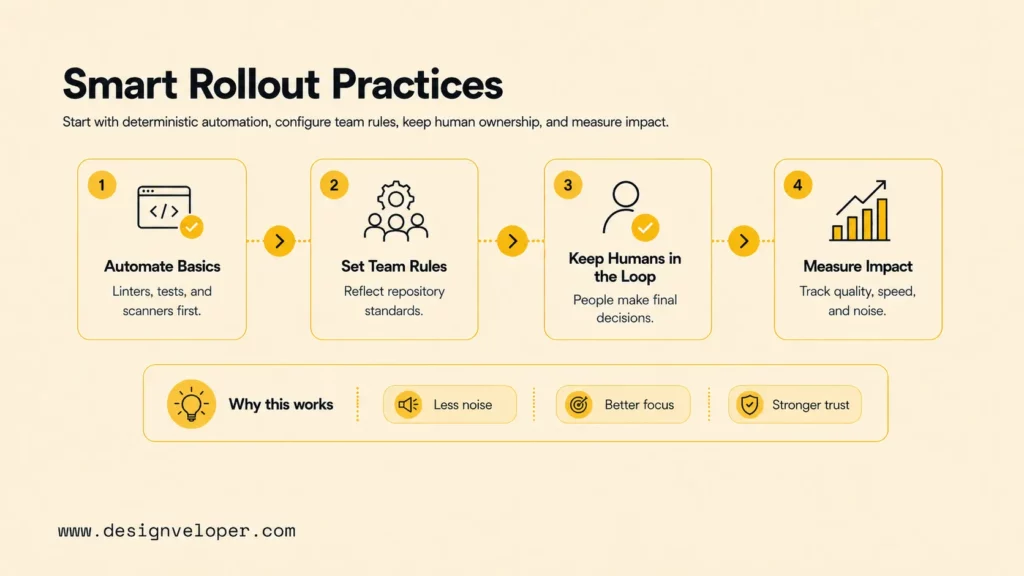
AI code review works best when teams implement it as a controlled engineering workflow. A strong rollout starts with basic automation, team-specific rules, human ownership, and measurable review impact.
Automate The Basics First
Teams should automate deterministic checks before asking AI to review deeper issues. Linters, formatters, type checkers, unit tests, dependency scanners, secret scanners, and static-analysis tools should catch issues that machines can detect reliably.
This order matters because AI reviewers are most valuable when they focus on context, edge cases, missing tests, unclear behavior, and review prioritization. If AI comments mostly repeat formatter or linter feedback, developers will ignore it quickly.
Set Team-Specific Rules
AI review should reflect the team’s standards. Repository instructions should cover naming, security expectations, test requirements, logging rules, API conventions, error handling, data access, and product-specific constraints.
Some tools support custom review rules, repository guidelines, commands, or configuration files. Teams should start with a small rule set and expand only after reviewing false positives. A long rulebook that no one maintains can make AI review noisy and brittle.
Keep Humans In The Loop
Humans must remain responsible for final code decisions. AI can suggest a change, but a reviewer should understand why the change is needed, whether the code fits the architecture, and whether tests prove the behavior.
Human review is especially important for business logic, security boundaries, permission checks, payment flows, data migrations, AI-generated code, and production configuration. AI should help reviewers move faster, not remove accountability from the review process.
Measure Accuracy, Noise, And Review Impact
Teams should measure AI review before scaling it across every repository. Useful metrics include false-positive rate, accepted suggestion rate, comments per pull request, review cycle time, escaped defects, developer trust, and number of meaningful issues found before merge.
A practical pilot can compare 20 to 50 recent pull requests with and without AI review. The team should ask whether the AI found real issues, whether comments were actionable, whether human reviewers saved time, and whether developers trusted the feedback enough to change behavior.
Learn more in:
- Agentic AI Security: Guardrails For Tool-Using Systems
- AI Agent Orchestration: Coordinating Systems Safely
- What Is An AI Harness & Build A Minimal One Yourself
Risks Teams Should Plan For
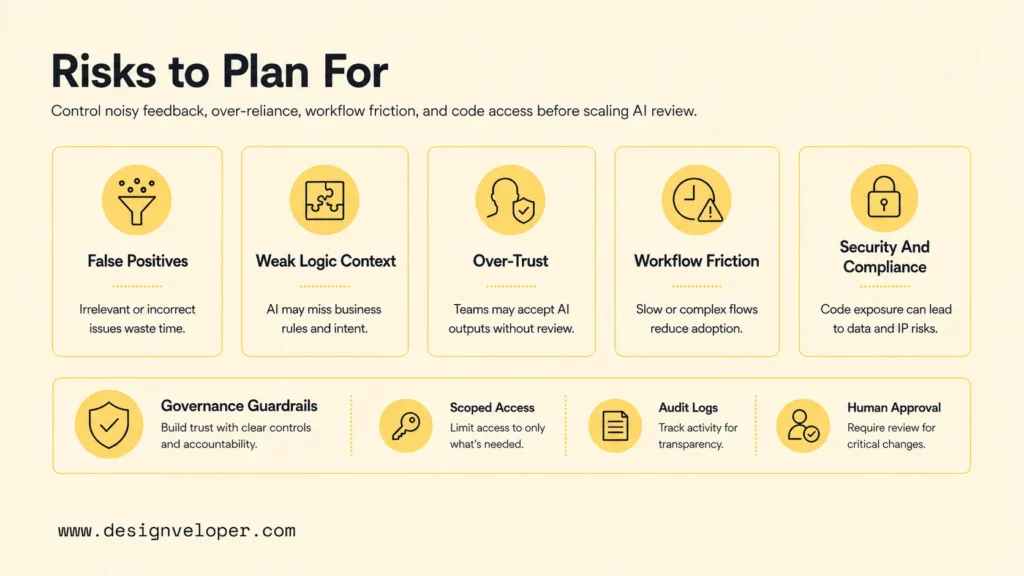
AI code review introduces risks that teams should plan for before rollout. The biggest risks are noisy comments, weak business-logic understanding, over-reliance on AI suggestions, poor workflow fit, and security or compliance concerns around code access.
- False positives and noisy feedback: Too many low-value comments can train developers to ignore the tool.
- Weak business-logic understanding: AI may miss domain-specific rules that are obvious to a product engineer.
- Over-reliance on AI suggestions: Developers may accept plausible fixes without understanding side effects.
- Poor workflow fit: A tool that disrupts existing branch protection, CI, or reviewer ownership can slow teams down.
- Security and compliance concerns: Tools may need repository access, third-party model processing, logs, or retention controls.
Security-sensitive teams should review vendor terms, data retention, model providers, encryption, audit logs, access controls, and enterprise deployment options. The NIST AI Risk Management Framework gives teams a useful vocabulary for validity, reliability, security, privacy, and accountability when AI enters engineering workflows.
Teams should also separate AI review permissions by risk. Read-only pull-request comments are lower risk than tools that can push commits, apply fixes, run commands, or open follow-up pull requests. Any tool with write access should operate through protected branches, scoped tokens, audit logs, and human approval for production-impacting changes.
For a deeper dive, read:
- From AI MVP To Product: Why Great Demos Are Not Enough
- AI In Product Development: From Concept To Market Faster
- Custom Software Development: A Practical Guide For Businesses
What It Takes To Implement AI Code Review Well
Implementing AI code review well requires workflow design, team trust, security review, and continuous measurement. The tool is only one part of the system. The review culture around the tool decides whether AI improves quality or simply adds more comments.
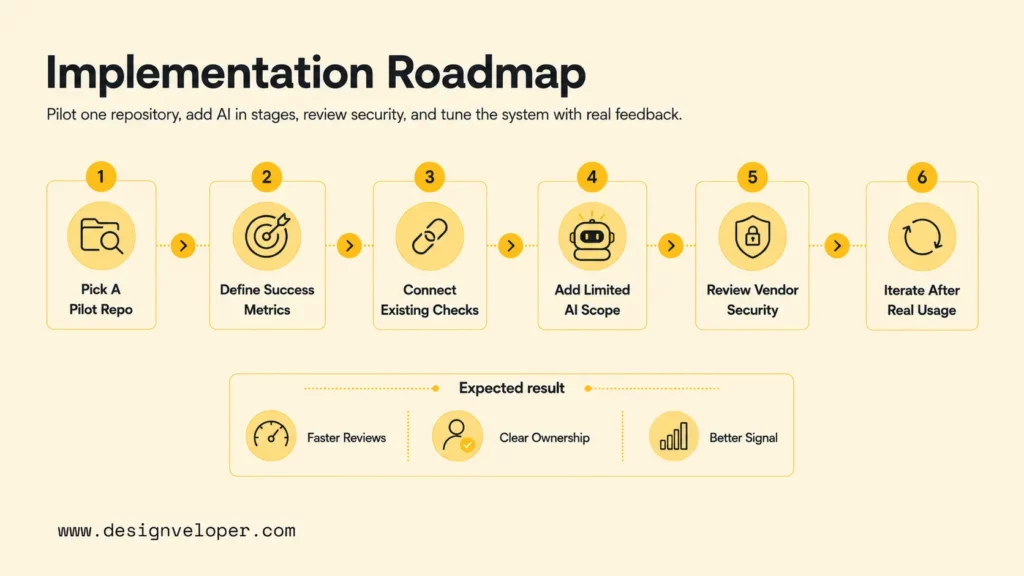
A practical implementation roadmap looks like this:
Teams should also decide how AI review interacts with existing reviewer roles. For example, an AI reviewer can prepare the first summary, a module owner can review architecture and domain behavior, a security reviewer can inspect sensitive paths, and the author can respond to both machine and human comments in one pull-request thread. Clear role design prevents duplicate work and keeps accountability visible.
- Pick one pilot repository. Choose a repo with active pull requests, meaningful tests, and reviewers willing to give feedback.
- Define success metrics. Track review time, accepted suggestions, false positives, missed issues, and developer sentiment.
- Connect existing checks first. Keep linters, tests, SAST, SCA, and quality gates as required checks.
- Add AI review with limited scope. Start with summaries, missing-test suggestions, and high-severity findings before enabling broad comments.
- Create review rules. Document which comments developers should fix, discuss, or ignore.
- Review vendor security. Confirm code access, retention, model providers, audit logs, and compliance needs.
- Iterate after real usage. Tune rules, disable noisy checks, and expand only when reviewers trust the signal.
Designveloper approaches AI code review as part of a larger software delivery system. As an AI-first software and automation partner, we help teams connect AI-assisted development with CI/CD, testing, code quality, security review, workflow automation, and post-launch maintenance. Designveloper’s public AI development services show why AI adoption needs product engineering, not only tool adoption.
The best AI code review strategy is balanced. Let automated tools catch repeatable problems. Let AI reviewers summarize, suggest, and prioritize. And, crucially, let human engineers own architecture, business logic, security-sensitive decisions, and final approval. That combination gives teams the speed benefits of AI assisted code review without weakening the engineering judgment that keeps production software reliable.
A final rollout checklist should include tool ownership, repository access, default comment severity, required checks, escalation rules, monthly metrics, and a path for developers to dispute bad feedback. AI code review should become part of the engineering quality system, not a side channel that posts comments no one owns.
Also published on

Share post on










Related Articles



How To Build A RAG System: Step-By-Step (New Guide)
How To Build A RAG System: Step-By-Step (New Guide) Published October 19, 2026
8 Best AI Onboarding Tools For Faster Employee Ramp-Up In 2026
8 Best AI Onboarding Tools For Faster Employee Ramp-Up In 2026 Published October 19, 2026
Is Vibe Coding Legal? Ownership, Copyright, and Release Risks
Is Vibe Coding Legal? Ownership, Copyright, and Release Risks Published October 16, 2026