














AI Agent Pricing Framework: Cost Models, Hidden Fees, And ROI Tips

AI agent pricing usually combines a platform fee, model or token usage, workflow volume, integrations, monitoring, and the human review work needed to keep the agent reliable. A simple customer service agent may start with outcome or conversation pricing, while a custom enterprise agent often needs discovery, data preparation, software integration, security review, hosting, and ongoing optimization. The practical question is not only “How much does an AI agent cost?” The better question is “What unit of value should the agent be priced against, and what costs appear after the first demo works?”
Quick decision guide: start with the smallest workflow that has measurable volume, a clear success definition, and a known fallback path. Use off-the-shelf pricing when the workflow fits a standard support, sales, or ecommerce pattern. Use custom development pricing when the agent must use private systems, complex approvals, regulated data, or multi-step reasoning that cannot be handled safely by a generic chatbot.
| Pricing question | Fast answer | What to verify before budget approval |
|---|---|---|
| Best model for predictable budgets | Fixed fee per agent or per seat. | Included usage, overage rules, channels, and support limits. |
| Best model for support automation | Per conversation, per resolution, or per outcome. | How the vendor defines a billable outcome and failed resolution. |
| Best model for technical teams | Usage-based API, token, or credit pricing. | Current model rates from OpenAI API pricing or Claude API pricing. |
| Best model for complex operations | Custom development plus recurring infrastructure and maintenance. | Data readiness, integrations, monitoring, security, and human escalation. |
| Best ROI metric | Cost per successful task, resolution, or workflow outcome. | Baseline labor cost, deflection quality, adoption, and exception handling. |
Recommended for you:
- AI Agent Vs. AI Assistant: Which Is Right For Your Business?
- Why AI Agents Need MCP: How AI Systems Connect To Tools And Data
- Types of AI Agents: Key Categories and When to Use Each
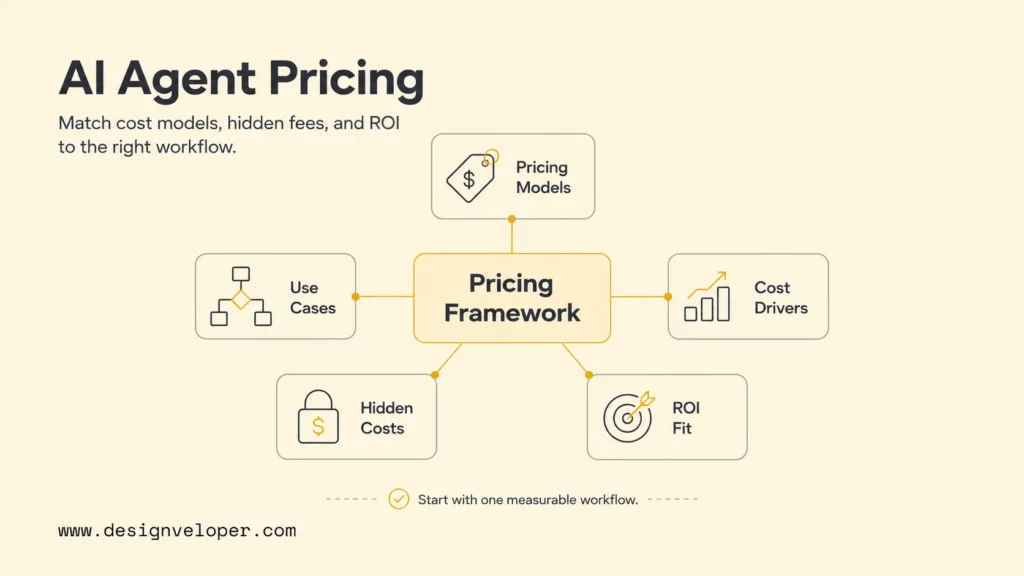
Understanding AI Agent Pricing Models And Frameworks
AI agent pricing models differ because AI agents are sold in several forms: AI chatbots in customer service, sales automation tools, AI tools for developers, hosted agent platforms, and custom software projects. Gartner’s 2026 agentic AI coverage says only 17% of organizations have deployed AI agents so far, while more than 60% expect to deploy them within two years. That fast adoption curve explains why pricing is still uneven across vendors.
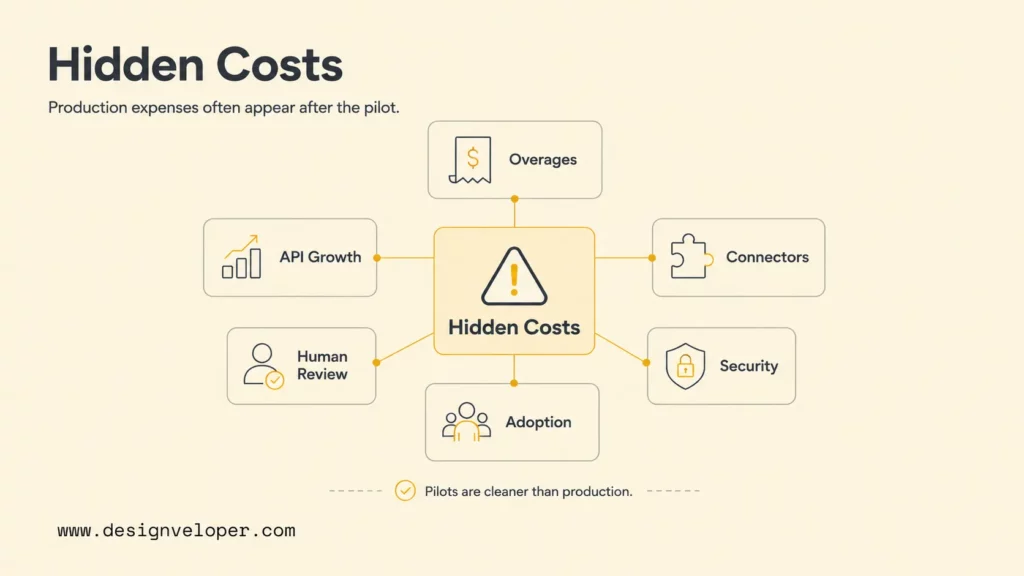
A team should compare pricing by unit, not by headline price. The unit may be an agent, seat, conversation, resolution, credit, token, workflow, or delivered outcome. Each unit moves cost risk to a different side of the contract. Seat pricing is predictable but may not reward automation. Usage pricing is granular but can grow quickly. Outcome pricing is attractive when outcomes are defined clearly, but it needs careful QA because a low-quality automated resolution can still damage the customer experience.
Fixed Fee Per Agent
Fixed fee pricing charges a monthly or annual amount for each deployed AI agent, teammate, workspace, or package. This model is easiest to budget because finance teams can forecast the number of agents or seats. It fits internal assistants, early pilots, and teams that want a stable subscription before optimizing per-task economics.
The tradeoff is that fixed fees can hide usage ceilings. A plan may include a certain number of conversations, workflow runs, channels, knowledge sources, or integrations, then charge overages. Before choosing this model, ask whether the fee includes production support, analytics, test environments, security controls, and access to higher-quality models.
Usage-Based Pricing
Usage-based pricing charges by tokens, API calls, messages, tool calls, compute time, or credits. Developer teams see this model in model APIs. The OpenAI API pricing page lists model costs per 1 million tokens, with different input, cached input, and output prices. The Anthropic Claude pricing documentation also presents model and feature pricing in USD. These pages matter because model choice can change an agent’s monthly cost more than the orchestration framework does.
Usage pricing is fair when tasks vary in complexity. A short routing agent should cost less than a research agent that reads documents, calls tools, and writes a long report. However, usage pricing requires controls. Developers should track token usage, tool-call counts, retries, and failed runs. The OpenAI Agents SDK usage documentation notes that token usage can be tracked for every run, which is exactly the kind of telemetry needed for cost governance.
Per Conversation Or Per Resolution Pricing
Per conversation or per resolution pricing is common in customer support because support teams already track tickets, contacts, and resolved issues. Intercom’s pricing page says Fin AI Agent pricing starts from $0.99 per Fin outcome. The standalone Fin pricing page also presents pricing from $0.99 per outcome. This model aligns cost with automated service volume rather than the number of internal users.
The definition of a “resolution” is the critical contract term. A vendor may count a resolution when the customer accepts the answer, when a ticket is closed, when a conversation avoids human handoff, or when a system action succeeds. Teams should check how refunds, reopened tickets, partial answers, low-CSAT outcomes, and escalations affect billing.
Credit-Based Pricing
Credit-based pricing converts different actions into a vendor-specific unit. One credit may represent a message, model call, workflow run, enrichment step, or premium feature. Credits are flexible for vendors because they can price several features with one unit. Credits are harder for buyers because the relationship between credits and actual work may be opaque.
Credit pricing needs a usage simulator. Before signing, estimate credits for best case, expected case, and high-volume case. Include retries, long context, file uploads, retrieval, function calls, and human review actions. A cheap credit pack can become expensive if a single successful workflow consumes many credits.
Outcome-Based Pricing
Outcome-based pricing charges for a verified business result, such as a resolved support issue, booked meeting, qualified lead, processed claim, or completed workflow. This model is appealing because it links price to value. It also forces the buyer and vendor to define what success means.
Outcome pricing can still create risk. If the outcome is too easy to count, the agent may optimize for closure rather than quality. If the outcome is too hard to verify, disputes increase. Teams should define outcome rules, quality thresholds, sampling review, exception handling, and the authority of human reviewers before production rollout.
Custom Development Pricing
Custom development pricing covers the software work needed to build an agent for a specific workflow. The budget may include discovery, architecture, prompt and tool design, RAG, database work, API integrations, workflow automation, testing, security review, analytics, deployment, training, and maintenance. This model is common when the agent must connect to private systems or operate inside business processes that generic tools cannot model safely.
Custom work is more expensive upfront, but it can reduce long-term waste when the workflow is complex. A custom agent can use the right model for each step, cache repeated context, limit tool calls, route exceptions, and produce audit logs that a regulated team can trust. Designveloper’s AI development services fit this category when the work requires production AI, software integration, and workflow-aware delivery rather than a standalone chatbot.
AI Agent Cost Per Month By Use Case
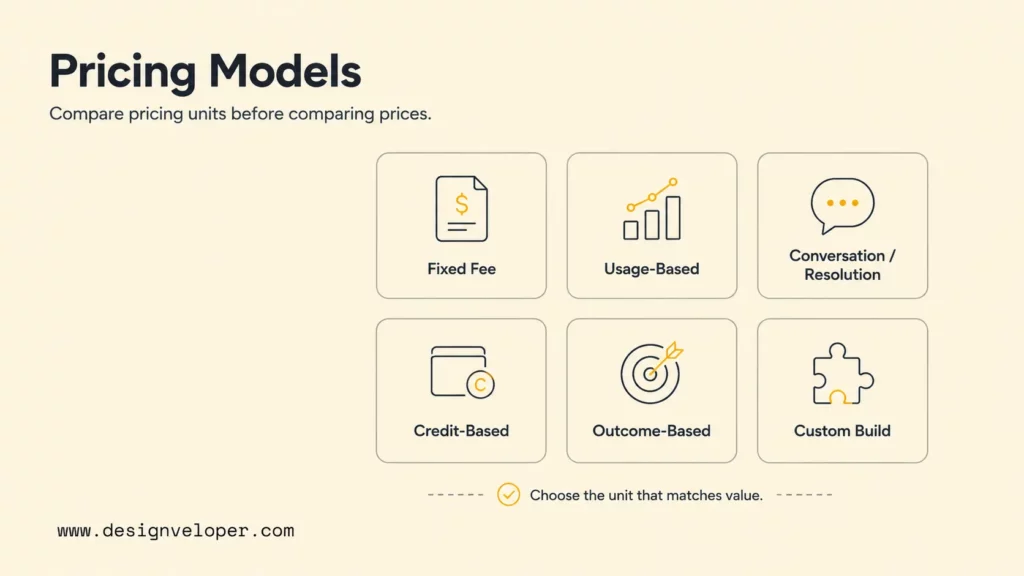
Monthly AI agent cost depends on the use case because each use case has different traffic, context length, integration depth, and quality expectations. A support bot may process thousands of short conversations. A research agent may run fewer tasks but use long documents and expensive reasoning. An internal workflow agent may need less public traffic but more security, permissions, and auditability.
| Use case | Typical pricing model | Main cost drivers | Best fit |
|---|---|---|---|
| Customer service agents | Per outcome, per resolution, per seat, or platform tier. | Conversation volume, channels, help-center quality, handoff rules, and QA sampling. | Teams with repeat support questions and clear resolution definitions. |
| Sales and CRM agents | Seat, workflow, lead, or usage-based pricing. | CRM integration, lead enrichment, email volume, meeting booking, and compliance review. | Teams that can measure qualified meetings or pipeline impact. |
| Shopping or ecommerce agents | Conversation, order, recommendation, or custom workflow pricing. | Catalog size, inventory access, returns workflows, promotions, and checkout handoff. | Retailers that need guided search, product matching, and order support. |
| Internal workflow automation agents | Custom development plus recurring platform, API, and hosting cost. | Identity, permissions, approvals, business-system integrations, and monitoring. | Operations teams with repetitive tasks and clear process owners. |
| Research or analysis agents | Token, credit, compute, or project-based pricing. | Long context, document retrieval, citations, tool calls, and review time. | Analysts who need traceable research rather than instant chat answers. |
| Custom enterprise AI agents | Discovery plus build plus monthly maintenance. | Security, governance, data pipelines, observability, uptime, and support. | Organizations with private data, regulated workflows, or multi-system operations. |
Customer service has the clearest public pricing examples because support automation has measurable ticket volume. Zendesk’s pricing page lists Suite Team from $55 per agent per month when billed annually and includes AI agent capabilities in that suite tier. Intercom and Fin price around outcomes. Those models are easier to evaluate when the company already knows monthly tickets, average handle time, labor cost per ticket, and escalation rate.
The cheapest AI agent is not the one with the lowest platform fee. It is the one that completes the right workflow with the fewest failed retries, escalations, and hidden operating costs.
Internal agents are harder to price because the savings may be spread across teams. An HR agent that answers policy questions, a finance agent that drafts reports, or an operations agent that updates project systems may save minutes across many employees. For these agents, monthly cost should be compared with process time saved, error reduction, turnaround time, and the cost of maintaining human approval flows.
Further reading:
- Best AI Agent Frameworks For Building Smarter AI Systems
- How To Build An AI Agent: A Practical Step-By-Step Guide
- Top AI Agent Companies: Industry Leaders to Watch
What Drives AI Agent Costs
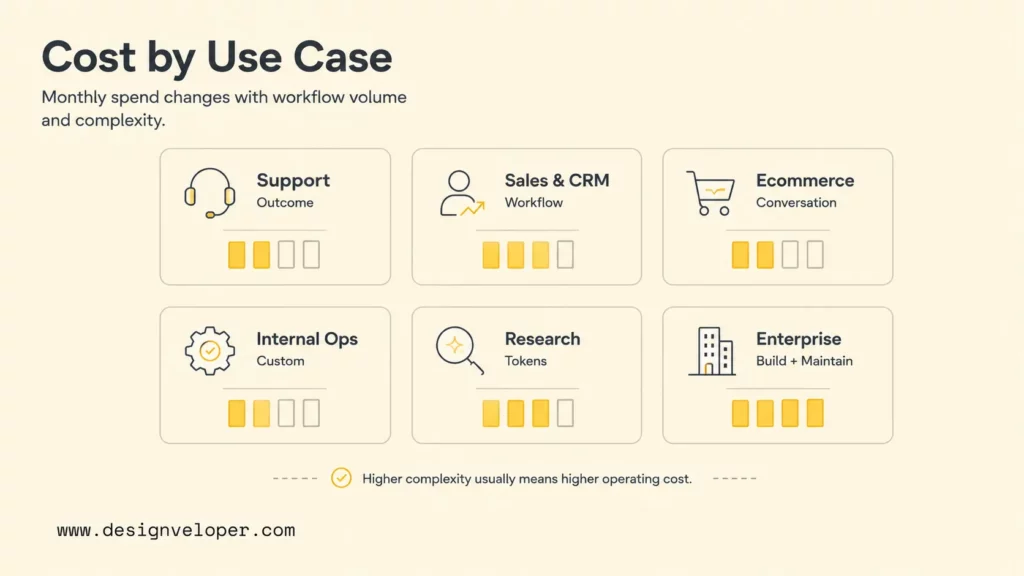
AI agent costs are driven by model choice, token consumption, workflow volume, reasoning steps, integrations, memory, monitoring, and human escalation. Two agents with the same user interface can have very different costs if one uses a small model for short answers and another uses a frontier model, long context, retrieval, code execution, and several external tools.
- Model choice and API usage: premium models cost more but may reduce retries for hard tasks. Compare official API pages such as OpenAI model pricing, Claude model pricing, and Azure OpenAI pricing before estimating run cost.
- Token consumption and context length: long prompts, large retrieved documents, verbose tool outputs, and long answers increase input and output tokens.
- Task volume, conversations, credits, or resolutions: monthly traffic turns a cheap unit price into a real bill. Always model low, expected, and high-volume scenarios.
- Tool calls, retries, and multi-step reasoning: agents often call search, databases, CRMs, calendars, payment systems, or internal APIs. Each call can add latency, cost, and failure paths.
- Workflow complexity and integrations: private business systems require authentication, permissions, schema mapping, testing, and fallback behavior.
- Memory, vector search, and orchestration: persistent memory and RAG add storage, indexing, retrieval, reranking, evaluation, and deletion requirements.
- Security, monitoring, and human escalation: agent logs, trace review, guardrails, and escalation queues are operating costs, not optional extras. The OpenAI Agents SDK tracing documentation describes trace records for LLM generations, tool calls, handoffs, guardrails, and custom events, which are the same artifacts teams need for debugging and governance.
Cost control should be designed into the architecture. Use smaller models for classification and routing, cache stable context, cap maximum steps, summarize long documents before repeated use, and route high-risk actions to humans. Also create budget alerts per agent, tenant, workflow, and customer segment. A single global AI budget is too blunt for production operations.
AI agent cost stack
Seats, agents, channels, workspace, support plan.
Input tokens, output tokens, cached input, premium reasoning.
Tool calls, retries, integrations, approvals, escalations.
Cleanup, embeddings, vector storage, sync, retention.
Monitoring, QA, prompt updates, security review, maintenance.
Use this cost stack to estimate the full operating cost before comparing vendor prices. The most useful estimate includes model usage, workflow retries, data work, monitoring, security review, and the human time needed for exceptions.
Hidden AI Agent Costs Teams Often Miss
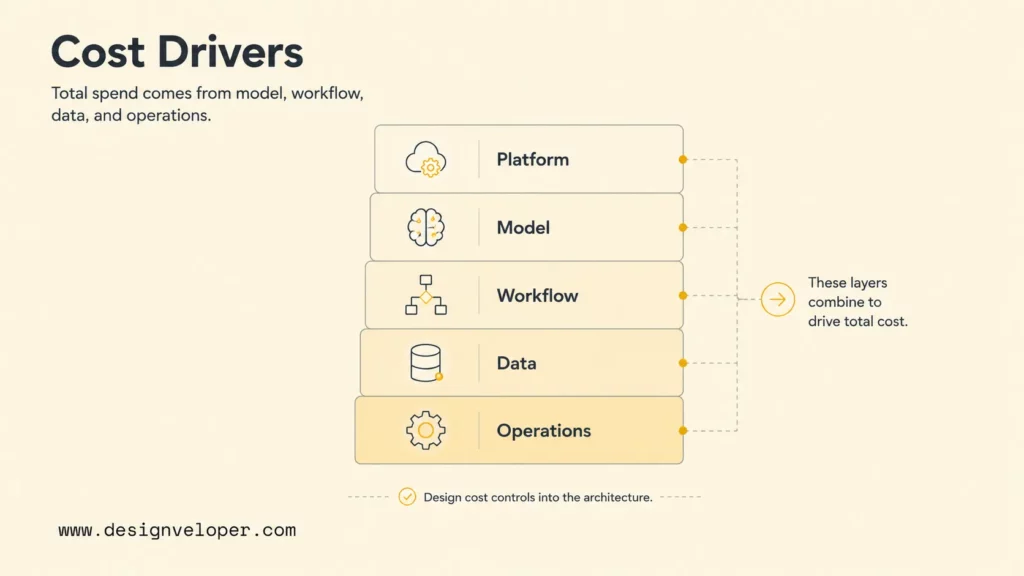
Hidden AI agent costs usually appear after the first pilot because pilots have clean data, limited users, and patient testers. Production has messy systems, exceptions, volume spikes, customer frustration, security review, and integration failures. Gartner warned in 2025 that over 40% of agentic AI projects may be canceled by the end of 2027 because of escalating costs, unclear business value, or inadequate risk controls.
- Overage fees from task, credit, or conversation limits: volume spikes, seasonal support, or repeated retries can push usage past included limits.
- Rising API costs as usage scales: longer prompts, bigger models, and more output tokens can make a popular agent materially more expensive.
- Premium integrations or connector limits: CRM, ERP, ecommerce, ticketing, voice, analytics, and warehouse connectors may be priced separately.
- Failed resolutions that still trigger charges: a conversation may count as an outcome even when the customer returns later or a human fixes the issue.
- Human escalation and review time: safe agents need exception handling, QA sampling, and review workflows for high-impact actions.
- Poor adoption or workflow mismatch: an agent that employees or customers avoid still costs money through subscriptions, maintenance, and opportunity cost.
Security is another hidden cost. The OWASP Top 10 for LLM Applications 2025 includes risks such as sensitive information disclosure, prompt injection, vector and embedding weaknesses, excessive agency, and unbounded consumption. AI agents touch tools and business systems, so security review must cover permissions, audit logs, prompt-injection resistance, data retention, and emergency shutoff.
A pilot proves that an agent can answer. Production pricing must prove that the agent can answer, act, fail safely, and stay affordable under real traffic.
Related reading:
- Agentic AI Security: Risks, Core Architecture, Solutions
- Agentic AI Architecture: Components, Workflow, Design Patterns
- A Practical Guide To AI Agent Architecture With Diagrams
Off-The-Shelf Vs Custom AI Agent Costs
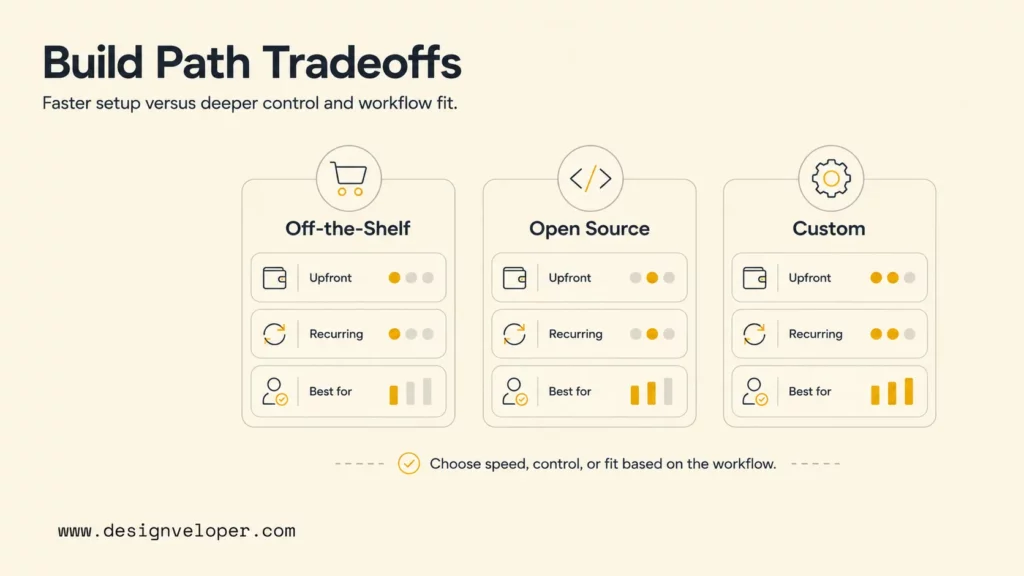
Off-the-shelf AI agents are faster to start and easier to budget. They work best when the business process already matches the vendor’s product shape, such as helpdesk automation, sales qualification, ecommerce support, scheduling, or knowledge-base answers. The buyer pays for speed, packaged integrations, vendor support, and standard analytics.
Free or open-source agents can reduce platform fees, but they do not remove setup, hosting, model API, vector database, security, integration, and maintenance work. A no-license prototype can still become expensive if engineers spend weeks wiring authentication, retrieval, monitoring, and exception handling. Open-source is strongest when the team has engineering capacity and wants architectural control.
Custom AI agents cost more upfront but fit private data, complex workflows, integrations, and governance needs better. A custom build can choose cheaper models for easy steps, expensive models only for hard steps, and deterministic code for operations that should not depend on LLM judgment. It can also integrate with existing dashboards, approval flows, CRM records, finance systems, or internal tools.
| Option | Upfront cost | Recurring cost | Use when | Main risk |
|---|---|---|---|---|
| Off-the-shelf platform | Low to medium. | Subscription, outcome, seat, or usage fees. | The workflow matches standard support, sales, or ecommerce patterns. | Vendor limits and overage fees. |
| Open-source or self-hosted stack | Medium engineering time. | Hosting, model APIs, storage, maintenance, and security. | The team needs control and has technical capacity. | Hidden maintenance workload. |
| Custom AI agent | Medium to high discovery and development. | Infrastructure, model usage, monitoring, support, and iteration. | The workflow uses private systems, approvals, or regulated data. | Scope creep without a clear ROI metric. |
Designveloper usually becomes relevant when the agent is part of a broader product or operational system. We help teams map the workflow, design the architecture, connect private systems, build human approval flows, test edge cases, monitor cost and quality, and maintain the system after launch. For teams comparing build paths, our software development services and AI software development services can support both the product engineering and AI integration layers.
For a deeper dive, read:
- How To Build And Use AI Business Process Automation Effectively
- AI Chatbot Integration: How To Connect Chatbots With Business Systems
- AI Chatbot Development: A Step-By-Step Guide
AI Agent ROI Depends On Workflow Fit
AI agent ROI depends on workflow fit more than model novelty. McKinsey’s 2025 State of AI survey describes a market where agentic AI is spreading but many organizations still struggle to move from pilots to scaled impact. Deloitte also predicted that 25% of companies using generative AI would launch agentic AI pilots or proofs of concept in 2025, rising to 50% in 2027, according to Deloitte autonomous generative AI agent predictions. A rush of pilots does not guarantee ROI. The workflow has to be worth automating.
- Start with one high-impact workflow. Choose a workflow with measurable volume, repeatable steps, available data, and a clear owner. Avoid starting with vague “AI assistant” scope.
- Estimate the full monthly cost. Include platform fees, API usage, hosting, setup, maintenance, monitoring, human review, and escalation time.
- Track cost per successful task, resolution, or workflow outcome. Do not stop at conversations handled. Measure whether the agent actually completes the work to an acceptable quality level.
- Optimize prompts, model choice, tools, and escalation rules over time. Use traces, analytics, and human review to reduce expensive retries and low-value automation.
- Compare savings with adoption and quality. An agent that saves labor but frustrates customers or creates manual cleanup does not have durable ROI.
AI agent ROI scorecard
| Question | Healthy signal | Warning signal |
|---|---|---|
| Workflow volume | Enough repeated tasks to amortize setup. | Low volume or constantly changing work. |
| Success metric | Cost per accepted outcome is tracked. | Only response count or demo quality is tracked. |
| Data readiness | Knowledge, systems, and permissions are maintained. | Answers depend on stale documents or manual copy-paste. |
| Escalation | Human handoff is defined and measured. | The agent fails silently or loops. |
Designveloper’s recommended approach is to price the first agent around one measurable workflow. The discovery phase should define the business baseline, data sources, integration boundaries, security requirements, quality threshold, and human fallback path. After launch, the team should review traces, model cost, adoption, successful outcomes, and support exceptions every month. That operating loop keeps AI agent pricing connected to value rather than vendor hype.
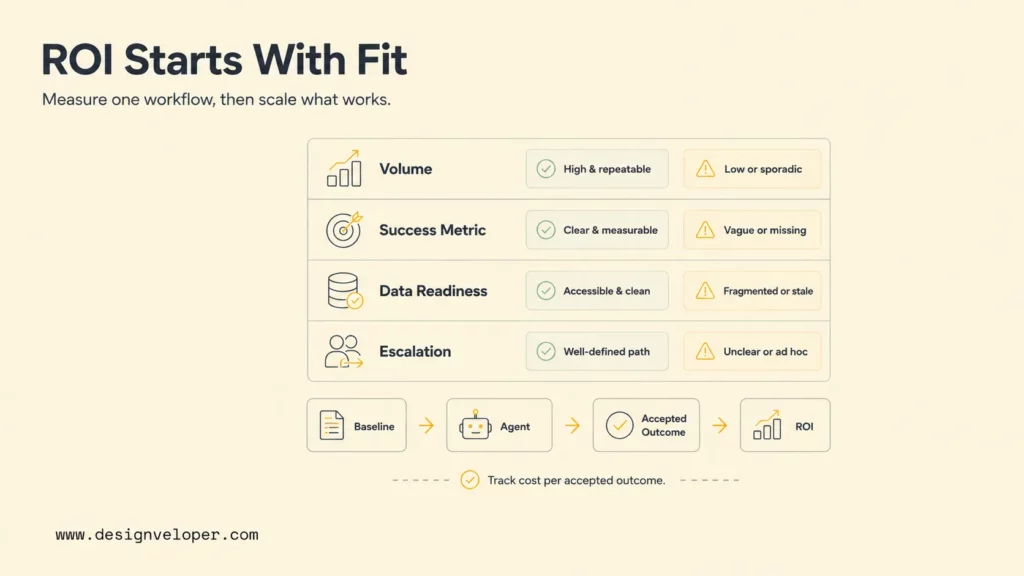
Use this ROI view as the final check before moving from a pricing estimate to a production commitment. The next questions focus on the cost ranges and pricing units teams usually need to confirm.
FAQs About AI Agent Pricing
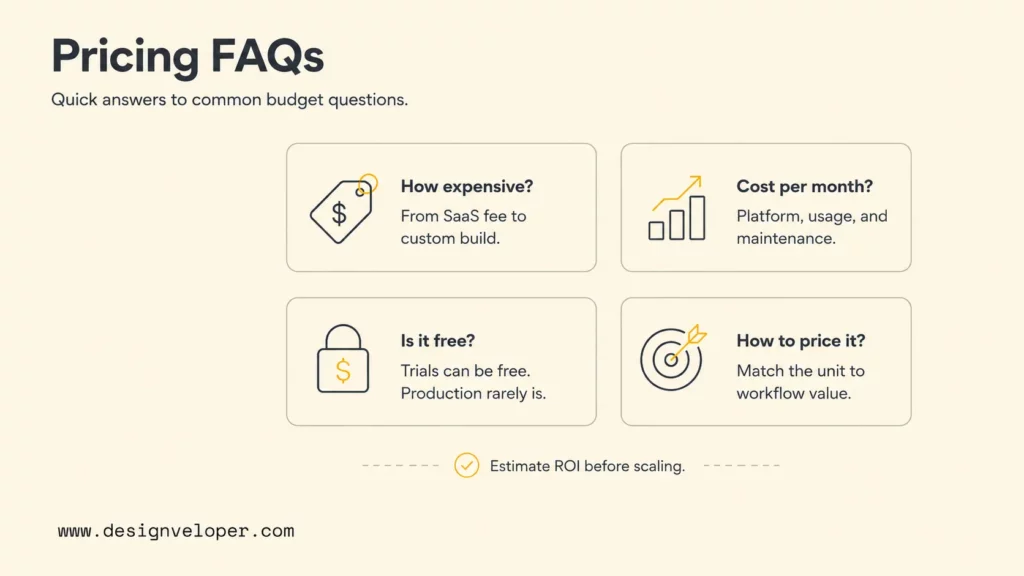
How Expensive Is An AI Agent?
An AI agent can cost anything from a low monthly SaaS subscription to a custom software project with ongoing infrastructure and support. The real price depends on workflow complexity, usage volume, model choice, integrations, security requirements, and human review. For budget planning, compare total monthly cost with cost per successful task, not only with the vendor’s starting price.
How Much Does An AI Agent Cost Per Month?
Monthly AI agent cost may include platform subscription, per-outcome charges, API tokens, hosting, vector database storage, monitoring, and maintenance. A support agent may be priced per outcome or seat. A developer-built agent may be priced by API usage and infrastructure. A custom enterprise agent may also include a support retainer for prompt updates, integration fixes, QA, and analytics review.
Is An AI Agent Free?
An AI agent can be free to test when a vendor offers a trial or when developers use open-source tools. A production AI agent is rarely free because model calls, hosting, data preparation, security review, integrations, monitoring, and maintenance still cost money. Free tools are useful for learning, but buyers should estimate the operating cost before putting an agent into a business workflow.
How Do You Price An AI Agent?
Price an AI agent by choosing the unit that matches value: per seat for internal productivity, per conversation or resolution for support, per workflow for operations, per token or credit for developer usage, and custom development for complex systems. Then add hidden costs such as overages, integrations, human escalation, monitoring, security, and ongoing improvement.
How Do Teams Estimate ROI Before Building An AI Agent?
Teams estimate ROI by measuring the current workflow baseline first. Count monthly task volume, average handling time, labor cost, error rate, escalation rate, and customer or employee impact. Then estimate AI agent pricing across platform, model, hosting, setup, maintenance, and human review. The agent is worth building when the expected cost per accepted outcome is lower than the current process and the quality risk is manageable.
AI agent pricing should be treated as a product and operations decision, not only a vendor quote. Start with one workflow, define the success unit, model full monthly cost, and keep a human review path for exceptions. If the workflow needs private data, integrations, security controls, or long-term maintenance, a custom AI agent may cost more upfront but create a clearer path to reliable ROI.
Also published on

Share post on










Related Articles


RAG Status In Project Management: Meaning, Colors, And Examples
RAG Status In Project Management: Meaning, Colors, And Examples Published September 09, 2026
What Is LangChain and Where Does It Fit in an AI Application?
What Is LangChain and Where Does It Fit in an AI Application? Published August 25, 2026
8 LangChain Use Cases For AI Products That Need More Than Prompts
8 LangChain Use Cases For AI Products That Need More Than Prompts Published August 25, 2026