











What Is LangChain and Where Does It Fit in an AI Application?

LangChain is an open-source framework for building applications around language models. It becomes most useful when a product needs to combine model calls with prompts, retrieval, tools, state, or output validation. LangChain is not an LLM and not a ready-made chatbot. It is application-layer software that helps developers coordinate model behavior with the rest of a product.
This article is an architecture-fit guide for teams deciding whether LangChain belongs in an AI product. It focuses on application design, trade-offs, pilot scope, and production controls rather than hands-on coding.
What Is LangChain? The Framework for Orchestrating LLM Applications
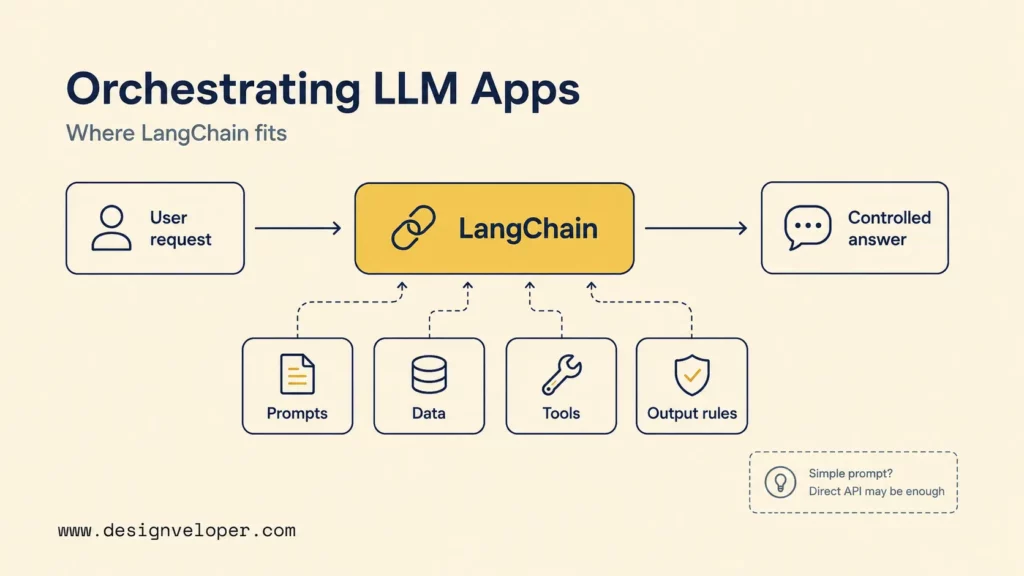
LangChain is an open-source framework for building applications and agents with language models. It provides reusable interfaces for models, prompts, tools, retrieval, structured outputs, and middleware. The official LangChain framework overview describes current LangChain as a configurable agent harness built from models, tools, prompts, and middleware.
LangChain does not provide the language model or the application’s data. It coordinates the work around the model by preparing context, calling tools, managing state, and validating output. A direct provider API may be enough for a simple prompt-response feature; LangChain becomes more useful when the application needs reusable, multi-step orchestration.
A simplified LangChain workflow has four stages:
- Receive the request. The application captures a user question, command, or event.
- Apply workflow logic. LangChain can prepare prompts, route work, manage state, and enforce tool or output rules.
- Use the required capabilities. The workflow can call a model, retrieve relevant data, or invoke a configured tool.
- Validate and return the result. The application checks the response or action, applies the required format, and passes the result to the user or another system.
This is a simplified flow. More complex applications may branch, repeat steps, call multiple tools, or invoke a model more than once. The level of validation and control depends on how the application team designs the workflow.
A single prompt-response feature may not need an orchestration framework. A direct provider API can be simpler when the application has one model, one prompt path, and limited application logic.
Origin of LangChain
LangChain began as an open-source project created by Harrison Chase in fall 2022. In his reflection on the first three years of LangChain, Chase describes the original project as a small Python package designed to connect language models with external data, tools, and reusable application patterns.
The project grew as developers began building applications that required more than text generation. Model integrations, retrieval systems, prompts, tools, and agent workflows became recurring parts of LLM application development.
The LangChain open-source repository is available under the MIT License. That license permits use, modification, and distribution subject to its conditions. It does not automatically determine the terms of a model provider, hosted observability platform, database, or third-party integration.
Core Components in LangChain Architecture
LangChain architecture is best understood as application-layer components that shape how the model behaves.
In this article, “LangChain architecture” refers to the components and workflow boundaries around the model, not the infrastructure architecture of the entire product.
Teams can use only the parts they need. A retrieval feature, for example, does not require an autonomous agent. The table below maps the main components to practical work.
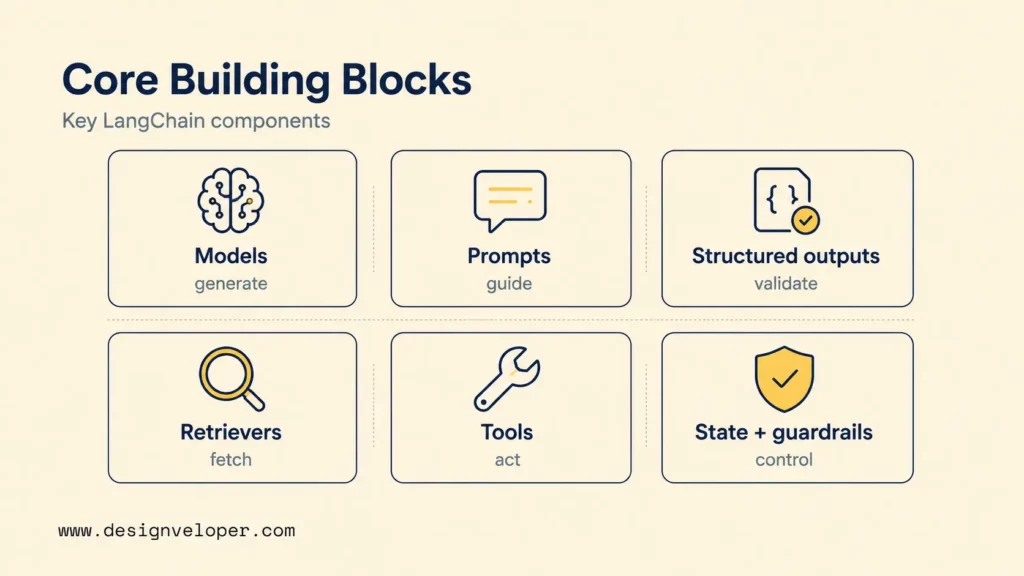
| Component | Role | Practical example |
|---|---|---|
| Models | Provide language or multimodal generation through a model-provider integration. | Generate a reply after the application supplies approved context. |
| Prompt templates | Build repeatable instructions with variables and reusable message structure. | Insert a ticket description into a support-classification prompt. |
| Structured outputs | Constrain a result to a defined schema that application code can consume. | Return category, priority, and next action as validated fields. |
| Retrievers | Return relevant documents or records for a query. | Fetch policy passages before answering an employee question. |
| Tools | Expose approved functions or APIs that a workflow can call. | Look up an order or create a support ticket. |
| State and checkpoints | Preserve workflow context so a process can continue across steps. | Resume a reviewed action after a human approves it. |
| Middleware and guardrails | Control model context, tool access, sensitive data, and approval points. | Require approval before an agent sends an external message. |
The table is a quick reference. The sections below focus on implementation decisions and limitations rather than repeating every row.
Models, Prompts, and Structured Outputs
Models generate or interpret content, while prompts tell the model what the application expects.
LangChain provides common model interfaces and prompt abstractions across many providers. These abstractions can reduce provider-specific code when a team needs to test or switch models.
Provider portability still has limits. Models may differ in tool-calling behavior, structured-output support, context-window limits, streaming behavior, token usage, rate limits, error handling, and safety controls.
Structured output makes the result easier for software to use. Instead of asking for a free-form paragraph, a support workflow can require three fields:
- Category.
- Priority.
- Next action.
The application can then validate those fields before saving them or triggering another step.
The difference between readable text and structured application data matters because downstream software needs predictable fields. A fluent answer can still break an expected schema. Validation creates a clear boundary between model generation and application code.
LangChain RAG, Retrievers, Tools, and External Data
Retrieval-augmented generation adds external context before a model answers. In LangChain, a retriever returns relevant documents or records for a query.
Those results may come from a vector store, but vector similarity search is only one retrieval design. An application may also use:
- Keyword search.
- Hybrid search.
- Metadata filters.
- A database query.
- A CRM or helpdesk search.
- A document-management system.
- A custom search service.
A LangChain RAG path can include document loading, text splitting, embedding generation, indexing, retrieval, context filtering, prompt construction, model generation, and output validation.
A retriever does not guarantee that the returned content is correct or current. Retrieval quality depends on the source corpus, parsing, metadata, indexing process, search strategy, and refresh schedule.
Teams working with structured business data can also combine LangChain with SQL, databases, or existing search systems. A LangChain RAG workflow can use these sources when the application needs access to private or frequently changing information.
Tools extend the workflow beyond reading. A tool can query an API, update a record, or trigger an approved business function.
The permission boundary matters. A support assistant that can read an order has a different risk profile from one that can refund it. Tool access should therefore be scoped to the task, and high-impact actions should require additional validation or human approval.
LangChain Agents, State, and Workflow Control
LangChain agents let a model choose tools and continue through an agent loop.
User request Model decision Tool call Tool result Model decision Final responseState keeps relevant context available during that process. Middleware can add limits, guardrails, retries, or approval checks around model and tool behavior.
Agent autonomy should match the task. A fixed business process is often safer as deterministic automation because the path is easier to test and audit.
An agent becomes more useful when the system must choose among several tools, adapt its path to changing input, decide which information source to query, perform multi-step research, or continue until a defined stopping condition.
Before deploying an agent, teams should define:
- Which tools it may call.
- Which arguments require validation.
- Which actions require human approval.
- How many steps it may execute.
- What happens when a tool fails.
- How tool calls are logged and evaluated.
Teams exploring this pattern can read our guide on how to build AI agents with LangChain for additional implementation considerations.
LangChain vs Direct LLM APIs, LangGraph, and LangSmith
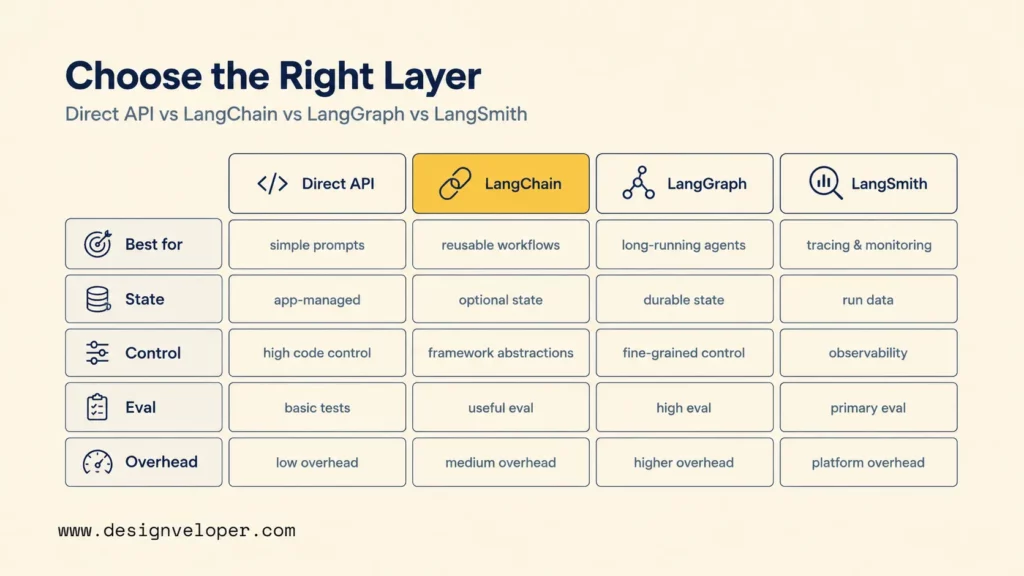
Start with the smallest layer that meets the requirement. A direct API fits a narrow prompt-response feature. LangChain fits reusable application logic around models, retrieval, tools, and structured outputs. LangGraph often fits when state, branching, durable execution, or human-in-the-loop control becomes central.
LangSmith serves a different job. It supports tracing, evaluation, and related production-quality work rather than defining the application’s business workflow.
| Option | Task type | Statefulness | Control | Evaluation need | Delivery overhead |
|---|---|---|---|---|---|
| Direct LLM API | Single or simple prompt-response interactions. | Usually application-managed. | High code-level control with few abstractions. | Basic tests may be enough for narrow tasks. | Lowest when the workflow stays simple. |
| LangChain | Reusable flows combining models, retrieval, tools, and structured outputs. | Can use state through agent and persistence patterns. | Framework abstractions plus middleware. | Useful when prompts, tools, or retrieval change often. | Moderate because the framework becomes another dependency. |
| LangGraph | Stateful, long-running, branching, or highly controlled agent workflows. | A core design concern. | Fine-grained graph and runtime control. | High because more paths and states must be tested. | Higher because teams design and operate the workflow graph. |
| LangSmith | Tracing, evaluation, and production quality management. | Observes run data rather than defining application state. | Controls observability and evaluation, not business logic. | Its primary purpose. | Adds platform setup and ongoing observability work. |
Architecture cost also includes maintenance, security, and operations. More orchestration can improve reuse, but it also creates more dependencies and failure paths.
Teams should compare the complexity of the application with the value of the framework. A more sophisticated framework is not automatically a better architecture.
LangChain in AI Product Workflows
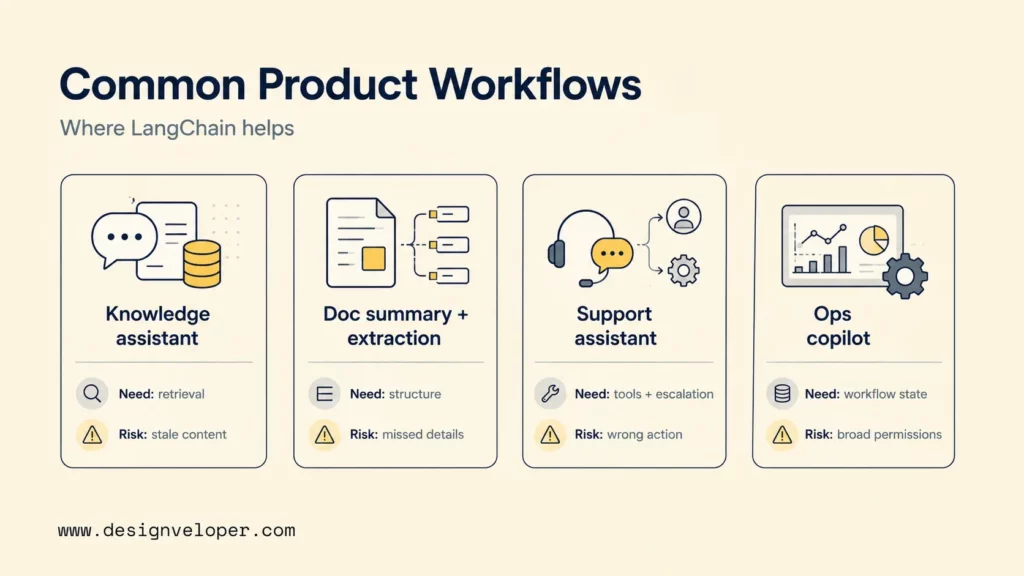
LangChain applications are most useful when a product has a clear workflow around the model.
The following examples show where orchestration can help without turning every feature into an autonomous agent.
| Use case | Required capability | Business outcome | Main risk |
|---|---|---|---|
| Internal knowledge assistant | Retrieval, source filtering, and response rules. | Faster access to trusted internal knowledge. | Stale or unauthorized content enters the answer. |
| Document summarization and extraction | Prompt templates, chunk handling, and structured outputs. | Faster triage and cleaner downstream data. | Missing details or malformed output passes unnoticed. |
| Customer-support assistant | Knowledge access, approved tools, and escalation paths. | Faster handling of bounded support cases. | Wrong actions or missed escalation. |
| Operations copilot | Tool use, workflow state, approval, and fallback logic. | Fewer manual handoffs across a defined process. | Tool permissions are broader than the task requires. |
These are architecture examples, not claims about a specific implementation. The framework choice should follow the product requirement.
Before selecting LangChain, teams should define:
- The user task.
- The trusted data.
- The allowed actions.
- The expected output.
- The failure boundary.
- The required level of human review.
- The quality and latency thresholds.
For a broader overview, see our guide to LangChain use cases and real-world examples.
Scope a LangChain Pilot for a Production Application
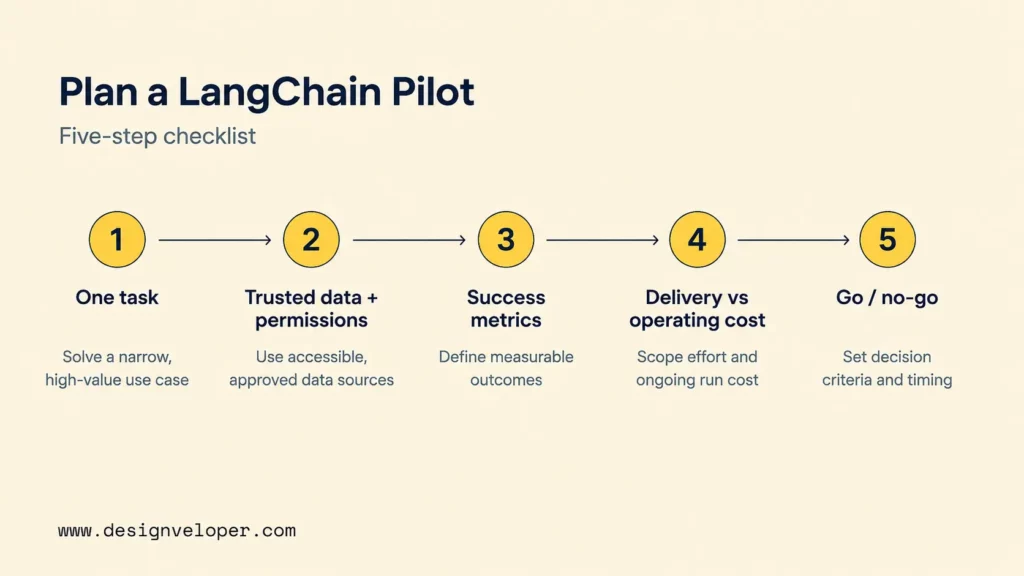
A useful pilot should answer one pre-investment question: Does this workflow create enough measurable value to justify production work?
Keep the pilot narrow so the team can test the task, data, output boundary, expected quality, and cost before expanding scope.
Use this five-step checklist to define what the pilot must prove:
- Select one user task. Define who performs the task today and what improvement would count as useful. Choose a single task with a measurable business outcome.
- Limit the action surface. Restrict the pilot to approved inputs and a small set of actions. Avoid connecting every possible tool before the core workflow has been validated.
- Define data and output boundaries. Identify trusted data, tool permissions, output formats, and conditions under which the system should refuse or escalate.
- Set acceptance criteria. Choose a representative test set. Define the minimum quality, latency, adoption, or human-review result needed to continue.
- Define the investment decision. Separate one-time integration and evaluation work from model, storage, and observability costs. State what evidence leads to GO, HOLD, or NO-GO before the pilot starts.
The checklist defines the experiment. Use the table below to interpret the evidence after the pilot.
| Decision | Meaning | Next action |
|---|---|---|
| GO | Pilot evidence meets the agreed acceptance criteria. | Plan production hardening and operating ownership. |
| HOLD | Potential value remains, but evidence is incomplete. | Run a targeted follow-up test for the unresolved criterion. |
| NO-GO | The pilot misses a critical criterion or a simpler design is better. | Stop expansion or redesign the solution. |
This separation keeps a pilot from drifting into production by default. A NO-GO result can still be useful if it prevents a larger investment in the wrong architecture.
Production Requirements for LangChain Applications
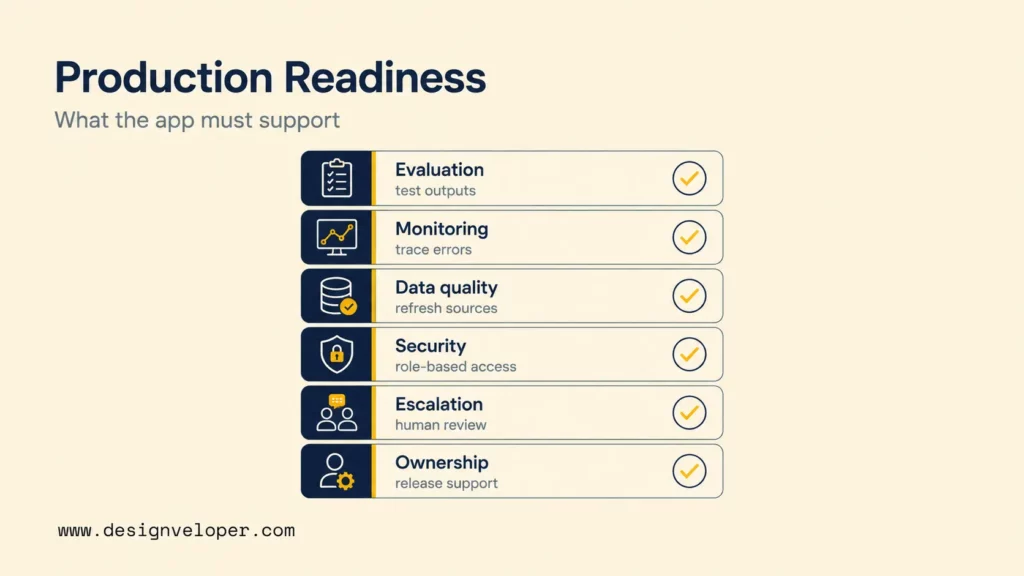
After a GO decision, the job changes from proving value to operating the application safely.
The team must define how the system is tested, observed, secured, recovered, and supported after release.
Use the following checklist for production hardening:
- Evaluation and regression: Maintain representative datasets and output checks. Rerun them when prompts, models, retrieval logic, or tools change.
- Tracing and monitoring: Record enough execution detail to investigate failures. Track latency, errors, model usage, and cost signals that the team can act on.
- Data and tool resilience: Define who refreshes each source. Add timeouts, retries, and fallback behavior for failed dependencies.
- Security: Scope tool permissions to the task. Protect secrets, sensitive data, and audit records through the product’s identity and infrastructure controls.
- Human escalation: Define which actions require approval. Name the person or role that can stop, override, or correct the workflow.
- Release ownership: Name the team responsible for incidents and post-launch support. Document how changes are reviewed and rolled back.
LangSmith can be one observability option. For LangGraph Agent Server deployments, LangChain documentation explains that tracing can be disabled or enabled conditionally. Teams should decide which production data may enter traces before turning tracing on.
Production security also depends on the model provider, retrieval store, APIs, hosting environment, and identity layer. LangChain coordinates application behavior, but it does not secure those external systems on its own.
FAQs About LangChain
Is LangChain Free To Use In Commercial Applications?
Yes. The open-source LangChain repository uses the MIT License, which permits commercial use when its license conditions are followed.
Teams should still review the repository license and the separate terms for model providers, databases, integrations, and hosted products.
Can LangChain Work With Different LLM Providers?
Yes. LangChain provides a standard model interface and dedicated provider integrations.
Provider capabilities still differ. Teams should test tool calling, structured output, streaming, token limits, rate limits, and error behavior with the exact model and integration version they plan to ship.
Does LangChain Store User Data Or Conversation History?
Not by default in one universal LangChain database.
Conversation history or workflow state is stored only when the application configures a memory system, checkpointer, database, or another persistence layer.
Teams should define:
- What information is retained.
- Where it is stored.
- Who can access it.
- How long it is retained.
- When it is deleted.
- What happens when stored memory is incorrect.
Is LangChain A Good Fit For A Simple Chatbot?
It can be, but a direct provider API is often enough for a chatbot with one prompt-response path.
Add LangChain when the chatbot needs reusable orchestration such as:
- Retrieval.
- Tools.
- Structured outputs.
- State.
- Guardrails.
- Multiple model calls.
- A workflow that changes based on the request.
The simplest suitable architecture is usually easier to test, operate, and maintain.
How Should Teams Plan LangChain Version Updates In Production?
Pin production dependencies, review release notes, test upgrades in staging, and rerun evaluation datasets before deployment.
Teams should also pin important partner packages instead of assuming every integration follows the same release policy. Treat provider SDK changes, model changes, prompt changes, and LangChain updates as separate production variables.
As of August 2026, LangChain and LangGraph 1.0 are designated LTS releases, while legacy LangChain 0.3 and LangGraph 0.4 remain in maintenance until December 2026. Teams should re-check the current LangChain versioning and LTS policy before publishing or upgrading.
Conclusion
LangChain is an application framework for coordinating language models with prompts, retrieval, tools, state, and output rules. It is a good fit when an AI product needs reusable orchestration or multiple connected capabilities. A direct provider API may be simpler for a narrow prompt-response feature, while LangGraph can provide more control for stateful or branching workflows. Whatever layer a team chooses, reliable production behavior still depends on evaluation, security, monitoring, recovery, and clear ownership.
If your team is evaluating an AI workflow, Designveloper can help review the architecture, pilot scope, production controls, and implementation risks through its AI development services.
Also published on

Share post on









Related Articles


AI Advantages and Disadvantages for Businesses: 5 of Each Explained
AI Advantages and Disadvantages for Businesses: 5 of Each Explained Published October 05, 2026
Will AI Replace Programmers? Tasks, Jobs, And Career Outlook
Will AI Replace Programmers? Tasks, Jobs, And Career Outlook Published October 05, 2026
Agentic AI Impact On The Workforce: Changing Tasks, Jobs, And Skills
Agentic AI Impact On The Workforce: Changing Tasks, Jobs, And Skills Published October 02, 2026