











AI Programming Language For AI Development And Where They Fit Best

KEY TAKEWAYS:
- Python is the safest first AI programming language because it has the widest ecosystem for experimentation, model training, automation, and production AI workflows.
- C++, Rust, Java, Julia, and R still matter when teams need performance, systems integration, scientific computing, enterprise scale, or statistical depth.
- The best language depends on the workload: training, inference, AI infrastructure, enterprise applications, data analysis, or deployment each push teams toward different tradeoffs.
- Most production AI systems are polyglot: one language may support notebooks, another may handle APIs, and optimized libraries may run the heavy compute underneath.
- Beginners should start with small AI projects in Python before optimizing for performance, infrastructure, or specialized deployment constraints.
An AI programming language is the language a team uses to explore data, train or fine-tune models, build inference services, connect AI to products, and maintain the system after launch. Python is usually the best first choice, but C++, Julia, Java, Rust, and R all have strong places in real AI work. The right choice depends on the workload: experimentation, high-performance compute, scientific modeling, enterprise integration, statistics, or production infrastructure.
The practical answer is rarely one language for everything. Modern AI teams often prototype in Python, rely on C++ or CUDA-backed libraries for performance, use Java or Rust in production services, and keep R or Julia where statistical or numerical teams already work well. The Stack Overflow Developer Survey 2025 notes Python’s continuing growth around AI, data science, and back-end work, while the GitHub Octoverse 2025 AI project analysis reported that nearly half of new AI projects on GitHub were primarily Python as of August 2025. This guide compares each language by workload, strength, learning curve, and production readiness so you can choose by fit.
Explore more:
- AI With Python: What You Can Build And Where To Start
- Best AI For Python Coding: Top Picks For Every Workflow
- Popular Python Frameworks And Which Projects They Fit Best
The Core Programming Languages Used In AI Development
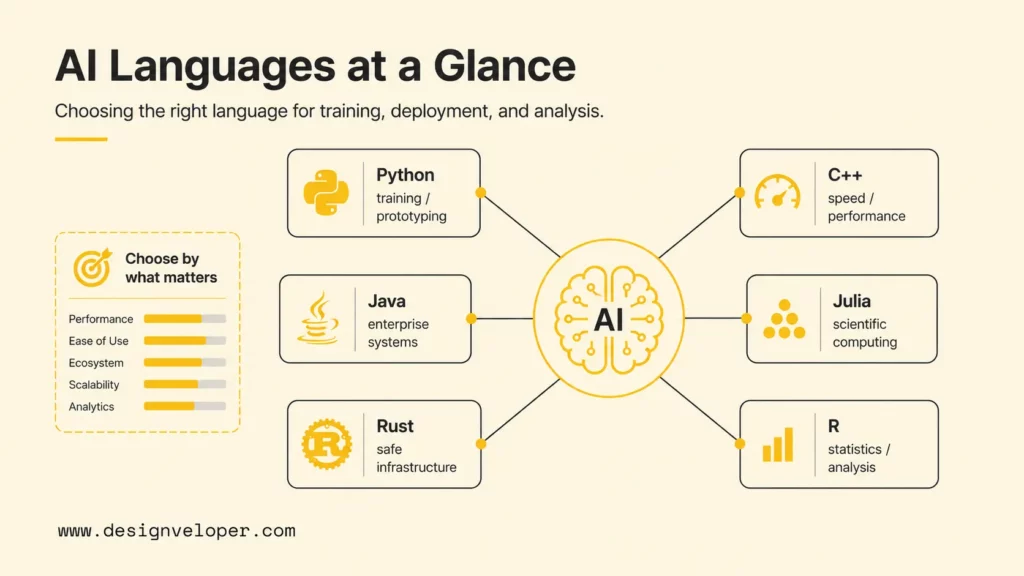
The core AI languages are best compared by primary use case, main strength, and learning curve. Popularity matters because it affects documentation, hiring, libraries, and community support, but production fit matters more. A language that is excellent for model research can still be the wrong choice for a low-latency service, a regulated enterprise system, or a small team that needs to ship quickly.
1. Python
Primary AI use case: Python is the default language for model training, machine learning workflows, generative AI prototypes, data pipelines, notebooks, retrieval-augmented generation, and agent experiments. Python’s official ecosystem starts at the Python official site, while AI practitioners usually meet Python through PyTorch, TensorFlow, Hugging Face documentation, and LangChain documentation.
Main strength: Python wins on ecosystem depth. A team can move from data cleaning to embeddings, model training, evaluation, API integration, and experimentation without changing languages. Python also works well for beginners because readable syntax lets learners focus on data structures, model behavior, and evaluation before fighting a compiler.
Learning curve: Python is easier to start than C++, Rust, or Java, but production Python still requires discipline. Teams need virtual environments, dependency locking, type hints where useful, test data, model evaluation scripts, security checks, and deployment patterns. Python is friendly at the notebook stage and still serious enough for production when supported by strong engineering practices.
2. C++
Primary AI use case: C++ is most useful when performance, memory control, inference speed, embedded deployment, or hardware-level optimization matters. Many AI developers never write C++ directly, yet they benefit from C++ inside high-performance libraries, model runtimes, databases, vector search engines, and GPU tooling such as the NVIDIA CUDA Toolkit.
Main strength: C++ gives teams close control over memory, latency, and hardware behavior. That control matters when an AI feature must run inside a device, serve high request volume, or meet strict real-time constraints. C++ also supports durable infrastructure because the ISO C++ official site and long-running compiler ecosystem have decades of production use behind them.
Learning curve: C++ is demanding. Developers need to understand pointers, memory ownership, build systems, compiler flags, ABI compatibility, and debugging at a lower level. C++ is not the best first language for most AI beginners, but C++ becomes valuable when Python prototypes need to become fast, compact, or deeply integrated with system software.
3. Julia
Primary AI use case: Julia fits scientific computing, numerical methods, optimization, simulation, and research-heavy AI workflows where speed and mathematical expressiveness both matter. The Julia official site positions Julia around high-performance technical computing, which makes the language attractive to researchers who want Python-like productivity with compiled-language speed.
Main strength: Julia is strong when a team needs to express mathematical ideas directly and still run them efficiently. Multiple dispatch, a numerical-first package culture, and fast execution can make Julia effective for experimentation in domains such as scientific machine learning, quantitative analysis, energy modeling, and operations research.
Learning curve: Julia is easier than C++ for many numerical programmers, but the ecosystem is smaller than Python’s. Hiring, third-party integrations, production hosting patterns, and enterprise support may be thinner. Julia is best when the team already has scientific computing expertise and the workload benefits from the language’s numerical strengths.
4. Java
Primary AI use case: Java fits enterprise AI applications, back-end systems, data platforms, and large organizations that already run business-critical services on the JVM. The Java official site ecosystem is less dominant in model training than Python, but Java remains relevant when AI features must live inside existing enterprise architecture.
Main strength: Java is strong in maintainability, observability, structured codebases, and mature tooling. Enterprise teams often need authentication, logging, monitoring, deployment pipelines, API governance, and integration with existing systems. Java can wrap AI capabilities through APIs, model-serving endpoints, or interoperable formats such as the ONNX official site without forcing the entire business stack into Python.
Learning curve: Java has more ceremony than Python, which can make early learning slower. The tradeoff is clearer structure for larger teams. Java works best when a company values strong conventions, long-term support, and integration with existing JVM services more than rapid notebook experimentation.
5. Rust
Primary AI use case: Rust fits performance-sensitive AI infrastructure, safe systems programming, data tooling, command-line utilities, edge services, and components where memory safety matters. The Rust official site ecosystem is younger in AI than Python’s ecosystem, yet Rust is increasingly attractive for infrastructure around AI systems.
Main strength: Rust combines performance with strong compile-time safety. That matters when teams are building AI-adjacent infrastructure such as data ingestion services, low-latency APIs, local inference tools, plugins, and developer tooling. Rust can reduce classes of memory bugs that C++ teams must manage carefully.
Learning curve: Rust has a steep early learning curve because ownership, borrowing, lifetimes, and compiler feedback require a new mental model. Rust is rarely the first AI language for beginners, but it can be excellent for experienced teams that need safer infrastructure around Python-based model work.
6. R
Primary AI use case: R fits statistics, data analysis, academic research, reporting, and organizations where analysts already use R for modeling. The R Project official site remains important in statistical computing, and the Tidyverse official site gives analysts a productive grammar for data manipulation and visualization.
Main strength: R is strong when the work starts with statistical reasoning rather than application engineering. Researchers, analysts, and data scientists can build models, visualize results, and explain assumptions clearly. R also has mature packages for many traditional statistical methods that remain important in business analytics and regulated fields.
Learning curve: R can feel natural for statisticians and unusual for general software engineers. R is not usually the best language for production APIs, mobile apps, or distributed systems. R works best when paired with a production stack that can operationalize insights after analysis is complete.
Which AI Programming Languages Fit Different Workloads
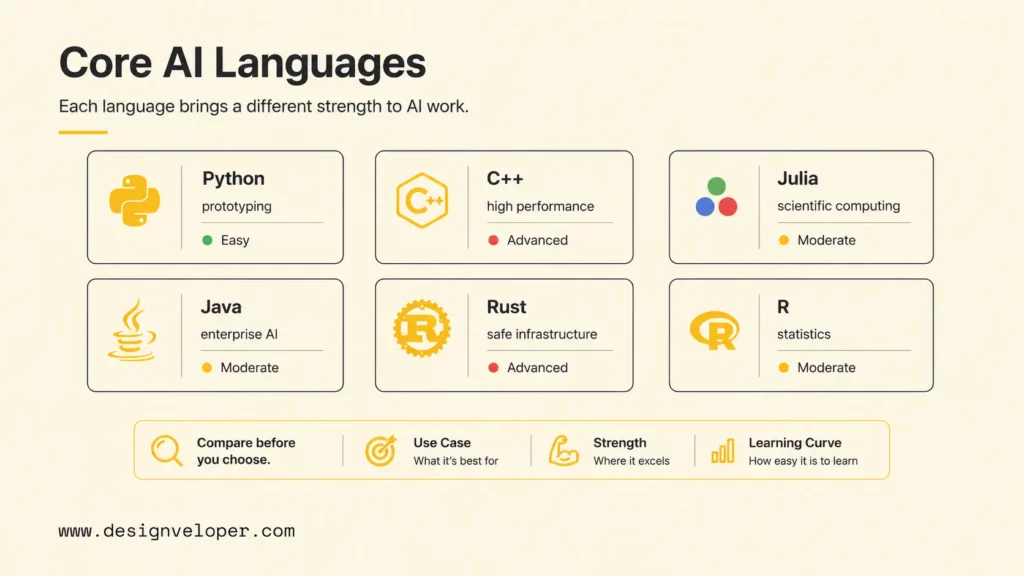
The best AI language changes with the workload. A team training a transformer model, optimizing GPU kernels, running simulations, integrating an AI assistant into a bank portal, and building a statistical dashboard should not make the same language decision. The workload should drive the stack.
The table below gives a fast decision view before the detailed sections.
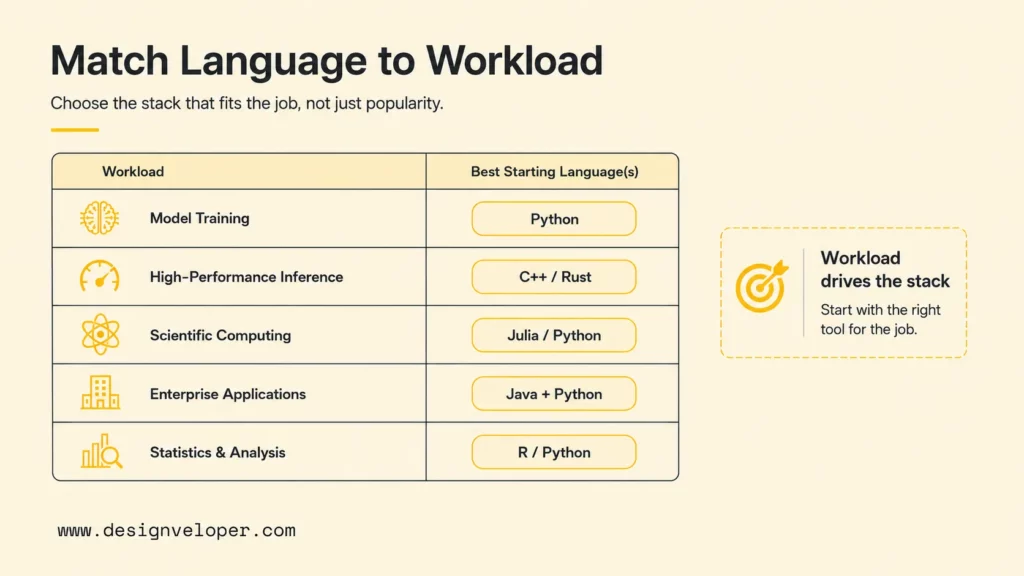
| Workload | Best starting language | Why it fits | Production caveat |
|---|---|---|---|
| Model training and generative AI | Python | Deep ecosystem around PyTorch, TensorFlow, Hugging Face, LangChain, evaluation, and notebooks. | Needs disciplined packaging, testing, and serving patterns. |
| High-performance inference or infrastructure | C++ or Rust | Better control over memory, latency, concurrency, and deployment footprint. | Harder hiring and slower iteration for pure model experiments. |
| Scientific computing | Julia or Python | Good balance of mathematical expression and performance-oriented libraries. | Julia ecosystem depth should be checked before enterprise use. |
| Enterprise applications | Java plus Python services | Stable JVM systems can call model services without rewriting the business platform. | Integration contracts and model monitoring become critical. |
| Statistics and analysis | R or Python | Strong packages for analysis, visualization, and model interpretation. | Operationalization often needs a separate application stack. |
Model Training, NLP, And Generative AI
Python is the most practical starting point for model training, natural language processing, and generative AI. The language has the broadest path from experiment to working prototype because frameworks such as PyTorch official site and TensorFlow official site are Python-first for most developer workflows. Hugging Face also makes transformer models, tokenizers, datasets, and inference patterns accessible through the Hugging Face documentation.
Generative AI application work also favors Python because orchestration libraries and examples tend to appear there first. LangChain’s documentation, for example, gives teams patterns for chains, retrieval, agents, and integrations through the LangChain documentation. A team can still expose the final feature through Java, Node.js, or Go, but Python remains the fastest way to explore the model layer.
High-Performance Compute And AI Infrastructure
C++ and Rust fit the infrastructure side of AI better than beginner-facing tutorials suggest. AI systems need model servers, vector stores, data processing services, local runtimes, observability agents, and edge components. C++ often appears where GPU acceleration, embedded constraints, or highly optimized libraries matter, especially around CUDA-backed compute from NVIDIA CUDA Toolkit.
Rust is useful when a team wants infrastructure performance with stronger memory safety. Rust can be a good fit for data tooling, command-line utilities, inference wrappers, and services that must handle concurrency safely. The tradeoff is ecosystem maturity: Python still has more model-level packages, while Rust may fit the surrounding infrastructure better.
Scientific Computing And Numerical Analysis
Scientific computing rewards languages that express mathematics clearly and run numerical workloads efficiently. Julia is a strong candidate for research teams that need fast numerical code without dropping into C++ too early. Python also remains strong because NumPy, SciPy, PyTorch, TensorFlow, and notebooks are deeply embedded in research workflows.
The practical choice depends on collaboration. If a research team already uses Julia, Julia can shorten the distance between equations and runnable code. If the team must work with broader ML infrastructure, Python may reduce integration friction. A scientific AI project should evaluate language fit by packages, collaborators, deployment environment, and reproducibility workflow, not only benchmark speed.
Enterprise AI Applications
Enterprise AI applications often split the stack. Python handles model training or AI service logic, while Java, .NET, or another enterprise language handles authentication, business workflows, transactions, integrations, and user-facing application behavior. Java remains especially relevant where the company already has JVM teams and operational practices around Java services.
Interoperability matters more than language purity. Formats and platforms such as ONNX official site, model registries such as MLflow official site, and container orchestration through Kubernetes documentation help teams separate model development from business application delivery. The language decision should support observability, rollback, permissions, and long-term ownership.
Statistical Modeling And Data Analysis
R and Python both fit statistical modeling and data analysis, but they serve different team cultures. R is excellent for statisticians, researchers, and reporting-heavy teams that need transparent analysis and strong visualization. Python is stronger when analysis must connect quickly to application code, ML pipelines, APIs, and automation.
Business teams should also consider who will maintain the analysis. If a finance, research, or analytics group owns the model, R may be efficient and readable. If a software team must operationalize the model in a product, Python may reduce handoff cost. The best statistical stack is the one that keeps assumptions, data lineage, and maintenance visible.
Recommended for you:
- Rust Vs Python: Which Language Is Best For Your Project?
- Java Vs Python: Key Differences & Which Language Fits AI Better
- AI Model: A Detailed Guide to Understanding & Building
How To Choose The Right Programming Language For AI
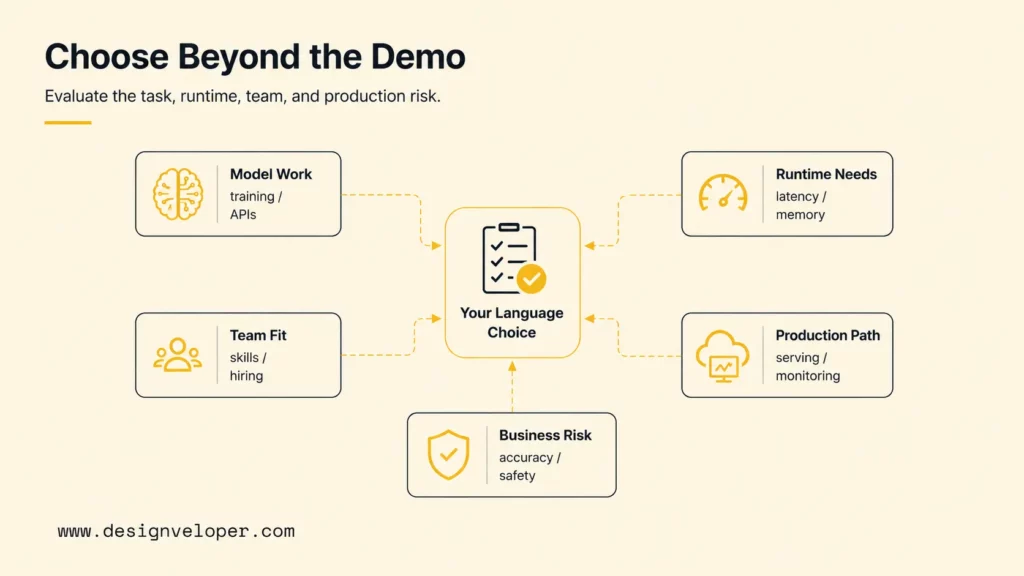
The right AI language is the one that fits the model task, the product environment, the team’s skills, and the maintenance plan. A good decision does not start with the language name. A good decision starts with the question: what must the AI system do reliably after the first demo?
Use this quick checklist before choosing:
- Model work: Does the team need training, fine-tuning, prompt orchestration, retrieval, simulation, or only API integration?
- Runtime needs: What are the latency, memory, concurrency, device, and uptime requirements?
- Team fit: Which languages can the team write, review, test, secure, deploy, and hire for?
- Production path: How will the model be served, monitored, updated, rolled back, and audited?
- Business risk: What happens if predictions, generated text, recommendations, or workflow actions are wrong?
Start With Python If You Are New To AI
Python is the safest beginner recommendation because it gives the shortest path to useful AI projects. A learner can install Python, open a notebook, use a dataset, call a model, run a classifier, build a chatbot prototype, and inspect outputs in one environment. That fast feedback loop matters when the main learning challenge is model behavior rather than language syntax.
Python also gives beginners access to the same ecosystem used by experienced teams. PyTorch, TensorFlow, Hugging Face, and LangChain all have extensive Python examples. A beginner who learns Python first can later add C++, Java, Rust, Julia, or R when a specific workload makes the second language useful.
Learn more in:
- Prompt Engineering For Developers: A Guide To Practical Patterns
- 10 Best Practices For Prompt Engineering With Any AI Model
- Build A RAG Agent With LangChain: Step-By-Step Tutorial
Choose Based On Performance And Deployment Needs
Performance requirements can change the language choice. A proof of concept that runs in a notebook can tolerate slow setup, manual execution, and generous memory use. A production inference service may need predictable latency, lower memory use, horizontal scaling, and observability. C++, Rust, Java, or a dedicated model serving stack may become important when those constraints appear.
Deployment also includes the environment. Edge devices, mobile apps, browser features, enterprise Kubernetes clusters, cloud functions, and on-premise systems all create different limits. Teams should decide where the AI feature will run before locking the language stack.
Match The Language To Your Team And Stack
A language is only a good choice if the team can maintain it. Python may be ideal for a data science group and risky for a backend team with no Python production experience. Java may be ideal for an enterprise team and slow for a research group that needs rapid model iteration. Rust may be excellent for infrastructure and too expensive for a small team that needs a simple prototype.
Designveloper treats AI language decisions as delivery decisions. As per our AI development services and broader web development services, we usually map the current stack, workflow owner, integration boundary, test strategy, and post-launch support model before recommending a language mix. That approach helps teams avoid fashionable choices that make maintenance harder.
Think Beyond Model Training To Production Systems
AI systems do not stop at model training. Production AI needs data access, permissions, retrieval, evaluation, monitoring, human review, fallback behavior, logging, cost tracking, and user experience design. The model language is only one part of that system.
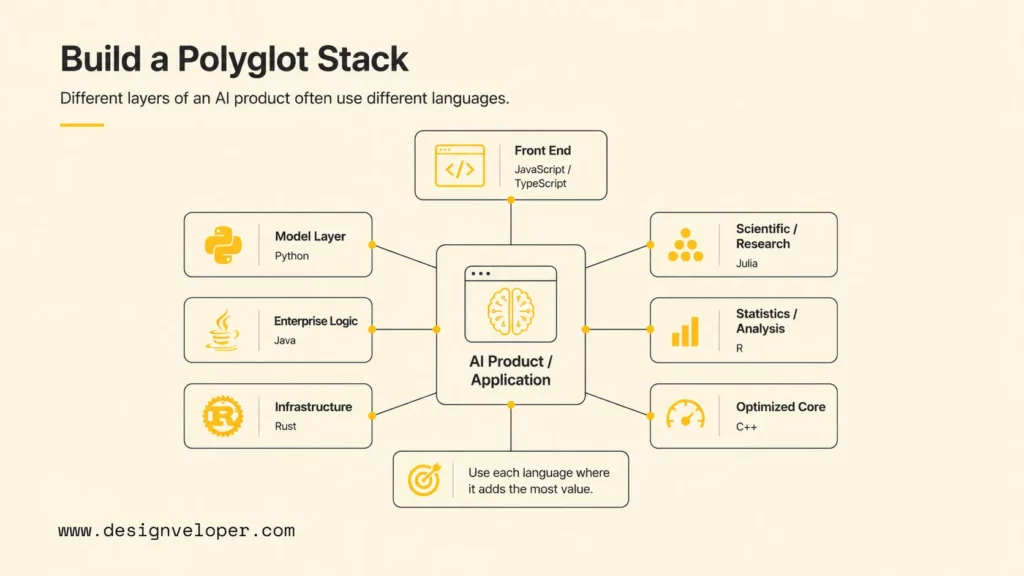
A strong production plan may use Python for model logic, TypeScript or JavaScript for front-end experiences, Java for business systems, Rust for infrastructure services, SQL for analytics, and C++ inside optimized libraries. The important question is not whether one language can do everything. The important question is whether each language has a clear responsibility and owner.
Discover more here:
- 11 Best Web Development Languages for Front-End and Back-End
- 15 Best AI Coding Assistant Tools For Developers
- Top 10 AI Code Review Tools & Best Practices For Implementation
Where Beginners Should Start With AI Programming
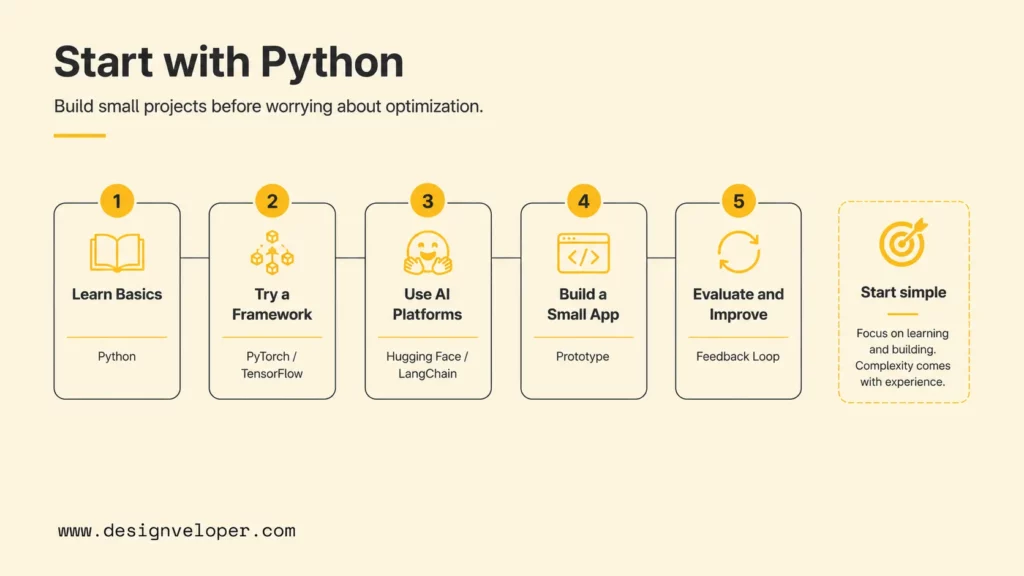
Beginners should start with Python, one simple project, and a clear feedback loop. The goal is to learn how data, models, prompts, evaluation, and application logic fit together. Beginners do not need to master every AI language before building something useful.
A practical first roadmap looks like this: learn Python basics, build a small classifier or text summarizer, try a framework, connect a model to a small app, evaluate failure cases, and only then optimize for performance. The roadmap keeps motivation high while still teaching habits that matter in real projects.
Learn Python First
Python gives beginners the most direct path into AI because the syntax is readable and the learning resources are broad. A good first month should cover variables, functions, lists, dictionaries, files, packages, virtual environments, and simple tests. Beginners should also learn how to read error messages and inspect data instead of treating AI libraries as black boxes.
The best early exercises are small and concrete: classify support tickets, summarize a short document, search a CSV file with embeddings, or predict a simple numeric outcome. Small projects help beginners learn data quality, model limits, and evaluation faster than abstract tutorials.
Explore Frameworks Like PyTorch And TensorFlow
PyTorch and TensorFlow are worth exploring after Python basics because they introduce the deeper model layer. PyTorch is common in research and experimentation, while TensorFlow has a long history in production ML workflows. Beginners do not need to master both immediately, but they should understand tensors, training loops, loss functions, validation data, and model saving.
A useful exercise is to train a small image or text classifier, then write down how the model fails. That exercise teaches an important production habit: AI quality is measured by behavior on examples, not by whether code runs without errors.
Use Platforms Like Hugging Face And LangChain
Hugging Face and LangChain help beginners move from model basics to modern AI application patterns. Hugging Face exposes model hubs, datasets, tokenizers, transformers, and inference patterns. LangChain introduces application orchestration concepts such as retrieval, tools, chains, and agents.
Beginners should use these platforms carefully. A chatbot that answers a sample question is not the same as a reliable support assistant. A useful beginner project should include a small evaluation set, expected answers, failure examples, and a rule for when the system should refuse or hand off.
Build Small AI Projects Before Optimizing For Performance
Small AI projects teach the full workflow without hiding behind scale. A beginner can build a FAQ retriever, document summarizer, receipt classifier, recommendation prototype, or code explanation tool. Each project should include data preparation, model or API use, basic evaluation, and a simple user interface or command-line entry point.
Optimization should come after the project works. C++, Rust, GPU tuning, distributed training, and complex serving infrastructure are valuable, but they are easier to learn when the developer understands what problem they are optimizing. The first goal is correctness and clarity; speed comes later.
The Best AI Language Depends On What You Want To Build
The best AI language depends on the outcome. Choose Python for the widest AI ecosystem and beginner learning. C++ when performance, embedded constraints, or optimized infrastructure matters. Julia for numerical and scientific computing. Java for enterprise integration. Rust for safe, high-performance infrastructure. R for statistical modeling and analysis-heavy teams.
The smartest AI teams usually become polyglot over time. They keep Python close to experimentation and model work, then introduce other languages where deployment, reliability, user experience, or infrastructure requires a different strength. The GitHub Octoverse 2025 report shows how fast language usage can shift as developers adopt AI and reshape their toolkits, so teams should design stacks that can evolve.
At Designveloper, we connect the language decision to the product decision. Our delivery process emphasizes discovery, specification, design, development, testing, deployment, and iteration because language choice is only useful when it supports a maintainable product. For AI work, that means choosing the stack that lets a team test behavior, integrate safely, monitor production, and improve after users interact with the system.
For a deeper dive, read:
- Which Programming Language Is Best for App Development?
- Most Used Programming Languages: Rankings, Jobs & Use Cases
- Front-End vs Back-End: Which Suits You Best?
FAQs About AI Programming Languages
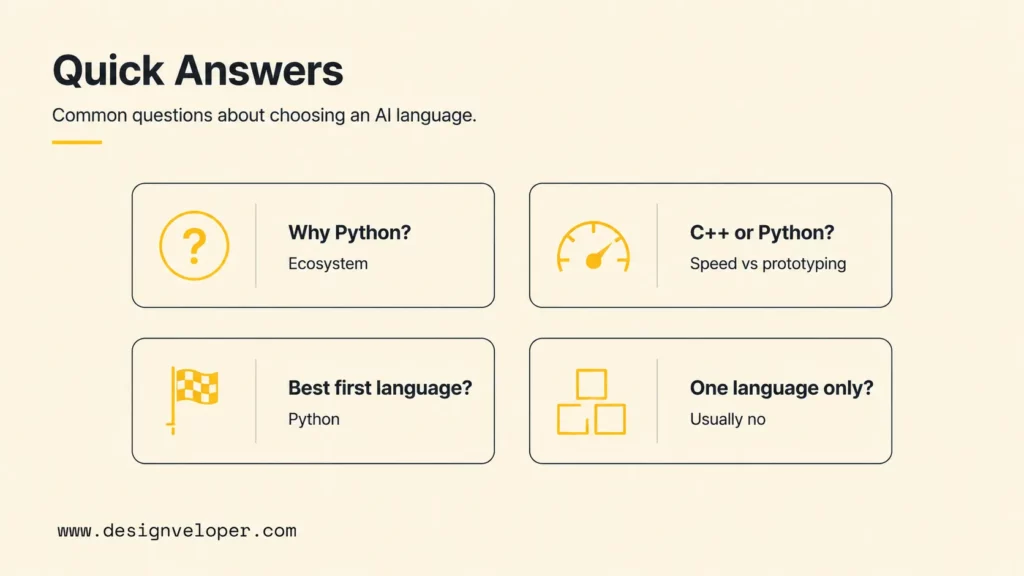
These short answers summarize the decisions readers usually make after comparing AI programming languages.
Why Is Python The Most Popular Language For AI?
Python is the most popular AI language because it combines readable syntax, a deep package ecosystem, strong community support, and first-class documentation for major AI frameworks. The Stack Overflow Developer Survey 2025 and GitHub Octoverse 2025 AI project analysis both point to Python’s strength in AI and data-heavy work, which reinforces the language’s hiring and learning advantages.
Is C++ Better Than Python For AI Performance?
C++ is better than Python for low-level performance, memory control, and latency-sensitive infrastructure. Python is usually better for experimentation, training workflows, notebooks, and application prototypes. Many production AI systems use both: Python for model work and C++ inside optimized libraries or runtimes.
Which Programming Language Should Beginners Learn First For AI?
Beginners should learn Python first for AI. Python gives the easiest path to data handling, model training, generative AI APIs, Hugging Face models, LangChain workflows, and simple prototypes. After Python, beginners can add SQL for data, JavaScript or TypeScript for web apps, and C++ or Rust when performance becomes important.
Do AI Teams Use More Than One Programming Language?
Yes. AI teams often use more than one programming language because AI systems include data pipelines, model code, APIs, front-end interfaces, infrastructure, monitoring, and business integrations. A team might use Python for model logic, Java for enterprise services, TypeScript for the interface, SQL for analytics, and Rust or C++ for performance-critical components.
Choosing an AI programming language is ultimately a product and operations decision. Start with Python if the goal is learning or fast experimentation, then add C++, Julia, Java, Rust, or R when a specific workload justifies the extra complexity. Teams that match language strengths to real deployment needs build AI systems that are easier to trust, maintain, and improve.
Also published on

Share post on










Related Articles


Machine Learning Vs AI: What’s The Difference?
Machine Learning Vs AI: What’s The Difference? Published September 16, 2026
AI Chatbot Development: Types, Process, Costs In 2026
AI Chatbot Development: Types, Process, Costs In 2026 Published September 14, 2026
Rust Vs Python: Performance, Safety, And Project Fit For Teams
Rust Vs Python: Performance, Safety, And Project Fit For Teams Published September 14, 2026