











Generative AI Applications: 20 Practical Use Cases Across Industries

Many teams start with a generative AI demo and then struggle to connect it to a real workflow. The hard part is not producing another text, image, or answer. It is giving the output the right context, review path, system access, and success measure.
This guide explains what generative AI applications are, where they create practical value, how to choose a suitable use case, and which controls a production system needs. It focuses on buildable workflows rather than a generic list of AI apps.
What Are Generative AI Applications?
Generative AI applications are software products, features, or workflows that use generative models to create, summarize, transform, or personalize content. Their outputs can include text, images, audio, video, code, documents, structured data, recommendations, or workflow instructions.
A useful application does more than call a model. It connects the model to reliable context, places the output inside a user task, applies appropriate validation, and measures the result. Depending on the risk, the system may assist a person, prepare a draft for approval, or take a limited action through a controlled integration.
Generative AI is a strong fit when the desired result is creative, language-based, or a transformation of complex information. The distinction between generative AI and agentic AI also matters: a content-producing application is not automatically an autonomous system. Traditional software, rules, analytics, or predictive models may be better for fixed transactions, exact calculations, classification, optimization, or decisions that need deterministic behavior.
Common Types Of Generative AI Applications
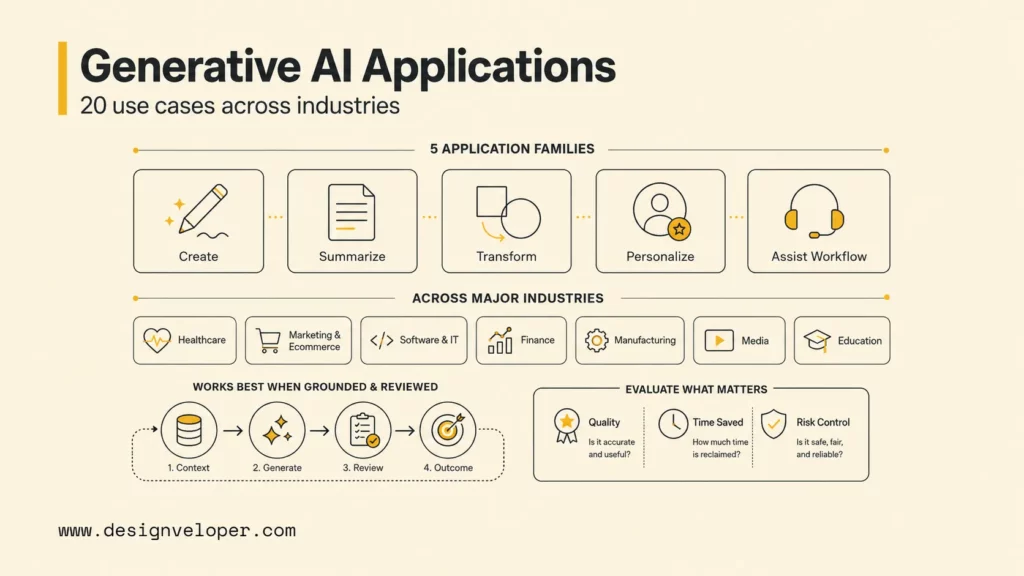
Most real applications combine one or more of five patterns. The pattern helps define the workflow, evaluation method, level of human review, and expected AI app development cost before a team selects a model.
| Application type | Typical output | What to measure first |
|---|---|---|
| Create | Text, images, audio, video, code, or design options | Quality, originality, review time, and acceptance |
| Summarize | Shorter records, reports, conversations, or code explanations | Coverage, factual accuracy, citations, and time saved |
| Transform | Translations, structured fields, explanations, redacted text, or adapted content | Meaning preserved, policy compliance, and correction rate |
| Personalize | Guidance, content, recommendations, or experiences based on approved context | Relevance, fairness, user control, and outcome quality |
| Assist a workflow | Evidence, drafts, suggestions, or actions inside business software | Cycle time, errors, escalation, adoption, cost, and risk |
Related reading:
- How To Build And Use AI Business Process Automation Effectively
- AI In Product Development: From Concept To Market Faster
- AI Agent Orchestration: How Multi-Agent Workflows Work In Practice
Generative AI Applications In Healthcare And Life Sciences
Healthcare applications need stronger validation, privacy controls, and qualified review than low-risk content tools. Generated output should support a defined clinical or research task, not replace professional judgment without evidence.
Related reading:
- Top 17 Innovative Healthcare App Ideas For Startup
- Healthcare App Development: Features, Costs, And Process
- AI Chatbot Development: Types, Process, Costs
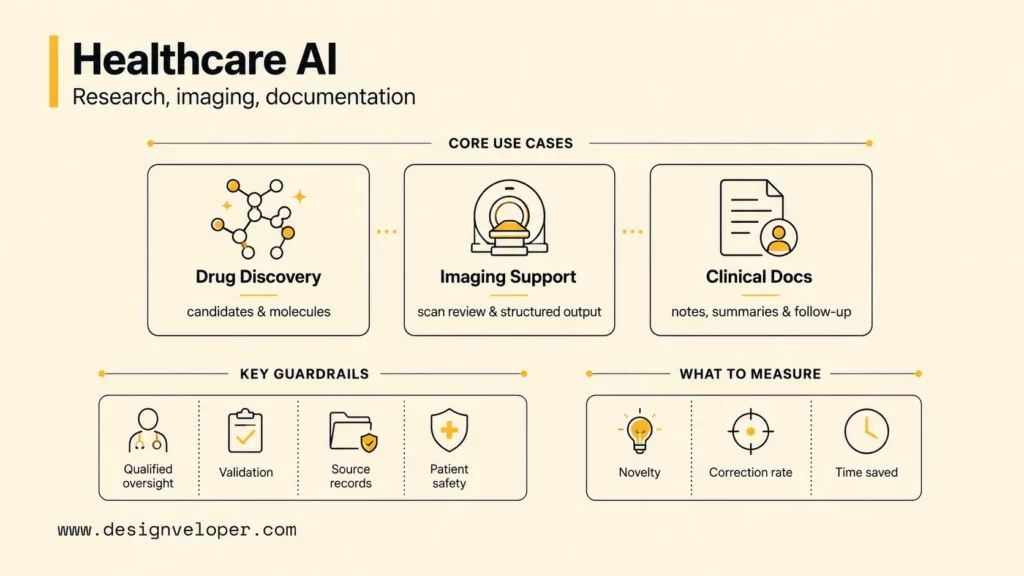
1. Drug Discovery And Molecular Design
Generative models can propose molecular structures, proteins, or experiment ideas that match target properties. Researchers can use these suggestions to narrow a search space before simulation, laboratory testing, toxicity analysis, and clinical development. For example, DeepMind’s AlphaFold work shows how AI can support the study of biomolecular structures and interactions.
The model does not prove that a candidate is safe or effective. Teams should measure novelty, predicted properties, experimental confirmation, failure rate, intellectual-property status, and time to a validated research milestone.
2. Medical Imaging Support
Generative AI can reconstruct noisy scans, create synthetic training images, draft structured descriptions, or highlight regions for review. A radiologist or other qualified professional remains responsible for interpretation. The application should preserve the original image, show the generated result, expose uncertainty, and record any transformation applied.
Evaluation should reflect the device, patient population, acquisition conditions, and consequences of an error. Visual plausibility is not enough for a clinical decision.
3. Clinical Documentation And Patient Support
A documentation assistant can turn a recorded or typed encounter into a draft note, extract follow-up tasks, prepare a patient-friendly summary, and populate structured fields. A patient-support tool can explain approved information, remind users about instructions, and route uncertain or urgent questions to staff.
Controls should cover consent, protected health information, source attribution, missing information, medical terminology, and clinician approval. Useful measures include documentation time, correction rate, omissions, inappropriate recommendations, comprehension, and escalation.
Generative AI Applications In Marketing, Sales, And Ecommerce
Marketing and ecommerce teams use generative AI to create variations, enrich product catalogs, answer customer questions, and adapt content to a known audience. The workflow must ground output in approved product, inventory, pricing, brand, and legal information.
Related reading:
- Ecommerce Business: How To Start, Grow, And Use Technology
- Customer Service Chatbots: 10 Best Platforms And Use Cases
- AI Chatbot Integration: How To Connect Chatbots With Business Systems
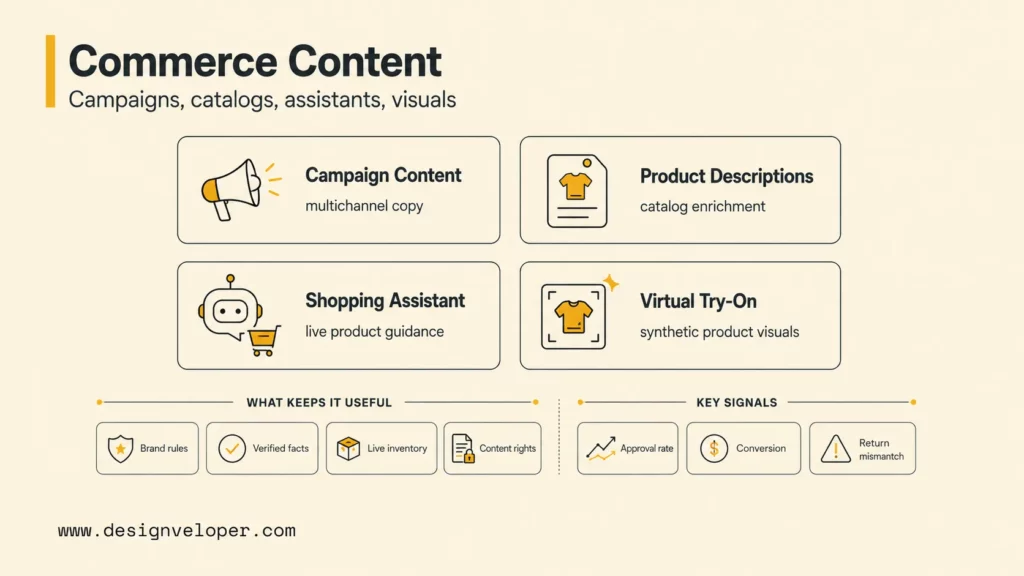
4. Blog, Ad, And Campaign Content
A campaign application can turn an approved brief into headline options, ad variants, email drafts, social posts, and landing-page sections. Give the system brand rules, product facts, prohibited claims, legal limits, channel requirements, and examples. Reviewers should select and edit useful variants instead of publishing every generated draft.
Measure time to first draft, human edit distance, approval rate, factual corrections, brand compliance, and campaign outcomes. More content is not automatically more value.
5. Product Description Generation
A product-content application can convert structured attributes, supplier files, images, and merchandising rules into titles, descriptions, feature bullets, translations, and metadata. The model should leave unknown values blank rather than inventing dimensions, materials, compatibility, safety, or performance claims.
Batch generation needs approval routing, change history, required-field checks, duplicate detection, and terminology controls. Track correction rates by attribute, approval time, content consistency, search performance, and product returns linked to inaccurate descriptions.
6. Personalized Shopping Assistants
A shopping assistant can understand a natural-language need, ask clarifying questions, retrieve eligible products, explain trade-offs, and guide a customer to checkout or human help. Retrieval should use current catalog, price, inventory, delivery, and policy data. The model should explain valid candidates rather than invent them.
Evaluate recommendation relevance, add-to-cart rate, conversion, returns, unsupported claims, customer satisfaction, and user corrections. Customers should be able to correct assumptions and understand why a recommendation appeared.
7. Synthetic Product Images And Virtual Try-On
Image models can create product backgrounds, lifestyle scenes, color variants, localized creative, and virtual try-on previews. The workflow should anchor output to the real product and label simulations when fit, appearance, lighting, or scale may differ.
Brand assets, model consent, usage rights, and body-image concerns need explicit review. Measure product fidelity, approval rate, asset production time, engagement, conversion, returns linked to visual mismatch, and complaints.
Generative AI Applications In Software Development And IT
Software and IT applications turn repository context, logs, issues, standards, and operational knowledge into code, tests, explanations, and support. This is one practical area of AI in software development, but the productivity benefit depends on whether the generated work is reviewable and verifiable.
Related reading:
- 15 Best AI Coding Assistant Tools For Developers
- Prompt Engineering For Developers: How To Write Better AI Prompts
- A Practical Guide To AI Agent Architecture With Diagrams
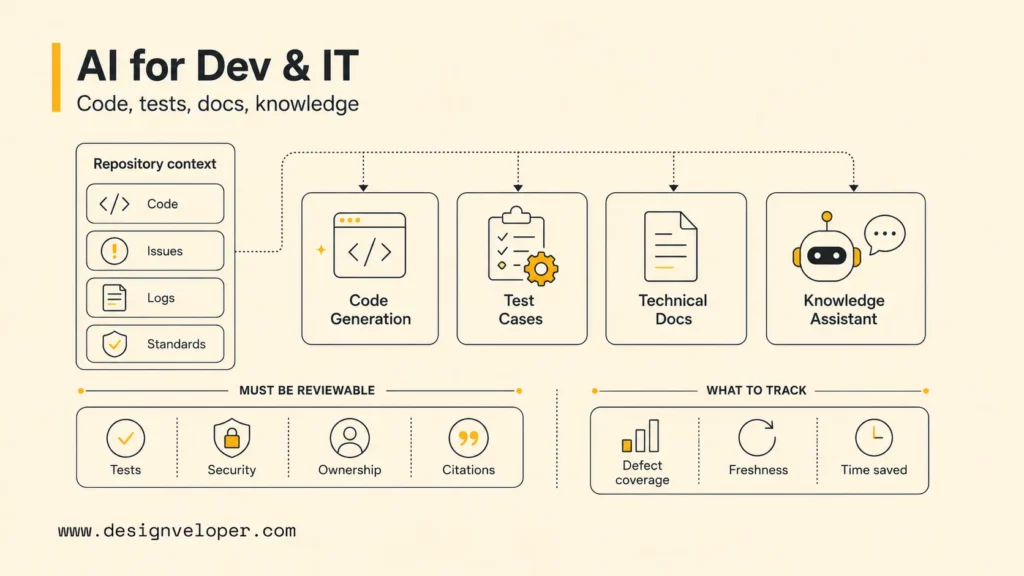
8. Code Generation And Completion
Code assistants can complete functions, scaffold modules, draft migrations, translate between languages, suggest refactors, and explain unfamiliar APIs. Teams can also use AI code review to surface possible defects, security issues, or maintainability concerns before a human approves a change. Useful context includes relevant files, repository rules, interfaces, examples, constraints, and acceptance commands.
Keep changes small enough for a developer to understand and review. Measure delivery time, review findings, rework, defects, security issues, maintainability, and support cost instead of counting generated lines.
9. Test Case Generation
A test-generation application can suggest unit, integration, boundary, negative, regression, and adversarial cases from requirements and code. Existing tests help the model match the project’s framework and style.
The team still needs a clear test oracle: a definition of correct behavior. Measure useful defects found, risk coverage, mutation detection, flaky tests, maintenance burden, and false confidence. A generated test that only repeats the implementation can pass while both are wrong.
10. Technical Documentation And Code Explanation
Generative AI can draft API examples, architecture summaries, change notes, runbooks, onboarding guides, and explanations of call paths or data models. The strongest workflow generates from source-controlled code, schemas, tests, issues, and decision records.
Assign an owner to verify and publish the result. Track coverage, freshness, broken examples, reviewer corrections, support questions, and time to first contribution. Do not turn guesses about undocumented behavior into authoritative documentation.
11. Internal Knowledge Assistants
An internal knowledge assistant can search policies, tickets, product documentation, runbooks, project records, and approved conversations, then answer with citations. Teams may also train a chatbot with their own data, but permission-aware retrieval is essential. The assistant must not reveal a document simply because an index can find it.
Evaluate answer correctness, citation support, retrieval coverage, stale content, access violations, unresolved questions, and employee time saved. Route missing or conflicting knowledge to an accountable owner.
Generative AI Applications In Finance And Banking
Finance applications can synthesize evidence, draft controlled reports, and explain information to customers. They can support AI-driven decision making, but should separate generated language from deterministic calculations and regulated decisions. Users need data provenance, review ownership, and a correction path.
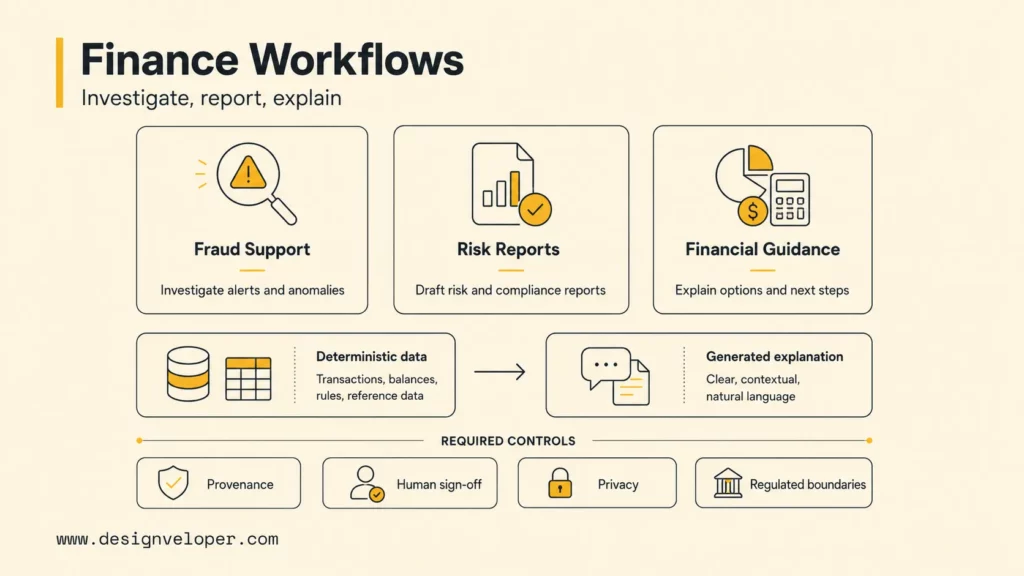
12. Fraud Investigation Support
A fraud-support application can summarize alerts, transactions, customer history, prior cases, device evidence, and policy rules into an investigation brief. It can suggest missing questions and explain why evidence matters, while traditional detection models or rules identify the anomaly.
Humans should own adverse decisions and suspicious-activity reporting. Measure investigation time, evidence completeness, false positives, missed risk, escalation quality, and consistency. Do not present model inference as a confirmed fact about a customer.
13. Risk And Compliance Report Drafting
A report-drafting application can collect control evidence, summarize exceptions, map findings to a framework, and prepare management commentary. The output should preserve source links, reporting periods, calculation sources, materiality thresholds, and reviewer changes.
Measure preparation time, unsupported statements, omitted exceptions, reviewer corrections, late evidence, and audit findings. Final sign-off should remain with the accountable risk, compliance, or finance owner.
14. Personalized Financial Guidance
A financial-guidance application can explain spending patterns, translate a budget into plain language, answer questions about accounts, and suggest educational next steps from user-approved data. The product must distinguish general guidance from regulated advice.
Use deterministic services for calculations. Let the model explain results and handle conversation. Give users control over assumptions and recommendations, then measure accuracy, corrections, fairness, goal progress, inappropriate advice, and support escalation.
Generative AI Applications In Manufacturing, Logistics, And Product Design
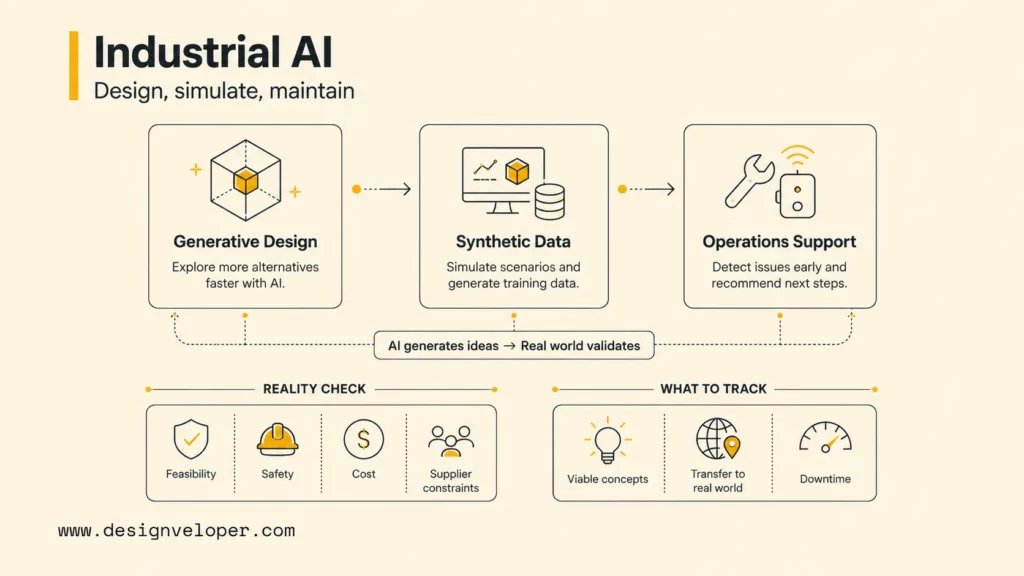
These applications use generative systems to explore designs, create simulation data, and turn operational evidence into action. Physical constraints, safety, cost, and downstream feasibility must be part of the evaluation.
15. Generative Product Design
A design application can produce concept variants from requirements such as weight, strength, material, manufacturing method, cost, dimensions, and aesthetics. This is a practical form of AI-driven development when engineers use the output to explore alternatives before simulation, prototyping, manufacturability review, and testing.
Measure viable concepts, iteration time, material use, simulation results, production constraints, and prototype outcomes. Reject outputs that violate safety, regulation, supplier capability, or lifecycle requirements.
16. Synthetic Data For Simulation And Training
Synthetic data can create rare events, environments, images, sensor sequences, or user records for training and simulation. Teams use it when real data is limited, sensitive, dangerous, or expensive. It can expand coverage, but it can also repeat assumptions embedded in the generator.
Validate coverage, realism, label accuracy, privacy, bias, and transfer to real conditions. Keep a representative real-world test set that the generation process cannot contaminate.
17. Maintenance And Operations Support
An operations assistant can combine manuals, sensor alerts, work orders, images, and technician notes to summarize an incident, propose checks, and prepare maintenance information. Predictive models may estimate failure probability; generative AI can turn the evidence into a reviewable workflow.
Require technicians to confirm asset identity, conditions, lockout procedures, and changes. Track diagnostic time, first-time fix rate, repeat failures, downtime, unsafe suggestions, parts use, and technician overrides.
Generative AI Applications In Media, Games, And Education
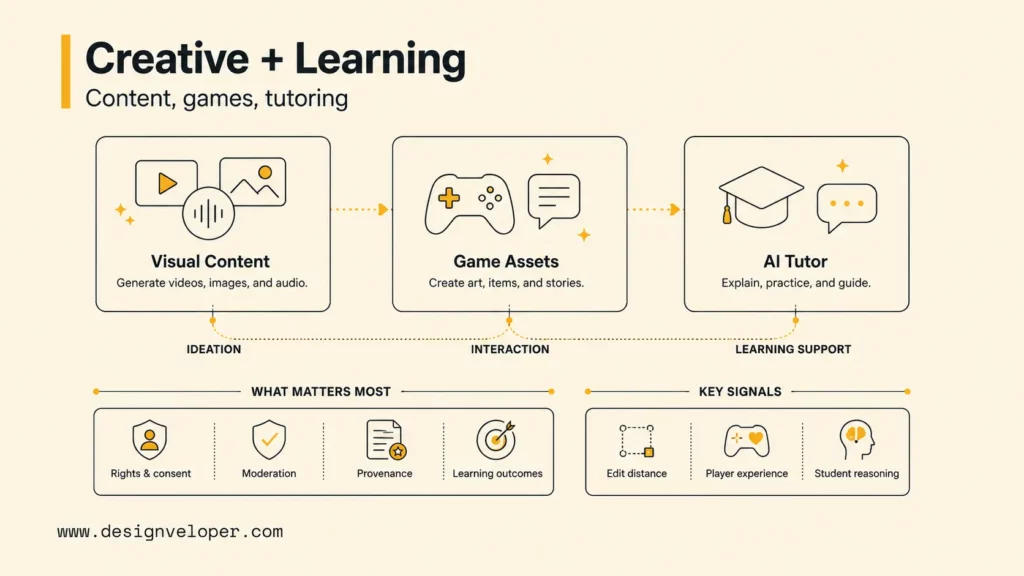
Media, entertainment, and education applications support faster creation and more adaptive experiences. Provenance, creator rights, age suitability, learning outcomes, and user control determine whether these systems are useful and responsible.
18. Video, Audio, And Visual Content Generation
Generative applications can create storyboards, image variations, voice drafts, music sketches, animation, visual effects, localized assets, and short video. Creative teams still edit the output to meet narrative, brand, technical, and rights requirements.
Track production time, approval rate, edit distance, asset consistency, licensing, consent, and audience response. Label synthetic media where needed and preserve provenance for important assets.
19. Game Asset And Interactive Story Generation
A game application can generate concept art, textures, dialogue variants, quests, level ideas, non-player-character responses, and narrative branches. Runtime generation needs stricter controls than offline asset creation because output reaches users immediately and may affect game state, safety, fairness, or cost.
Use lore, age-rating, moderation, economy, and state constraints. Measure coherence, repetition, unsafe output, latency, inference cost, asset acceptance, and player experience. Important state changes should use deterministic validation.
20. AI Tutors And Learning Content Generation
An AI tutor can ask guiding questions, adapt an explanation, generate practice, provide feedback, and help teachers draft lessons or rubrics. The system should support learning rather than deliver every answer.
Test curriculum alignment, factual accuracy, age suitability, accessibility, student reasoning, teacher control, privacy, and actual learning outcomes. Engagement alone can reward a pleasant conversation that teaches little.
How To Choose The Right Generative AI Application
Choose the application by starting with a workflow and measurable outcome, not with a model or feature list. IBM’s enterprise use-case guidance also emphasizes frequent, well-defined tasks, trusted data, measurable outcomes, and human oversight.
- Output fit: the task genuinely needs creation, synthesis, transformation, or conversation.
- Business value: the workflow has a measurable delay, cost, error, capacity, or experience problem.
- Data readiness: sources are accessible, permissioned, current, representative, and owned.
- Evaluation: experts can define good output and create representative test cases.
- Integration: the application can receive inputs and return output inside the real workflow.
- Risk: failures can be detected, contained, corrected, or approved before impact.
- Economics: model, retrieval, media, infrastructure, review, and support costs fit the value.
Related reading:
- What Is AI Automation? How It Works, Benefits, Tools, And Use Cases
- How To Build A RAG System: Step-By-Step (New Guide)
- What Are AI Hallucinations? Why They Happen & How To Reduce Them
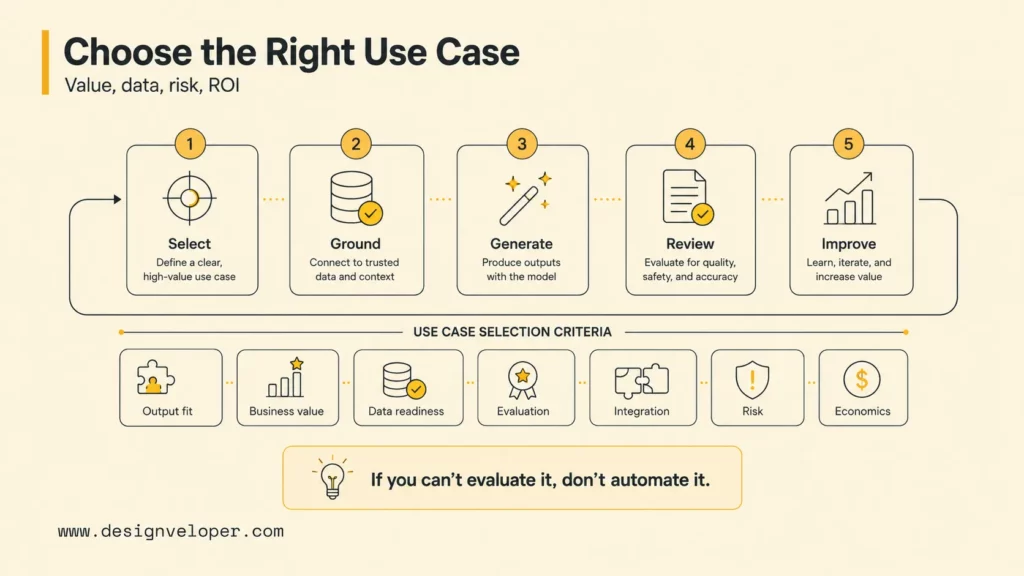
A good first use case is narrow enough to evaluate and important enough to matter. If the team cannot define what acceptable output looks like, it is not ready to automate the consequence.
How To Build A Generative AI Application
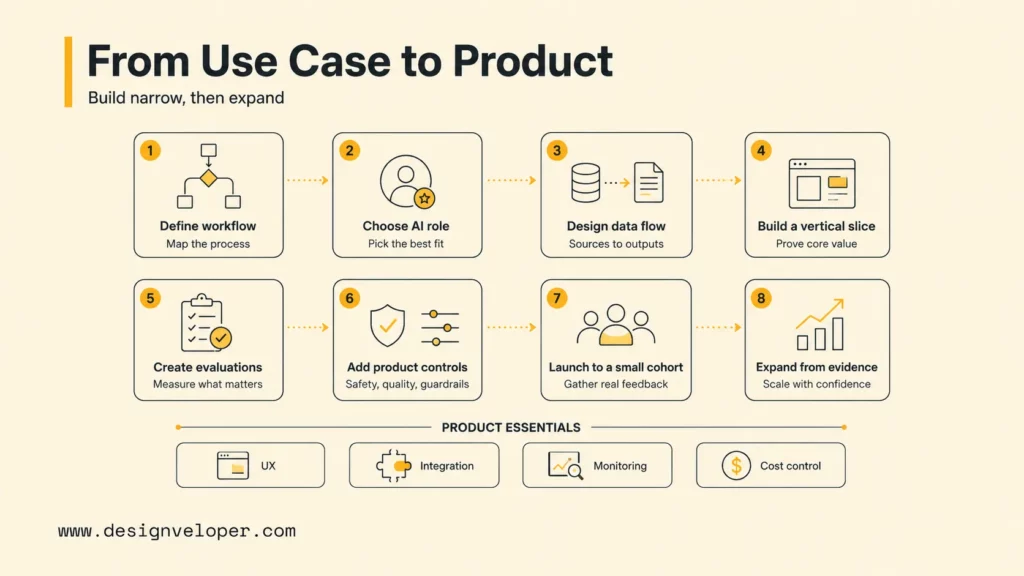
Building a dependable application requires more than connecting a model API. The product needs a workflow, data boundary, evaluation method, and operating owner. If the system can call tools or take actions, an agentic AI architecture and workflow can help define the boundaries between planning, tools, approvals, and execution.
- Define the workflow: document the user, trigger, current process, pain point, outcome, and baseline.
- Choose the AI role: decide whether the system should create, summarize, transform, personalize, recommend, or assist an action. If it needs bounded autonomy, define the task before you build an AI agent.
- Design the data flow: identify approved sources, permissions, retention, provenance, and user consent.
- Build a narrow vertical slice: connect one input to one reviewed output inside the real product.
- Create evaluations: test normal, ambiguous, adversarial, sensitive, stale, and failure cases.
- Add product controls: include review, feedback, refusal, escalation, versioning, monitoring, and rollback.
- Launch to a small cohort: measure total cycle time, quality, adoption, cost, incidents, and user outcomes.
- Expand from evidence: broaden users, data, or automation only after the control loop is stable.
For product teams, a one-page use-case brief can expose weak ideas early. Include the example input, expected output, data sources, user decision, system action, review owner, prohibited behavior, evaluation set, unit cost, and expansion threshold. For autonomous workflows, document AI agent governance before expanding access or permissions.
Challenges And Controls For Generative AI Applications
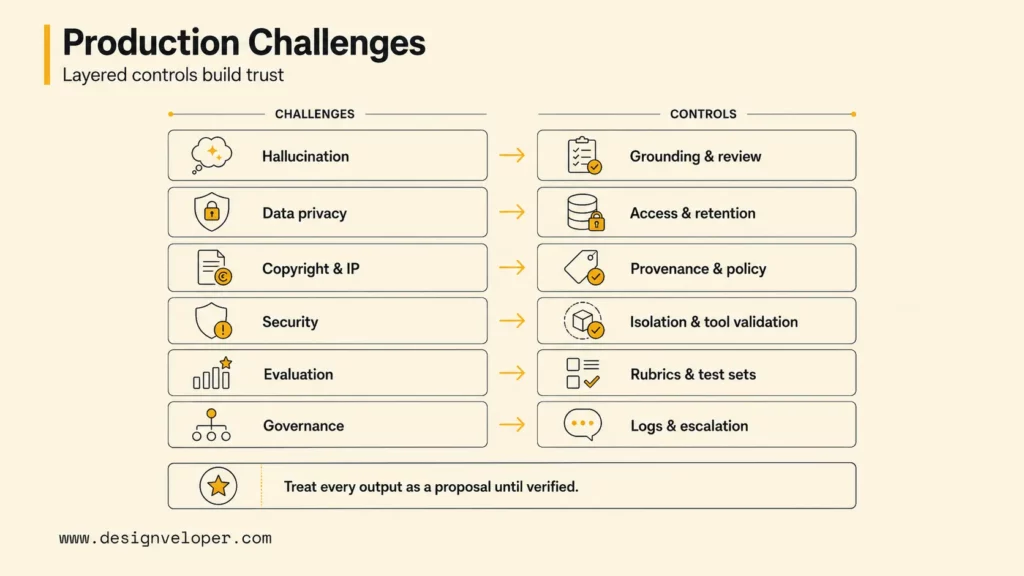
Production systems must assume that model output can be wrong and that external content can be hostile. The NIST Generative AI Profile discusses risks such as confabulation, data privacy, information security, and intellectual property. The OWASP Top 10 for Large Language Model Applications also covers risks such as prompt injection and insecure output handling.
| Risk | What can go wrong | Practical control |
|---|---|---|
| Hallucination | Invented facts, sources, records, or actions | Grounding, citations, structured validation, and review |
| Privacy | Sensitive input or output crosses an unapproved boundary | Data classification, minimization, access controls, retention, and contracts |
| Copyright and IP | Unclear rights, imitation, memorization, or confidential leakage | Approved data, provenance, policy, similarity review, and legal guidance |
| Prompt injection | Untrusted content changes model behavior or triggers unsafe action | Content isolation, least privilege, tool validation, and human approval |
| Cost and latency | Long context, retries, media generation, or volume exceed value | Budgets, routing, caching, rate limits, and unit economics |
| Weak evaluation | The team cannot distinguish good output from plausible output | Expert rubrics, test sets, automated checks, and outcome monitoring |
| Governance | No owner controls changes, incidents, or user complaints | Inventory, approval, logs, change management, and escalation |
| Integration failure | Output stays in a demo or breaks an existing workflow | Stable APIs, retries, reconciliation, and rollback |
The safest generative AI application treats output as a proposal until evidence earns trust. The level of automation should match the consequence of an error.
FAQs About Generative AI Applications
What Are The Most Common Generative AI Applications?
Common applications create content and code, summarize documents or conversations, answer questions over business knowledge, personalize customer or employee experiences, transform information, generate media, and assist multi-step workflows. The strongest starting points have clear context, reviewable output, measurable value, and a defined owner.
Which Industries Use Generative AI The Most?
Generative AI appears across software, marketing, retail, financial services, healthcare, manufacturing, media, education, and customer operations. Early opportunities often involve large volumes of language, documents, code, images, or support interactions. Regulated sectors need stronger validation, approval, and audit controls.
How Is Generative AI Used In Software Development?
Software teams use generative AI for code completion, scaffolding, refactoring, test drafts, code explanation, documentation, repository search, debugging hypotheses, review assistance, and migration planning. Developers still own requirements, architecture, security, integration, verification, deployment, and maintenance.
What Are The Risks Of Generative AI Applications?
Key risks include hallucination, bias, privacy loss, copyright and intellectual-property issues, prompt injection, insecure output handling, excessive access, harmful content, model drift, cost volatility, and weak evaluation. Controls include approved data, least privilege, grounding, validation, human review, monitoring, incident response, and fallback processes.
Can Generative AI Be Integrated Into Existing Business Software?
Yes. Generative AI can be added through model APIs, cloud services, retrieval systems, workflow tools, agents, event pipelines, or custom services. The integration should reuse existing identity, permissions, data ownership, audit logs, and approval rules. Start with one bounded workflow before granting broad access or autonomous action.
At Designveloper, we help teams turn selected use cases into working applications by shaping the workflow, data flow, integrations, evaluation criteria, monitoring, and cost controls. A narrow feature can be validated first, then expanded as user evidence and operational controls mature.
Also published on

Share post on










Related Articles


AI Agent Case Studies: 10 Real-World Examples Across Industries
AI Agent Case Studies: 10 Real-World Examples Across Industries Published October 21, 2026
How Will AI Affect Software Development? Complete Guide In 2026
How Will AI Affect Software Development? Complete Guide In 2026 Published October 21, 2026
How To Build A RAG System: Step-By-Step (New Guide)
How To Build A RAG System: Step-By-Step (New Guide) Published October 19, 2026