












AI Agent Case Studies: 10 Real-World Examples Across Industries

KEY TAKEAWAYS:
- A useful AI agent case study shows the workflow, the agent’s permissions, and where a person remains accountable.
- Separate production deployments, pilots, research demonstrations, and vendor-described capabilities before comparing results.
- Published metrics need context: source, measurement window, sample, and limitations matter as much as the headline number.
- Start with reversible, high-volume work and expand access only after quality, escalation, and recovery are tested.
The most useful AI agent use cases are not the ones with the boldest autonomy claims. They are workflows with clear inputs, limited tool access, measurable completion criteria, and an accountable human. This article reviews 10 examples across customer service, research and development, cybersecurity, healthcare, finance, HR, legal services, education, supply chain, and government. The evidence varies: some sources describe deployments with reported results, while others cover a pilot, research experiment, or sandbox trial. That distinction matters because a product feature description does not prove typical customer outcomes.
10 AI Agent Use Cases and Real-World Examples by Industry
These examples cover different maturity levels, so the table identifies what each source actually supports. “Reported result” means the named organization or its technology provider published the outcome; it does not mean an independent study verified it.
| Industry and example | Evidence stage | What the example helps explain |
|---|---|---|
| Customer service — Ryanair | Customer deployment; AWS-published results | Scaling routine, multilingual questions without treating answer volume as proof of resolution quality. |
| R&D — AstraZeneca | Customer case study; multi-agent research workflow | Why connected, governed data is as important as the model. |
| Cybersecurity — Google Big Sleep | Research-stage vulnerability discovery | How constrained tool use can support specialist security work, not authorize open-ended scanning. |
| Healthcare — Sarah Bush Lincoln | Measured pilot with 50 providers | An administrative documentation task can be evaluated separately from clinical decision-making. |
| Accounting services — 1-800Accountant | Seasonal customer-support deployment | A service agent resolving routine chats is not the same as automating tax judgment. |
| HR — IBM AskHR | Long-running internal service; agentic capabilities added later | How an internal agent can handle recurring requests while preserving sensitive decisions for HR. |
| Legal — Johnson Stokes & Master | Deployed lawyer-supervised workflow | First-pass drafting can save time without delegating legal advice or accountability. |
| Education — University of Leicester | Student-facing information agent | A service agent can answer campus questions; that does not make it an autonomous tutor. |
| Manufacturing and supply chain — Danfoss | Customer case with supplier-reported operating metrics | A bounded order workflow can automate routine transactions and route exceptions to people. |
| Government — Singapore AI Agents Sandbox | Four-month public-sector trial | Testing task performance and failure risks before any production claim. |
1. Customer Service: Ryanair’s Agentic AI
Ryanair’s customer-service system is a customer deployment built with Amazon Bedrock AgentCore and Amazon Nova 2 Lite. The agent answers routine customer questions at high volume, giving this example a clearer operational basis than a vendor feature page alone.
AWS reports that since the service launched in October 2024, it has generated 10 million answers, handles about 120,000 daily answers, and achieved a reported 94% accuracy rate. The provider also reports an 84% reduction in response time, from 18 seconds to 2.9 seconds. These are AWS-published case metrics. The public story does not give the evaluation denominator, error categories, or an independent audit, so the figures should not be treated as a universal service benchmark.
Evidence level: Customer deployment with outcomes reported in AWS’s Ryanair case study.
2. Research and Development: AstraZeneca’s Development Assistant
AstraZeneca’s Development Assistant uses specialized agents to help clinical, regulatory, patient-safety, and quality teams retrieve insights from structured and unstructured data. In the example described by AWS, a user asks a question in natural language. The application maps it to domain terminology, generates and runs SQL against approved data, then returns an answer and identifies the tables queried.
AWS describes the system as reducing some insight-gathering work from hours to minutes or seconds. The useful lesson is that the data platform and shared vocabulary underpin the agent: without clean, permissioned sources, the same workflow can return a confident answer from incomplete context. AWS’s customer story does not publish a sample size or independent measurement method, so the speed result is a reported outcome rather than a general guarantee for drug-development teams.
Evidence level: Customer case study published by AWS on AstraZeneca’s Development Assistant; the public report supports the workflow and attributed time improvement, not a controlled cross-company comparison.
3. Cybersecurity: Google’s Big Sleep Finds a SQLite Vulnerability
Big Sleep is a collaboration between Google Project Zero and Google DeepMind. In a research experiment, its AI agent identified an exploitable stack buffer underflow in SQLite. The team reported the issue to SQLite developers, who fixed it on the same day and before it appeared in an official release. This is a concrete research result, not a claim that an agent autonomously secured a production network.
The boundary is important. Google said the work was highly experimental and that a target-specific fuzzer might be at least as effective. Security teams should therefore read the example as evidence that an agent can assist a constrained vulnerability-research loop, not as permission to probe systems without authorization. A defensible deployment needs an approved target, isolated environment, restricted tools, reproducible findings, and a human security reviewer.
Evidence level: Research-stage result documented by Google Project Zero’s Big Sleep report. It demonstrates one verified finding and also states a relevant limitation.
4. Healthcare: Sarah Bush Lincoln’s Clinical Documentation Pilot
Sarah Bush Lincoln Health System piloted Oracle Health Clinical AI Agent to reduce the documentation burden on providers. The agent listens to provider-patient conversations and prepares documentation for the clinician to review; the use case is note preparation, not diagnosis or treatment selection.
Oracle reports that 50 providers in the pilot had a 25% reduction in documentation time and a 14.8% decrease in time spent in the electronic health record. The published comparison uses pre- and post-implementation periods from November 2024–January 2025 and March–May 2025. That detail helps readers interpret the outcome. Still, it is a vendor-published pilot involving a defined provider group. It does not prove that every clinic will see the same change. Clinicians still need to verify the note before it becomes part of a patient record.
Evidence level: A 50-provider pilot with a stated measurement window, reported in Oracle’s Sarah Bush Lincoln customer story. The evidence is about documentation efficiency, not clinical outcomes.
5. Accounting Services: 1-800Accountant’s Tax-Season Support
1-800Accountant used Salesforce Agentforce to handle recurring customer-support chats during a seasonal workload spike. Salesforce says the agent autonomously resolved 70% of the company’s chat engagements during tax week in 2025. The example shows how an accounting service can provide always-on responses to routine administrative questions without temporarily staffing every increase in demand.
The number is reported by Salesforce, the technology provider, and is tied to one peak period. The published account does not establish that the agent prepared tax returns, made professional tax judgments, or resolved 70% of all accounting work. Those distinctions matter: customer-support containment is a service metric, not evidence that an AI system can safely replace a qualified accountant. Tax advice, unusual client circumstances, and filing decisions should remain with an accountable professional.
Evidence level: Seasonal customer deployment described in Salesforce’s 1-800Accountant customer story. Treat the reported resolution rate as context-specific.
6. HR: IBM’s AskHR Internal Service Agent
IBM’s AskHR handles employee requests such as vacation questions, payroll access, employee letters, and manager workflows. IBM says the service has grown to cover about 80 automated tasks. It reports a 94% containment rate for common questions, a 75% reduction in support tickets since 2016, and more than 11.5 million employee interactions in 2024.
These figures describe a long-running HR transformation, not a clean before-and-after test of a single new agent. IBM added watsonx Orchestrate to AskHR in 2025 to expand its generative-AI and agentic-automation capabilities; the reported four-year, 40% reduction in HR operating costs spans the broader transformation. The practical pattern is to automate repeatable service requests while keeping pay changes, accommodations, employment decisions, and sensitive exceptions under human authority.
Evidence level: Internal production case reported by IBM’s AskHR case study. The metrics are company-reported and cover different periods and scopes.
7. Legal Services: Johnson Stokes & Master’s Employment Advice Agent
Hong Kong law firm Johnson Stokes & Master (JSM) developed an Employment Legal Advice Copilot Agent for high-volume employment instructions. The agent organizes matter context, identifies issues, and prepares a structured first draft covering risks, options, and possible next steps. A lawyer reviews and finalizes the work before it reaches a client.
Microsoft’s customer story reports a 40–60% reduction in first-pass preparation time for standard employment queries. It also reports 25–35% less substantive rework during supervisory review and one to two hours saved per matter on average. These figures are attributed to JSM’s deployment, not an independent evaluation. JSM’s stated controls are as instructive as the productivity numbers: the agents do not give autonomous legal advice, self-learn from client data, or bypass professional review.
Evidence level: Deployed, lawyer-supervised workflow with reported case results in Microsoft’s JSM customer story.
8. Education: University of Leicester’s Citizen Information Agent
The University of Leicester’s student-facing agent, Citizen, answers common university questions and provides information such as timetables, building directions, and food outlets. It began as an internal FAQ agent during welcome periods, then moved to student use after internal testing. This is a campus-service workflow, not evidence of an autonomous teaching or assessment system.
Microsoft’s customer story says Citizen handled more than 6,000 queries during Welcome Week. The public source does not publish a resolution-accuracy rate or show how many queries required staff follow-up. A useful implementation pattern is to ground answers in approved university information and offer an easy route to staff. Teams can use unanswered-question feedback to find gaps in the knowledge base. Do not infer learning gains from a count of service queries.
Evidence level: Student-facing deployment described in Microsoft’s University of Leicester customer story; the reported volume is not a measure of answer quality or educational outcomes.
9. Manufacturing and Supply Chain: Danfoss Email-Order Processing
Danfoss uses an AI agent to process incoming email orders. The agent reads message text and attachments, extracts order details, and interacts with the enterprise resource planning system. An employee retains decision authority for exceptions such as price discrepancies, making this a bounded transaction workflow rather than an unrestricted purchasing agent.
Google Cloud reports that the system automates up to 80% of transactional decisions and has reduced average customer response time from roughly 42 hours to near real time. The report does not disclose the measurement period, order sample, error rate, or independent validation. These results belong to Danfoss’s system, integrations, and order mix; they are not an expected outcome for another manufacturer. A pilot should separately track order accuracy, exception rate, staff review time, and recovery from a mistaken or incomplete transaction.
Evidence level: Customer example in Google Cloud’s 2026 AI business trends report; the reported automation and speed figures lack public measurement detail.
10. Government: Singapore’s AI Agents Sandbox
Singapore’s Cyber Security Agency, GovTech, and IMDA worked with Google on a four-month sandbox for computer-use agents. The trial tested three public-service tasks: government website quality assurance, multilingual AI-safety testing, and guidance through social-assistance applications. It is a documented trial, not proof of a live, scaled government service.
In website QA, the agent identified seeded inactive pages, filler text, and staging-URL mismatches. In chatbot safety testing, the sandbox found that agents could perform large-scale multilingual assessments with less manual effort, although the approach was not error-free. For social-assistance applications, the agent guided applicants or social workers through a complex process; the source describes possible resource savings, not measured production impact. CSA also reported risks involving human oversight, prompt injection, cybersecurity, and personal-data privacy. This is stronger evidence than a hypothetical government scenario because the tasks and observed outcomes are named, and the maturity limit is explicit.
Evidence level: Government sandbox results and risks documented by Singapore’s CSA. The findings support controlled testing, not claims of production efficiency or citizen impact.
Explore related industry guides:
- AI Agent for Customer Service: Best Use Cases and Examples
- AI Agents in Education: Common Use Cases & Tools
- AI Agents in Supply Chain: Benefits, Use Cases & How to Get Started
What These AI Agent Examples Show About Real-World Adoption
The cases do not support one universal claim that “AI agents work” or a reliable ranking of industries by adoption. They show a narrower pattern: agents can help with repeatable work when they have current context, limited tools, clear stopping conditions, and an owner who checks outcomes.
Use the evidence label to decide what a case can teach:
- Production customer story: useful for understanding a workflow and its reported outcomes. Check who measured the result and whether the source publishes a baseline, period, and sample.
- Pilot: useful for understanding fit in a defined setting. A short or limited pilot does not prove reliability at scale.
- Research experiment or sandbox: useful for showing what was tested and what failed. It should not be presented as a deployed business service.
- Product capability or scenario: useful for understanding a proposed workflow, but not evidence of adoption, impact, or ROI.
Keep outcome measures distinct. Answer accuracy, task completion, containment, response time, documentation time, and operating cost measure different things. For example, a lower response time does not show that an issue was resolved correctly, and a high containment rate does not show whether customers had to return later. Compare cases only when their metric definitions and populations are clear.
How to Choose and Validate an AI Agent Use Case
Choose a workflow before selecting a model or platform. The best first AI agent use case has enough volume to matter. It also needs accessible and authorized data, a measurable baseline, bounded actions, and an owner who can stop or correct the process.
Score a candidate against these questions before committing to a build:
- Value: How often does the workflow run, how long does it take, and what errors or delays does it create?
- Data readiness: Are records current, consistent, permissioned, and linked to the right person or transaction?
- Action risk: Can an incorrect action be reversed? Does the workflow involve money, health, legal rights, employment, security, or public benefits?
- System access: Can the agent use narrow, authenticated tools instead of broad database, inbox, or browser access?
- Ownership: Who reviews exceptions, handles escalations, monitors changes, and authorizes a rollback?
For example, an invoice-review agent could extract fields, compare an invoice with an approved purchase order, and prepare a discrepancy packet. It should not post a mismatched invoice or release payment just because the document appears complete. That is an illustrative design pattern, not a claim about any of the deployments above.
Before a pilot, create an evaluation set with routine cases and difficult ones. Include missing fields, conflicting records, ambiguous requests, malicious instructions in documents, unavailable systems, and actions that must always be escalated. Compare the agent with the existing workflow using the same cases. Track task completion and accuracy alongside review time, exceptions, rework, cost, user impact, and safety incidents.
Controls That Make an Agent Pilot Safer
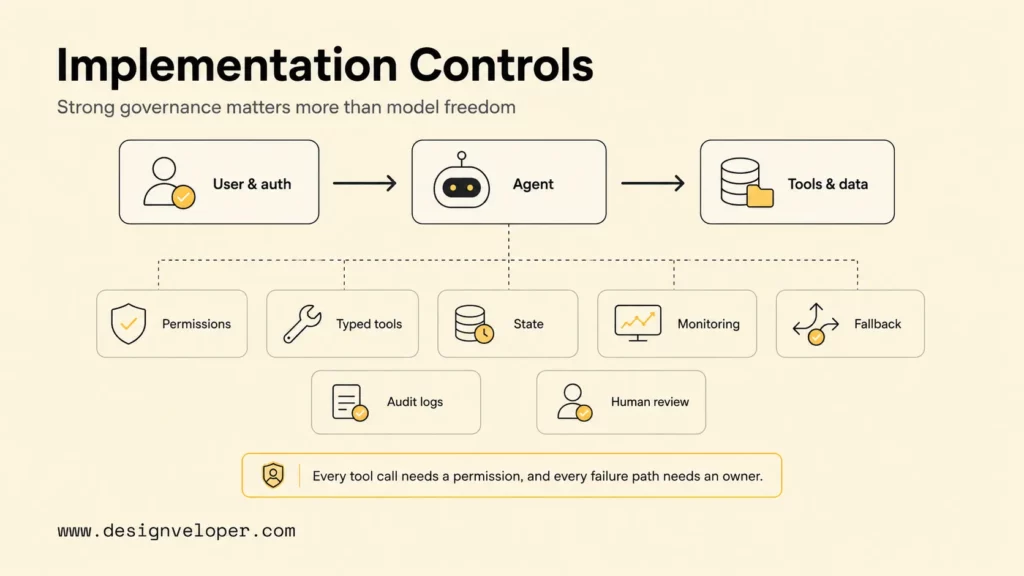
Technical reliability depends on the operating controls around the model. The Singapore sandbox is a reminder that real-world agents face indirect prompt injection, privacy exposure, and decisions that require accountable oversight. A pilot should define these controls before it receives live access.
- Limit permissions: separate read, prepare, approve, and execute actions; grant only the minimum access needed for the workflow.
- Make tool calls auditable: log the requester, records accessed, evidence retrieved, action proposed, approval, and result returned by the connected system.
- Set stop and handoff rules: route low-confidence, high-impact, conflicting, or irreversible cases to a named human owner.
- Test recovery: define behavior for timeouts, rejected actions, duplicate requests, missing data, and downstream system failures.
- Expand gradually: start with historical tests, then shadow mode, then staff-reviewed recommendations. Allow limited execution only after the quality and rollback criteria are met.
These practices are part of AI Agent Governance: How To Manage Agents In Production, not an optional checklist to add after launch. A human approval step is meaningful only when the reviewer can see the source evidence, uncertainty, proposed action, and authority to reject it.
FAQs About AI Agent Use Cases
What counts as a real-world AI agent case study?
A useful case study identifies the organization, workflow, deployment or test stage, actions available to the agent, human boundary, and evidence for any reported result. A vendor product description or “imagine this” scenario can illustrate a possible use case, but it is not proof of customer adoption or outcome.
Which industries are using AI agents today?
Public examples in this review span customer service, R&D, cybersecurity, healthcare, accounting services, HR, legal work, education, manufacturing, and government. The sources use different definitions and report different maturity levels, so they do not support a reliable ranking of which industry uses agents the most.
How are AI agents different from chatbots?
A basic chatbot responds to a prompt or conversation. An AI agent can pursue a bounded goal across several steps, use approved tools, check the returned result, and continue or escalate. The interface may look like a chat in either case; the important difference is whether the system can take actions and how those actions are controlled.
Should an AI agent make decisions in healthcare, finance, or legal work?
It can gather information, prepare a draft, or handle a low-risk administrative step under defined permissions. A qualified professional or authorized employee should remain accountable for diagnosis, legal advice, financial transactions, eligibility, or other high-impact decisions, with escalation and review designed into the workflow.
Can published case-study results predict my organization’s ROI?
No. Results depend on workflow volume, data quality, integrations, human-review effort, and how the source defines success. Use a published result to form a hypothesis, then measure your own baseline, pilot outcomes, error and escalation rates, operating costs, and maintenance effort before estimating ROI.
Conclusion
The strongest AI agent use cases solve a specific multi-step problem and make the agent’s evidence, permissions, limits, and outcomes visible. The cases above range from research experiments to measured pilots and customer deployments; their metrics should not be compared without checking scope and measurement method. Start with one workflow, a reversible action boundary, an evaluation set, and a named owner. Expand only when your own results justify the next level of access.
If you are exploring a custom workflow, you can learn more about Designveloper’s AI Development Services.
Also published on

Share post on










Related Articles


AI Agent Case Studies: 10 Real-World Examples Across Industries
AI Agent Case Studies: 10 Real-World Examples Across Industries Published October 21, 2026
How Will AI Affect Software Development? Complete Guide In 2026
How Will AI Affect Software Development? Complete Guide In 2026 Published October 21, 2026
How To Build A RAG System: Step-By-Step (New Guide)
How To Build A RAG System: Step-By-Step (New Guide) Published October 19, 2026