















What Is An LLM Agent? How It Works, Architecture, And Examples

KEY TAKEWAYS:
- LLM agents combine language models with workflow control, allowing systems to plan, call tools, use memory, evaluate progress, and complete multi-step tasks.
- The difference from a chatbot is operational autonomy: a chatbot mainly responds, while an agent can coordinate actions across APIs, knowledge sources, and business systems.
- Architecture quality matters more than model choice alone because planning, permissions, context, tool contracts, monitoring, and fallback rules determine reliability.
- Production LLM agents need governance around security, data access, evaluation, cost, human oversight, and clear boundaries for when the agent should stop or escalate.
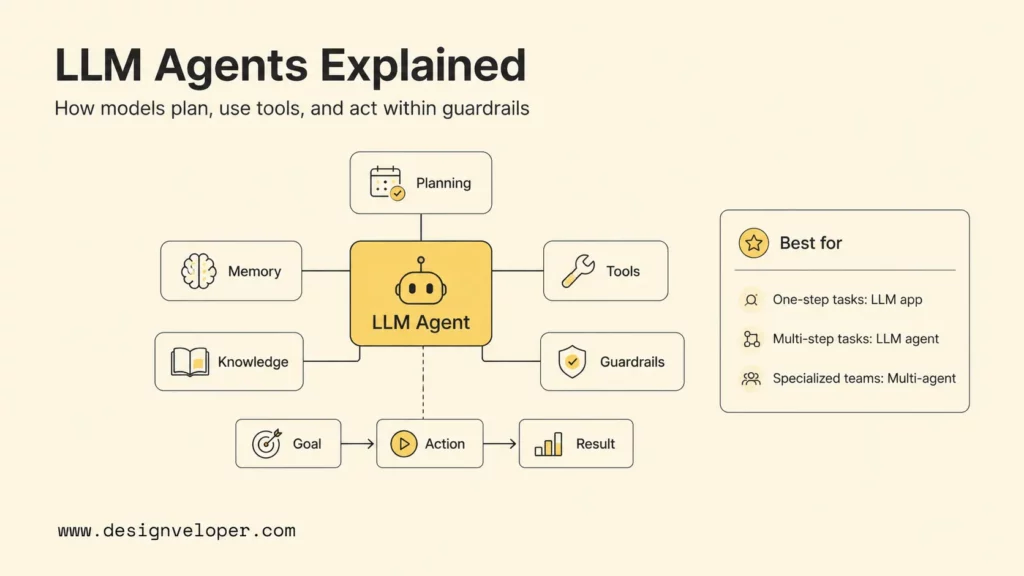
What is LLM agent technology? An LLM agent is a software system that uses large language models to interpret a goal, decide what to do next, call approved tools or data sources, evaluate results, and continue until it produces an answer or completes a task. The LLM supplies language understanding and flexible decision-making, while application code supplies tools, memory, permissions, execution, monitoring, and guardrails.
Quick decision guide:
| Need | Best Starting Point | Reason |
|---|---|---|
| Answer a fixed set of common questions | Basic chatbot or rules | Predictable behavior with low operating complexity |
| Generate, classify, extract, or summarize once | LLM application | A single model call or fixed pipeline may be enough |
| Complete a multi-step task across data and tools | LLM agent | The system can choose actions and adapt to intermediate results |
| Coordinate several specialized capabilities | Agentic workflow or multi-agent system | Clear routing can separate responsibilities while preserving control |
The key question is not whether an interface looks conversational. The key question is whether the model controls part of the workflow. A simple assistant returns text. An LLM agent can retrieve a customer record, inspect policy, decide which action is allowed, call an API, verify the result, and escalate when the request exceeds its authority.
Recommended for you:
- How To Build An AI Agent: A Practical Step-By-Step Guide
- What Are AI Agents? How They Work And Examples In Business
- AI Agent Vs. Chatbot: Key Differences & Which One Do You Need?
What Is An LLM Agent?
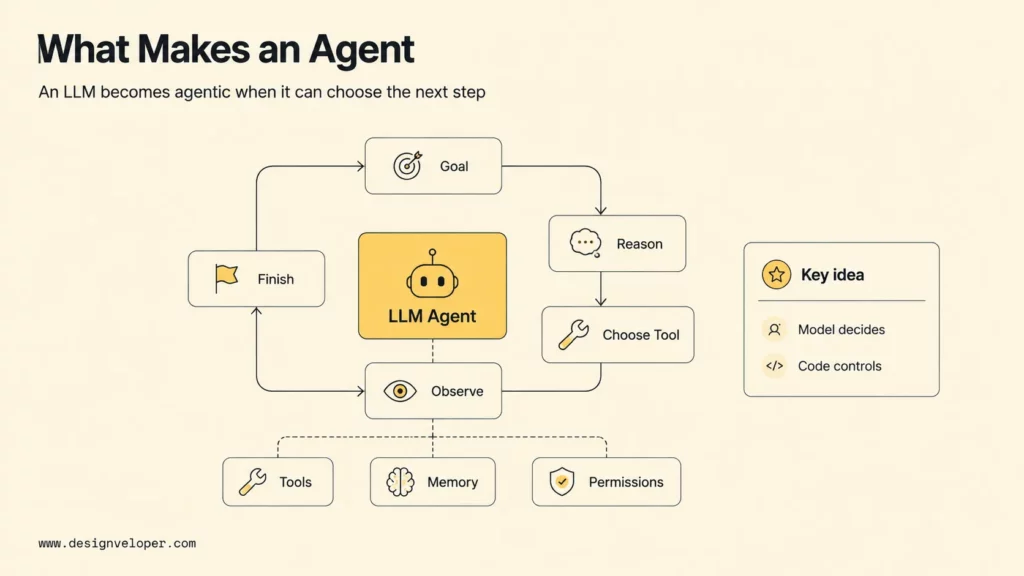
An LLM agent is an application in which a large language model helps manage task execution instead of only generating a response. The agent receives a goal, uses instructions and context to select a next action, interacts with external capabilities when needed, observes the result, and repeats within defined limits. The surrounding software decides what the agent can access, how state is stored, which actions require approval, and when execution must stop.
OpenAI’s current OpenAI describes agents as systems that independently accomplish tasks on a user’s behalf. The guide distinguishes agents from applications that include an LLM but do not let the model control workflow execution, such as a single-turn generator or a sentiment classifier.
The word “independently” does not mean unlimited autonomy. A useful agent may be authorized to read account information but must ask before changing it. Another may automatically draft a refund decision but require a human to approve the payment. Autonomy is a design variable defined by permissions, risk, confidence, reversibility, and business policy.
An LLM alone is not an agent. A model can understand instructions, generate language, and make inferences, but it does not automatically have access to a CRM, file system, search engine, payment service, browser, or business database. The application adds those capabilities as tools and controls how the model can request them. The application also validates inputs and outputs, enforces authentication and authorization, stores state, records events, and handles failures.
A practical LLM agent therefore contains both probabilistic and deterministic parts. The model is useful when language, ambiguity, judgment, or flexible planning makes rigid rules expensive. Deterministic code is better for permissions, calculations, schema validation, transaction boundaries, rate limits, and policy enforcement. Reliable systems combine both instead of asking the model to be the entire application.
An agent is most appropriate when a workflow has several steps, depends on unstructured information, includes exceptions, or requires choosing among tools. A conventional function or fixed workflow is usually better when the task is stable, rules are complete, and errors carry high cost without a meaningful need for language-based adaptation.
An LLM becomes an agent when it participates in choosing and executing the next step, not merely when it speaks in a conversational interface.
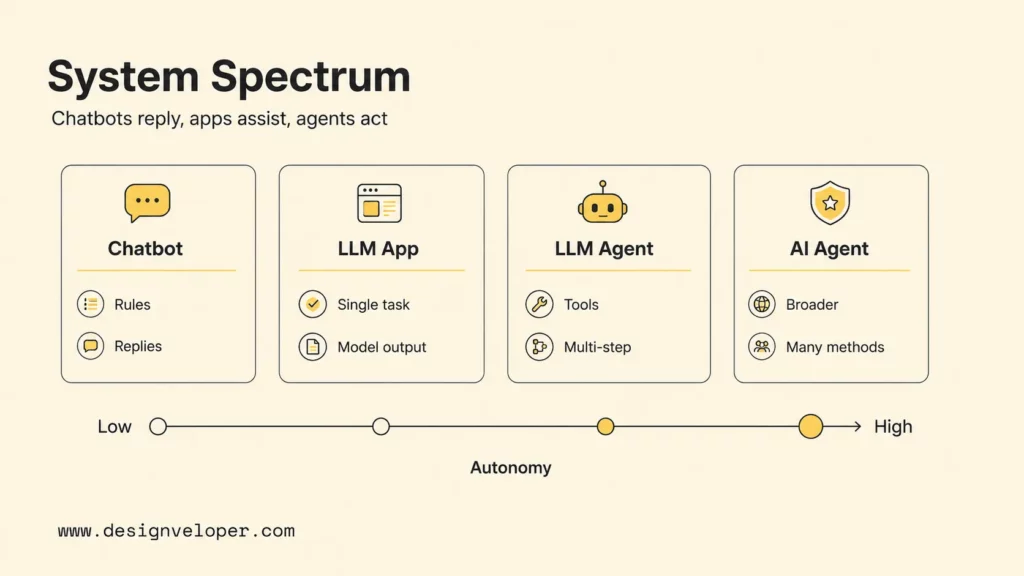
LLM Agent Vs Chatbot Vs AI Agent
A basic chatbot follows predefined conversation paths, an LLM application generates or analyzes content, an LLM agent controls a bounded task loop, and AI agent is the broader category for systems that perceive, decide, and act. The terms overlap in marketing, so compare actual capabilities instead of product labels.
| System | What It Does | Level Of Autonomy | Best For |
|---|---|---|---|
| Basic chatbot | Matches intents, rules, buttons, or scripted paths to prepared responses | Low | FAQs, routing, structured intake, and predictable service flows |
| LLM application | Uses a model for a defined generation, classification, extraction, or analysis task | Low to moderate | Summaries, drafting, semantic search, structured extraction, and copilots |
| LLM agent | Uses an LLM to choose tools and actions across a bounded multi-step workflow | Moderate to high within configured limits | Research, ticket resolution, coding tasks, document operations, and workflow automation |
| AI agent | Perceives state, makes decisions, and acts toward a goal using any suitable AI approach | Varies widely | Broader software, robotic, optimization, planning, and autonomous systems |
A chatbot can still use an LLM. If the system receives a question and generates one response from supplied context, it may be an LLM-powered chatbot rather than an agent. Adding retrieval does not automatically change that classification. The system becomes more agentic when the model can decide whether to search, ask a clarifying question, call a service, inspect the result, retry, or hand control to a person.
An LLM application can also contain a fixed workflow. A document pipeline might always extract text, classify the document, summarize it, and store the output in the same order. The LLM contributes intelligence, but application code controls every transition. That predictable pattern is often easier to test and operate than a free-form agent, and it should remain a fixed workflow unless adaptation adds measurable value.
AI agent is an umbrella term. A reinforcement-learning agent, fraud-detection decision system, robotic controller, or route optimizer may not use a large language model at all. An LLM agent is a specific type of AI agent whose decision layer is built around language-model capabilities. Designveloper’s overview of AI agents versus LLMs explores the division between model reasoning and system execution in more detail.
Autonomy should be assessed by action, not by how fluent the response sounds. Ask whether the system selects steps, accesses live systems, changes state, spends money, communicates externally, or retries without human review. Each added capability increases both usefulness and the need for permissions, auditability, evaluation, and recovery.
Further reading:
- A Practical Guide To AI Agent Architecture With Diagrams
- AI Agent Orchestration: How Multi-Agent Workflows Work In Practice
- AI Agent Governance: How To Manage Agents In Production
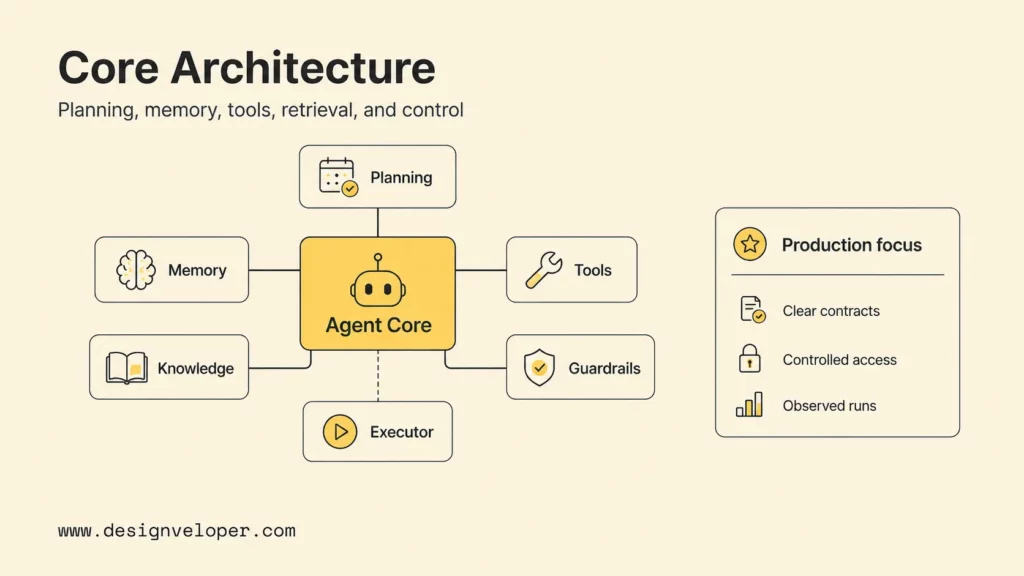
LLM Agent Architecture: Planning, Memory, Tools, And Guardrails
LLM agent architecture combines an agent core with planning, memory, tools, retrieval, execution, feedback, and control layers. Production quality depends less on drawing many boxes and more on defining the contract, permissions, failure behavior, and evidence for every component.
| Component | Role | Example |
|---|---|---|
| LLM or agent core | Interprets goals, chooses actions, and generates structured requests or responses | Select whether to ask for an order number, retrieve an order, or escalate |
| Planning and reasoning | Breaks a goal into workable steps and revises the next action from observations | Plan research queries, inspect gaps, then request another source |
| Memory and context | Maintains task state and retrieves approved information relevant to the current decision | Recall the user’s account, prior tool results, and a saved workflow checkpoint |
| Tools and function calling | Expose typed operations for reading data or changing external systems | Search knowledge, query CRM, create a ticket, or run a calculation |
| Knowledge or retrieval layer | Finds grounded documents, records, policies, and references | Retrieve the current refund policy and the customer’s transaction |
| Executor and feedback loop | Runs approved actions, returns observations, applies limits, and manages retries | Call an API, validate the response, record status, and continue or stop |
| Guardrails and human review | Enforce safety, scope, permissions, approvals, and escalation | Require approval before a large refund or external message |
The agent core should receive clear instructions, available tools, current context, and an explicit completion condition. Model selection depends on the task: a simple routing decision may use a fast economical model, while difficult analysis may require stronger reasoning. Routing different steps to different models can control cost and latency, but it creates more behavior to evaluate.
Planning turns an outcome into actions without requiring developers to encode every branch. The application should still limit maximum steps, retries, elapsed time, and spend. Plans are working hypotheses, not proof that an action is correct. The executor must validate tool arguments and observations before continuing.
Memory is managed context, not a magical human-like recollection. Short-term state includes the current request, prior messages, tool results, and workflow variables. Long-term memory may include user preferences, durable facts, historical cases, or summaries stored outside the model. Every memory item needs provenance, access control, retention rules, and a strategy for correction when it becomes stale.
Tools convert model intent into software operations. A well-designed tool has a specific name, narrow purpose, typed input schema, validated output, documented errors, authentication context, and predictable side effects. Read-only lookup should be separated from mutation. A tool named “manage account” is harder to secure and evaluate than separate operations for reading an account, proposing a change, and applying an approved change.
Retrieval grounds the agent in approved information that can change independently of the model. Retrieval-augmented generation may search policies, product documentation, customer records, or knowledge bases. The agent should preserve citations or record identifiers so a user or evaluator can verify the basis for an answer. Retrieved content must be treated as data, because documents and web pages can contain malicious instructions.
The executor owns the control loop. It parses the model’s structured request, checks policy, calls a tool, captures the result, and determines whether execution may continue. Idempotency keys and transaction boundaries prevent accidental duplicate actions when calls time out or retry. Checkpoints let a long-running task resume after interruption.
Guardrails are layered controls rather than one universal filter. OpenAI’s guide recommends combining model-based and rules-based checks with authentication, authorization, strict access controls, output validation, and human intervention. High-risk or irreversible actions should pause for review even when lower-risk steps run automatically.
How An LLM Agent Works Step By Step
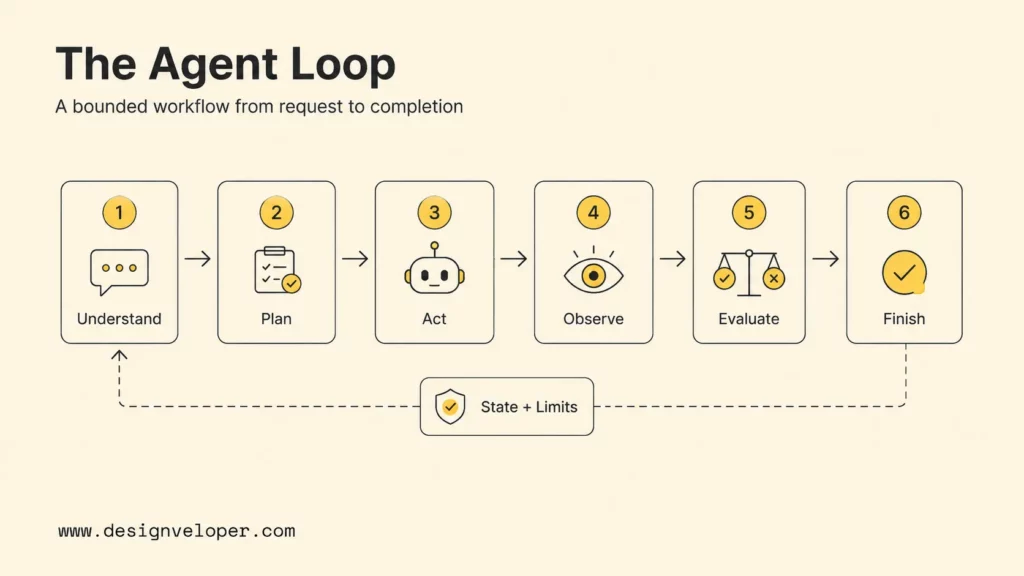
An LLM agent works as a bounded feedback loop: understand the goal, create a task plan, select a capability, observe the result, update state, evaluate progress, and stop or continue. The loop should expose enough state for monitoring without revealing private model internals.
Bounded LLM Agent Control Loop
Resolve the goal, context, constraints, and missing information
Choose a bounded sequence or next useful action
Call an approved tool or retrieve governed knowledge
Validate the result and update task state
Check progress, limits, risk, and completion criteria
Return evidence, request approval, escalate, or complete
Step 1. Understand The Goal Or User Request
The agent first identifies the requested outcome, relevant entities, constraints, and missing facts. A support request such as “refund my last order” requires an authenticated customer, a specific order, refund policy, amount, payment status, and authority boundary. If essential information is missing or ambiguous, the correct next action is a clarifying question rather than a guess.
Step 2. Reason Through The Task And Create A Plan
The agent chooses a sequence that can achieve the goal within its instructions. The application does not need to expose hidden model reasoning. A useful observable plan can be a concise action list such as “verify identity, retrieve order, check refund eligibility, propose outcome, request approval if required.” Developers can test the plan structure and allowed transitions without storing private reasoning traces.
Step 3. Choose Tools, APIs, Or Knowledge Sources
The agent selects among capabilities described by names, schemas, permissions, and instructions. It may query an order API, retrieve policy, calculate an amount, or create a proposed action. Tool selection improves when operations are distinct and their descriptions explain when not to use them. The executor validates every argument and confirms that the current identity can perform the requested operation.
Step 4. Use Memory And Context To Continue The Workflow
The application adds relevant state to the next model call: the verified customer ID, retrieved order, policy version, prior tool outcome, and remaining steps. Context should be selective. Sending an entire history increases cost and can obscure important facts. Store structured state separately, summarize long conversations carefully, and retrieve durable memory only when it is authorized and useful.
Step 5. Evaluate Progress And Decide The Next Action
The agent and executor compare the observation with completion criteria. If the order is eligible and the amount is below an automated limit, the next step may be a refund tool. If policy is unclear, the system can escalate. And if a tool fails, the loop can retry a limited number of times or stop. Quality checks should verify both the final result and the path, including tool choice, argument correctness, policy compliance, and unnecessary steps.
Step 6. Return An Output Or Complete The Task
The agent finishes by returning a grounded response, completing an authorized action, requesting approval, or transferring the case. The final message should state what happened, which item was affected, what evidence supports the result, and what the user should do next. The system records structured outcome data for audit, evaluation, and later improvement.
Related reading:
- What Is Agentic AI? Benefits, Architecture and How It Works
- Agentic AI Architecture: Components, Workflow, Design Patterns
- Agentic AI Security: Risks, Core Architecture, Solutions
LLM Agent Use Cases And Examples
LLM agents are most useful when a workflow combines language, variable paths, external systems, and clear completion criteria. Good use cases give the agent bounded authority and make success observable.
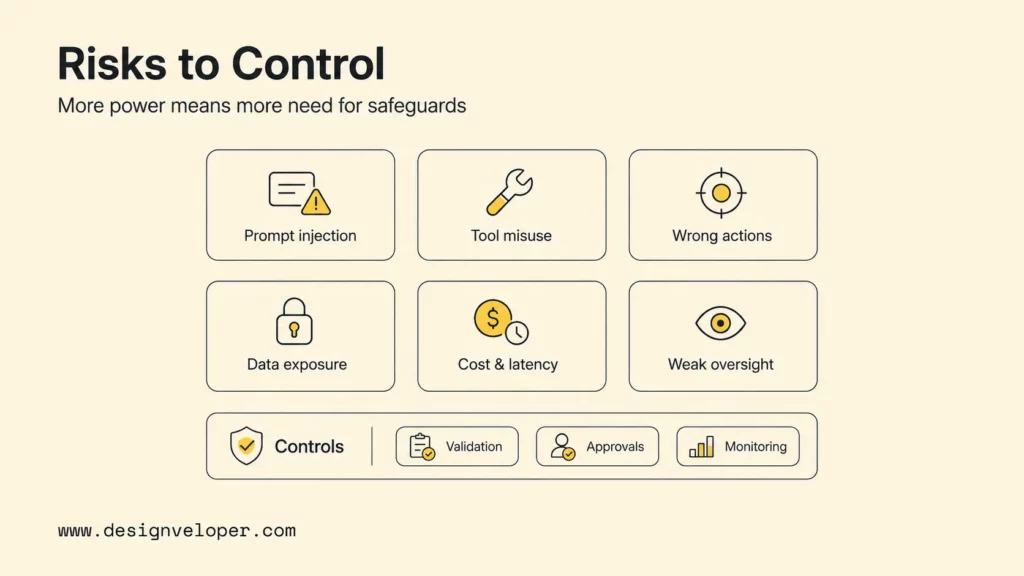
The 2026 OWASP Top 10 for Agentic Applications includes prompt injection and tool misuse among risks that can turn untrusted text into unintended behavior. Security should assume the agent will encounter hostile content and should limit the damage any single model decision can cause.
Risk management also covers non-security harm. NIST’s NIST AI Resource Center provides resources for operationalizing the AI Risk Management Framework, including testing, evaluation, verification, and validation. Teams should connect technical agent tests to business impact, affected users, accountability, and documented risk acceptance.
The safest agent is not the one that never fails; it is the one whose authority, evidence, limits, and recovery path are designed before failure occurs.
Explore more:
- Enterprise AI Agents: Use Cases, Tools, And Implementation Guide
- Types of AI Agents: Key Categories and When to Use Each
- AI Agent Pricing Framework: Cost Models, Hidden Fees, And ROI Tips
Continue reading:
- What Is RAG in AI? How Retrieval-Augmented Generation Works
- What Is A Vector Database? A Practical Guide For AI Search And RAG
- Build A RAG Chatbot From Local Prototype To Production Deployment
From LLM Agent Prototype To Reliable AI Workflow
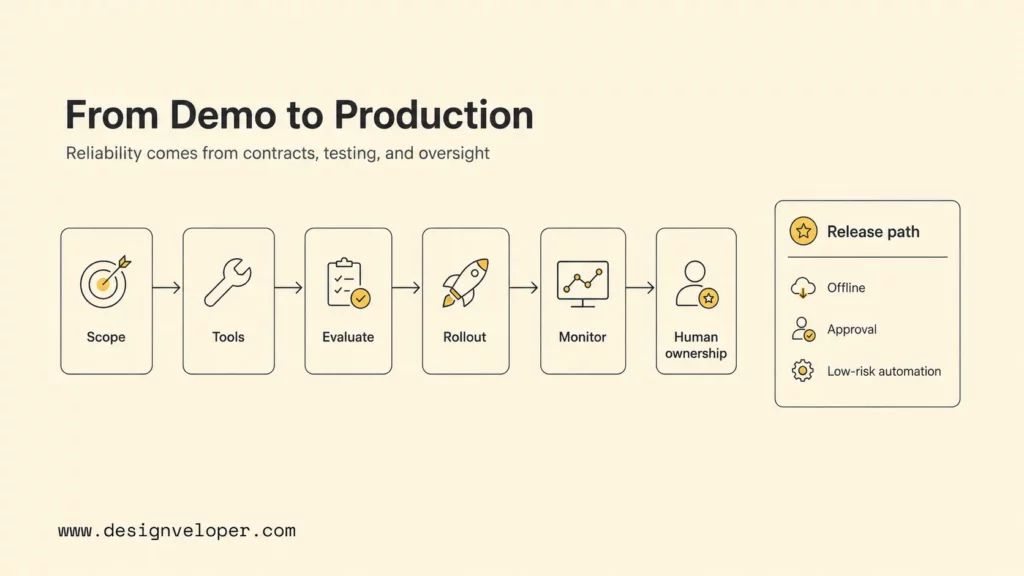
An LLM agent becomes useful in production when planning, memory, tools, permissions, evaluation, monitoring, and human review are designed around a real workflow. A polished demo proves capability. Production readiness proves controlled behavior across normal cases, edge cases, attacks, outages, and model changes.
Define the workflow contract. Name the user, trigger, goal, allowed inputs, expected output, systems touched, completion criteria, exclusions, and accountable owner. List actions from read-only to irreversible. Decide which can run automatically, which need confirmation, and which the agent must refuse.
Design narrow tools and permissions. Use least privilege for the agent identity. Separate data retrieval, proposal, approval, and execution. Validate arguments outside the model. Require idempotency for mutations, set spending and volume limits, and test that cross-account access fails. Store credentials in the execution layer rather than exposing them to prompts.
Build an evaluation set before launch. Include common cases, ambiguous requests, missing data, policy conflicts, tool failures, prompt injection, permission violations, and high-risk actions. Grade final correctness, evidence, tool selection, arguments, step count, escalation, policy compliance, latency, and cost. Anthropic’s guide to evaluating AI agents emphasizes that multi-turn tool-using systems require tests of both outcomes and trajectories, using grader types calibrated against expert judgment.
Release through controlled stages. Start in offline evaluation, then shadow mode where the agent observes but cannot act. Move to human approval for every proposal, then allow low-risk actions for a small group. Expand only when quality, security, cost, and operational metrics meet written thresholds. Keep a fast rollback path and version models, prompts, tools, policies, and retrieval indexes.
Monitor the complete run. Track success rate, escalation, user correction, policy violations, tool errors, retries, time to completion, model and tool latency, tokens, cost, memory retrieval, and approval decisions. Preserve enough structured evidence to investigate a run without storing unnecessary sensitive content. Sample successful runs because silent failures do not always trigger alerts.
Keep human ownership explicit. A named team owns the policy, evaluation set, production incidents, content sources, tool changes, and approval thresholds. Users need a visible way to stop, correct, or appeal an agent outcome. High-stakes decisions remain accountable to qualified people even when the agent prepares the work.
An LLM agent is ready to leave the prototype stage only when its autonomy boundary is explicit. In our AI development work, we define which sources the agent may retrieve, which tools it may call, what requires human approval, how success is evaluated, and how partial actions are recovered. The resulting permission and evaluation matrix is more important than adding another planning loop because it determines whether the workflow can be trusted in real operations.
The best first production agent is rarely the broadest one. Choose a workflow with frequent effort, accessible data, clear actions, measurable success, and safe escalation. Reliability compounds when each component has a small contract and the team can see exactly where a run succeeded or failed.
For a deeper dive, read:
- What Is LangChain and Where Does It Fit in an AI Application?
- What Is The Model Context Protocol (MCP)? How Does It Work?
- LangChain Vs MCP: What’s The Difference And When To Use Each?
FAQs About LLM Agents
What Is The Difference Between An LLM Agent And A Chatbot?
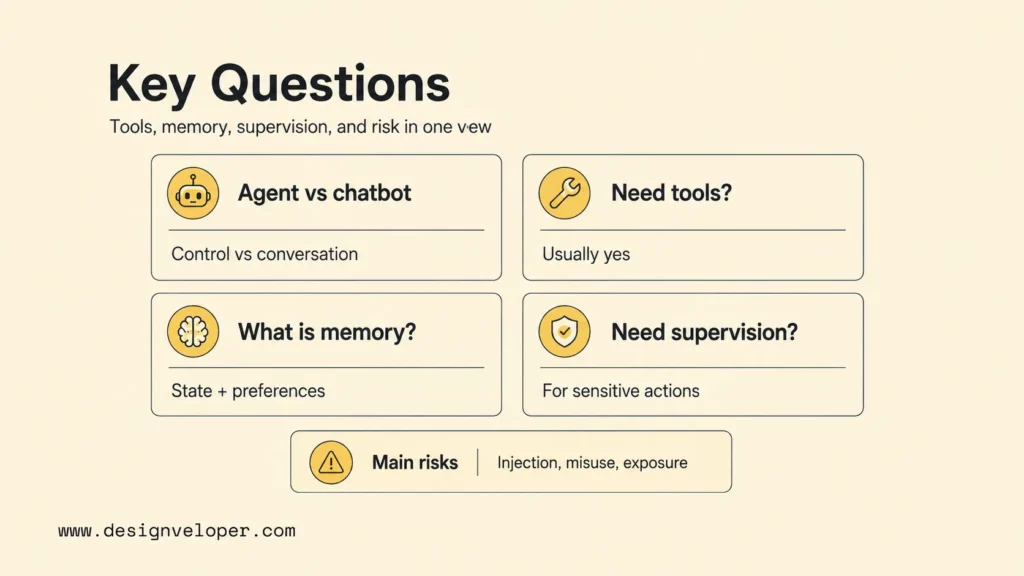
A chatbot primarily conducts a conversation and may follow rules or generate responses with an LLM. An LLM agent uses the model to control part of a task workflow, including selecting tools, observing results, adapting steps, and deciding when the goal is complete. A chatbot interface can contain an agent, but conversation alone does not make a system agentic.
Do LLM Agents Need Tools Or Function Calling?
Most useful LLM agents need tools because tools provide live information and real-world actions beyond text generation. Function calling is a common structured mechanism for requesting those operations, but it is not the only implementation. An executor can interpret a validated action schema, call an API, run code in a sandbox, search data, or hand work to another service.
What Is Memory In An LLM Agent?
Memory is the application-managed information used to continue a task or personalize future work. Short-term memory includes conversation and tool state for the current run. Long-term memory can store approved preferences, facts, or prior outcomes in an external database or retrieval system. Memory needs provenance, access controls, freshness, retention, and correction.
Can LLM Agents Work Without Human Supervision?
LLM agents can complete low-risk, well-tested tasks without reviewing every step, but they still need human ownership, monitoring, incident response, and periodic evaluation. Sensitive, irreversible, financial, legal, medical, employment, or externally visible actions usually need approval or stronger controls. Autonomy should expand only when evidence supports it.
What Are The Main Risks Of LLM Agents?
The main risks are prompt injection, tool misuse, hallucinated decisions, permission errors, sensitive-data exposure, stale or incorrect memory, excessive cost and latency, unreliable tool execution, and weak monitoring or oversight. Layered security, narrow permissions, deterministic validation, evaluations, approvals, audit trails, and safe failure behavior reduce those risks.
Also published on

Share post on










Related Articles


Generative AI Applications: 20 Practical Use Cases Across Industries
Generative AI Applications: 20 Practical Use Cases Across Industries Published September 18, 2026
Machine Learning Vs AI: What’s The Difference?
Machine Learning Vs AI: What’s The Difference? Published September 16, 2026
Enterprise AI Agents: Use Cases, Tools, And Implementation
Enterprise AI Agents: Use Cases, Tools, And Implementation Published September 14, 2026