










What Is Deep Learning? How It Helps AI Learn From Data

KEY TAKEAWAYS:
- Compare a simpler baseline with a pretrained AI model before planning custom training.
- Supervised learning uses labeled targets; self-supervised learning can create training targets from the input data.
- Backpropagation calculates gradients, while an optimizer uses them to update the network’s weights.
- CNNs, RNNs, transformers, and GNNs describe architecture families. Autoencoders, GANs, and diffusion models describe other, overlapping approaches.
- Keep a deep-learning system only when it improves an agreed task metric enough to justify its data, compute, review, and upkeep costs.
Image recognition, speech transcription, and text generation can look like different products, but each may depend on models that learn patterns across many examples. Deep learning can help when those patterns are hard to describe with fixed rules, yet it also adds data, compute, and oversight needs. This explainer defines the method, shows how neural networks learn, and compares model families. It also gives a practical way to test whether deep learning fits a real task or whether a simpler approach is enough.
What Is Deep Learning?
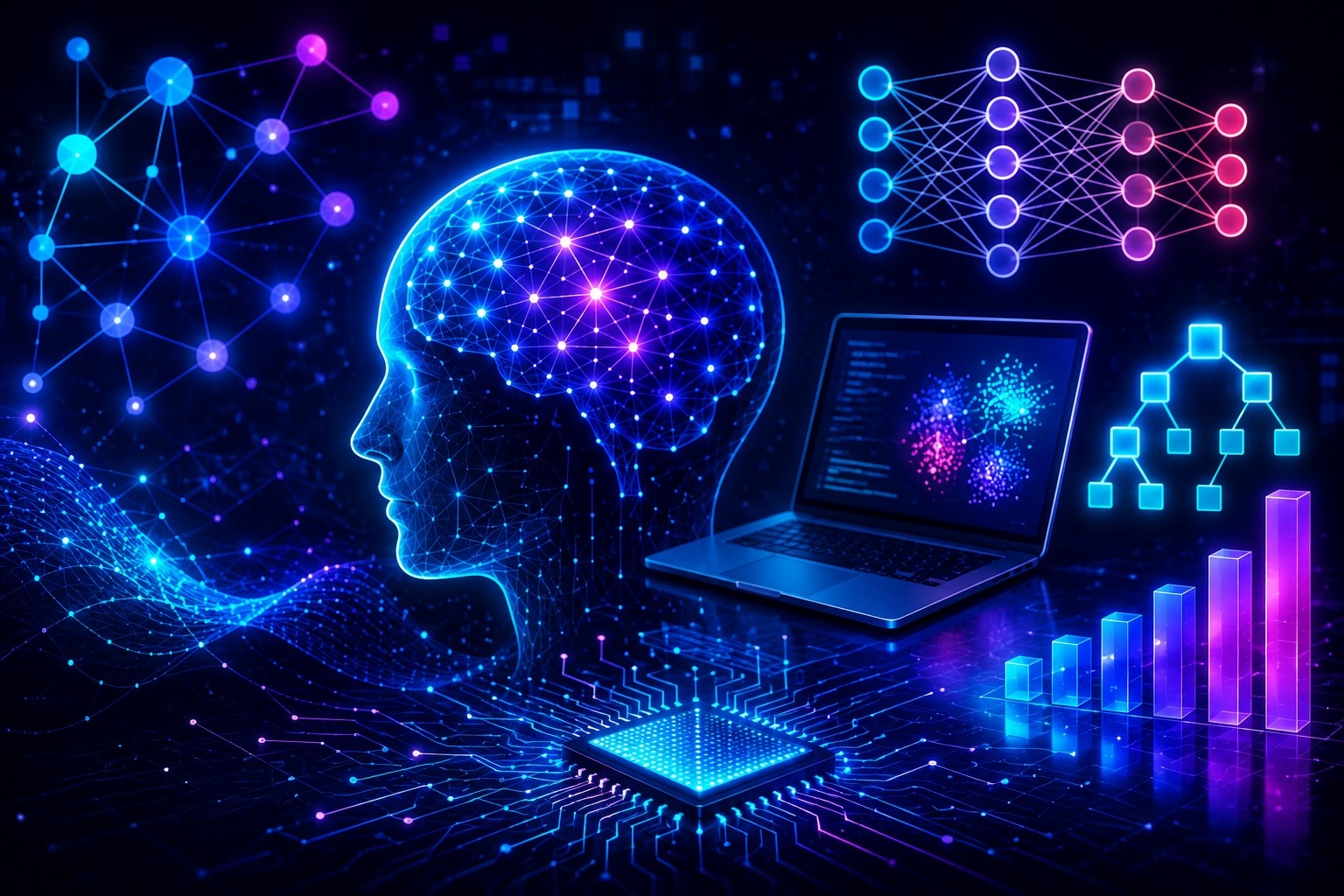
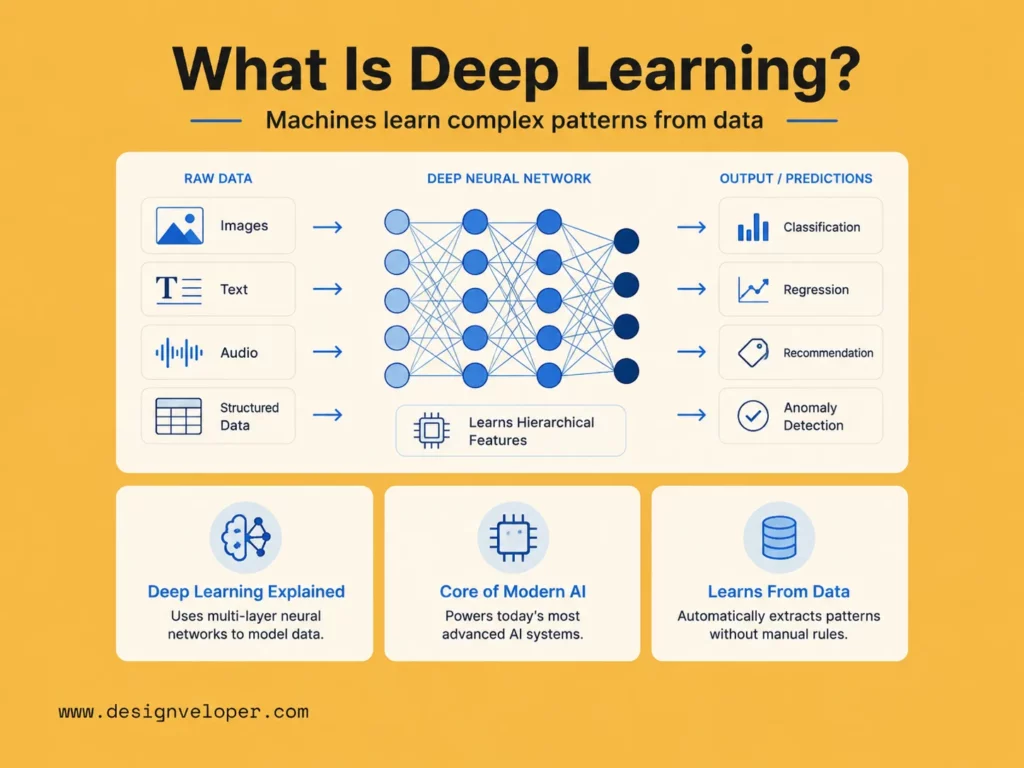
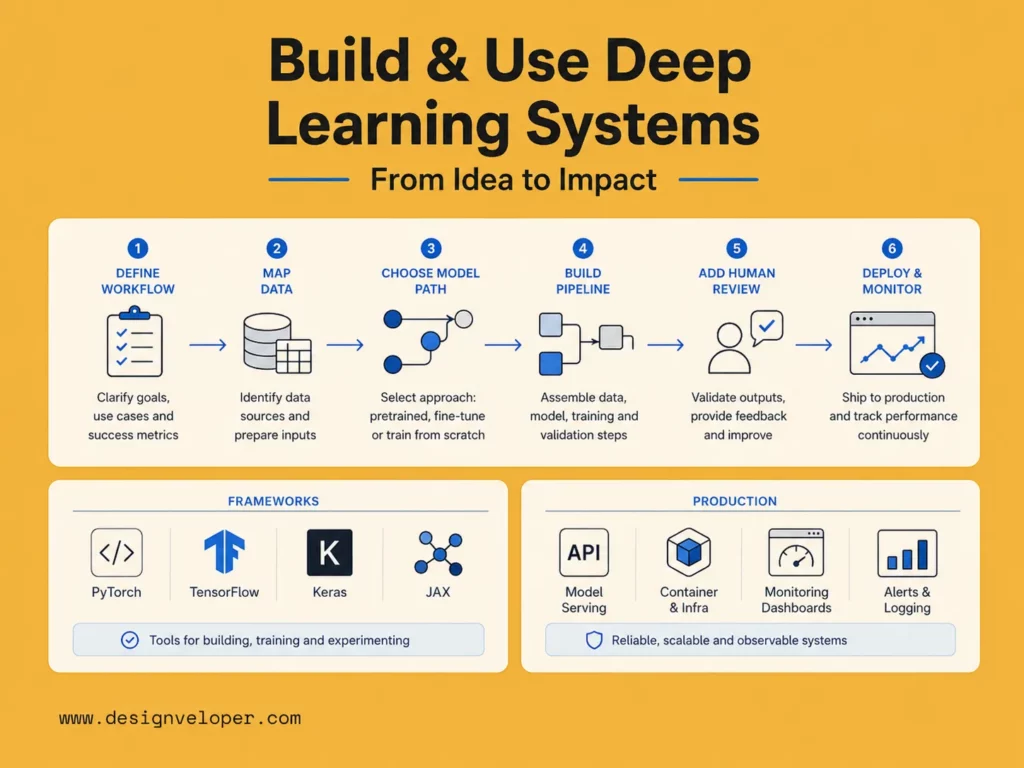
Deep learning is a subset of machine learning that uses multilayer neural networks to learn patterns in data and produce predictions, classifications, or generated content.
The word “deep” refers to the network’s layers, not to human-like thought. Those layers learn useful representations from examples. Deep learning is one method within the wider field of artificial intelligence. Stanford HAI’s deep-learning definition also centers on patterns learned through multiple network layers.
What “Deep” Means in a Neural Network
A neural network passes numeric data through connected layers. Early layers may respond to simple patterns, while later layers combine them into more task-specific patterns. In an image model, those patterns might progress from edges to shapes and then to a likely object.
The network does not need a person to write a separate rule for every pattern. People still choose the task, prepare data, design or select the model, and check its errors. The learned patterns come from training rather than from a hand-written list of visual rules.
A Simple Image-Recognition Example
Imagine a factory testing a model that flags scratches on metal parts. A camera supplies an image, the network processes its pixel values through learned layers, and the output estimates whether the part has a defect.
This is a hypothetical example, not a measured result. A quality worker should review uncertain predictions and check samples the model marks as acceptable. A missed defect may cost more than an extra manual inspection, so the team must set its error limits before use.
Related reading:
- What Is Generative AI? How It Works, Examples And Business Impact
- AI With Python: What You Can Build And Where To Start
- AI Programming Language For AI Development And Where They Fit Best
How Deep Learning Works
A deep-learning model first turns an input into numbers, then applies a sequence of learned transformations. The structure and training process explain why it can detect patterns, and why its output still needs evaluation.
Layers Transform the Input
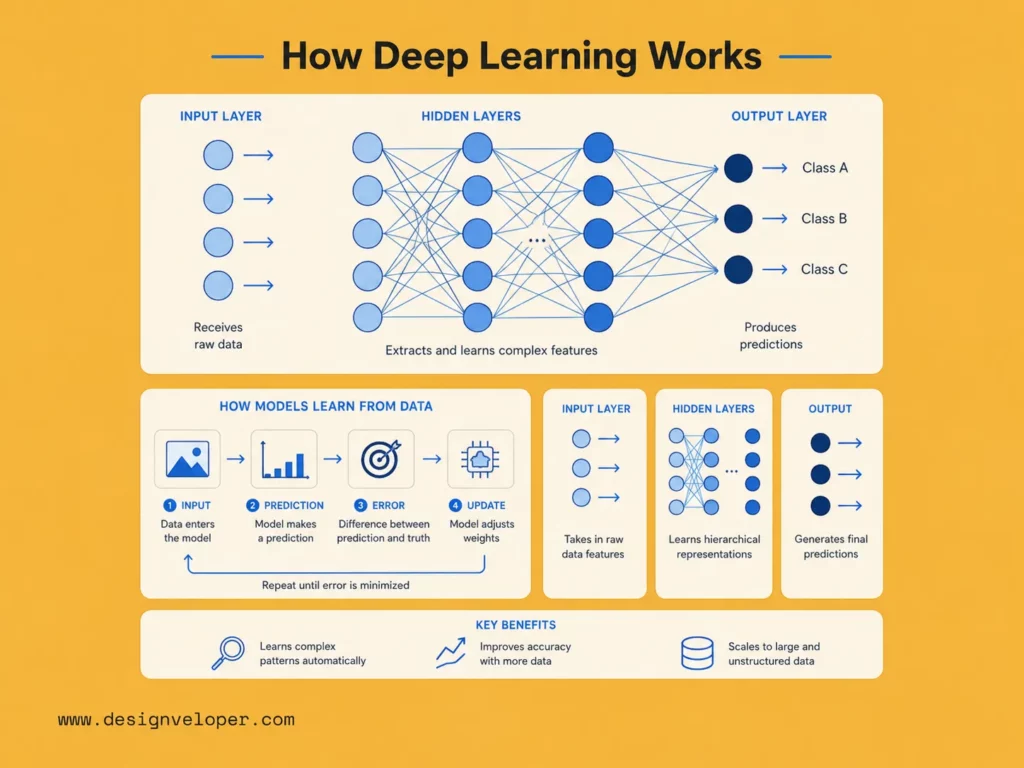
The model’s input layer receives data in a format the network can process. Hidden layers apply weights and activation functions, which help the network represent non-linear patterns. The output layer returns a score, category, value, or generated sequence, depending on the task.
| Part | What it does | Example in image inspection |
|---|---|---|
| Input layer | Receives values in the model’s expected shape. | Pixel values from a camera image. |
| Hidden layers | Learn and combine patterns through weighted calculations. | Edges, surface texture, and scratch-like shapes. |
| Output layer | Produces the task result. | A defect score or an acceptable/inspect category. |
The Forward Pass Produces a Prediction
During a forward pass, data moves from the input through the network to an output. For a classifier, the output may be a score for each possible class. A high score is a model estimate, not proof that the prediction is correct. Google’s neural-network overview explains the layers and training process in more detail.
At first, a new model’s weights are not useful for the task. Training adjusts them using examples and an objective that tells the model what to improve. The training setup determines what feedback the model receives.
How Deep-Learning Models Learn From Data
Deep-learning training uses a goal to guide changes to the model. That goal may use human-provided labels, patterns derived from the input, or feedback from an environment.
Training Modes Use Different Feedback
Supervised learning is one common setup, but it is not the only way to train a deep network. The training signal depends on the task and the data available.
| Training setup | Feedback | Example task |
|---|---|---|
| Supervised | Examples include labels or target values. | Classify a reviewed image as “defect” or “no defect.” |
| Self-supervised | The system derives a learning target from the input itself. | Predict a hidden part of text or another data sequence. |
| Reinforcement learning | Actions receive rewards or penalties from an environment. | Learn a policy for a simulated control task. |
Some systems also use unsupervised objectives or combine several training stages. A team should describe the actual objective rather than assume that every model learns from a set of correct answers.
Backpropagation Calculates Gradients
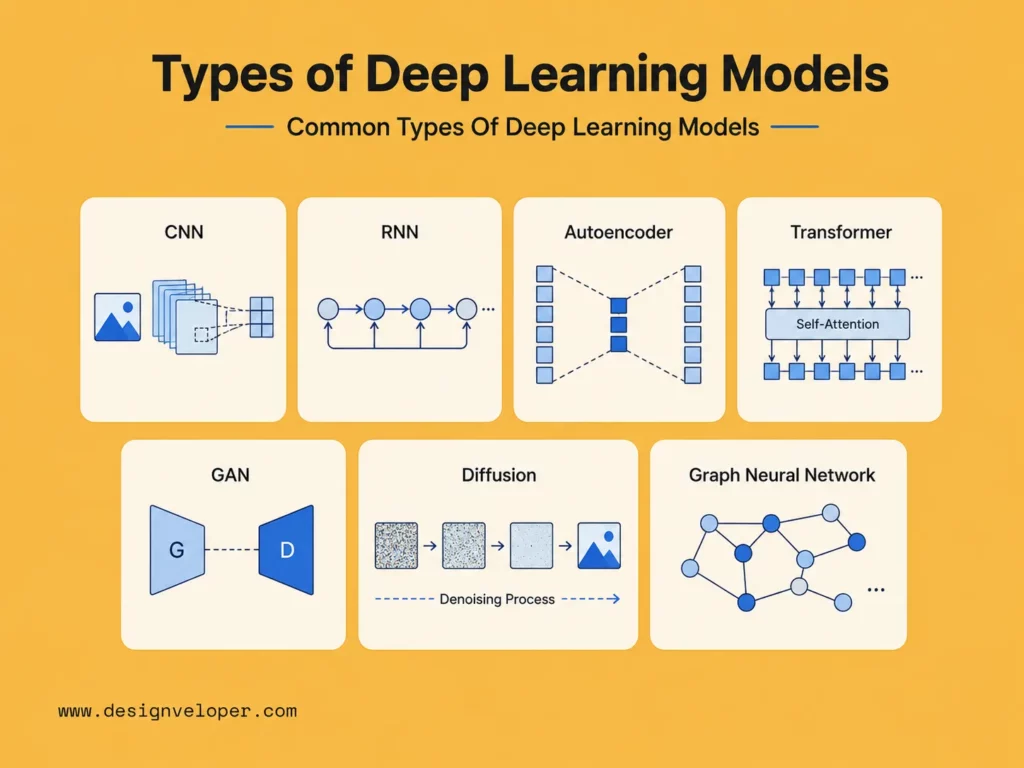
In supervised training, a loss function measures how far a prediction is from its target. Backpropagation calculates gradients, which show how changes to network weights would affect that loss. It sends this information backward through the layers; it does not, by itself, choose the final weight update.
An optimizer uses the gradients to update the weights. Gradient descent is one such method. The model repeats prediction, loss calculation, gradient calculation, and updates across many training examples. A separate validation set helps the team spot overfitting, where the model learns the training data too closely and performs worse on new cases. See Google’s neural-network backpropagation guide for a step-by-step explanation.
Data and Compute Depend on the Task
Deep learning often benefits from many useful examples, but there is no universal minimum dataset size. Results depend on task difficulty, data quality, class balance, model size, and whether a suitable pretrained model exists. A small, carefully labeled dataset can be more useful than a larger set with wrong labels or a different data mix.
Mozilla’s Common Voice Scripted Speech v27.0 lists 42,593 total hours across 295 languages. That is a public-corpus example, not a requirement for a speech project. A team can start with a pretrained model, which has already learned from related data, and adapt it to a narrower task. It can also use a hosted application programming interface (API) rather than train a large model from scratch.
Large-model training often uses GPUs or other accelerators, while a small model may train on a CPU. Inference, or using a trained model to make predictions, can run on a device, a server, or through an API. The right choice depends on latency, privacy, cost, and the amount of control the team needs.
For practitioners:
- AI Engineer Vs ML Engineer: Key Differences, Skills, And Best Fit
- 15 Best AI Coding Assistant Tools For Developers In 2026
- AI In Product Development: From Concept To Market Faster
Common Types of Deep-Learning Models
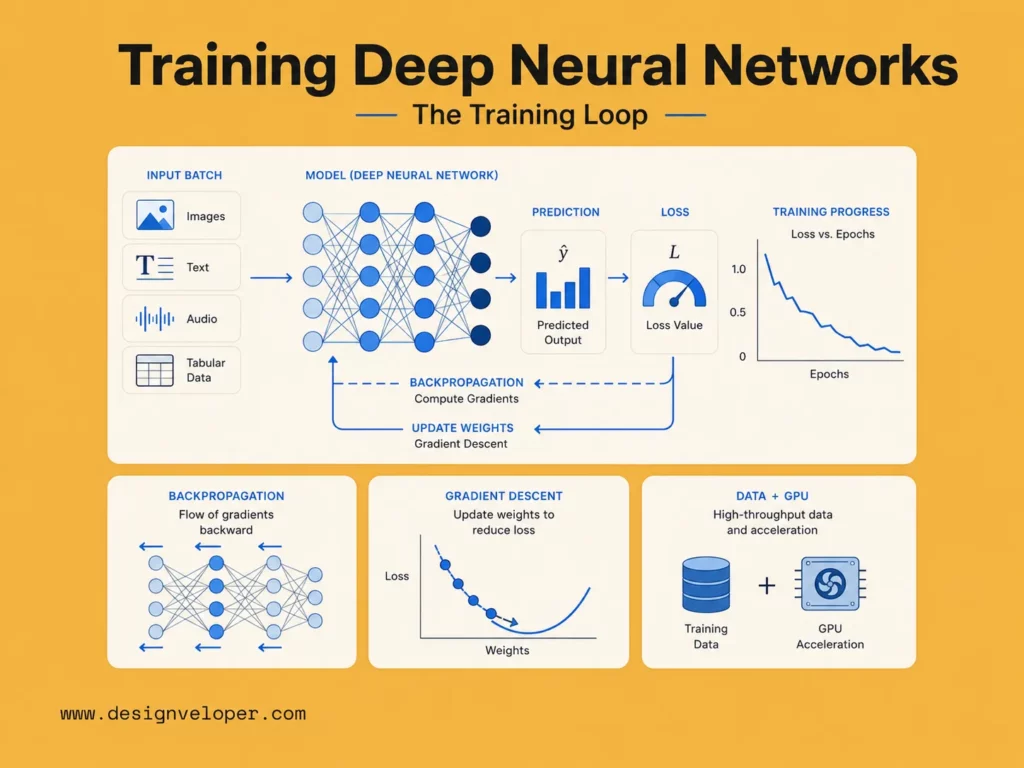
Deep-learning labels describe more than one kind of choice. CNNs, RNNs, transformers, and GNNs are architecture families; autoencoders, GANs, and diffusion models describe reconstruction or generation approaches. These categories can overlap, so they are not one exclusive list.
Architecture Families Match Different Data Shapes
An architecture defines how a network organizes and processes information. The best fit depends on the input, the task, and the serving constraints.
| Family | Useful fit | Limit to consider |
|---|---|---|
| Convolutional neural network (CNN) | Local patterns in images, video frames, or some audio signals. | Image quality, camera position, and rare defects can affect results. |
| Recurrent neural network (RNN) | Sequential data where earlier values can inform later ones. | Long sequences can be difficult to train; newer tasks may use other designs. |
| Transformer | Text, code, images, and other inputs where relationships across a sequence matter. | Attention and context length can raise memory and compute needs. The original Transformer paper describes the architecture. |
| Graph neural network (GNN) | Data made of entities and their relationships, such as users linked to devices. | The graph must reflect real relationships; a graph model is not automatically better for fraud or recommendation tasks. |
Reconstruction and Generative Approaches Can Overlap
These approaches describe what a model learns to reconstruct or create. They can use or combine with different network architectures.
- Autoencoders compress input into a smaller representation and learn to reconstruct it. Variational autoencoders are one generative variant; a basic autoencoder is not automatically a general-purpose content generator.
- Generative adversarial networks (GANs) train a generator against a discriminator. The generator makes samples, while the discriminator learns to distinguish generated examples from training examples. The original GAN paper introduced this setup.
- Diffusion models learn to generate samples by reversing a noise-adding process. They are used for tasks such as image generation; the Denoising Diffusion Probabilistic Models paper describes a foundational method.
A transformer can power a generative language model, for example. The architecture and the generation objective answer different questions about how the system is built and what it learns to produce.
Deep Learning vs. Machine Learning vs. Generative AI
Machine learning is the broader category, deep learning is one family of machine-learning methods, and generative AI describes systems built to create outputs. Modern generative systems often use deep learning, but the terms do not mean the same thing.
| Term | What it describes | Common strength | Trade-off |
|---|---|---|---|
| Machine learning | Methods that learn patterns from data. | Many methods work well on structured business data. | The team may need to select or design useful input features. |
| Deep learning | Machine learning with neural networks that have multiple learned layers. | Can learn representations from complex inputs such as images, text, or audio. | Training and operation may need more data, compute, and monitoring. |
| Generative AI | Systems designed to create content or other outputs. | Can draft, synthesize, or transform text, images, audio, and code. | Outputs can be incorrect or unsuitable and may need human review. |
One practical difference is that deep networks can learn useful features from less-structured inputs. Traditional machine-learning methods may be simpler to train and explain on a small, well-defined table. Neither approach wins for every task. Compare them on the same held-out examples, which were not used for training, and score them against the metric and operating limits that matter to the workflow.
Real-World Applications of Deep Learning
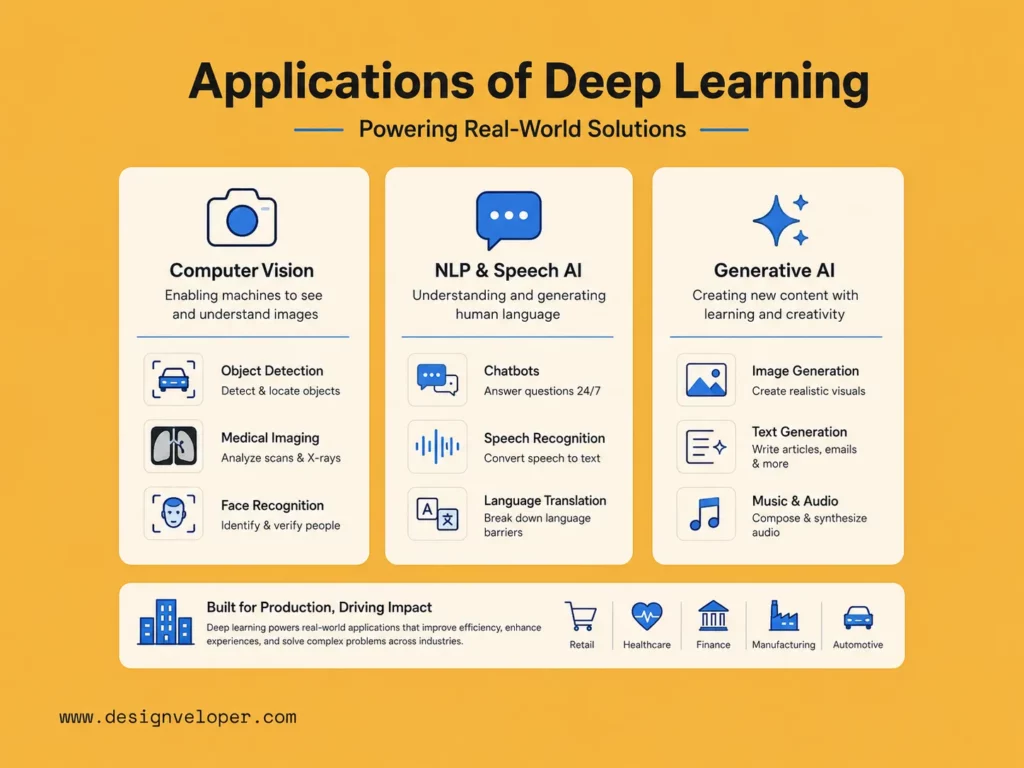
Deep learning can support tasks where data contains patterns that are hard to describe with fixed rules. The examples below are scenarios, not claims about measured results.
Computer Vision
A manufacturer could use images from a line camera to flag dents, cracks, or surface marks. The model sorts images by likely class, while a worker checks uncertain cases and samples of accepted parts.
The team should measure missed defects and false alarms against the current inspection process. Changes in lighting, camera angle, or product type can shift image patterns, so the system needs checks when the production setup changes.
Language and Speech
A support team could turn a recorded call into a draft transcript, then search it for order numbers or a stated reason for the call. A language or speech model may help, but the pipeline also needs consent, access control, and a way to correct errors.
Names, accents, background noise, and domain terms can lower transcription quality. Keep a person in the loop before a transcript changes an order or customer record. Learn more about voice technology and the systems around speech input.
Connected Accounts and Graph Data
A payment team might represent accounts, devices, and transfers as a graph, then look for unusual links among them. A GNN can learn from both the nodes and their relationships, which may add context that a row-by-row model misses.
This does not prove that a GNN is the right fraud model. The graph may contain missing or outdated links, and a high-risk score should trigger review rather than an automatic account block unless the policy and evidence support that action.
Generative AI
A service team could use a language model to draft a reply from approved support documents. A retrieval step can supply current policy text, while an employee checks the cited source and approves the response before it reaches a customer.
Generated text can sound certain while being wrong. Teams should check source match, factual error rate, escalation rate, and review time before expanding use. Read more about AI in software development for related product workflows.
For practical application:
- What Are AI Hallucinations? Why They Happen & How To Reduce Them
- RAG Vs. Fine-Tuning: Choose The Right Approach For Your LLM Apps
- RAG Pipeline Diagram: Components, Workflow, And Production Design
When Does Deep Learning Make Sense?
Deep learning is worth considering when the task depends on complex patterns and a neural model can improve the result enough to cover its extra cost. Start with the task and its failure risks, not with a model family.
- Consider deep learning when inputs include images, audio, text, or other high-dimensional data, and a simpler baseline misses useful patterns.
- Compare a simpler method first when a small set of rules or a conventional model already meets the need on held-out examples.
- Check operating limits when the workflow has strict latency, privacy, explainability, energy, or per-task cost requirements.
- Delay automation when labels are unreliable, important user groups are missing from the data, or no one owns error review.
Possible gains include fewer missed patterns or less manual sorting, but a model does not guarantee lower costs or faster work. Compare it with the current process and include annotation, infrastructure, review, monitoring, and retraining in the cost estimate.
How to Evaluate a Deep-Learning Use Case
A small, controlled pilot can show whether a model adds value without handing it decisions before the team understands its errors. Use a fixed workflow and document the baseline first.
- Define the task. Write down the input, output, user, and decision the model may support. Set the cost of a false positive and a missed case.
- Set a baseline. Measure the current rule, manual process, or simpler machine-learning model on representative examples.
- Review the data. Check data rights, quality, missing groups, labels, and train/test separation. Avoid putting the same person, asset, or time period in both sets when that would leak information.
- Compare model paths. Test a pretrained model or API against the baseline before committing to custom training. Keep the same examples and scoring rules for each option.
- Limit and monitor use. Route uncertain or high-impact cases to a person. Log decisions, inspect errors, and define a rollback path before launch.
Proposed inspection pilot: A quality lead could own a fixed four-week test, extending it if the sample contains too few examples of rare defects. Before the test, the team sets a target for critical-defect recall and limits for false alarms, review hours, latency, and cost per item. The quality lead reviews uncertain cases daily and checks performance against the existing process each week. Keep the model only if it meets the pre-set recall target without exceeding the guardrails; otherwise, adjust the data or workflow, or return to the baseline. These are proposed checks, not observed results.
The same discipline applies when deep learning is part of a wider AI software development effort: assign an owner for data, model quality, and operations before the pilot grows.
Continue reading:
- How To Build And Use AI Business Process Automation Effectively
- 10 Must-Have AI Apps In 2026 And How They Work
- What Is Agentic AI? Benefits, Architecture and How It Works
FAQs About Deep Learning
Does Deep Learning Always Need a GPU?
No. Larger models often use GPUs or other accelerators for training, but a small model may train on a CPU. Inference may run locally, on a server, or through a hosted API, depending on speed, privacy, and cost needs.
Can Deep Learning Work With a Small Dataset?
Yes, in some cases. A team can adapt a pretrained model, use data augmentation, or narrow the task, but it still needs representative examples for evaluation. If the test set is too small or misses rare cases, the measured quality may be uncertain.
Is ChatGPT a Deep-Learning Model?
ChatGPT is an AI service powered by foundation models; the service is not itself one neural-network architecture. Many language models use deep neural networks, while the exact models available in ChatGPT can change over time.
Conclusion
Deep learning can help when a task depends on complex patterns, but a larger network is not automatically a better choice. Compare a pretrained or custom model with a simpler baseline, then check quality, error costs, latency, and upkeep in the real workflow. If your team is planning an AI feature and needs help with model selection or integration, review Designveloper’s AI development services.
Also published on

Share post on









Related Articles


AI Agents vs Agentic AI: Differences From Execution to Autonomy
AI Agents vs Agentic AI: Differences From Execution to Autonomy Published October 30, 2026
Best AI Trading Bots For Crypto & Stocks In 2026 (We Tested Them All)
Best AI Trading Bots For Crypto & Stocks In 2026 (We Tested Them All) Published October 30, 2026
Claude Vs ChatGPT Vs Gemini For Coding In 2026: Which Is Best?
Claude Vs ChatGPT Vs Gemini For Coding In 2026: Which Is Best? Published October 29, 2026