















Most Used Programming Languages In 2026: Rankings, Jobs & Use Cases

KEY TAKEWAYS:
- Python, JavaScript, HTML/CSS, SQL, Java, TypeScript, C#, C/C++, PHP, and Go remain the most used programming languages when rankings combine surveys, GitHub activity, jobs, and real production use.
- No ranking source is complete by itself: developer surveys, open-source activity, job demand, and tutorial interest each measure a different kind of popularity.
- Python leads AI, data, scripting, and automation, while JavaScript and TypeScript stay central because web applications still dominate software delivery.
- Java, C#, C/C++, SQL, PHP, and Go stay relevant because enterprise systems, databases, infrastructure, and existing production code continue to need them.
- The best language to learn is not always the most popular one; choose based on what you want to build, the ecosystem, and the career path you want.
The most used programming languages in 2026 are Python, JavaScript, HTML/CSS, SQL, Java, TypeScript, C#, C/C++, PHP, and Go when rankings combine developer usage, repository activity, hiring demand, and practical software development use cases.
This guide explains how those rankings differ, where each language fits, and how to choose by project and career goals. It draws on the Stack Overflow Developer Survey 2025, the GitHub Octoverse 2025 report, the GitHub Octoverse 2025 AI project analysis, and the PYPL PopularitY of Programming Language Index.
Explore more:
- Which Programming Language Is Best for App Development?
- Java Vs Python: Key Differences & Which Language Fits AI Better
- Rust Vs Python: Which Language Is Best For Your Project?
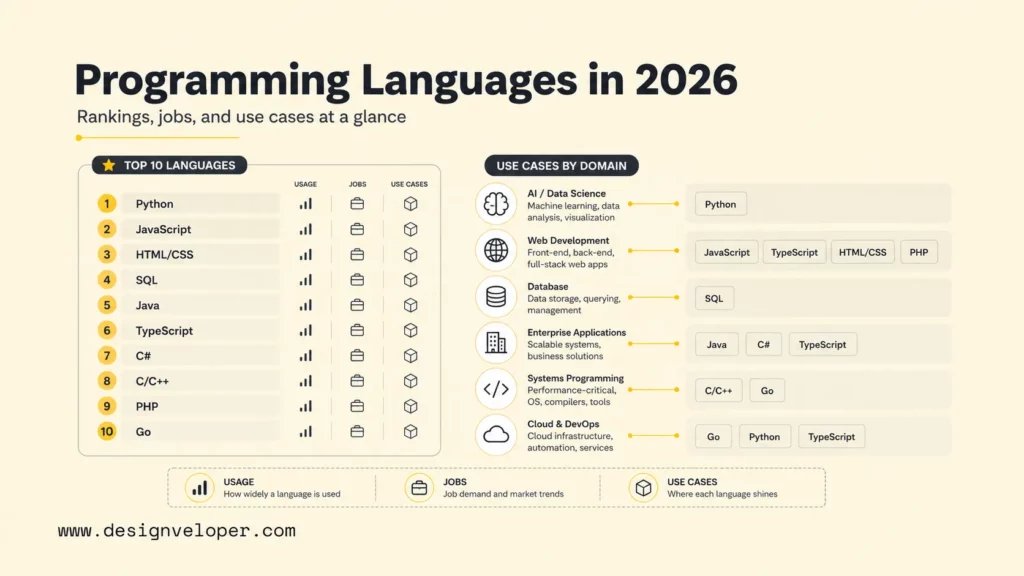
Top 10 Most Used Programming Languages In 2026
The top 10 list below blends developer usage, open-source activity, hiring relevance, and real-world software coverage. The exact order can change by methodology, but these languages repeatedly appear across modern programming ecosystems.
Use the ranking as a market map, not a rule. The best language for a web portfolio, an AI chatbot, a banking backend, an embedded device, and a DevOps automation tool will be different.
| Rank | Language | Best-known use | Why it stays used |
|---|---|---|---|
| 1 | Python | AI, data, automation, backend scripting. | Fast learning curve and a huge AI ecosystem. |
| 2 | JavaScript | Browser and full-stack web development. | Every modern website depends on browser interactivity. |
| 3 | HTML/CSS | Web structure and styling. | Foundational for front-end interfaces. |
| 4 | SQL | Relational databases and analytics. | Most businesses still run on structured data. |
| 5 | Java | Enterprise software and backend systems. | Large organizations keep JVM systems for reliability. |
| 6 | TypeScript | Typed JavaScript and scalable web apps. | Large JavaScript codebases need stronger typing. |
| 7 | C# | .NET, enterprise apps, games, cloud services. | Microsoft ecosystem remains broad and mature. |
| 8 | C/C++ | Systems, embedded, performance-critical software. | Hardware-level control and existing infrastructure. |
| 9 | PHP | CMS and server-rendered websites. | WordPress and legacy web systems keep PHP relevant. |
| 10 | Go | Cloud, infrastructure, APIs, DevOps tools. | Simple concurrency and deployment-friendly binaries. |
1. Python
Python is the strongest all-around choice for AI, data science, automation, scripting, notebooks, and fast backend prototypes. The Python official site gives the language a stable official foundation, while frameworks such as PyTorch official site make Python central to modern AI work.
The Stack Overflow Developer Survey 2025 highlighted Python’s growth in 2025 around AI, data science, and backend development. Python also stays popular because analysts, researchers, automation teams, and software engineers can all use it productively.
2. JavaScript
JavaScript remains one of the most used programming languages because it is the native language of browser interactivity. The MDN JavaScript documentation covers how JavaScript changes web pages, responds to events, and connects front-end interfaces to APIs.
JavaScript also runs on the server through Node.js official site, which makes it useful for full-stack teams. A product team can use JavaScript across browser interfaces, APIs, build tools, and lightweight automation.
3. HTML/CSS
HTML and CSS are not programming languages in the same way as Python or Java, but they appear in developer usage rankings because web development depends on them. MDN HTML documentation defines page structure, while MDN CSS documentation controls layout, typography, spacing, and responsive design.
HTML/CSS remains essential because every website, web app, landing page, dashboard, and e-commerce flow needs a usable interface. Even AI-generated websites still need semantic HTML and maintainable CSS to work well.
4. SQL
SQL remains heavily used because business software depends on relational data. Customer records, orders, invoices, analytics tables, financial systems, and operational dashboards often use relational databases. The ISO SQL standard page reflects SQL’s long-standing role as a standardized database language.
SQL is also important for AI and analytics because models need clean, governed, queryable data. A developer who knows Python or JavaScript but cannot query data is limited in many real business projects.
5. Java
Java stays widely used because enterprise software changes slowly. The Java official site ecosystem supports backend systems, business applications, APIs, Android legacy code, financial systems, and large team development. Frameworks such as Spring Boot official site keep Java relevant for cloud and microservice work.
Java is less dominant in AI experimentation than Python, but it is still important when AI features must integrate with enterprise systems. Many organizations use Java for the business layer and Python for the model or data layer.
6. TypeScript
TypeScript is one of the fastest-growing web languages because it adds static typing to JavaScript. The TypeScript official site helps large teams make JavaScript codebases easier to refactor, document, and maintain.
The GitHub Octoverse 2025 report reported that TypeScript became the most used language on GitHub by monthly contributors in August 2025. That signal does not erase JavaScript or Python, but it shows how large web and AI-assisted development workflows increasingly prefer typed code.
7. C#
C# remains widely used through the .NET ecosystem. The Microsoft C# documentation supports enterprise applications, APIs, Windows software, Azure services, games with Unity, and cross-platform development.
C# is a practical choice for teams already invested in Microsoft tooling. Its strong typing, mature IDE support, and enterprise ecosystem keep it relevant for long-lived business applications.
8. C/C++
C and C++ remain critical because lower-level software still needs performance and hardware control. The ISO C standard page and ISO C++ official site are relevant in operating systems, embedded software, databases, game engines, real-time systems, compilers, and high-performance computing.
AI teams may not write much C++ directly, but many AI libraries, runtimes, and GPU-accelerated tools rely on C or C++ underneath. These languages stay important because modern software still rests on performance-critical infrastructure.
9. PHP
PHP remains widely used because much of the web still runs on PHP systems. The PHP official site ecosystem powers WordPress, Drupal, Laravel applications, e-commerce sites, publishing systems, and long-running server-rendered websites.
PHP is not always the first language developers choose for a new AI product, but it remains economically important. Many companies need PHP developers to maintain, modernize, secure, and integrate existing websites.
10. Go
Go is popular for cloud infrastructure, APIs, developer tools, and DevOps systems. The Go official site emphasizes simplicity, fast builds, concurrency, and deployment-friendly binaries. Those qualities fit containerized services and infrastructure tooling.
Go is not the most common beginner language, but it is attractive for teams that want readable backend services with strong concurrency and low operational friction. Go often appears in cloud-native stacks, CLI tools, and platform engineering.
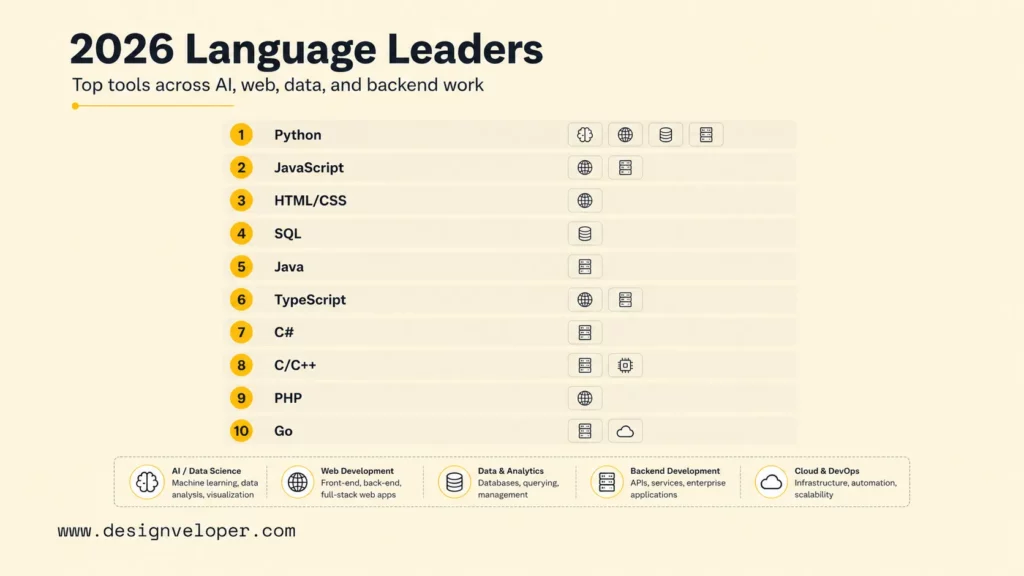
How Most Used Programming Languages Are Ranked
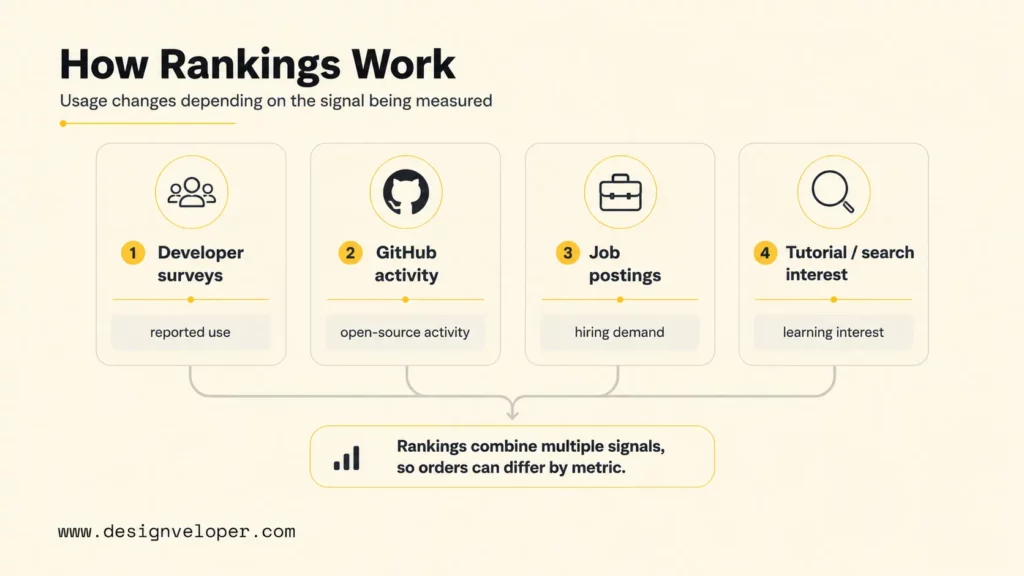
Programming language rankings are built from different signals, so a language can rank high in one index and lower in another. Surveys, GitHub activity, job postings, tutorial searches, package downloads, and enterprise installed base all measure different kinds of popularity.
Developer Survey Usage
Developer surveys ask people what they used recently. The Stack Overflow Developer Survey 2025 is useful because it captures professional and learning behavior across many countries and roles. Survey results are strong for practical usage, but they reflect who answered and how questions were framed.
Survey rankings often favor languages used every day by web, backend, data, and full-stack developers. They may underrepresent closed-source enterprise code, embedded systems, or specialized domains where developers do not participate heavily in public surveys.
GitHub And Open-Source Activity
GitHub activity measures public and private repository activity inside GitHub’s ecosystem. The GitHub Octoverse 2025 report is especially useful for open-source and collaborative development trends. GitHub signals can reveal rising languages such as TypeScript because repository work changes faster than enterprise hiring.
Open-source activity does not equal total business usage. A bank may run millions of lines of Java or COBOL without exposing that activity publicly. A language can be essential in production even if it looks less exciting in repository rankings.
Job Market Demand
Job demand measures what employers need. Hiring tends to favor languages that support existing systems and revenue-generating products, so Java, JavaScript, Python, SQL, C#, and TypeScript often stay strong. Demand can lag behind technical trends because companies hire for systems already in production.
Job data should be read by role. Python is strong in AI and data jobs. JavaScript and TypeScript dominate many web roles. Java and C# remain strong in enterprise backend roles. SQL appears across analytics, data engineering, backend, and business intelligence jobs.
Why Rankings Do Not Always Match
Rankings do not match because they measure different behaviors. PYPL measures tutorial search interest through the PYPL PopularitY of Programming Language Index, Stack Overflow measures survey usage, and GitHub measures repository work. A beginner learning Python, a developer contributing to TypeScript, and a company hiring Java engineers create different signals.
The safest way to read rankings is to combine them. If a language appears across surveys, GitHub, jobs, and production systems, it is broadly important. If a language appears in only one ranking, it may be strong for a narrower audience.
Recommended for you:
- What is the Difference Between HTML and CSS?
- Best Javascript Tutorial for Beginners
- 11 Best Web Development Languages for Front-End and Back-End
Where These Programming Languages Are Used Most
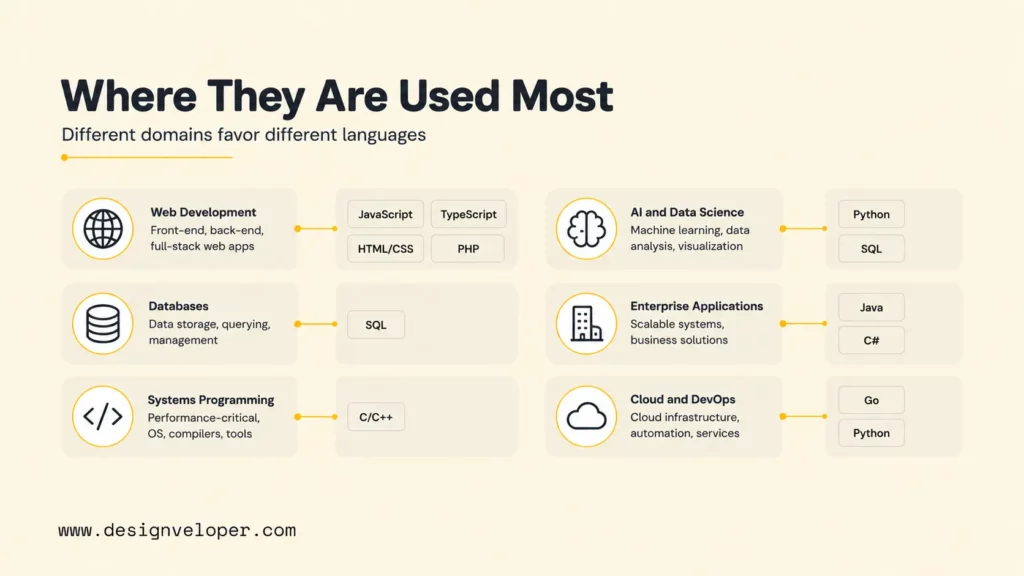
The most used programming languages cluster around web development, AI and data work, enterprise systems, infrastructure, automation, and DevOps. A language’s value depends on where it fits inside a real software development process.
Web Development
Web development is the strongest reason JavaScript, TypeScript, HTML, CSS, PHP, Python, Java, and C# remain used. Browser interfaces need HTML, CSS, and JavaScript. Larger front-end applications often use TypeScript. Server-side systems may use Node.js, Java, C#, Python, PHP, Go, or other stacks.
Designveloper’s web development services work reflects this practical mix. Web projects often need interface engineering, backend APIs, databases, deployment, performance, accessibility, and long-term maintenance rather than a single-language answer.
AI, Data, And Backend Work
AI and data work strongly favor Python and SQL. Python handles experimentation, model workflows, automation, and APIs. SQL handles structured data retrieval and analysis. Java, TypeScript, Go, and C# often wrap AI features inside production applications.
The GitHub Octoverse 2025 AI project analysis reported that new AI projects on GitHub heavily favored Python in 2025. That does not mean every AI product is pure Python. Production AI often combines Python model services with JavaScript interfaces, Java or C# enterprise systems, SQL databases, and cloud infrastructure.
Enterprise And Systems Engineering
Enterprise engineering keeps Java, C#, SQL, Python, and TypeScript highly relevant. Large organizations need stable services, identity, auditability, transactions, monitoring, and integration with existing systems. Java and C# are especially strong where structured service development and long-term support matter.
Systems engineering keeps C and C++ relevant. Operating systems, drivers, databases, game engines, compilers, and embedded systems require control over memory, latency, and hardware. These areas change slowly because reliability and performance are critical.
Infrastructure, Automation, And DevOps
Infrastructure and DevOps work often uses Go, Python, Shell, TypeScript, and sometimes Java or C#. Go is common in cloud-native tooling because it builds static binaries and handles concurrency well. Python is common for scripts and automation. TypeScript appears in infrastructure-as-code ecosystems and developer tooling.
Automation choices should follow the team’s operations model. A quick internal script may be best in Python. A long-running platform service may fit Go. A typed cloud automation project may use TypeScript. Popularity helps only when it matches ownership and maintainability.
Discover more here:
- Popular Python Frameworks And Which Projects They Fit Best
- Best JavaScript Frameworks For Web Development
- Best Frontend Frameworks: 8 Options, Tradeoffs, And Tips
Most Used Programming Languages In Jobs
The most used programming languages in jobs are usually the languages that power existing business systems. Employers hire for today’s stack, not only tomorrow’s trends. That is why Python, JavaScript, Java, SQL, TypeScript, C#, and C++ keep appearing in job descriptions.
Most In-Demand Languages For Hiring
Hiring demand varies by market and role, but broad demand usually favors Python, JavaScript, Java, SQL, TypeScript, and C#. Python leads many AI, ML, automation, and analytics roles. JavaScript and TypeScript lead web roles. Java and C# remain strong in enterprise backend roles.
Job demand also reflects maintenance. A company may not write blog posts about a Java monolith or PHP CMS, but it still needs developers to improve, secure, and integrate those systems. Maintenance demand is real demand.
Why Python, JavaScript, And Java Stay Strong
Python, JavaScript, and Java stay strong because each has a broad domain. Python covers AI, data, automation, and backend scripting. JavaScript covers browser interfaces and full-stack web. Java covers enterprise systems and structured backend applications.
These languages also have large hiring pools, extensive documentation, mature tooling, and many existing codebases. A business choosing one of them is less likely to struggle with support, onboarding, or long-term maintenance.
Why Job Demand And Usage Are Not Always The Same
Job demand and usage differ because one developer may use a language daily while another company hires aggressively for a smaller but business-critical stack. A language can be common in open-source but less visible in enterprise hiring. Another language can have fewer new repositories but more long-term maintenance jobs.
Readers should compare job postings in their target city, industry, and role. A global ranking is useful background, but local demand decides what skills help most for a specific career move.
How To Choose A Programming Language Beyond Popularity
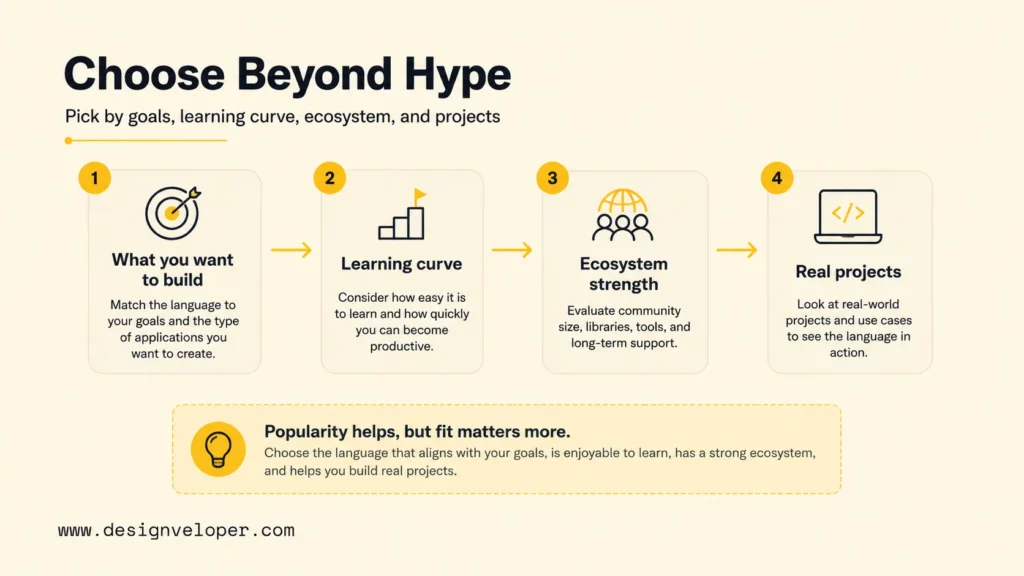
Choose a programming language by what you want to build, how hard it is to learn, how strong the ecosystem is, and whether you can build real projects with it. Popularity reduces risk, but fit creates progress.
Choose Based On What You Want To Build
Choose Python for AI, data, automation, and fast prototypes. JavaScript or TypeScript for web interfaces and full-stack apps. Java or C# for enterprise backends. Choose SQL for data. C/C++ for systems and performance. And Go for cloud tools and infrastructure services.
At Designveloper, language choices are tied to delivery architecture. Through our AI development services, web development services, and delivery process, we usually map product goals, data flows, integrations, security needs, deployment targets, and team skills before recommending a stack.
Balance Learning Curve With Career Value
A beginner should balance quick progress with long-term opportunity. Python is often easiest for early wins. JavaScript gives immediate web feedback. Java and C# build strong backend foundations. SQL is valuable across almost every business role involving data.
The best learning path is not always the easiest language. A learner who wants embedded systems may need C or C++. A learner who wants cloud infrastructure may need Go. And a learner who wants enterprise backend work may need Java or C#.
Look At Ecosystem Strength, Not Just Rankings
Ecosystem strength includes libraries, frameworks, documentation, tooling, deployment options, community answers, and hiring. Python’s AI ecosystem, JavaScript’s web ecosystem, Java’s enterprise ecosystem, C#’s .NET ecosystem, and Go’s cloud-native ecosystem all matter more than rank alone.
A strong ecosystem lowers risk because developers can find examples, packages, documentation, and people who understand the stack. A high ranking without ecosystem fit will not help a project ship.
Focus On One Language Long Enough To Build Real Projects
Beginners often switch languages too quickly. Learning one language long enough to build real projects teaches debugging, architecture, testing, deployment, and maintenance. Those skills transfer better than shallow familiarity with many languages.
A practical goal is to build three projects: one small script or utility, one web or data project, and one deployed application. After that, the learner can add a second language with clearer judgment.
Learn more in:
- What are Enterprise Applications?
- 11 Software Developer Career Paths What Suits You Best
- What Is Data Structure and Their Applications?
The Most Used Language Is Not Always The Best One For You
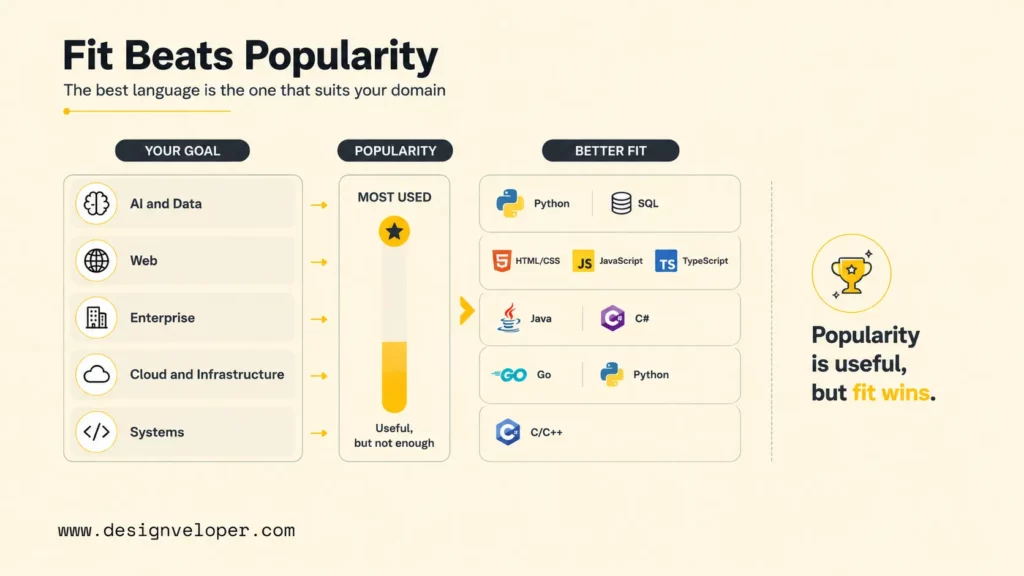
The most used language is not always the best language for your goal. JavaScript may dominate web development, but it is not the best first choice for data science. Python may dominate AI workflows, but it is not the best fit for a high-performance embedded system. Java may be excellent for enterprise systems but too heavy for a quick script.
Popularity is still useful because it reduces hiring, documentation, and ecosystem risk. A popular language gives learners more tutorials and companies more candidates. The mistake is treating popularity as a substitute for project fit.
The strongest choice is a language that helps you build something real in your target domain. If you want AI, start with Python and SQL. If you want web, learn HTML, CSS, JavaScript, and TypeScript. While if you want enterprise backend work, learn Java or C#. If you want infrastructure, learn Go and Python. And if you want systems work, learn C or C++.
For a deeper dive, read:
- TOP 30 Web Development Tutorials to Build Your Career
- How to Become a Web Developer? A Detailed Guide
- AI With Python: What You Can Build And Where To Start
FAQs About The Most Used Programming Languages
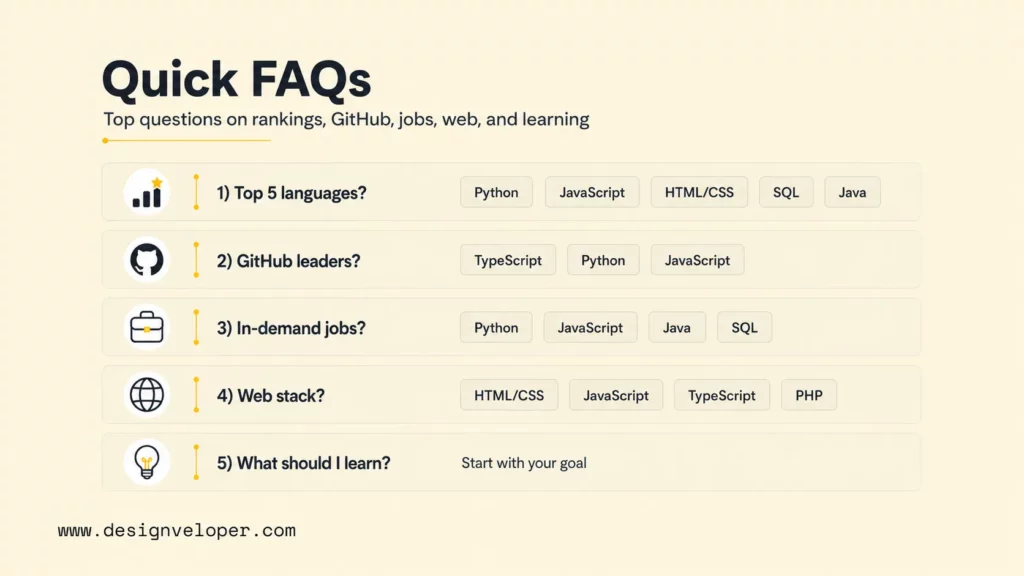
These answers summarize the most common ranking and career questions.
What Are The Top 5 Most Used Coding Languages?
The top five most used coding languages usually include Python, JavaScript, HTML/CSS, SQL, and Java when practical usage across web, data, enterprise, and developer surveys is considered. Some rankings place TypeScript, C#, or C/C++ higher depending on the source and methodology.
Which Programming Languages Are Most Used On GitHub?
GitHub’s 2025 Octoverse reporting highlighted TypeScript, Python, JavaScript, Java, C++, and C# as major languages in repository activity, with TypeScript overtaking Python and JavaScript by monthly contributors in August 2025.
Which Programming Languages Are Most In Demand In Jobs?
The most in-demand languages in jobs commonly include Python, JavaScript, Java, SQL, TypeScript, C#, and C++. Demand depends on role and region: Python for AI/data, JavaScript and TypeScript for web, Java and C# for enterprise backend, and SQL for data-heavy business roles.
What Are The Most Used Programming Languages For Web Development?
The most used programming languages for web development are HTML, CSS, JavaScript, TypeScript, SQL, PHP, Python, Java, and C#. Frontend vs backend choices depend on the product stack and team: front-end work needs HTML, CSS, and JavaScript, while backend work depends more on architecture and infrastructure.
Should You Learn The Most Used Language Or The One That Fits Your Goal Best?
You should learn the language that fits your goal best, then use popularity as a risk check. Python is a strong general first choice for AI and automation. JavaScript is essential for web. Java and C# are strong for enterprise backends. SQL is useful almost everywhere data matters.
The most used programming languages are popular because they solve recurring real-world problems. The best language for you is the one that helps you build useful projects, get feedback, enter the job market you want, and keep growing without fighting the wrong ecosystem.
Also published on

Share post on










Related Articles



Best Claude Model in 2026: Fable, Opus, Sonnet and Haiku
Best Claude Model in 2026: Fable, Opus, Sonnet and Haiku Published September 18, 2026
Generative AI Applications: 20 Practical Use Cases Across Industries
Generative AI Applications: 20 Practical Use Cases Across Industries Published September 18, 2026
Best ChatGPT Models in 2026: GPT-6 Astra and GPT-5.6 Guide
Best ChatGPT Models in 2026: GPT-6 Astra and GPT-5.6 Guide Published September 16, 2026