













Java Vs Python: Key Differences & Which Language Fits AI Better

KEY TAKEWAYS:
- Python is usually the better choice for AI, data science, automation, scripting, and fast prototypes because it is concise and has stronger AI/data libraries.
- Java is usually stronger for enterprise backends, high-throughput services, large teams, and systems that need long-term structure.
- Python is easier for beginners at first, while Java teaches static typing, object-oriented design, and maintainability earlier.
- Performance depends on workload: Java often wins in long-running services, while Python can be fast enough when optimized libraries or external services handle heavy work.
- Many real products use both: Python for AI/data workflows and Java for durable business systems, APIs, and enterprise integration.
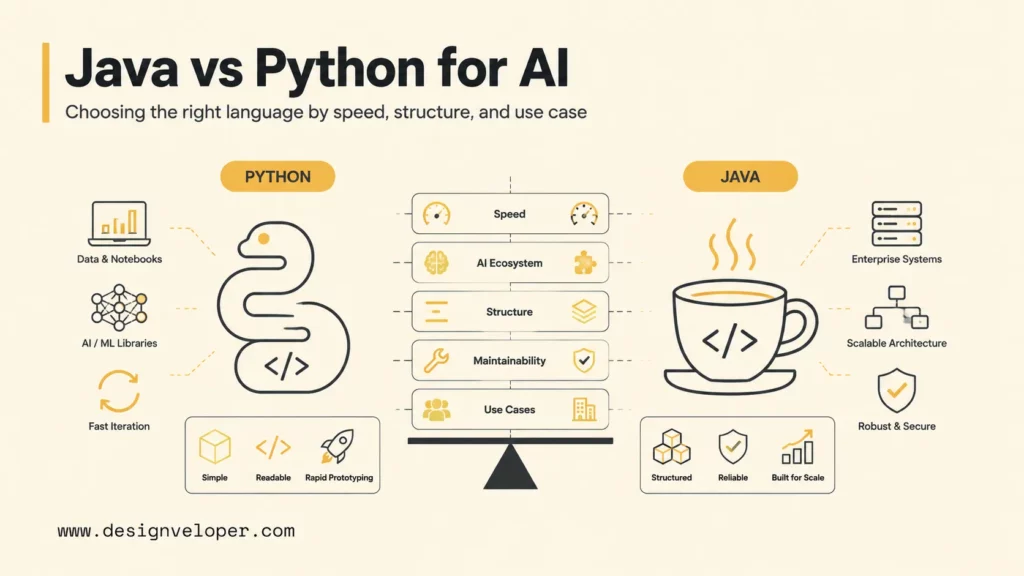
Java vs Python is a choice between two mature languages with different strengths. Python usually fits AI, data science, automation, scripting, and fast prototyping better. Java usually fits large enterprise systems, strongly structured backends, high-throughput services, and long-lived team codebases better. The right choice depends on the custom software development context, team, performance needs, and career goal.
The difference between Python and Java is not simply easy versus hard. Python has simpler syntax and a faster learning path, while Java has stricter structure, static typing, and a runtime ecosystem built for large applications. The Stack Overflow Developer Survey 2025 reported that Python adoption grew in 2025, while GitHub’s Octoverse 2025 report showed Python and Java both remaining among the main languages used in new repositories. This guide compares syntax, speed, typing, libraries, maintainability, learning curve, AI fit, enterprise use, and practical projects so you can choose by fit.
For a deeper dive, read:
- Which Programming Language Is Best for App Development?
- TOP 30 Web Development Tutorials to Build Your Career
- Most Used Programming Languages: Rankings, Jobs & Use Cases
Java Vs Python: Key Difference
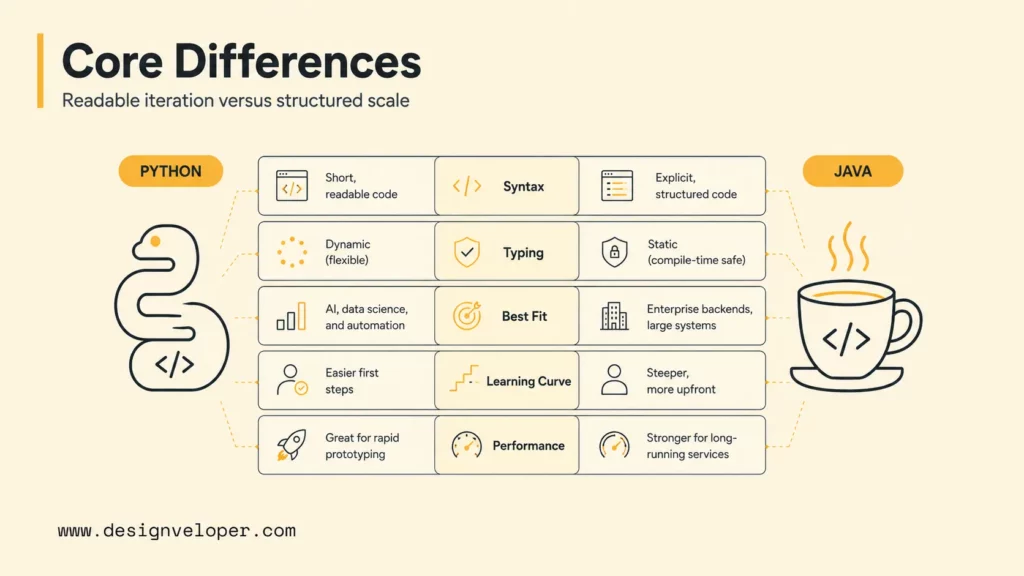
The key difference is that Python prioritizes readability and fast iteration, while Java prioritizes explicit structure and long-term maintainability in large systems. Python code is usually shorter and easier to write at the start. Java code is usually more verbose but clearer about types, interfaces, and application boundaries.
The table below gives the short comparison before the detailed sections.
| Criteria | Python | Java |
|---|---|---|
| Syntax | Short, readable, indentation-based. | Verbose, class-based, braces and explicit declarations. |
| Typing | Dynamically typed with optional type hints. | Statically typed with compile-time checks. |
| Best fit | AI, data, automation, APIs, scripting, prototypes. | Enterprise systems, Android history, backend services, large teams. |
| Learning curve | Easier first steps. | More structure and concepts upfront. |
| Performance | Usually slower in pure runtime, often fast enough with optimized libraries. | Usually faster for long-running services through JVM optimization. |
Syntax And Readability
Python syntax is designed to be readable and compact. The Python official tutorial introduces core ideas with fewer symbols, less boilerplate, and indentation that mirrors code structure. Beginners can usually write useful scripts before learning advanced language mechanics.
Java syntax is more explicit. A simple program requires classes, method signatures, types, braces, and a compilation step. The extra structure can feel heavy for beginners, but it becomes useful when many developers maintain the same application.
Performance And Execution Speed
Java usually has an advantage in execution speed for long-running backend services because the JVM can optimize code over time. Oracle’s Oracle JVM technology overview explains the runtime layer that supports Java execution and optimization. Java services also benefit from mature profiling, monitoring, and concurrency patterns.
Python can be slower for pure CPU-bound code, but Python often delegates heavy work to optimized libraries written in C, C++, CUDA, or other lower-level technologies. That is why Python remains strong in AI despite runtime limitations. The performance question should be tied to the workload, not only the language.
Typing And Error Handling
Python is dynamically typed, which means developers can move quickly without declaring every type upfront. Type hints can improve readability and tooling, but many errors still appear at runtime if tests are weak. Python is forgiving during experimentation and less forgiving when large teams skip discipline.
Java is statically typed, so many type errors appear before execution. That makes refactoring safer in larger codebases. Java also encourages explicit exception handling and interface contracts, which can reduce ambiguity in enterprise projects.
Ecosystem And Libraries
Python has a dominant ecosystem for AI and data science. Frameworks such as PyTorch, TensorFlow, and Hugging Face make Python the common language for model training, inference experiments, embeddings, notebooks, and automation scripts.
Java has a strong enterprise ecosystem. Frameworks such as Spring Boot and Quarkus support REST APIs, microservices, cloud-native applications, security, dependency injection, and structured service development. Java is less dominant in AI research but still important when AI features must live inside enterprise architecture.
Code Structure And Maintainability
Python code can stay maintainable when teams use modules, type hints, tests, linters, packaging, and clear architecture. Python becomes risky when teams treat quick scripts as permanent systems without refactoring. Short code is not automatically maintainable code.
Java often pushes developers toward structure earlier. Packages, classes, interfaces, types, build tools, and conventions help large teams reason about code over time. Java can become overly complex, but its structure is useful when the system has many modules, teams, and release cycles.
Explore more:
- Python Best Practices For Writing Clean, Maintainable Code
- What Is JavaScript? How It Makes Websites Interactive
- Rust Vs Python: Which Language Is Best For Your Project?
Is Java Or Python Easier To Learn?
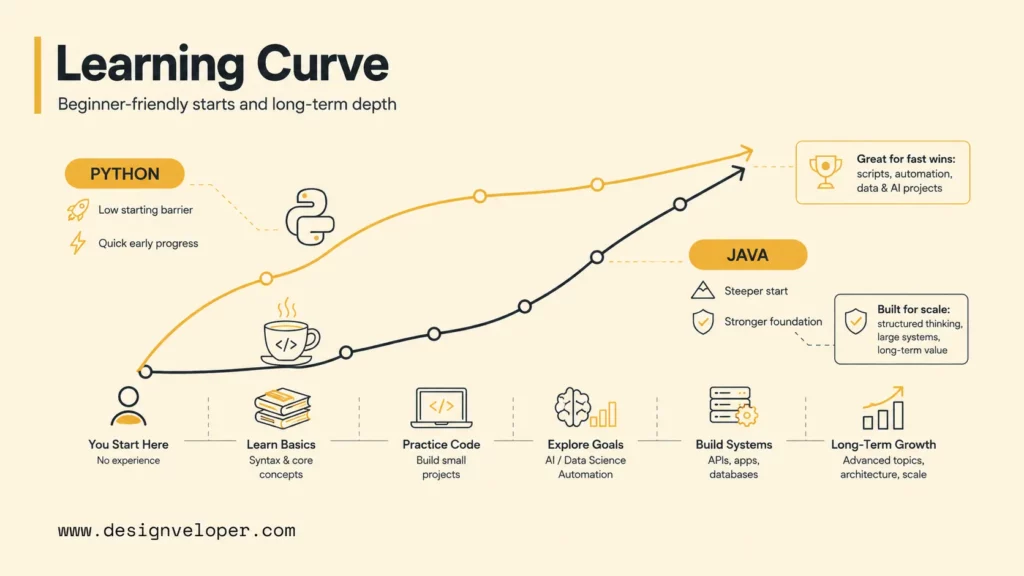
Python is usually easier to learn first because the syntax is simpler and feedback is faster. Java is usually harder at the beginning because learners must understand classes, types, method signatures, compilation, and object-oriented structure early.
That does not mean Python is always easier forever. Python becomes challenging when projects need architecture, packaging, asynchronous work, type discipline, deployment, and performance. Java becomes easier after learners understand its structure because the language guides many decisions explicitly.
Why Python Usually Feels Easier At The Start
Python feels easier because a beginner can write a script with a few lines and see results quickly. The language hides ceremony so the learner can focus on variables, functions, loops, data structures, files, and simple APIs. That low barrier helps people build confidence.
Python also has strong learning momentum in AI and automation. A beginner can move from basic syntax to a notebook, a data visualization, an API call, or a small chatbot prototype without switching languages. That path makes Python attractive for students, analysts, and builders who want practical output quickly.
Why Java Can Feel More Demanding For Beginners
Java can feel demanding because a beginner meets object-oriented structure early. Classes, public static methods, type declarations, packages, and build tools can make simple examples look larger than the concept being taught. This is why many beginners ask whether Java is like Python and often conclude that Java feels stricter.
The difficulty has a purpose. Java teaches structure, types, APIs, and maintainability from the beginning. A learner who wants backend engineering, Android legacy maintenance, enterprise systems, or computer science fundamentals may benefit from Java’s discipline.
When Java’s Structure Becomes A Strength
Java’s structure becomes a strength when projects grow. Explicit types, interfaces, dependency management, and mature IDE support make refactoring safer. Large teams can understand service boundaries more easily when the codebase follows consistent conventions.
Java is also strong when an organization values long-term support. Enterprise systems often live for years, integrate with many services, and require stable onboarding for new developers. Java’s structure reduces ambiguity in those environments.
Which Language Fits Different Learning Goals Better
Choose Python first if the learning goal is AI, data analysis, automation, scripting, or rapid web API prototyping. Choose Java first if the learning goal is enterprise backend development, object-oriented design, typed systems, or long-lived application architecture.
A practical learning path can include both. Learn Python to build quickly and understand AI/data workflows. Learn Java to understand static typing, larger application design, and enterprise software patterns. The combination is useful because many companies use polyglot stacks.
Recommended for you:
- 11 Software Developer Career Paths What Suits You Best
- How to Become a Web Developer? A Detailed Guide
- What Does a Web Developer Do? Career, Salary, Reviews
What Python Does Better Than Java
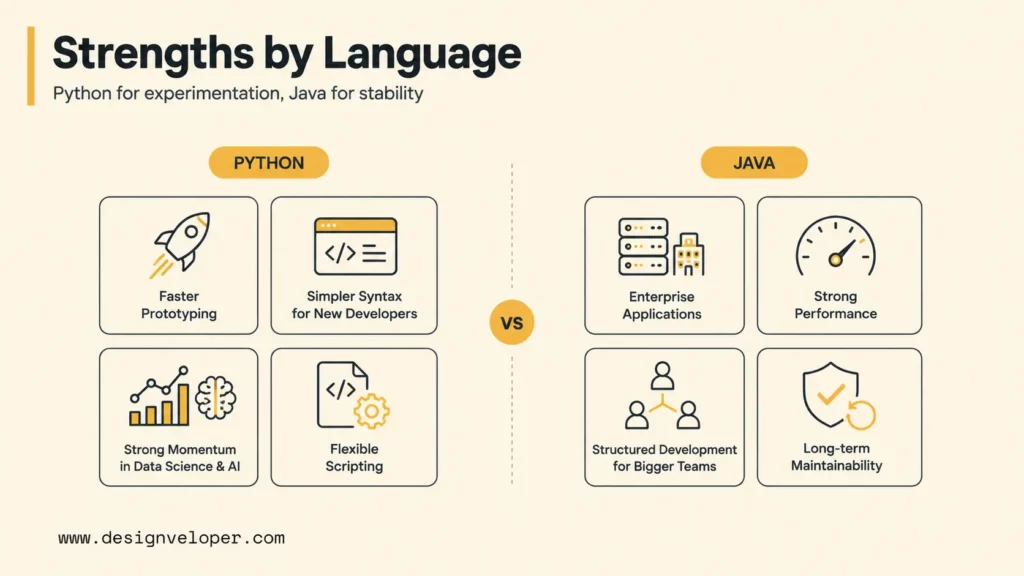
Python does better than Java when speed of experimentation, data workflows, AI libraries, automation scripts, and simple syntax matter most. Python benefits over Java are clearest in early product discovery, data science, ML experiments, internal tools, and workflows that change often.
Faster Prototyping And Shorter Code
Python lets developers build prototypes quickly. Fewer lines of code mean teams can test ideas, analyze data, call APIs, automate manual work, or prove a feature before investing in heavy architecture. This is valuable during software development life cycle planning, especially when the problem is still uncertain.
Fast prototyping should still include quality checks. A prototype can become production code accidentally. Teams should decide when a Python script needs tests, configuration management, logging, type hints, packaging, and deployment review.
Simpler Syntax For New Developers
Python’s simpler syntax helps new developers focus on problem solving. A beginner can learn loops, functions, lists, dictionaries, files, and HTTP requests without heavy setup. The Python documentation gives a large official reference for learners who want to go deeper.
Simpler syntax also helps nontraditional programmers. Analysts, operations teams, researchers, and automation-focused staff often use Python because the language is easier to read and modify than more verbose alternatives.
Stronger Momentum In Data Science, AI, And Automation
Python has stronger momentum in data science, AI, and automation. Stack Overflow’s 2025 survey coverage highlighted Python’s growth around AI, data science, and backend work, and connected Python’s rise with AI-compatible development. This momentum matters because libraries, tutorials, hiring, and community examples compound over time.
For AI projects, Python gives teams direct access to model libraries, notebooks, data-processing tools, orchestration frameworks, and current examples. Java can integrate with AI services, but Python is usually closer to the model development workflow.
Flexible Scripting And Rapid Development
Python is excellent for flexible scripting. Teams use Python to clean files, call APIs, generate reports, move data, test models, automate QA steps, and connect tools. That flexibility makes Python useful even inside organizations whose core applications are written in Java.
Rapid development is especially useful when business workflows change quickly. A Python automation can be revised faster than a large service. The tradeoff is that flexible scripts need ownership, documentation, and monitoring if they become important to operations.
Discover more here:
- Best AI For Python Coding: Top Picks For Every Workflow
- Building And Deploying An MCP Server In Python
- AI Programming Language For AI Development And Where They Fit Best
Where Java Still Has The Advantage
Java still has the advantage in large enterprise systems, structured backend services, long-lived applications, and teams that need strong conventions. Java is less fashionable in AI headlines, but it remains a durable choice for serious business software.
Enterprise Applications And Large Systems
Java is deeply established in enterprise applications. Banks, insurers, logistics companies, governments, SaaS platforms, and large internal systems often use Java because the ecosystem supports security, observability, transactions, build tooling, and long-term support.
When AI is added to those systems, Java does not need to disappear. A Java backend can call a Python model service, an LLM API, a vector database, or an inference endpoint. This separation keeps enterprise workflows stable while letting AI teams experiment in Python, which is often the practical pattern behind AI chatbot integration and similar product features.
Strong Performance And JVM Optimization
Java’s JVM gives long-running services strong optimization potential. The runtime can optimize hot paths, manage memory, and support mature concurrency patterns. For backend APIs and enterprise services, Java often delivers predictable performance with strong tooling.
Python can still perform well when the heavy work runs in optimized libraries or external services. The question is where the bottleneck lives. If the bottleneck is model inference through a GPU service, Python may be fine. If the bottleneck is a high-throughput business service, Java may fit better.
Structured Development For Bigger Teams
Java supports structured development for bigger teams. Static typing, interfaces, package conventions, build tools, and mature IDEs help developers understand dependencies and refactor code. Those features reduce coordination cost as the team grows.
Python teams can also scale, but they need explicit discipline: architecture rules, type hints, tests, code review, packaging, and conventions. Java includes more of that structure by default, which is why bigger organizations often keep Java in core systems.
Long-Term Maintainability In Complex Projects
Java is strong when a system must be maintained for many years. Long-term maintainability depends on stable APIs, clear module boundaries, reliable build systems, test coverage, observability, and onboarding support. Java’s ecosystem supports those needs well.
Complex projects also need predictable behavior. Java’s static typing and explicit structure make it easier to understand what changes might break. Python can be maintainable too, but the team must intentionally add the guardrails that Java encourages early.
Java Vs Python For Different Use Cases
The best choice changes by use case. Python is usually better for AI, data, automation, and quick APIs. Java is usually better for large enterprise backends, structured services, and teams that already run JVM systems. Many real systems use both.
Web Development
Python web development is strong for prototypes, APIs, dashboards, and data-heavy applications. Frameworks such as Django and FastAPI let teams move quickly from idea to working web service. Python is especially useful when the web app connects to ML models or analytics.
Java web development is strong for enterprise applications, microservices, and systems that need mature security and integration patterns. Spring Boot and Quarkus support structured backend development for teams that value Java’s conventions.
Data Science And Machine Learning
Python is the clear starting point for data science and machine learning. The libraries, notebooks, model examples, and community momentum are strongest in Python. Teams using PyTorch, TensorFlow, Hugging Face, and related tools will usually write core AI workflows in Python.
Java can still play an important role around ML systems. Java services can expose APIs, manage business workflows, connect to enterprise systems, and consume model predictions. The AI core may be Python while the product system remains Java.
Enterprise Software
Java is usually stronger for enterprise software because of its ecosystem, tooling, runtime performance, and long history in large organizations. Enterprise teams often care about access control, observability, transactions, compliance, and long-term support, where Java has mature patterns.
Python can be used in enterprise software too, especially for internal tools, automation, data services, and AI features. The best architecture may use Java for business-critical services and Python for AI or automation layers.
Automation, APIs, And Backend Services
Python is excellent for automation and quick APIs because it reduces development friction. Teams can script data movement, connect SaaS tools, automate reports, and build internal APIs quickly. FastAPI is especially useful for lightweight services around AI or data workflows.
Java is excellent for backend services that need strong structure, concurrency, resilience, and long-term maintainability. If the service is core to the business, serves high traffic, and needs a large team, Java may be the safer long-term choice.
Learn more in:
- What Is Software Architecture? Benefits, Characteristics and Examples
- Front-End vs Back-End: Which Suits You Best?
- What Is Software Development and the Software Development Process?
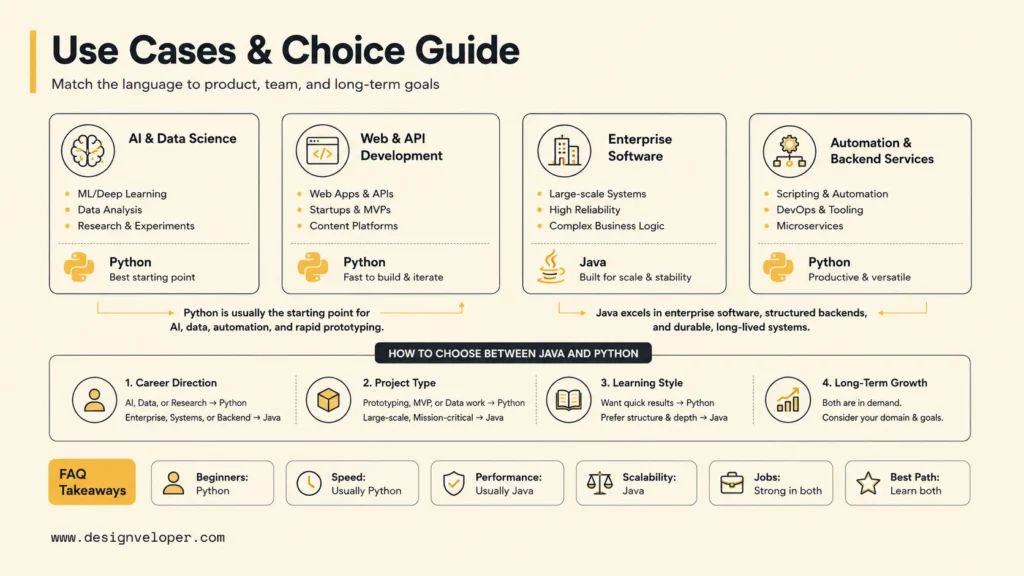
How To Choose Between Java And Python
Choose between Java and Python by matching the language to career direction, project type, learning style, and long-term growth. A popularity ranking can help, but it should not decide the project alone.
At Designveloper, language decisions are tied to product architecture. Through our AI development services, web development services, and delivery process, we usually evaluate the workflow, integration requirements, team skills, deployment environment, testing needs, and support model before recommending Java, Python, or a mixed stack.
Choose Based On Career Direction
Choose Python if the career direction is AI, data science, automation, analytics engineering, ML engineering, scripting, or rapid product prototyping. Python gives a broad path into modern AI and data work.
Choose Java if the career direction is enterprise backend engineering, platform engineering, distributed systems, Android maintenance, banking systems, insurance systems, or large-scale business applications. Java remains valuable where software must last and scale.
Choose Based On Project Type
Choose Python for prototypes, data workflows, AI features, automation, internal tools, and flexible APIs. Meanwhile, Java can be great for large service-oriented applications, enterprise integrations, high-throughput backend systems, and applications with many developers.
Use both when the project needs both strengths. A Python service can handle AI inference or data processing while a Java service handles identity, transactions, business rules, and enterprise integration.
Choose Based On Learning Style
Choose Python if the learner wants quick wins and readable syntax. Python helps beginners build momentum. Choose Java if the learner wants explicit structure and is comfortable learning object-oriented concepts early.
Neither path is wrong. Python teaches fast experimentation. Java teaches structured application thinking. A strong developer eventually benefits from understanding both dynamic and static language styles.
Choose Based On Long-Term Growth
Choose based on long-term growth by asking what kind of systems the learner or team wants to build in three years. Python opens doors in AI, data, automation, and fast software development. Java opens doors in enterprise engineering, backend architecture, and large systems.
The strongest path may be sequential. Learn Python first to build and automate quickly. Add Java when the work requires larger architecture, static typing, and enterprise service patterns. The combination is practical for AI products that need both model workflows and durable business systems.
Conclusion
Java vs Python is not a winner-take-all decision. Python is usually the better first language for AI, data science, automation, and fast prototyping. Java is usually better for enterprise software, structured backend systems, and long-term maintainability in large teams.
For AI specifically, Python fits the model-development workflow better because the ecosystem around PyTorch, TensorFlow, Hugging Face, notebooks, and automation is stronger. Java still matters when AI must connect to existing business systems, secure APIs, and enterprise workflows.
The right answer is the language that makes the project easier to build, test, deploy, and maintain. For many teams, that means Python for AI and data layers, Java for enterprise services, and clear contracts between them. Teams that need implementation support can also compare this decision against broader software development services needs.
FAQs About Java Vs Python
These short answers address the most common learning, hiring, and performance questions.
Does NASA Use C++ Or Python?
NASA and aerospace projects use multiple languages depending on the system, including C, C++, Python, Java, and specialized tools. C++ is common where performance and hardware control matter, while Python is often used for scripting, analysis, automation, and research workflows.
Do Employers Prefer Python Or Java?
Employers prefer Python or Java based on the job. AI, data, automation, and scripting roles often prefer Python. Enterprise backend, banking, insurance, large SaaS, and JVM service roles often prefer Java. Many employers value developers who can learn both.
Is Java Or Python Easier For Beginners?
Python is usually easier for beginners because the syntax is shorter and the first programs require less setup. Java can feel harder because learners meet types, classes, and object-oriented structure early. Java’s structure becomes more useful as projects grow.
Why Do Many Developers Choose Python Over Java?
Many developers choose Python over Java because Python is faster for prototypes, easier to read, strong in AI and data science, and flexible for automation. Python also has a large learning ecosystem and practical libraries for modern technical work.
Is Java Faster Than Python?
Java is usually faster than Python for long-running, CPU-heavy backend services because the JVM can optimize execution. Python can still be fast enough when heavy work is handled by optimized libraries, external services, GPUs, or compiled extensions.
The best final rule is simple: choose Python when speed of learning, AI experimentation, data workflows, or automation matter most. Choose Java when structure, performance, enterprise integration, and long-term maintainability matter most. Use both when the product needs both strengths.
Also published on

Share post on










Related Articles


AI Chatbot Development: A Step-By-Step Guide
AI Chatbot Development: A Step-By-Step Guide Published September 14, 2026
10 Best Alternatives To ChatGPT In 2026: Compare By Use Case
10 Best Alternatives To ChatGPT In 2026: Compare By Use Case Published September 11, 2026
Best AI Chatbot In 2026: 10 Tools For Writing, Research And Work
Best AI Chatbot In 2026: 10 Tools For Writing, Research And Work Published September 09, 2026