













Rust Vs Python: Performance, Safety, And Project Fit For Teams

KEY TAKEAWAYS:
- Rust vs Python is a workload and product decision, not a universal winner-takes-all contest.
- Rust is stronger for performance-critical, memory-sensitive, concurrent, embedded, and systems-level software.
- Python is stronger for fast iteration, AI and data workflows, automation, APIs, and business logic that changes often.
- A hybrid architecture can keep Python at the product layer and use Rust for a measured performance bottleneck.
- The final choice should account for workload, team readiness, deployment, maintenance, security, and product risk.
The Rust vs Python choice often starts with a tempting shortcut: prioritize speed, or prioritize fast delivery. The better answer depends on where the workload is costly, how often the product changes, and which skills the team can support over time. The comparison begins with the technical differences that make each language a better fit for particular workloads.
For a deeper dive:
- Python Best Practices For Writing Clean, Maintainable Code
- AI With Python: What You Can Build And Where To Start
- Popular Python Frameworks And Which Projects They Fit Best
Rust Vs Python At A Glance
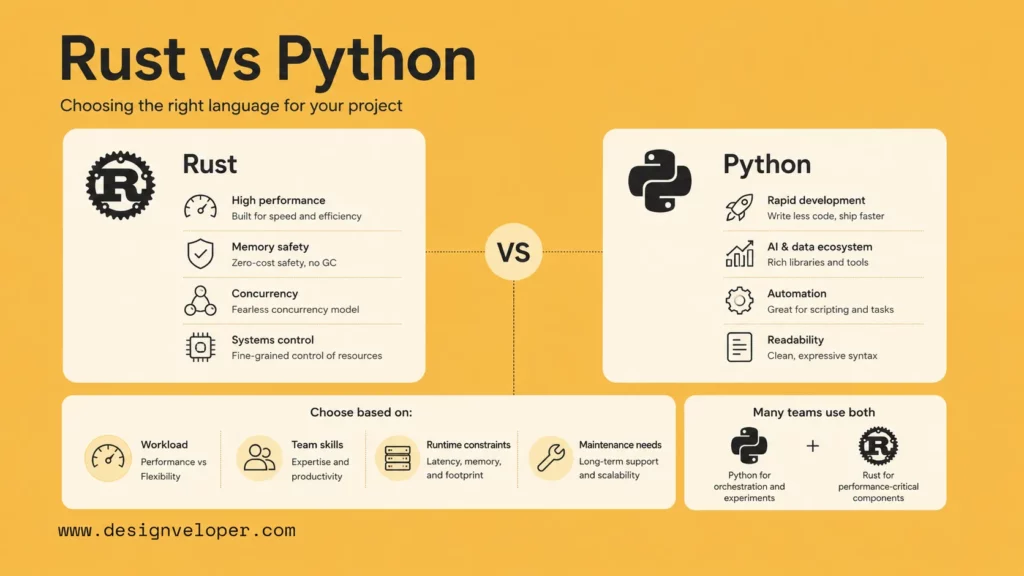
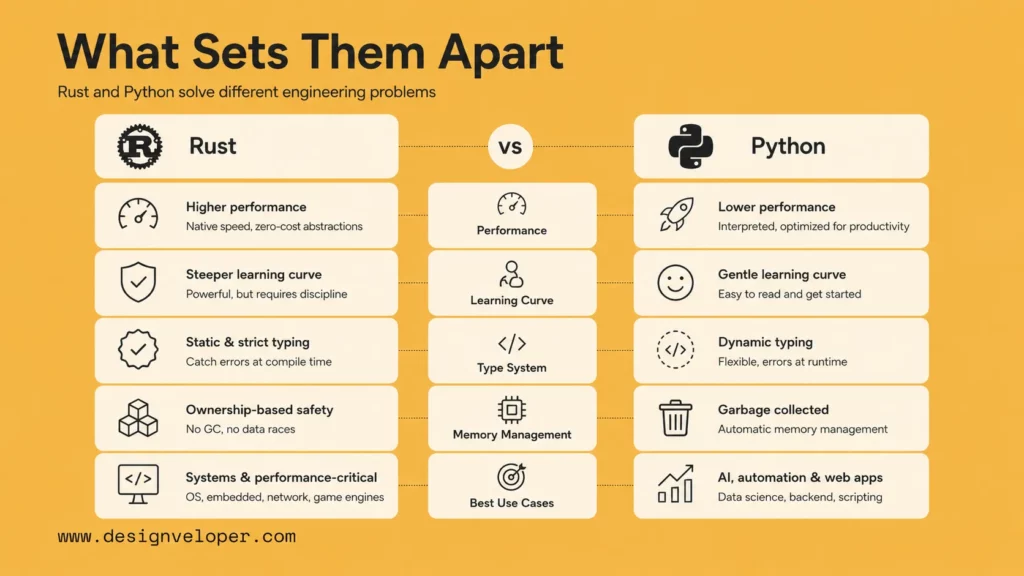
Rust is a compiled, systems-oriented language designed for performance, control, and memory safety. Python is a high-level, dynamically typed language designed for readability, rapid development, and broad ecosystem access. These are useful defaults, not complete descriptions of either language.
The official Rust language overview emphasizes speed, memory efficiency, thread safety, and tooling. The official Python documentation reflects a different strength: a readable language with a large standard library and a fast feedback loop.
| Decision area | Rust | Python |
|---|---|---|
| Runtime | Compiled native binaries with strong control over resources | Interpreted or bytecode-based execution optimized for fast iteration |
| Type model | Static and strict; many mismatches fail during compilation | Dynamic by default; optional type hints support gradual checking |
| Memory | Ownership and borrowing without a traditional garbage collector | Automatic memory management with less low-level control |
| Concurrency | Strong compile-time guardrails for shared-state concurrency | Excellent for I/O and orchestration, with important CPU-threading constraints in common CPython builds |
| Best first fit | Systems, embedded, infrastructure, low-latency, and resource-sensitive workloads | AI, data, automation, APIs, prototypes, internal tools, and changing business logic |
The useful question is not “Which language is faster?” It is “Where is this product most likely to fail or become expensive?” If the risk is runtime efficiency or memory safety, Rust deserves serious consideration. If the risk is slow discovery, limited libraries, or difficult onboarding, Python may be the better starting point.
The Technical Trade-Offs That Matter
Language differences matter only when they change the product, delivery process, or operating cost. The following four areas usually create the most meaningful trade-offs.
Compiled Rust Vs Python Runtime Iteration
Python lets developers run a small change quickly, inspect the result, and keep exploring. That loop is valuable for notebooks, scripts, data transformations, API prototypes, and AI features where the problem definition is still moving.
Rust adds a compilation step before execution. The compiler checks syntax, types, ownership, and other constraints before producing a binary. Compilation can slow the first few iterations, but it also moves many defects earlier in the development cycle.
Rust is a better fit when latency, throughput, memory footprint, or binary distribution is a product requirement. Python is often better when the main challenge is discovering the right workflow or changing business logic quickly.
Static Rust Types Vs Python Flexibility
Rust uses a static type system. The compiler verifies the types of expressions, return values, enums, and interfaces before the program runs. This makes domain states explicit and helps prevent certain invalid combinations from reaching production.
Python is dynamically typed, but teams can add annotations and check them gradually. The Python typing documentation describes how optional type hints support static analysis without removing Python flexibility.
// Rust: the match must handle every payment state
enum PaymentStatus {
    Pending,
    Paid,
    Failed,
}
fn can_ship(status: PaymentStatus) -> bool {
    match status {
        PaymentStatus::Paid => true,
        PaymentStatus::Pending | PaymentStatus::Failed => false,
    }
}
# Python: annotations clarify the contract
from enum import Enum
class PaymentStatus(Enum):
PENDING = "pending"
PAID = "paid"
FAILED = "failed"
def can_ship(status: PaymentStatus) -> bool:
return status is PaymentStatus.PAIDStatic typing is not automatically better for every feature. It is most valuable where incorrect assumptions are expensive, such as payment states, permissions, protocols, data contracts, and public library interfaces. Python is often more productive when the data shape is still being explored.
Ownership And Borrowing Vs Automatic Memory Management
Rust uses ownership and borrowing. The Rust Book ownership chapter explains how values have owners, how ownership can move, and how references can borrow data without copying it. This model gives Rust strong memory-safety guarantees without relying on a traditional garbage collector.
Python manages memory automatically, including reference counting and cyclic garbage collection in CPython. The Python garbage collector documentation describes the interfaces available for that cycle detector. Automatic management is easier to start with, but it provides less control over memory behavior.
The practical trade-off appears in systems that run under tight resource limits, high volume, or security-sensitive boundaries. Python is usually sufficient when the dominant cost is database, network, or human workflow latency. Rust becomes more attractive when memory, CPU, binary size, or predictable runtime behavior is the constraint.
Python Threading Constraints Vs Rust Concurrency Guardrails
Python is strong for asynchronous I/O, multiprocessing, background jobs, and workloads that call optimized native libraries. In common CPython deployments, CPU-bound Python bytecode has important thread-parallelism limits. Python is also evolving: the free-threading documentation describes optional free-threaded builds and the compatibility considerations teams must evaluate.
Rust approaches concurrency through ownership, types, and explicit synchronization. The Rust Book concurrency chapter explains how these rules help move many data-race problems into compile-time feedback. Rust does not make concurrency effortless, but it gives teams stronger guardrails for shared state.
Use Python for I/O-heavy APIs, queues, orchestration, and many data workflows. Consider Rust for CPU-bound parallel work, low-latency pipelines, edge software, and services where shared-state safety is a central requirement.
Developer Experience And Total Cost
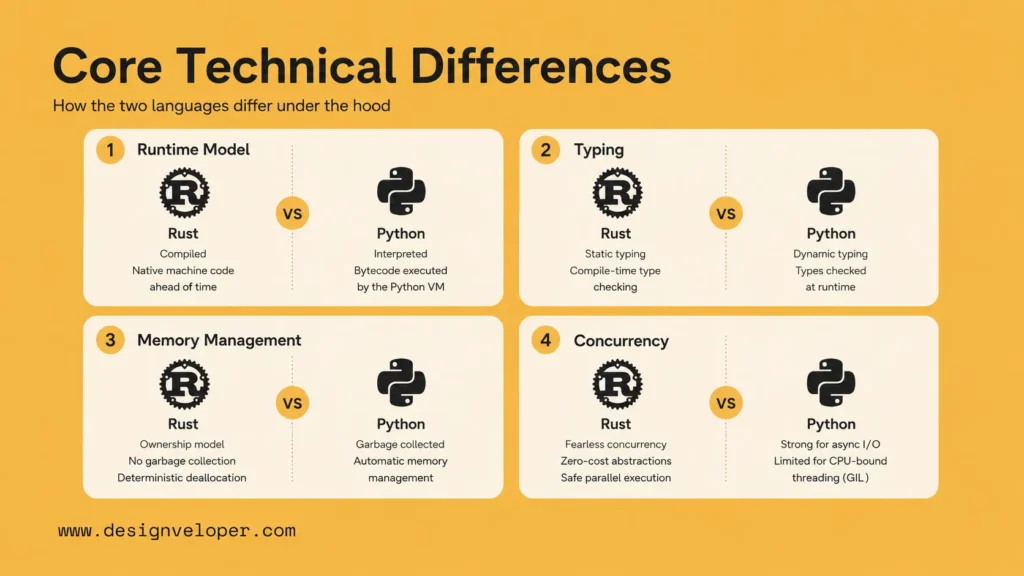
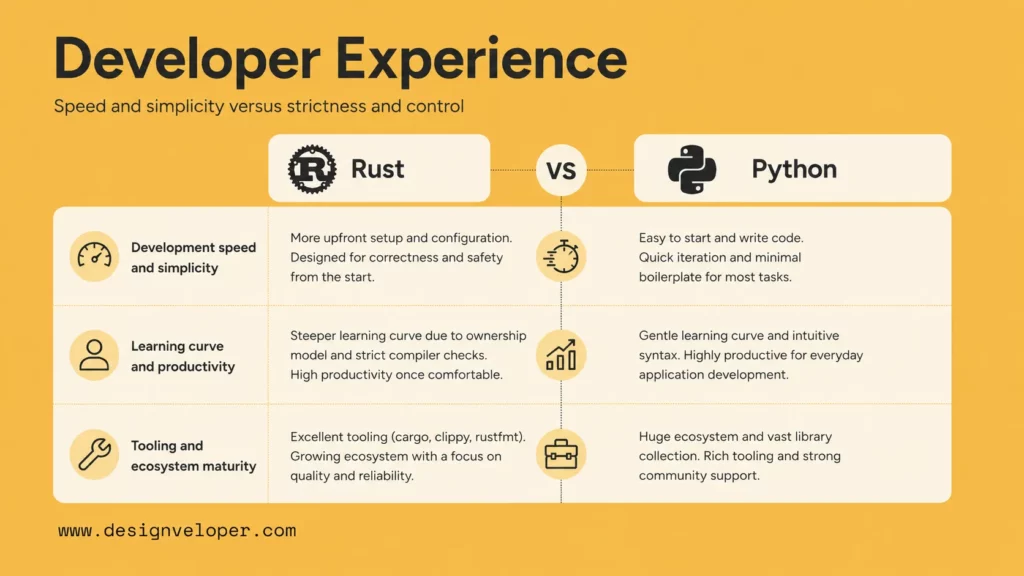
Rust often feels slower during the first weeks of adoption and more predictable after the team learns its model. Python often feels productive on day one and requires more discipline to keep large, dynamic codebases consistent. The better developer experience depends on the team and the type of work.
Learning Curve And Day-To-Day Productivity
Python has a low entry barrier and syntax that stays close to common pseudocode. That makes it accessible for product engineers, analysts, automation specialists, and teams that need to validate a workflow quickly.
Rust asks developers to learn ownership, borrowing, lifetimes, traits, generics, explicit error handling, and often asynchronous programming. The learning curve is real. In return, the compiler gives developers feedback about resource and state behavior before deployment.
A team with strong Python skills and an urgent AI or product workflow may deliver faster with Python. A team building infrastructure or a resource-sensitive platform may accept Rust onboarding time because runtime guarantees have higher business value. Pair programming and focused examples can reduce the adoption risk for either language.
Tooling, Packaging, And Maintenance
Rust has a relatively unified workflow around Cargo, rustfmt, Clippy, and rust-analyzer. The Cargo documentation covers the package manager and build system that sit at the center of Rust development.
Python has a broader but more fragmented toolset. Teams may combine virtual environments, uv or pip, Poetry, Ruff, pytest, mypy or Pyright, framework tools, and deployment-specific packaging. This flexibility is powerful, but projects should document one supported workflow so developers do not assemble their own environments.
The maintenance question is bigger than syntax. During the software development life cycle, the team must be able to test, package, deploy, observe, secure, and upgrade the chosen stack. A language that only one specialist can debug may create more delivery risk than its technical advantages remove.
Hiring, Onboarding, And Ownership
Python skills are common across backend, data, QA automation, and AI teams. Rust skills are more specialized, especially when a project uses advanced async patterns, unsafe code, FFI, or embedded targets. Neither fact decides the architecture by itself, but both affect staffing and support plans.
- Python ownership risk: inconsistent types, packaging, tests, and conventions can make a large codebase depend on undocumented context.
- Rust ownership risk: a small group of specialists may become a bottleneck for every change in a systems component.
- Shared mitigation: define boundaries, document setup, use automated checks, and make the simplest useful path easy for the whole team to follow.
Related language and application context:
- Java Vs Python: Key Differences & Which Language Fits AI Better
- Web Application Architecture: Types, Components, and Tools
- Web Application Development Tutorial: The Ultimate Guide for Beginners
Use Cases: AI, Data, Web, And Systems
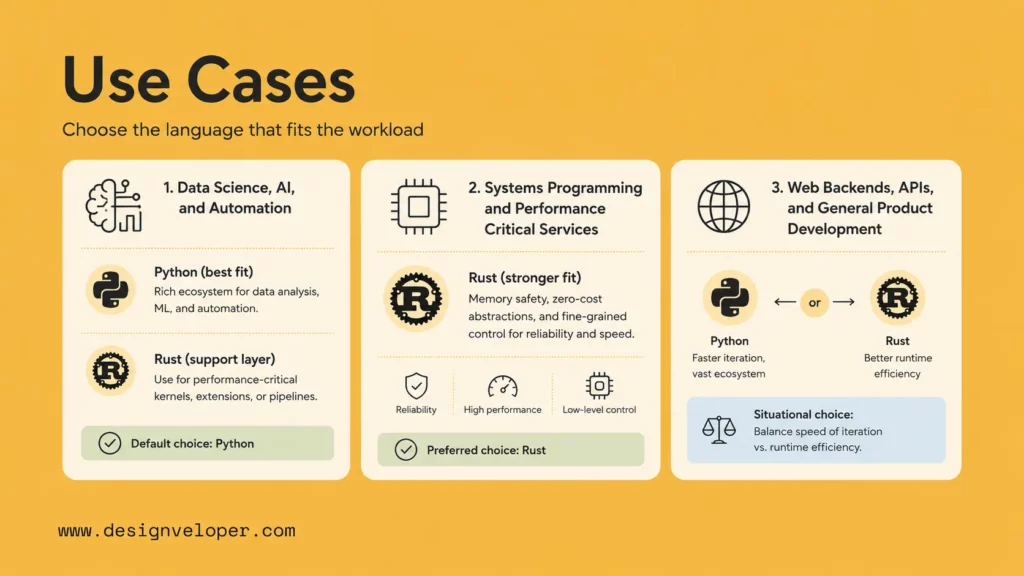
Use case is usually more reliable than a generic benchmark when choosing Rust or Python. Start with the workload the product must handle, then ask which ecosystem and operating model make that workload easiest to ship.
AI, Data Science, And Automation
Python is usually the top-level choice for data science, machine learning, notebooks, automation, analytics, and AI application development. Teams benefit from mature libraries, tutorials, integrations, and a large pool of developers who can read and modify the workflow.
Rust can support AI and data systems through high-performance parsers, tokenizers, data engines, model-serving components, vector operations, and native libraries. It is often a strong implementation language for a stable hot path, but Python remains easier for experimentation and ecosystem-heavy orchestration.
A practical pattern is to prototype the workflow in Python, measure it with realistic inputs, and move only a proven bottleneck into Rust. This keeps the discovery loop fast while preserving a path to lower latency or resource use. The decision should fit the broader AI software development workflow rather than being driven by language enthusiasm.
Systems, Embedded, And Performance-Critical Services
Rust is a natural candidate for systems programming, embedded software, networking, parsers, security tooling, WebAssembly modules, data engines, and low-latency services. Its native compilation and memory model are attractive when C or C++ would otherwise be considered but memory safety is a product requirement.
Python still has an important role around systems: deployment tools, test harnesses, observability scripts, release automation, and operations workflows. It may not be the runtime for a packet processor or embedded controller, but it can be the most productive language for the surrounding system.
Web Backends, APIs, And Business Products
Python is a strong fit for APIs, admin tools, workflow platforms, data-backed products, and features whose business rules change frequently. Django and FastAPI can help teams move from an idea to a tested service quickly.
Rust web frameworks can support high-performance APIs, streaming services, gateways, and compute-heavy endpoints. Rust is most compelling when predictable latency, resource efficiency, or type-level correctness is more important than rapid feature iteration.
For a broader product choice, compare the language decision with custom software development criteria such as integration complexity, team ownership, security, operations, and post-launch change.
Continue with related product engineering topics:
- Software Development Costs: Guide to Estimate Your Project
- What Is DevOps? The DevOps Lifecycle And How It Works
- What Is Agile Software Development? Methodologies and Benefits
When Rust And Python Work Better Together
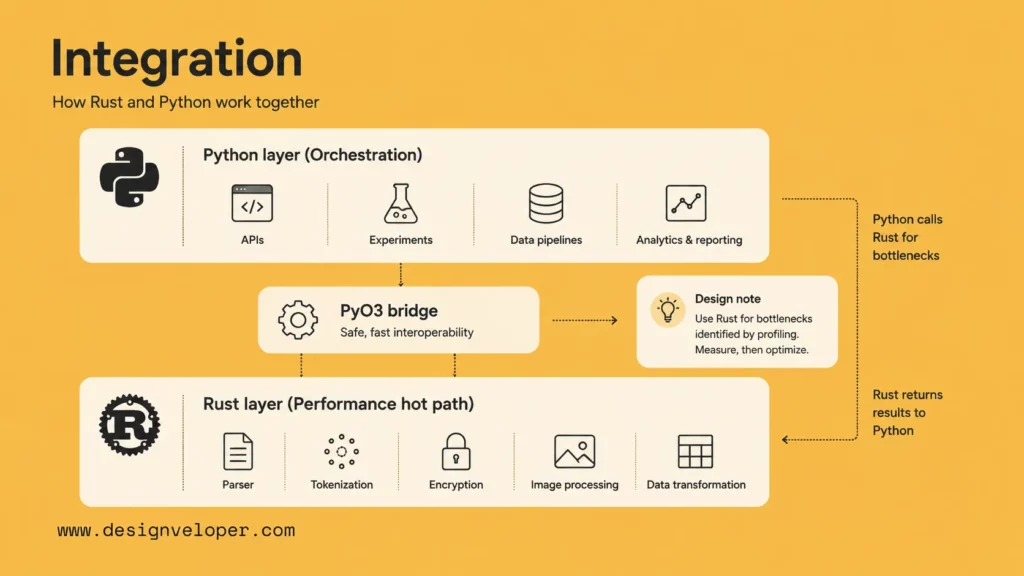
A hybrid architecture is useful when the product has two different constraints. Python can own orchestration, APIs, experiments, and business workflow while Rust owns a narrow parser, scoring function, image operation, encryption module, simulation, or data transformation.
Find A Real Bottleneck Before Adding A Language
Do not introduce Rust because a benchmark looks impressive or because a team wants a more technical stack. First measure the real workload. Identify the function, request, job, or pipeline stage that consumes meaningful CPU, memory, latency, or operational attention.
- Profile realistic inputs: measure production-like data, not only a tiny synthetic example.
- Define the boundary: choose simple inputs and outputs such as bytes, strings, arrays, or typed records.
- Protect behavior with tests: keep the expected result visible in the Python test suite before rewriting internals.
- Implement the hot path: keep Rust focused on the expensive or safety-sensitive operation.
- Compare the full cost: evaluate speed, memory, build time, deployment, CI, debugging, and long-term ownership.
Where PyO3 Fits
PyO3 provides Rust bindings for Python and can help teams build Python extensions in Rust. A Python package can keep its familiar API while delegating a stable, performance-sensitive implementation to Rust.
PyO3 is most useful for a narrow, well-tested boundary. Teams still need to handle packaging for supported platforms, versioning, error translation, CI coverage, and the experience of developers who work on both sides. It is an integration tool, not a shortcut around architecture.
Make The Language Boundary Operable
- Document which team owns the Rust component and which team owns the Python-facing API.
- Define how Rust errors become Python exceptions or structured results.
- Test the boundary in CI for every supported operating system and runtime version.
- Version the extension and Python package together when compatibility requires it.
- Monitor the boundary separately so packaging or native-runtime failures are diagnosable.
Read more about implementation quality and safe delivery:
- Building User Trust through Secure Software Development
- Top 10 AI Code Review Tools & Best Practices For Implementation
- AI In Software Development: Changing How Software Gets Built
Choose Rust, Python, Or A Hybrid Stack
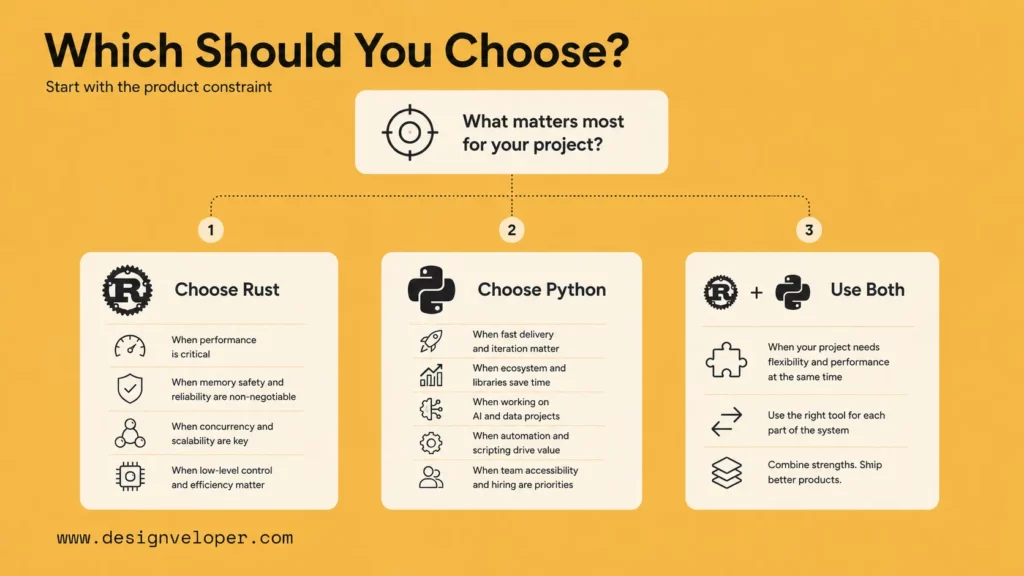
Choose the stack that matches the dominant product constraint. A language decision should be specific enough to guide architecture, but flexible enough to change when evidence changes.
Choose Rust When Runtime Guarantees Lead
Choose Rust when the product depends on performance, resource control, safe concurrency, predictable binaries, or low-level integration. Strong candidates include infrastructure services, embedded runtimes, gateways, parsers, WebAssembly modules, security-sensitive components, and CPU-heavy workloads.
- Latency or throughput is a user-visible requirement.
- The service runs close to hardware, networks, filesystems, or memory-sensitive boundaries.
- Resource usage affects unit economics or deployment feasibility.
- The team can support Rust review, testing, packaging, and incident response.
Choose Python When Delivery And Ecosystem Lead
Choose Python when the product needs fast discovery, broad libraries, accessible onboarding, or strong AI and data capabilities. Python is often the better first choice for prototypes, automation, internal tools, data pipelines, model workflows, APIs, and business features that evolve frequently.
- The main risk is choosing the wrong workflow rather than missing raw runtime speed.
- The product depends on Python-first AI, data, analytics, or automation libraries.
- Business rules change often and need to stay readable across roles.
- The existing team already has reliable Python practices for testing, typing, packaging, and deployment.
Choose Hybrid Only When The Boundary Earns Its Cost
Choose both languages when Python and Rust each own a distinct, measurable responsibility. Keep the boundary narrow and stable. If most of the code changes together, a second language may add more coordination cost than performance value.
| Project signal | Starting direction | Why |
|---|---|---|
| Changing AI workflow or data experiment | Python | Fast iteration and ecosystem access reduce discovery time. |
| High-throughput parser or resource-sensitive service | Rust | Native performance and explicit resource control are central. |
| Python product with one measured hot path | Python plus Rust | Keep orchestration flexible and optimize only the expensive component. |
| Internal admin or workflow application | Python | Readability, delivery speed, and integrations usually dominate. |
| Embedded or platform-level runtime | Rust | Predictable binaries, memory behavior, and concurrency guardrails matter. |
Avoid Common Rust Vs Python Decision Mistakes
Comparison articles often reduce the decision to speed, syntax, or popularity. Those shortcuts leave out the factors that create real project risk. Check for these mistakes before committing to a stack:
- Choosing from a benchmark alone: benchmark the workload, deployment shape, and data volume that the product will actually use.
- Ignoring team capability: a technically strong language can become a delivery bottleneck when nobody can review or operate it confidently.
- Rewriting too early: keep Python until profiling proves that a Rust component changes a meaningful product or operating metric.
- Adding a hybrid boundary without ownership: define packaging, error behavior, release versioning, and support before splitting the codebase.
- Confusing I/O waits with CPU work: a faster language does not remove database, network, or third-party API latency.
- Forgetting security and operations: include secrets, observability, dependency updates, deployment, and incident response in the language decision.
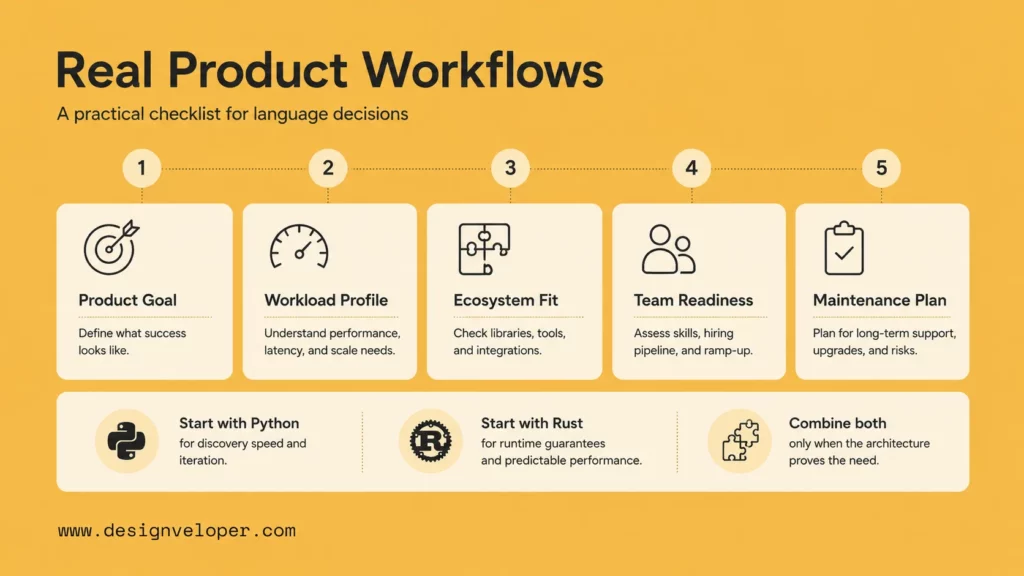
A good decision record should state the workload, the main constraint, the selected language, the rejected alternative, the evidence used, and the signal that would trigger a review. That keeps the choice revisable without turning every future discussion into a technology debate.
For broader decision and delivery context:
- Custom Software Development Cost: 5 Factors to Consider
- 20 Software Project Management Methodologies for Software Development
- What Is Web Application Security? OWASP 10 Web App Vulnerabilities
FAQs About Rust Vs Python
Is Rust Better Than Python?
Rust is better for performance-critical, memory-sensitive, concurrent, embedded, and systems-level workloads. Python is better for fast development, AI and data workflows, automation, scripting, and many business applications. The better choice depends on the project constraint.
Is Rust Closer To C++ Or Python?
Rust is closer to C++ because both are compiled, systems-oriented languages designed for high-performance software. Rust differs by using ownership and borrowing to provide stronger memory-safety guardrails. Python is higher-level, dynamic, and optimized for readability and rapid development.
Will Rust Replace Python In AI?
Rust is unlikely to replace Python across AI because Python has a deeper ecosystem for notebooks, data science, machine learning, and application orchestration. Rust will continue to support AI infrastructure, native libraries, data engines, and performance-sensitive components.
Can Rust And Python Be Used In The Same Project?
Yes. Teams can use Python for APIs, orchestration, experiments, or data workflows and Rust for a stable performance-critical component. Tools such as PyO3 can expose Rust logic to Python, but the boundary should remain small, tested, versioned, and owned.
Which Language Is Easier To Learn?
Python is generally easier to start with because its syntax is concise and its runtime model hides more low-level details. Rust takes longer to learn because ownership, borrowing, lifetimes, and explicit error handling are central to the language. The extra learning can pay off when the product needs Rust-level control and safety.
Conclusion
Rust vs Python is not a popularity contest. Start with Python when fast discovery, AI and data libraries, automation, or changing business logic are the main priorities. Start with Rust when performance, memory behavior, concurrency, binary distribution, or low-level safety are the main priorities. Combine them only when a measured boundary justifies the extra complexity.
For teams turning that decision into a real product, software development services should cover architecture, testing, deployment, observability, and long-term ownership – not only the first implementation. The best language is the one your team can ship, operate, secure, and improve over time.
Also published on

Share post on










Related Articles



10 Best AI Agents in 2026 for Work, Coding, and Automation
10 Best AI Agents in 2026 for Work, Coding, and Automation Published September 24, 2026
How To Build An AI Agent: A Beginner’s Step-By-Step Python Example
How To Build An AI Agent: A Beginner’s Step-By-Step Python Example Published September 23, 2026
10 Best ChatGPT Alternatives In 2026: Features And Use Cases
10 Best ChatGPT Alternatives In 2026: Features And Use Cases Published September 23, 2026