










Vector RAG vs Graph RAG: Retrieve Meaning, or Map Relationships?

Vector RAG and Graph RAG solve different retrieval problems. Vector RAG is strongest when a system needs passages with similar meaning. Graph RAG becomes useful when an answer depends on entities and their connections. For readers comparing vector rag vs graph rag, the practical decision is not which method is universally better. It is which retrieval approach fits the questions, data, and operating constraints.
This is a decision and delivery guide for CTOs, tech leads, and software practitioners. It explains how both approaches work, where each one fails, when a vector-plus-graph hybrid is justified, and what teams should evaluate before production. Readers who need a RAG refresher can start with our guide to retrieval-augmented generation.
Vector RAG vs Graph RAG: The Core Retrieval Difference
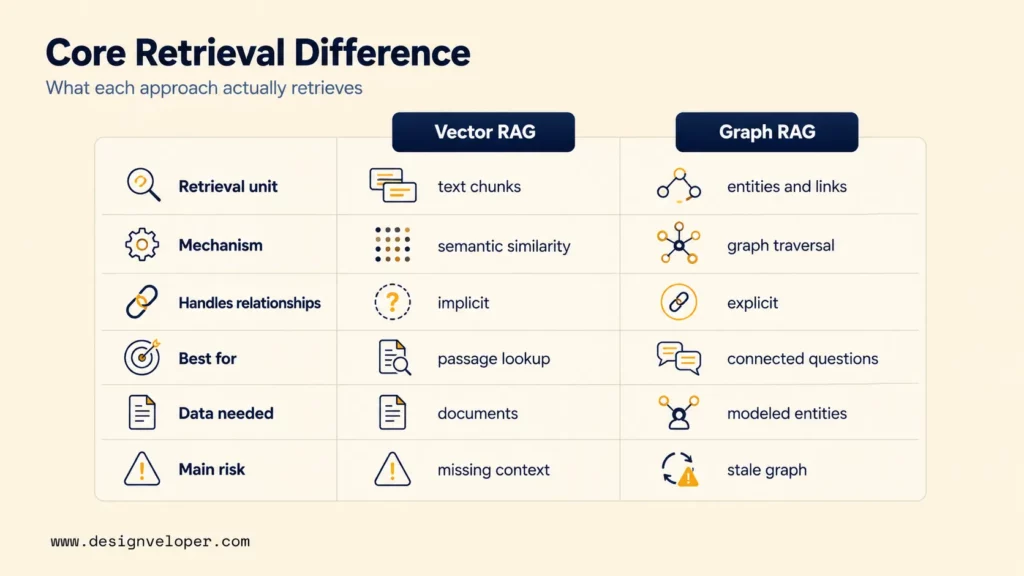
Vector RAG retrieves chunks that are semantically similar to a query. Graph RAG retrieves connected context through entities, relationships, graph neighborhoods, communities, or other graph-aware structures. The model then reasons over the retrieved context.
Terminology matters here. Graph RAG refers to the broader family of graph-aware retrieval designs. Microsoft GraphRAG refers to Microsoft’s open-source implementation. Other Graph RAG systems can use different graph models, storage layers, and retrieval methods.
A typical vector pipeline splits source content into chunks, creates embeddings, stores those vectors in an index, and retrieves nearby vectors for a new query. LangChain’s current retrieval documentation describes the main building blocks, including document loaders, text splitters, embeddings, vector stores, and retrievers.
Graph-aware retrieval can take several forms. Microsoft’s current GraphRAG indexing documentation describes a configurable pipeline. Its standard pipeline can extract entities and relationships, detect communities, generate community reports, and embed text into vector space.
The comparison below is a decision aid, not a definition of one universal Graph RAG stack. Graph RAG covers multiple graph-aware retrieval designs; the exact retrieval unit and storage layer depend on the implementation.
| Dimension | Vector RAG | Graph RAG |
|---|---|---|
| Retrieval mechanism | Embedding-based similarity search over indexed content. | Graph-aware lookup, traversal, neighborhood expansion, graph summaries, or a combination. |
| Retrieval unit | Usually text chunks or records linked to source content. | May include entities, relationships, paths, graph-linked text, communities, or summaries. |
| Relationship handling | Relationships are mostly implicit in text or metadata unless modeled separately. | Relationships are explicit enough to traverse or retrieve as connected context; the model reasons over the retrieved context. |
| Strongest question type | Which passage best answers this question? | How are these entities, events, systems, or rules connected? |
| Data requirement | Clean source documents and useful chunks can often support an initial system. | Useful entities and relationships must exist or be extracted with acceptable quality. |
| Implementation effort | Often has a lower initial implementation burden, although chunking and retrieval tuning still need evaluation. | Usually adds modeling, extraction, relationship validation, and refresh work. |
| Common risk | Required context is split across chunks that similarity search does not retrieve together. | The graph is incomplete, stale, or inaccurate, so connected context becomes misleading. |
Some systems combine vector and graph-aware retrieval. That option can be valuable, but its orchestration and operating cost deserve a separate decision rather than becoming the default.
Use vector retrieval when the answer depends on relevant passages. Add graph-aware retrieval when explicit relationships change the answer.
Vector RAG Finds Relevant Meaning In Unstructured Content
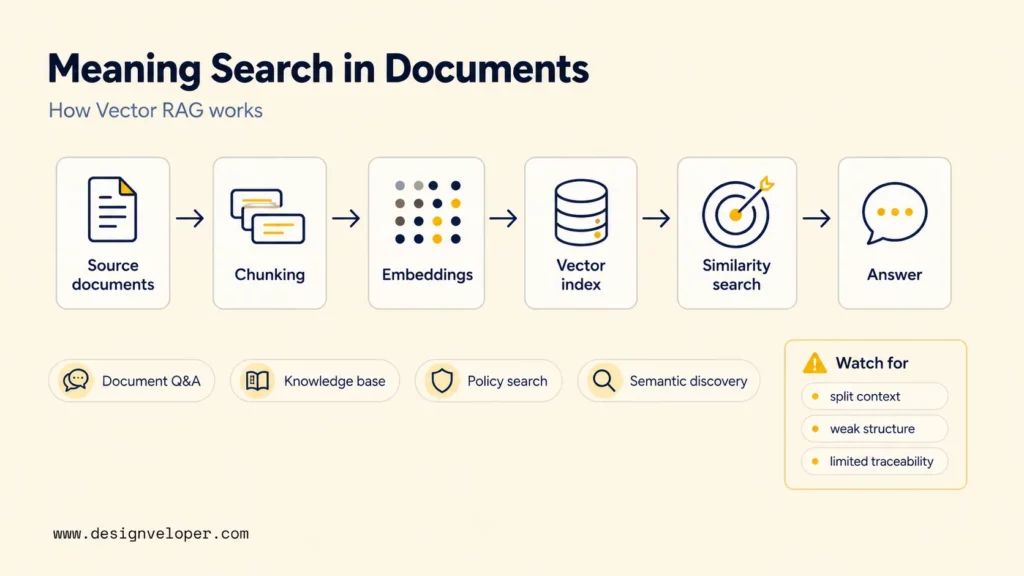
Vector RAG is a practical baseline for document-heavy systems because it can search unstructured text without first creating an explicit relationship model. Embeddings represent the meaning of text as numeric vectors. A query receives its own embedding, and the retriever searches for stored vectors that are close to it.
Chunking decides what each retrievable unit contains. Smaller chunks can isolate precise passages but may lose surrounding context. Larger chunks preserve more context but can introduce unrelated text. Pinecone’s search relevance guidance discusses chunking, metadata filtering, and reranking as ways to improve retrieval. For implementation detail, our step-by-step RAG system guide follows the path from source preparation through retrieval evaluation.
The approach works best when the answer can usually be supported by a small set of relevant passages. Common applications include:
- Document Q&A: retrieve passages that support a direct factual answer.
- Support knowledge bases: match a user’s problem description with relevant troubleshooting guidance.
- Policy search: locate clauses that match the meaning of a user’s question before generating an explanation.
- Semantic discovery: find related ideas even when the source and query use different vocabulary.
The main weakness appears when one answer depends on facts spread across several records. A vendor may be named in one document, its contract in another, and an approval rule in a third. Similarity search can retrieve useful passages without exposing the full relationship chain.
Source preparation also matters. Poor chunk boundaries can separate a rule from its exception. Weak metadata can make filtering difficult. If a user must trace why two entities are connected, plain vector retrieval may not contain enough explicit structure to show that path.
Graph RAG Adds Connected Context To Complex Questions
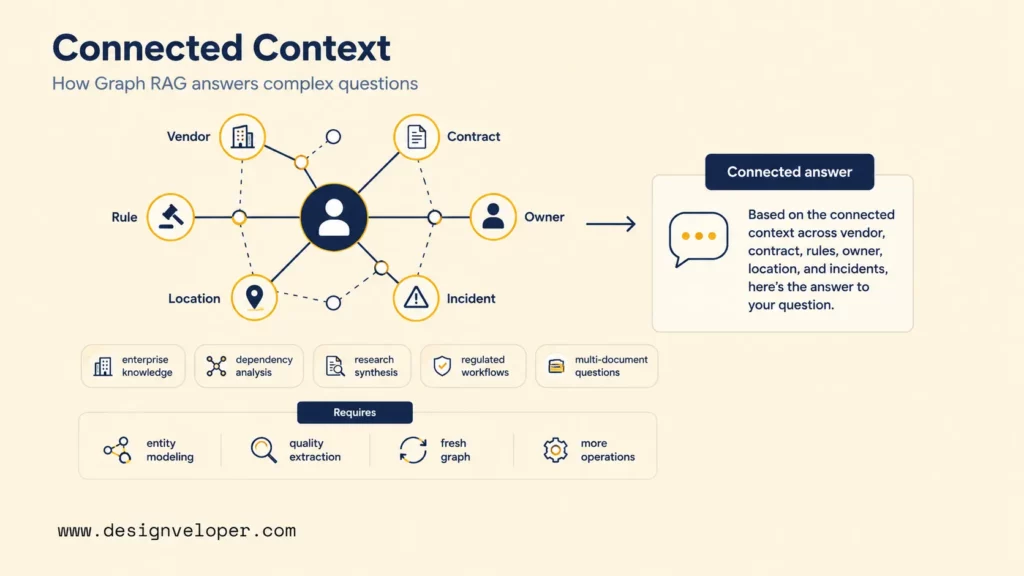
Graph RAG becomes useful when relationships form part of the answer. Important items can be represented as entities and connected with explicit relationships. A retriever can then use those structures to gather context that isolated chunks may miss.
When a knowledge graph is the main retrieval structure, teams may describe the pattern as knowledge graph RAG. The broader Graph RAG label can also cover other graph-aware designs. For additional background, our Graph RAG vs traditional RAG comparison focuses on the architecture trade-off.
Microsoft GraphRAG provides one concrete example. Its current local search documentation says local search combines structured graph data with source text. It starts from semantically related entities and can retrieve connected entities, relationships, community reports, covariates, and associated text units.
Microsoft GraphRAG also offers a different mode for corpus-level questions. Its current global search documentation describes a map-reduce process over community reports. This design targets questions that require information from broad parts of a dataset.
Graph-aware retrieval is most useful when the relationship structure changes what the user can learn. Common jobs include:
- Connected enterprise knowledge: trace people, vendors, systems, policies, or records across sources.
- Dependency analysis: follow how one component, supplier, or decision affects another.
- Research synthesis: connect findings, entities, events, and source documents.
- Regulated workflows: retrieve rules and the entities or records to which they apply.
- Multi-document questions: assemble an answer from facts that are separated across files.
For example, a system may need to connect a supplier to its contract, owner, incident history, and approval rule. Those links can change which evidence belongs in the answer.
Neo4j shows a different implementation pattern. Its current Neo4j GraphRAG user guide provides several retrievers. One option, VectorCypherRetriever, can start with vector search and then apply a Cypher query to traverse connected graph data.
That Neo4j pattern is a product-specific capability, not a requirement for every Graph RAG design. Other implementations can choose different graph stores, retrieval paths, or summarization methods.
Explicit relationships also create new failure modes. Entity extraction can merge different entities or split one entity into duplicate records. Relationship extraction can miss or misclassify a connection. Even a correct graph becomes unreliable if source changes do not reach derived graph data quickly enough.
A graph earns its place when explicit connections recover context that passage similarity cannot reliably assemble.
Choose Retrieval Architecture By Question Shape And Data Readiness
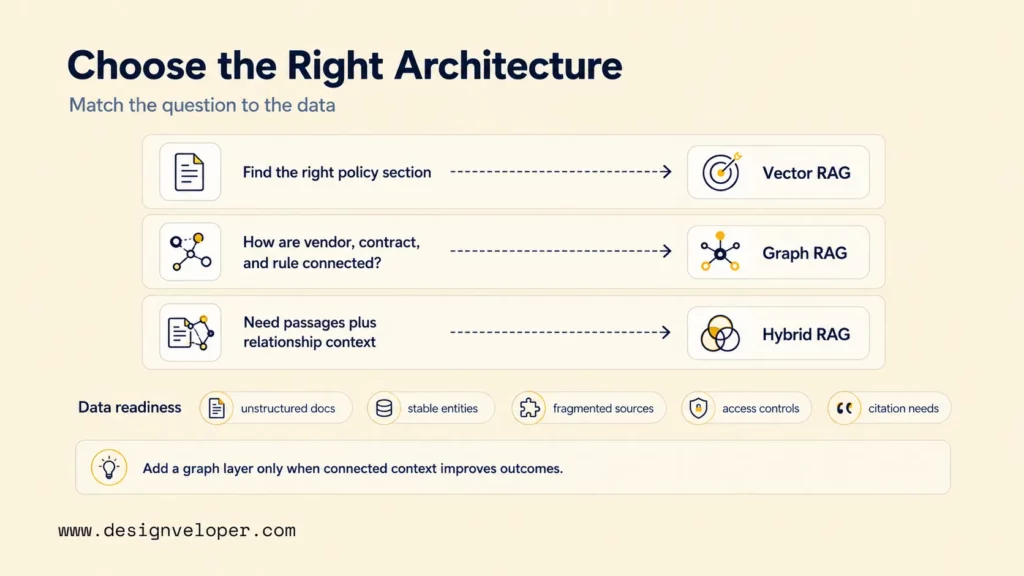
For a practical vector rag vs graph rag decision, start with representative user questions. Then check whether the available data can support the required answer path. This keeps teams from adding graph infrastructure to problems that vector retrieval already handles well.
The matrix below turns that rule into three common question patterns.
| Question shape | Starting architecture | Why |
|---|---|---|
| Find the most relevant policy section. | Vector RAG | The evidence should exist in one or a few relevant passages. |
| How are this vendor, contract, and approval rule connected? | Graph RAG | The answer depends on explicit links across entities or records. |
| Answer with source passages and relationship context. | Hybrid RAG | Both semantic evidence and connected context affect the response. |
Question shape is only the first check. Data readiness determines whether the architecture can work reliably. A graph layer is difficult to maintain when entity names change often, source systems conflict, or relationships cannot be checked.
Teams should assess several concrete conditions before committing to a graph-aware design:
- Unstructured documents: if answers already live in documents, a vector-first baseline is easier to test.
- Stable entities: graph retrieval is easier to maintain when important entities can be identified consistently.
- Fragmented sources: explicit links become more useful when answers regularly cross systems or documents.
- Access controls: retrieval must prevent users from receiving context they are not allowed to access.
- Citation needs: teams should trace important facts and relationships back to source evidence.
The implementation trade-offs are easier to compare as concrete work:
- Vector RAG: prepare documents, choose chunk boundaries, maintain metadata, and evaluate retrieval. Test reranking before adding another retrieval layer. Pinecone documents reranking as a second-stage retrieval pattern.
- Graph RAG: add entity or schema design, extraction, relationship validation, graph refreshes, and graph-specific evaluation.
- Decision rule: add the graph layer when important baseline failures repeatedly depend on missing relationship context or broad corpus structure.
Hybrid RAG Connects Semantic Retrieval With Relationship Context
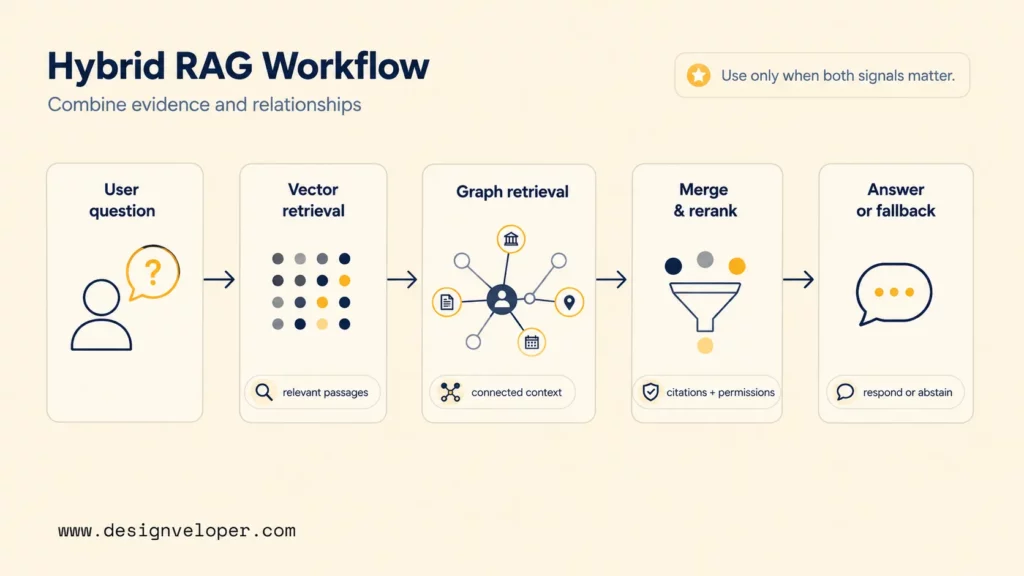
In this article, hybrid RAG means combining vector retrieval with graph-aware retrieval. It is different from dense-plus-sparse hybrid search. Pinecone documents that separate dense-plus-sparse hybrid search pattern.
Vector-plus-graph hybrid RAG is useful when users need direct source evidence and connected context in the same answer. The orchestration should make clear which retriever contributes each part of the evidence.
The workflow below shows a practical delivery path. Readers who want the simpler baseline first can use our RAG pipeline diagram guide to review the standard retrieval-and-generation flow.
- 1User questionKeep identity and permission context attached to the request.
- 2Vector retrievalFind source passages with strong semantic relevance.
- 3Graph retrievalExpand relevant entities, relationships, or graph summaries.
- 4Merge and rerankApply permissions, remove duplicates, rank evidence, and retain citations.
- 5Answer or fallbackGenerate from supported evidence or explain what is missing.
Consider a user asking, “Which approval rule applies to this vendor’s current contract?” Vector retrieval may locate the contract and policy passages. Graph retrieval can connect the vendor, contract, owner, and approval rule. The merge step should remove context the user cannot access.
Citations should survive that process. Store source identifiers with chunks and preserve provenance for graph-derived facts where possible. If a relationship cannot be traced to reliable evidence, the answer should not present it as verified.
Fallback behavior also needs an explicit design. If graph data is unavailable or stale, the application may use vector-only retrieval and disclose the limitation. If neither retriever returns enough evidence, abstaining is safer than producing an unsupported answer.
Hybrid RAG adds latency, more components, and more failure paths. Its complexity is justified when testing shows that both retrieval signals improve important user outcomes.
Evaluate Retrieval Quality Before Expanding The Architecture
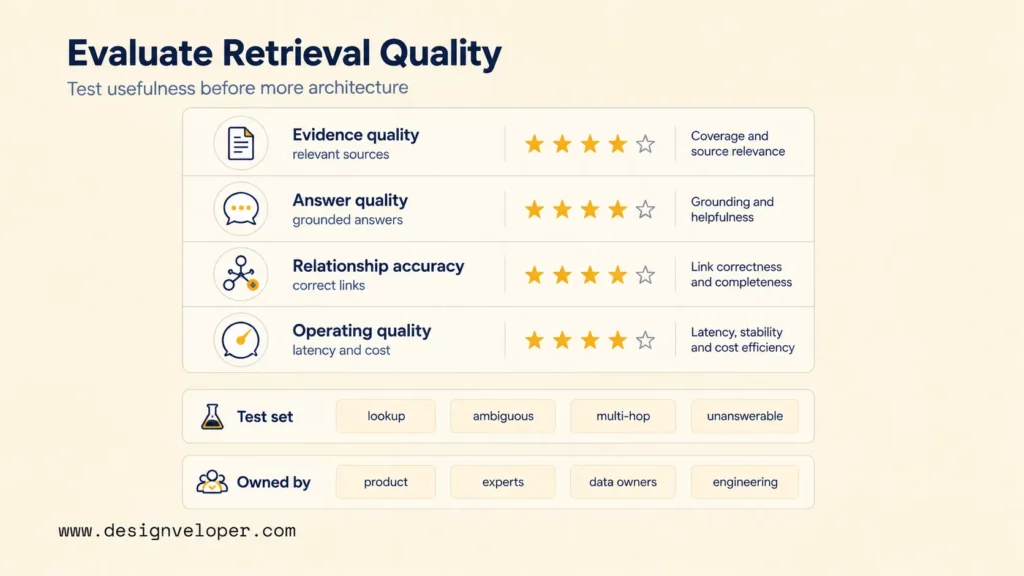
Evaluate the current retrieval system before adding another layer. A graph cannot compensate for poor source data, weak chunking, or an untested retrieval pipeline. The team first needs evidence that important failures come from missing relationship context.
LangSmith’s current RAG evaluation tutorial separates four evaluator relationships:
- Correctness: compare the response with a reference answer.
- Relevance: compare the response with the user’s input.
- Groundedness: compare the response with retrieved documents.
- Retrieval relevance: compare retrieved documents with the input.
A product evaluation should add system-specific checks around those dimensions. Graph-aware systems, for example, need explicit tests for entity and relationship accuracy. Our RAG best practices guide covers the broader evaluation and production controls around retrieval quality.
- Evidence quality
- Did retrieval return relevant source material with enough context and usable citations?
- Answer quality
- Is the answer useful, relevant, grounded, and appropriately uncertain?
- Relationship quality
- Are entity matches, relationships, and graph-derived claims correct and source-backed?
- Operating quality
- Track latency, cost, permission failures, stale data, empty retrieval, and fallback behavior.
Build the test set around real question shapes rather than one average score. Include:
- Lookup questions: test whether the correct evidence appears quickly and precisely.
- Ambiguous questions: test whether the system resolves the right entity or asks for clarification.
- Multi-hop questions: test whether connected facts are complete and correctly linked.
- Unanswerable questions: test whether the system abstains instead of inventing support.
Add permission-sensitive cases when users have different access rights. A factually correct answer can still be a production failure if its evidence came from restricted content.
Evaluation ownership should be explicit. Product owners define what makes an answer useful. Domain experts judge factual and relationship accuracy. Data owners verify source quality and permissions. Engineers measure retrieval behavior, latency, cost, and failure traces.
Question type can also change what quality means. Microsoft Research’s 2025 BenchmarkQED work distinguishes local and global query classes. For its GraphRAG-style evaluation of global questions, it uses comprehensiveness, diversity, empowerment, and relevance.
Those evaluation results should become inputs to production controls. Once the team knows which failures matter, governance can define who owns source quality, refresh, access, monitoring, and fallback.
Production Governance For Vector RAG And Graph RAG
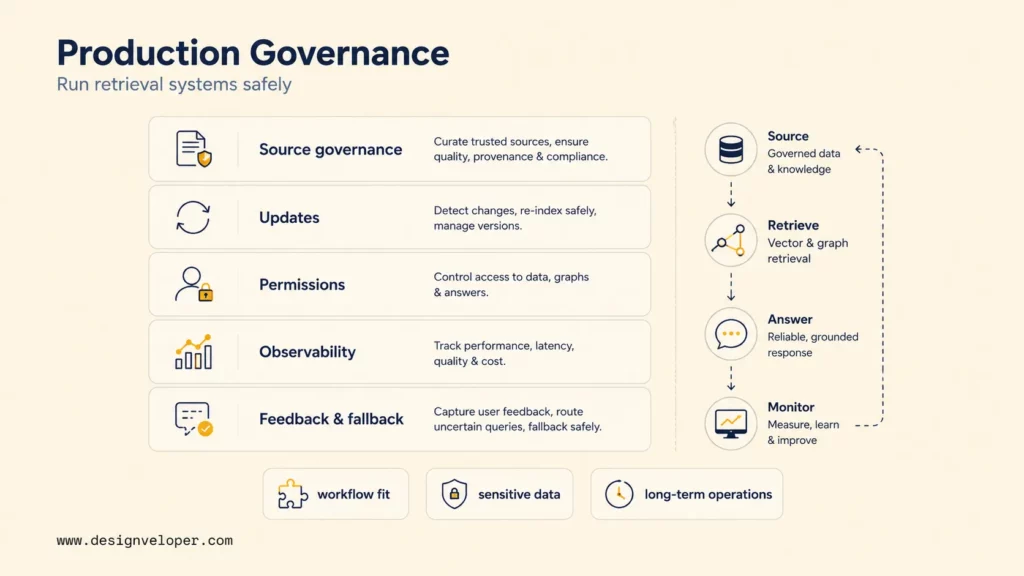
Production governance starts with source ownership rather than the retrieval algorithm. Teams need to know which system is authoritative and who may change its content. They also need rules for user access and index refresh timing.
Before launch, the team should be able to name an owner and a ready state for every control layer. The stack below turns governance into a deployment check.
A missing owner is itself a readiness gap. The following controls explain what each layer needs to do in practice.
For vector RAG, a changed document may require updated chunks, embeddings, metadata, or deletions. The application should retain enough source identity to replace old records instead of leaving stale passages in the index.
Graph RAG adds derived entities and relationships to that update path. A source change can invalidate an edge even when both entities still exist. Teams therefore need refresh, replacement, and deletion rules for derived graph records.
Current Microsoft GraphRAG output documentation says its default pipeline writes output tables as Parquet files. The same documentation includes ingest-period fields used for incremental update merges in some output tables.
Permissions must be enforced before restricted context reaches the model. Pinecone’s current multitenancy guidance documents a one-namespace-per-tenant pattern for serverless multitenancy. It presents metadata filtering as an alternative when strict tenant isolation is not required.
Pinecone separately documents role-based access control for organization and project resources. Those controls do not remove the application’s responsibility to enforce record-level access in the retrieval path.
Observability should expose the retrieval path, not only the final response. Useful traces should make three questions answerable:
- What was retrieved? Record selected sources, graph expansions, and reranking results.
- What was allowed? Record permission filters and other access decisions.
- What failed? Record latency, errors, empty retrievals, and fallback state.
LangSmith’s observability documentation shows one way to trace and monitor LLM application runs. Feedback should then feed the evaluation loop.
A wrong answer should become a reproducible test case. A stale relationship should trigger a refresh review. A permission leak should be treated as an access-control defect. Fallback rules should also define when the system retries, uses a simpler retrieval path, or abstains.
A retrieval system is production-ready only when sources, permissions, updates, evaluation, monitoring, and fallback behavior have clear owners.
FAQs About Vector RAG vs Graph RAG
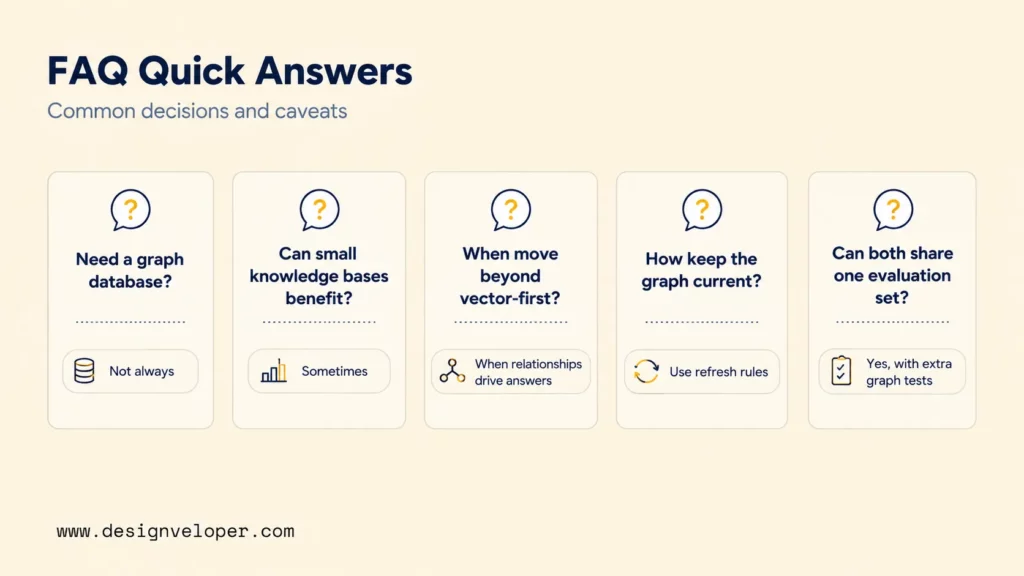
Does Graph RAG Require A Graph Database?
No. Graph RAG needs graph-structured knowledge or graph-aware retrieval, but a dedicated graph database is not mandatory. As of August 2026, Microsoft’s current GraphRAG output documentation says its default pipeline writes output tables as Parquet files on disk.
A graph database can still be useful when the application needs live traversal, graph queries, frequent relationship updates, or graph-specific operational tooling.
Can A Small Internal Knowledge Base Benefit From Graph RAG?
Yes, if relationships are central to the questions. A small collection about vendors, contracts, owners, dependencies, and approval rules may benefit even when its document count is modest.
If users mainly ask for passages from policies or manuals, graph modeling may add work without enough retrieval benefit.
When Should A Team Move Beyond A Vector RAG Baseline?
Move beyond the vector baseline when important failures depend on relationships or broad connected context rather than poor semantic retrieval. Before doing so, use the checks in the architecture decision section.
How Do You Keep A Graph RAG System Current When Source Data Changes?
Treat the graph as a derived index with explicit refresh and deletion rules. Source changes should update or invalidate affected graph records instead of leaving stale relationships in retrieval.
Can Vector RAG And Graph RAG Use The Same Evaluation Set?
Yes. They can share lookup, ambiguous, multi-hop, and unanswerable questions so both architectures face the same product tasks. Add graph-specific diagnostics for entity resolution, relationship correctness, and connected-context completeness.
Teams that move from comparison to delivery also need workflow design, data controls, evaluation, and long-term operations. Our AI development services can support that wider implementation work. One public example is a conversational finance workflow that accepts chat or spoken inputs and returns reports. Another is a document collaboration workflow with PDF editing, annotation, cloud access, and electronic signatures. These examples show relevant delivery capabilities; they do not establish a Graph RAG implementation.
Also published on

Share post on









Related Articles


Top Agentic AI Companies: 18 Vendors By Product Layer And Fit
Top Agentic AI Companies: 18 Vendors By Product Layer And Fit Published October 07, 2026
Agentic AI Architecture: Components, Patterns, And Workflows
Agentic AI Architecture: Components, Patterns, And Workflows Published October 07, 2026
AI Advantages and Disadvantages for Businesses: 5 of Each Explained
AI Advantages and Disadvantages for Businesses: 5 of Each Explained Published October 05, 2026