
















Rust Vs C++ Performance: Speed, Safety, And Real-World Tradeoffs

Rust vs C++ performance is not decided by language reputation alone. Both compile to native code and can deliver high throughput and low latency, but real results depend on algorithms, data layout, compiler settings, I/O, synchronization, memory allocation, profiling, and team expertise. Rust can reduce memory and concurrency risk; C++ can offer mature libraries, platform control, and legacy integration.
This guide compares Rust and C++ performance in practice, including raw throughput, memory safety, concurrency, tooling, ecosystems, benchmarking, and incremental migration. Choose Rust when safety and maintainability are central risks, C++ when existing libraries or platform control dominate, and both when a mixed stack offers the lowest delivery risk.
Explore more:
- What Is C++: Definitions, Strengths & Usages
- Most Used Programming Languages: Rankings, Jobs & Use Cases
- 11 Best Web Development Languages for Front-End and Back-End
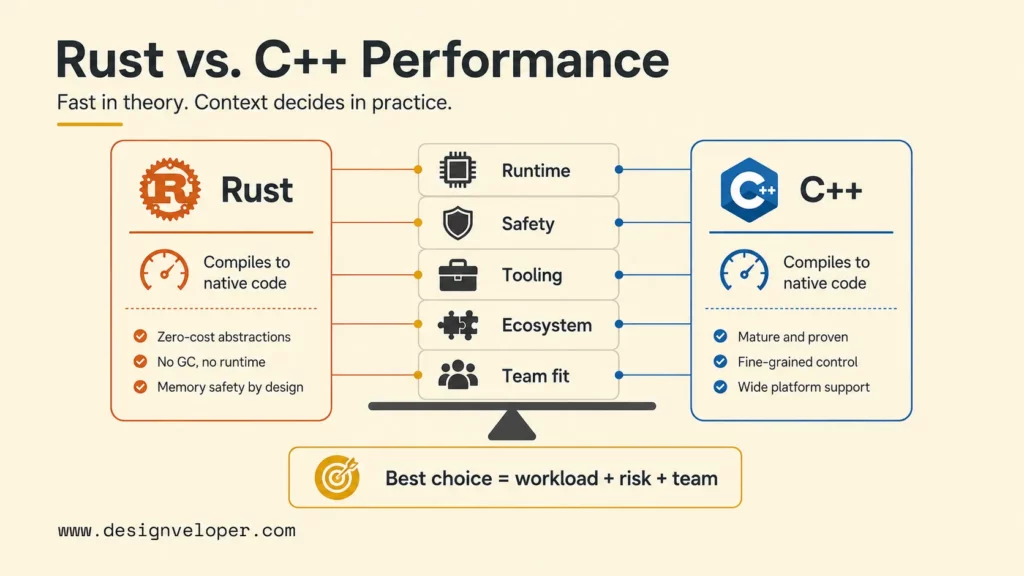
The Core Difference Between Rust And C++
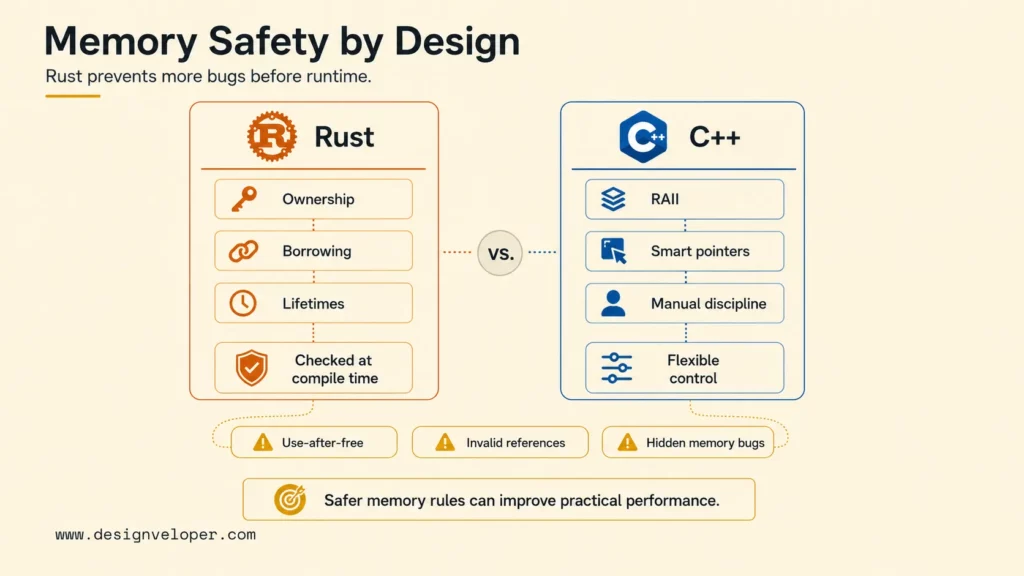
The core difference between Rust and C++ is how each language balances control and safety. In real product work, this balance is also a software architecture decision because ownership, module boundaries, and deployment constraints shape performance over time. Rust enforces ownership, borrowing, lifetimes, and many concurrency rules at compile time. C++ gives developers direct control over memory, object lifetime, pointers, templates, and platform-level optimization, but the developer and codebase must enforce many safety rules through discipline, guidelines, reviews, tools, and tests.
- Rust enforces memory safety and concurrency rules at compile time. The Rust book explains that ownership enables memory safety guarantees without needing a garbage collector in its ownership chapter.
- C++ gives developers maximum control, flexibility, and ecosystem depth. The C++ Core Guidelines focus on interfaces, resource management, memory management, and concurrency while preserving high performance.
- Both are high-performance systems languages. Rust and C++ optimize different tradeoffs: Rust emphasizes safer defaults and clearer dependency workflow, while C++ emphasizes mature infrastructure and fine-grained control.
Rust’s compiler rejects many patterns that could become use-after-free bugs, data races, or invalid references. That can slow early development because the borrow checker forces the programmer to make ownership explicit. The payoff is that many classes of memory mistakes are caught before runtime.
C++ gives experienced developers room to write extremely efficient code, including custom allocators, cache-aware layouts, SIMD, low-level embedded code, game engine systems, and high-frequency trading paths. The tradeoff is that unsafe memory behavior and undefined behavior remain possible when code violates the language’s rules or library contracts.
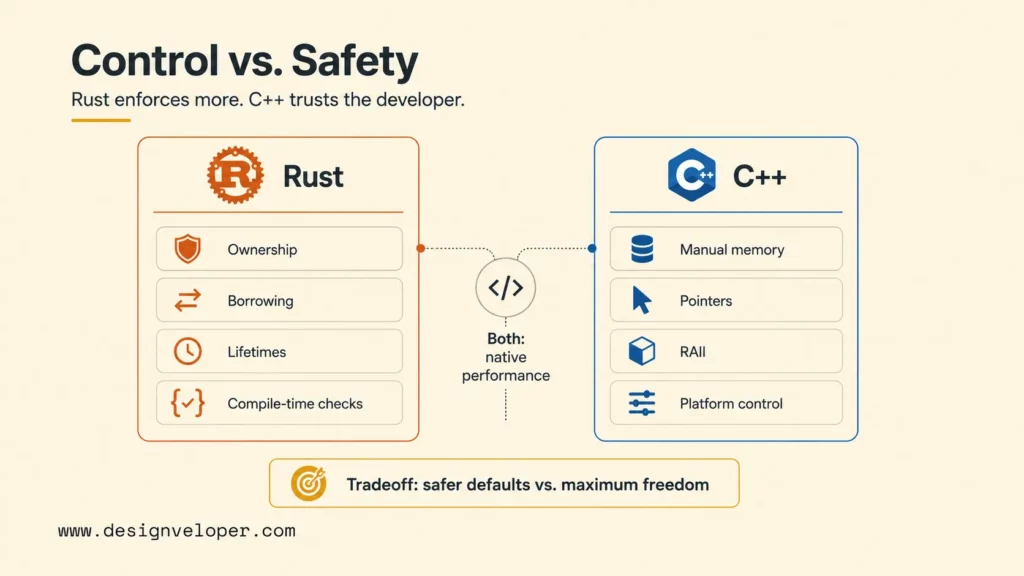
Head-To-Head Comparison
Rust and C++ are close enough in raw capability that the right choice should come from workload, team skill, ecosystem needs, and risk tolerance. The table below compares the tradeoffs that usually matter more than a single benchmark result.
Rust vs C++ at a glance
Both compile to fast native code; implementation decides the winner.
Rust has stronger safe defaults; C++ relies more on discipline and guidelines.
Cargo is cohesive; C++ tooling is mature but fragmented.
C++ is deeper in legacy and games; Rust is growing in secure infrastructure.
The summary shows why Rust vs C++ performance is not a one-line benchmark answer. Teams should compare runtime speed together with safety, tooling, ecosystem depth, and maintenance risk.
| Category | Rust | C++ |
|---|---|---|
| Performance | Native code, no garbage collector, strong zero-cost abstraction goals, excellent for safe systems work | Native code, no mandatory garbage collector, maximum tuning control, very mature low-level optimization options |
| Memory management | Ownership, borrowing, lifetimes, and explicit unsafe blocks for lower-level operations | Manual control, RAII, smart pointers, raw pointers, and deep resource-management idioms |
| Concurrency | Compile-time restrictions reduce data race risks in safe Rust | Threads, atomics, mutexes, condition variables, futures, and mature concurrency libraries |
| Tooling | Cargo gives integrated package, build, test, and documentation workflow | CMake, Bazel, Meson, Make, vendor tools, and mature but fragmented build ecosystems |
| Ecosystem | Growing strongly in cloud infrastructure, CLIs, security-sensitive systems, WebAssembly, and embedded work | Huge library base in games, embedded systems, browsers, operating systems, finance, graphics, and legacy platforms |
| Learning curve | Borrow checker and lifetimes are hard early but reduce many runtime failure classes | Language breadth, undefined behavior, templates, build systems, and legacy patterns can be hard over time |
C++ has manual control, huge library availability, a mature legacy ecosystem, and fragmented tooling. Rust has an ownership-based memory model, safer defaults, a modern Cargo workflow, and stronger compile-time guarantees. Neither language removes the need for profiling and architecture judgment.
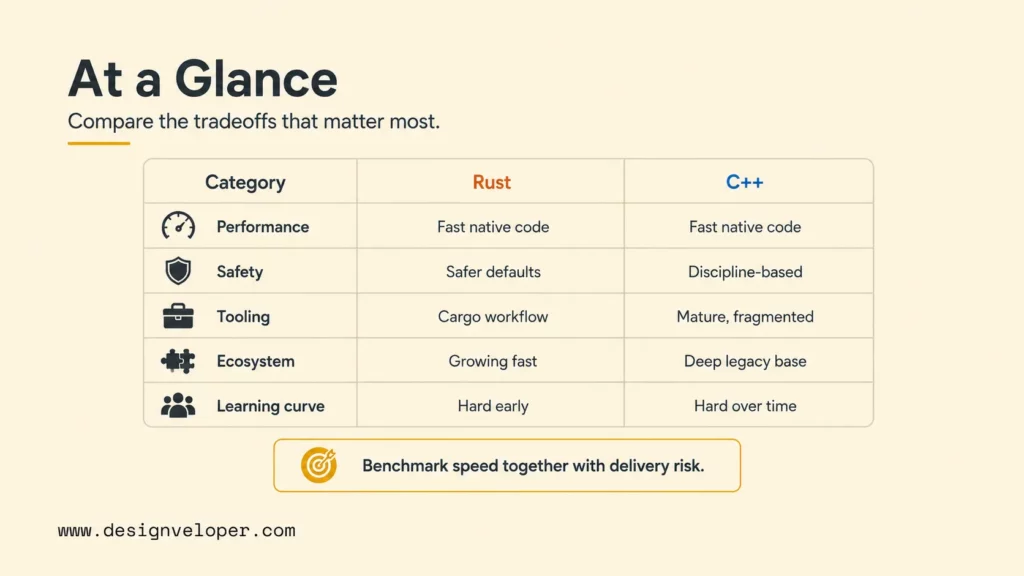
Performance Differences That Matter In Practice
The performance differences that matter in practice usually come from architecture, not from language branding. Rust and C++ can both be extremely fast. The important question is which language helps the team keep the hot path simple, memory access predictable, concurrency safe, and maintenance sustainable.
Performance comparison flow
CPU, I/O, memory, latency, or concurrency
Compare the same design first.
Use realistic release settings.
Find allocations, locks, cache misses, and copies.
Include refactor safety and bug cost.
The flow keeps benchmarks honest. A team should not compare Rust and C++ until algorithms, compiler settings, data layout, libraries, and representative workloads are aligned.
Raw Throughput And Latency
Raw throughput and latency can be similar when Rust and C++ implementations use comparable algorithms, compiler optimizations, memory layouts, and I/O strategies. Both languages can produce native code without a tracing garbage collector, which makes them suitable for systems where latency predictability matters.
C++ may have an advantage where a team can use mature libraries, vendor-specific intrinsics, established allocators, game engine infrastructure, or highly tuned legacy code. Rust may have an advantage where safety guarantees prevent costly memory bugs or make concurrent refactors safer. The winner is usually the implementation, not the logo.
Abstraction Cost And Runtime Overhead
Both languages support low-overhead abstractions. C++ uses templates, inline functions, RAII, move semantics, and compile-time polymorphism. Rust uses monomorphized generics, traits, iterators, and ownership-based resource management. In optimized builds, high-level code can often compile down to efficient machine code in both ecosystems.
Runtime overhead appears when abstraction hides allocations, copies, dynamic dispatch, locks, or unnecessary bounds checks. Rust’s safety checks are mostly compile-time, but some operations still need runtime checks. C++ can avoid many checks, but unsafe assumptions can create undefined behavior. Profiling is the only reliable way to confirm the real cost.
Where Benchmarks Mislead
A useful benchmark plan should compare systems, not language reputations. The same principle appears in strong software development life cycle practice: define the requirement, test the real workload, and keep performance evidence reproducible. Before using benchmark results to choose Rust or C++, check the conditions below.
| Benchmark check | Why it matters | What to record |
|---|---|---|
| Same algorithm and data layout | Different algorithms can overwhelm language effects. | Input size, data structures, memory layout, and algorithmic complexity. |
| Release builds and compiler flags | Debug builds or mismatched optimization flags produce misleading results. | Compiler version, flags, target CPU, link-time optimization, and profile-guided optimization if used. |
| Representative workload | A tight loop may not reflect I/O, serialization, locks, cache misses, or allocation pressure. | Dataset, concurrency level, hardware, warm-up, and production-like traffic shape. |
| Profiling evidence | The winning language may not address the real bottleneck. | CPU profile, allocation profile, lock contention, cache behavior, and I/O wait. |
| Change cost | Practical performance includes how safely the team can modify code later. | Bug rate, refactor effort, test coverage, and complexity of future changes. |
Benchmarks mislead when they compare different algorithms, libraries, compiler flags, hardware, or developer skill levels. A microbenchmark may show one language winning a narrow loop while ignoring build time, debugging time, memory bugs, dependency quality, or production failure rates.
Benchmarks also miss the cost of maintainability. A C++ implementation may be the fastest today but hard to modify safely. A Rust implementation may take longer to write but be easier to refactor without introducing data races or lifetime mistakes. For product teams, total delivery speed includes both runtime speed and change safety.
When Design Matters More Than Language Choice
Design matters more than language choice when performance depends on data structures, memory locality, batching, I/O, serialization, scheduling, lock contention, or network behavior. Teams using Agile software development can validate those assumptions through small measured increments instead of relying on generic benchmarks. A cache-friendly Rust program will beat a poorly designed C++ program. A carefully profiled C++ program will beat a bad Rust program.
Before switching languages, teams should profile the current system. Identify hot paths, allocation patterns, synchronization bottlenecks, cache misses, and I/O stalls. A language migration should be justified by measurable constraints, not by the assumption that one systems language is automatically faster than another.
Further reading:
- AI Programming Language For AI Development And Where They Fit Best
- AI In Software Development: Changing How Software Gets Built
- Scrum Software Development Turns Change Into Working Software
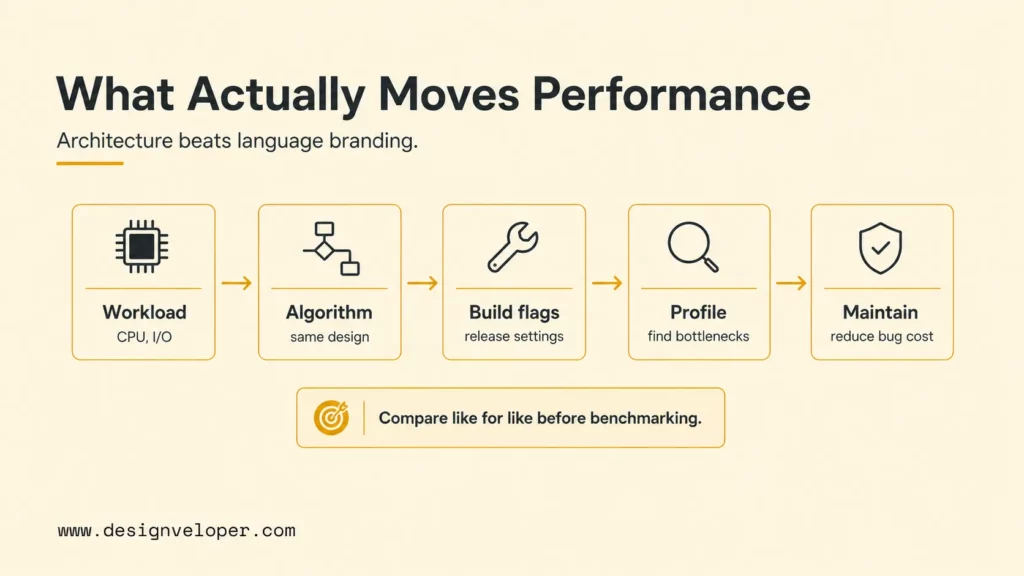
Memory Safety And Ownership
Memory safety is where Rust and C++ differ most clearly. Rust makes ownership rules part of the type system. C++ gives developers resource-management patterns and powerful tools, but memory safety depends more on code discipline and review.
C++ Manual Memory Control And RAII
C++ memory management has evolved far beyond manual `new` and `delete` in well-written modern code. RAII, smart pointers, containers, move semantics, and guidelines help developers manage resources safely. The C++ Core Guidelines resource-management rules recommend managing resources automatically using resource handles and RAII.
RAII is powerful because resources are acquired and released through object lifetime. Files, locks, sockets, memory, and handles can be tied to scope. However, C++ still allows raw pointers, unchecked casts, manual lifetime mistakes, and undefined behavior when the rules are broken.
Rust Ownership, Borrowing, And Lifetimes
Rust ownership means each value has a clear owner, and values are dropped when the owner goes out of scope. Borrowing lets code use references without taking ownership, while lifetimes help the compiler prove references remain valid. These rules make memory safety a compile-time concern for safe Rust.
The tradeoff is learning friction. Developers coming from C++ may initially feel slowed by borrow checker errors. Over time, those errors often reveal ownership ambiguity that would have become runtime risk in a less restrictive system.
What The Borrow Checker Prevents
The borrow checker prevents many use-after-free bugs, dangling references, double frees, and data race patterns in safe Rust. It does not make every program logically correct, and `unsafe` Rust still requires manual care, but it moves many dangerous memory mistakes into compile-time feedback.
This matters for performance because memory bugs often create production cost: crashes, security vulnerabilities, rollback work, and defensive copying. Preventing a class of failures can improve practical performance by making high-performance code safer to maintain.
Why Safety And Maintainability Matter Beyond Crashes
Safety matters beyond crashes because teams must change code after launch. A high-performance service may need new features, new protocols, new data structures, or new concurrency behavior. Rust’s stricter compiler can make refactoring safer by rejecting invalid ownership or sharing patterns early.
C++ teams can reach similar reliability with strong engineering discipline, static analysis, sanitizers, guidelines, reviews, and tests. Collaborative practices such as pair programming can also reduce review blind spots in safety-sensitive code. The difference is where the burden sits. Rust pushes more of the burden into the compiler. C++ leaves more flexibility and responsibility with the team.
Concurrency And Parallelism
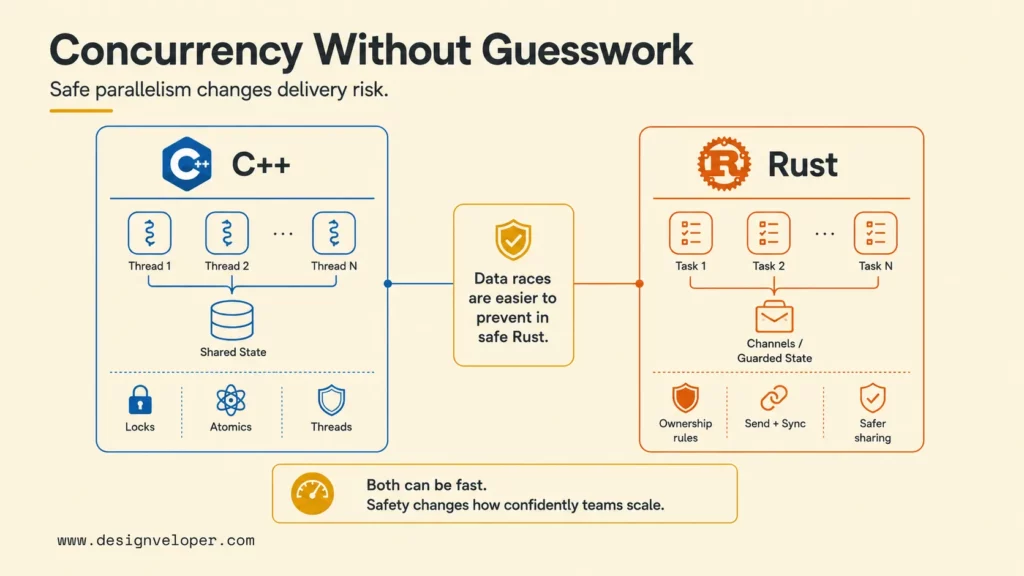
Concurrency and parallelism often expose the practical difference between Rust and C++. Both languages can build highly concurrent systems, but Rust’s type system makes some shared-state errors harder to express in safe code.
C++ Threads, Locks, And Atomics
C++ includes standard support for threads, atomics, mutexes, condition variables, and futures. The cppreference C++ concurrency library page summarizes built-in support for threads, atomic operations, mutual exclusion, condition variables, and futures.
C++ concurrency is powerful but demanding. Developers must reason carefully about ownership, locking order, memory ordering, object lifetime, and data races. High-performance C++ concurrency can be excellent, but it requires deep expertise.
Rust Fearless Concurrency
Rust’s fearless concurrency means the language helps developers write concurrent code with fewer subtle bugs. The Rust book’s fearless concurrency chapter explains how ownership and type checking support safer concurrent programming.
Rust does not remove the need to design concurrent systems well. Deadlocks, starvation, poor task scheduling, and bad async architecture can still happen. Rust’s advantage is that safe code prevents many unsynchronized shared-mutable-state mistakes from compiling.
Data Races And Shared Mutable State
Data races are dangerous because they can create intermittent bugs that are hard to reproduce. Rust prevents data races in safe code through ownership and borrowing rules. C++ provides atomics, locks, and synchronization primitives, but it is easier to write unsafe shared mutable access if the programmer makes a mistake.
For low-latency systems, synchronization choices also affect performance. Atomics, locks, lock-free queues, work stealing, message passing, and actor-style designs have different costs. Language safety helps, but architecture still decides whether concurrency scales.
Where Concurrency Safety Matters Most
Concurrency safety matters most in infrastructure, networking, databases, embedded systems, browsers, trading systems, game engines, and back-end services with high parallel load. In these systems, one lifetime or data race bug can create outages or security exposure.
Rust is attractive when teams want strong compiler support for concurrent refactoring. C++ remains strong when teams have established concurrency libraries, platform expertise, and performance-critical code that already works reliably.
Tooling And Developer Workflow
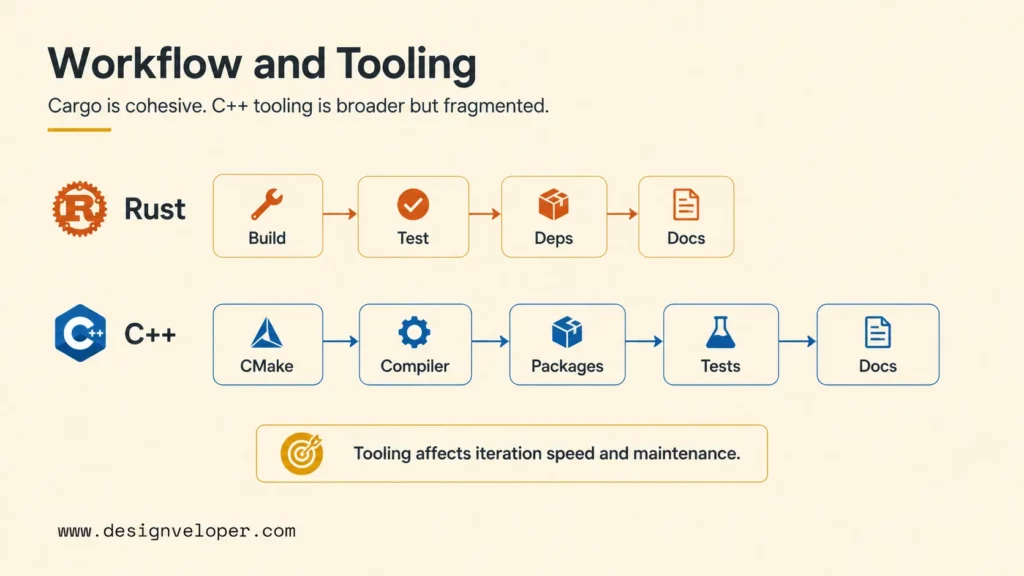
Tooling affects performance indirectly by shaping build speed, test reliability, dependency management, refactoring confidence, and day-to-day developer productivity. Rust’s tooling is more unified. C++ tooling is more mature but fragmented.
Cargo Vs CMake And Other Build Tools
Cargo is one of Rust’s strongest workflow advantages. It handles package management, builds, tests, documentation, benchmarks, and crates.io integration through a common tool. The Cargo book documents the standard workflow for Rust packages and builds.
C++ does not have one universal workflow. CMake, Bazel, Meson, Make, Visual Studio projects, Conan, vcpkg, and vendor-specific tools all appear in real projects. This flexibility is useful, but new developers often face more setup complexity.
Dependency Management And Reproducible Builds
Rust’s Cargo.lock and crates.io workflow make dependency management more consistent for many applications. C++ dependency management has improved, but teams still often manage a mix of system packages, vendored libraries, build scripts, and platform-specific toolchains.
Reproducibility matters for performance too. If dependency versions or compiler flags drift, benchmark results and runtime behavior can change. Both Rust and C++ teams should pin compilers, dependencies, build flags, and benchmark environments for serious comparisons.
Compiler Feedback, Debugging, And Refactoring
Rust’s compiler feedback is strict and often educational. It can reject code that would be unsafe or ambiguous before runtime. That feedback can feel slow during early development but useful during refactoring.
C++ compilers are powerful, and C++ has excellent debuggers, profilers, sanitizers, and static analysis tools. However, C++ diagnostics and template errors can still be hard to read, and undefined behavior may not be obvious without sanitizers or careful tests.
Day-To-Day Productivity And Maintainability
Day-to-day productivity depends on team background. A team with deep C++ experience and existing libraries may move faster in C++. A team building a new secure service may move faster in Rust after the ownership model clicks.
Maintainability is where Rust often wins new projects. Cargo, compiler checks, formatting, linting, and safe defaults reduce some routine friction. C++ can be equally maintainable in disciplined teams, but the standard workflow depends more on project conventions.
Recommended for you:
- Custom Software Development: How It Can Drive Your Business Growth
- Agile Vs Scrum: What’s the Difference and When to Use Each?
- Agile Vs. Waterfall Vs. Scrum Vs. Kanban: Key Differences
Ecosystems And Real-World Use Cases
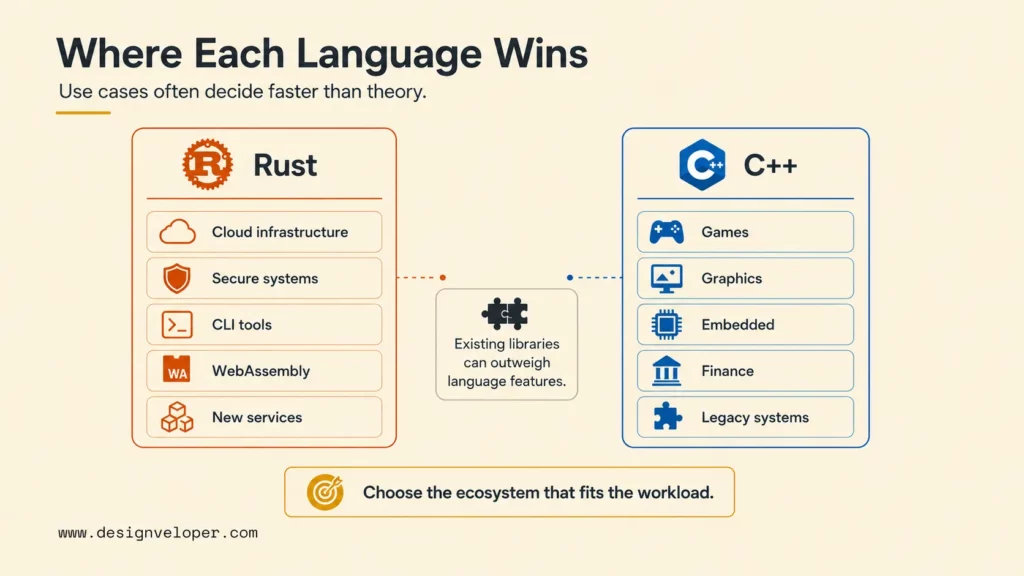
Ecosystem depth often decides more projects than theoretical performance. C++ has decades of libraries, frameworks, engines, compilers, hardware integrations, and platform support. Rust has a younger but fast-growing ecosystem with strong momentum in secure infrastructure, developer tools, CLIs, WebAssembly, and cloud systems.
C++ Strengths In Games, Legacy Systems, And Low-Latency Software
C++ remains strong in game engines, graphics, embedded systems, browsers, databases, operating systems, robotics, finance, high-frequency trading, and performance-critical legacy software. Existing C++ codebases and libraries are major assets.
If a project depends on Unreal Engine, mature native libraries, device SDKs, or long-established C++ infrastructure, C++ may be the pragmatic choice even when Rust has attractive safety properties.
Rust Growth In Cloud Infrastructure, Secure Systems, And CLIs
Rust is growing in cloud infrastructure, secure systems, command-line tools, WebAssembly, embedded software, and performance-sensitive services. The 2025 Stack Overflow Developer Survey notes that Python developers aspire to use Rust and Go as a path to high-performance systems programming, reflecting Rust’s reputation among developers interested in systems work.
Rust also benefits from a strong developer experience around Cargo, rustfmt, Clippy, and documentation. For new systems where memory safety and concurrency risk matter, Rust is increasingly credible.
When Existing Libraries Matter More Than Language Features
Existing libraries can matter more than language features. A mature C++ physics engine, graphics library, trading gateway, hardware SDK, or embedded platform may outweigh Rust’s safety advantages. Rewriting stable C++ infrastructure in Rust can create more risk than value.
The best path is often incremental. Teams can keep mature C++ where it works and introduce Rust around risky new modules, CLIs, network services, or security-sensitive components. Interoperability can be more practical than a full rewrite.
Related reading:
- What Is Software Development and the Software Development Process?
- Jira And Agile: How To Use Jira For Agile Project Management
- What Is DevOps? The DevOps Lifecycle And How It Works
How Developers Should Choose Between Rust And C++
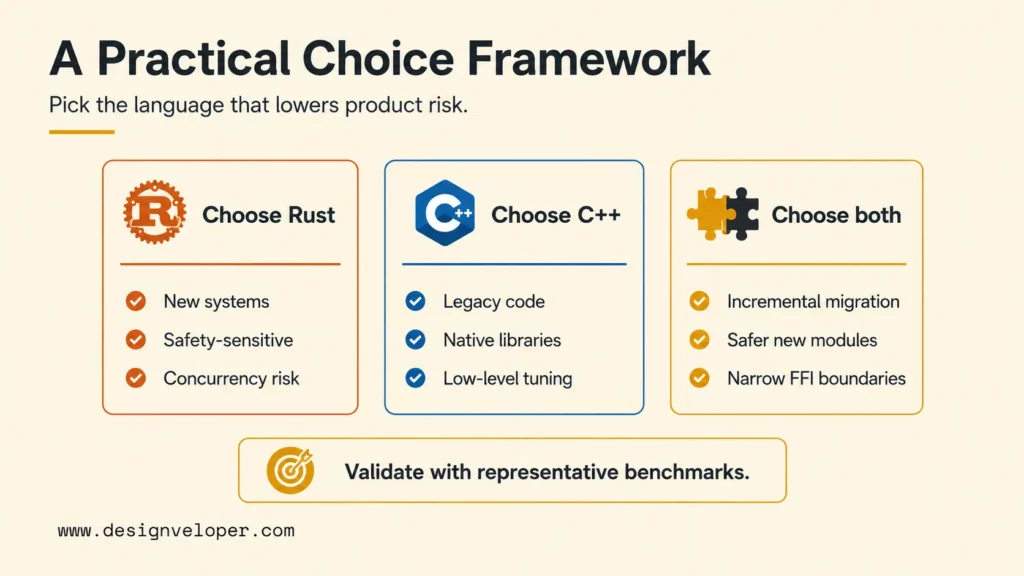
Developers should choose between Rust and C++ by matching the language to the risk profile, ecosystem needs, and team expertise of the project. Performance should be tested with representative workloads, not decided from generic claims.
Language choice matrix
New systems, memory safety, concurrency risk, secure tooling, maintainable infrastructure.
Legacy code, game engines, mature native libraries, platform SDKs, extreme tuning control.
Incremental migration, safe new modules, narrow FFI boundaries, no risky rewrite.
The choice matrix gives a practical ending point: Rust is not automatically faster, and C++ is not automatically riskier. The better choice is the language that lets the team deliver and maintain the required performance with the least product risk.
Choose Rust When Safety And Concurrency Risk Matter Most
Choose Rust when memory safety, concurrency safety, maintainability, and modern tooling are major concerns. Rust is a strong fit for new infrastructure services, CLIs, security-sensitive tools, WebAssembly modules, and systems where data races or lifetime bugs would be expensive.
Rust is also attractive when the team wants fewer runtime memory surprises and is willing to invest in the learning curve. The compiler becomes part of the design process.
Choose C++ When Ecosystem Depth And Low-Level Control Matter Most
Choose C++ when the project depends on mature native libraries, game engines, device SDKs, legacy codebases, platform-specific optimization, or deep low-level control. C++ remains one of the strongest languages for hand-tuned systems work.
C++ is also a practical choice when the team already has strong C++ expertise, profiling tools, coding standards, and test infrastructure. A disciplined C++ team can produce excellent, reliable, high-performance systems.
Choose Both When Interop Or Incremental Migration Is Required
An incremental migration plan is usually safer than a rewrite. The table below shows where using both languages can be practical.
| Interop pattern | Best use | Risk to control |
|---|---|---|
| Rust module behind a C ABI | Secure parsers, CLI tools, data processing, or isolated services inside a C++ estate | Keep ownership, allocation, and error-handling rules explicit at the boundary |
| C++ library called from Rust | Reuse mature engines, SDKs, hardware integrations, or numeric libraries | Wrap unsafe calls in a narrow, tested Rust API |
| Sidecar service | Introduce Rust without touching risky in-process memory boundaries | Measure network overhead, deployment complexity, and operational ownership |
| New Rust subsystem beside legacy C++ | Add safer new functionality while preserving stable C++ core systems | Define data contracts, testing strategy, and rollout boundaries |
Choose both when the project needs migration without a risky rewrite. Rust can call C APIs, and C++ systems can expose C-compatible boundaries where needed. This allows teams to introduce Rust in new modules while preserving C++ infrastructure that already works.
Interop adds complexity, so boundaries should be narrow and well tested. Use language mixing for clear value: safer new modules, isolated hot paths, secure parsers, or tooling around legacy systems.
For teams deciding between Rust, C++, or a mixed native stack, Designveloper can help evaluate architecture constraints, benchmark strategy, integration risk, and maintainability through software development services that connect engineering choices with long-term product operations.
FAQs About Rust Vs C++
The questions below summarize the practical performance and adoption decisions behind Rust and C++.
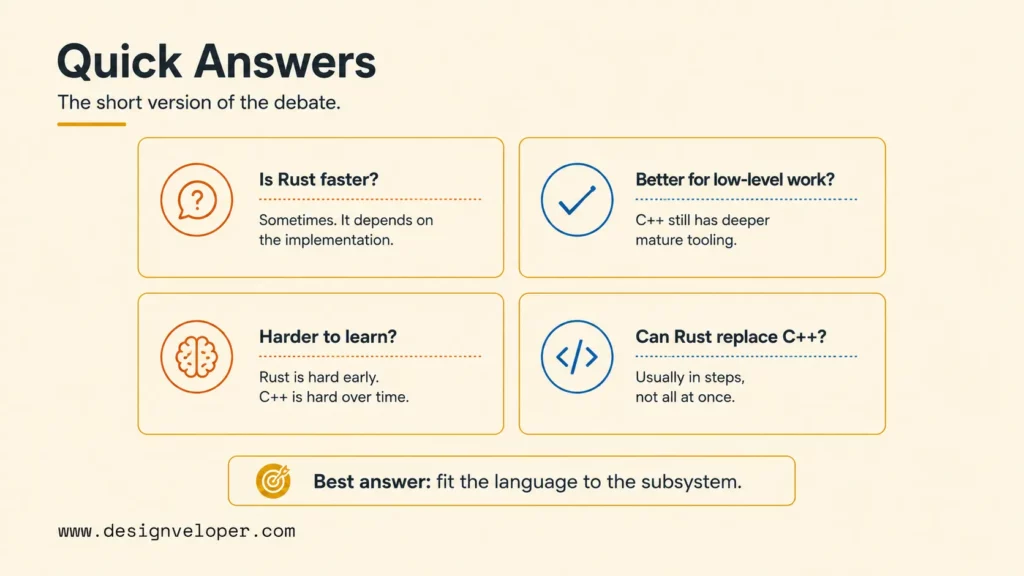
Is Rust Faster Than C++
Rust can be faster than C++ in some implementations, and C++ can be faster than Rust in others. Both languages can reach native-code performance. The real winner depends on algorithms, data layout, compiler optimization, memory allocation, concurrency design, and developer expertise. Rust’s safety can improve practical performance by reducing bug-driven rework, while C++ can win when mature libraries and hand-tuned control matter.
Is C++ Still Better For Low-Level Optimization
C++ is still excellent for low-level optimization because it has deep compiler support, mature profiling tools, extensive libraries, custom allocators, platform-specific intrinsics, and decades of production use. Rust can also support low-level optimization, but C++ often has a larger ecosystem in games, embedded systems, high-frequency trading, and graphics.
Is Rust Harder To Learn Than C++
Rust is hard early because ownership, borrowing, and lifetimes are unfamiliar to many developers. C++ is hard over the long term because the language is large and allows many unsafe patterns. Rust front-loads difficulty into the compiler and type system. C++ spreads difficulty across memory management, templates, build systems, undefined behavior, and legacy conventions.
Can Rust Replace C++ In Existing Systems
Rust can replace C++ in some new modules, tools, services, and security-sensitive components, but replacing an entire mature C++ system is rarely simple. Existing libraries, platform integrations, team knowledge, and business risk matter. Incremental migration is usually safer than a full rewrite.
Which Language Is Better For Systems Programming
Rust is better when memory safety, concurrency safety, and maintainability are the main risks. C++ is better when ecosystem depth, legacy integration, and maximum low-level control are the main risks. For many real systems teams, the best answer is not Rust or C++ in isolation, but choosing the right language for each subsystem and validating performance with real benchmarks.
Also published on

Share post on










Related Articles



How To Learn Rust? A Practical Roadmap For Beginners & Developers
How To Learn Rust? A Practical Roadmap For Beginners & Developers Published October 03, 2026
Rust Vs Java: Performance, Memory, And Project Fit For Teams
Rust Vs Java: Performance, Memory, And Project Fit For Teams Published September 30, 2026
vLLM Tutorial: Install, Run Inference, and Serve an API
vLLM Tutorial: Install, Run Inference, and Serve an API Published September 29, 2026