














Python Best Practices For Writing Clean, Maintainable Code

KEY TAKEAWAYS:
- Readable names, focused functions, and explicit boundaries make Python easier to review and change.
- A predictable project layout should make setup, testing, configuration, and ownership obvious.
- Specific exceptions, useful logs, behavior-focused tests, and type hints protect production code.
- Formatters, linters, type checkers, dependency controls, and CI turn conventions into repeatable checks.
- The right standard is the one that reduces risk for the next developer without creating needless ceremony.
A Python script becomes harder to trust when setup, errors, tests, and configuration depend on tribal knowledge. Python best practices give teams a practical way to keep APIs, data pipelines, AI features, and automation tools readable as they grow. The first step is to see which habits protect the codebase from the changes and failures it will face in production.
For a deeper dive:
- AI With Python: What You Can Build And Where To Start
- Popular Python Frameworks And Which Projects They Fit Best
- Building And Deploying An MCP Server In Python
What Python Best Practices Actually Protect
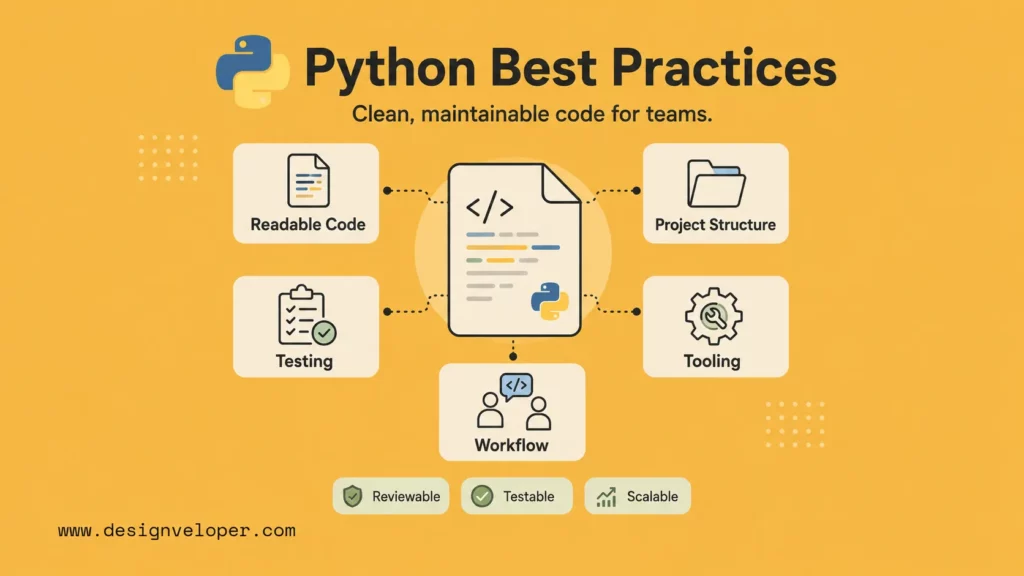
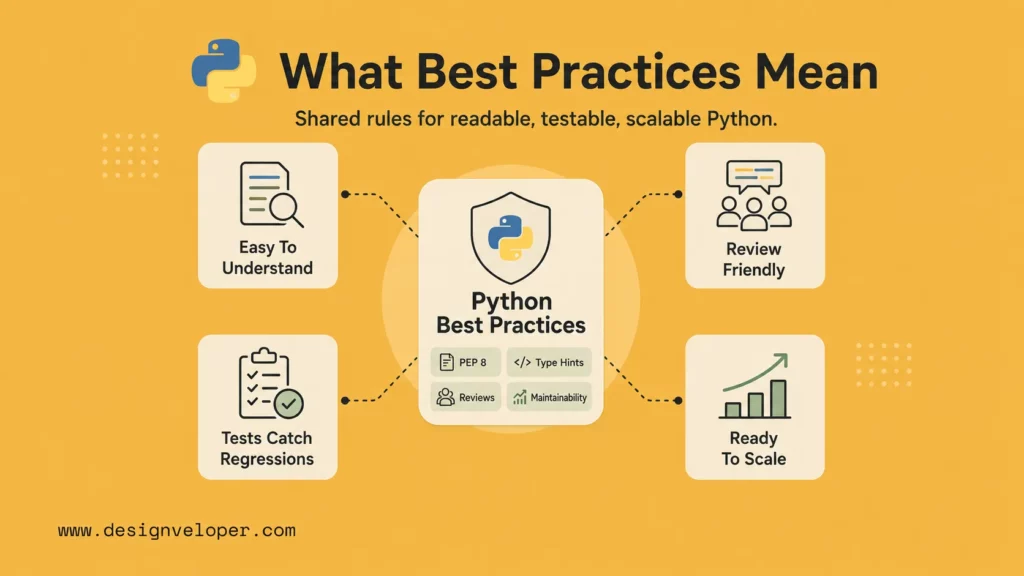
Python best practices are shared decisions about how a team writes, organizes, tests, and operates Python code. Some are community conventions, such as the recommendations in PEP 8. Others are engineering controls added because a project has real users, external dependencies, sensitive data, or production deadlines.
The goal is not to make every repository look identical. A small command-line tool, a Django application, a FastAPI service, a data pipeline, and an AI feature can use different boundaries. They should still make intent visible, keep setup repeatable, and make failure easier to understand.
A useful practice earns its place when it improves at least one of these outcomes:
- Comprehension: a teammate can understand the purpose of a module without reconstructing hidden context.
- Change safety: a feature or refactor has a clear boundary and a testable failure path.
- Operational clarity: logs, configuration, and errors help the team diagnose what happened.
- Delivery consistency: local checks and CI apply the same quality bar before code reaches users.
That standard also prevents overengineering. If a rule adds ceremony but does not improve readability, correctness, security, or operability, the team should revisit it. Good conventions create useful defaults; they do not replace judgment.
Write Python That States Its Intent
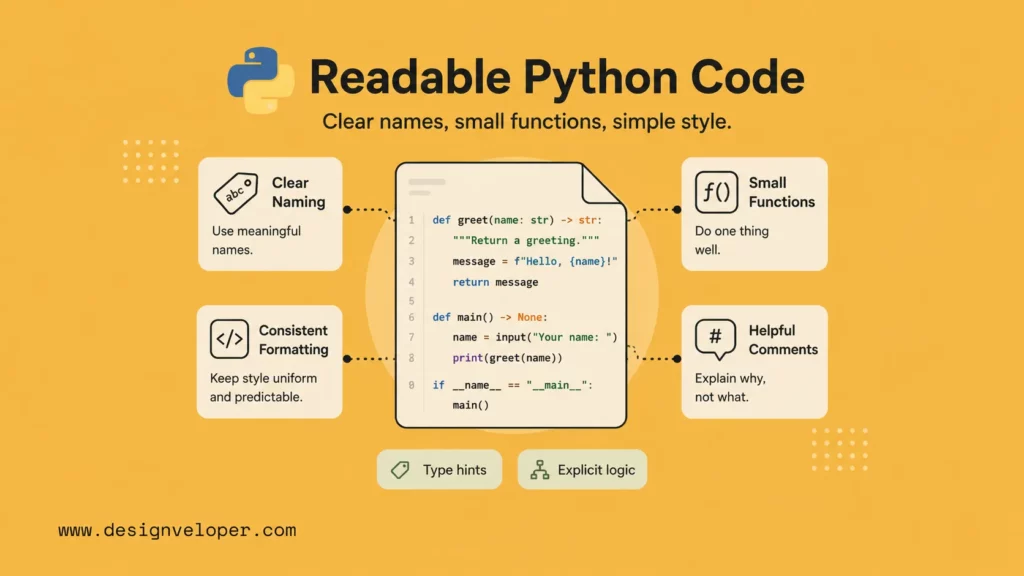
Readable Python lets a reviewer follow the business idea before studying implementation details. Prefer names that explain the domain, functions that do one coherent job, and control flow that makes important states visible.
A name such as paid_invoice_rows gives a reader more information than data. A function such as normalize_customer_email should return a normalized value rather than quietly updating a database or sending an event. When a function has side effects, expose them through its name, boundary, or documentation.
# Harder to review
def process(data):
    return [row for row in data if row[2] > 0]

# Easier to review
def get_paid_invoice_rows(invoice_rows):
    return [row for row in invoice_rows if row.amount_paid > 0]
Keep one level of abstraction inside a function. A shipping calculation should not also parse environment variables, open a database connection, format an HTTP response, and publish analytics. Splitting those responsibilities gives each step a name, a test boundary, and a clear place to handle failure.
Use comments and docstrings to explain decisions, constraints, and public interfaces—not to narrate obvious syntax. A short docstring is valuable when it states accepted inputs, units, return values, exceptions, or an edge case that a future maintainer could otherwise miss.
def calculate_discounted_total(
    subtotal_cents: int,
    discount_percent: float,
) -> int:
    """Return the invoice total in cents after a percentage discount."""
    if subtotal_cents < 0:
        raise ValueError("subtotal_cents must be non-negative")
    if not 0 <= discount_percent <= 100:
        raise ValueError("discount_percent must be between 0 and 100")
    return round(subtotal_cents * (1 - discount_percent / 100))
The example makes the unit, accepted range, and failure behavior visible. That is more useful than a long comment because the contract is close to the code and can be protected with tests.
Structure A Python Project For Change
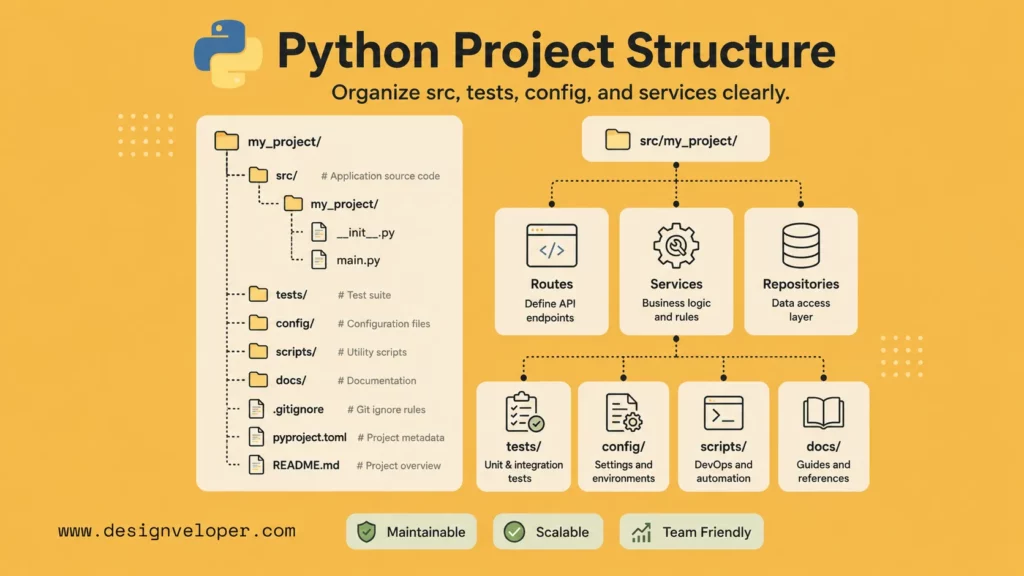
Project structure is part of the developer experience. A new contributor should be able to identify the package, run the tests, find configuration, and understand the main execution paths without guessing. For packages that may grow, the Python Packaging User Guide explains the trade-offs between a src layout and a flat layout. Choose deliberately, then use the same layout in local development and CI.
example_project/
├── pyproject.toml
├── README.md
├── src/
│   └── example_app/
│       ├── api/
│       ├── domain/
│       ├── repositories/
│       ├── services/
│       └── settings.py
├── tests/
│   ├── unit/
│   └── integration/
├── scripts/
└── docs/
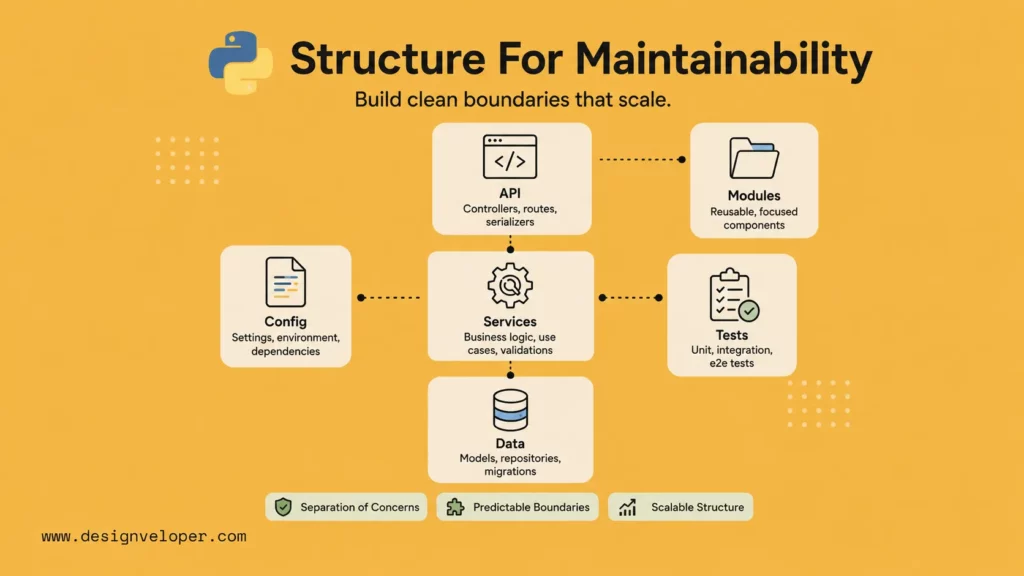
Do not create folders only because a template includes them. Add boundaries when they make ownership or change impact clearer. In a growing API, routes can validate input and call services; services can hold business rules; repositories can isolate persistence. In a data or AI workflow, ingestion, transformation, model calls, evaluation, and storage should not be mixed into one notebook or untestable script.
Configuration deserves its own boundary. Read environment variables in one settings module, validate them at startup, and pass typed settings into the components that need them. This avoids repeated calls to os.getenv and makes missing configuration fail early instead of appearing as an unrelated error during a request.
from dataclasses import dataclass
import os

@dataclass(frozen=True)
class Settings:
    database_url: str
    log_level: str = "INFO"

def load_settings() -> Settings:
    database_url = os.environ.get("DATABASE_URL")
    if not database_url:
        raise RuntimeError("DATABASE_URL is required")
    return Settings(database_url=database_url)
A useful structure review asks three practical questions: Can a developer run the project with documented commands? Can they find the code that owns a behavior? Can they change one integration without opening unrelated modules? If the answer is no, simplify or refactor the boundary before adding more features.
Explore the surrounding engineering context:
- Web Application Architecture: Types, Components, and Tools
- Web Application Development Tutorial: The Ultimate Guide for Beginners
- What Is a Web Application (Web App)? Is It the Same as Website?
Handle Failures Explicitly And Test Behavior
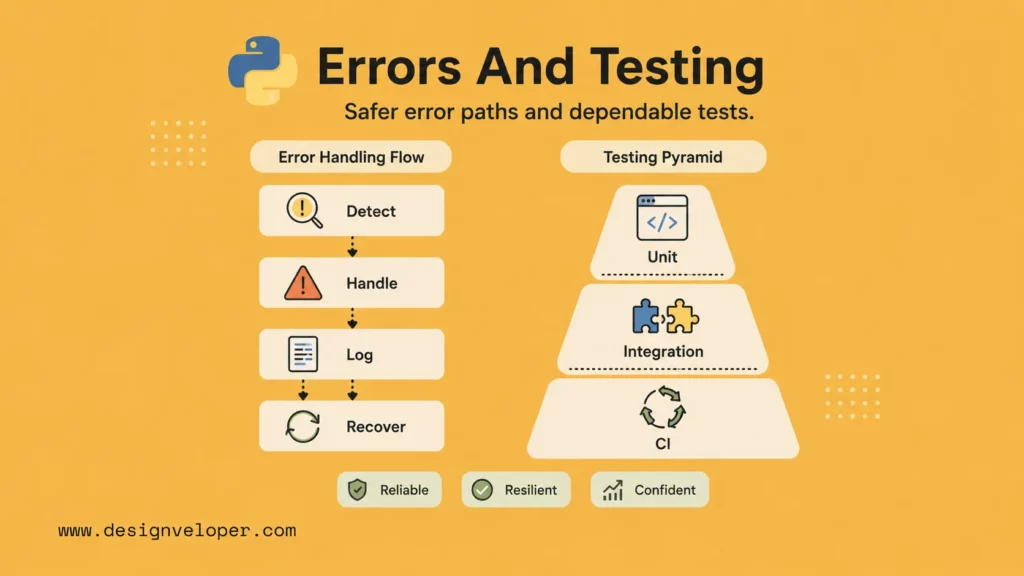
Reliable code does not pretend that external systems, user input, networks, or files will always behave perfectly. Python’s exception model gives teams the tools to catch specific failures, add context, and preserve the original cause with exception chaining.
Use Specific Exceptions At The Right Boundary
Catch an exception only when the current layer can make a useful decision. A timeout from a payment provider may be retried. Invalid input should return a clear validation response. A permission failure should stop the operation and create an appropriate audit trail. Unexpected defects should remain visible to monitoring rather than being converted into None.
class PaymentProviderError(RuntimeError):
    pass

def charge_customer(payment_client, customer_id: str, amount_cents: int) -> str:
    try:
        result = payment_client.charge(customer_id, amount_cents)
    except TimeoutError as exc:
        raise PaymentProviderError("Payment provider timed out") from exc
    return result.transaction_id
Logging should provide context without exposing secrets. A request ID, job ID, or internal entity ID can make an incident traceable; API tokens, passwords, full payment payloads, and unnecessary personal data do not belong in logs. The standard library’s logging guidance is a useful baseline, but production teams should also define retention, access, and redaction rules.
Test The Rules And The Boundaries
Unit tests protect focused business rules. Integration tests protect boundaries such as a database, queue, file system, third-party API, or authentication flow. A healthy suite needs both because a function can be correct in isolation while its integration contract is broken.
Use behavior-focused names and realistic edge cases. pytest supports readable assertions, fixtures, parametrization, and workflows that can grow from a small project into a dependable safety net. Coverage is a signal, not the goal; prioritize rules and failure modes that would hurt users if they regressed.
import pytest

@pytest.mark.parametrize(
    ("subtotal_cents", "discount_percent", "expected_total"),
    [(10000, 10, 9000), (2500, 0, 2500), (999, 100, 0)],
)
def test_calculate_discounted_total(subtotal_cents, discount_percent, expected_total):
    assert calculate_discounted_total(
        subtotal_cents, discount_percent
    ) == expected_total

def test_calculate_discounted_total_rejects_negative_subtotal():
    with pytest.raises(ValueError, match="non-negative"):
        calculate_discounted_total(-1, 10)
When a production bug is found, turn it into a regression test before or alongside the fix. That practice converts an incident into a permanent improvement instead of relying on memory during the next refactor.
Use Tooling To Make Quality Repeatable
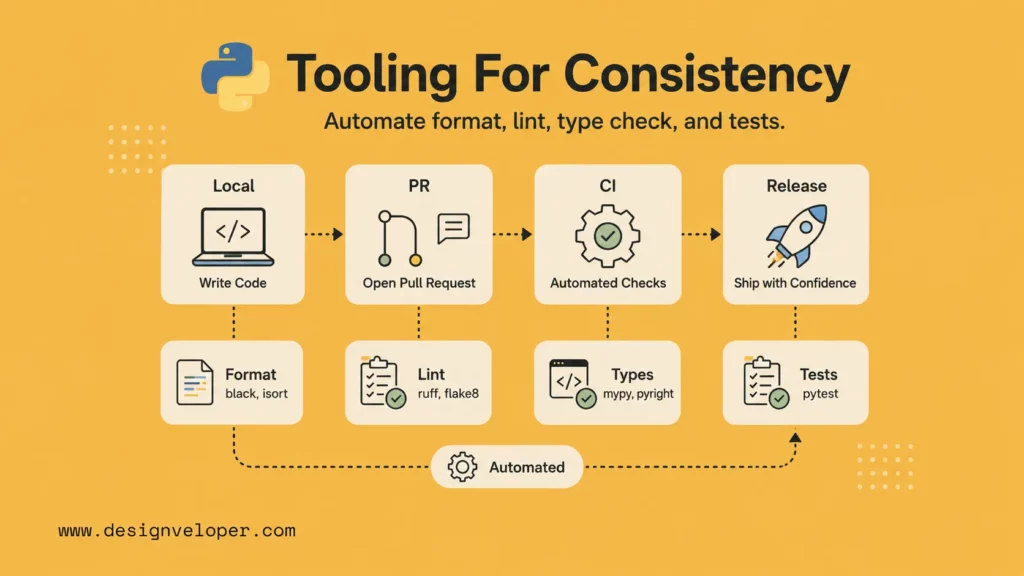
A team should not spend review time debating import order, whitespace, unused variables, or obvious type mistakes. Automate those checks so human review can focus on correctness, product risk, and maintainability.
A practical Python toolchain can include the Ruff formatter and linter, mypy or Pyright for type checking, pytest for tests, and pre-commit hooks for fast local feedback. The exact tools can vary; consistent commands matter more than tool loyalty.
[tool.ruff]
line-length = 100

[tool.ruff.lint]
select = ["E", "F", "I", "B", "UP"]

[tool.mypy]
python_version = "3.12"
warn_unused_ignores = true
strict_optional = true
Start with a ruleset the team can understand. Enabling every strict rule in an old repository can produce a wall of noise and encourage people to bypass the checks. Add high-value rules first, fix existing violations in manageable batches, and prevent new violations from entering changed files.
Run the same quality sequence in three places:
- Local development: format and lint changed files while feedback is cheap.
- Pull requests: run the full test, lint, and type-check commands before review.
- Release or deployment: repeat the checks and add dependency or security validation where the project risk requires it.
Use a virtual environment or another repeatable environment workflow for every project. The standard library’s venv documentation describes the basic isolation model; teams should then document the exact install, test, format, and run commands in the repository.
Protect Configuration, Dependencies, And Data
Maintainability includes the code around the code. A project can have elegant functions and still be unsafe if secrets are committed, dependencies are unbounded, or production configuration differs from staging in undocumented ways.
- Keep secrets out of source: use environment variables or a managed secret store, and make secret scanning part of the delivery workflow.
- Separate runtime and development dependencies: document which packages are required to run the product and which are only used for tests, formatting, or local tooling.
- Control upgrades deliberately: review dependency changes, test them in CI, and keep a clear path for security updates.
- Validate settings at startup: fail with a useful message when a required URL, key, feature flag, or environment value is missing.
- Minimize sensitive logs: redact credentials and personal data before values reach application logs, traces, or error reports.
These controls support secure software development because they reduce the chance that a coding shortcut becomes an operational or privacy incident. They also make deployments easier to reproduce: the project declares what it needs, how it is configured, and how the team verifies it.
# Good: validate configuration at the boundary
class Settings:
    def __init__(self, api_key: str, timeout_seconds: int = 10):
        if not api_key:
            raise ValueError("API key is required")
        if timeout_seconds <= 0:
            raise ValueError("timeout must be positive")
        self.api_key = api_key
        self.timeout_seconds = timeout_seconds

# Avoid: reading a secret in many unrelated modules
# API_KEY = "paste-a-secret-here"
Type hints can reinforce these boundaries. They are especially useful for public service functions, API schemas, data-transfer objects, and repository interfaces where two parts of a system must agree. Use the Python typing documentation as a reference, but adopt stricter checks gradually if the codebase is older.
Continue with related software engineering guidance:
- Software Development Costs: Guide to Estimate Your Project
- 7 Tips on How to Choose a Software Development Company
- Custom Software Development Cost: 5 Factors to Consider
Apply The Practices To Real Python Projects
The best way to make a convention useful is to tie it to a real workflow. The same principles look slightly different depending on what the Python project must do.
API Service: Keep Request Handling Thin
For a FastAPI or Django service, keep routes focused on transport concerns. They should validate input, authenticate the request, call a domain service, and map the result to a response. Put pricing, permissions, state transitions, and integration behavior in testable service or domain modules. This makes the request flow easier to review and reuse.
- Define request and response models at the API boundary.
- Keep database access behind a clear repository or query boundary as the service grows.
- Test business rules without starting the whole web server.
- Add integration tests for migrations, authentication, and the most important external calls.
Data Or AI Pipeline: Separate Experiments From Production
For a data or AI workflow, separate ingestion, transformation, model calls, evaluation, and persistence. A notebook can be useful for exploration, but stable logic should move into importable modules with versioned inputs, logs, tests, and repeatable commands. This matters when an AI feature is part of a wider software development workflow. A prompt or model change should be reviewable and testable rather than silently changing the product.
- Store prompts, schemas, and evaluation cases where they can be reviewed and versioned.
- Keep credentials and provider configuration outside notebooks and source files.
- Test parsing, retries, fallbacks, and empty or malformed model responses.
- Record enough metadata to reproduce an output without logging sensitive user content.
CLI Or Automation Tool: Make Reruns Safe
For an internal automation tool, make the command, configuration, and expected side effects obvious. Use explicit exit codes, structured logs, dry-run support where destructive actions are possible, and idempotent operations when the task may be retried. A small CLI with a clear README can be more maintainable than a large framework hidden behind a one-off script.
See how related product systems are structured:
- What Is Web Application Security? OWASP 10 Web App Vulnerabilities
- Custom Software Development: How It Can Drive Your Business Growth
- 20 Software Project Management Methodologies for Software Development
Avoid Python Anti-Patterns That Create Debt
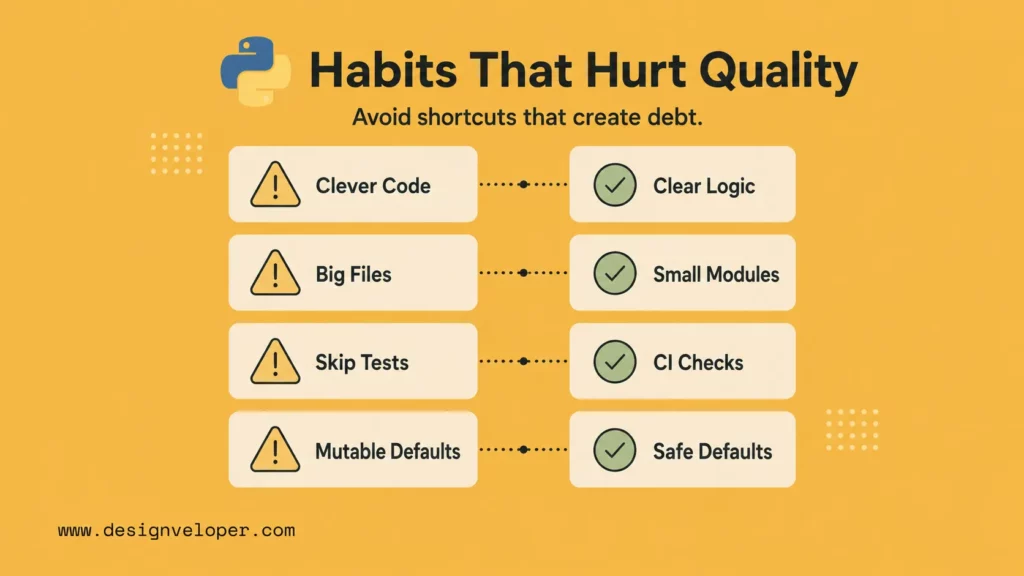
Python gives developers a lot of flexibility. That flexibility becomes expensive when a shortcut hides state, makes behavior implicit, or prevents a teammate from reproducing the result. Watch for these patterns during review:
- Clever code instead of clear code: prefer explicit control flow when a compact expression makes intent harder to scan.
- One giant module: split responsibilities when a file mixes transport, business rules, persistence, configuration, and integrations.
- Broad exception swallowing: do not catch everything, log a vague message, and continue with invalid data.
- Mutable default arguments: use
Noneand create a fresh object inside the function. - Hidden global state: pass clients, settings, and dependencies explicitly when tests or deployments need to swap them.
- Notebook-only production logic: move stable behavior into versioned modules with tests and repeatable execution.
- Delayed refactoring: improve names and boundaries while the relevant behavior is already understood and covered by tests.
# Risky: one list is reused across calls
def add_tag(tag, tags=[]):
    tags.append(tag)
    return tags

# Safer: create a fresh list when no value is provided
def add_tag(tag, tags=None):
    tags = [] if tags is None else tags
    tags.append(tag)
    return tags
The right response is not to ban every advanced language feature. It is to make behavior visible, document a deliberate exception, and add a test when the behavior matters. Reviewers should ask whether the next developer can safely change the code without hidden context.
Turn Python Best Practices Into A Team Workflow
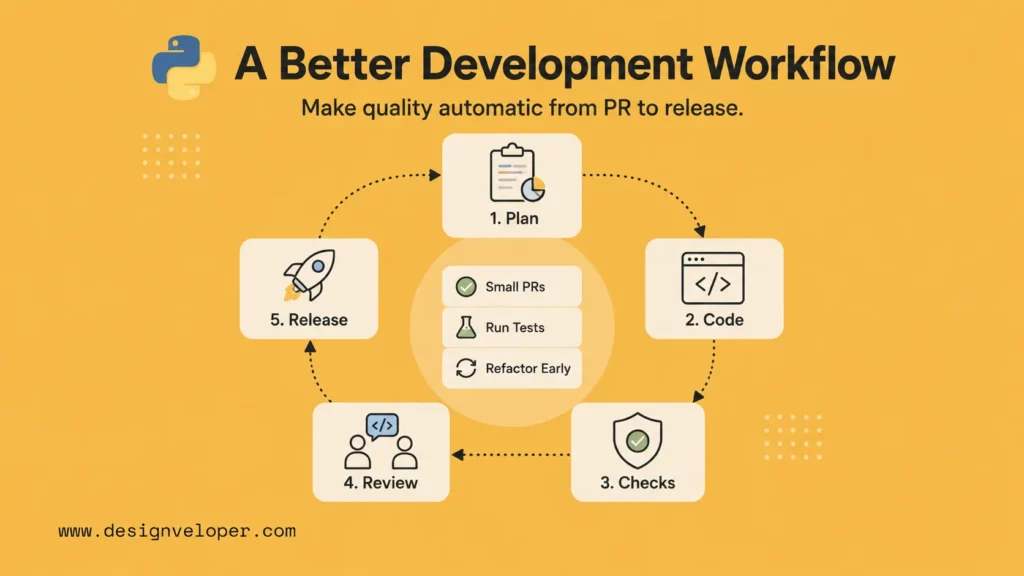
A checklist is useful only when it changes what happens before code is merged. A lightweight workflow can make good Python habits part of delivery without turning every pull request into a ceremony exercise.
- Clarify the behavior: define the user-visible outcome, edge cases, and failure modes before implementation.
- Choose the smallest boundary: decide which module, function, service, or API contract should own the change.
- Write or update tests: cover the happy path, important edge cases, and at least one meaningful failure path.
- Run automated checks: format, lint, type-check, and test locally before opening the pull request.
- Review for future change: ask whether the code is understandable, observable, secure, and safe to modify later.
A pull request template can keep the review focused: What changed? How was it tested? Which assumptions or risks remain? Does configuration, logging, documentation, or monitoring need an update? These questions are more useful than asking a developer to “follow best practices” without a concrete workflow.
# A small, repeatable local/CI command sequence
python -m ruff format src tests
python -m ruff check src tests
python -m mypy src
python -m pytest tests
For a larger team, this workflow fits naturally into the software development life cycle and a release process shaped by DevOps. The important point is continuity: the checks used by a developer, a pull request, and a deployment should agree about what “ready” means.
At Designveloper, this same concern appears in long-lived backend services, AI features, data workflows, and automation products. When a team needs help building or modernizing a Python-based product, our software development services can support architecture, implementation, testing, and post-launch improvement as one delivery conversation.
A useful long-term signal is boring reliability: new developers can onboard, CI failures are understandable, tests catch meaningful regressions, logs contain actionable context, and refactoring is normal work. When those signals are present, Python best practices have become part of the team’s engineering system.
For implementation and review ideas:
- Top 10 AI Code Review Tools & Best Practices For Implementation
- How Will AI Affect Software Development? Complete Guide
- Java Vs Python: Key Differences & Which Language Fits AI Better
FAQs About Python Best Practices
Should Python Teams Always Follow PEP 8?
Python teams should use PEP 8 as a strong default because shared formatting and naming conventions reduce review noise. A team can make a local exception when it clearly improves readability or fits an established interface, but the exception should be intentional, documented, and applied consistently.
Which Tools Help Enforce Python Best Practices?
A practical setup may include Ruff for formatting and linting, mypy or Pyright for type checking, pytest for tests, pre-commit for local hooks, and CI for repeatable checks. The best toolchain is the one developers understand and run consistently, not the one with the longest configuration file.
How Do You Keep Python Code Maintainable Over Time?
Keep code maintainable by making ownership and behavior visible: use clear names, small functions, predictable structure, focused tests, explicit errors, documented configuration, and regular refactoring. Revisit the boundaries when the product adds new integrations, runtimes, or teams.
When Should A Python Project Add Type Hints?
Start with boundaries where ambiguity is costly: public functions, API schemas, data-transfer objects, settings, and interfaces between services. Type hints can be adopted gradually; they are most valuable when a checker such as mypy or Pyright turns them into feedback rather than leaving them as decoration.
Conclusion
Python best practices are not a fixed list of style rules. They are the small decisions that help people understand, test, operate, and safely change a codebase. Start with readable names and focused functions, then make structure, configuration, tests, errors, security, and tooling support the way the team actually ships software.
The strongest practice is the one that removes a recurring source of confusion without adding unnecessary ceremony. When those decisions are documented and automated, Python stays flexible at the code level while becoming predictable at the team level.
Also published on

Share post on









Related Articles


Best Claude Model in 2026: Fable, Opus, Sonnet and Haiku
Best Claude Model in 2026: Fable, Opus, Sonnet and Haiku Published September 18, 2026
Generative AI Applications: 20 Practical Use Cases Across Industries
Generative AI Applications: 20 Practical Use Cases Across Industries Published September 18, 2026
Best ChatGPT Models in 2026: GPT-6 Astra and GPT-5.6 Guide
Best ChatGPT Models in 2026: GPT-6 Astra and GPT-5.6 Guide Published September 16, 2026