













Advanced RAG Techniques For Production-Grade AI Search

Advanced RAG improves a production RAG system by fixing measured failures in data preparation, retrieval, context assembly, generation, and evaluation. This decision-and-delivery guide to advanced rag shows how to choose the smallest effective technique for each failure, then validate it against a simple baseline before it reaches a real workflow.
This is a decision-and-delivery guide rather than a hands-on coding tutorial. It maps failure modes to techniques, shows a production architecture, defines evaluation levels, and covers governance, operating trade-offs, and rollout. The running example is an internal knowledge assistant that answers policy, workflow, and document questions.
What Advanced RAG Fixes After Naive RAG
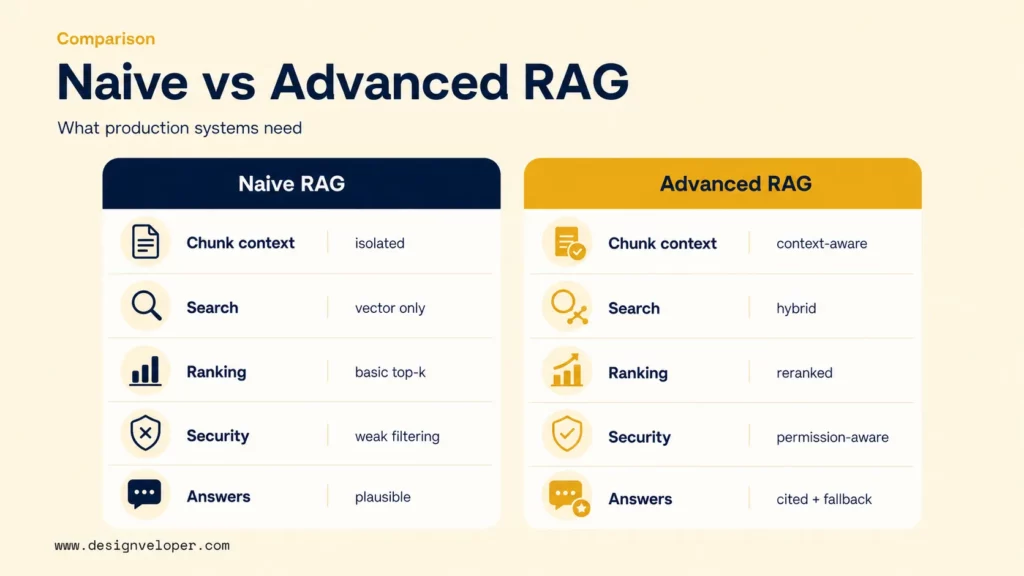
Advanced RAG strengthens the weak points that appear after a naive RAG demo. Production systems also face stale, duplicated, or unauthorized documents, ambiguous questions, long files, exact identifiers, and evidence gaps. The goal is to make retrieval and generation more traceable without turning every query into a complex workflow.
If you need a refresher on the baseline pattern, our guide to retrieval-augmented generation explains the core retrieve-then-generate flow. Advanced RAG keeps that idea but adds targeted controls around the stages that fail in production.
- Lost chunk context: a policy paragraph is retrieved without its department, effective date, or section title. Contextual retrieval and richer metadata can restore that meaning.
- Weak exact-term matching: vector search can miss product codes, acronyms, IDs, or policy names. Hybrid search combines lexical and semantic retrieval.
- Noisy top-k retrieved candidates: the first results contain useful evidence, but weak passages crowd it out. Reranking can move stronger support higher.
- Stale or unauthorized data: retrieval returns an old procedure or a source the caller should not see. Freshness metadata and permission-aware retrieval reduce that risk.
- Unsupported answers: the model writes a plausible response that the retrieved evidence does not justify. Citation checks and safe fallback behavior expose that gap.
- Regressions after change: a new prompt, index, model, or chunking rule lowers quality. Versioned evaluation makes the regression reproducible and reversible.
Consider an enterprise knowledge assistant asked, “Can a contractor approve a production release for Project Atlas?” A naive vector search may retrieve a general release policy and miss the contractor exception. An advanced pipeline can preserve the policy hierarchy, search exact project terms, rerank the exception clause, and return a cited answer or a clear fallback when support is incomplete.
Map The Advanced RAG Architecture
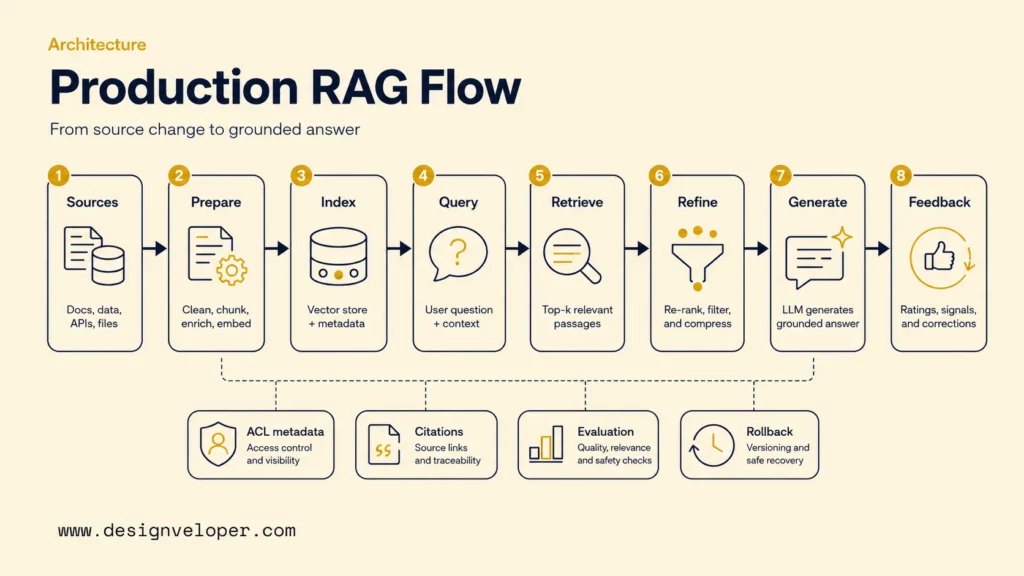
A production architecture should separate data preparation from query-time retrieval, then connect both to answer generation and a feedback path. Microsoft Architecture Center describes a similar RAG flow: chunk source content, enrich it with metadata, create embeddings, persist it, retrieve grounding data, and evaluate the system. See Microsoft’s RAG solution design and evaluation guide for that vendor-specific model.
The visual below follows the enterprise knowledge assistant from source change to answer. The native list beneath it preserves the same sequence for readers who prefer a linear workflow.
Policies, SOPs, tickets, product docs
Parse, chunk, enrich, preserve ACL metadata
Text index, vectors, metadata
Rewrite, expand, route when needed
Keyword + vector candidates
Deduplicate, rerank, filter
Fit the strongest evidence to budget
Answer, citations, fallback
Check retrieval and answer quality
Fix data, retrieval, prompt, or policy
- Collect approved sources and record ownership, freshness, and access metadata.
- Parse and chunk documents without losing headings, tables, dates, or parent sections.
- Create text and vector indexes with the metadata needed for filtering and traceability.
- Transform or route the user query only when the direct query is not enough.
- Retrieve a broad candidate set from the relevant indexes.
- Remove duplicates, filter weak passages, and rerank candidates against the question.
- Assemble the best-supported evidence within the context-window budget.
- Generate an answer with citations and a fallback when evidence is insufficient.
- Evaluate retrieval and answer behavior against the production test set.
- Feed failures back to the source, retrieval, prompt, or governance owner.
The key boundary is between candidate retrieval and answer generation. Teams should be able to inspect what was retrieved, what was removed, and what evidence reached the model. Detailed release metrics and rollback rules belong in the evaluation section below.
Prepare Data And Indexes
Prepare the knowledge base before tuning prompts. For the policy assistant, each source should have an owner, refresh rule, effective date, document type, permission scope, and deduplication rule. Preserve section titles, table labels, headings, and parent-child relationships because those fields help a retrieved chunk retain its original meaning.
Semantic chunking groups content by meaning or document structure instead of relying only on a fixed token count. That approach is useful when policies, tables, procedures, and nested sections should not be split at arbitrary boundaries. Keep access control list (ACL) metadata with the chunks when the source system uses ACLs to define who may read a document.
Contextual retrieval adds a short chunk-specific explanation before embedding or indexing so an isolated passage keeps more of its document-level meaning. In Anthropic’s Contextual Retrieval experiments, contextual embeddings plus contextual BM25 reduced the top-20 retrieval failure rate from 5.7% to 2.9% on Anthropic’s test data. Adding reranking reduced it further to 1.9%. These are experiment results, not a universal production benchmark.
Retrieve, Route, And Expand Queries
Start with the simplest retrieval that covers the question types. Hybrid search is a strong default when users mix natural language with exact terms. In Azure AI Search, text queries use BM25, while vector queries can use Hierarchical Navigable Small World (HNSW) or exhaustive K-nearest neighbors (KNN). Hybrid queries merge text and vector result lists with Reciprocal Rank Fusion, as described in Microsoft’s Azure AI Search relevance and ranking overview.
Query rewriting and multi-query expansion can help when one phrasing is too narrow. Hypothetical Document Embeddings (HyDE) generates a hypothetical answer or document, embeds it, and retrieves passages that are similar to that generated text. Synthetic questions use generated example questions to improve matching or expand coverage. These methods require additional model calls and may introduce retrieval noise, so test them only against misses that a direct query cannot solve.
Routing matters when one assistant searches several domains or indexes. A benefits question can go to HR content while a release question goes to engineering policy. Agentic RAG lets a model choose tools, retrieval steps, or routes during a multi-step task; deterministic routing follows predefined rules. Keep routing deterministic when those rules are enough. The final FAQ explains when agentic behavior becomes justified. Our guide to agentic AI architecture covers that broader pattern.
Compress, Rerank, And Generate Answers
Initial retrieval should favor coverage, while the next stage should favor support. Remove duplicate or low-support passages, then rerank the remaining candidates against the actual question. Permission filtering should already have excluded unauthorized evidence before candidate text reaches generation; the deployment section defines the acceptance tests for that requirement.
Then assemble a context set that fits the model budget without crowding out stronger evidence. Keep the source title, section, date, and citation identifier attached to each passage. The generation prompt should require a structured answer, cite supporting sources, and state when the evidence is incomplete.
Our RAG pipeline diagram guide covers the simpler pipeline. A production version adds traceability around retrieval decisions and context selection before the model writes the answer.
Match Advanced RAG Techniques To Real Failure Modes
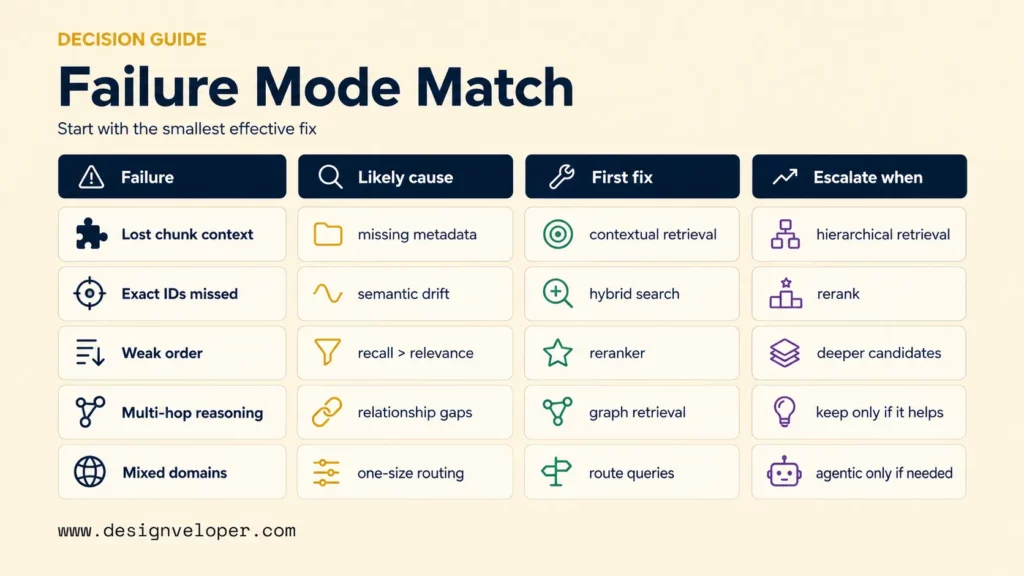
The central question is which measured failure needs fixing. Start with the lowest-complexity intervention, then add another layer only when evaluation shows a remaining gap. GraphRAG in this section means a family of graph-based retrieval patterns that use entities and relationships; it does not imply one vendor implementation.
Use the table as a decision aid rather than a feature checklist. Each row starts with an observable failure, then points to the smallest first fix.
| Observed failure | Likely cause | First fix | When to increase complexity |
|---|---|---|---|
| Retrieved chunks lose meaning outside the full document | Chunks lack titles, parent sections, dates, or local context | Add contextual retrieval or richer metadata | If context still fragments across long documents, test structure-aware or hierarchical retrieval |
| Long or mixed documents split important ideas badly | Fixed-size chunking ignores semantic or document boundaries | Use semantic or structure-aware chunking | If answers require relationships across distant sections, consider hierarchical or graph-based indexing |
| Exact IDs, acronyms, product names, or policy codes are missed | Dense vector retrieval overweights semantic similarity | Combine keyword/BM25 with vector search | If candidate volume stays noisy, tune fusion or add reranking |
| Top-k retrieved candidates contain relevant evidence but order it badly | First-stage retrieval favors recall over final relevance | Add a reranker after candidate retrieval | Increase candidate depth only when evaluation shows the right evidence is present but ranked too low |
| Questions require multi-hop relationships across documents | Plain chunks do not encode entity and relationship structure | Test graph-based retrieval and GraphRAG | Keep it only when relationship-aware retrieval improves the measured multi-hop cases enough to justify extra indexing work |
| One assistant spans several domains | A single retriever searches everything with the same logic | Route queries to the correct index or retriever | Use learned or LLM-based routing only when deterministic rules become too brittle |
| The task needs branching tool use or repeated retrieval | A fixed retrieval path cannot complete the workflow | Keep a deterministic workflow where possible | Consider agentic RAG only when the required branching cannot be expressed cleanly with fixed rules |
Each row should map to a reproducible test. If the policy assistant misses “Atlas-REL-204” because dense retrieval treats the identifier as noise, hybrid retrieval is a direct fix. Graph-based retrieval would add work without addressing that measured failure.
A strong retrieval result is not enough if the team cannot trace the answer back to its supporting passages.
Evaluate Advanced RAG Beyond Demo Accuracy
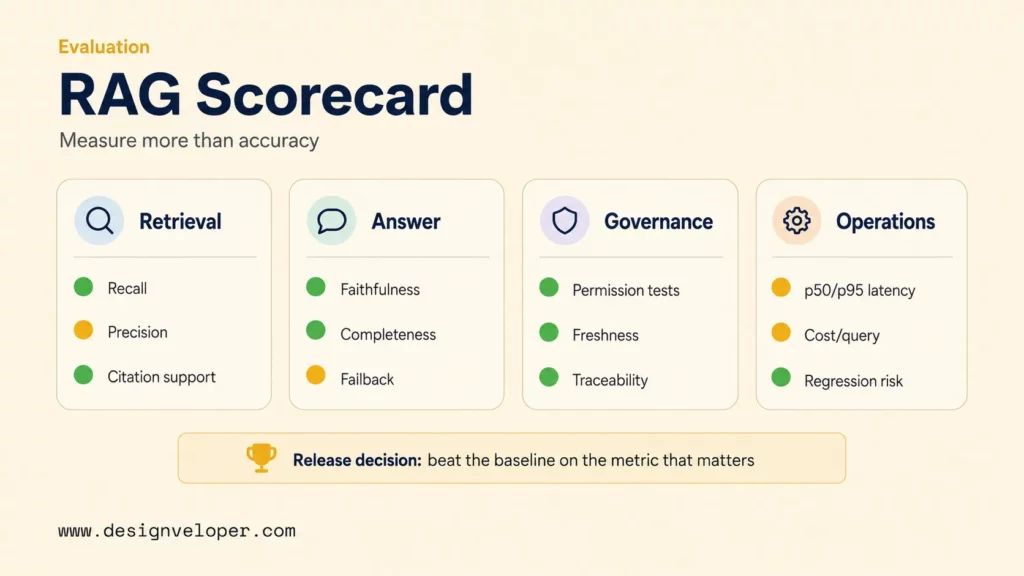
A production RAG evaluation set should reflect how people actually fail the system, not only how a demo succeeds. Build a golden set from common questions, edge cases, unsupported requests, ambiguous wording, stale-policy scenarios, and permission boundaries. Keep the expected evidence and expected behavior with each query so the same cases can be replayed after index, prompt, retriever, reranker, or model changes.
Measure retrieval before judging the final answer by tracking retrieval recall, precision, citation support, faithfulness, and completeness. Define each metric at the level where it is meaningful. Retrieval metrics usually operate on chunks or documents, while faithfulness and citation support are easier to inspect at the claim level. Completeness is usually an answer-level check against the expected points.
Microsoft Foundry’s RAG evaluator documentation separates final-response checks such as groundedness, relevance, and completeness from retrieval quality. That separation matters because a fluent answer can hide a weak retrieval stage.
Use the categories below to define thresholds for your workflow risk and baseline. Do not copy generic thresholds from another system. A release gate should compare the candidate version with the simple RAG baseline and state what level of regression is acceptable for the workflow.
The table below makes the scorecard operational by showing where each metric is measured and what the result should represent.
| Metric | Evaluation level | Practical definition |
|---|---|---|
| Retrieval recall | Chunk or document | Share of expected supporting evidence that appears in the retrieved set |
| Retrieval precision | Chunk or document | Share of retrieved items that are relevant to the question |
| Citation support | Claim | Share of evidence-requiring claims that point to a source that actually supports them |
| Faithfulness | Claim | Share of evaluated claims that are supported by the supplied context |
| Completeness | Answer | Share of expected answer points covered without inventing unsupported detail |
| Latency | Query | Track p50/p95 latency, meaning the median and 95th-percentile response time |
| Cost per query | Query | Total retrieval, reranking, model, and supporting runtime cost for one request |
Version the prompt, chunking configuration, embedding model, index snapshot or schema, retriever, reranker, and generation model with the evaluation result. That release manifest makes a regression reproducible and gives the team a concrete rollback target. A cheaper or slightly weaker system can still be the right choice when it meets the required thresholds with lower operating cost.
Human review is a risk control, not a universal requirement. Add it when the workflow has high impact, difficult-to-reverse actions, regulatory obligations, or a low tolerance for unsupported answers. Low-risk internal lookup may not need the same approval path.
Deploy Advanced RAG In Enterprise Workflows
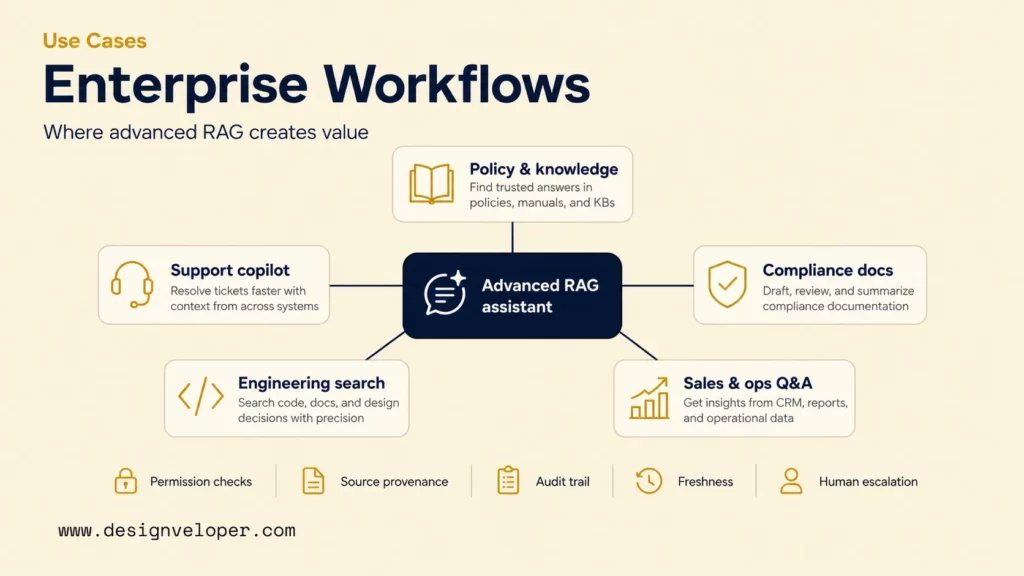
Advanced RAG creates the most value when a workflow depends on private, changing, or scattered knowledge. Typical uses include internal knowledge assistants, customer support copilots, document-heavy compliance work, engineering search, and sales or operations Q&A.
The deployment question is not only, “Can the assistant find the answer?” Teams also need to know whether the caller may see the evidence and whether the source can be audited. They also need a clear response when support is weak. Those questions turn retrieval quality into a workflow and governance problem.
- Permission enforcement: treat pre-generation permission filtering as an implementation requirement. The retrieval layer should exclude evidence the caller cannot read.
- Source provenance: retain document ID, owner, date, section, and citation data through retrieval and generation.
- Audit trails: log the query, route, retrieved evidence, filters, model version, final answer, and fallback outcome when the workflow needs traceability.
- Data freshness: define how quickly an approved source change must reach the searchable index.
- Human escalation: route high-impact or unsupported cases to a person when workflow risk, reversibility, or regulatory context justifies it.
Permission behavior needs explicit acceptance tests. Test a normal user, a group member, a cross-tenant identity where relevant, inherited permissions, a deleted user, and a newly restricted document. The pass condition is observable: a query must not return or expose content that the current caller cannot read in the source system.
Microsoft’s Azure AI Search document-level access control guide documents preview identity-based document access patterns in the 2026-05-01-preview REST API, including SharePoint ACL ingestion. Microsoft also warns that permission changes can take time to reach the index. Teams using these features should verify the API and SDK status again before release.
Security should connect to workflow outcomes. For the policy assistant, a permission leak could expose a confidential HR clause or an internal release record. A freshness failure could return a superseded policy. A missing provenance field could make an otherwise correct answer impossible to audit.
Control Cost, Latency, And Maintenance
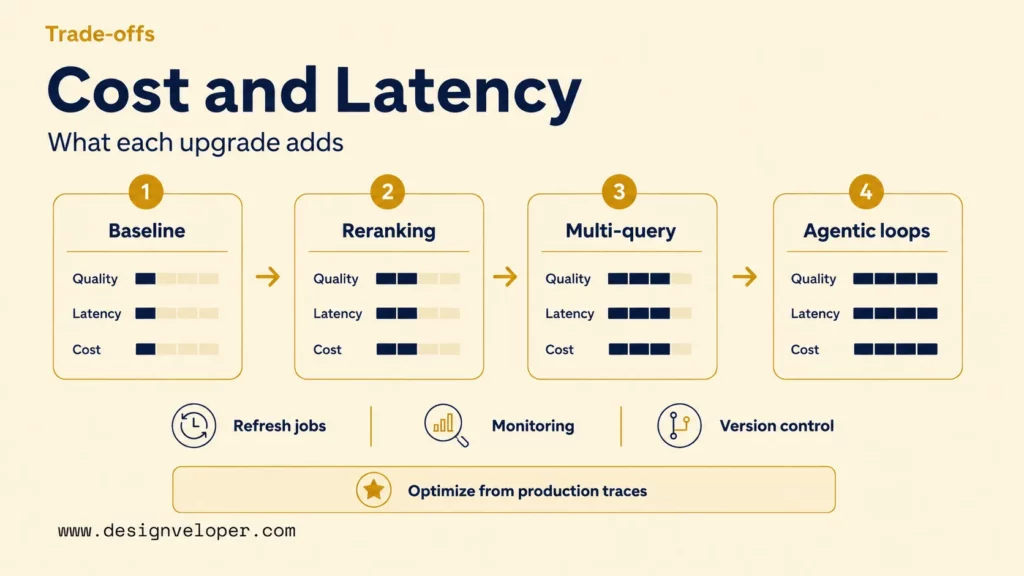
Operating cost comes from both offline preparation and per-query runtime. Offline work covers parsing, contextual enrichment, embeddings, indexing, and refresh. Runtime work covers retrieval, reranking, and generation. Evaluation and monitoring add a separate operating budget that should not be hidden inside model cost.
Latency rises as more stages enter the query path. A direct vector lookup may need one retrieval call, while multi-query search can issue several. Reranking adds another stage. Agentic loops can repeat retrieval or tool use, so they usually create more variable tail latency than a fixed path. Track p50/p95 latency, meaning the median and 95th-percentile response time, rather than one average.
- Reranking: improves ordering when relevant evidence is already in the candidate set, but adds runtime work.
- Larger context windows: can preserve more evidence, but may increase generation cost and introduce distracting passages.
- Multi-query retrieval: can improve coverage for ambiguous queries, but multiplies retrieval work and may introduce extra noise.
- Agentic loops: may help with branching multi-step tasks, but add the largest variance in latency, cost, and auditability. Use the deterministic-versus-agentic criteria in the final FAQ before adding them.
These trade-offs should feed the rollout plan below; they are not reasons to adopt every technique at once. Use production traces to identify which stage consumes time or budget before optimizing it.
Tail latency and cost per query often reveal production problems that demo accuracy does not.
Plan A Production RAG Roadmap
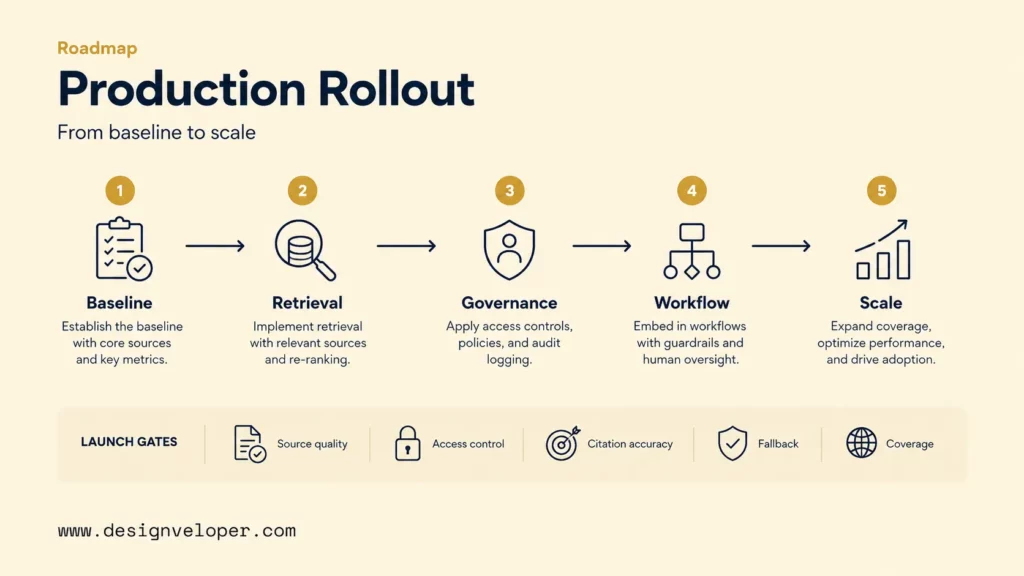
A production roadmap should make ownership, deployment order, maintenance, and rollback explicit. The evaluation section already defines how to set release thresholds. This section focuses on who owns each stage and how the system moves from baseline retrieval into a governed workflow.
- Baseline: data owners approve source quality while the product team defines the fallback experience.
- Retrieval: search or AI engineers own chunking, indexing, query handling, and reranking changes.
- Governance: security and product owners define release authority, logging, incident handling, and rollback responsibility.
- Workflow: the business process owner confirms that escalation, evidence, and human handoff match the real operating process.
- Scale: operations owners tune refresh, caching, model choice, and infrastructure from measured production demand.
Before the baseline launches, apply the thresholds already defined in the evaluation section. The minimum gate should also cover source quality, access control, citation accuracy, fallback behavior, and enough evaluation coverage for the target workflow. The roadmap should not introduce a second scoring system.
Maintenance needs a named owner for source changes, index refreshes, prompt updates, model changes, and incident response. Keep a rollback path to the previous release manifest so the team can restore the last known configuration when quality drops.
FAQs About Advanced RAG
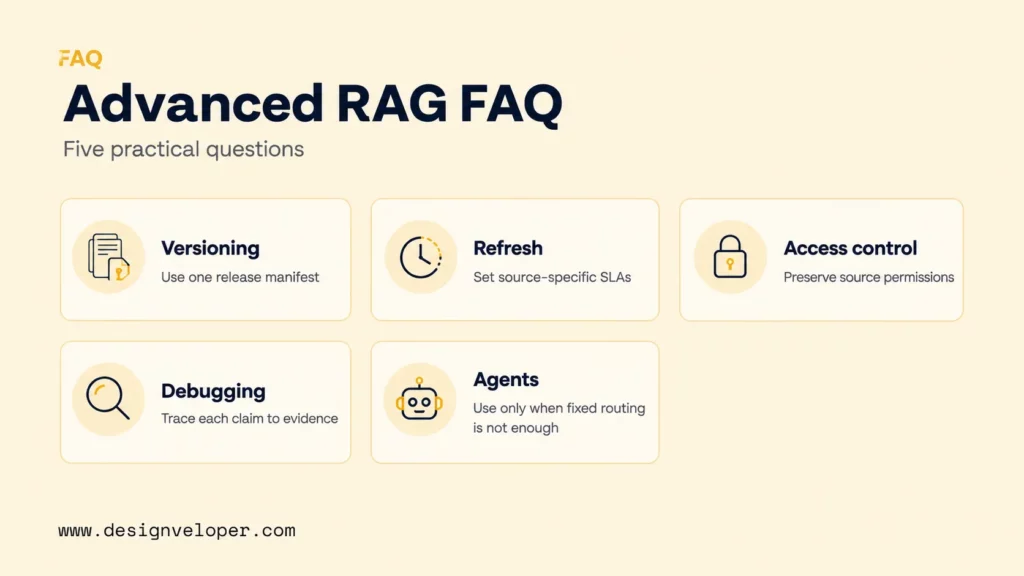
How Do You Version Advanced RAG Prompts And Indexes Together?
Bundle them into one release manifest. Store the prompt, chunking rule, embedding model, index snapshot or schema, retriever, reranker, and generation model under the same release ID. Link that manifest to the evaluation run described above so rollback means redeploying a known configuration rather than reconstructing it from memory.
How Often Should An Advanced RAG Index Be Refreshed?
Refresh the index according to source-change risk, not a universal schedule. A quarterly policy source may need event-driven checks around publication dates, while support or product-status data may need much shorter intervals.
Define a freshness service level for each source and measure the delay between an approved change and searchable availability. Include deletions and permission changes because stale access metadata can be more dangerous than stale text.
What Access-Control Rules Should Advanced RAG Preserve?
Preserve the source system’s effective read permissions at retrieval time. Reuse the user, group, tenant, inheritance, deletion, and reclassification tests defined in the deployment section rather than creating a second permission model for RAG.
How Do You Debug An Answer That Looks Correct But Is Unsupported?
Trace the answer backward from each claim to the context that reached the model. Check whether the cited chunk actually supports the claim, then inspect whether a stronger source was retrieved but filtered out, ranked too low, or lost during context assembly.
If the evidence never entered the candidate set, debug retrieval. If the right evidence reached the model but the answer added unsupported detail, debug generation and fallback behavior. Add the case to the golden set so the same failure becomes a regression test.
When Should Advanced RAG Stay Deterministic Instead Of Using Agents?
Keep Advanced RAG deterministic when the workflow has a known sequence and a fixed retrieval path can meet the release target. Policy lookup, document search, and many support questions benefit from predictable routing, bounded latency, simpler testing, and clearer audit trails.
Use agentic RAG when the task genuinely requires dynamic planning, tool selection, repeated retrieval, or branching based on intermediate results. That flexibility adds cost, latency variance, and more behavior to test. Human approval is appropriate when the agent can trigger high-impact or hard-to-reverse actions, or when regulatory context requires review; it is not a blanket requirement for every agentic workflow.
Teams that need help moving an advanced rag system from prototype to governed production can work with us through our AI development services. We can support enterprise integration, retrieval evaluation, and workflow-connected delivery. We start with one workflow, one acceptance suite, named owners, and a rollback path before expanding the architecture.
Also published on

Share post on









Related Articles


Agentic AI Single Vs. Multi-Agent Systems: When To Use Each One
Agentic AI Single Vs. Multi-Agent Systems: When To Use Each One Published October 19, 2026
Is Vibe Coding Legal? Ownership, Copyright, and Release Risks
Is Vibe Coding Legal? Ownership, Copyright, and Release Risks Published October 16, 2026
How Will AI Affect Software Development? Complete Guide
How Will AI Affect Software Development? Complete Guide Published October 16, 2026