
















DevOps Best Practices: 10 Ways To Improve Speed And Reliability

KEY TAKEAWAYS:
- DevOps works best when teams combine culture, automation, and shared ownership instead of treating it as only a tooling upgrade.
- High-performing teams usually improve delivery through CI/CD, infrastructure as code, automated testing, observability, DevSecOps, and smaller releases working together.
- The strongest DevOps practices reduce both speed and stability tradeoffs by using progressive delivery, rollback readiness, and continuous feedback loops across the lifecycle.
- Teams adopt DevOps more successfully when they start with one high-impact workflow, remove bottlenecks early, and standardize environments before scaling automation.
If you are planning to implement the DevOps process, understanding the concept alone is not enough. Teams also need practical ways to improve release speed, reduce deployment risk, and keep software quality stable while systems grow.
That is why DevOps best practices matter. In this guide, you will see the core practices behind DevOps, then the top 10 habits high-performing teams use to turn those ideas into reliable delivery workflows. If you want the tooling angle as well, it also helps to understand the DevOps tools that usually support these practices in production environments.
Related articles:
- What Is A DevOps Engineer? Skills And How To Become One
- What Is MLOps? Understanding MLOps Lifecycle and How It Works
- What Is DevSecOps? Shift‑Left Security in Modern DevOps
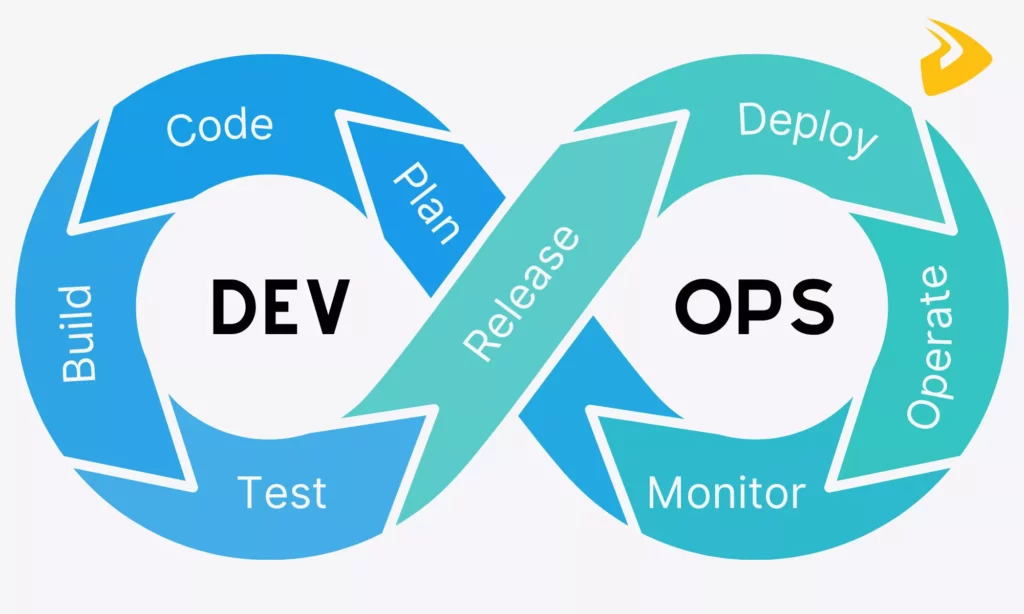
The guide moves from the DevOps model to practical delivery habits, then shows how teams can roll out improvements in a controlled way.
What Is DevOps?
DevOps is a working approach that brings development and operations teams closer together. Instead of letting those teams work separately in isolated phases, DevOps encourages them to share responsibility across the full software lifecycle.
In practice, that means a continuous loop of build, test, release, monitor, and improve. Teams rely on practices such as CI/CD, automated testing, infrastructure as code, and real-time feedback to reduce manual errors and accelerate deployments without sacrificing quality.
A traditional workflow may force developers to hand finished code to operations at the end, which often creates delays and expensive rework. In a DevOps model, operations gets involved much earlier to help shape infrastructure, deployment logic, and runtime readiness while developers are still building. That shared involvement is what makes faster and safer delivery possible.
Importance Of DevOps
DevOps matters because modern software teams need both speed and reliability, not one at the expense of the other. According to Research and Markets, the DevOps market is projected to reach $18.77 billion in 2026 and keep growing at a 25.8% CAGR through 2030.

That momentum reflects a wider shift in how delivery teams operate. DevOps helps organizations in several practical ways:
- Faster time to market: Teams can release updates more frequently while maintaining quality.
- Improved collaboration: Developers and operations work toward shared outcomes instead of passing work across silos.
- Higher software quality: Continuous testing and monitoring catch issues earlier, when fixes are still cheap and manageable.
- Greater system reliability: Automation and environment consistency make deployments more predictable.
- Scalability and flexibility: Practices such as infrastructure as code make it easier to scale environments without rebuilding everything manually.
- Better customer experience: Smaller, safer releases usually mean more stable products and faster fixes for users.
Core DevOps Practices
Before teams adopt best practices, they need to understand the core capabilities DevOps is built around. These ideas shape how delivery workflows become faster, safer, and easier to scale.
- Continuous Integration (CI): Developers frequently integrate code into a shared repository where builds and tests run immediately.
- Continuous Delivery and Deployment (CD): Teams automate release preparation and, in some cases, production deployment.
- Infrastructure as Code (IaC): Infrastructure is defined in code so environments remain consistent and repeatable.
- Monitoring, Logging, and Observability: Teams track system behavior in real time and investigate why failures happen, not only that they happened.
- Microservices: Smaller independent services can improve flexibility and scaling, although they also increase operational complexity.
- Shift-Left Security and Testing: Security and quality checks move earlier in the delivery process.
- Version Control: Teams track code and infrastructure changes through systems like Git to support audits, reviews, and rollbacks.
- Collaboration, Automation, and Continuous Feedback: Shared ownership and fast feedback loops make the other practices work in a meaningful way.
Top 10 DevOps Best Practices For High-Performing Teams
The core practices above are the foundation. What high-performing teams do differently is turn those ideas into habits that fit their real delivery constraints, product architecture, and release pace.
1. Use Agile Planning To Support Continuous Delivery
Agile planning supports continuous delivery because it encourages incremental work instead of large, monolithic release batches. That makes it easier for teams to build, test, and ship smaller changes with less risk.
To make Agile planning support DevOps more effectively, teams should:
- Break work into deployable increments. Smaller features are easier to validate and release independently.
- Align sprint cycles with release cadence. If releases happen daily or weekly, planning should reflect that rhythm.
- Prioritize flexibly through backlog refinement. Teams should adjust priorities based on feedback instead of following rigid long-range plans.
- Integrate DevOps tasks into the backlog. Pipeline improvements, environment work, and infrastructure changes should stay visible, not live as invisible side work.
This is one reason many teams combine DevOps with Jira for Agile project management and broader Agile versus Scrum decision-making.
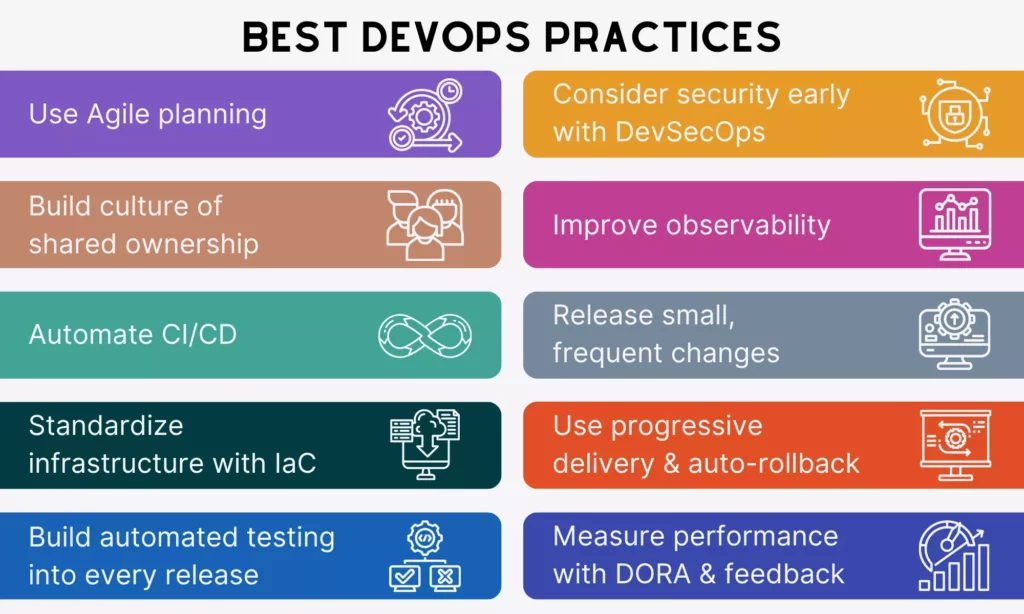
The remaining practices apply this same discipline to team culture, automation, quality, security, and operational feedback.
2. Build A Culture Of Shared Ownership And Collaboration
DevOps fails when development and operations still optimize for separate goals. Shared ownership matters because delivery reliability depends on how well people coordinate, not only on which tools they install.
Teams can strengthen that culture by:
- Encouraging cross-functional teams. Developers, operators, and QA should work toward the same product outcome.
- Creating shared metrics. Indicators like deployment frequency and change failure rate keep attention on system-level outcomes.
- Running joint retrospectives. Reviewing incidents together reduces blame and improves shared understanding.
- Building a blameless culture. Teams learn faster when they fix systems instead of searching for someone to blame.
3. Automate Continuous Integration And Continuous Delivery
Automation is the operational backbone of DevOps, and CI/CD is one of the clearest ways that backbone appears in real projects.

To automate CI/CD effectively, teams should:
- Start small, then expand pipelines. Begin with automated builds and unit tests, then add broader validation when the core flow is stable.
- Use version control for everything. Application code, infrastructure definitions, and pipeline configurations should all stay traceable.
- Implement deployment automation with smart release strategies. Feature flags, blue-green deployment, and controlled rollouts reduce release risk.
- Implement automatic rollbacks. Systems should revert quickly when deployment health checks fail.
- Build once and deploy consistent artifacts. Packaging applications into stable deployable artifacts helps environments behave more predictably.
Teams that want to go deeper into this area should understand both the DevOps pipeline and the role of a CI/CD pipeline inside it.
4. Standardize Infrastructure With Infrastructure As Code
Infrastructure as Code helps teams provision and manage resources in a repeatable, machine-readable way instead of relying on manual environment setup.
Teams usually improve consistency here by:
- Using declarative configuration tools. Platforms like Terraform, CloudFormation, or OpenTofu help teams define the desired infrastructure state clearly.
- Modularizing infrastructure code. Reusable modules reduce duplication and make large systems easier to maintain.
- Versioning infrastructure code. Infrastructure should be reviewed and tracked just like application code.
- Adding automated validation. Tools such as Checkov or policy enforcement layers help catch risky misconfigurations before deployment.
- Monitoring for drift. Teams should watch for differences between the intended state and the actual runtime environment.
5. Build Automated Testing Into Every Release
In DevOps, speed without quality creates production incidents that are harder to fix later. That is why testing has to be built into the release path instead of treated as a final checkpoint.

Teams usually do this better when they:
- Implement multiple testing layers. Unit, integration, and end-to-end checks catch different categories of failure.
- Run tests automatically in CI/CD. Every commit or pull request should trigger validation without waiting for manual intervention.
- Prioritize fast and reliable tests. Slow or flaky tests weaken trust in the delivery system.
- Review and refactor tests continuously. Test suites have to evolve with the application.
- Shift testing earlier. Writing tests alongside code reduces rework and keeps feedback loops short.
6. Shift Security Left With DevSecOps
Traditional security reviews often arrive too late, which turns security into a release bottleneck. DevSecOps helps teams move security checks earlier so vulnerabilities are easier to find and cheaper to fix.
Teams can implement that shift by:
- Integrating security into CI/CD. SAST, SCA, DAST, and dependency scanning should run as part of the delivery workflow.
- Automating security testing. Repeated scans help teams catch exposed secrets, risky configurations, and known vulnerabilities consistently.
- Training developers in secure coding. Security becomes stronger when engineers understand common risks while building.
- Using policy-as-code. Security and compliance rules can be enforced automatically during builds and deployments.
7. Improve Observability Across Every Layer
It is not enough to know that something failed. Teams also need to understand why it failed and how that failure moved through the system.
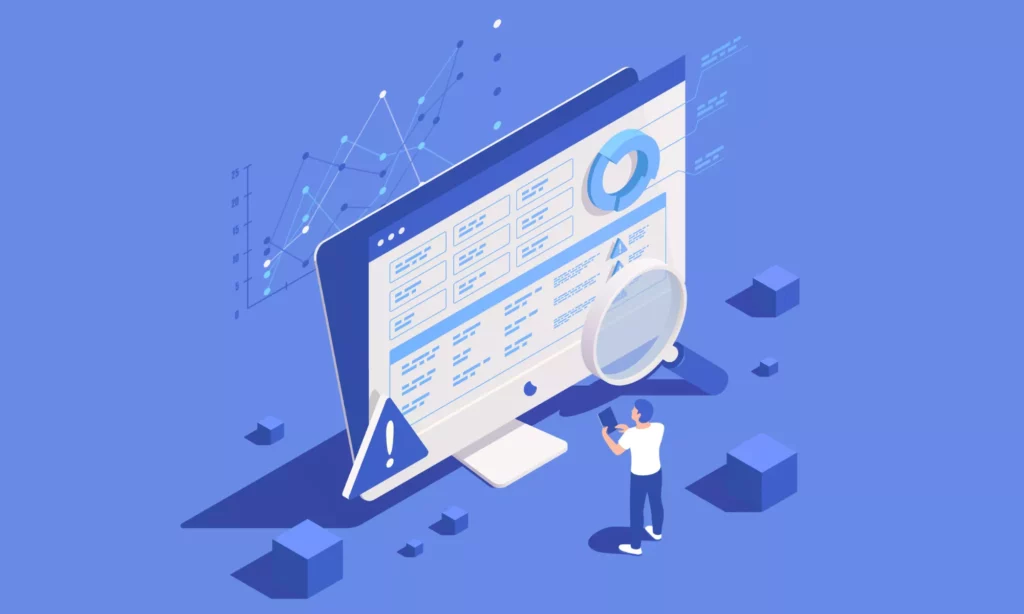
Practical ways to improve observability include:
- Collecting metrics, logs, and traces. These signals together show system health, event history, and request flow.
- Centralizing monitoring tools. Shared dashboards help teams compare behavior across services and environments.
- Setting meaningful alerts. Alert fatigue is reduced when thresholds reflect real incidents instead of noise.
- Refining observability continuously. Dashboards, traces, and alerts should evolve with the architecture.
This is also where the observability side of the DevOps toolchain becomes critical, especially when releases are happening more frequently.
8. Use Progressive Delivery With Auto-Rollback
Progressive delivery reduces release risk by exposing changes gradually instead of pushing them to everyone at once. Auto-rollback strengthens that pattern by reverting quickly when health signals degrade.
Teams usually improve here when they:
- Automate the rollback process. Reversions should happen quickly when failures cross known thresholds.
- Use canary or blue-green strategies. Smaller rollout groups reduce blast radius.
- Define rollback conditions clearly. Error spikes, latency jumps, or health-check failures should have explicit response rules.
- Monitor rollout health continuously. Delivery decisions should be driven by live system behavior, not guesswork.
9. Release Smaller Changes More Frequently
Smaller releases are easier to test, debug, and deploy. They also reduce the scope of any single failure, which is why they are one of the most reliable habits in mature DevOps teams.

To keep that rhythm sustainable, teams should:
- Break features into smaller increments. Smaller units move through the pipeline faster and with less uncertainty.
- Automate as many deployment steps as possible. Repeated manual work slows the cycle and adds error risk.
- Use safe release strategies. Feature flags, canary releases, and blue-green deployment help teams ship often without exposing everyone at once.
10. Measure Performance With DORA Metrics And Continuous Feedback
Moving fast matters, but teams still need evidence that their delivery system is improving in the right direction. DORA metrics and continuous feedback give them that visibility.
Below is a simple way to think about those four DORA metrics:
| Speed | Stability |
| – Deployment Frequency (DF): How often successful code reaches production. – Lead Time for Changes (MLTC): How long it takes a code change to move from commit to production. | – Change Failure Rate (CFR): The percentage of deployments that introduce failures. – Time to Restore (MTTR): How quickly teams recover when failures happen. |
Used together, these metrics show whether teams are accelerating delivery while keeping systems reliable. They become much more useful when combined with real feedback from incidents, dashboards, retrospectives, and user-facing problems.
- Review DORA metrics regularly alongside incident reports and user feedback
- Use dashboards to track trends and surface bottlenecks over time
- Adjust workflows based on both data and real-world outcomes
- Encourage cross-team discussions so improvements reflect actual system behavior
How To Implement DevOps Successfully
DevOps adoption usually fails when teams try to transform everything at once. A more reliable path is to improve one important workflow, learn from it, and scale gradually.
- Start with one high-impact workflow. Focus on the delivery area causing the most friction first, such as slow deployments or unstable testing.
- Remove bottlenecks before scaling automation. Automating a broken process usually just helps it fail faster.
- Standardize environments across development, test, and production. Consistency reduces the risk of environment-specific surprises later in the pipeline.
- Improve continuously through measurement and feedback. No pipeline is perfect, so teams need to keep learning from results and adjusting accordingly.
Further reading:
- Web Application Architecture: Types, Components, and Tools
- What Is Agile Software Development? Methodologies and Benefits
- Agile Vs. Waterfall Vs. Scrum Vs. Kanban: Key Differences

Use this rollout sequence as a starting point, then adjust the pace to your team’s release risk, system complexity, and measurement results.
Conclusion
Understanding DevOps and adopting tools are only part of the picture. Real improvement usually comes from how teams apply the right practices around planning, CI/CD automation, infrastructure as code, testing, security, observability, progressive delivery, and continuous feedback.
Applying those practices effectively is where experienced implementation support can make a real difference. At Designveloper, teams combine Agile and DevOps thinking to deliver software in smaller, manageable increments while keeping releases stable and predictable.
That approach helps support SaaS platforms, websites, and mobile applications with clearer collaboration, stronger delivery workflows, and better long-term maintainability. If your team is planning a broader rollout, our software development services can help bridge planning, engineering, and DevOps execution more effectively.
If you are planning to adopt DevOps in software delivery, contact us.
Also published on

Share post on










Related Articles



Types of Agile Development Methodology: Key Approaches Compared
Types of Agile Development Methodology: Key Approaches Compared Published October 14, 2026
Agile Methodology Testing: Lifecycle, Quadrants & Team Practices
Agile Methodology Testing: Lifecycle, Quadrants & Team Practices Published October 13, 2026
What Is an Agile Team? Structure, Roles, and How to Build One
What Is an Agile Team? Structure, Roles, and How to Build One Published October 13, 2026