














What Is A DevOps Engineer? Skills And How To Become One

KEY TAKEAWAYS:
- A DevOps engineer is a job title; DevOps is a way teams share delivery and operational work. Start with what DevOps means before treating either as a fixed organization chart.
- Daily work may include CI/CD, infrastructure as code, cloud environments, monitoring, and incident response, while developers and operations still share responsibility for production.
- A useful learning project should show a working pipeline, an infrastructure change, a monitored staging deployment, and a tested recovery path.
- Compare DevOps, cloud, and SRE roles by their real ownership, on-call expectations, and success measures, not by title alone.
A DevOps engineer can build delivery platforms, improve release workflows, support cloud infrastructure, or combine several of those jobs. The title does not tell you which systems the person owns or whether the wider team shares production responsibility. That distinction matters if you are exploring the career or deciding what a team needs. This guide explains the role, its common responsibilities and skills, when dedicated DevOps capacity helps, and how to build practical evidence for an entry-level application.
What Is A DevOps Engineer?
A DevOps engineer is a technology professional who builds or improves the systems and practices that help teams deliver and operate software. The work often spans development, IT operations, security, testing, and cloud or platform engineering. It may include automating builds and deployments, managing infrastructure, improving monitoring, or helping teams respond to production issues.
DevOps itself is broader than a job title. Google Cloud describes DevOps as an organizational and cultural movement centered on software delivery, service reliability, and shared ownership. A company can organize that work in a central platform team, a dedicated DevOps group, or product teams that own more of their own delivery and operations.
The title therefore has no single universal boundary. One employer may expect a DevOps engineer to maintain CI/CD tooling and infrastructure. Another may focus the role on developer platforms, cloud foundations, or reliability work. Atlassian’s role guide also notes that responsibilities vary by organization. In every model, the person improves shared systems; they do not automatically become the sole owner of every release, security decision, or production incident.
The distinction gives readers two useful questions: what does the DevOps model change, and what will this job own? Read the job description for its service scope, pipeline duties, infrastructure decisions, and on-call expectations.
Further reading:
- What Is A DevOps Pipeline? A Complete Guide To Building One
- DevOps Best Practices: 10 Ways To Improve Speed And Reliability
- Best DevOps Tools by Category: Fit, Trade-Offs, and Team Needs

When Does A Team Need Dedicated DevOps Capacity?
A team may need dedicated capacity when recurring delivery or operations work keeps blocking product work. It is not universal: team size, infrastructure complexity, and existing ownership determine the model.
Look for recurring problems rather than adopting a title first. Dedicated support may be useful when:
- Releases depend on manual steps: Deployments require repeated handoffs, undocumented commands, or a specialist who must be available every time.
- Environments are hard to reproduce: A change works on one machine but fails in staging because configuration, access, or infrastructure differs.
- Incidents expose missing ownership: Teams cannot quickly identify who investigates an alert, approves a rollback, or updates the runbook.
- Operational toil keeps returning: Engineers repeatedly provision similar resources, fix the same deployment issue, or perform routine checks by hand.
A dedicated role can improve shared tooling, but it can also create a new ticket queue. A platform team may provide reusable tools while product teams retain application ownership and production support. Smaller teams can distribute the work across developers and operations staff.
Map one painful workflow before hiring. Find the repeated wait, failure, manual step, or unclear handoff. Then decide whether the fix is a role, clearer ownership, better automation, or all three. The goal is to reduce a bottleneck without making one person a single point of failure.
What Does A DevOps Engineer Do Day To Day?
The daily work usually centers on making software changes easier to test, release, observe, and recover. The exact mix changes with the organization, but common responsibilities include:
- Build and maintain delivery workflows: Connect source control, automated tests, build steps, approvals, and deployment environments so teams can repeat a release safely.
- Manage infrastructure: Provision and update servers, networks, cloud resources, and shared environments with reviewed, repeatable changes.
- Automate routine work: Replace error-prone manual setup or maintenance tasks with scripts and pipeline steps that can be checked and reused.
- Improve visibility and recovery: Set up logs, metrics, alerts, runbooks, and incident reviews so teams can detect and respond to problems.
- Work across security and product teams: Add access controls and security checks to delivery workflows while keeping service owners involved in risk and release decisions.
These duties connect: a pipeline needs relevant checks, correct environment access, and enough evidence for the team to continue or stop a release.
Example 1: Recovering A Failed Staging Release
Consider a small product team releasing a change to a web service. Its continuous integration (CI) job fails because a required test variable is missing. The DevOps engineer helps find the cause without taking application ownership from developers.
- Detect: A developer opens a change, and the automated pipeline stops before deployment. The job log points to a missing configuration value.
- Diagnose: The DevOps engineer checks the pipeline output and compares the staging configuration with the application’s documented requirements. The application owner confirms which value is safe to store as configuration and which, if any, is a secret.
- Correct: The team updates the version-controlled configuration or approved secret store. It avoids putting credentials in source code or a plain-text repository file.
- Verify: The pipeline runs again, deploys to staging, and executes the project’s smoke checks. If a required check fails, the release stays on hold rather than moving forward.
- Recover and learn: After the team approves the release under its normal process, it watches the existing health signals. If those signals breach the team’s release guardrail, the team pauses or rolls back, then records the cause and prevention step in its runbook.
This example shows the role’s practical value: find the weak handoff, improve the workflow, and make the decision visible. It does not imply that one engineer writes the application change or guarantees a successful release. The application team remains part of testing, approval, and production follow-up.
What Skills Does A DevOps Engineer Need?
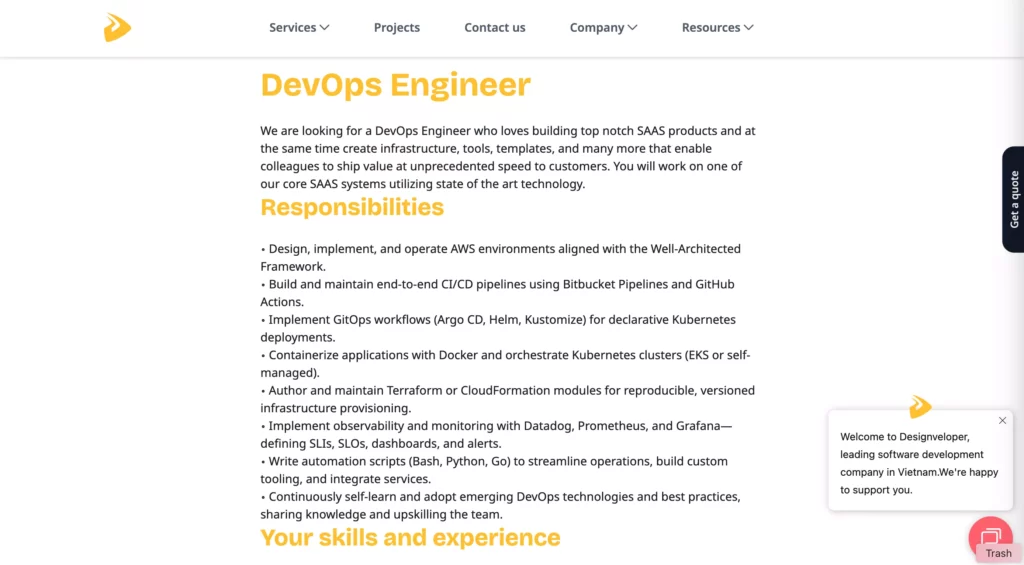
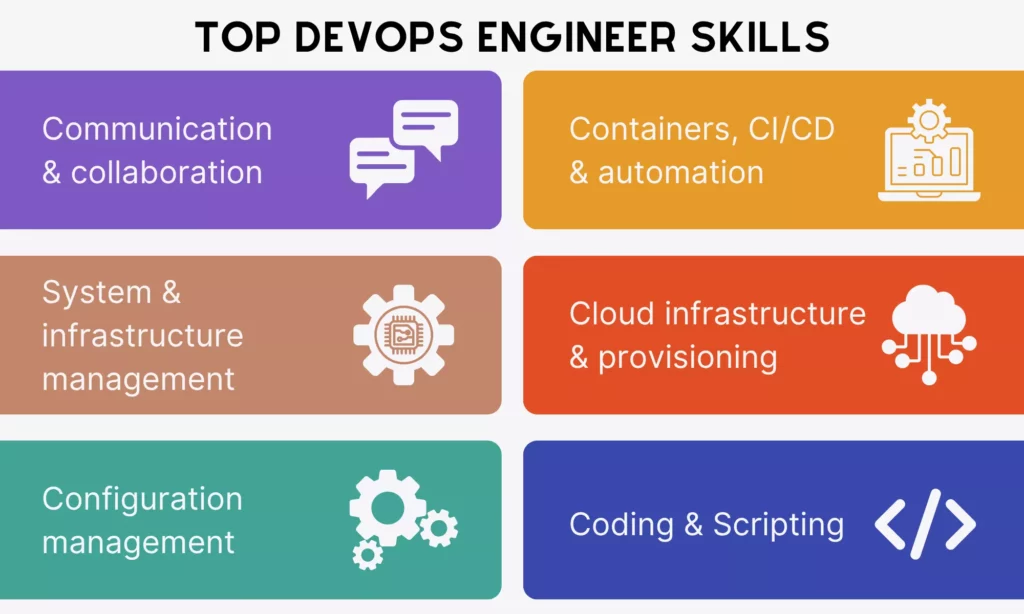
A DevOps engineer needs enough breadth to understand the delivery path and enough depth to solve problems in the systems their team uses. Employers do not expect every candidate to master every cloud, container platform, and automation tool. Start with transferable foundations, then build depth around the job’s actual environment.
Linux, Networking, And Troubleshooting
Linux skills help engineers inspect processes, permissions, services, and logs. Networking basics explain how DNS, ports, certificates, load balancers, and firewalls affect application connections. If a service cannot reach a database, test name resolution, network access, credentials, and application configuration one at a time.
Scripting, Version Control, And Safe Changes
Bash or Python can automate repeatable checks, file handling, deployment steps, and small integrations. The goal is not to script every task; it is to make repeated work easier to review and less dependent on memory. Version control is equally important because pipeline and infrastructure changes need a history, review, and a way to restore a known-good version. Beginners can practice with Git and project change tracking.
Automation should fail visibly and protect resources. A script should report changes, stop when inputs are missing, and avoid repeated destructive actions.
CI/CD, Testing, And Release Controls
Continuous integration checks changes as they enter a shared codebase; continuous delivery or deployment prepares or releases validated changes. A DevOps engineer should understand how source changes trigger builds, tests, artifact creation, and deployment. Learn what each pipeline stage proves, what it does not prove, and where a human approval or rollback guardrail belongs.
A passing unit test does not prove that a service can reach its production database or that a migration is safe. Match checks to the change and environment. Engineers should trace a failed job to code, configuration, tests, or deployment and choose the right fix.
Cloud, Containers, And Infrastructure As Code
Cloud skills include understanding identity and access, networks, compute, storage, and the cost or security effects of resource choices. Containers package an application with a defined runtime environment, while orchestration tools manage how containerized workloads run across a cluster. These technologies solve different problems, so learn them as concepts before collecting product names.
Infrastructure as Code (IaC) describes infrastructure through versioned configuration instead of one-off console changes. It supports review and reuse, but engineers must still protect credentials and state and review planned changes. Configuration drift occurs when a running environment no longer matches its declared setup.
Observability, Security, And Incident Response
Monitoring checks known signals; observability uses logs, metrics, traces, and context to help explain system behavior. A DevOps engineer may build dashboards, tune alerts, maintain runbooks, and help teams learn from incidents. The useful measure is not the number of dashboards but whether an alert helps the right person understand impact and choose a safe next action.
Security work can include least-privilege access, secret handling, dependency checks, and auditable deployment permissions. The engineer helps put controls in the workflow, but security ownership is shared with application, security, and platform teams. A production change should have a clear owner, an approved access path, and a recovery plan.
Communication And Collaboration
DevOps engineers often translate between developers, operations, security, and product stakeholders. They need to explain why a release is blocked, what evidence would clear the block, and who can make the decision. Clear documentation, calm incident communication, and useful code or configuration reviews help teams solve the system problem instead of assigning blame.
Collaboration makes automation usable. Work with service builders and operators so the pipeline remains understandable after ownership changes.
How To Become A DevOps Engineer: A Practical Roadmap
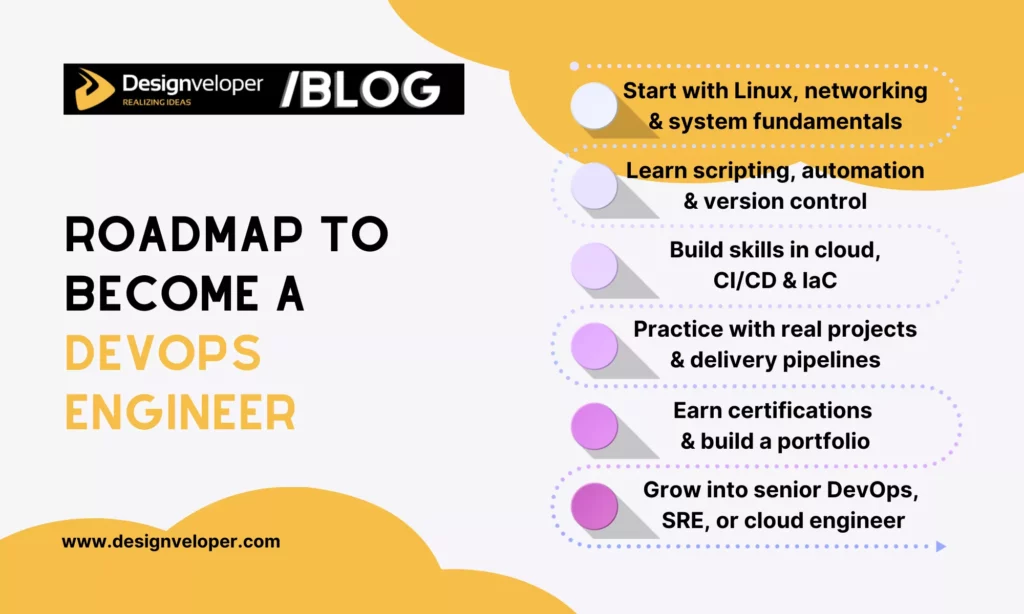
There is no single required degree or tool sequence for becoming a DevOps engineer. A practical path builds systems knowledge first, then adds automation, delivery, and production operations. Treat the sequence below as a way to organize practice, not as a promise that a fixed number of weeks will qualify someone for every job.
Use one small application or sample service throughout the path. Reusing the same project lets you see how a system changes as you add version control, tests, infrastructure, deployment, and monitoring.
| Stage | Learn | Show in practice |
|---|---|---|
| 1. Systems | Linux, processes, DNS, ports, permissions, and logs | Diagnose a service that cannot reach a dependency and document the checks |
| 2. Code and change control | Git, a scripting language, pull requests, and basic tests | Automate one repeatable setup or validation task and explain its failure behavior |
| 3. Delivery | Build, test, package, and deploy stages | Run a pipeline that blocks a deliberately failing test |
| 4. Infrastructure | One cloud provider, containers, IaC, and access control | Recreate a small staging environment from reviewed configuration |
| 5. Operations | Logs, health checks, alerts, runbooks, and rollback | Simulate a failure, identify the signal, and document a recovery path |
Build One Project That Shows The Whole Workflow
A portfolio project should show a delivery path, not just a cloud-console screenshot. Use a small web service and document how a reviewed change moves to staging. Keep each component small enough to explain.
- Store application and infrastructure changes in a version-controlled repository with a clear README.
- Configure a CI workflow to run formatting or lint checks, automated tests, and a build. Show that a failing check blocks the next step.
- Package the service in a container and define a minimal staging environment through IaC. Use a sandbox account, restrict permissions, and avoid committing secrets.
- Deploy to staging, add a health check or basic dashboard, and write a short runbook for a failed deployment.
- Demonstrate one recovery case: introduce a safe configuration error, observe the pipeline or health check catch it, correct or roll back the change, and explain what the team should learn.
Ask another person to follow the README and reproduce the setup. Tests should block a known failure, staging should deploy without exposed credentials, and a recovery step should be documented. This is evidence of practice, not a substitute for production experience. Remove paid resources and label simulated work clearly.
Use Certifications As Structure, Not A Substitute
A certification can structure study or show familiarity with a cloud platform. It does not prove you can debug a failed release or make a safe infrastructure change. Check target job descriptions, then pair a useful credential with a repository, runbook, or demonstration.
People enter DevOps from development, IT support, system administration, QA, networking, and cloud operations. Build from your current strengths: developers may focus on deployment and runtime work, while administrators may add scripting and test automation. Use target job descriptions to identify the next gap.
DevOps Engineer Vs Cloud Engineer Vs SRE
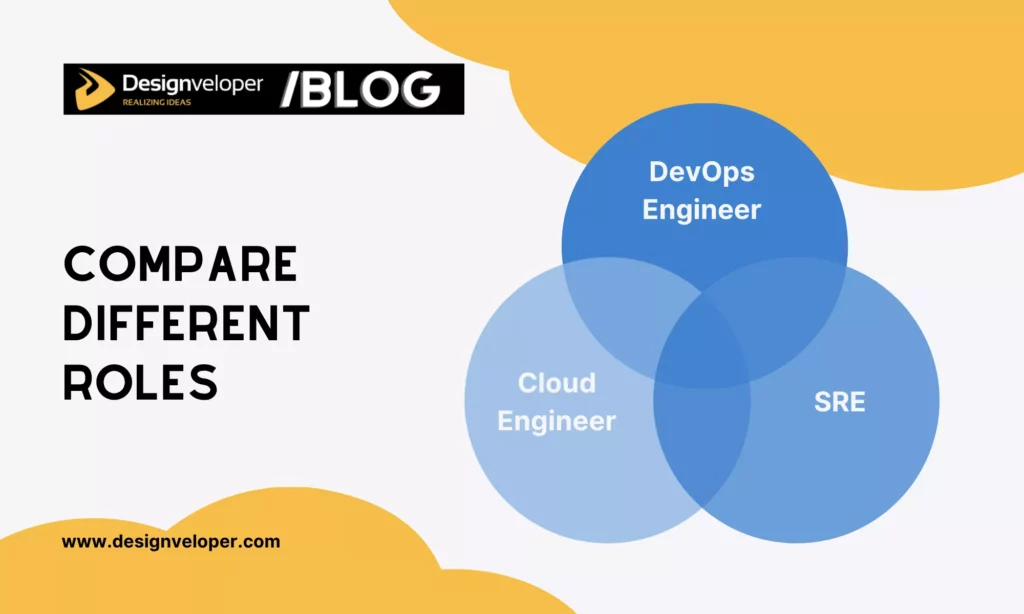
DevOps, cloud engineering, and site reliability engineering (SRE) often overlap, but job titles usually point to different centers of attention. The boundaries are not universal: one company may combine the work, while another may assign it to separate teams. Compare the service ownership, daily tasks, and decision rights in a job description rather than assuming that one title guarantees a fixed scope.
DevOps Engineer Vs Cloud Engineer
A DevOps engineer often focuses on the route from code change to a deployable, observable service. A cloud engineer often focuses on cloud architecture, resource provisioning, identity, networking, and platform foundations. Both roles may use IaC, automation, and monitoring, so the distinction is usually about emphasis rather than exclusive tools.
| Common emphasis | DevOps engineer | Cloud engineer |
|---|---|---|
| Typical focus | Delivery automation and developer workflows | Cloud design, provisioning, and shared infrastructure |
| Example work | Improve build, test, deployment, and recovery steps | Design network, identity, compute, and storage patterns |
| Ask the employer | Which teams own the pipeline and production service? | Which cloud foundations or product teams does this role support? |
DevOps Engineer Vs Site Reliability Engineer
SRE applies software engineering and operational practices to service reliability. An SRE team may work on incident response, automation, service health, and production systems; a DevOps engineer may work across those areas as well as delivery tooling. AWS’s SRE overview describes reliability work that includes operations, system support, and process improvement. It should not be read as a universal job boundary.
| Common emphasis | DevOps engineer | SRE |
|---|---|---|
| Typical focus | Shared delivery systems and workflow improvement | Service reliability and production operations |
| Example work | Pipeline, infrastructure automation, and release support | Reliability automation, incident learning, and service health |
| Ask the employer | Does the role build shared tools or operate individual services? | How are on-call, reliability targets, and incident follow-up handled? |
Questions To Ask About Role Boundaries
Use the interview or job description to learn how the title works in that organization. Ask:
- Which services, pipelines, or platform components would I own?
- Can product developers deploy changes themselves, and who reviews risky production changes?
- Is on-call part of the role? How is the rotation staffed and how are incidents handed back to service owners?
- How does the team balance delivery work with reliability, security, and infrastructure requests?
Answers to those questions reveal whether a role is mainly platform enablement, cloud operations, release engineering, reliability work, or a combination. They also help identify whether the organization has clear ownership or expects one person to absorb every unresolved operational task.
FAQs About DevOps Engineers
Does Every Company Need A DevOps Engineer?
No. A company needs clear delivery and operational ownership, but it does not always need a separate DevOps job title. A dedicated role can help when repeated release, infrastructure, or reliability work has become a bottleneck. Smaller teams may share those responsibilities across developers and operations staff.
How Much Coding Does A DevOps Engineer Do?
The amount varies by role. Many DevOps engineers write scripts, maintain pipeline definitions, review infrastructure code, and connect tools. Some roles also include application code, while others focus more on systems and platform operations. Check the job description for languages, code review, and automation expectations.
Do You Need A Degree Or Certification To Become A DevOps Engineer?
Requirements vary by employer, and neither a degree nor a certification alone proves practical ability. Candidates can strengthen an application with systems fundamentals, relevant work experience, and a project that shows testing, deployment, access control, monitoring, and recovery. Check local job postings before choosing a course or credential.
Are DevOps Engineers On Call?
Some are, but it depends on how the organization assigns service ownership and incident response. Ask whether the role joins a rotation, which services it supports, how often incidents are escalated, and whether product teams share follow-up work. A job title alone does not answer those questions.
How Much Does A DevOps Engineer Earn?
Pay depends on country, location, experience, employer, and the work attached to the title. For a U.S.-only snapshot, Indeed reported an average base salary of $134,605. Its estimate uses 4.4k job-posting salary records from the prior 36 months and was updated October 5, 2026. This is not a global benchmark; check current local listings before making a decision.
Conclusion
A DevOps engineer improves the systems that help teams build, release, and operate software. The job may focus on pipelines, infrastructure, cloud platforms, monitoring, or reliability, but the title does not make one person responsible for every production outcome. Teams still need clear service ownership, reviewable changes, useful alerts, and a recovery path.
If you are entering the field, build a small project that shows these practices working together. If you are hiring, name the recurring bottleneck and decisions the role should own. A product team planning a delivery workflow can discuss its technical scope and team responsibilities with Designveloper’s software development services.
Also published on

Share post on










Related Articles



What Is An Agile Framework? Definition, Types And Examples
What Is An Agile Framework? Definition, Types And Examples Published November 26, 2026
Best Open Source Vector Database: 10 Options Compared In 2026
Best Open Source Vector Database: 10 Options Compared In 2026 Published November 25, 2026
What Is a CI/CD Pipeline? Stages, Gates, and Examples
What Is a CI/CD Pipeline? Stages, Gates, and Examples Published November 25, 2026