

















Top 12 Best eCommerce Website Builders For Free in 2026

One big plus of tech advancements is that they allow even non-technical people to build a simple website or mobile app on their own. Instead of building a website from scratch, any individual or company can turn their focus on the best eCommerce website builder to shorten the time between development and launch. Sound great, right?
But what exactly is an eCommerce website builder? Which key features does it cover? When should you use one instead of hiring an outsourcing development company? What are the best eCommerce website builders to consider? You can find all the answers in this article.
What Is an Ecommerce Website Builder?
At its core, an eCommerce website builder is a tool you use to put UI components together and build an online store without coding from scratch. With this builder, you just need to log in, choose a template, drag design components, and add your brand elements. And you have a store that can actually sell things.
In plain terms, it’s web-based software that bundles everything needed to run an online shop in one place. Design tools, product management, shopping carts, payment gateways, or any common features.
Most builders work on a drag-and-drop model. You move blocks around, adjust colors, and change text.
Some platforms even integrate AI copilots to support eCommerce website development. Just type some descriptions, and the AI suddenly builds a basic framework of your site. You want some customization? No worry! Some builders flexibly let you add customized functionalities to make your site unique.
With this convenience, no wonder that eCommerce website builders are increasingly popular. Their estimated value in 2026 is $12.35 billion. This global revenue will continuously grow by 9.6% each year until 2035.
Recommended reading: 6 Best eCommerce App Development Companies
Key Features to Look for in an Ecommerce Web Builder
Choosing an eCommerce website builder isn’t just about picking the one with the prettiest templates. It’s more practical than that. Below are some important features to look for in a builder:
- Drag-and-drop editor: A good drag-and-drop editor lets you move UI components around easily. Further, you can adjust or customize the interface visually without touching the code.
- Mobile responsiveness: Most shoppers are on their phones now. That’s not new, but it still gets overlooked. A good builder should support your store in automatically adjusting to smaller screens without breaking layouts or hiding buttons.
- Payment gateway integration: The builder should support common options like PayPal or credit cards. Otherwise, your eCommerce website is just an online store that showcases products.
- Inventory & order management: Even small stores need some structure. Stock levels, order statuses, and basic alerts when items run low.
- SEO & performance: Fast loading pages matter. So do editable URLs, meta tags, and clean code. These features help your store get found more easily on search engines.
- Security & scalability: The builder should support SSL, secure payments, and platform updates. As your store grows, the builder should grow with it, not suddenly become the thing holding you back.
FURTHER READING: |
1. eCommerce Websites Definition: What To Know About This? |
2. How to Build an eCommerce Website Fastest in 2023 |
3. 10 Best eCommerce Website Design Services for Succes |
Top 12 Best eCommerce Website Builders
Now, we’ll discover the best eCommerce website builders in the world now. Some of them aren’t actually free and open-source, but come up with a free plan or trial for beginners.
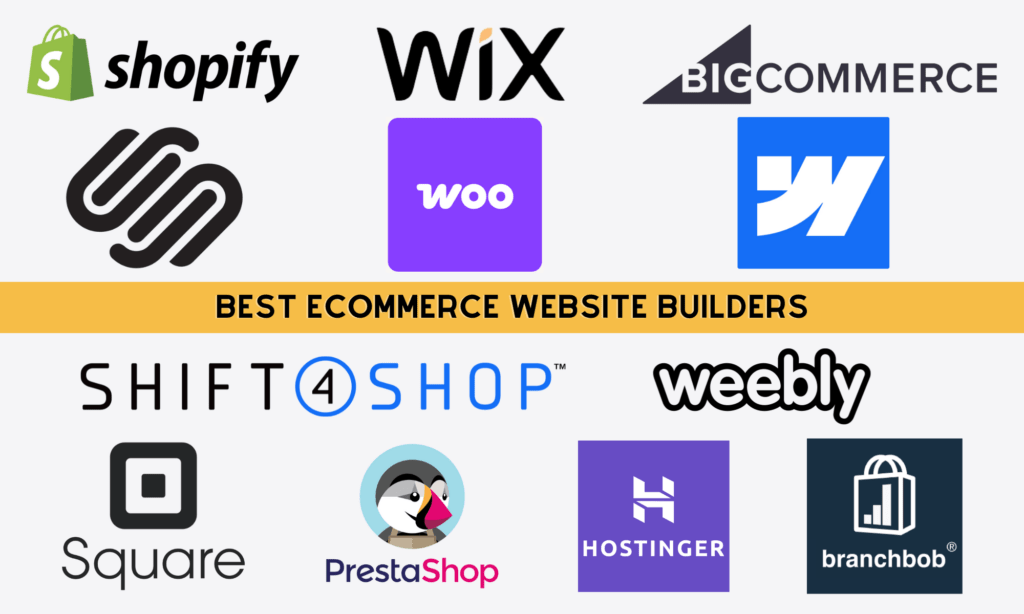
1. Shopify

Shopify is considered the most popular eCommerce website builder in the current market. It enables you to build tailored websites without technical skills or complex software installations. With Shopify stores, you can sell products, handle inventory, process payments, and perform marketing campaigns in one place.
Features:
- Over 70 free and premium templates, each of which is customized to add functionality and features on the Shopify App Store to your company’s website;
- AI to build a custom website in minutes and analyze your data points;
- Over 100 payment gateways to select, hence there’s no need to link with external remittance processors;
- Web hosting, unlimited bandwidth a content sending network, and unlimited email forwarding;
- SEO and marketing tools;
- Analytics and mobile optimization tools;
- Multi-channel integration with different social media platforms (Facebook, Instagram), marketplaces (Amazon, eBay, Walmart), search engines (Google Search) to perform multichannel selling;
- Built-in business tools, like a Logo Maker, a Slogan Maker, or a QR Code Generator.
Pros:
- Beginner-friendly
- Strong scalability
- A massive ecosystem of features and external apps
- Reliable 24/7 customer support
- Strong built-in security, stable hosting, and powerful marketing & SEO tools
Cons:
- Higher costs than other competitors
- Some important eCommerce features require paid external services, adding up the total cost
- Migrating away from Shopify is hard
Pricing:
- A 3-day free trial
- Basic (for solo entrepreneurs): $19/month (billed annually)
- Grow (for small teams): $49/month (billed annually)
- Advanced (for scaling businesses): $299/month (billed annually)
- Plus (for more complex businesses): $2,300/month (billed annually)
2. Wix eCommerce
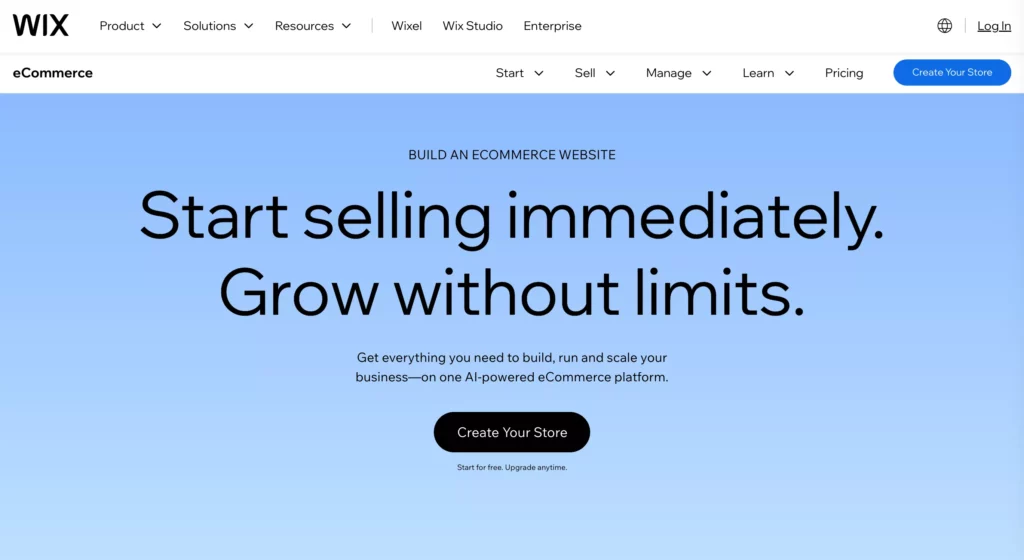
One of the most prevalent eCommerce web builders is Wix. It’s famous for building a store with ease in no time. Do you want to customize your storefront design or back your store with a strong backend? Wix offers different tools to realize your eCommerce website idea.
Features:
- 500+ free templates for different types of stores;
- Free business tools, including Wix Logo Maker and Business Name Generator, to build your unique brand identity;
- Secure Wix Payments methods with prestigious payout providers;
- Wix dashboard to track and process orders, remittances, revenues, and inventory as well as devise data-centric business plans;
- ADI builder to create a whole website automatically based on your answers to pre-established questions;
- SEO tools to grow your organic traffic;
- AppMarket with 250+ outstanding apps possibly incorporated in websites;
- Wix Owner app to administer your business activities 24/7, even on the go.
Pros:
- Very beginner-friendly editor
- All-in-one platform with hosting included
- Good for small to medium catalogs with the potential capacity of up to 50,000 products
Cons:
- Advanced eCommerce features (shopping carts, payment processing, or custom domains) require a paid plan
- Less scalable for complex stores
- Limited backend customization
Pricing:
- Free account
- Light: $17/month
- Core: $29/month
- Business: $39/month
- Business Elite: $159/month
3. Squarespace

Squarespace is another popular eCommerce website builder for individuals and small businesses. It helps you create professional or creative websites without deep technical skills.
Features:
- A drag-and-drop editor with auto layouts, image editing tools, and other components;
- Nearly 200 customizable website templates in different categories, like fashion, food, or fitness & sports;
- Mobile-optimized designs with rich eCommerce features, such as inventory management, product displays, or related products;
- Squarespace Blueprint AI to build custom websites in minutes;
- Diverse integrations with third-party apps, like Instagram, Facebook, or Etsy, to advertise your products on social media, manage inventory levels, integrate customer reviews, and more;
- Various payment methods (credit cards, Apple Pay, Afterpay, etc.) in different currencies;
- Built-in tools for commerce marketing, sales analytics, invoicing, etc.
Pros:
- Award-winning, mobile-responsive design templates
- Strong eCommerce support
- Integrated marketing tools
Cons:
- Limited customization and fewer plugins than WordPress
- Generated eCommerce sites may load slowly sometimes
Pricing:
- A 14-day free trial
- Personal: $10/month (billed annually)
- Business: $14/month (billed annually)
- Basic Commerce: $17/month (billed annually)
- Advanced Commerce: $30/month (billed annually)
4. WooCommerce
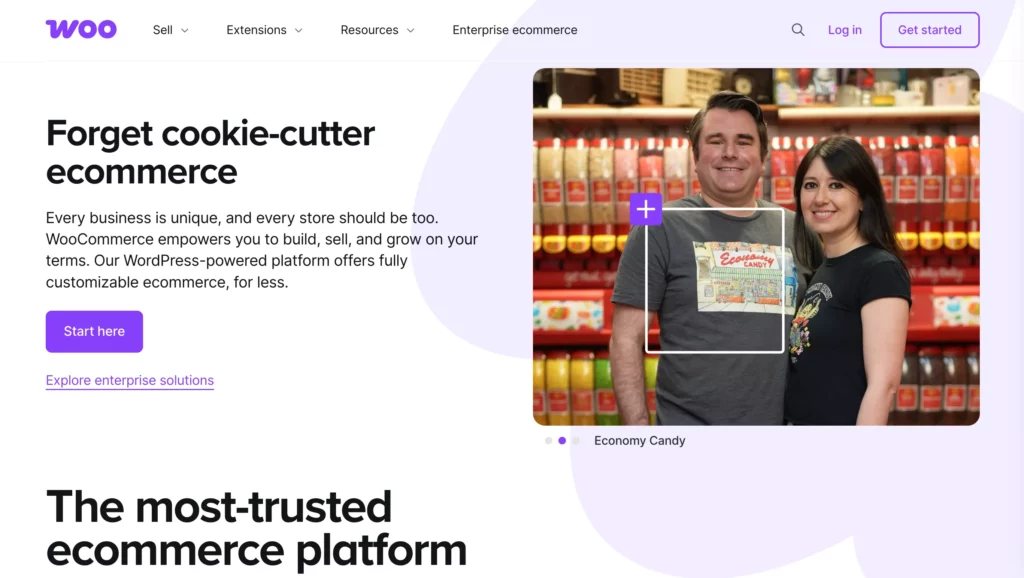
WooCommerce is one of the most reliable eCommerce website builders in the world. It can turn any WordPress website into a customizable, unique online store for SMBs and large enterprises. The platform is famous for its rich support for extensions, themes, and business services to empower your site.
Features:
- Customizable Block Themes for non-technical people to tailor without needing coding knowledge;
- The complete developer toolkit, like documentation, REST API, and CLI, to develop and customize eCommerce sites for advanced performance and excellent security;
- Mobile-optimized designs;
- The huge WooCommerce Marketplace with more than 1,000 plugins for shipping, accounting, and more;
- Secure payments via WooPayments or your existing payout solutions;
- Multichannel sales support;
- Diverse marketing and SEO tools.
Pros:
- Free core plugin
- Very customizable
- Strong SEO potential
- High scalability with advanced selling features and security for large-scale online stores
Cons:
- Costs may increase significantly if you add more extensions
- Requires coding expertise for advanced features
- Can get messy with too many plugins
Pricing: Free and open-source. But many extensions, website themes, and business services require costs.
5. BigCommerce
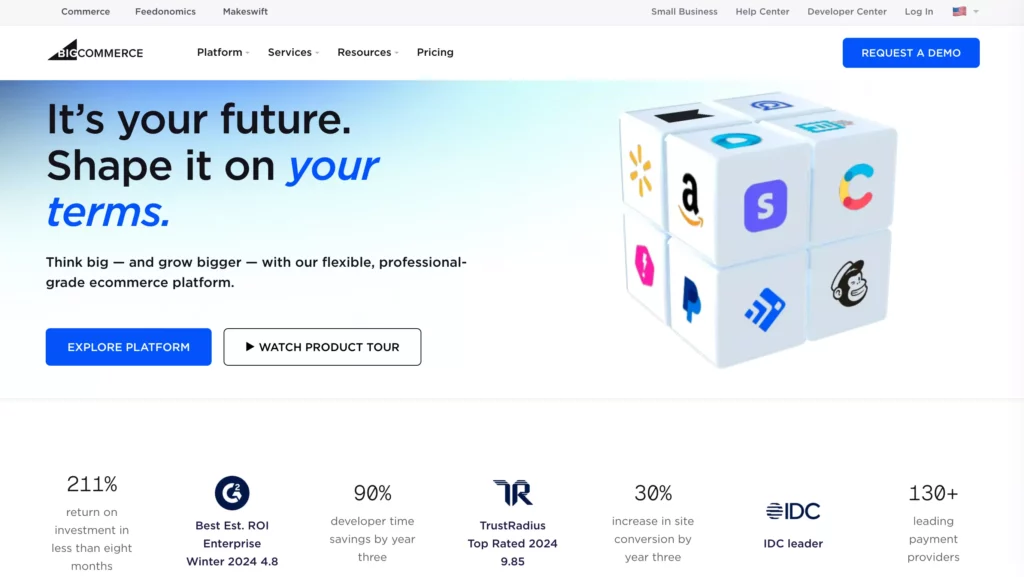
If you want to develop multi-channel or omnichannel websites, BigCommerce is a good option for your future online store without a doubt. This eCommerce website builder comes with exceptional B2B-driven functionality that renders your company scalable with ease. With BigCommerce, you can make sales across different platforms such as Instagram, Google Shopping, or Amazon.
Features:
- Quote management with native CSR-generated tools (e.g. B2B Ninja and BundleB2B);
- Bulk pricing management;
- Custom pricing lists for different B2B end-users;
- A broad spectrum of B2B payment solutions and shipping providers;
- The industry’s fastest APIs to sync massive data from third-party systems automatically into BigCommerce-based websites;
- Advanced search with Elasticsearch;
- High uptime rates and business-level security;
- SEO strategies and integrated POS plugins to increase your website’s traffic.
- Moreover, the process of designing a website’s storefront becomes simpler thanks to the Page Builder Editor which allows you to drag and drop elements. Both desktop-based and mobile-responsive websites are easily built with BigCommerce.
Pros:
- Strong native eCommerce tools
- Good performance for large catalogs
Cons:
- Can feel complex for beginners
- Design flexibility is limited
Pricing:
- A 15-day free trial
- Standard (for individuals and small brands): $29/month (billed annually)
- Plus (for ambitious small businesses): $79/month (billed annually)
- Pro (for fast-growing businesses): $299/month (billed annually)
- Enterprise (for established businesses): Custom pricing
6. Webflow
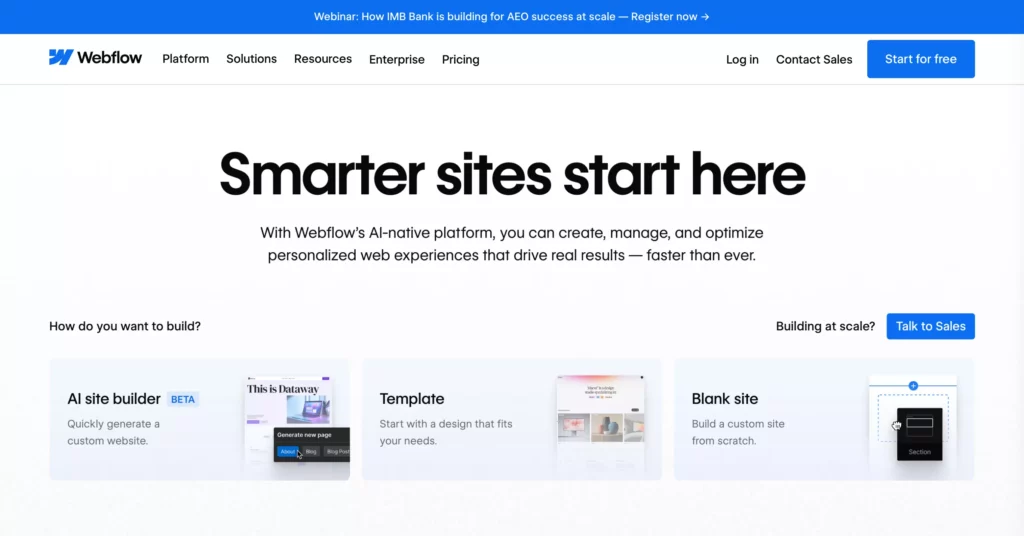
Webflow is a no-code tool that lets you visually build, design, and launch custom websites. It combines visual design tools, eCommerce features, managed hosting, and more to transform visual designs into clean websites without coding.
Features:
- A visual canvas to edit reusable components and build scalable content;
- Content management and SEO automation;
- Advanced web animations with the GSAP plugin;
- Real-time collaboration on the visual editor to design, edit, and launch a website faster;
- Webflow Shared Libraries to share components, variables, and assets across different sites;
- Built-in analytics and optimization tools;
- Webflow AI to create an eCommerce website, adjust page designs, generate copy, create code, and improve SEO or AEO.
Pros:
- High design flexibility
- Clean, fast storefronts
- Free plan for testing
Cons:
- Limited eCommerce features on a free plan
- Steeper learning curve than some competitors
- Not ideal for large stores
Pricing:
- A free plan
- Standard (for beginners): $29/month (billed yearly)
- Plus (for higher volume businesses): $74/month (billed yearly)
- Advanced (for scaling): $212/month (billed yearly)
7. Shift4Shop

Shift4Shop is suitable for those who wish to build an enterprise-grade website at the lowest possible costs. Like other given counterparts, Shift4Shop affords all essential features to build even a high-volume entrepreneur website.
Features:
- The Core Template Engine with over 100 templates to add unlimited products, edit UI components, and add extra pages;
- Flexible checkout and diverse payout solutions;
- Customizable shipping types, seamless connections with many carriers (USPS, Canada Post, FedEx, etc.), and easy eCommerce sales tax setup;
- Mobile-first, responsive designs;
- PCI-compliant security with advanced tokenization;
- Order and product management;
- SEO & marketing tools;
- Al-driven fraud protection powered by Kount.
Pros:
- Quick and easy setup
- Unlimited bandwidth, free hosting, and free SSL certification
- Seamless integration between orders and payments
- Strong built-in eCommerce features
Cons:
- Interface feels a bit outdated
- A smaller app ecosystem
Pricing:
- A free plan
- An unlimited plan with $41/month
- An end-to-end eCommerce plan with $229/month
8. Square Online

Square is well-known for its software installed in point-of-sale (POS) systems. The company also provides Square Online, an eCommerce website builder, to develop code-free websites.
These sites can seamlessly integrate the Square POS system in your brick-and-mortar store to create a centralized database where sales and inventory data is synced and well-managed online. This helps you avoid manually processing inputs in separate databases. Concurrently, you can easily track and control your real-time sales and stocks.
Features:
- A user-friendly editor with drag-and-drop functionality;
- A myriad of customizable website themes for online selling;
- Seamless integration with Square POS to connect in-person and online sales, as well as other external services, like ReachifyAI, QuickBooks Online, or Thrive Inventory;
- Secure payment processing to enable online payments, facilitate auto-billing, send professional receipts, and check them in real-time;
- Built-in business tools for marketing, SEO, analytics & reporting, loyalty programs, etc.;
- Square AI to monitor real-time data, analyze best-selling items, and more.
Pros:
- Easy setup for an eCommerce store
- Seamless POS integration
- Core eCommerce tools
Cons:
- Limited designs than other builders like Wix or Shopify
- Basic SEO tools
- Scaling for large inventories or advanced eCommerce functionality may be hard
Pricing:
- Free
- Plus: $49/month, with a 30-day free trial
- Premium: $149/month, with a 30-day free trial
9. Weebly
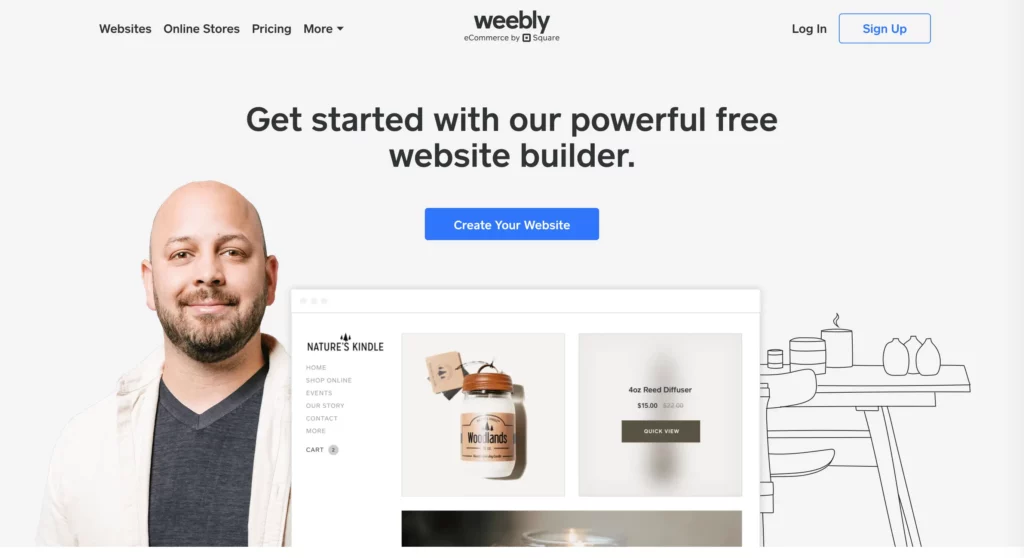
Weebly is a Square-powered eCommerce website builder that supports entrepreneurs in building online stores at a reasonable price. Therefore, Weebly websites may be easily incorporated with the Square POS to control inventory and products in a centralized place.
Features:
- Responsive themes for eCommerce websites;
- A drag-and-drop editor with various tools, like custom fonts, site search, image editing, and video displays;
- Fully integrated shopping carts and secure checkout;
- Inventory management;
- Smart marketing and SEO tools;
- Built-in analytics tools to measure site performance;
- Display and merchandising options to showcase products or services;
- Bulk import and export management;
- SSL security, hosting, and domain management to monitor security and infrastructure for your website.
Pros:
- Ease of use
- Strong built-in eCommerce features
- Good customer support with guidance on SEO and marketing
Cons:
- Limitations on highly unique designs
- Limited website themes
- Less scalable for large or complex websites
Pricing:
- A free plan
- Personal: $10/month (billed annually)
- Professional: $12/month (billed annually)
- Performance: $26/month (billed annually)
10. Hostinger Website Builder
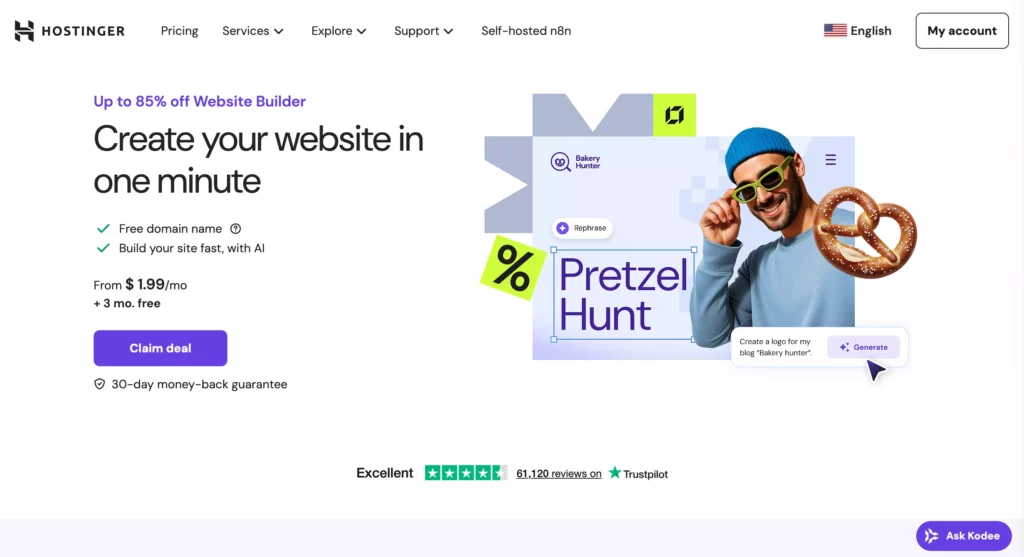
This is a perfect eCommerce website builder for beginners who have no coding knowledge or even lack the ability to produce decent content for their online stores. It also offers lots of AI-powered tools for design, content, and SEO.
Features:
- Drag-and-drop tool to select suitable functions for your specs;
- Smart grid to keep UI elements aligned on your site’s interface;
- Over 170 customized templates in distinct categories;
- Responsive designs on mobile gadgets;
- Free domain with cloud hosting;
- Over 100 payout solutions;
- Powerful integrations with external websites such as Google Ads, Meta Pixel, or Google Analytics.
- Built-in marketing and SEO tools, like Hostinger Reach, to create and track email campaigns, improve your marketing strategies, and optimize your online store.
- AI to build high-converting storefront and product pages in seconds, create content, edit images, and optimize your store for search engines.
Pros:
- Clean, modern interface
- Simple store setup
- Fast performance
- 24/7 live chat & knowledge base
Cons:
- Limited design flexibility
- Fewer third-party app integrations than other competitors
- Not built for large eCommerce stores, with limits like 1,000 products
Pricing:
- Free account
- Premium Website Builder: $1.99/month
- Business Website Builder: $2.99/month
11. PrestaShop
PrestaShop is considered an open-source eCommerce website builder in Europe and Latin America. In November 2021, it started becoming a part of Fortidia, a leading eCommerce and logistics platform for SMBs. Its core features are free, but you need to pay for hosting, domain registration, themes, and other paid features.
Features:
- A rich library of responsive themes and SEO modules to optimize your online store for search engines;
- Marketing tools to support multichannel sales, track abandoned shopping carts, and add reward or affiliate programs;
- Over 50 payout solutions plus various shipping tools;
- Advanced eCommerce statistics tools like a built-in dashboard or integrations with Google Analytics and PrestaShip Metrics;
- Store management tools to secure your eCommerce website, manage inventory levels, ensure regulatory compliance, and more.
Pros:
- Free core features (without hosting, a domain name, support, and other eCommerce services)
- Highly customizable
- Strong for international selling
Cons:
- Hosting and add-ons cost extra
- Advanced customization requires technical expertise (PHP)
- Struggle to scale or upgrade
Pricing:
- Classic: Free use, excluding hosting, a domain name, and other eCommerce services
- Hosted: €24/month plus VAT (including hosting, support, and other eCommerce services), with a 14-day free trial
- Enterprise: €2,115/month plus VAT (billed annually)
12. IONOS eCommerce
IONOS is a web-based service provider of website hosting, eCommerce websites, business emails, cloud storage, and more. Its eCommerce website builder helps you build an online store without significant technical skills by using pre-made templates or AI. IONOS-generated online stores come with all the features you need to run small to medium-sized eCommerce operations.
Features:
- Diverse website templates;
- The AI Website Generator to build a basic framework (with text and images) of your online store within minutes;
- The AI Text Generator to create website content effortlessly;
- Cross-platform eCommerce support to sell physical products, e-products, and services across the world’s most popular social networks and marketplaces, like Facebook or Amazon;
- Various payment options, like credit card, direct debit, PayPal, etc.;
- IONOS eCommerce plugin to add an online store to your website;
- Different tools to track shipping, manage eCommerce operations, and perform marketing campaigns.
Pros:
- Easy to use
- Affordable initial pricing
- Diverse services to run a website, like hosting, domain & SSL, and the eCommerce website builder
Cons:
- No free plan
- Customization for mobile-responsive designs is limited or even unavailable in some templates
Pricing:
- Starter: $6 for the first month, then $26/month with a yearly term
- Plus: $1 for the first month, then $32/month with a yearly term
- Pro: $34/month with a yearly term
- Expert: $44/month with a yearly term
Free vs Paid Ecommerce Website Builders
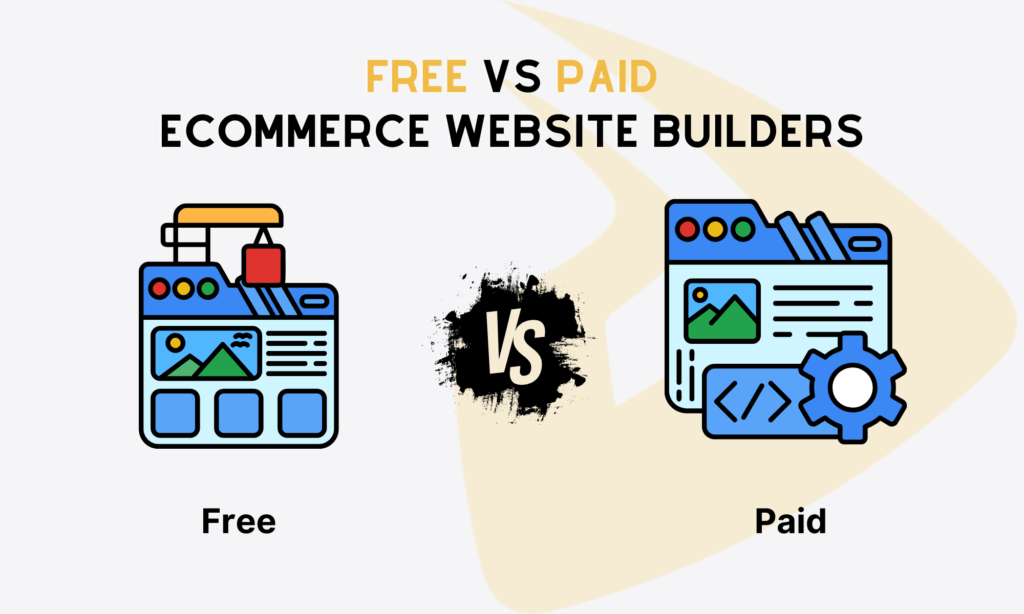
At first glance, free eCommerce website builders look like a gift. And in some ways, they are. You sign up, add products, and publish a store without credit cards or long-term commitment. For side projects, early testing, or beginners, free plans make a lot of sense.
But, free builders come with limitations that you might somehow notice after reading through our above list. They include fewer eCommerce features, product limits, or performance limits that only show up when traffic starts to pick up. Not to mention that you might notice platform branding in the footer of your published website. That’s why we say free plans are built to help you start, not necessarily to help you grow.
Paid eCommerce builders, on the other hand, feel more settled. You pay monthly for sure, but in return you get better checkout flows, more integrations, and more advanced eCommerce features. Other perks include faster loading pages, more control over SEO, and even better support.
That said, paid isn’t always better by default. Some small stores don’t need advanced reporting or custom checkout logic. Paying for features you’ll never touch is money-wasting. Free builders can handle simple catalogs just fine, especially if sales volume stays modest.
So the choice depends on your purpose. Free builders help you learn, experiment, and validate an idea. Meanwhile, paid builders are for businesses that seriously handle more orders, more customers, and more sales.
Recommended reading: How to Save Big on eCommerce App Development Cost?
Ecommerce Website Builder vs Custom Ecommerce Development
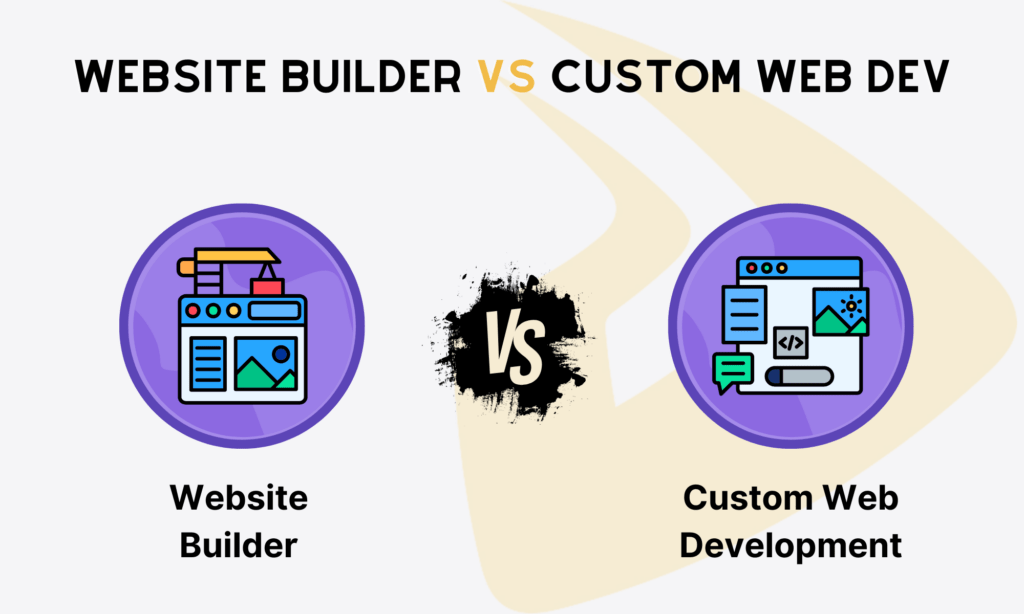
Another question coming up a lot is, “Should I use an eCommerce website builder or custom eCommerce development?” The answer, once again, depends on your ultimate purpose.
An eCommerce website builder is the faster route. You sign up, choose a template, upload products, connect payments, and you’re live. For startups, small teams, or businesses testing a market, that convenience matters. So, an eCommerce website builder is a better option.
But builders have their own limitations. You may struggle with customization, performance tuning, or complex integrations with your legacy infrastructure. Some platforms sometimes don’t support scaling well.
Custom eCommerce development sits on the other end. This is where everything is built around your exact needs. From custom checkout logic and unique integrations to complex pricing rules, a development team handles them all with coding. But the downside? Development takes longer, and costs add up.
When Should You Use an Ecommerce Website Builder?

After weighing the ups and downs, you may now know when each approach works best.
eCommerce builders make sense when speed matters, when your budgets are tight, and when you just want to get products online and see what happens. If your store has a modest catalog, predictable workflows, and no complex technical requirements, a builder is a good choice.
How about custom eCommerce development? It shines if your eCommerce website requires custom integrations, handles unique checkout logic, or processes increasing traffic that goes beyond a builder’s capability.
If you’re leaning toward a builder now, one small tip: choose a platform that supports scalability and clean migration. Future you will appreciate that.
But do you prefer custom development and look for a reliable development partner? If so, Designveloper is ready to help. As a leading software and web development company in Vietnam, we bring 13 years of experience building websites and web apps, with a strong focus on eCommerce.
One of our successful eCommerce projects is Aha.is. We helped Netgengið ehf. increase their website’s speed, improve content management, and reduce costs. Further, we developed the Chloe Ting Fitness Hub, a unified platform that sells clothes, offers personalized workout plans, and delivers expert nutrition content.
Do you want to build an eCommerce website from scratch or modernize the existing one with AI integrations? Do you want cybersecurity consulting or maintenance services for your online store? Regardless of your choice, we have the right expertise and tech stacks.
If you’re planning something more tailored or just want expert advice, why don’t you contact us? Let’s discuss your idea further and bring it to life with our expert!
Conclusion
After all, an eCommerce website builder plays an important role in supporting companies to build a fast, yet high-quality, online store. Despite several facilities, each of the listed tools serves a separate purpose. Therefore, you should ponder your specific requirements for an eCommerce website, then pick the right builder to optimize business activities over the Internet.
Also published on

Share post on