














10 Best Web App Languages in 2026

KEY TAKEAWAYS:
-
JavaScript and TypeScript remain leading web app languages, with strong developer adoption and near-universal JavaScript use across websites.
-
Python, Java, and C# remain strong choices for scalable backend systems.
-
PHP and Ruby still make sense for the right products, especially when speed, ecosystem, or existing infrastructure matters.
-
SQL, HTML, and CSS remain foundational for data handling and web interface delivery.
- The best web app language depends on product goals, team expertise, and long-term maintenance needs.
Choosing the right web app language is one of the most important decisions in software development. The language you choose affects performance, scalability, hiring, maintenance, development speed, and the frameworks you can use. It also shapes how easily your product can evolve as business needs change.
This is why choosing a web app language is not just about popularity. A real-time SaaS platform, an AI-powered dashboard, a content-driven website, and an enterprise portal do not all need the same stack. This guide covers the best web app languages in 2026, what makes them useful, and where each one fits in modern web development. It also explains how Designveloper approaches language selection in real projects.
Related guide:
- Top 10 Best Programming Language for Beginners
- Hardest Programming Languages (Ranked by Difficulty)
What is a web app language?
A web app language is a programming, scripting, markup, or query language used to build browser-based applications. These languages help developers create everything a web app needs, from user interfaces and application logic to database operations and integrations.
In practice, web applications rely on multiple languages rather than just one. A modern product may use JavaScript or TypeScript for the frontend, Python or Java for the backend, SQL for data access, and HTML/CSS for layout and styling. That is why choosing the best web app language often means choosing the right combination of languages.
Types of web application languages usually fall into four practical groups:
- frontend languages, which shape what users see and interact with in the browser
- backend languages, which handle business logic, APIs, authentication, and server-side workflows
- database languages, which manage storage, querying, and structured application data
- markup and styling languages, which define the structure and presentation of web pages
This distinction matters because most web apps are built as a stack, not as a single-language system. A team may choose TypeScript for the frontend, Go or Python for the backend, SQL for the database layer, and HTML/CSS for interface delivery. Looking at web app languages by role makes it easier to understand why different languages appear in the same shortlist.
Web app languages matter because they influence:
- how fast developers can build and ship features
- how easy the codebase is to maintain
- how well the app performs under load
- how secure the application can be
- how easy it is to hire developers for the stack
In real projects, the choice is rarely about syntax alone. Teams usually end up evaluating the surrounding ecosystem: framework maturity, package stability, debugging tools, cloud deployment fit, testing support, and how difficult it is to onboard new developers six months later. That is why a technically elegant language can still be the wrong business choice for a web app.
Are web app languages different from other programming languages?
Yes, but the difference becomes clearer when you compare web app languages with two related categories: website languages and app-development languages.
Website development languages are mainly used to present content in the browser. HTML and CSS define structure and styling, while JavaScript may add interaction. A web app goes further. It includes user accounts, business logic, real-time behavior, integrations, dashboards, forms, permissions, and database operations. That is why web app development usually needs a broader stack, not just presentation-layer code.
App-development languages such as Swift for iOS or Kotlin for Android are built for native mobile environments. They interact with device hardware, operating-system APIs, and mobile UI frameworks. Web app languages are different because they are chosen for browser delivery, server communication, API handling, cloud deployment, and ongoing web-based iteration.
In short:
- website languages focus on content presentation and browser rendering
- web app languages support interactive product behavior across frontend, backend, and data layers
- native app languages are optimized for mobile or desktop operating systems rather than browser-based delivery
This is why not every programming language is equally suitable for modern web applications. The best web app languages are usually the ones with strong frameworks, reliable tooling, large communities, and proven success in production web systems.
10 best web app languages to use in 2026
The best web app languages in 2026 are the ones that balance developer productivity, ecosystem maturity, performance, scalability, and long-term maintainability. Some are better for frontend work, some are stronger on the backend, and some are essential supporting technologies.
Here is a quick comparison before we look at each language in more detail:
| Language | Best for | Main strengths | Common use cases | Popular frameworks/libraries |
|---|---|---|---|---|
| JavaScript | Full-stack web development | Universal web support, flexibility, huge ecosystem | SPAs, real-time apps, frontend, Node.js backends | React, Vue, Angular, Next.js, Express |
| TypeScript | Large-scale web apps | Static typing, safer refactoring, maintainability | Enterprise apps, SaaS platforms, complex frontends | Angular, NestJS, Next.js, React, tRPC |
| Python | Backend and data-heavy apps | Readability, speed of development, strong AI/data ecosystem | APIs, dashboards, AI features, automation | Django, Flask, FastAPI, SQLAlchemy |
| Java | Enterprise backends | Stability, security, scalability, JVM ecosystem | Banking, enterprise software, large backend systems | Spring Boot, Jakarta EE, Hibernate |
| C# | Microsoft-centric web systems | Strong tooling, performance, .NET ecosystem | Enterprise apps, cloud systems, internal platforms | ASP.NET Core, Blazor, Entity Framework |
| Go | High-performance backend services | Concurrency, simplicity, strong cloud-native performance | APIs, microservices, real-time systems, backend platforms | Gin, Echo, Fiber, Buffalo |
| PHP | Content-heavy and practical web builds | Mature ecosystem, easy deployment, strong CMS support | CMS, portals, eCommerce, business websites | Laravel, Symfony, CodeIgniter, WordPress |
| Ruby | Fast product development | Developer-friendly syntax, Rails productivity | MVPs, SaaS products, startup platforms | Ruby on Rails, Sinatra, Hanami |
| SQL | Data management | Structured querying, reporting, relational data handling | CRUD apps, analytics, transaction systems | PostgreSQL, MySQL, SQL Server, SQLite |
| HTML/CSS | Web interface foundation | Universal browser support, responsive layouts | UI structure, styling, forms, design systems | Tailwind CSS, Bootstrap, Sass, PostCSS |
1. JavaScript
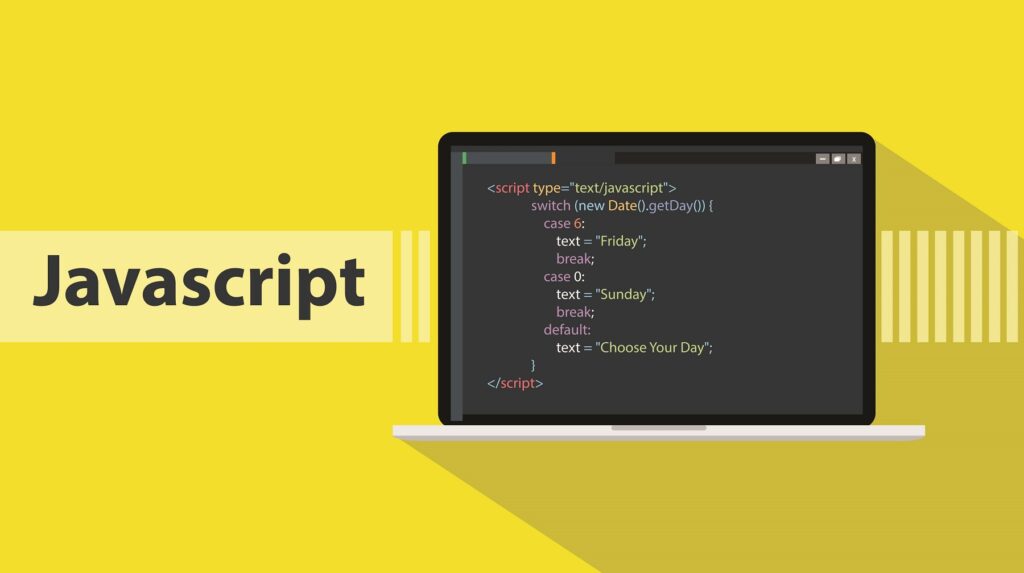
JavaScript is a versatile, high-level web app language used to build both client-side and server-side functionality. It runs directly in the browser and also works on the server through Node.js, which makes it one of the few languages that can support interactive user interfaces, APIs, and real-time features in the same product stack.
Its widespread use is reflected in recent data: Stack Overflow’s 2025 Developer Survey found that 68.8% of professional developers use JavaScript, and W3Techs reports that JavaScript is used on 98.8% of websites as a client-side language.
JavaScript stands out for its flexibility. JavaScript supports dynamic interfaces, rich interactions, and fast iteration across both frontend and backend environments.
Popular frameworks/libraries include React, Vue, Angular, Next.js, Node.js, and Express.
JavaScript is a strong choice when you need:
- interactive user interfaces
- single-page applications
- progressive web apps
- real-time chat or collaboration features
- full-stack development with one main language
For startups and fast-moving product teams, that flexibility still makes JavaScript one of the safest bets.
The main tradeoff is maintainability at scale. JavaScript moves very fast, but large teams can run into inconsistent patterns, weak type safety, and dependency sprawl unless they enforce strong code standards.
To learn more about JavaScript, check out these articles:
- Best Javascript Tutorial for Beginners
- JavaScript Frameworks Worth Attention
- Best Resources to Learn Javascript for Beginners
2. TypeScript
TypeScript builds on JavaScript by adding static typing. That sounds simple, but the impact is large. TypeScript makes big codebases easier to understand, safer to refactor, and less error-prone as teams grow.
TypeScript stands out for its structure. For many companies, TypeScript has become the default choice for serious web app development because it adds safer collaboration and better long-term maintainability to the JavaScript ecosystem. It works especially well for SaaS products, enterprise frontends, and long-lived systems where code quality matters over time.
Popular frameworks/libraries include React, Next.js, Angular, NestJS, and tRPC.
TypeScript is a strong choice when you need:
- maintainable code at scale
- large frontend applications
- safer collaboration across teams
- better IDE support and code navigation
- a modern full-stack JavaScript workflow
TypeScript is often the preferred layer on top of JavaScript when a product is expected to scale across multiple developers and release cycles. It reduces ambiguity in shared code and makes frontend maintenance more predictable over time.
Its main cost is stricter upfront engineering. Teams gain clarity, but they also accept more type design, more build complexity, and more discipline during implementation.
For more detail, read this guide: Key Differences Between TypeScript and JavaScript
3. Python
Python remains one of the best backend languages for web apps because it is readable, productive, and backed by an enormous ecosystem. It is especially valuable for projects that need fast development, automation, analytics, machine learning features, or heavy data processing.
Python stands out for its productivity. Python supports readable code, rapid development, and a strong ecosystem for AI, automation, and data-heavy applications. Frameworks such as Django, Flask, and FastAPI make Python practical for a wide range of web systems, from startup MVPs to internal platforms and data-driven products.
Popular frameworks/libraries include Django, Flask, FastAPI, and SQLAlchemy.
Python is a strong choice when you need:
- rapid backend development
- APIs and admin systems
- AI or data-heavy features
- dashboards and reporting tools
- clean, readable code for growing teams
Python is particularly useful when a web app needs more than standard CRUD logic. If the product includes data pipelines, automation, or intelligent features, Python often becomes the most practical option.
Python becomes less attractive when ultra-high concurrency or extremely low-latency services are the top priority. In those cases, teams may prefer Go or a JVM-based backend.
Explore more:
- Python Best Practices You Should Master
- Python Web Scraping Tutorial
- Comparison Between Rust vs Python
4. Java
Java remains one of the strongest web app languages for enterprise-grade systems. It has been around for decades, but it is still highly relevant because it offers reliability, performance, mature tooling, and strong security practices.
Java stands out for its enterprise stability. Java works especially well for large backend systems with strict business rules, compliance requirements, and long maintenance cycles.
Popular frameworks/libraries include Spring Boot, Jakarta EE, and Hibernate.
Java is a strong choice when you need:
- enterprise web applications
- secure backend systems
- large-scale APIs and services
- high reliability under long-term maintenance
- strong hiring availability in enterprise environments
Java makes the most sense when the project has a long lifecycle, multiple integration points, and stricter governance requirements than a startup MVP usually needs.
For teams building finance, healthcare, logistics, or government platforms, Java still solves problems that lightweight stacks do not always handle as well.
The tradeoff is development overhead. Java is powerful, but it usually asks for more architecture discipline and more boilerplate thinking than teams need for a lightweight MVP.
Continue with these:
- Rust vs Java Performance Comparison
- Dark Programming Language (Tutorial for Beginner)
5. C#
C# is one of the most practical web app languages for organizations invested in the Microsoft ecosystem. With ASP.NET Core, C# can power modern backend systems that are fast, secure, and scalable. For full guide, see this artice What Is C# Programming Language.
C# stands out for its ecosystem alignment. C# offers strong tooling, solid performance, and deep integration with Azure, Microsoft services, and enterprise infrastructure.
Popular frameworks/libraries include ASP.NET Core, Blazor, and Entity Framework.
C# is a strong choice when you need:
- enterprise backend development
- Microsoft-native integrations
- cloud applications on Azure
- secure business systems
- long-term maintainability with strong tooling
C# is typically the right fit when a client environment is already centered on Microsoft infrastructure. In those cases, the advantage comes less from language preference and more from ecosystem alignment and lower integration friction.
For many organizations, C# is less about trendiness and more about operational fit. When the environment already depends on Microsoft technologies, it is often one of the best choices available.
C# is usually strongest when the business context already supports it. If the team has no .NET background and no Microsoft ecosystem dependency, other backend choices may be easier to adopt.
6. Go (Golang)
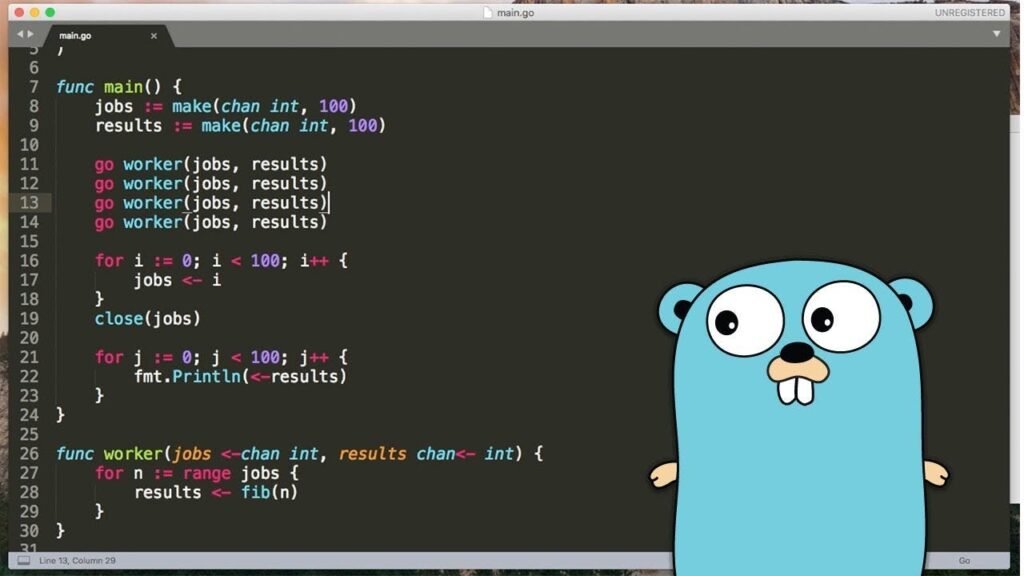
Go is one of the most practical additions to a modern web app language list because it is designed for simplicity, speed, and concurrency. It is especially effective for backend systems that need to handle large traffic volumes, parallel workloads, and cloud-native deployment environments. For full definition, see our guide on What is Go: Definitions, Strengths & Usages
Go stands out for its operational simplicity. Go has become a strong choice for web APIs, microservices, backend infrastructure, and performance-sensitive services because its syntax is relatively small, its tooling is clean, and its runtime characteristics support predictable performance.
Popular frameworks/libraries include Gin, Echo, Fiber, and Buffalo.
Go is a strong choice when you need:
- lightweight and fast backend services
- microservices and distributed systems
- high-concurrency web applications
- cloud-native APIs and infrastructure
- maintainable systems with strong runtime efficiency
Go becomes more attractive when backend throughput, service reliability, and operational simplicity matter more than rapid convention-based feature building.
For teams building SaaS infrastructure, real-time platforms, or scalable service backends, Go is often a better fit than niche or platform-specific alternatives.
Go is less compelling when the application depends heavily on complex domain modeling, rich metaprogramming, or highly expressive abstractions. Its simplicity is a strength, but it also limits how much structure you can encode elegantly.
Read more: Top Golang Web Development Companies in Vietnam
7. PHP
PHP, short for Hypertext Preprocessor remains relevant because it solves real business problems efficiently. It may not always be the most fashionable language, but it still powers a large portion of the web and has a mature ecosystem for practical development.
PHP stands out for its practical delivery. PHP is especially useful for content-heavy sites, portals, business websites, eCommerce systems, and applications that need cost-effective development with widespread hosting support.
Popular frameworks/libraries include Laravel, Symfony, CodeIgniter, and WordPress.
PHP is a strong choice when you need:
- CMS-based or content-led products
- web portals and customer-facing platforms
- fast delivery with a mature ecosystem
- eCommerce development
- access to a large developer pool
PHP remains a practical option for projects where business goals favor speed, cost efficiency, and proven CMS or portal workflows over architectural novelty.
For companies that need proven web delivery rather than technology for its own sake, PHP still makes a lot of sense.
Its weakness is not capability, but perception and variation in code quality. PHP can work very well, but mixed legacy patterns and uneven project standards still make some PHP codebases harder to modernize.
Read more: Best PHP Courses to Become a Master
8. Ruby
Ruby is best known for helping teams build products quickly. Its syntax is clean, expressive, and developer-friendly, while Ruby on Rails remains one of the most productive frameworks for web application development. For detail information, read this post Everything About the Ruby Programming Language.
Ruby stands out for its convention-driven productivity. Ruby is often a good fit for startups, MVPs, SaaS tools, and internal platforms where shipping quickly matters.
Popular frameworks/libraries include Ruby on Rails, Sinatra, and Hanami.
Ruby is a strong choice when you need:
- rapid MVP development
- product iteration at startup speed
- convention-driven web development
- SaaS and admin-heavy applications
- readable code that supports productivity
Ruby is most compelling when a team wants to validate a product quickly and values strong development conventions more than broad ecosystem standardization.
Ruby is no longer the default choice for every startup, but it still offers one of the fastest routes from product idea to working software.
The main concern is ecosystem momentum compared with JavaScript, Python, or Go. Ruby remains productive, but some teams may find hiring and long-term stack standardization easier elsewhere.
Recommended for you: Top 10 Ruby Software Development Companies in Vietnam
9. SQL
SQL, short for Structured Query Language, is not a general-purpose application language in the same way as JavaScript or Python, but it is still essential to web app development. Most serious web applications need structured data storage, querying, filtering, reporting, and transactional integrity. SQL remains the standard way to handle that.
SQL stands out for its data reliability. Whether your backend is written in Java, Python, PHP, Node.js, or C#, SQL often sits underneath the application as the system of record for structured business data.
Popular database systems and tools include PostgreSQL, MySQL, SQL Server, and SQLite.
SQL is a strong choice when you need:
- relational database management
- reporting and analytics
- transactional business logic
- structured querying across large datasets
- durable application data handling
SQL is usually treated as a core architectural layer rather than a secondary implementation detail. In most business applications, data quality, reporting accuracy, and query design have a direct effect on product reliability.
A modern web app stack can change at the framework level, but SQL tends to remain part of the foundation.
The real decision is often not whether to use SQL, but how much of the product logic should depend on relational modeling versus caches, search engines, queues, or event-driven components around it.
Recommended for you: Advanced Features of Query Language You Should Know
10. HTML/CSS
HTML and CSS are not backend languages, but they are still core web app languages because every browser-based product depends on them. HTML provides the structure of the interface, while CSS controls layout, presentation, responsiveness, and visual consistency. Read detail guideline about what is HTML and CSS tutorial here.
HTML and CSS stand out for their foundational role in UI delivery. Even in projects built with React, Vue, or Angular, the final interface still relies on HTML and CSS concepts.
Popular frameworks/libraries include Tailwind CSS, Bootstrap, Sass, and PostCSS.
HTML/CSS is a strong choice when you need:
- page structure and semantic markup
- forms, layouts, and user interface building
- responsive design across devices
- styling systems and design consistency
- accessible browser-based experiences
This layer is not treated as cosmetic. Clean HTML structure and disciplined CSS architecture usually make later frontend work faster, more accessible, and easier to maintain across product iterations.
No matter how advanced a web app becomes, strong frontend execution still depends on solid HTML and CSS foundations.
Teams often underestimate this layer. In practice, many frontend performance, accessibility, and maintainability problems come from weak HTML structure or overcomplicated CSS, not from the JavaScript framework itself.
A good next read is:
Common mistakes when choosing a web app language
The biggest language mistakes usually happen before the first line of code is written. In client and product work, these are the patterns that cause the most regret later:
- Choosing for trend value instead of product fit. A language may be popular and still be wrong for your delivery speed, team size, or hosting model.
- Optimizing for launch speed only. Teams often ignore maintenance, testing, refactoring, and hiring until the codebase becomes expensive to evolve.
- Underestimating ecosystem lock-in. Framework, cloud, and ORM decisions can matter as much as the language itself.
- Picking too many languages too early. Polyglot stacks can be powerful, but they also raise onboarding, debugging, and DevOps complexity.
- Ignoring the data layer. Many web apps fail at the database and integration layer before they fail at the programming-language layer.
- Copying big-tech architecture too soon. What works for a hyperscale company may be a poor fit for a startup or mid-sized product team.
How Designveloper chooses languages for web app projects
At Designveloper, we do not treat language selection as a theoretical exercise. We choose technologies based on product goals, system requirements, delivery timeline, team fit, and future maintenance needs.
In practice, JavaScript, TypeScript, HTML/CSS, and Python are among the most useful languages in our web development work because they cover a wide range of product needs. JavaScript and TypeScript are strong choices for interactive frontend experiences and modern full-stack applications. Python is valuable when products need automation, data processing, or AI-related capabilities. SQL remains essential wherever structured application data is involved.
Our experience across products such as Lumin PDF, Walrus Education, Joyn’it, Song Nhi, and other client systems has reinforced one simple lesson: there is no single best web app language for every project. The right decision depends on what the product needs to do, how fast it needs to evolve, and what kind of team will maintain it long term.
In practice, we usually review language choices against a short delivery checklist:
- user experience demands, such as real-time updates, complex frontend state, or highly interactive dashboards
- backend workload, such as CRUD-heavy operations, workflow automation, reporting, or performance-sensitive APIs
- integration complexity, including payment systems, third-party APIs, admin tooling, and authentication
- expected hiring and handoff risk, especially for products that must outlive the original development team
- roadmap pressure, including whether the product is moving toward AI features, analytics, or service decomposition
This process matters because the wrong choice often does not fail immediately. It creates friction later in testing, hiring, incident response, refactoring, and feature delivery. From an engineering management perspective, maintainability is usually the deciding factor long after the launch sprint is over.
FAQs
What is the best language for web app development?
There is no single best language for every web app. JavaScript and TypeScript are leading choices for modern browser-based products, while Python, Java, and C# are strong backend options depending on the product’s needs.
The better question is which language gives your team the best balance of delivery speed, maintainability, hiring access, and future architectural flexibility.
Is JavaScript enough to build a web app?
Yes, in many cases. JavaScript can handle frontend development and, through Node.js, backend development as well. However, most production apps also rely on HTML/CSS, databases, and often TypeScript for better maintainability.
A JavaScript-only strategy is usually strongest for small to mid-sized teams that value speed and a unified stack. Larger systems often add TypeScript, stricter architecture, and specialized data services as complexity grows.
Is Python good for web apps?
Yes. Python is one of the best backend languages for web applications, especially for fast development, APIs, dashboards, automation, AI features, and data-intensive systems.
It is especially valuable when the product roadmap includes analytics, internal tooling, or machine learning workflows that would otherwise require a second stack.
Do web apps need SQL?
Most web apps do. If your application stores structured user data, transactions, reports, or business records, SQL is usually part of the stack through a relational database such as PostgreSQL, MySQL, or SQL Server.
Even when teams add NoSQL, caching, or event streaming later, SQL often remains the system of record for core business data.
Why is TypeScript becoming more popular than plain JavaScript in large projects?
TypeScript helps teams catch errors earlier, manage large codebases more safely, and refactor with more confidence. That makes it especially useful for enterprise products and long-lived web applications.
Conclusion
The best web app languages in 2026 are not just the most popular ones. They are the ones that match your product, your team, and your long-term technical direction.
JavaScript and TypeScript lead modern web app development because they are flexible and deeply connected to the browser ecosystem. Python, Java, C#, and Go remain strong backend choices for scalable systems. PHP and Ruby still offer real value when the project fits their strengths. SQL continues to power application data, while HTML and CSS remain foundational to every web interface.
If you are choosing a language for a new product, start with the kind of web app you want to build, the team you have, and the system you will need to maintain two or three years from now. That is usually a better decision framework than chasing trends alone.
Also published on

Share post on










Related Articles



vLLM Tutorial: A Step-By-Step Guide To Deploying And Serving LLMs
vLLM Tutorial: A Step-By-Step Guide To Deploying And Serving LLMs Published June 29, 2026
Rust vs. C++ Performance: Can Rust Actually Be Faster In Practice?
Rust vs. C++ Performance: Can Rust Actually Be Faster In Practice? Published June 23, 2026
AI Programming Language For AI Development And Where They Fit Best
AI Programming Language For AI Development And Where They Fit Best Published June 17, 2026