















Software Development Life Cycle (SDLC): Guide for Business

The Software Development Life Cycle (SDLC) is a crucial framework for businesses aiming to develop high-quality software efficiently. As per recent statistics, the world population might reach 28.7 million software developers at the end of 2024 proving the demand for skilled professionals. This guide explores the SDLC phases, including planning, requirements analysis, design, development, testing, and maintenance, providing insights backed by recent reports.
For instance, a report by SlideShare details how SDLC helps break down development into manageable phases, ensuring better project management. Furthermore, the IT sector is to experience growth at 5% CAGR up to 2024 higher than the pre-Covid levels. Finally, this guide will also discuss specific examples, like the example of the development of a Customer Relationship Management (CRM) system which costs businesses around $30,000 to $200,000 in 2024.
By understanding the SDLC, businesses can streamline their software development processes, reduce costs, and enhance customer satisfaction. This comprehensive yet easy-to-understand guide from Designveloper aims to equip business leaders with the knowledge needed to navigate the complexities of software development successfully.
Understanding Software Development Life Cycle (SDLC)
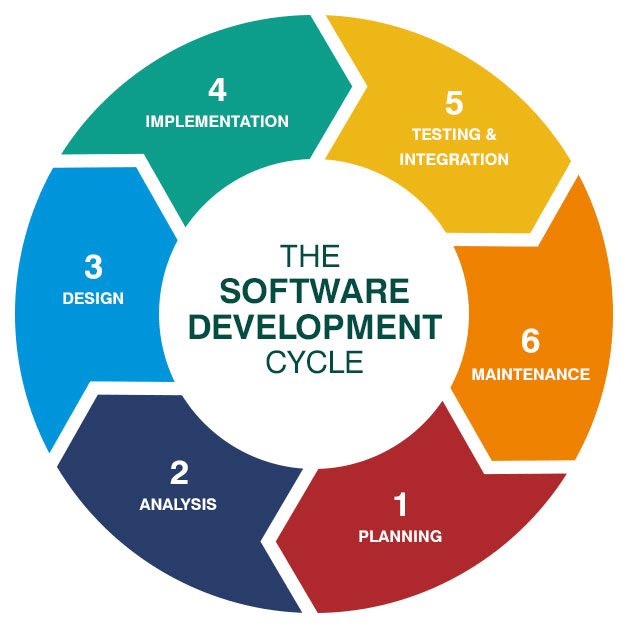
The software development life cycle is a closed cycle consisting of a series of six stages, ranging from planning, analyzing, designing, implementing, testing and integrating, and maintenance. Any successful websites or applications were primarily based on this process.
What is the Software Development Life Cycle or SDLC?
The Software Development Life Cycle, often abbreviated as SDLC, is a fundamental process that guides the creation of software applications. It’s essential to understand this cycle to grasp how software development works.
SDLC is a structured approach used by software developers to plan, design, build, test, deploy, and maintain software systems. This process ensures that software is developed systematically and efficiently.
The SDLC consists of several distinct phases, each with its own set of tasks and objectives. These phases typically include:
- Planning: In this initial phase, one must define the project’s scope, requirements, and objectives. This is where the software development team outlines what the software should accomplish.
- Analysis: During this phase, the team gathers detailed information about the project’s requirements, such as user needs, system functionality, and constraints. This analysis serves as the foundation for the subsequent stages.
- Design: In the design phase, we focus on the software’s architecture and technical specifications. This step outlines how the software will meet the requirements identified in the previous phases.
- Development: Here, the actual coding of the software takes place. Developers write the source code based on the design specifications. It’s the hands-on creation of the software.
- Testing: In the testing phase, the software goes through thorough examinations to identify and fix any issues or bugs. This step ensures that the software functions correctly and meets the user’s needs.
- Deployment: After successful testing, the software is deployed or released to users. It’s made available for use in the intended environment.
- Maintenance: Once the software is in use, the maintenance phase begins. This involves ongoing support, updates, and enhancements to address changing user requirements and address any issues that may arise.
The importance of SDLC in software development
Understanding the Software Development Life Cycle (SDLC) is crucial for businesses aiming to develop high-quality software efficiently. The SDLC framework ensures that software development projects are well-planned, executed, and maintained. Here are some key reasons why SDLC is important:
- Improved Quality: Following the SDLC phases helps in early detection of defects and issues, leading to higher quality software. It also ensures that a full phase must be completed before moving onto the next one, minimizing the likelihood of errors.
- Cost Efficiency: By breaking down the development process into distinct phases, SDLC helps in better project management and resource allocation. The earlier issues can be addressed, the sooner potential costs are reduced.
- Enhanced Customer Satisfaction: SDLC ensures that the final product meets or exceeds customer expectations. Businesses can deliver a product satisfies the user needs by involving stakeholders in the requirement analysis phase and continously testing the software.
- Scalability and Maintenance: Software developed using SDLC is easier to maintain and scale. With the structured approach, it is possible to update and enhance the software easily with the software being relevant and functional over time.
- Risk Management: SDLC provides a framework for identifying and mitigating risks throughout the development process. This way has a proactiveness that can help cut down the time for eventual setbacks and will have a smoother development journey.
For more detailed insights, you can refer to the comprehensive report on SDLC by SlideShare.
By adhering to the SDLC, businesses can achieve better project outcomes, reduce costs, and enhance customer satisfaction. This makes SDLC an indispensable part of modern software development practices.
The 6 Stages of Software Development Life Cycle
Stage 1: Planning
Prior to any project of software development life cycle, there comes strategy setting and planning. A business must be aware of its overall goal and the original idea that the whole plan will be based on later on.
1. Idea creation
The first step in the Software Development Life Cycle (SDLC) is idea creation. This stage consists of brainstorming and coming out with contemporary concepts that endeavour to handle certain business matters or market places.
An outstanding example is Customer Relationship Management (CRM), aimed at improving customer interactions and the organization’s business processes.
By fostering creativity and leveraging new technologies, businesses can develop software solutions that drive growth and efficiency.
2. Defining your goal with SDLC
Defining your goal is crucial in the first stage of the Software Development Life Cycle (SDLC). This step first sets the complete foundation of the whole project. First, we define what should be the primary goal or objective of our software. That is, what need does it serve? What problem does it try to solve? Setting clear goals will help to align the teams efforts and ensure that everyone is on the same page when working together.
Statista reported that 65% of software developers use JavaScript, making it key to pick the ideal tools and technology at the start of construction. According to this decision, a lot depends on the efficiency and the successful implementation of this project.
This is illustrated in a company wanting to develop a customer relationship management (CRM) system, which would set the goals such as improving customer satisfaction, streamline the sales processes, or gives detailed analysis. These goals guide the subsequent stages of the SDLC, from design to testing.
A SlideShare study backs this approach by stating that the need for a detailed planning and clear specifications is critical to the completion of high quality software. The paper explains how well defined goals assist to have better projects management, and more satisfied clients.
Stage 2: Analysis
The analyzing stage could be of tremendous significance in SDLC. The professionals at Designveloper would often call this stage “the make or break” due to its importance.
1. Sketching
In the Analysis stage of the Software Development Life Cycle (SDLC), sketching plays a crucial role. This phase comprises visual representations of the proposed system. These sketches help stakeholders understand functionality and the design of the system.
When sketching is incorporated into the Analysis phase of development, teams gain a more defined and agreed understanding of the project goals, resulting in more efficient more productive development cycles.
2. Flow and features
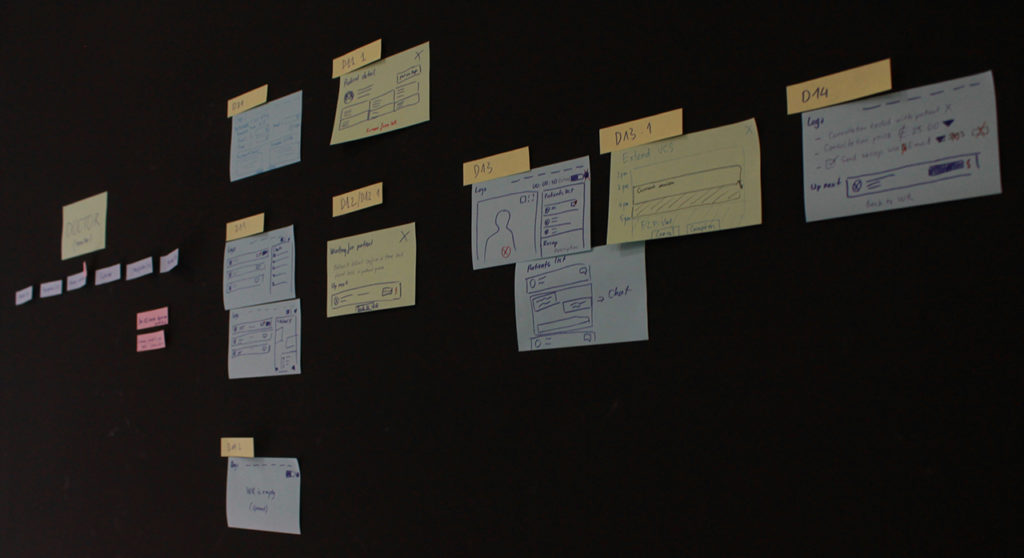
In the second stage of the Software Development Life Cycle (SDLC), the focus shifts to analysis. This stage is crucial as it sets the foundation for the entire project. Here’s a detailed look at the flow and features of this stage:
- Requirement Gathering: The analysis stage begins with requirement gathering. This involves collecting detailed information about what the stakeholders need from the software. It’s essential to involve all relevant parties, including end-users, developers, and business analysts.
- Requirement Analysi: Once requirements are gathered, they are analyzed to ensure they are clear, complete, and feasible. This step helps in identifying any potential issues early on. According to a report by SlideShare, requirement analysis is the most critical phase in SDLC as it lays the groundwork for the entire project.
- Feasibility Study: A feasibility study will begin to evaluate the project’s viability. This includes assessing technical, economic, and operational aspects. The study helps in determining whether the project should proceed or not.
- Documentation: All the requirements are documented in a detailed requirements specification document. This document serves as a reference throughout the development process. It includes functional and non-functional requirements, use cases, and any constraints.
- Validation: The requirements are validated with stakeholders to ensure they meet their expectations and needs. This step helps in avoiding misunderstandings and ensures that the project is on the right track.
- Prioritization: Requirements are prioritized based on their importance and impact on the project. This helps in managing resources effectively and ensuring that critical features are developed first.
- Approval: Finally, the requirements document goes through reviews and approvals by the stakeholders. This marks the end of the analysis stage and the beginning of the design phase.
3. Creating the MVP
Creating a Minimum Viable Product (MVP) is an additonal, seemingly optional, yet crucial step in the software development life cycle (SDLC). An MVP is the simplest version of a product that can be released to gather feedback from early adopters. This feedback helps developers understand if their product meets market needs before investing heavily in full-scale development.
Below are key steps to create an MVP:
- Identify Core Features: Focus on the essential features that solve the primary problem for users. This helps in reducing development time and costs.
- Build a Prototype: Develop a basic version of the product to test its feasibility. This can be a simple landing page, a demo video, or a basic app.
- Gather Feedback: Release the MVP to a small group of users and collect their feedback. This step is crucial for making necessary improvements.
- Iterate and Improve: Use the feedback to refine and enhance the product. This iterative process helps in aligning the product with user expectations.
Stage 3: Software Design
In the third stage of the Software Development Life Cycle (SDLC), the focus shifts to software design. This phase is important since it converts the requirements captured in the previous stage into a full fledged blueprint. Now, as per recent reports, a well executed design phase may reduce development time significantly.
1. System design
In the Software Development Life Cycle (SDLC), the system design phase is crucial. It involves to create a blueprint of the system that encompasses all the requirements of the analysis phase. This phase is concerned with specifying the architecture, components, modules and data flow, of the system.
- Architecture Design: This involves deciding what the overall structure of the system is. It consists of choosing the right technology stack, framework, and design pattern. Consider a web application with a three tier architecture consisting of client, server and database layer.
- Component Design: Details of design for each component of the system are given. It contains the functionality, interfaces, and functionality between various components. For example, the shopping cart component in an e-commerce application will need to have first hand contact with the product catalog and the payment gateway components.
- Data Design: Designing the database schema and data models is one of this. Among them, we find the definition of tables, relationships and constraints to garanty data integrety and performance. For example, in a customer management system, there would be tables for customers, orders and products, but there will be relationships between them.
- User Interface Design: The user interface (UI) design concerns itself with designing an interface that is visually appealing, and favorable to use. This requires that screens, navigation flows and interactive elements are designed. For example, the home screen, product listing screen, and the checkout screen of a mobile app.
- Security Design: System design virtually always involves security. This involves the implementation of data protec on, prevention of unauthorized access and secure communication. For example, encryption of your sensitive data or using authentication mechanisms.
2. User experience (UX) design
In the third stage of the Software Development Life Cycle (SDLC), User Experience (UX) design plays a crucial role. UX design is all about building a smooth and easy to understand user interaction with the software.
Recent statistics highlight the importance of UX design: A well executed UX planned design can boost website conversion rates anywhere from 100% up to 400%. However 90% of users have quit using an app because of poor performance. This is further evidence of the need to have a great UX design so as to have users stick around and become satisfied with the product.
Another recent report support these findings. A Forrester report indicates that for every $1 invested in UX design, $100 in return is produced, demonstrating a large return on investment (ROI). A Walmart report further confirms that faster loading time is directly correlated with the conversion rate, showing the success of business depends on UX as high as it depends on UI.
For instance, Housing.com and JobNimbus have made remarkable breakthroughs after redesigns of their UX. Addressing UX issues helped Housing.comdouble its in app sales and JobNimbus redesigned and moved from 2.5 to 4.8 app ratings.
To summarize, UX design is not just about pretty things, but how to create a functional, easy to use experience that helps engage and grow the business. By prioritizing UX design in the SDLC, businesses can ensure their software meets user needs and stands out in a competitive market.
3. User interface (UI) design
User interface design plays a crucial role in the third stage of the Software Development Life Cycle (SDLC). A good UI is one that improves user satisfaction, which relates directly to increased user engagement and eventually the success of the software. According to recent statistics:
- 91% of organizations with powerful UI strategies experienced higher customer satisfaction rates.
- In 2022, the global UI/UX design industry was worth $18 billion and is expected to reach $34 billion by 2027.
- In 2023, 70% of design teams saw a budget increase allocated for UI improvements.
- For example, if companies are investing in UI optimisation, they can expect a 30% increase in customer retention.
A lot boils down to the user experience, which is heavily dependent on the usability, accessibility, visual aesthetics, and interactivity of a UI design. I.e. mobile applications with good design present five times higher user retention compared with bad design.
UI design is a vital component of the SDLC, impacting user satisfaction, engagement, and overall success of the software. Maintaining intuitive and exciting UIs can greatly increase users’ experience and result.
Stage 4: Implementation
In the Software Development Life Cycle (SDLC), the implementation stage is where the actual construction of the software takes place. The Developers write code, Designers create the visual elements and the project begins to take shape. With this phrase, this is the most important phase which transforms design into a working product.
In this phase, developers write the required code of the software. It integrates and tests together different components of the software. It is then deployed to a test environment to check if it works as it is expected to.
For example, a company creating Customer Relationship Management (CRM) system designs the system first and then it goes to the implementation stage. Likewise, an e commerce platform will combine integration of multiple modules like payment gateways and inventory management during this stage.
The implementation phase is key, because that’s where the project starts to come into reality. This phase will help to find any issues which can get resolved before the software release to the users resulting in a higher quality product.
Stage 5: Testing and integration
Testing and integration is a crucial phase in the Software Development Life Cycle (SDLC). It guarantees that the software that is developed works perfectly when connected with other systems and satisfies all technical requirements.
According to the recent statistics, 44% of the IT companies have already automated more than forty percent of their testing processes delivering a 24% increase of ROI for automated testing. This highlights the importance of rigorous testing in the SDLC.
In the case of integration testing one combines individual modules and together tests them as a group. It allows you to discover potential issues of interaction between different parts of the system. For instance, an e commerce platform company will integrate tests to verify whether the payment gateway works well with the shopping cart.
The other crucial aspect is system testing where the entire and integrated software is tested to confirm that it satisfies the predefined requirements. Such as security, performance and compatibility tests. The software testing market may experience rising growth rate at a CAGR of 7% over 2024 – 2032, according to a Global Market Insights report, attributed to the rise in software quality demand.
There is user acceptance testing (UAT) done to make sure the software fulfills the end users requirements and expectations. Usually, the real users or testers test the software in a controlled environment to provide feedback about how well the software runs and how easy it is to use during this phase.
The testing and integration phase of the SDLC is essential for delivering high-quality software that meets user expectations and performs reliably in real-world scenarios. Through automation and adequate testing, companies can improve significantly their software development outcomes.
Stage 6: Maintenance
The final stage of the Software Development Life Cycle (SDLC) is maintenance. This phase guarantees that the software will continue to work well and to fulfil the user needs for a while. Bug fixing, Performance optimization, and adapting to new environment are the few key activities associated with maintenance.
- Bug Fixing: The primary task during maintenance is to identify and fix bugs or defects which were omitted during earlier phase or which has arisen in the production environment. This enables to have reliable and user friendly software.
- Performance Optimization: Monitoring and optimization of the performance of the software is a regular process. This could be tuning the database, optimizing the code, and scaling the infrastructure to make the software run efficiently.
- Security Updates: Since the field of cybersecurity threats changes all the time, maintaining the software safe is important. Keeping software up to date is the easiest way to protect it from vulnerabilities and attacks: regular updates and patches protect against vulnerabilities, making your software safe.
- Adaptation to Changing Environments: Changes in hardware, operating system, or any other external software must be adapted to otherwise, the software will no longer be in the acceptable and functioning mode. The software has to be updated to work together with the new tech and environment perfectly.
- Enhancements: New features and functionalities will be added for ever changing user needs and business requirements. Planning, designing and implementing these enhancements form the section of the maintenance phase through which the software is kept relevant and useful.
It was reported that global predictive maintenance is expected to grow 29.5% from 2023 to 2030. This highlights the importance of proactive maintenance strategies in ensuring software longevity and performance.
You can check SSW Softdoc contents for more detailed information.
The Software Development Life Cycle (SDLC) at Designveloper
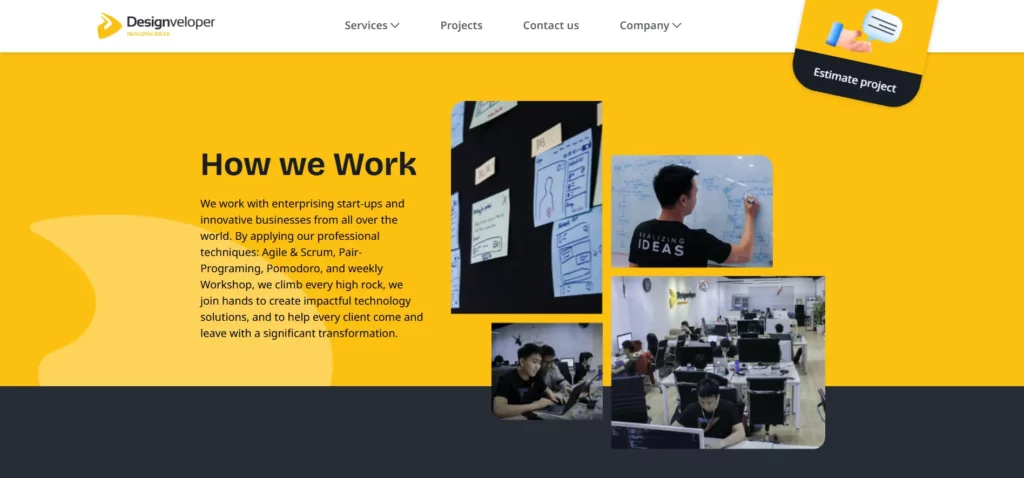
At Designveloper, we follow a structured approach to software development known as the Software Development Life Cycle (SDLC). By following this process we guarantee we deliver high quality software solution that meets our customer needs. Here’s a detailed look at each phase of our SDLC:
Requirement Gathering and Analysis
First we gather detailed requirements from our clients. Like any firm, our team of business analysts and project managers meet with a client to understand their needs, goals, and expectations. This phase is important because it lays the foundation for an entire project.
Design
After the requirements are clear, our design team produce detailed architecture and design specification. In this phase, we would create the wireframing, mockup, and prototypes to see the final product. Our designers make sure that the design is user friendly and that of course, it matches with the client’s vision.
Implementation or Coding
Now, it is the time of our developers to take over from here and start coding the software according to these design documents. The software is developed by a combination of different programming languages and frameworks like Java, Python, ReactJS, Angular. We follow the best practices to get the cleaner, maintainable, and efficient code.
Testing
Testing is a critical phase in our SDLC. We are engaged in different kinds of testing such as unit testing, integration testing, system testing and user acceptance testing (UAT). The software is tested by our QA team, to ensure that there are no bugs and to ensure that the supplied software meets the existing client allured quality.
Deployment
The software is tested thoroughly and deployed to client’s environment. To help make the transition go smoothly we provide detailed deployment guides, as well as offer training sessions. In the event that you are having trouble with the deployment phase, we have a support team at your disposal.
Maintenance
The final phase of our SDLC is maintenance. We continue to provide support and maintenance services to the software so that it remains optimal. We work on the software and update it on a regular basis with bug fixes, new features and improve performance based on client feedback.
By following this structured SDLC process, Designveloper ensures that each project is delivered on time, within budget, and meets the highest quality standards. With our dedication to excellence, we’ve been recognized as one of Vietnam’s front runner software development companies.
Conclusion
The Software Development Life Cycle (SDLC) is a crucial framework for businesses aiming to develop high-quality software efficiently. Recently, there was news that the global software development industry will grow from its current US $565.20 Bn in 2019 to reach US $1.04 trillion by 2027; a forecasted compound annual growth rate (CAGR) of 22.54%. This growth highlights the increasing importance of SDLC in modern business operations.
To stay competitive, businesses must adopt SDLC methodologies that streamline development processes and ensure high-quality outcomes. Take, for an example, the Agile methodology, which furthers flexibility and constant improvement. According to Statista, 85% of development teams now use several programming languages to meet their diverse technological needs in software development.
Moreover, SDLC helps businesses meet customer expectations and deliver projects within budget and timelines. A study by Radixweb revealed that 84.7% of software development projects are based on enterprise applications, underscoring the critical role of SDLC in business automation and eCommerce.
Understanding and implementing SDLC is essential for businesses looking to thrive in the digital age. By leveraging SDLC methodologies, companies can enhance their software development processes, improve product quality, and achieve better project outcomes. For more detailed insights, you can refer to comprehensive reports on SDLC available on platforms like SlideShare and Statista.
Also published on

Share post on










Related Articles


Cloud Application Development: From Architecture To Launch
Cloud Application Development: From Architecture To Launch Published September 11, 2026
Android App Development: Stack, Process, Cost, And Best Practices
Android App Development: Stack, Process, Cost, And Best Practices Published September 09, 2026
How Gitignore Works: Rules, Patterns, Examples, And Debugging Tips
How Gitignore Works: Rules, Patterns, Examples, And Debugging Tips Published August 05, 2026