










Generative AI, RAG, And Agentic AI: From Output To Action

Teams comparing rag vs generative ai vs agentic ai often face a category problem before they face a technology problem. The terms describe different parts of an AI system, so choosing between them as if they were three competing products can lead to unnecessary complexity.
This guide helps developers, software practitioners, and technical leads decide what each approach adds. It also shows where retrieval, tool use, approvals, evaluation, and fallback behavior belong in a production workflow.
Quick Answer: How Generative AI, RAG, And Agentic AI Differ
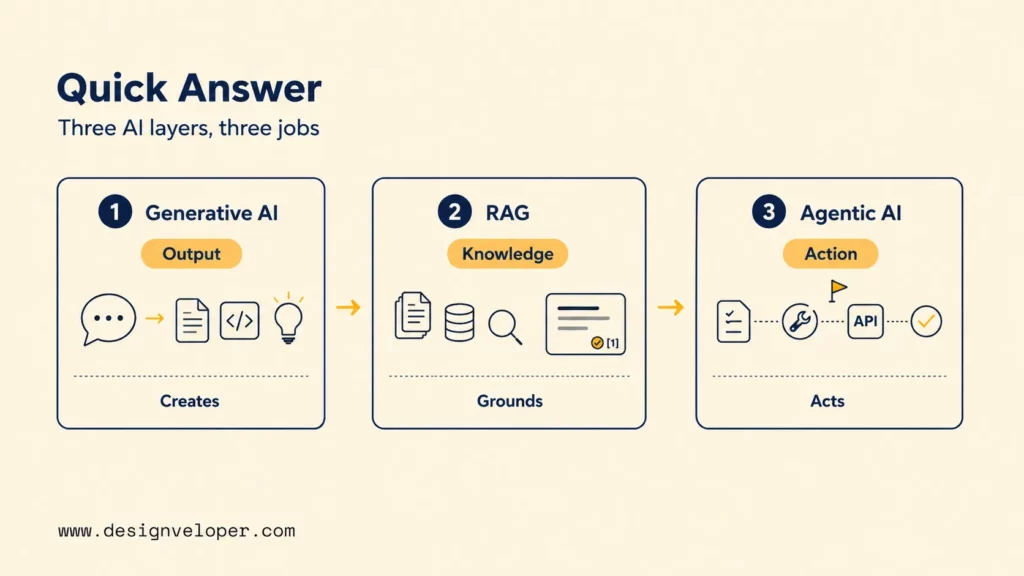
The core distinction is output, retrieved context, and action. Generative AI creates or transforms content. RAG retrieves external knowledge before generation. Agentic AI may choose steps and take permitted actions through tools or connected systems.
There is also an important taxonomy difference. In this comparison, Generative AI is a model capability. RAG and agentic AI are application or system patterns that can use generative models inside a larger workflow.
Use three questions to choose the minimum useful layer:
- Output: Use Generative AI when the workflow mainly needs content generation or transformation.
- Knowledge: Add RAG when the answer depends on private, current, or approved external knowledge.
- Action: Consider an agentic layer when the system must choose steps, use tools, or take permitted actions.
These layers do not form a maturity ladder. A focused RAG assistant can be a better architecture than an agent when the job is document Q&A. A production system can also combine all three when the workflow truly needs them.
What Generative AI Does Best
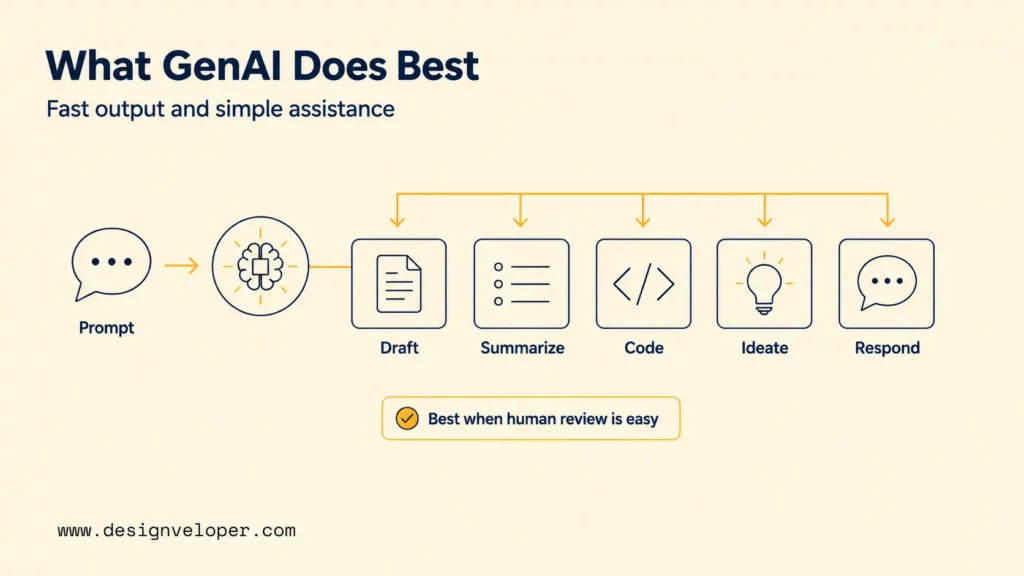
Generative AI works best when the user needs new or transformed content from a prompt. Typical outputs include text, summaries, code, images, and recommendations.
These content-generation capabilities make Generative AI useful for drafting, summarization, code suggestions, brainstorming, and low-risk chatbot responses. Human review remains important because a generative model may produce incorrect, incomplete, or unsupported content.
The practical boundary is company-specific knowledge. If a drafting assistant can do its job from the prompt and model context, retrieval may add infrastructure without improving the result enough to justify it. If the answer must cite a policy, product manual, or current internal record, the workflow has moved into RAG territory.
What RAG Adds To Generative AI
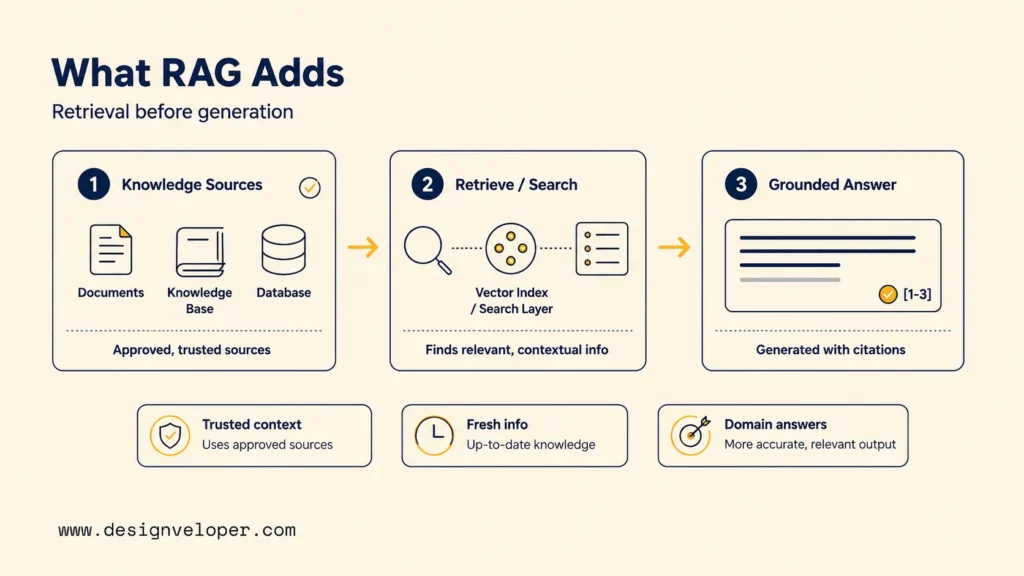
Retrieval-augmented generation adds a retrieval step before generation. The application searches an external source, selects relevant material, and places that material into the model context for the current request.
AWS’s guide to retrieval-augmented generation describes RAG as using an external knowledge base before an LLM generates a response. The source might be internal documents, a product knowledge base, a database, or another repository the application is allowed to query.
Many RAG implementations use embeddings and vector search, but the retrieval method can vary. Keyword search, hybrid search, metadata filters, and reranking may also shape which passages reach the model. The useful question is not which database sounds most advanced. It is whether the retriever finds the right evidence for the user’s request.
The workflow below shows where teams should inspect quality rather than treating RAG as one black box.
Approved documents, records, or knowledge bases
Search, filter, rank, and select relevant passages
Pass only useful evidence into the model prompt
Answer from the retrieved context and application rules
Teams can refresh the indexed source corpus without retraining the base model. The final answer still depends on retrieval quality and source freshness. Retrieval also does not prove that a passage is accurate, authorized for that user, or sufficient to support the answer.
Source citations can be useful when the application supports them, but citation behavior is implementation-specific. Teams should verify that a cited passage actually supports the statement shown to the user.
RAG can improve what a model can reference, but retrieval quality still decides whether that context is useful.
What Agentic AI Adds Beyond Answers
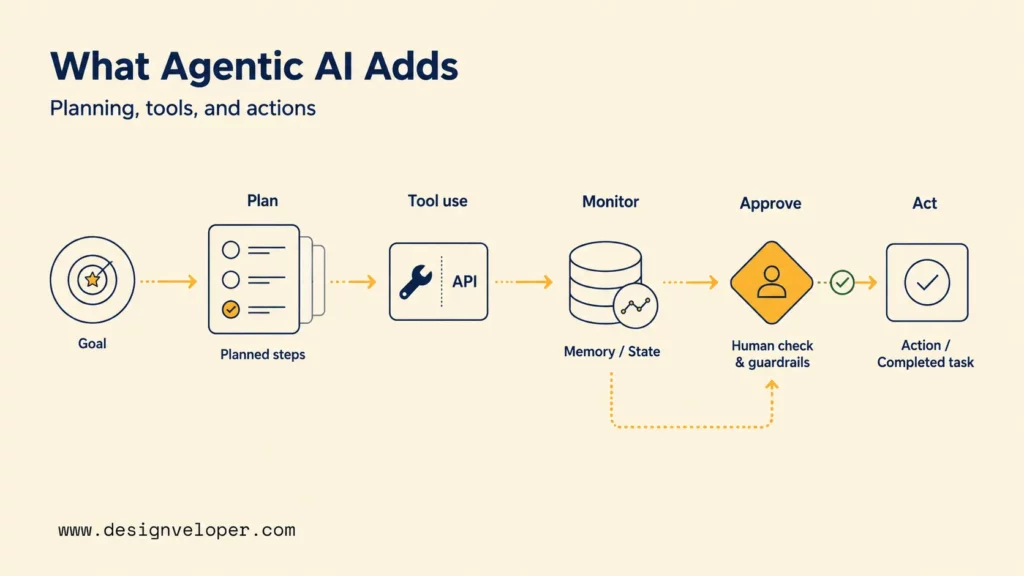
Agentic AI adds goal-directed control flow around models, tools, and business systems. Depending on its design, an agentic system may break a goal into steps, use tools, inspect results, and continue toward a defined outcome.
The main distinction between Generative AI and agentic AI is the control flow. Generative AI usually responds to a prompt. An agentic system may decide what happens next, call a tool, observe the result, and continue or stop under defined rules.
Planning, memory, and tool use are common building blocks, but they are not mandatory in the same form for every agent. A narrow agent may use one tool and no long-term memory. A more complex system may coordinate several tools, preserve state, and route work across multiple steps.
Action changes the risk boundary. A system that can update a ticket or issue a refund can cause operational harm that a drafting assistant cannot. Microsoft’s 2026 least-privilege guidance for AI agents says identity, scope, tool access, and auditability should be defined before autonomy expands.
Production teams should also decide which actions need approval and who owns recovery when a tool call fails. Those controls belong in the workflow design, not in a prompt that the model can reinterpret.
The important step from Generative AI to agentic AI is not more intelligence; it is controlled authority to choose and perform actions.
Generative AI Vs RAG Vs Agentic AI: Key Differences
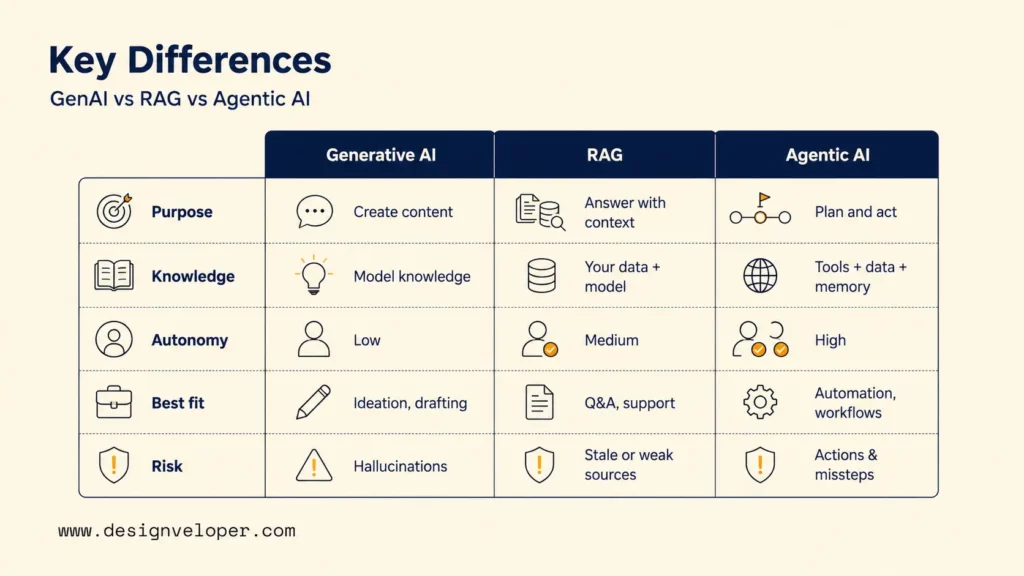
The biggest differences between rag vs generative ai vs agentic ai are what the system must produce, what context it can use, and whether it can act. The table keeps the comparison at the application level so teams can choose an architecture without treating the terms as maturity stages.
| Area | Generative AI | RAG | Agentic AI |
|---|---|---|---|
| Primary purpose | Create or transform content | Generate with retrieved external context | Pursue a goal through controlled decisions and actions |
| Knowledge source | Training data plus prompt and runtime context | Model context plus retrieved approved or domain sources | Context, tools, retrieved data, memory, and system state as designed |
| Autonomy level | Usually low and user-prompt driven | Usually low in a fixed retrieval pipeline | Variable; depends on the workflow and allowed actions |
| Tool/API usage | Optional | Retrieval or search layer is required | May use tools or APIs; often central when actions are required |
| Workflow complexity | Often one request and one output | Retrieve, augment context, then generate | May plan, act, observe, retry, or escalate |
| Best-fit use cases | Drafting, summarization, ideation, simple assistance | Knowledge search, document Q&A, grounded support | Routing, system updates, multi-step operations, workflow automation |
| Cost and latency | Depends mainly on model and context size | Adds retrieval and search overhead | Can add repeated model and tool calls, depending on the design |
| Main risks | Unsupported output, unsafe content, data leakage | Irrelevant retrieval, stale or unauthorized sources, misleading grounding | Wrong actions, excessive permissions, cascading failures, tool misuse |
| Governance needs | Output evaluation and data controls | Data access, source freshness, retrieval and answer evaluation | Identity, permissions, action approval, auditability, monitoring, recovery |
Generative AI is a capability, while RAG and agentic AI describe ways to assemble an application around one or more models. That distinction explains why the same model can sit inside a simple chatbot, a RAG assistant, or an agentic workflow.
Complexity should follow the task. Retrieval adds another quality and latency boundary. Agentic behavior may add repeated calls, tools, permissions, and recovery paths. The extra layer is useful only when it solves a workflow problem the simpler pattern cannot solve.
When To Use Each AI Approach
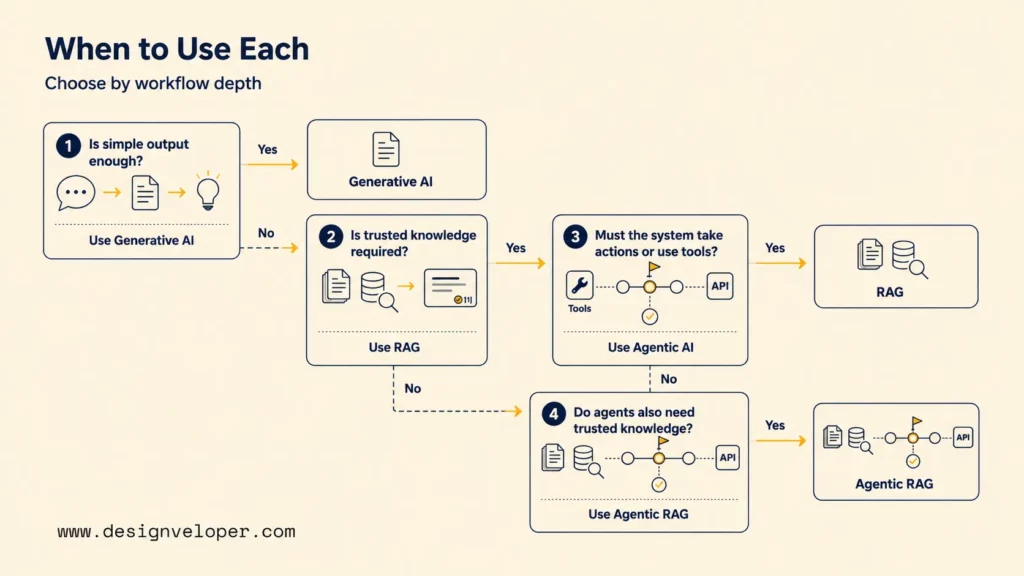
Choose the simplest architecture that satisfies the workflow. Start with generation, add retrieval when the answer depends on approved external knowledge, and add agentic behavior only when the system must choose steps or take action.
Use Generative AI For Fast Output And Simple Assistance
Use Generative AI when a person mainly needs an output they can inspect before use. Good examples include first drafts, summaries, code suggestions, brainstorming, and low-risk chatbot replies.
The decision rule is simple: ask whether private or current company knowledge changes the answer. If not, a direct model interaction may be easier to build, evaluate, and operate than a retrieval pipeline.
Use RAG For Knowledge-Based Answers And Document Workflows
Use RAG when the response must depend on a controlled source. Internal search, policy Q&A, customer support, product documentation, legal references, compliance material, and document assistants are common fits.
Changing source material is another reason to use RAG. Teams can refresh documents or indexes as the source changes. They still need to test whether the retriever selects the right passages for each query.
Evaluate retrieval quality separately from answer quality. A fluent answer is not reliable if the system retrieved irrelevant, stale, or unauthorized passages. AWS’s guidance on evaluating RAG reliability separates retrieval-related checks from measures of the generated answer.
For a production path that covers ingestion, retrieval, access control, monitoring, and deployment, our RAG chatbot build guide goes deeper into the engineering work behind a document assistant.
Use Agentic AI For Multi-Step Workflows And System Actions
Use agentic AI when the workflow must make choices across several steps or interact with business systems. Typical jobs include routing a case, checking records, updating a system, or coordinating multiple tools.
A refund request shows where the layers change responsibility. The workflow below makes each handoff visible, including the approval and fallback path that a demo often omits.
Customer asks for a refund
Fetch order data and refund policy
Check conditions and draft the proposed action
Require a human for risky or exceptional cases
Call refund API and update the ticket
Generative AI owns the drafting step in this example. RAG supplies the policy and order context. The agentic layer coordinates checks and tools. The workflow should not let the model bypass an approval gate simply because its response sounds confident.
Use Agentic RAG When Agents Need Trusted Knowledge
Agentic RAG combines retrieval with an agentic workflow. Instead of always following one query-retrieve-generate path, the agent may decide when to retrieve, reformulate a query, request more evidence, or continue to another tool.
The combination of iterative retrieval and agentic actions fits document-heavy support agents, research assistants, compliance review workflows, and internal operations agents. It also creates more failure paths because retrieval choices become part of the agent’s control flow.
NVIDIA’s comparison of traditional RAG and agentic RAG describes traditional RAG as a simpler query-retrieve-generate path and agentic RAG as a more dynamic pattern. In that comparison, traditional RAG is typically faster and less expensive. That trade-off is not a universal rule for every workload.
Our guide to building a RAG system recommends adding agentic RAG only when a simple chain cannot handle the workflow. Logs and evaluation should show the need before the architecture expands.
Implementation Tradeoffs To Plan Before You Build
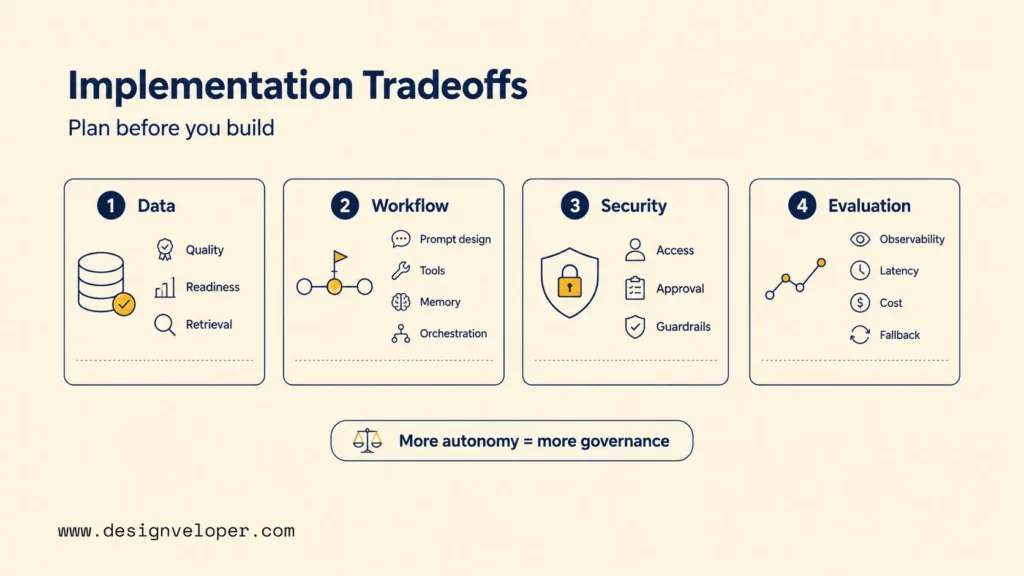
Implementation difficulty grows when the system gains more data paths, decisions, and permissions. Before choosing a stack, connect every major component to a failure the team can detect, contain, and recover from.
The grouped checks below keep that planning practical:
- Data and retrieval: Confirm that source data is permitted, current enough for the use case, and searchable. Test chunking, metadata, retrieval quality, filters, reranking, and the vector database or search layer. Define what happens when no source is good enough.
- Generation and orchestration: Define prompt behavior, tool calling, memory, and orchestration rules. Set stop conditions, retry limits, timeouts, and fallback behavior. Decide which failures should trigger a simpler path instead of another model call.
- Access and approval: Scope data and tool permissions to the task. Separate read actions from write actions where possible. Decide which actions need human approval and record enough detail to audit who or what changed a system.
- Evaluation and operations: Measure retrieval quality, answer quality, task completion, latency, and model or tool cost. Add traces for model calls and tool calls. Monitor failures after launch and keep a human escalation path for cases the workflow cannot resolve safely.
A team building agentic workflows may also need a clearer component map. Our agentic AI architecture guide shows how planning, memory, tools, observations, and feedback loops fit together without assuming that every implementation needs every component.
Before production, turn the evaluation categories into explicit pass, fail, and review criteria. The scorecard below shows what each metric should answer without inventing one universal threshold.
Add autonomy only when the workflow benefit justifies more testing, permissions, monitoring, and recovery logic.
Choosing The Right AI Layer For A Business Workflow
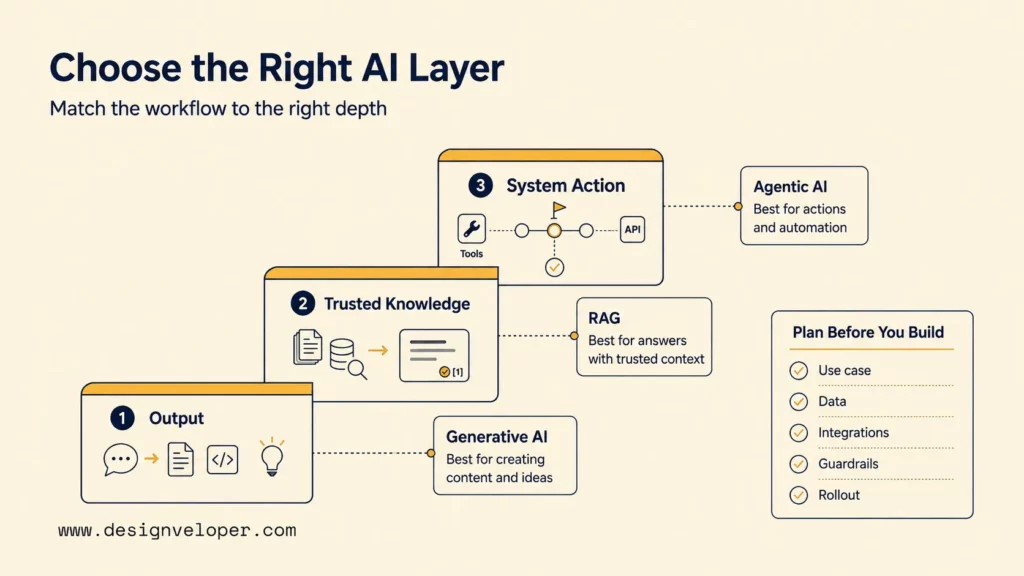
For teams comparing rag vs generative ai vs agentic ai, the practical choice is the simplest architecture that can complete the job. Output alone points to Generative AI. Evidence-dependent answers point to RAG. Multi-step decisions or system changes may justify an agentic layer.
If your team is evaluating an AI workflow, our AI development team can help map the data sources, retrieval layer, tool permissions, evaluation plan, and rollout checkpoints. The deliverable should make failure paths and human approval points visible before the team commits to a production architecture.
FAQs About Generative AI, RAG, And Agentic AI
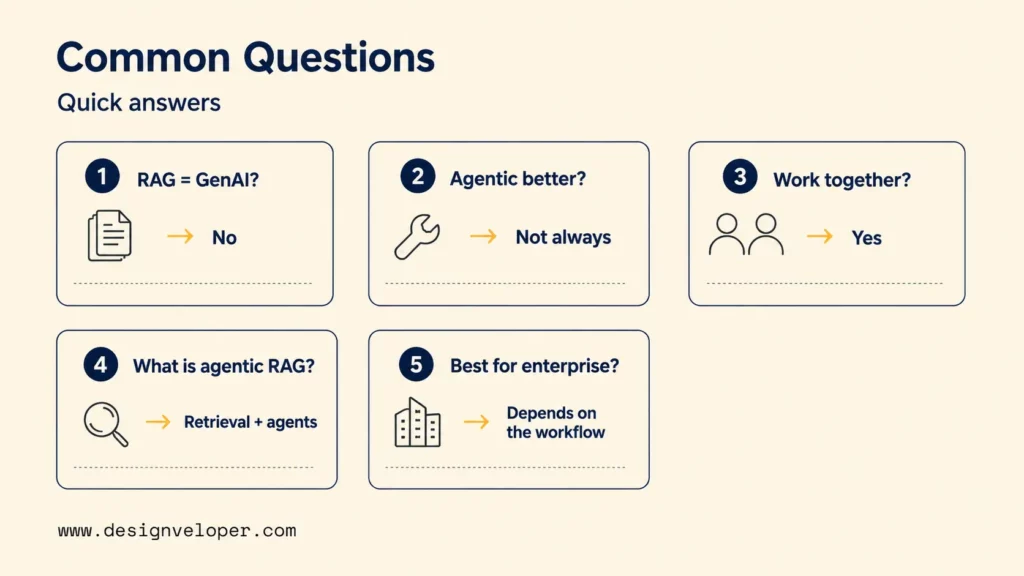
Is RAG The Same As Generative AI?
No. Generative AI describes a capability for creating or transforming content. RAG is an application pattern that retrieves external context before a generative model produces an answer.
Use RAG only when that external knowledge changes what the system needs to say. Otherwise, a direct Generative AI interaction may be enough.
Is Agentic AI Better Than RAG?
No. RAG improves access to relevant knowledge, while agentic AI adds decision and action logic. A policy assistant may need RAG but no agentic behavior because answering is the entire job.
Add an agentic layer when the system must do something with the answer, such as route a case or update a record. More capability is useful only when the workflow needs it.
Can Generative AI, RAG, And Agentic AI Work Together?
Yes. One system can use Generative AI for language, RAG for retrieved evidence, and agentic logic for controlled steps and actions. The architecture should still keep source permissions, tool permissions, and approval rules separate.
What Is Agentic RAG?
Agentic RAG is a pattern where retrieval becomes part of an agent’s broader workflow. The agent may decide whether another retrieval step is needed instead of following one fixed retrieval sequence.
The limitation is complexity. More retrieval decisions create more behavior to evaluate, trace, and recover when the agent chooses a weak query or source.
Which AI Approach Is Best For Enterprise Workflows?
The best enterprise approach is the least complex pattern that meets the workflow, data, and control requirements. Teams comparing rag vs generative ai vs agentic ai should decide whether the system only needs output, needs external evidence, or must take controlled action.
That decision should be tested against real production constraints before rollout. Retrieval quality, task completion, permissions, latency, cost, and fallback behavior matter more than choosing the most advanced-sounding label.
Also published on

Share post on









Related Articles


Training An AI Model Starts With Better Decisions, Not Better Tools
Training An AI Model Starts With Better Decisions, Not Better Tools Published August 18, 2026
Generative AI, RAG, And Agentic AI: From Output To Action
Generative AI, RAG, And Agentic AI: From Output To Action Published August 18, 2026
8+ Best ChatGPT Models In 2026: Which One Should You Use?
8+ Best ChatGPT Models In 2026: Which One Should You Use? Published August 11, 2026