














Training An AI Model Starts With Better Decisions, Not Better Tools

Training an AI model starts with a clear task, a defined target, and evidence that shows whether the result works. If you are learning how to train an AI model, remember that using an API or retrieving documents is not the same as training. Training fits or updates model parameters with data, such as labeled examples for a predictive model or curated examples for fine-tuning a pretrained model.
This guide explains how to decide whether training is necessary, prepare usable data, choose the right approach, evaluate a pilot, and operate the resulting system in production. It is a decision-and-delivery guide for teams building a reliable product, not a framework-specific coding tutorial.
Decide Whether Training Is The Right Answer
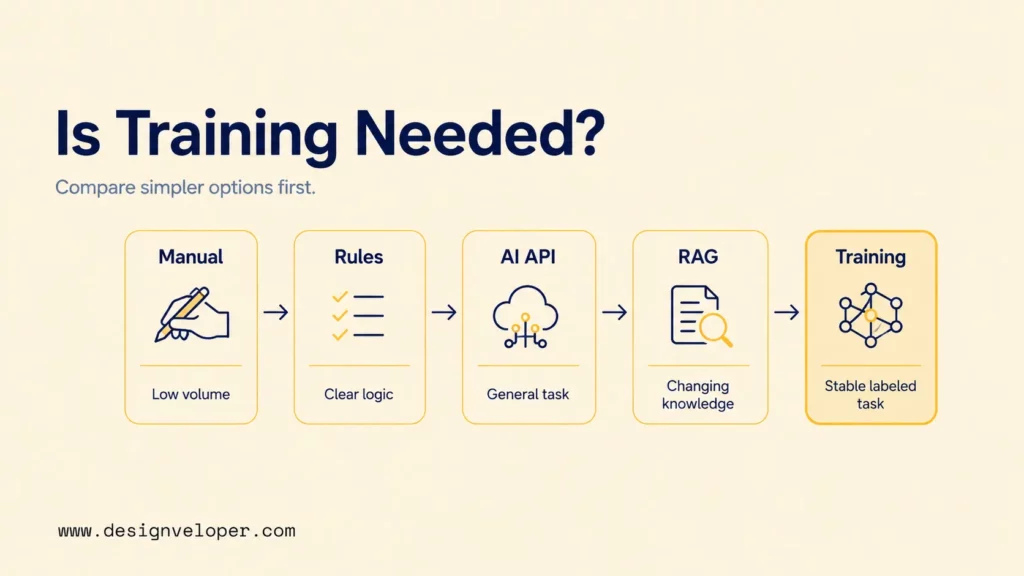
Training is worth considering when a repeatable, measurable problem remains after simpler options have been tested. Start by defining the workflow, expected output, error impact, and success metric.
Consider support-ticket routing. The input is a support ticket, and the output is a destination queue. A wrong route may cause a minor delay, or it may hide a security issue. The success metric should reflect that difference.
Start with a baseline such as manual triage, keyword rules, or an existing AI service. Google’s Rules of Machine Learning guidance recommends keeping the first model simple and establishing observable metrics before adding complexity.
For a ticket-routing pilot, measure correct queue assignment, high-impact misroutes, reviewer effort, and the minimum improvement required for release. A tailored model is justified only when that improvement offsets the additional work required for data, integration, evaluation, and maintenance.
Choose the first option by problem type:
| Problem Type | Best First Option | Why | When Training Is Justified |
|---|---|---|---|
| Low-volume or changing workflow | Manual workflow | People can adapt while requirements are still unstable. | The workflow becomes repetitive, measurable, and expensive to handle manually. |
| Clear deterministic conditions | Rules | Rules are transparent and easy to test when the logic is explicit. | Real inputs vary too widely for a stable rule set. |
| General language, vision, or generation task | Existing AI API | A pretrained service may already provide the required capability. | Prompting and configuration still miss a stable behavior that matters to the product. |
| Answers require changing internal knowledge | RAG | Retrieval supplies approved documents at request time without changing model weights. | Retrieval solves the knowledge gap, but a stable behavior still needs model adaptation. |
| Stable task with labeled examples | Fine-tuning or custom predictive model | Training can adapt behavior or learn a prediction boundary from examples. | The baseline misses a defined threshold and suitable training data is available. |
Rules may handle most obvious tickets. That is not a failed experiment. It narrows the training problem to cases where language or context varies too widely for deterministic logic.
Choose The Data That Can Teach The Desired Behavior
Useful training data represents the decisions the model will make in production. More records cannot compensate for inconsistent labels, missing edge cases, or data that the team cannot use safely.
Separate Training Data From Knowledge Sources And Evaluation Cases
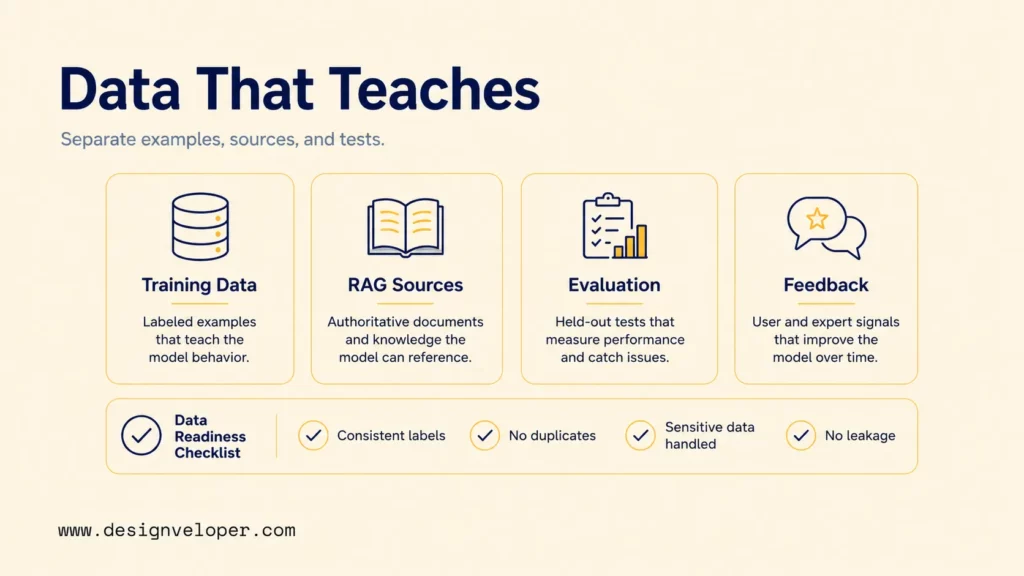
Training examples, knowledge sources, evaluation cases, and user feedback have different jobs. Keep those roles explicit so the team knows what changes model behavior and what supplies context or evidence at runtime.
- Labeled training examples pair an input with the desired target. A supervised model learns from these examples.
- Retrieval-augmented generation sources provide documents or records at request time. They do not automatically become training data.
- Evaluation cases stay outside training. They show whether the model works on examples it did not learn from.
- User feedback identifies production failures. It should become training data only after review, permission checks, and labeling.
Representative data includes common inputs and meaningful edge cases. For support routing, include a two-topic ticket, a rare security request, and wording from recently launched products. These examples expose decisions that an average-case dataset may hide.
Write labeling rules before scaling annotation. Specify who owns each label, how reviewers resolve disagreements, and when an example should be excluded. Confirm that consent, contracts, and internal policy allow the intended use of customer or employee data.
Check Whether The Data Is Ready To Use
Before training, verify that the dataset is internally consistent and that evaluation will remain independent. Complete this checklist before the first run:
- Labels follow a written rule, and disagreements have a review path.
- Duplicate or near-duplicate records are removed or deliberately controlled.
- Required fields are present and have consistent meanings.
- Rare classes have enough examples for separate evaluation.
- Sensitive fields are removed, masked, or approved for the intended use.
- Training records do not leak into the final evaluation set.
For supervised training, split the data into training, validation, and test sets. Train on the training set, use validation results to choose settings, and keep the test set for final evaluation. For ordered data, scikit-learn’s TimeSeriesSplit documentation explains why time-aware splits avoid training on future records and evaluating on earlier ones.
For example, 500 consistently labeled tickets may be more useful than 10,000 noisy exports when the smaller set covers the decisions and edge cases the model must handle. This is an illustration, not a universal dataset threshold. The appropriate sample size depends on the task, label distribution, and evaluation goal.
Use the data result to choose the next action:
- Labels disagree: Rewrite the labeling rule and review disputed cases.
- Important cases are missing: Collect targeted examples before expanding the dataset broadly.
- Knowledge changes often: Use retrieval when the main problem is access to current information.
- Data and tests are ready: Move to a pilot with a fixed evaluation set and release threshold.
Match The Training Method To The Product Constraint
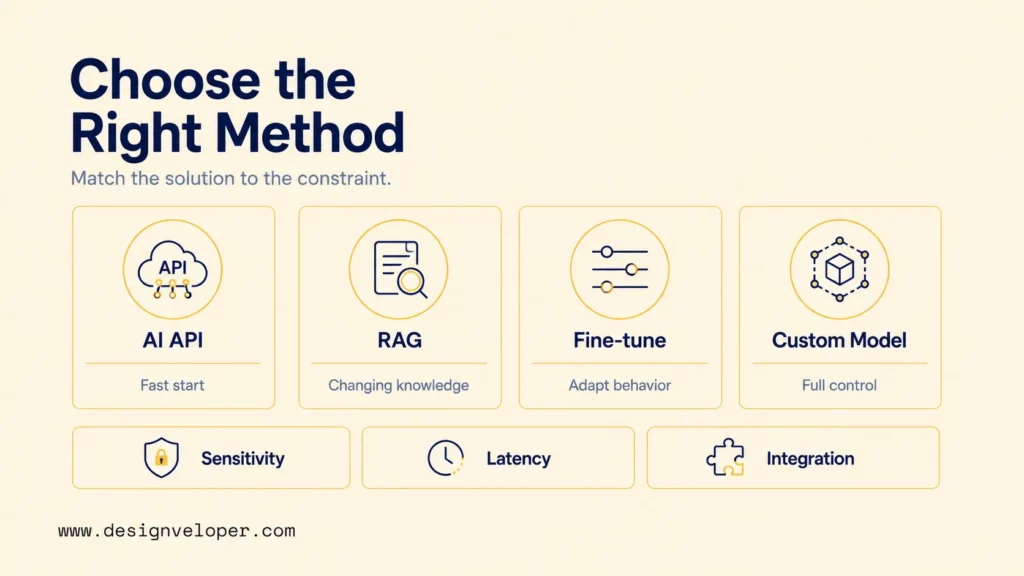
The previous section asks whether training is justified at all. If the measured gap remains, choose the approach that solves it with the least product and operational complexity.
An AI API and RAG use existing models. Fine-tuning and custom predictive modeling involve training or updating model parameters.
Use RAG when the product must answer from changing documents. Retrieval supplies relevant knowledge at request time; it does not teach that knowledge into model weights. Our RAG vs. fine-tuning guide explains this distinction in more depth.
Fine-tuning adapts a pretrained model to a stable behavior, response pattern, or task. A custom predictive model is appropriate when the primary task is to predict a defined outcome, such as a ticket category, fraud risk, or demand class from structured features and labeled examples. These approaches can also be combined with retrieval or application rules when the product requires both prediction and current context.
Choose the method by its constraints:
| Approach | Control | Data Readiness | Delivery Effort | Maintenance | Avoid When |
|---|---|---|---|---|---|
| Existing AI API | Lower model-level control | Prompt examples and evaluation cases may be enough | Lower relative effort | Track provider behavior, prompts, usage, and application quality | Data boundaries, latency, or behavior requirements cannot be met. |
| RAG | High control over approved knowledge sources | Clean documents, permissions, and retrieval tests | Moderate | Maintain ingestion, indexing, retrieval quality, and document access | The main gap is stable behavior rather than knowledge. |
| Fine-tuning | More control over learned behavior | Consistent examples of desired outputs | Moderate to high | Version datasets, compare model versions, and retune when behavior changes | Facts change frequently or examples do not define the target behavior. |
| Custom predictive model | High control over task design and serving | Reliable labels, representative features, and independent evaluation data | High | Maintain feature pipelines, serving, drift checks, and retraining | A simpler rule or existing model already solves the prediction problem. |
When training is the selected path, the core loop is concrete: select an algorithm or architecture, define a loss function, feed training batches, calculate error, and update parameters. Validate settings without touching the final test set. PyTorch’s training-loop tutorial demonstrates this process with datasets, loss functions, optimizers, and parameter updates.
Data sensitivity can rule out an option before modeling begins. If data must remain in an approved environment, keep storage, retrieval, inference, and logs within that boundary. RAG alone does not guarantee this because retrieved text may still be sent to an external model endpoint.
Choose the serving mode separately from the training or retrieval method. Batch inference works when predictions can be prepared ahead of use. Real-time inference works when the application needs current request context, but it adds latency, availability, and monitoring requirements. Integration complexity also rises when several systems, identities, or permission layers sit on the request path.
Plan The Commitment Before The First Training Run
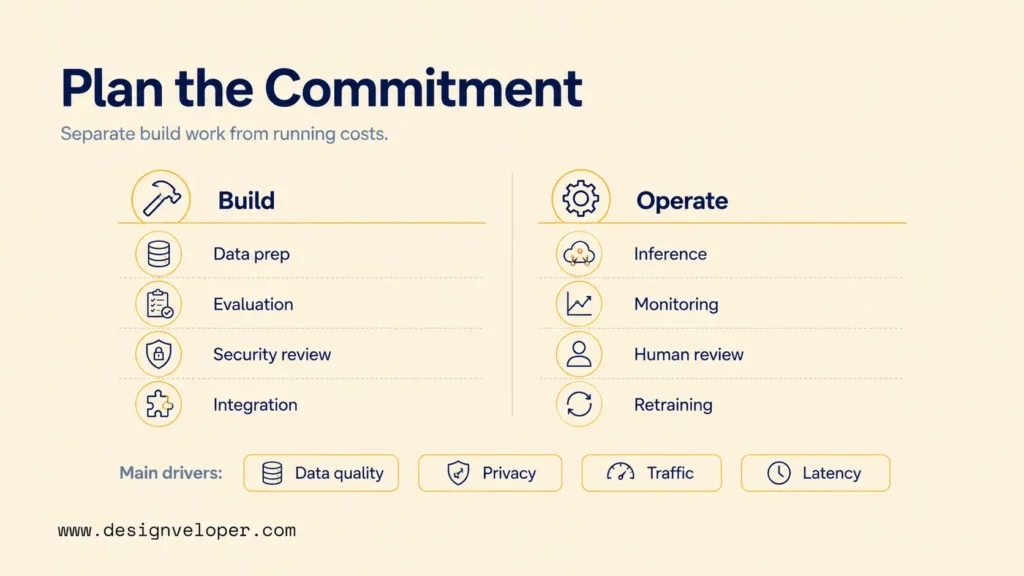
Plan the effort and cost model before running experiments. Data preparation, expert review, evaluation, integration, and privacy controls can take more time than the training job itself.
Separate one-time build work from recurring costs. One-time work includes preparing data, defining labels, building evaluations, integrating the selected approach, and completing security review. Recurring costs may include inference, storage, human review, monitoring services, incident handling, and later retraining.
Do not turn these categories into a universal timeline or budget. Delivery time usually grows with labeling effort, privacy review, integration count, evaluation depth, traffic requirements, and the number of systems on the request path. The main cost drivers are data type, labeling effort, privacy constraints, traffic volume, latency target, and operating complexity. Our AI app cost planning guide explains how architecture choices change an AI product’s scope.
Use this planning framework to estimate the work without treating every option as a mandatory stage:
| Delivery Option | One-Time Work | Recurring Work | Main Time Drivers |
|---|---|---|---|
| API prototype | Workflow design, prompts, evaluation, integration, and access setup | Provider usage, monitoring, and application maintenance | Workflow scope, integration count, evaluation depth, and approval needs |
| RAG proof of concept | Document preparation, permissions, chunking, retrieval tests, and index setup | Ingestion, indexing, retrieval monitoring, and document access reviews | Document quality, permission rules, source count, and retrieval evaluation |
| Fine-tuning pilot | Labeled examples, training runs, model comparison, and version control | Inference, model evaluation, dataset maintenance, and later retuning | Labeling effort, experiment count, model size, and release controls |
| Custom predictive model | Feature work, training infrastructure, evaluation, serving integration, and security review | Serving, feature pipelines, drift checks, monitoring, and retraining | Feature availability, target quality, serving architecture, and production integrations |
A team may stop after an API prototype, choose RAG without fine-tuning, or build a custom predictive model when the task requires it. Choose the smallest commitment that can produce credible evidence for the product decision.
Run A Pilot That Can Change The Decision
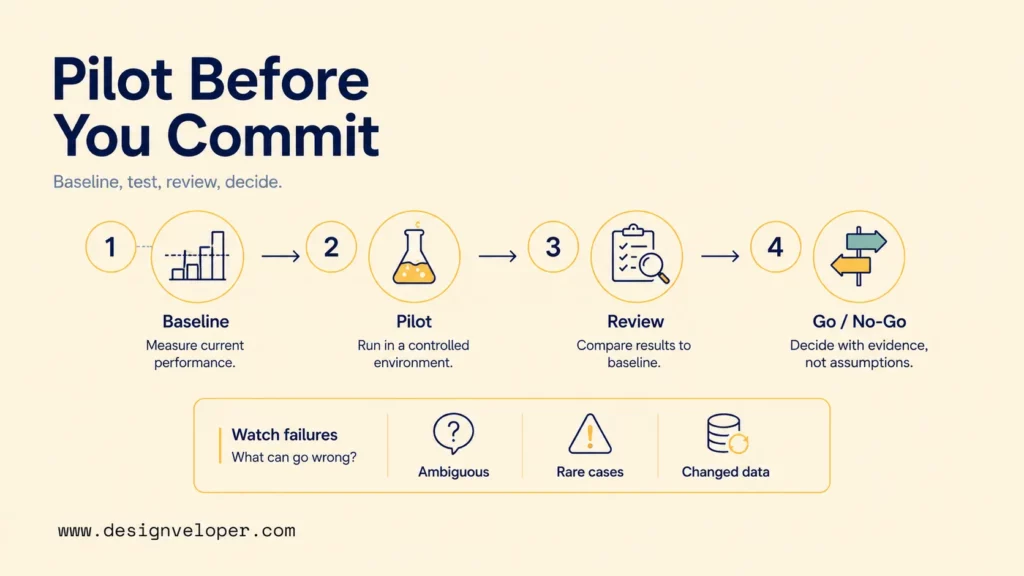
A pilot should be able to show that fine-tuning or a custom model is unnecessary. Its purpose is to test a product hypothesis against evidence, not to justify a predetermined architecture.
Establish A Baseline And Go/No-Go Criteria
Set the baseline and release threshold before reviewing the final result. Compare the pilot with the current manual process, rules-based logic, or off-the-shelf model on the same evaluation cases.
For support routing, overall accuracy is not enough. A team may set a separate limit for security-ticket misroutes because those errors carry more harm. Name the person who can approve release and the person who handles exceptions.
If the pilot includes supervised training, keep the test set untouched while the team iterates. Fit the model on the training data and choose settings using validation results. Run the final test only after the candidate is fixed. Repeatedly tuning against the test set turns it into another training signal.
Use four ordered steps so the pilot can change the decision:
- Establish the baseline: Measure the current process or simple alternative on the agreed cases.
- Run the pilot: Change one important factor at a time and record the model, data, and configuration version.
- Review the evidence: Compare the target metric, critical failures, response time, reviewer effort, and expected operating cost.
- Decide go or no-go: Continue only if the result clears the threshold without creating an unacceptable new risk.
Test The Failures Users Will Notice
Test ambiguous inputs, rare cases, changed patterns, and mistakes with high user impact. Improve the data or evaluation design before adding compute or model complexity.
For the ticket-routing example, test three failure cases deliberately: a two-topic ticket, a rare security issue, and a new product name. Connect each observed signal to a plausible cause and next action.
| Observed Signal | Likely Cause | Next Action |
|---|---|---|
| Two-topic tickets jump between queues | The labeling policy does not define multi-intent cases. | Set a primary-intent rule or allow multi-label routing, then relabel examples. |
| Rare security tickets are misrouted | The evaluation and training data contain too few representative rare cases. | Collect targeted cases and evaluate that class separately. |
| New product names cause errors | Production inputs changed after the data snapshot. | Add recent examples or use a retrieval or feature source that updates faster. |
| Training performance rises while held-out quality stalls | Overfitting, leakage, or duplicate examples. | Audit the splits and features before changing model size or compute. |
A failed pilot is still useful when it identifies the next decision. The team may need better labels, a narrower use case, a retrieval layer, or no trained model at all.
Make The Model Work In A Real Product
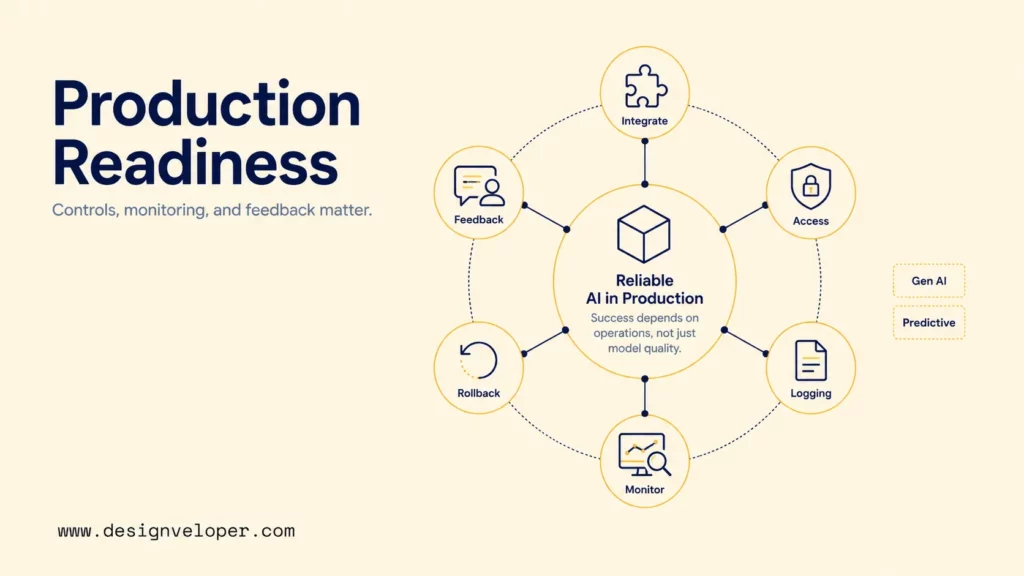
A successful pilot is not a reliable production workflow. Production requires controlled integration, serving, permissions, logging, rollback, monitoring, and a way for users to report problems.
Choose batch or real-time inference according to the workflow. Batch inference works when predictions can be prepared ahead of use. Real-time inference is often appropriate for new requests, but it needs tighter latency and availability controls.
The system should not expose a document, input field, model feature, or prediction beyond the user’s authorization. Enforce authorization at every layer—retrieval, inference, application actions, and log access—and ensure that logs do not expose data beyond the user’s permissions. Our AI chatbot integration guide shows how permissions, business systems, human handoff, and monitoring fit around conversational AI.
Monitoring should cover system health and model quality. Watch the metric used for release, changes in input patterns, latency, failure rates, and high-impact error types. Define a rollback path before deployment so the team can restore the previous model or workflow when a release performs worse.
Retraining should respond to evidence rather than a calendar alone. Triggers can include sustained quality decline, meaningful data drift, changed user behavior, a new label definition, or a business rule that changes the target itself.
Generative and predictive systems fail in different ways. Generative AI needs controls for prompt injection and unintended disclosure. Teams should also validate outputs and restrict access to sensitive data. The OWASP GenAI LLM Top 10 2026 provides current guidance on application-specific LLM security risks.
Predictive models also need privacy checks. Their risks may include group-level bias, false positives, false negatives, and the actions taken after an incorrect prediction. Review the error that matters to the user, not only the average score.
Governance should connect technical controls to named owners and review actions. The NIST AI Risk Management Framework organizes AI risk management around four functions: Govern, Map, Measure, and Manage. NIST states that AI RMF 1.0 is being revised; verify the current framework status before publication if the article uses a date-sensitive statement.
Make the response path explicit:
| Signal | Owner | Review Frequency | Action |
|---|---|---|---|
| Quality falls below the release threshold | Product and ML owner | Per release and scheduled review | Pause rollout, inspect failures, and decide whether to revert or retrain. |
| Input distribution changes | Data or ML owner | Automated monitoring plus review | Check whether labels, features, and evaluation cases still represent production. |
| Latency or inference cost rises | Engineering owner | Continuous operational monitoring | Profile the request path, change serving strategy, or set usage limits. |
| A user flags a harmful or incorrect result | Operations or support owner | Per incident with trend review | Escalate high-impact cases and add reviewed failures to evaluation. |
Align Delivery, Adoption, And Ownership
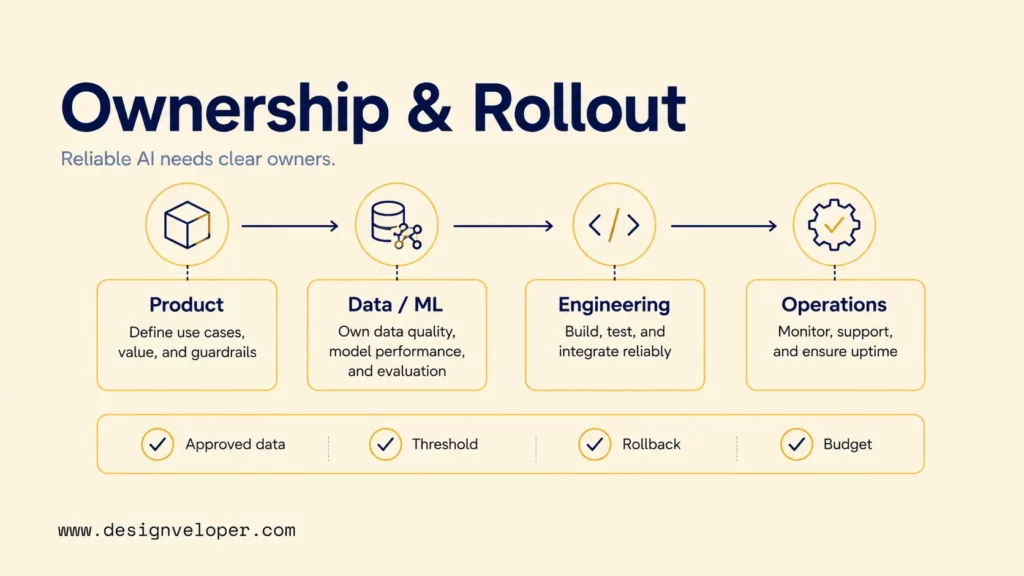
Assign clear owners for the data, product, integration, support process, and budget. Each owner should accept their responsibilities and escalation path before broad rollout.
Use this readiness checklist to confirm that operational decisions have owners, not just documents:
- The data source and intended use are approved.
- The business threshold and high-impact failure limits are written.
- An engineer owns the production integration and release path.
- Support staff know how to handle uncertain or incorrect outputs.
- A rollback path exists for model, prompt, retrieval, and application changes.
- Monitoring has a named owner and a response rule.
- The recurring operating budget has an accountable owner.
The handoff should cover user adoption as well as technical ownership. Explain what the system can do, where it is uncertain, and how users can report a bad result. Connect feedback to the model or configuration version so the team can reproduce the failure.
Use the ownership relay to make accountability explicit:
- Product: Define the outcome, success threshold, and unacceptable failure.
- Data and ML: Own data quality, evaluation evidence, and model-release recommendations.
- Engineering: Own serving, permissions, logs, deployment, and rollback.
- Operations: Support users, escalate failures, and track ongoing operating impact.
FAQs About How To Train An AI Model
Who Should Label And Review Training Data?
Domain experts should define the label meaning and review difficult cases. Trained annotators can label data at scale while preserving consistency. A data or ML owner should measure disagreement and update the labeling guide when reviewers interpret a rule differently.
What Should A Team Do When Its Data Cannot Leave Its Own Environment?
Treat the requirement that data must remain in its approved environment as an architecture constraint. Rule out any design that sends protected content outside that boundary. Check the full request path, including storage, retrieval, inference, application actions, and logs.
How Do You Set A Go/No-Go Decision After An AI Proof Of Concept?
Set one release rule before the final review: the pilot must clear the agreed threshold without crossing a critical failure limit. If the pilot does not clear that rule, change the data, method, or scope instead of moving the target after seeing the result.
Which Costs Continue After The Model Goes Live?
Recurring costs can include inference, storage, retrieval infrastructure, monitoring services, human review, incident handling, and later retraining. The exact mix follows the architecture. Budget for the workflow that keeps the system usable, not only the initial build.
When Should A Team Involve A Data Scientist, ML Engineer, Or External Partner?
Involve a data scientist when the main uncertainty is data quality, metrics, experiments, or model choice. Bring in an ML engineer when training pipelines, serving, monitoring, and retraining become production requirements. Use an external partner when the team lacks several of those capabilities or needs coordinated product integration.
Designveloper has experience building AI-oriented assistant products for conversational finance workflows. If your team needs help evaluating an AI approach, connecting it to internal systems, or operating it safely in production, talk to our AI development team.
Also published on

Share post on










Related Articles



LangGraph Vs MCP: Key Differences, Use Cases, And When To Use Both
LangGraph Vs MCP: Key Differences, Use Cases, And When To Use Both Published October 12, 2026
Prompt Engineering Best Practices: 10 Tips, Examples, And Evaluation
Prompt Engineering Best Practices: 10 Tips, Examples, And Evaluation Published October 07, 2026
AI Agent Architecture Diagrams: Components, Patterns, and Design Steps
AI Agent Architecture Diagrams: Components, Patterns, and Design Steps Published September 29, 2026