


Healthcare App Development In 2026: Features, Costs, And Process

KEY TAKEAWAYS:
- Healthcare app development starts with care workflow clarity: define users, clinical tasks, data sources, consent, risk level, and expert input before choosing features or technology.
- The strongest healthcare apps combine UX, security, compliance, and integrations instead of treating them as separate workstreams added after design.
- MVP scope should stay narrow: prove one valuable healthcare workflow, include the minimum safe data flow, and avoid advanced AI or complex integrations until reliability is validated.
- Cost and timeline depend on risk, regulated data, interoperability, testing depth, and post-launch operations more than on screen count alone.
- AI can support triage, summarization, reminders, and workflow assistance, but healthcare products still need human review, auditability, monitoring, and clear accountability.
A patient may book a video visit in seconds, yet the care team still needs to verify identity, review consent, reach the right record, document the encounter, and recover if the connection fails. Healthcare app development has to make that entire journey work, not just the patient-facing screen. For teams planning a portal, telemedicine service, or monitoring product, the difficult choices are where clinical responsibility sits, which data can move between systems, and what a safe first release will cost to build and operate.
The sections below connect app types and essential features to a concrete telemedicine workflow, regulatory boundaries, integration and testing decisions, and an estimate worksheet. If you are still exploring the problem, test healthcare app ideas for startups against an observed care journey before committing to a build.
What Is Healthcare App Development?
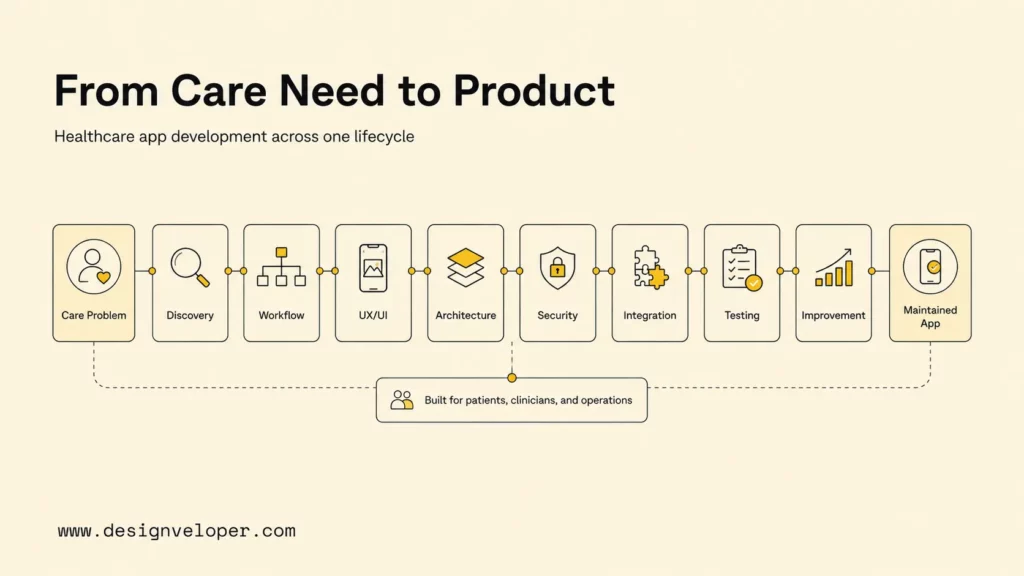
Healthcare app development turns a defined care, patient-service, or health-operations problem into maintained software. The work includes product discovery, clinical workflow analysis, UX/UI, architecture, data modeling, security, compliance planning, integration, testing, deployment, monitoring, support, and continuous improvement.
The category spans low-risk wellness products and high-risk clinical software. A habit tracker, appointment app, clinician dashboard, medication tool, remote monitoring service, imaging viewer, and diagnostic algorithm may face very different requirements. Intended use matters. The U.S. Food and Drug Administration applies a risk-based approach to device software functions and mobile medical applications, focusing oversight on functions that meet the device definition and could create patient risk if they fail.
Healthcare applications often serve two or more sides of a workflow. A patient books an appointment, a scheduler checks availability, a clinician reviews history, a pharmacy receives an order, a payer verifies coverage, and an administrator handles exceptions. Optimizing one screen without mapping the complete workflow can shift work and risk to another participant.
Product success therefore needs clinical or operational outcomes alongside engagement. A telehealth service might measure completed visits, connection quality, documentation completeness, escalation, no-shows, and follow-up. A patient portal might measure successful record access and message resolution, not screen time. Metrics must not encourage behavior that conflicts with patient safety or professional standards.
Common Types Of Healthcare Apps
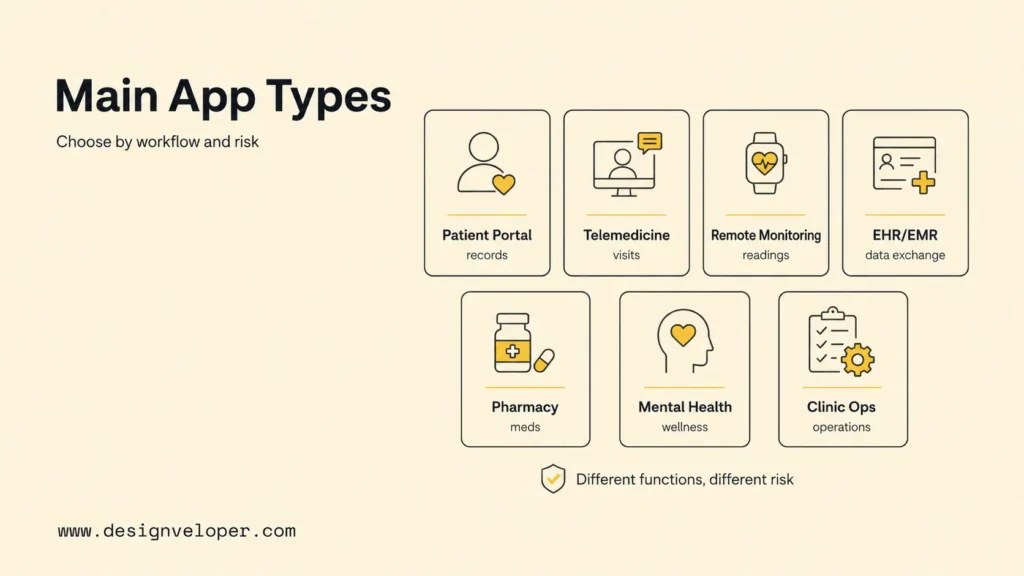
Healthcare apps are best categorized by the workflow they support and the risk of their intended function. A single platform may combine several categories, but each added workflow brings new users, permissions, data, integrations, and failure modes.
- Patient portal apps provide records, results, appointments, forms, billing, care plans, messages, and proxy access for caregivers. Identity proofing and understandable data presentation are central.
- Telemedicine apps support discovery, eligibility, scheduling, consent, video or voice visits, documentation, prescribing where allowed, payment, and follow-up. They need graceful recovery when connectivity fails.
- Remote patient monitoring apps receive readings from patients or devices, apply thresholds, show trends, route alerts, and document review. Teams must define who monitors, when, and what happens when data is missing or abnormal.
- EHR/EMR-connected apps read or write clinical and administrative data through APIs, HL7 messages, interfaces, or files. Mapping, terminology, provenance, authorization, reconciliation, and change management determine reliability.
- Medication and pharmacy apps can support reminders, medication lists, interaction information, refills, orders, delivery, and adherence. Clinical statements and prescribing functions require careful scope and qualified review.
- Mental health and wellness apps provide education, tracking, coaching, peer or professional sessions, and self-management. Crisis language, escalation, privacy, evidence, and vulnerable-user design require explicit handling.
- Provider, hospital, or clinic management apps coordinate schedules, intake, queues, documentation, orders, staff, rooms, inventory, claims, and reporting. Integration and role design often matter more than the number of screens.
Product teams should separate wellness, administrative support, clinical decision support, and diagnosis or treatment functions. A feature can change category as its claims or output change. Showing a patient’s recorded trend is different from recommending a dose. Regulatory and clinical review should follow the intended function, target user, evidence, and potential harm.
Key Healthcare App Features
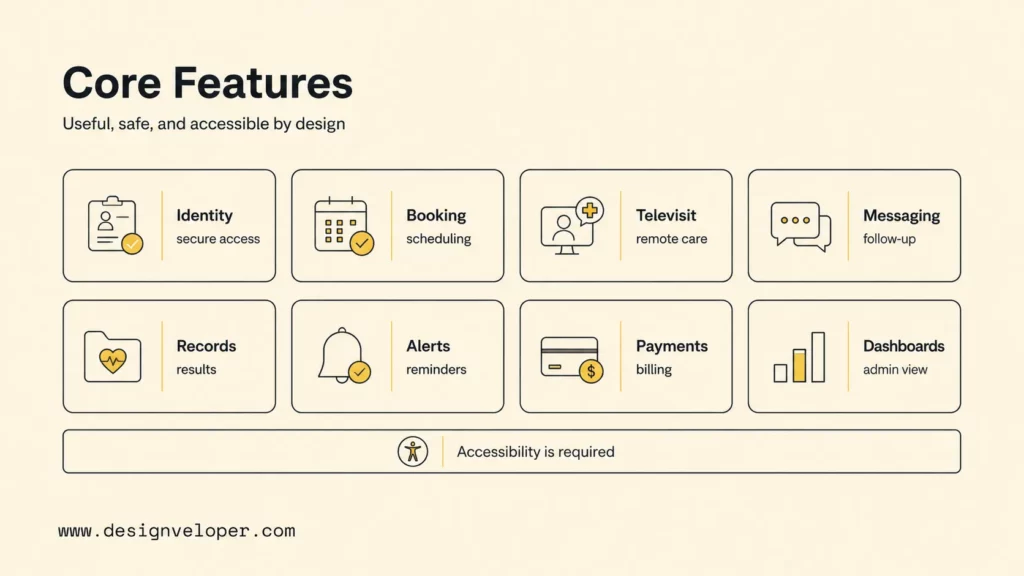
Healthcare app features should reduce friction without removing necessary safeguards. Every feature needs a user value, a data boundary, a failure response, and an accountable owner.
| Feature | User Value | Technical Consideration |
|---|---|---|
| User profiles and authentication | Correct patient, caregiver, provider, or administrator access | Identity proofing, MFA, SSO, session control, account recovery, and proxy relationships |
| Appointment booking | Search, schedule, reschedule, cancel, and prepare for care | Real-time availability, time zones, eligibility, reminders, waitlists, and reconciliation |
| Teleconsultation | Remote access to qualified care | Consent, media security, connectivity checks, fallback, documentation, and emergency routing |
| Secure messaging | Asynchronous questions, instructions, and follow-up | Participant identity, encryption, retention, attachments, routing, response expectations, and audit |
| Medical records access | View results, medications, documents, and care history | Authorization, sensitive-data segmentation, terminology, provenance, download, correction, and proxy access |
| Notifications and reminders | Timely appointments, medication, tasks, and care-plan prompts | Consent, preference, channel privacy, quiet hours, delivery status, and non-alarming language |
| Payment or insurance integration | Coverage checks, estimates, payment, and claims visibility | PCI scope, payer rules, coding, authorization, disputes, refunds, and financial reconciliation |
| Admin and provider dashboards | Manage queues, patients, schedules, alerts, operations, and outcomes | Least privilege, clinical prioritization, filtering, audit trails, workload, and safe bulk actions |
Accessibility is a clinical and operational requirement, not a styling preference. Patients may use assistive technology, have low vision, limited dexterity, cognitive load, low digital confidence, or urgent needs. Plain language, readable contrast, keyboard access, clear errors, large touch targets, language support, and alternative channels can determine whether care is reachable.
Every workflow also needs explicit states. An appointment is not just booked or unbooked; it can be requested, pending eligibility, confirmed, rescheduled, arrived, completed, canceled, no-show, or disputed. State models allow the interface, audit log, notifications, billing, and integrations to agree about what happened.
To refine the release boundary, compare How To Develop A Low-Code MVP: Step-By-Step Guide with the requirements for clinical integration above.
Practical Healthcare App Workflow Example
A workflow example makes the scope easier to test than a feature list. Consider a telemedicine MVP for a clinic that wants to reduce phone scheduling while keeping a clinician responsible for the care decision. The first release can stay narrow, but it still needs a complete path from request to follow-up.
| Stage | Inputs | Output and review owner | Failure state to test |
|---|---|---|---|
| Request | Patient identity, reason for visit, location, language, and availability | Eligible appointment request; scheduling team reviews exceptions | Identity cannot be verified, service is unavailable, or the request may be urgent |
| Prepare | Appointment record, consent, intake answers, coverage or payment details | Confirmed visit packet; patient and clinic receive clear next steps | Consent is incomplete, payment fails, or an intake answer needs human review |
| Visit | Authenticated patient, clinician, device permission, connection, and relevant history | Completed consultation and clinician-owned note | Connection drops, the wrong participant joins, or the case is outside the service scope |
| Follow up | Instructions, prescription or referral where allowed, result, and support route | Patient receives an understandable plan; clinician or support owner tracks exceptions | Message is not delivered, a medication question is unresolved, or escalation is missed |
The same pattern applies to remote patient monitoring. The input is a device reading with patient, timestamp, unit, quality, and provenance. The output is not simply an alert; it is a documented review, a defined response, or a safe “data missing” state. A clinical owner must decide threshold, response time, escalation route, and what happens when the device or network stops reporting.
Use this input-output-review-failure pattern during discovery, UX design, API contracts, QA scenarios, and operational training. It also creates useful project documentation: a workflow map, state model, data-flow diagram, responsibility matrix, decision log, and acceptance criteria. These artifacts help a team compare a real healthcare app project with a generic screen-based estimate.
Healthcare App Technology Stack And Integrations
Technology choices should follow the care workflow, risk level, device environment, data boundaries, and operating model. A healthcare app is usually a connected product rather than a single mobile interface: the user experience, identity layer, backend, records, notifications, devices, and external systems must agree about permissions and state.
Choose The Right Healthcare App Delivery Model
Native iOS or Android development can provide deep access to platform capabilities and device features. Cross-platform development can reduce duplicated work when workflows and device needs are similar. A responsive web app may be the better starting point for staff, administration, or broad access. The decision should account for offline behavior, notifications, accessibility, device permissions, release control, security updates, and the skills available to maintain the product.
Design The Backend, Identity, And Data Layer
The backend should enforce identity, organization boundaries, roles, consent, authorization, validation, audit events, and data retention on the server. It may also coordinate appointments, records, messaging, payments, queues, notifications, and device data. Separate operational data from analytics where appropriate, limit sensitive data in logs, and plan backup, recovery, monitoring, and vendor exit before production.
Connect EHR, Devices, Pharmacy, And Payment Systems
Common integrations include EHR and EMR systems, laboratories, pharmacies, insurers, scheduling, identity providers, video, messaging, wearables, and payment services. Start with a system-of-record map: identify who owns each field, how patient identity is matched, which consent permits exchange, how errors are reconciled, and what happens when an interface is delayed. A focused custom mobile app development process can then turn the integration map into testable release slices instead of a late-stage checklist.
Healthcare App Compliance, Security, And Data Protection
Healthcare app compliance begins by determining the app’s legal role, intended use, data, users, geography, vendors, and contractual relationships. HIPAA does not automatically cover every health app, and an app outside HIPAA is not outside privacy obligations. Teams need qualified legal and regulatory guidance for the actual product.
For U.S. covered entities and business associates, the HHS HIPAA Security Rule overview requires appropriate administrative, physical, and technical safeguards for the confidentiality, integrity, and availability of electronic protected health information. Security is a risk-management program, not a list of cloud settings.
Health apps that are not covered by HIPAA can still fall under the Federal Trade Commission’s rules. The FTC’s July 2024 amendments clarify application of the Health Breach Notification Rule to many health apps, connected devices, and similar products. State privacy and health-data laws, consumer-protection duties, medical-device rules, professional licensing, consent, records rules, and contracts may also apply.
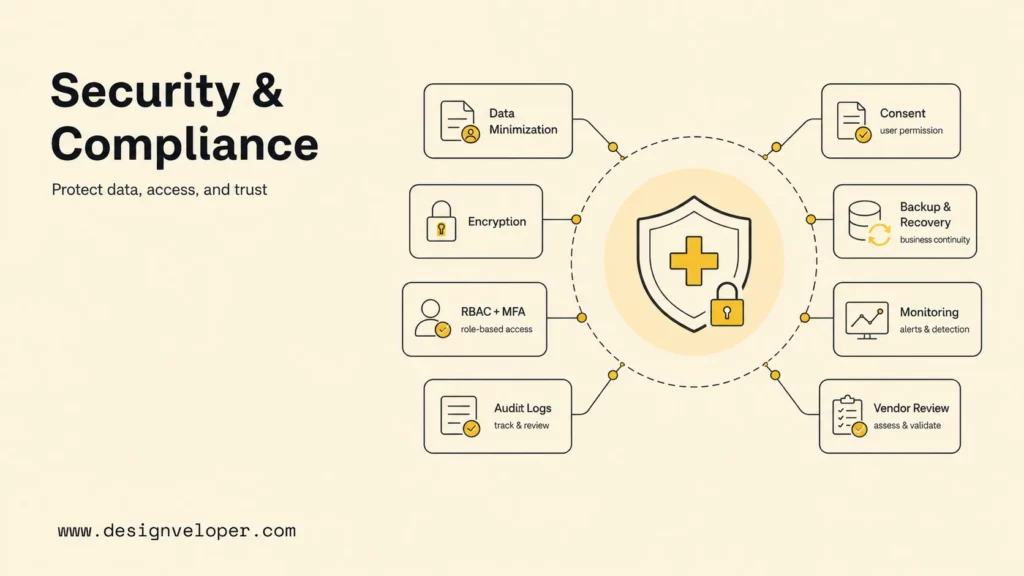
- Protect PHI and sensitive health data: Collect only necessary data, document purpose, classify it, limit access, define retention, support deletion or correction where required, and prevent analytics or advertising tools from receiving unauthorized health data.
- Encrypt data: Protect data in transit and at rest with managed key practices, but remember that encryption does not correct excessive access or inappropriate disclosure.
- Apply role-based and context-aware access: Verify tenant, organization, care relationship, role, resource, action, and purpose on the server. Use least privilege, MFA, session controls, and reviewed emergency-access procedures.
- Create useful audit logs: Record authentication, access to sensitive records, changes, exports, consent, administrative actions, and integration events. Protect logs from tampering and limit the health information placed inside them.
- Manage consent: Capture who agreed to what, for which data and purpose, at what time, under which policy version, and how withdrawal affects future processing.
- Secure storage, backup, and recovery: Define regions, vendors, retention, immutable or protected backups, recovery objectives, restoration tests, and safe disposal.
- Monitor and respond: Detect suspicious access, unusual exports, malware, credential abuse, integration failures, and service degradation. Maintain incident roles, evidence, communications, containment, recovery, and notification procedures.
Third-party SDKs deserve the same scrutiny as core infrastructure. HHS guidance on online tracking technologies and HIPAA discusses risk analysis, authorization, business-associate relationships, encryption, access, and audit controls where tracking vendors receive PHI. Product analytics should use deliberate data minimization and approved contracts, not default mobile or web tracking.
Healthcare App Development Process
A healthcare app should move through five risk-led stages. Clinical, security, privacy, and operational review continue across all stages rather than appearing as one approval at the end.
Reader asset: each stage must produce safety and workflow evidence before the next investment expands.
Step 1. Define Users, Care Workflow, And Expert Input
Map patients, caregivers, clinicians, administrators, payers, pharmacists, support staff, and external systems. Observe the current workflow, including interruptions, paper, calls, duplicate entry, handoffs, approvals, exceptions, and time-critical decisions. State the intended outcome and the harm if the app gives wrong, late, incomplete, or inaccessible information.
Involve healthcare professionals, patient representatives, privacy and security specialists, regulatory counsel, accessibility expertise, and operations owners as the risk requires. A developer can implement a rule but should not invent a clinical workflow. Document clinical ownership, escalation, and the boundary between information, support, and medical judgment.
Step 2. Choose Core Features And App Architecture
Select the smallest complete care or operations path. A telemedicine healthcare MVP may include identity, eligibility, appointment booking, consent, secure visit, clinician documentation, payment, follow-up, and support. It does not need every specialty, integration, device, insurance workflow, or analytics view in the first release.
Choose web, mobile, backend, data, messaging, media, and integration components based on workflow, reliability, security, device access, and team capability. Define role and organization boundaries early. Prefer managed services that can meet the required contracts and controls, while preserving logs, export, recovery, and vendor exit plans.
Step 3. Plan Compliance, Security, And Data Flow
Create a data-flow diagram for every sensitive path: collection, device, browser or app, API, database, object storage, queue, integration, analytics, support, backup, and deletion. Mark data class, purpose, legal basis or consent, access, vendor, region, encryption, retention, audit, and failure behavior. Determine which organizations are covered entities, business associates, processors, controllers, or other regulated roles.
Build a threat model and compliance traceability matrix. Convert rules and risk decisions into requirements and test cases. Include identity proofing, MFA, authorization, session management, device security, API protection, secure development, vulnerability management, audit, backup restoration, incident exercises, breach notification, and vendor review.
Step 4. Build, Integrate, And Test The Healthcare App
Build vertical slices across UX, API, data, roles, audit, and integration. Use automated unit, integration, contract, security, and end-to-end tests, then add clinical or operational scenario review. Test representative users, realistic data, assistive technology, poor connectivity, interrupted sessions, delayed interfaces, duplicate messages, missing readings, invalid states, and downtime.
Integration tests must verify semantic meaning, not only successful transmission. HL7’s FHIR specification overview describes a standard for exchanging healthcare information electronically through structured resources. A FHIR connection still requires profile selection, terminology, authorization, provenance, version compatibility, patient matching, error handling, and reconciliation with the source system.
Conduct penetration testing and privacy review appropriate to the release. Restore backups in a test environment. Exercise incident and downtime workflows with the people who will use them. A control is incomplete until the team can verify that it works in the deployed system and that responsible staff understand the response.
Step 5. Launch, Monitor, Maintain, And Improve
Launch to a controlled cohort with support coverage, escalation, status communication, rollback, and decision criteria. Monitor technical reliability, integration queues, authentication failures, suspicious access, record mismatches, notification delivery, clinical or operational exceptions, and patient-reported problems. Keep personal health data out of alerts and general collaboration tools.
Post-launch maintenance includes dependency and platform updates, vulnerability remediation, vendor changes, interface versions, backup tests, access review, audit review, incident exercises, compliance evidence, content review, model evaluation, device support, and user research. Measure outcomes across patient, provider, operational, safety, equity, and support dimensions.
Healthcare App Development Cost And Timeline
There is no defensible single price for a healthcare app without its scope, team rates, vendor terms, and intended use. To estimate app development cost, start with the hypothetical clinic telemedicine workflow above. This is a planning worksheet, not a Designveloper quote or a benchmark: replace every blank with your own approved effort, rate, and vendor figures.
| Phase / owner | Scope and estimate input | Approval or dependency |
|---|---|---|
| Discovery: product lead, clinician, privacy lead | Map booking-to-follow-up, intended use, consent, roles, data flows. Enter person-days by role × agreed day rate. | Clinic signs off workflow and clinical escalation; counsel assesses applicable rules. |
| Design and architecture: UX, tech lead | Accessible patient and staff journeys, state model, prototype, threat model. Enter person-days × rate. | Patient and staff review; security and accessibility criteria agreed. |
| Core build: frontend, backend, QA | Identity, eligibility, booking, consent, visit, note, notifications, follow-up, audit. Enter person-days by role × rate. | Clinic supplies scheduling rules and test accounts. |
| Video and optional EHR: integration engineers, vendor | Price video SDK setup and usage separately. Estimate EHR read/write mapping, patient matching, retry and reconciliation only if selected. | Video security review; EHR vendor access, contract, sandbox and clinician sign-off may be external blockers. |
| Verification and pilot: QA, security, clinician | Accessibility, security, failed calls, wrong-identity and delayed-data tests; remediation and pilot support. Enter effort and external test fees. | Security and clinical owners approve acceptance criteria and controlled launch. |
| Recurring operations: support, cloud, vendors | Monthly hosting, video minutes, messaging, monitoring, backup, support, maintenance and periodic reviews; multiply by forecast months. | Finance approves usage caps, vendor terms and incident coverage. |
Worksheet formula: one-time build estimate = sum of (person-days per role × that role’s contracted day rate) + one-time vendor, assessment, and setup fees. Add a separately approved contingency to the one-time subtotal, with its percentage justified by unknowns. Total ownership cost for the chosen horizon = one-time estimate + (monthly cloud, video, messaging, monitoring, support, and maintenance × number of months) + known renewal fees. Show currency, taxes, exchange-rate assumption, rate validity, and who owns each input. Leave the total blank until real quotes and capacity are entered; never label an illustrative worksheet as a price offer.
For each phase, enter three effort scenarios in person-days: low if the approved integration works as documented, base with normal review and rework, and high if vendor access or patient matching needs remediation. Have the clinic and delivery team agree on the assumptions before multiplying by role rates. This creates an auditable band without pretending that a generic app-type price applies to this clinic.
Scope decision: using a contracted video provider can shorten the first integration, but still requires consent, secure configuration, connection-failure testing, usage fees, and vendor review. EHR write-back adds patient matching, field mapping, permissions, provenance, test environments, reconciliation, and clinician validation; put it in a later phase if an approved manual handoff safely supports the pilot. If writing to the EHR is essential for the intended care workflow, include it in the first phase and do not call the smaller scope a complete release. Budget both alternatives with the same acceptance criteria before choosing.
Timeline assumptions: estimate elapsed time from dependencies and available team capacity, not from generic months per app type. Discovery and UX may overlap with vendor procurement, but integration testing cannot finish before sandbox access and test data arrive. Record start and approval dates for clinic workflow, vendor contracts, privacy and security review, clinical review, pilot, and any regulatory submission. Engineering effort and calendar duration are different measures; external approvals can extend the latter without increasing coding days. Exclude additional specialties, native mobile clients, devices, EHR write-back, and medical-device evidence only if the intended use and safe operating path truly permit it.
For separate planning decisions, see Healthcare UX Design: Innovative Approaches to User Experience and App Development Timeline: How Long Does It Take to Build an App?.
AI And Connected Devices In Healthcare App Development
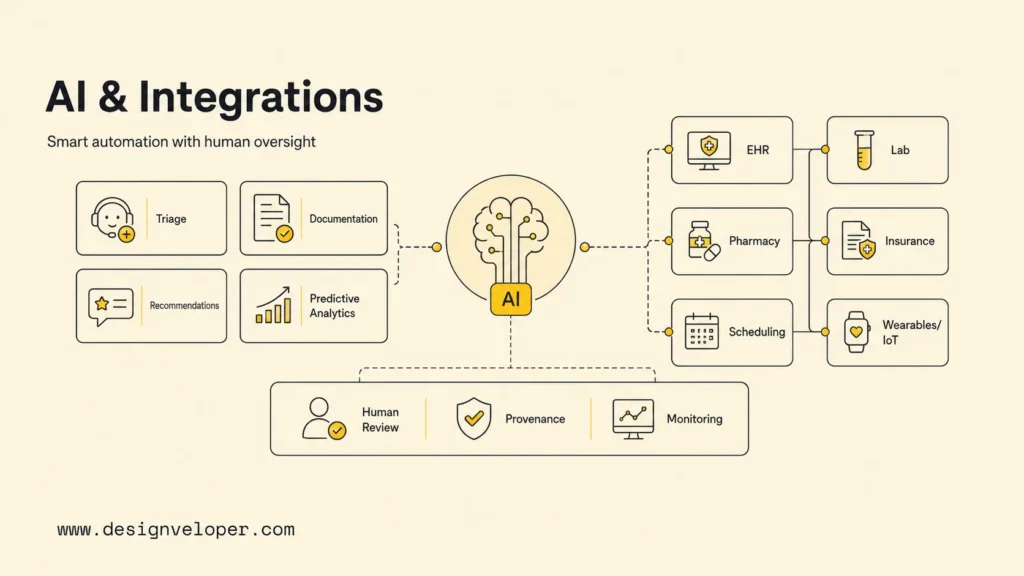
AI and integrations can improve healthcare workflows when they are designed around a bounded task, qualified review, reliable data, and measurable benefit. They also introduce dependency, bias, privacy, safety, drift, and accountability risks that must be governed throughout operation.
- AI triage: Collect and structure information, identify urgency signals, and route to defined care pathways. It must not present unsupported diagnosis or delay emergency escalation.
- Clinical documentation: Draft notes or summaries from approved sources, show evidence, handle missing content, and require the responsible professional to review and sign.
- Personalized recommendations: Tailor education or next steps using verified context, consent, policy, and clear boundaries. High-impact recommendations need clinical governance and evaluation.
- Predictive analytics: Estimate risk or resource needs using representative data, calibrated thresholds, subgroup analysis, workflow testing, and monitoring for changing performance.
- Wearables and IoT devices: Ingest readings with device identity, timestamp, units, quality, provenance, connectivity status, and missing-data rules. Define who monitors and responds.
- Healthcare integrations: Connect EHR, lab, pharmacy, insurance, scheduling, identity, communication, and payment systems through authenticated, observable, versioned interfaces.
The World Health Organization’s AI ethics and governance guidance for health centers human autonomy, well-being, safety, transparency, responsibility, inclusiveness, and sustainability. In practical product terms, healthcare AI needs a named owner, defined use, evaluation dataset, performance thresholds, user explanation, escalation, change control, and post-release monitoring.
Do not let a model calculate or invent authoritative clinical records without review. Preserve input and output provenance, separate deterministic rules from generated language, and test the complete workflow. Measure false positives, false negatives, omissions, correction, acceptance, latency, cost, subgroup performance, user reliance, and downstream outcomes as appropriate.
For a wider product context, see AI In Product Development: From Concept To Market Faster; healthcare use still requires the additional clinical review described here.
Healthcare App Development Challenges And Best Practices
The hardest part of healthcare app development is not adding screens. It is making the product dependable when people, data, devices, organizations, and clinical responsibilities meet. The following practices address the gaps that often appear between a promising prototype and a safe production service.
Design For Clinical Workflow, Accessibility, And Adoption
Healthcare users work under time pressure and may have limited digital access, language barriers, low vision, or cognitive load. Test the complete task with patients, caregivers, clinicians, and operations staff. Use clear labels, readable hierarchy, predictable states, keyboard and assistive-technology support, recovery from mistakes, and an alternative path when the app or network is unavailable.
Manage Interoperability And Data Quality
Healthcare data may arrive late, use different terminology, belong to a duplicate patient, or lack the context needed for a safe decision. Define ownership, provenance, units, timestamps, matching rules, validation, retry behavior, reconciliation, and manual review. An interface that returns a successful response can still create a dangerous product if the meaning of the data is wrong.
Plan For Security Incidents, Downtime, And Change
Threats, dependencies, policies, devices, regulations, and user needs change after launch. Apply app security fundamentals throughout the lifecycle, review access and vendors, test restoration, monitor unusual behavior, and rehearse incident and downtime procedures. Give every critical alert an owner, an expected response time, and a safe fallback.
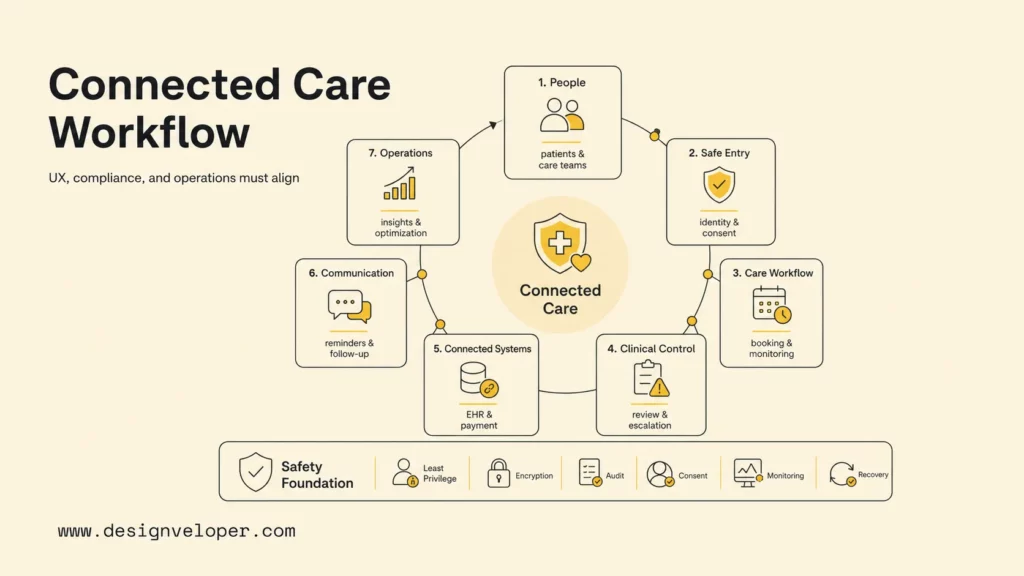
Connecting Healthcare App UX, Compliance, And Care Workflows
The handoff between a patient’s consent, the clinician’s decision, and an external record is where ownership can become unclear. For each handoff, name who confirms receipt and who recovers an incomplete transfer.
At Designveloper team, we can help healthcare teams turn a care or operations workflow into a secure product roadmap. Our software development services can connect patient experience, provider operations, identity, healthcare integrations, AI features, auditability, testing, deployment, and post-launch maintenance.
A public example is Designveloper’s healthcare booking and telemedicine platform project, which describes patient and doctor workflows including appointments, medicines, online examinations, documents, prescriptions, bookings, and payments. This is a product-scope example, not evidence of clinical effectiveness or regulatory approval.
We recommend beginning with a multidisciplinary discovery that produces a care-workflow map, intended-use statement, user and role model, data-flow diagram, compliance and threat assessment, integration proof plan, MVP boundary, test strategy, and operational responsibility map. Those artifacts allow the team to estimate work and risk before architecture becomes difficult to reverse.
Conclusion
Healthcare app development is a workflow, safety, and operations problem as much as an engineering problem. Start with one complete user outcome, map the people and systems involved, classify intended use and data, and turn failure states into requirements and tests. Then choose the stack, integrations, compliance evidence, and delivery phases that fit the real risk.
A focused MVP can validate demand without hiding essential controls. Identity, consent, authorization, auditability, accessibility, recovery, clinical ownership, and post-launch monitoring belong in the first plan. The practical examples, official guidance, workflow documents, and public project reference in this guide can help a team move from an app idea to a reviewable healthcare product scope.
FAQs About Healthcare App Development
These questions cover the decisions that most often affect healthcare app scope, safety, budget, and launch readiness. Use the answers as planning guidance, then validate the details for the target market, users, data, and intended function.
How Much Does Healthcare App Development Cost?
Without a scoped specification and verified rates, no single figure is reliable. Use the telemedicine worksheet above: add role-specific effort times contracted rates, one-time vendor and assessment fees, an approved contingency, and recurring operating costs for the chosen horizon. Price EHR write-back separately from the video-enabled pilot and record exclusions before approving a budget.
How Long Does It Take To Build A Healthcare App?
There is no universal timeline by app category. Map person-days against actual team capacity and schedule vendor access, integration testing, privacy and clinical review, pilot, and any regulatory work as explicit dependencies. Procurement and external approvals can lengthen calendar time without adding equivalent engineering effort.
What Features Should A Healthcare App MVP Include?
Include the smallest complete workflow that produces one safe outcome, plus identity, roles, consent, necessary records, audit, secure storage, support, monitoring, backup, and failure recovery. Add booking, messaging, video, payments, devices, or integrations only when the chosen outcome requires them. Define the success and safety metrics before building.
Does Every Healthcare App Need HIPAA Compliance?
No. HIPAA applies to covered entities, business associates, and protected health information within its scope; not every consumer health app is covered. Other federal, state, national, medical-device, privacy, breach-notification, and consumer-protection rules may still apply. Determine entity role, data, geography, intended use, and vendors with qualified counsel.
Can AI Be Used In Healthcare App Development?
Yes, for bounded tasks such as documentation support, information retrieval, workflow routing, pattern detection, and reviewed recommendations. Healthcare AI needs representative evaluation, privacy and security, human oversight, transparency, fallback, clinical and regulatory review, change control, and post-release monitoring. The required evidence depends on intended use and potential harm.
If your team is moving from a healthcare app idea to a scoped product, contact Designveloper to discuss the workflow, integration, security, and MVP decisions that need to be resolved first.
Also published on

Share post on










Related Articles



10 Case Studies Of AI In Healthcare: Evidence, Results, And Limits
10 Case Studies Of AI In Healthcare: Evidence, Results, And Limits Published October 12, 2026
Healthcare App Development In 2026: Features, Costs, And Process
Healthcare App Development In 2026: Features, Costs, And Process Published July 29, 2026
Build Smarter Healthcare: How Software Brings Medical Devices to Life
Build Smarter Healthcare: How Software Brings Medical Devices to Life Published April 24, 2026