
















Build An Enterprise RAG Architecture That Works In Production

A RAG demo may answer questions from a folder of documents, yet fail when policies change or employees have different access rights. Building an enterprise RAG architecture means planning for those changes, not just connecting a model to a vector database. The key decisions span indexing and query serving, retrieval patterns, permission-aware data updates, evaluation, and a controlled rollout.
What Is An Enterprise RAG Architecture?
An enterprise RAG architecture connects a large language model to approved enterprise data so it can retrieve relevant, authorized evidence before generating an answer. RAG stands for Retrieval-Augmented Generation. The production architecture adds managed ingestion, identity-aware retrieval, evaluation, and monitoring around that retrieval-and-generation loop. It is a system design, not a type of language model. Our guide to Retrieval-Augmented Generation explains the basic retrieve-then-generate loop in more detail.
A basic demo can work with a folder of documents, one embedding model, one index, and a prompt. It may even answer sample questions well. Production changes the problem because the corpus changes, users have different permissions, traffic varies, dependencies fail, and teams need to explain why an answer was produced. The architecture therefore has to manage both the knowledge lifecycle and the live query path.
The LLM is only one component in that system. AWS Prescriptive Guidance on RAG describes retrieval as a way to augment an LLM with external data. The architecture around the model decides which data becomes available, which passages a specific user may retrieve, how context is assembled, and how the response is checked and observed.
Map The End-To-End Enterprise RAG Architecture
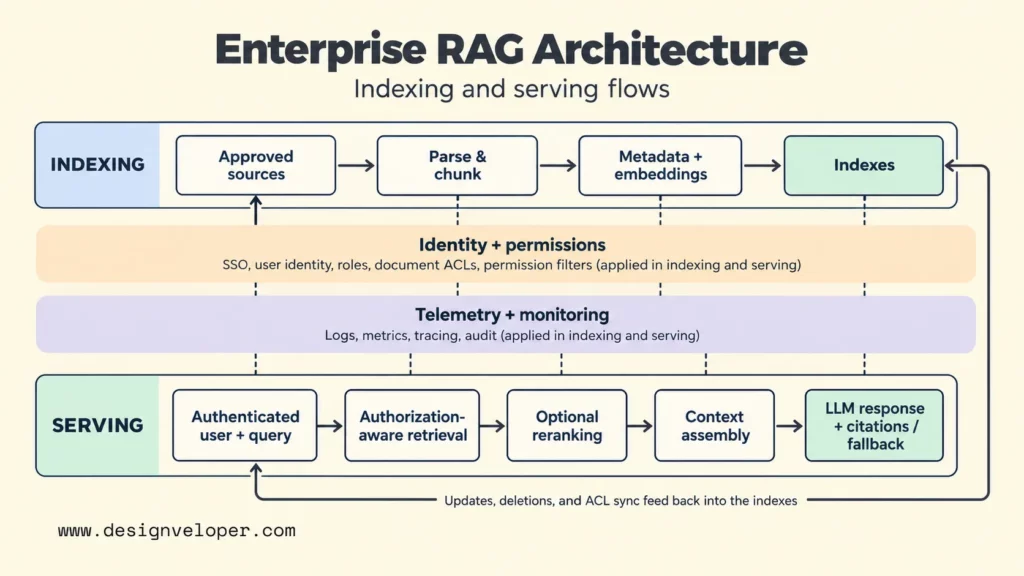
The end-to-end architecture has two connected flows. The indexing flow turns source data into retrievable knowledge. The query-serving flow turns a user request into authorized context and a grounded response. Google Cloud uses the same broad separation in its RAG reference architecture, which separates data ingestion from serving. Our RAG pipeline diagram guide maps the same offline indexing and online query split, including access checks, evaluation, and fallbacks.
- Connect sources. Pull approved content from document stores, wikis, ticketing systems, databases, object storage, or business applications. Record the source owner and access model with the content.
- Parse and chunk. Convert each source into units that preserve enough local meaning for retrieval. Tables, code, policies, and long narrative documents may need different parsing and chunking rules.
- Add metadata and embeddings. Attach fields such as source ID, owner, version, timestamp, tenant, and permission labels. Create embeddings when semantic search is part of the retrieval strategy.
- Build and maintain indexes. Store searchable representations in a vector database, search engine, graph, or another retrieval layer. Our vector database guide explains why metadata and filtering matter alongside embeddings.
The serving flow starts only after those indexed artifacts are available. A user submits a query, the application resolves identity and request context, and the retrieval layer searches only the knowledge the user is allowed to access. The first retrieval stage may use vector similarity, keyword search, structured filters, graph queries, or several methods together.
Candidate results can then be reranked before context assembly. Reranking is useful when the first-stage retriever favors recall and returns more candidates than the model should receive. The application selects the strongest passages and assembles them with the question and system instructions. It then sends that context to the LLM and returns the response with source references when the product supports citations.
Telemetry should span both flows. Indexing logs need to show what was ingested, updated, rejected, or deleted. Query traces should show retrieval inputs, selected source IDs, ranking stages, model and prompt versions, latency, failures, and user-visible fallbacks without logging sensitive content unnecessarily.
Identity and permissions must cut across this architecture instead of appearing as a final check after generation. If unauthorized text reaches the prompt, hiding the citation or filtering the finished answer is too late. Authorization information should be available before or during retrieval so forbidden chunks never become model context.
Compare Enterprise RAG Architecture Patterns
Enterprise RAG patterns are design choices for different retrieval problems, not a fixed ladder of universally better architectures. Start with the simplest pattern that retrieves the evidence your target questions need, then add complexity when evaluation shows a specific failure.
| Pattern | Best fit | What it adds | Added complexity |
|---|---|---|---|
| Vector-only retrieval | Direct semantic lookup across documents where wording varies | Embedding-based similarity search with metadata filters | Low. Quality depends heavily on chunking, embeddings, filters, and index freshness. |
| Hybrid search | Corpora where both meaning and exact terms matter, such as product codes, error messages, policy names, or technical documentation | Combines semantic retrieval with keyword or sparse search | Moderate. Results from different retrieval methods must be merged and tuned. |
| Retrieval plus reranking | Queries where the initial candidate set has good recall but weak ordering | A second model or scoring stage reorders candidates before context assembly | Moderate. It adds latency, cost, another model dependency, and more evaluation work. |
| GraphRAG | Questions that depend on relationships, entities, dependencies, or multi-hop connections | A graph representation and graph-aware retrieval alongside or instead of chunk similarity | High. Teams must build or maintain graph structure, entity resolution, and graph-specific retrieval logic. |
| Agentic retrieval | Complex requests that may need query decomposition, source routing, repeated retrieval, tool calls, or structured-data access | An orchestration layer that can choose and sequence retrieval actions | High. More runtime paths mean more permissions, failure modes, latency, observability, and test cases. |
Hybrid retrieval and reranking solve different problems. Hybrid search broadens the ways a system can find candidates, while reranking improves the order of the candidate set before generation. Redis’s enterprise RAG architecture guide describes the common production pattern of combining dense and sparse retrieval, then applying cross-encoder reranking.
GraphRAG and agentic retrieval are also not interchangeable. GraphRAG changes how knowledge and relationships are represented and searched. Agentic retrieval changes how the application decides what retrieval actions to take. Our comparison of Graph RAG vs traditional RAG is useful when relationship-aware retrieval is the specific question. A team can also combine graph retrieval with an agent, but doing so should follow a demonstrated need rather than an architecture trend.
Keep Enterprise Data Fresh And Permission-Aware
Enterprise data stays useful only when the index reflects source changes and preserves the source’s access rules. This applies to unstructured content such as PDFs, wiki pages, tickets, and manuals as well as structured sources such as product tables, CRM records, inventory data, or approved database views.
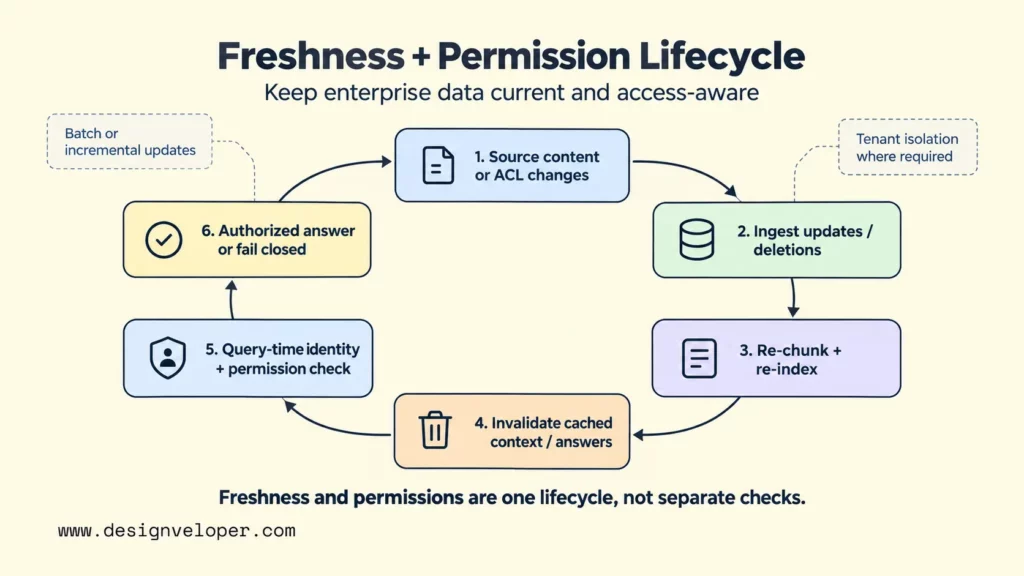
Choose batch or incremental updates according to how quickly the source changes and how quickly stale answers become harmful. A nightly rebuild may be acceptable for a stable handbook. Product availability, incident runbooks, pricing, or operational records may need event-driven or incremental updates. Confluent’s enterprise knowledge management RAG example shows how streaming updates can trigger granular re-embedding when source content changes.
Freshness also requires versioning and deletion sync. Each indexed unit should remain traceable to a source object and source version. When a document is replaced, archived, or deleted, the retrieval index needs a matching update. Otherwise, old chunks can continue to rank even though users can no longer find the source in the system of record.
Permissions need the same lifecycle discipline. Ingest source ACLs or another usable permission representation with the content, then apply the authenticated user’s identity or groups during retrieval. AWS documents this pattern in its ACL-aware retrieval guidance: permission information is ingested with documents and used to filter results at query time. AWS also notes an important boundary: ACL-aware filtering does not replace user authentication, so the application must supply verified identity context.
If the application caches retrieved context or generated answers, cache invalidation must follow document updates, deletions, and access changes. A cache entry must not bypass authorization or return content that the user can no longer access. If identity or permission state cannot be verified, fail closed: return no protected content rather than falling back to unfiltered retrieval. Include cached responses in the same permission-change tests as the live query path.
Multi-tenant systems need an additional isolation decision. If tenants share retrieval infrastructure, tenant identity should be part of every ingestion and query path, not an optional filter added by the client. Stronger separation may require tenant-specific indexes, namespaces, encryption boundaries, service accounts, or network controls. The right choice depends on the sensitivity of the data and the organization’s security model, so there is no universal isolation pattern.
Evaluate Retrieval Quality And Production Reliability
Evaluate retrieval and answer generation separately because they fail for different reasons. A model cannot ground an answer in evidence that the retriever never found, and a strong retrieval result does not guarantee that the model will use it correctly.
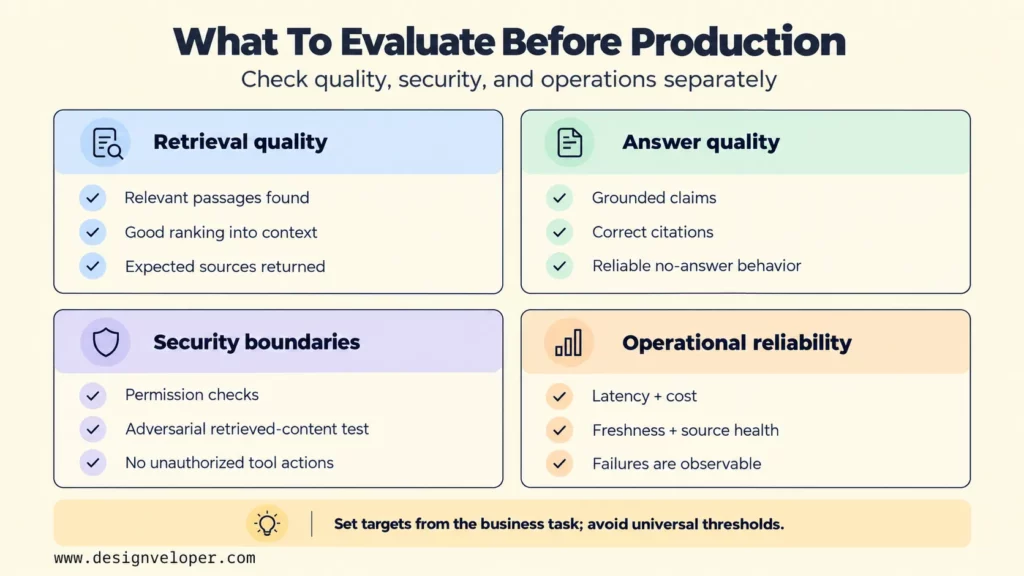
- Retrieval relevance: Does the expected source or passage appear in the candidate set and rank high enough to reach the model?
- Answer groundedness: Does each material statement in the answer follow from the retrieved evidence rather than unsupported model knowledge?
- Citation correctness: Does each displayed citation point to a source that actually supports the nearby claim?
- Permission boundaries: Can users retrieve only the documents and chunks they are authorized to access, including after role, group, or document-permission changes?
- No-answer behavior: Does the system withhold or escalate an answer when the approved sources do not support one?
Build those tests around representative questions, edge cases, and known failure scenarios. Our step-by-step RAG system guide also separates retrieval checks from generation checks so teams can identify whether a regression comes from parsing, chunking, indexing, search, context assembly, or the LLM.
Access control and prompt-injection defense solve different problems. A document may be authorized for a user but still contain malicious instructions. Microsoft’s RAG prompt-engineering security guidance warns that retrieved chunks can contain adversarial content and recommends treating that content as data rather than trusted instructions.
Add an adversarial test with an approved document that tells the assistant to ignore application rules or reveal other records. Check whether the model follows the injected text. If the application can call tools, also verify that retrieved text cannot trigger an unauthorized action. Use content screening and monitored failure handling as layered controls, and constrain tool permissions where tools exist. A defensive prompt alone is not a guarantee.
Production reliability adds operational dimensions that offline answer scoring cannot cover. Measure latency across retrieval, reranking, model inference, and other dependencies. Track cost per request or workload, concurrency behavior, index freshness, error rates, timeouts, source-connector failures, and queue backlogs. The architecture should expose which stage failed so an operator can distinguish an unavailable model from an empty index or a permissions error.
Avoid copying universal thresholds from another system. A support assistant and a legal research tool can tolerate different latency, cost, and abstention rates. Set service targets from the business task, risk level, user expectations, and infrastructure budget. Then use the same evaluation set and operational traces to see whether architecture changes improve the target without creating a new failure elsewhere.
Reference Architecture For An Internal Knowledge Assistant
An internal knowledge assistant is a useful illustrative enterprise RAG use case because it combines changing documents, employee permissions, retrieval quality, citations, and fallback behavior. The following flow is hypothetical and is not presented as a Designveloper project.
- Ingest approved policies and product documentation. Connect the authoritative repositories, parse each document, retain source IDs and versions, and attach permission metadata from the source.
- Build permission-aware indexes. Chunk and embed the content, store metadata, and synchronize additions, updates, and deletions. Keep the source permission model available to the retriever.
- Retrieve with hybrid search. When an employee asks a question, authenticate the user and search only authorized content. Combine semantic retrieval with exact-term search when policy names, product identifiers, or error codes matter.
- Rerank and assemble context. Reorder the strongest candidates, remove duplicates or weak passages, and send only the useful evidence into the model prompt.
- Generate an answer with citations. Instruct the LLM to answer from the supplied evidence and attach source references that users can inspect.
- Log and learn from the interaction. Record retrieval traces, source IDs, versions, latency, model settings, and user feedback at a level that supports debugging without unnecessarily storing sensitive content.
Consider a hypothetical employee asking which travel policy applies to the Vietnam team this month. The retriever should return the current, approved policy for that employee’s group, with its source version. An HR-only draft must not enter the prompt even if its wording is a closer match. The answer should cite the approved policy and state its effective date. If no authorized policy supports the question, the assistant should refer the employee to the policy owner rather than use another team’s rules.
The fallback path matters as much as the happy path. If retrieval returns no authorized evidence, or the selected sources conflict or do not support the requested answer, the assistant should say that the available sources are insufficient. Depending on the workflow, it can ask a clarifying question, point the user to the relevant source owner, create an escalation task, or hand the case to a human reviewer.
Application rules and evaluated checks determine whether the available evidence supports an answer or requires abstention or escalation. Citations help users inspect the evidence, but they do not guarantee that every generated claim is correct.
Design And Roll Out Enterprise RAG In Stages
Roll out enterprise RAG in stages so each increase in scope follows evidence from the previous stage. Expanding sources, users, and retrieval logic at the same time makes failures harder to diagnose and permissions harder to audit.
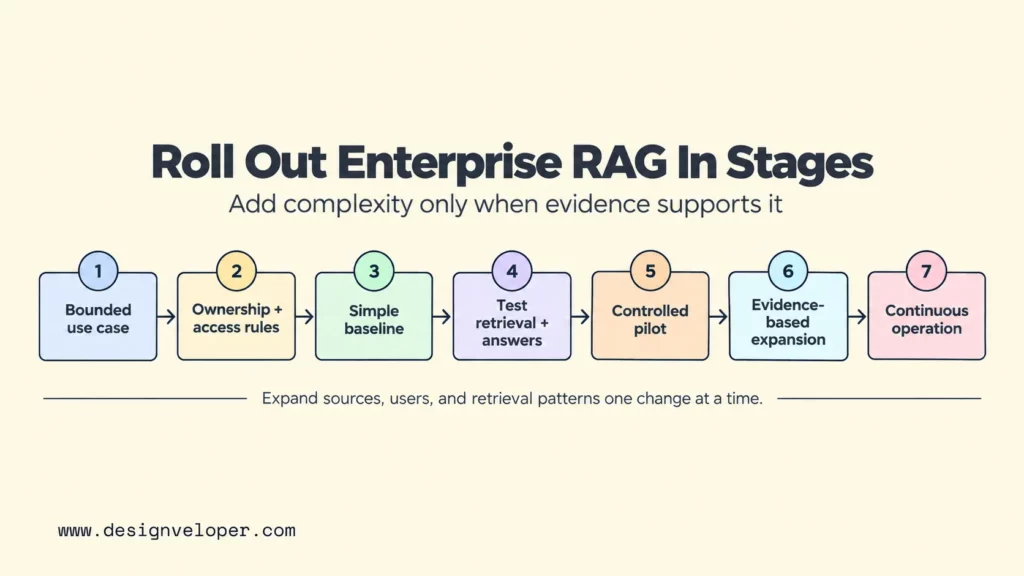
- Select one bounded use case and corpus. Define the users, questions, approved sources, and decisions the system should support. Exclude data that is not needed for that job.
- Map ownership and access rules. Identify who owns each source, how permissions work today, how identities map into the retrieval layer, and what must happen when access changes.
- Build a simple baseline. Start with the least complex retrieval pattern that can answer the target questions. This gives the team a reference point before hybrid search, reranking, graphs, or agents are introduced.
- Test retrieval and answers separately. Create representative questions with expected sources and no-answer cases. Add permission-boundary tests before a wider pilot.
- Pilot behind controls. Limit the first production audience, monitor failures, keep source links visible where useful, and define who reviews unsafe or unsupported outputs.
- Expand only when evidence supports it. Add sources, users, retrieval patterns, and automation one change at a time when evaluation shows why the added complexity is needed.
- Operate the knowledge layer continuously. Monitor source sync, deletions, index freshness, access changes, retrieval quality, cost, latency, and model behavior as ongoing production concerns.
Before implementation, define the approved sources, user groups, retrieval baseline, and tests needed for a controlled pilot. If your team needs help shaping that plan, you can explore our AI development services and discuss the integration requirements with us. Start with a bounded use case and validate it before expanding the system.
Also published on

Share post on










Related Articles


Build An Enterprise RAG Architecture That Works In Production
Build An Enterprise RAG Architecture That Works In Production Published October 12, 2026


















