













What Is an Epic in Agile? How to Write It (Guide & Examples)

KEY TAKEAWAYS:
- An epic groups related backlog work around one product outcome; teams decide its practical size boundary.
- The Agile framework and tool a team uses affect its labels and hierarchy. Scrum does not require epics.
- Keep epic-level outcomes and guardrails distinct from observable child-item checks that a team can verify.
- Track delivery progress separately from product outcomes, with a baseline, target, owner, data source, review window, and guardrail.
Large product goals often begin with more uncertainty than a team can plan as one small backlog item. The challenge is to keep the intended result visible while the team learns and adjusts the work. This guide explains the common Agile epic pattern, how teams use neighboring labels, and how to refine a broad goal into smaller work. It also shows two illustrative examples and a measurement template that separates delivery progress from product outcomes. Because labels vary by framework and tool, the guide separates common practice from formal Scrum rules.
What Is An Epic In Agile?
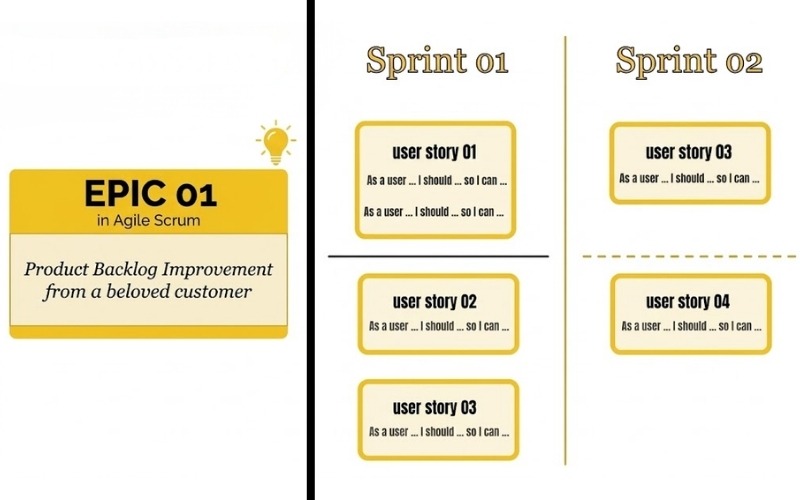
In many Agile teams, an epic is a broad, outcome-focused backlog item that groups related work too large to plan as one small delivery item. Teams refine it into smaller user stories or other product backlog items (PBIs) that can be discussed, selected, and completed incrementally. An epic is a common planning convention, not a term with one size threshold or required place in every Agile method.
A useful epic gives the team a shared reason to connect related work. Its child items can change as the team learns, so the epic should describe the outcome and important boundaries rather than freeze every implementation detail in advance.
Agile Epic Vs User Story: What Changes?
An epic and a user story serve different planning needs. The epic keeps a broader outcome in view, while a smaller backlog item gives the team a nearer piece of work to discuss, select, and review.
| Dimension | Epic | User Story Or Smaller PBI |
|---|---|---|
| Scope | Groups related work around a broader product outcome or capability. | Describes a smaller need, change, or piece of work that a team can refine for its workflow. |
| Detail | Records the goal, context, boundaries, and open questions that matter now. | Can include specific behavior, dependencies, and checks for the item being planned. |
| Planning use | Helps keep related work connected while scope is refined over time. | Helps the team discuss and plan a more specific increment of work. |
A product backlog item does not have to use the classic user-story sentence format. Teams may use stories, issues, or another format that makes the work clear. The useful boundary is whether the smaller item can be understood and planned in the team’s delivery process, not whether it fits a universal time limit.
Related reading:
- Agile Methodology Sample: A Practical Project Plan
- What Is an Agile Team? Structure, Roles, and How to Build One
- The 12 Agile Principles And 4 Agile Values Explained For Teams
How Epics Fit Into Agile Frameworks
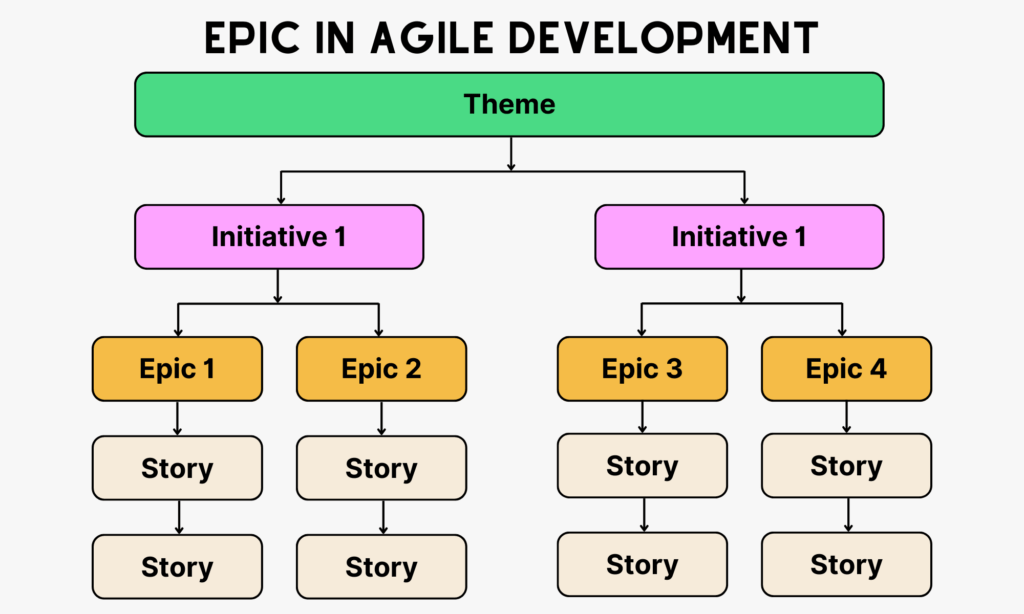
Agile does not prescribe one hierarchy for labels such as initiative, feature, epic, story, and task. Their meaning and order depend on the framework, organization, and work-tracking tool. Treat the labels below as common uses, not as a required chain.
| Label | Common Use | What To Confirm |
|---|---|---|
| Initiative | A broad strategic goal that may group several work areas. | Some teams do not use this label or place it above epics. |
| Theme | A way to group work around a shared topic or direction. | A theme may be a filter or tag, not a formal backlog level. |
| Feature | A capability or behavior that matters to a user or stakeholder. | Teams may put features inside epics, use them at another level, or use the terms differently. |
| Epic | A broad work item that connects related backlog items to an outcome. | Agree on the team’s meaning and the point at which work should be refined. |
| Story Or PBI | A more specific backlog item that can be refined and planned. | A story is one possible format for a PBI, not the only one. |
| Task | A concrete activity used to organize or complete work. | Task placement and relationship to stories vary by workflow and tool. |
Scrum does not define an epic as a formal artifact. The Scrum Guide names the Product Backlog, Sprint Backlog, and Increment as its artifacts. The Scrum Alliance’s overview of epics likewise describes epics as an optional way to organize work. A Scrum team may use them, but should not treat them as a Scrum requirement.
For practical planning, agree on what an epic means in your team’s backlog. Keep labels only when they help people see the outcome, dependencies, and next refinements without adding a tracking layer that no one uses.

Agile Epic Examples
The examples below are illustrative scenarios, not measured case studies. They show how a team can connect an outcome to smaller items without claiming that one decomposition fits every product.
Example 1: User Authentication
A team may frame an account-access epic as: “Help customers access and recover their accounts with clear, dependable flows.” That statement points to the goal without claiming that a broad phrase such as “secure login” proves the system is safe. Product and security owners still need to define the rules that apply to the product.
| Child Backlog Item | Example Observable Check |
|---|---|
| Create an account | When a user submits valid required fields, the system saves the account and shows a confirmation state. |
| Reset a password | A valid, unused reset link lets the user set a password that follows the product’s rules; expired or used links are rejected. |
| End an inactive session | After the configured inactivity period, a request to open a protected page asks the user to sign in again. |
These checks describe observable behavior, but they do not set universal security requirements. The team should agree on values such as link expiry, password policy, and session rules with the people who own product security.
For practical examples, read:
- User Stories In Agile: Examples, Template, And Practical Writing Tips
- Agile Methodology Testing: Lifecycle, Quadrants & Team Practices
- 10 Agile Development Best Practices & Templates
Example 2: E-Commerce Checkout
A checkout team might set an epic outcome such as “Help eligible shoppers complete checkout with fewer avoidable failures.” That outcome gives the team a reason to compare potential changes, but it is not evidence that conversion has already improved.
Possible child items could include:
- Offer guest checkout to shoppers who do not want to create an account.
- Reduce unnecessary form fields while preserving the information required to fulfill an order.
- Show a clear order summary before payment so shoppers can confirm their choices.
The team can deliver and review these slices separately. It should measure the agreed checkout outcome and guardrails before deciding whether the epic achieved its goal.
How To Write An Epic In Agile
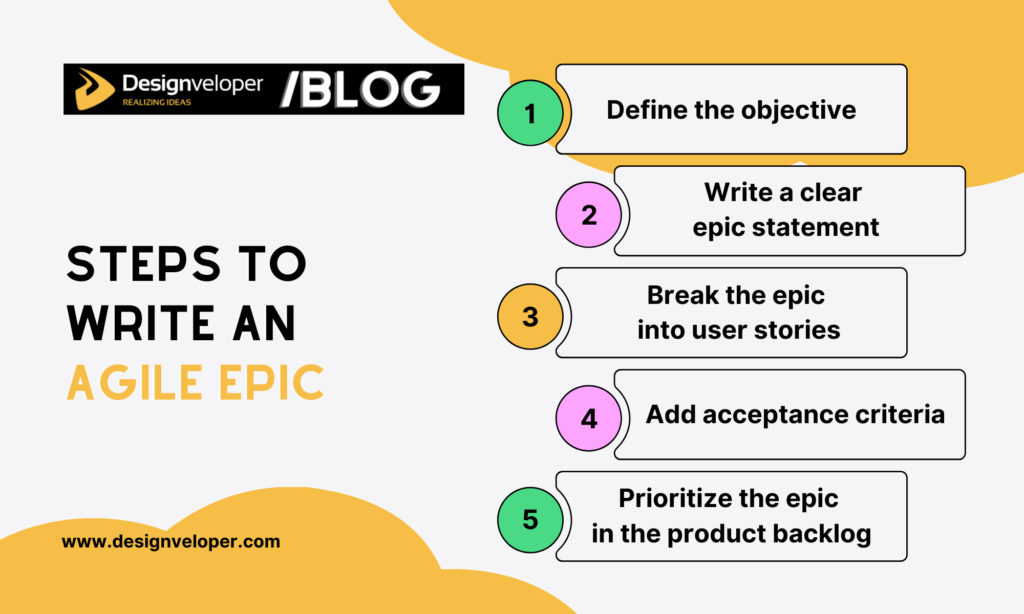
Writing an epic is a way to clarify a product outcome before the team commits to all of its details. Use the steps below to make the goal understandable, the child work refinable, and the later review meaningful.
Step 1: Define The Objective
Start with the user or business problem, not a list of requested features. Ask what should improve, who needs the change, and what evidence would show that the problem is smaller. Note important constraints, such as a dependency, a policy, or a customer group that should not be harmed.
If the team cannot name a useful outcome yet, keep the epic as a discovery placeholder and record the open question. Do not turn a guess into a promised result before the team has evidence.
Step 2: Write A Clear Epic Statement
Write a short statement that keeps the audience, problem, and intended change visible. A lightweight starting point is:
Epic: For [audience] experiencing [problem], improve [desired outcome] by addressing [scope].
For example: “For shoppers who abandon checkout when forms feel difficult, improve successful order completion by reducing avoidable steps.” This describes the goal, not a complete solution specification. Add boundaries and assumptions separately when the team needs them to make decisions.
Step 3: Break The Epic Into Smaller Backlog Items
Refine the epic into user stories or other PBIs that the team can discuss and plan. Prefer slices that produce a useful behavior or learning signal over a breakdown based only on technical layers. A child item may still need refinement if its scope, dependencies, or expected behavior remain unclear.
Keep the parent-child relationship useful rather than mandatory. Add, remove, or reorder items when new information changes the best path to the same outcome. Split the epic when its children now serve different goals.
Step 4: Separate Epic Outcomes From Acceptance Criteria
At the epic level, record the intended outcome and any guardrails the whole effort must preserve. Add Agile acceptance criteria to the child stories or PBIs they apply to when the team needs a clear way to decide whether that item is complete. Keep each check observable or testable instead of relying on broad words such as “secure” or “easy to use.”
For a password-reset item, a check could say: “Given a valid, unused reset link, when the user submits a password that meets the product’s policy, the system saves the new password and displays a confirmation.” The exact policy belongs to the product and security owners. The criterion tests the agreed behavior; it does not certify the entire authentication system.
Step 5: Prioritize The Epic In The Product Backlog
Compare the epic with other work using the outcome’s expected value, urgency, dependencies, effort, and delivery risk. Make the trade-off visible: a high-value idea may wait if a critical dependency is missing or the team needs more evidence first.
In Scrum, the Product Owner is accountable for effective Product Backlog management and may delegate parts of that work. The Developers who will do the work are responsible for sizing backlog items. Other Agile workflows may assign these decisions differently, so name the roles your team actually uses and revisit the order when assumptions change.
For a deeper dive:
- Agile Release Planning: Steps, Benefits, And Best Practices In 2026
- Agile Software Development Life Cycle Guide
- Agile Web Development: How It Works, Process, and Benefits
Best Practices For Writing Agile Epics
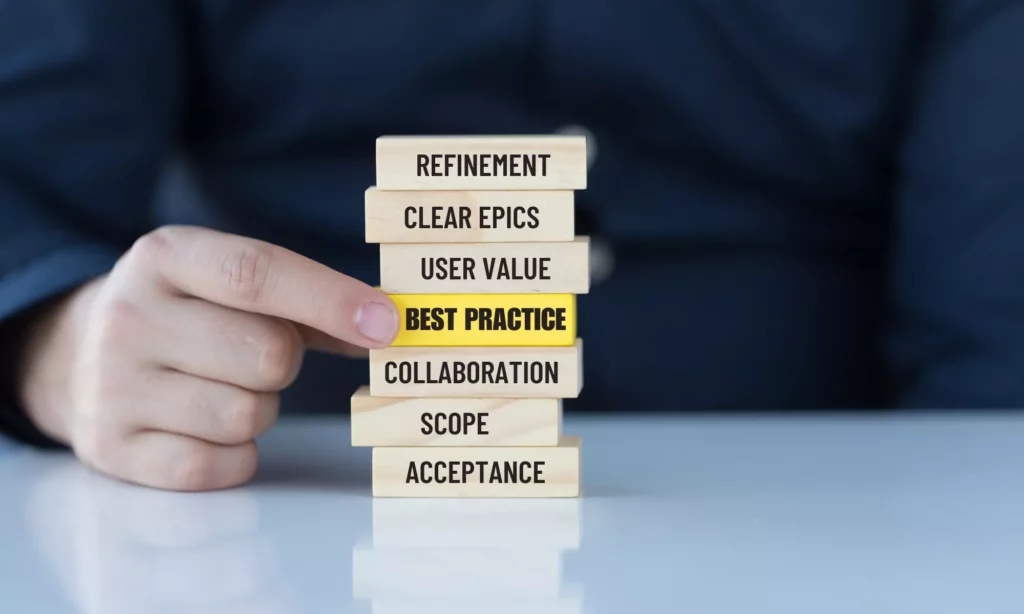
Use an epic to keep an outcome visible while details change. These practices help prevent a broad work item from becoming a permanent bucket for unrelated requests.
- Keep one outcome in view. If child items no longer support the same result, split or re-scope the epic.
- Keep the statement useful, not exhaustive. Record the problem, intended outcome, boundaries, and key unknowns; refine lower-level details when they matter.
- Refine before planning the child work. Clarify dependencies, ownership, and observable checks for the items the team is ready to discuss.
- Review the epic as evidence changes. Remove work that no longer supports the outcome and add new items only when they do.
- Use local sizing rules carefully. A team’s preferred duration or item size can help its workflow, but should not be presented as a universal Agile benchmark.
A useful split decision is practical: separate items when they have independent outcomes, and refine a child item when the team cannot yet plan or review it with confidence.
How To Measure The Success Of Agile Epics
Measure delivery progress and product outcomes separately. Completed stories, remaining work, or an epic burndown can show how delivery is moving; they do not prove that users received the intended value. Choose an outcome measure that matches the epic, then decide how to interpret it before reviewing results.
| Measure Type | Example | What It Can Tell You |
|---|---|---|
| Delivery progress | Completed child items, blocked items, or remaining work. | Whether delivery is moving and where the team may need to adapt. |
| Product outcome | Checkout completion, successful account recovery, or task completion. | Whether the user behavior tied to the epic changed, if the measure is defined and collected reliably. |
| Guardrail | Payment failures, support contacts, or failed account-recovery attempts. | Whether the change may have created a cost or harm while the primary outcome moved. |
For the checkout example, set up a measurement plan before release. The fields below are a proposed template, not results or a claim that conversion increased.
| Field | Checkout Measurement Plan |
|---|---|
| Baseline | Current checkout completion rate for the agreed shopper group and observation period. |
| Target | The change the product decision-maker approves before the work is evaluated. |
| Owner | A named product or analytics owner responsible for checking and explaining the result. |
| Data source | The analytics events or system of record used to define a started and completed checkout. |
| Review window | The agreed period after release, long enough to collect usable data for the selected audience. |
| Guardrail | Payment failures, cancellations, or support contacts that should not worsen beyond the team’s agreed limit. |
Write down how the team will act if the outcome misses its target or a guardrail moves in the wrong direction. Check that the events use consistent definitions and that the comparison covers the intended users. If the team has not measured the result yet, describe the plan as proposed and leave outcome claims open.
For related delivery and estimation topics:
- Agile Innovation: Process, Benefits, Examples, And Best Practices
- Agile Sprint Cycle: Definition, Execution, and Steps Explained
- Story Points in Agile and How to Estimate Them Effectively

Tools For Tracking Agile Epics
A spreadsheet or a work-management tool can track an epic; the team does not need a particular product to use the concept. Choose a setup that makes the parent outcome, child items, owners, dependencies, status, and changes easy to inspect.
Before adopting a more detailed workflow, check whether it helps the team answer these questions:
- Can people see which child items support the epic and who owns the next decision?
- Can the team distinguish delivery status from the outcome measure and guardrails?
- Can the backlog show dependencies and scope changes without requiring duplicate status updates?
Tool labels are product-specific. For example, Jira Cloud uses Epic as a default work type in some spaces, and the name and available work types can vary by configuration. Check the Atlassian documentation on Jira epics for that product’s behavior rather than treating it as an Agile-wide hierarchy. When comparing tools, prioritize fit with the team’s actual planning and reporting needs over popularity claims.
Continue with:
- 11 Best Agile Project Management Tools For Teams In 2026
- Jira And Agile Project Management: Complete Guide For Agile Teams
- 10 Project Management Tools For Productive Team Work

FAQs About Agile Epics
Is An Epic Part Of Scrum?
No. An epic is not a formal Scrum artifact. Scrum teams may use it as an optional way to group related backlog work, but the Scrum Guide does not require the label.
How Is An Epic Different From A Feature?
There is no universal boundary. A team may use “feature” for a product capability and “epic” for a broader group of work, but another team or tool may define them differently. Agree on the terms in your backlog and focus on the outcome each item represents.
How Long Should An Agile Epic Last?
There is no standard duration for an Agile epic. Teams may keep one open across multiple iterations, but the useful test is whether it still has one clear outcome and can be refined into items the team can plan and review. Split or re-scope it when that is no longer true.
Who Writes Epics In Agile Teams?
People who understand the user need and product direction can draft an epic, then refine it with the team and stakeholders. In Scrum, the Product Owner remains accountable for effective Product Backlog management, even when parts of the work are delegated. A project manager is not a required Scrum accountability.
How Many User Stories Should An Epic Contain?
There is no standard number. Keep the child items that support the same outcome; split the epic when they serve independently valuable goals, and refine any child item that is still too broad to plan.
Conclusion
An epic is useful when one product outcome needs more than one manageable backlog item. Keep the outcome visible, refine the work as evidence changes, and split the epic when its children no longer belong to the same goal. Measure the delivery separately from the result users experience.
If your team is preparing a software product and needs help framing the backlog and delivery plan, explore Designveloper’s software development services.
Also published on

Share post on










Related Articles


What Is a Vector Database? How It Works, Use Cases & Limits
What Is a Vector Database? How It Works, Use Cases & Limits Published October 28, 2026
How Will AI Affect Software Development? Complete Guide In 2026
How Will AI Affect Software Development? Complete Guide In 2026 Published October 21, 2026
How Gitignore Works: Rules, Patterns, Examples, And Debugging Tips
How Gitignore Works: Rules, Patterns, Examples, And Debugging Tips Published October 16, 2026