
















Agile Methodology Testing: Lifecycle, Quadrants & Team Practices

KEY TAKEAWAYS:
- Use the Agile Testing Quadrants to spot coverage gaps, not as a fixed test sequence; manual and automated checks can appear in more than one quadrant.
- A practical testing loop starts with risk and acceptance criteria, then checks changes during development and uses evidence to make release decisions.
- Common test levels describe scope. Regression testing is a test type that can be run at different levels, not a separate level.
- Make each story testable with observable outcomes; see these Agile acceptance criteria examples for a practical starting point.
A release can meet its planned date and still leave users facing defects if testing begins only after implementation is complete. Agile methodology testing is often reduced to a sprint-end QA task or a list of automated checks, but neither shortcut guarantees useful feedback. This guide separates the testing quadrants from test levels, explains where Scrum events fit, and turns one password-reset story into a testable example. The goal is not to prescribe one universal lifecycle; it is to help a team choose checks that fit its risks and delivery context.
What Is Agile Methodology Testing?
Agile methodology testing is a collaborative, iterative way to build quality into software work by designing, running, and reviewing tests as requirements and code evolve. The team tests small changes, uses feedback to adjust the backlog or implementation, and checks that each increment meets its agreed quality bar. It is not one prescribed process, a QA phase after coding, or a promise that every test will be automated.
In practice, testing work can begin during refinement, continue while developers build and integrate a change, and extend into release and production feedback. The exact mix depends on the product, architecture, regulation, and delivery model. A team may use Scrum, Kanban, or another approach; Agile is broader than any one framework. For a wider overview of Agile software development, keep the distinction between principles and a team’s chosen process clear.
Agile testing also does not mean “test less.” It means making quality work visible throughout delivery. Testers, developers, product people, and users contribute different knowledge, while specialists remain important for areas such as security, accessibility, performance, and regulated evidence.
Why Integrate Testing Into Agile Work?
Testing close to a change can give a team feedback while the relevant code and decisions are still easy to inspect. When the checks cover the right risks and the team responds to failures, this can reduce late rework and make product decisions better informed. It does not guarantee fewer defects or faster releases: weak coverage, unreliable automation, unclear acceptance conditions, and slow environments can cancel out the benefit.
- Find problems sooner: A failing component or API check can point to a recent change before it is mixed with more work.
- Make scope safer to change: A maintained regression suite gives evidence about important existing behavior, although it cannot prove that every path is safe.
- Share product understanding: Developers, testers, and product owners can resolve unclear examples before they become different interpretations of “done.”
- Use feedback to choose the next step: Test findings, user feedback, and operational signals can inform whether to refine, release, or investigate further.
These are possible outcomes, not a market-wide guarantee. Teams should start from a baseline, decide which quality signals matter for their product, and review them at an agreed cadence rather than treating test count as a measure of customer value.
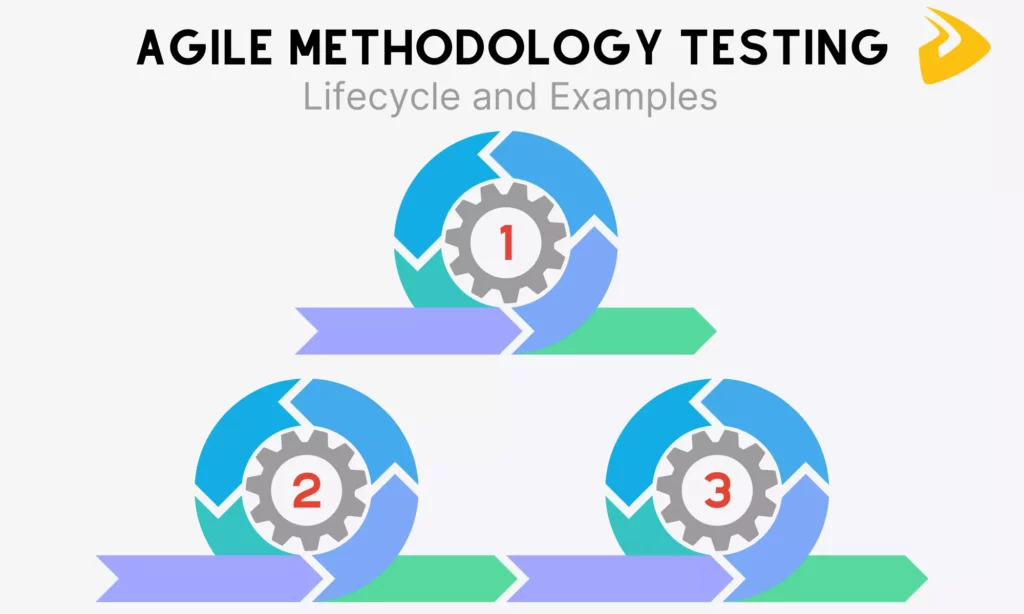
What Does an Agile Testing Loop Look Like?
There is no standard five-phase Agile testing lifecycle. The following loop is a practical way to organize quality work around an increment; teams can adapt it to their workflow and release policy. Testing should not be held until the last days of an iteration.
- Refine the change and its risks. Clarify the user outcome, acceptance conditions, affected components, dependencies, and failure impact. The useful output is a shared view of what could go wrong and what evidence would matter.
- Choose the checks before implementation is finished. Decide which component, integration, system, acceptance, non-functional, or exploratory checks fit the change. Prepare test data and environments where they could block progress.
- Run feedback with the change. Developers and testers execute relevant checks as code is built and integrated. A failed check should identify the observed behavior, affected change, and next owner rather than only report a red build.
- Inspect the increment against its quality bar. The team reviews test evidence, unresolved defects, and relevant risks against its Definition of Done and release policy. Passing automated checks alone is not proof that a product is ready for every user or context.
- Use results to improve the next slice. Review escaped defects, slow or flaky checks, user feedback, and repeated bottlenecks. Update the backlog, test approach, or quality bar where the evidence supports a change.
When a team uses Scrum, the Daily Scrum is a Scrum event for Developers to inspect progress toward the Sprint Goal and adapt their plan; it is not an Agile testing phase. Other teams can coordinate testing through the cadence that fits their work. The Scrum Guide defines Scrum events, while release timing remains a product and organization decision.
Turn the Loop Into a Test Strategy
A useful Agile test strategy connects a risk to a check, an owner, and an observable result. It can be lightweight for a low-risk feature and more formal where safety, privacy, money, or regulation raises the cost of failure. Agile teams still need durable plans and records when those artifacts support decisions, compliance, or maintenance.
| Practice | Who contributes | Make visible | Review signal |
|---|---|---|---|
| Risk-based planning | Product, development, and testing | Changed behavior, impact, test scope, dependencies, and owner | High-impact risks have a named check or an explicit reason for deferral |
| Automation in the delivery pipeline | Developers and test specialists | Fast, repeatable checks at suitable component and integration boundaries | Failures are actionable; flaky checks have an owner and a repair plan |
| Exploratory testing | Testers, developers, and product partners | A focused charter, time box, data, observations, and follow-up | Findings change a decision, add a check, or clarify remaining risk |
| Definition of Done | The whole team | Shared conditions for calling an increment complete | The team can point to evidence for each applicable condition |
| Feedback and learning | Product, engineering, testing, and operations as relevant | A baseline, chosen quality signals, an owner, and a review date | The next action follows observed risk, not a generic target or test-count quota |
Choose measures that support a decision. A team might review time to receive test feedback, escaped defects by severity, unstable checks, or the risks left untested. Record a baseline and set a threshold only when the team has enough context to use it; there is no universal Agile testing target.
Responsibilities should be clear even when quality is shared. A cross-functional Agile team can agree who maintains each check, who investigates a failure, and who decides whether unresolved risk blocks release.
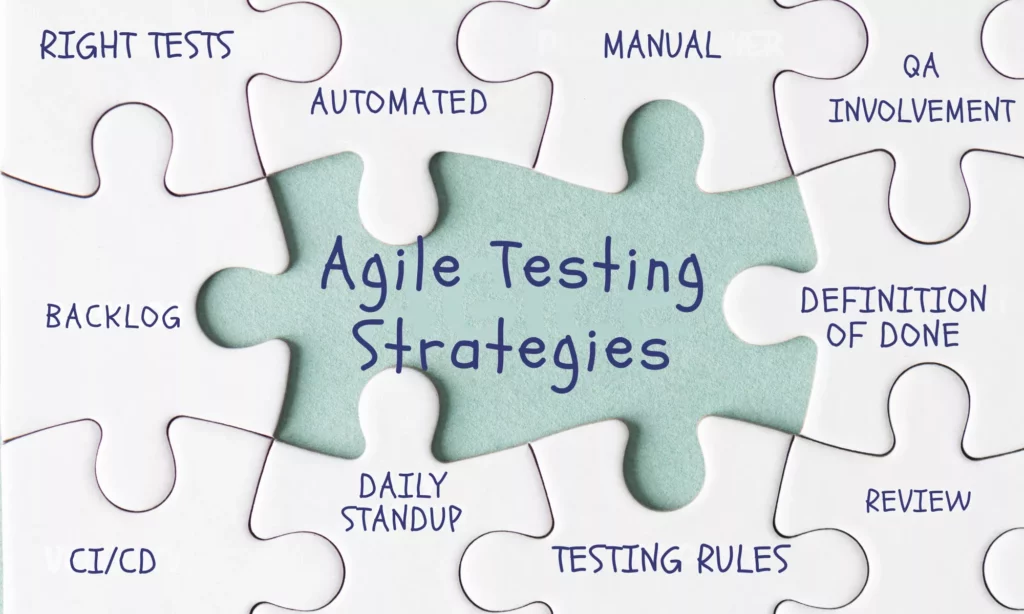
How Do the Agile Testing Quadrants Organize Coverage?
The Agile Testing Quadrants group tests along two dimensions: whether they are technology-facing or business-facing, and whether they guide development or evaluate (critique) the product. The model helps a team discuss coverage; Q1 to Q4 are labels, not mandatory steps. The version described here follows Lisa Crispin and Janet Gregory’s discussion of the quadrants, which builds on Brian Marick’s original testing matrix.
| Quadrant | Purpose and audience | Examples |
|---|---|---|
| Q1: Technology-facing, guides development | Helps the team build and change code with feedback on component behavior | Unit, component, and some service-level checks |
| Q2: Business-facing, guides development | Clarifies expected business behavior while the team implements it | Acceptance examples, functional checks, and examples used in BDD |
| Q3: Business-facing, evaluates the product | Explores whether the product works for users in realistic situations | Exploratory, usability, and user acceptance testing |
| Q4: Technology-facing, evaluates the product | Checks technical qualities and operating behavior under relevant conditions | Performance, security, reliability, and compatibility checks |
Automation is not the axis: a business-facing acceptance check may be automated or manual, and a technical evaluation can use tools without “tools” being its category. The quadrants also do not define a complete test plan. Teams select checks based on product risk, architecture, users, and release context, then revisit gaps as the system changes.
What Are the Common Test Levels and Test Types?
Test levels describe the scope or test object being checked; they are different from test types such as functional, performance, or regression testing. The ISTQB CTFL v4.0.1 syllabus describes these five common test levels:
- Component (unit) testing: checks an individual component or unit in isolation.
- Component integration testing: checks interactions and interfaces between components.
- System testing: checks the behavior and quality of the complete system.
- System integration testing: checks interactions between the system and other systems or services.
- Acceptance testing: checks whether the solution meets business or user needs and relevant acceptance conditions.
Teams sometimes use a simplified grouping, so name the model when discussing levels. Regression testing is not a sixth level: it checks whether a change has affected existing behavior and can be performed at component, integration, system, or acceptance scope. A team may choose regression coverage according to change impact and risk rather than rerunning every test after every edit.
Which Agile Testing Techniques Fit Different Risks?
Testing techniques are ways to design or perform checks, not interchangeable Agile methodologies. A team can combine them and adjust the mix as its product changes.
- Test-driven development (TDD): write a small failing test, implement enough behavior to pass it, then refactor. It gives fast feedback on component behavior but does not replace broader product evaluation.
- Behavior-driven development (BDD): use concrete examples and shared language to clarify expected behavior among product, development, and testing. A Given/When/Then format can help, but the format alone does not guarantee shared understanding.
- Acceptance test-driven development (ATDD): agree on acceptance examples before implementation so the team can test whether a story meets its intended outcome.
- Exploratory testing: learn about the product while testing it, guided by a charter such as “check how account recovery behaves with invalid or repeated links.” Record what was tried, what was observed, and what risk remains.
- Automated regression checks: automate stable, repeatable behavior that matters often enough to justify its maintenance. Keep human-led exploration for areas where judgment, usability, or unexpected interaction matters.
Automation and manual testing are complementary choices, not competing definitions of Agile. Automate where speed and repeatability help; use skilled human testing where context and discovery add value. Review the cost of maintaining each check alongside the risk it covers.

Worked Example: Test a Password-Reset Story
This is an illustrative scenario, not a report of a real project. Suppose a team adds password reset to an account service. A user story might say: “As a registered user, I want to reset my password so I can regain access to my account.” The user story explains the goal; acceptance criteria make the expected outcomes testable.
- A reset request produces a safe confirmation without revealing whether an email address belongs to an account.
- A valid reset token is tied to the right account, can be used only as allowed by product policy, and expires according to the agreed security rule.
- An invalid, expired, or already-used token does not change the password and gives the user a safe next step.
- After a successful reset, the new password works and the previous password no longer grants access.
- Request limits and audit events follow the product’s security requirements; the team defines the applicable thresholds before release.
The team can cover the story at several scopes. Component tests check token validation and state changes; API tests check valid, invalid, expired, and repeated requests; a browser-level check covers the main user path. A time-boxed exploratory session can then probe navigation, confusing messages, and behavior not captured by the scripted examples.
Before merging or releasing, compare the evidence with the team’s Definition of Done and release policy. A failed security-relevant check should have a named owner and an explicit decision; a green test run does not resolve a risk the suite never covered. If the acceptance rule is unclear, refine the story before treating the result as pass or fail.

Agile Testing vs. Plan-Driven Testing
Agile and plan-driven delivery often differ in feedback cadence and how teams handle change, but the labels do not describe every organization. Both approaches can use documentation, automation, risk-based testing, and release controls. The useful comparison is how the work is planned and how evidence informs decisions.
| Dimension | Agile-style delivery, often | Plan-driven delivery, often | What to decide |
|---|---|---|---|
| Feedback cadence | Checks and feedback recur as small increments are built | Testing may follow planned phases or formal review points | How soon must the team detect a change-related risk? |
| Scope changes | Backlog and test scope are revisited as learning changes priorities | Impact and approval may be recorded through change control | What evidence and approval does this product require? |
| Test planning | Plans are updated with the work and may be kept close to the backlog | Plans and traceability may be established earlier and maintained formally | Which records support safe work, handoffs, and audits? |
| Release decision | Uses increment evidence, the Definition of Done, and release policy | Uses planned exit criteria and required approvals | Who accepts remaining risk, and on what evidence? |
These are common tendencies, not hard boundaries. A regulated product, a legacy system, or a high-impact change may require detailed traceability and formal approval regardless of whether the team works iteratively. Agile practices can also coexist with those controls.
Common Challenges in Agile Testing
Short feedback cycles do not remove delivery constraints. The team needs to make the constraints visible and decide what to change rather than quietly moving quality work to the end.
- Testing is squeezed by sprint scope: make test work and dependencies visible during refinement, then reduce scope when the team cannot complete the agreed quality checks.
- Automation is slow or unstable: identify whether failures come from product behavior, test code, or infrastructure; assign maintenance ownership before treating a flaky suite as reliable evidence.
- Environments or test data arrive late: plan access and safe data needs with the change, and record which cases remain unverified when a dependency is unavailable.
- Requirements change without a risk review: revisit affected checks and acceptance conditions whenever a material behavior or dependency changes.
Teams can use a short review to track recurring blockers, untested high-risk changes, and defects found after release. The purpose is to choose a specific improvement for the next cycle, not to add another ceremony by default.
FAQs About Agile Methodology Testing
What Are the Common Levels of Software Testing?
Common levels are component (unit), component integration, system, system integration, and acceptance testing. Teams may use a simplified grouping, so identify the model being used. Regression testing is a test type that can be performed at more than one level.
Is Agile Testing Manual or Automated?
It can use both. Automation supports repeatable checks, while manual and exploratory testing help people evaluate context, usability, and unexpected behavior. Choose by risk and purpose, not by an assumption that Agile requires one mode.
Are the Agile Testing Quadrants a Required Sequence?
No. The quadrants group test purposes and audiences; they do not prescribe the order in which a team must test. Teams use the model to discuss coverage and adapt checks to their product.
Does Every Agile Team Need a Daily Scrum?
No. The Daily Scrum is part of Scrum, not a required event in every Agile approach. Teams should coordinate testing and blockers through a cadence that fits their framework and work.
Related reading:
- Agile Development Best Practices: 10 Tips And Templates In 2026
- Agile Methodology Sample: Real Examples & Success Stories
- Agile And Lean: Differences, Similarities And When To Use Each
Use the quadrants to ask whether coverage is balanced, test levels to describe scope, and a risk-based strategy to decide which checks matter for the next change. Teams planning a custom product can review Designveloper’s software development services.
Also published on

Share post on










Related Articles


Types of Agile Development Methodology: Key Approaches Compared
Types of Agile Development Methodology: Key Approaches Compared Published October 14, 2026
Agile Methodology Testing: Lifecycle, Quadrants & Team Practices
Agile Methodology Testing: Lifecycle, Quadrants & Team Practices Published October 13, 2026
What Is an Agile Team? Structure, Roles, and How to Build One
What Is an Agile Team? Structure, Roles, and How to Build One Published October 13, 2026


















