
















Web apps power SaaS, e-commerce, internal workflows, and customer portals. Yet many teams still guess budgets, specifically, the many types of web application development cost. That guess often turns into delays, scope fights, or rushed quality.
This guide breaks down web application development cost in a way you can use right away. You will see what usually drives the price up. Finally, you will see what you can control early, before costs lock in.
You will get practical breakdown tables by type, phase, region, use case, and infrastructure. Each section uses simple language, clear takeaways, and realistic examples.

How Much Does Web App Development Cost in 2026?
If you want a real market baseline, start with verified project data. Based on reviews collected by Clutch, $66,499.09 is the average project cost, and the same dataset also reports 9 months as a typical timeline plus $7,138.93 as the average monthly cost, while many agencies cluster around $25–$49/hour and many projects still come in under < $10,000.
That spread is normal. A web app is not a single product. One team might build a landing-page-like portal. Another might build a multi-tenant SaaS with billing and admin tools. Both are “web apps,” but the effort differs.
Several factors shape your final budget. Use these links to jump to the detailed breakdowns:
- App scope and complexity by type
- Budget allocation by phase
- Hourly rates by region
- Common patterns by use case
- Non-negotiables like hosting and tooling in infrastructure
If you need a fast starting point, create a simple web application cost estimation template. Then refine it as you learn more. This approach beats guessing a single “fixed” price too early.
1. Web App Development Cost Breakdown by Type
App “type” mainly means complexity. Complexity grows when you add roles, permissions, integrations, heavy data, and strict security. It also grows when you need high traffic support or real-time features.
Many teams think “simple” means “cheap.” That can be true. However, you still pay for planning, UI, testing, and launch work. So even small apps need smart scope control.
Here is a practical way to think about tiers. The ranges below offer a quick yardstick across common market guidance, including $30,000–$80,000 for a simple MVP, $80,000–$200,000 for a mid-range SaaS build, and $200K–$1M+ for enterprise-level complexity.
| Type | Typical Scope | What Usually Drives Effort | How to Control Cost Early |
|---|---|---|---|
| Simple web app | One primary workflow, basic admin, limited integrations | Clean UX, stable data model, reliable auth | Ship one “hero” flow and postpone extras |
| Medium complexity web app | Role-based access, billing, multiple integrations, dashboards | Edge cases, permissions, data reporting, product polish | Standardize UI components and reuse patterns |
| Complex / enterprise web app | Advanced security, compliance needs, multi-tenant, high scale | Architecture, testing depth, observability, performance | Design the platform in phases and avoid overbuilding v1 |
When someone asks, “How much does it cost to develop a web app?” start by placing the idea into one tier. Then validate the tier with discovery work.
2. Web App Development Cost Breakdown by Phase
Most budget surprises come from unclear phases. Teams often label everything “development.” That hides where time really goes.
A clearer split helps you protect quality. It also helps you negotiate scope changes without chaos. Here is a phase view many teams use as a budgeting rule of thumb.
| Phase | Typical Share | What You Pay For | Common Cost Risk |
|---|---|---|---|
| UI/UX Design | 10–20% | Flows, wireframes, UI kit, clickable prototypes | Frequent redesign due to unclear requirements |
| Front-end development | 20–30% | UI components, state management, performance, accessibility | Too many “unique” screens with no shared components |
| Back-end development | 30–40% | APIs, databases, auth rules, business logic, integrations | Complex data rules and late integration changes |
| Testing & QA | 10–15% | Test plans, automation, regression, performance checks | Testing too late, causing rework and delays |
| Project Management | 5–10% | Sprint planning, stakeholder alignment, delivery tracking | Slow approvals and unclear decision ownership |
| Maintenance | Ongoing | Bug fixes, updates, security patches, minor improvements | Ignoring maintenance until issues pile up |
This view also helps you explain “why it costs that much.” It shows that web application development cost includes more than code. It includes decisions, validation, and risk control.
3. Web App Development Cost Breakdown by Region
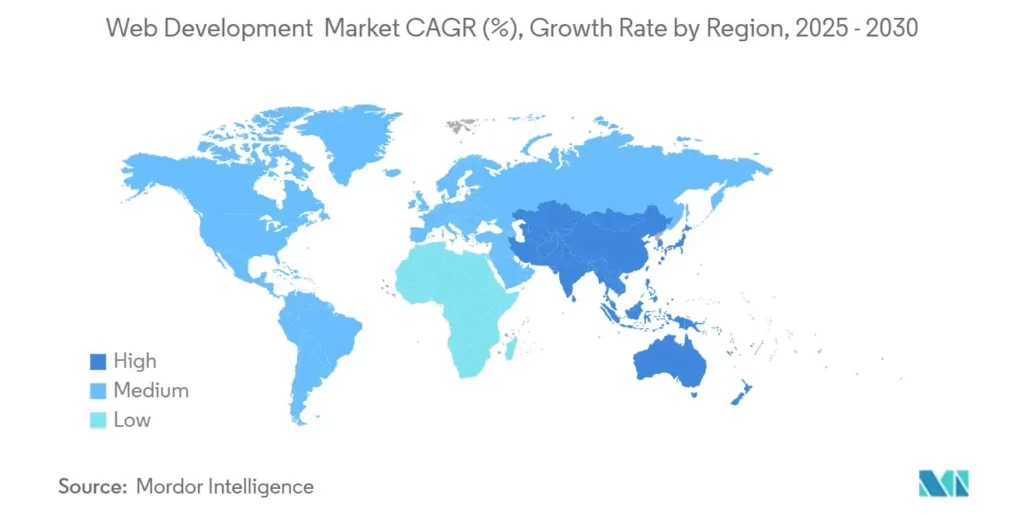
Region still changes your budget. However, region is not the only lever. Experience level and engagement model matter just as much.
Also, market prices move over time. In fact, the 2025 Accelerance guide cited in the press describes developer hourly rates dropping between 9% and 16% across several major outsourcing regions as AI tooling and tighter budgets reshaped deals.
The table below combines two useful lenses. First, it shows location-based agency bands from Clutch data. Next, it shows a common freelance benchmark by experience level.
| Region | Agency Rate Snapshot | Freelance Benchmark by Experience | Best Fit When You Need |
|---|---|---|---|
| North America & Western Europe | Clutch lists the United States and Canada at $100 – $149 per hour | Upwork cites web developers at $15–$50/hr with a median around $30 | Fast collaboration, complex stakeholder needs, tight discovery cycles |
| Eastern Europe | Clutch shows Ukraine at $25 – $49 and Poland at $50 – $99 | Use a blended team, then reserve higher-cost experts for architecture | Strong engineering depth with cost control and structured delivery |
| Asia (Vietnam, India, Philippines) | Clutch lists India at < $25 and the Philippines at $25 – $49 | Pair clear specs with daily check-ins to avoid rework | MVP builds, dedicated teams, and ongoing feature delivery |
If you evaluate “web application development cost per hour,” look beyond the sticker rate. Ask about team structure. Also ask how they handle testing, documentation, and handover.
4. Web App Development Cost for Different Use Cases
Use cases change the “shape” of effort. Even two apps in the same tier can cost very different amounts. For example, a SaaS product needs billing and access rules. An e-commerce build needs catalog, checkout, and integrations.
Instead of chasing a single number, match your use case to the cost drivers. Then plan the MVP around the riskiest parts first.
| Use Case | Must-Have Features | Typical Complexity Hotspots | Smart MVP Cut |
|---|---|---|---|
| SaaS Web Application | Auth, roles, subscription logic, onboarding | Permissions, billing edge cases, analytics, multi-tenant data | Launch one plan, one core role, and one primary workflow |
| E-commerce Web App | Catalog, search, cart, checkout, order tracking | Payment flows, tax and shipping rules, inventory sync | Start with one payment method and simple shipping rules |
| Enterprise Internal Tools | Workflows, approvals, integrations, audit logs | Legacy systems, data quality, change management | Automate one painful workflow before expanding |
| Startup MVP Web App | One clear value flow, basic admin, feedback loop | Scope creep, unclear audience, frequent pivots | Build the “aha” moment first and measure adoption |
This section also answers “cost of building a web app” in a practical way. It shows which features create the biggest budget swings for each product shape.
5. Essential Infrastructure Cost When Creating a Web App
Infrastructure costs often look small at launch. Then they grow with traffic, data, and third-party usage. You can still plan them early. That planning reduces surprises.
A useful first-year benchmark comes from Hostinger’s breakdown, which places essential web app costs in a wide annual band of $1,200 to $15,000/year for a freelancer or agency approach, while some no-code paths can land near $0 to $2,000 annually depending on tooling and needs.
| Infrastructure Item | What It Covers | What Makes It Grow | How to Keep It Lean |
|---|---|---|---|
| Hosting | Compute, scaling, deployment environments | Traffic spikes, multiple environments, heavy background jobs | Start small, measure load, then scale on real usage |
| Domain Name | Brand address and DNS management | Many domains, complex DNS, multi-region routing | Buy only what you use and keep DNS simple |
| SSL certificates | HTTPS security and trust signals | Many subdomains, strict compliance needs | Automate renewals and standardize certificate handling |
| API | Payments, email, SMS, maps, auth providers | Usage-based pricing, high-volume events | Choose providers with clear limits and alerts |
| Databases | Storage, backups, performance tuning | Large datasets, analytics, replication | Use managed backups and index only what you need |
If you ask, “What are the costs of running an web app,” infrastructure is a big part of the answer. Monitoring, backups, and incident response also matter. So plan for them from day one.
Hidden Costs When Building a Web App You Should Consider

Hidden costs do not feel “hidden” once you hit them. They usually show up after launch, or right before a deadline. So you should name them early.
First, scope creep costs real money. Small “quick changes” add up fast. They also create testing debt.
Second, integrations can explode effort. Payment gateways, CRMs, ERPs, and identity providers all add edge cases. You also spend time on retries, logs, and error handling.
Third, security work expands beyond code. You might need vulnerability scans, penetration testing, or access reviews. You might also need compliance evidence and audit trails.
Fourth, data work often surprises teams. Data cleanup, migration scripts, and mapping old systems take time. They also need careful validation.
Finally, internal time is a cost. Stakeholder reviews, approvals, and content preparation can slow delivery. That delay still burns budget because the team stays engaged.
How to Estimate Web App Development Cost Accurately
Accurate estimates start with clarity. Clarity does not mean a perfect spec. It means shared understanding.
Define clear requirements. Write user stories around outcomes. Then add acceptance criteria. This step reduces redesign and rework.
Prioritize MVP features. Choose the smallest set that proves value. Then rank everything else. This keeps your first release focused.
Choose the right development model. Fixed scope can work for stable requirements. A dedicated team model works better when you expect learning and change. Hybrid models often work well for startups.
Use web app cost calculators (limitations & risks). Calculators can help you sanity-check complexity. However, they often miss integration depth, QA rigor, and security needs. So treat calculator outputs as a rough starting point, not a final budget.
If you keep a web application cost estimation template, update it every sprint. That habit improves forecast accuracy over time.
How to Reduce Web App Development Cost Without Sacrificing Quality

You can reduce cost without lowering standards. You just need the right trade-offs.
Start with MVP. Focus on the core value flow. Then ship early. Feedback saves money because it prevents building the wrong features.
Reuse components. Build a small design system. Reuse UI patterns and backend modules. This reduces both development and QA effort.
Choose the right outsourcing partner. Look for clear communication and strong QA habits. Also check how they document decisions. Good process reduces rework.
Agile and iterative development. Short iterations reveal risk early. They also help you control scope. So you spend budget on what users actually need.
These tactics directly reduce web application development cost because they reduce waste. They also improve delivery speed.
Is Web App Development Worth the Investment?
A web app is an asset. It can automate work, improve customer experience, and create new revenue paths.
Long-term ROI improves when you build on a stable foundation. A clean architecture reduces future change costs. Good UX also improves retention.
Scalability and flexibility matter when your business grows. A well-built web app can support new products, new markets, and new workflows.
Business value vs initial cost is the real decision. If the app removes bottlenecks or creates revenue, the investment often makes sense. So tie scope to measurable outcomes.
Cost Comparison: In-House vs Outsourcing Web App Development
In-house teams offer deep product context. Outsourcing offers speed and flexible scale. Neither is always cheaper. The “best” choice depends on your stage and constraints.
| Factor | In-House Team | Outsourced Team | Best When |
|---|---|---|---|
| Speed to start | Slower due to hiring and onboarding | Faster if the partner has ready capacity | You need to ship quickly |
| Flexibility | Harder to scale up or down | Easier to add or reduce people by phase | Your workload changes a lot |
| Product knowledge | Strong internal context | Requires good documentation and discovery | The domain is complex or regulated |
| Cost structure | Higher fixed cost and overhead | More variable and project-based | You want predictable project spending |
| Quality control | Direct oversight and shared standards | Depends on partner process and QA discipline | You have clear quality criteria and reviews |
Many teams use a blended model. They keep product leadership in-house. Then they outsource delivery capacity. This model can balance cost, speed, and control.
FAQs About Web App Development Cost
1. How Much Does it Cost to Build a Simple Web App?
A simple web app usually focuses on one core workflow. It often uses standard components for auth and admin. So the budget stays more predictable.
Start by defining what “simple” means for your product. Then remove anything that does not support the core user outcome. This step alone can cut a lot of spend.
2. Does Cost Affect the Quality of the Web Application?
Cost does not automatically equal quality. Process and discipline matter more than hype.
Quality improves when teams invest in testing, clear requirements, and solid architecture. Quality drops when teams rush without validation. So focus on how the team works, not only the price tag.
3. What is The Monthly Cost to Maintain a Web App?
Monthly maintenance depends on complexity and usage. It includes bug fixes, updates, and small improvements.
One practical benchmark breakdown lists simple apps at $50–500/month and complex enterprise apps at $1,000–10,000+/month for maintenance-level spend patterns.
4. Is Outsourcing Cheaper Than In-House Development?
Outsourcing can be cheaper when you avoid long hiring cycles and overhead. It can also be cheaper when you only pay for the skills you need at each stage.
However, outsourcing gets expensive if you manage it poorly. Unclear requirements and slow feedback create rework. So you still need strong product ownership.
5. Can I Build a Web App With a Limited Budget?
Yes, but you must narrow scope. You should also choose a build method that matches your constraints.
For some early-stage needs, no-code tools can reduce upfront spend, and one overview places certain no-code paths near $0 to $2,000 annually depending on the tool stack and requirements.
Web app budgets feel complicated because many moving parts influence the final number. Still, you can make it manageable. Start with a clear MVP. Break the work into phases. Then pick the right team model for your stage. When you do that, web application development cost becomes a planning tool instead of a scary unknown.
Conclusion
Smart planning turns web application development cost from a guess into a roadmap. You start with a clear MVP. Then you budget for the phases that protect quality. After that, you scale the app when the numbers prove the demand.
At Designveloper, we build from Vietnam for global teams, and we keep budgets tied to outcomes. We started as a Ho Chi Minh City team formed in 2013, and we have shipped more than 100 projects in over 20 industries and implemented more than 50 technologies, so we know what drives cost and what keeps it under control.
You can see that experience in products we helped deliver, such as Lumin, Swell & Switchboard, Walrus Education, and Joyn’it, where clean UX, stable architecture, and steady iteration made the work easier to scale.
Next, we can help you scope an MVP, validate UI/UX, build and test fast, and run production with clear DevOps and monitoring. We also support web app development, mobile app development, UI/UX design, AI development services, cybersecurity consulting, and VoIP solutions when you want one partner from discovery to maintenance.
Share your goals, timelines, and must-have features. Then we will turn them into a clear estimate, a release plan, and a cost-saving build strategy that still protects quality.
Also published on

Share post on










Related Articles


Read more topics



AI Development
AI Development

Automation Technologies & Solutions
Automation Technologies & Solutions
Back-End Development
Back-End Development

Best Companies
Best Companies

Blockchain Technology and Applications
Blockchain Technology and Applications

Business Analyst Role & Skills
Business Analyst Role & Skills

Chatbot Development
Chatbot Development

Cloud Technology Revolution
Cloud Technology Revolution

CMS Platforms Development
CMS Platforms Development

Cyber Security
Cyber Security