












MVP Development Cost In 2026: Budget Guide And Timeline

KEY TAKEWAYS:
- MVP development cost depends on the problem the product must validate, not only the number of screens or features in the first release.
- Most MVP budgets fit three bands: simple validation builds, mid-level products with custom workflows, and complex MVPs with AI, integrations, compliance, or heavy backend needs.
- The safest estimate separates stages such as discovery, UX, engineering, integrations, testing, release, monitoring, and post-launch iteration.
- Reducing cost should remove low-value scope, not the foundations that protect learning, security, quality, analytics, and maintainability.
- AI and regulated MVPs need extra budget control because evaluation, data handling, model usage, governance, and fallback workflows continue after launch.
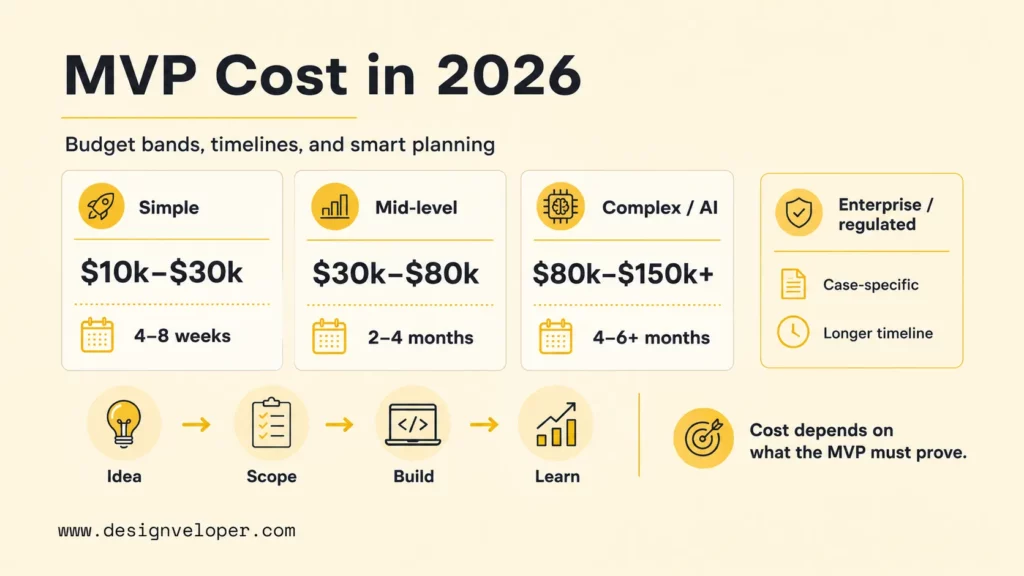
MVP development cost in 2026 commonly falls into three practical planning bands: about $10,000-$30,000 for a simple validation product, $30,000-$80,000 for a mid-level MVP with custom workflows and backend services, and $80,000-$150,000 or more for complex, AI-enabled, regulated, or highly integrated products. Typical timelines range from four to eight weeks for a narrow MVP to four months or longer for complex delivery. These are planning bands, not quotes, and they should be refined through an MVP scope, risk, and delivery review.
The real budget depends on what the MVP must prove. A clickable prototype can test usability without production code. A web MVP can validate a workflow with one responsive client. A marketplace needs at least two user roles, supply and demand flows, payments, and administration. An AI MVP needs data, model integration, evaluation, monitoring, and failure handling. Calling all of these products an MVP does not make their cost comparable.
Quick decision guide: Define one risky business assumption and one end-to-end user journey before asking for an estimate. Budget for discovery, UX/UI, engineering, integrations, QA, security, launch, monitoring, and the first learning cycle. Start with one platform when possible, reuse managed services where they fit, and hold a contingency for uncertain integrations instead of cutting the quality controls that protect the experiment.
| MVP level | Planning budget | Typical timeline | Best fit |
|---|---|---|---|
| Simple validation MVP | $10,000-$30,000 | 4-8 weeks | One core workflow, limited roles, light backend or managed services. |
| Mid-level MVP | $30,000-$80,000 | 2-4 months | Custom UX, accounts, backend, integrations, admin, and production QA. |
| Complex or AI-enabled MVP | $80,000-$150,000+ | 4-6+ months | Advanced logic, AI, offline or real-time behavior, regulated data, or several integrations. |
| Enterprise or highly regulated MVP | Case-specific | Often longer | Security, compliance, legacy integration, procurement, and governance dominate scope. |
Recommended for you:
- How To Build An App For Your Business In 10 Steps
- Mobile App Development: Definition, Process, And Best Practices
- Mobile App Design Process: Steps, Best Practices, And Examples
Quick Answer: MVP Development Cost And Timeline In 2026
Further reading:
- Web App Development Cost: 2026 Breakdown
- eCommerce App Development Guide 2026: Features, Process
- 10 Best Mobile App Development Frameworks In 2026
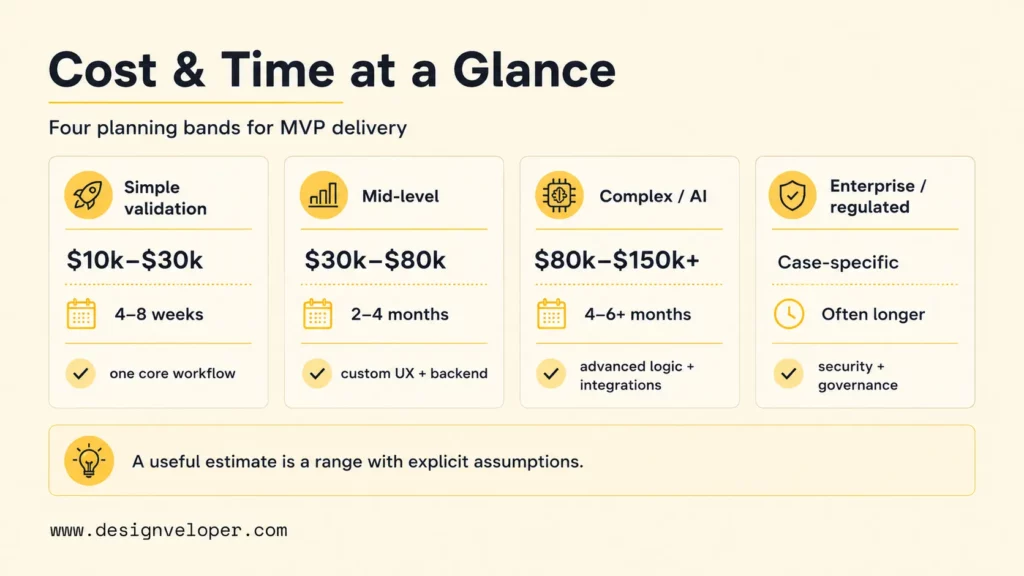
A realistic MVP estimate is a range with explicit assumptions. The $10,000-$30,000, $30,000-$80,000, and $80,000-$150,000+ bands are useful for early planning, but the estimate must state users, platforms, features, integrations, design depth, quality gates, and post-launch support. A founder who asks only for a screen count leaves the costliest risks unpriced.
Current market data confirms that app budgets vary widely. Clutch’s July 2026 mobile app pricing guide reports that most reviewed app projects fall between $10,000 and $49,999, while its recorded average is about $90,780. Clutch also reports a typical project timeline around 11 months for the broader reviewed market. An MVP can be narrower and faster, but the market figures show why a single universal average is misleading.
A simple MVP in four to eight weeks, especially after a clear mobile app development process, might include a responsive web client, authentication through a managed provider, one role, one primary workflow, basic administration, and event analytics. A mid-level MVP may add multiple roles, custom UX, payments, notifications, data dashboards, and third-party APIs. A complex product may add native mobile clients, offline sync, real-time collaboration, AI, migration, regulated data, or high-availability requirements.
Timeline and cost are connected through scope, team composition, and uncertainty. Adding people does not linearly shorten delivery because product decisions, architecture, integration, review, and coordination remain. A small cross-functional team with fast stakeholder decisions can often deliver a focused MVP more predictably than a large team working against changing requirements.
An MVP budget should buy evidence about the business, not a smaller version of every feature in the final vision.
MVP Development Cost By Product Type
Related reading:
- AI In Software Development: Changing How Software Gets Built
- What Is Agile Software Development? Methodologies And Benefits
- Software Development Outsourcing: Definition, Benefits, And How To Start
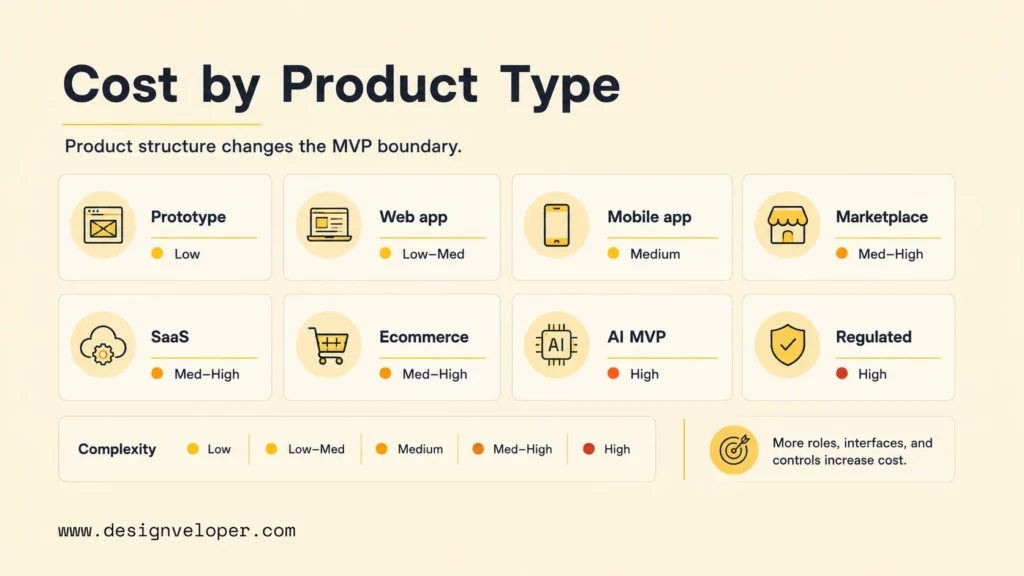
Product type changes the number of interfaces, roles, integrations, and operating controls an MVP needs. The ranges below describe relative cost pressure rather than a vendor quote. A disciplined web product can cost more than a poorly scoped mobile app if its workflows, permissions, and integrations are deeper.
| Product type | Typical MVP boundary | Complexity | Main cost impact |
|---|---|---|---|
| Clickable prototype or landing page | Interactive design, value proposition, lead capture, or concierge test | Low | Research and design; little or no production backend. |
| Web app MVP | Responsive client, accounts, one core workflow, admin basics | Low to medium | Frontend, backend, hosting, authentication, and browser QA. |
| Mobile app MVP | iOS, Android, or shared client with device and store work | Medium | Device QA, native configuration, signing, notifications, and store release. |
| Marketplace MVP | Buyer and seller flows, listings, search, messaging, payments, moderation | Medium to high | Multiple roles, transaction states, trust, operations, and reconciliation. |
| SaaS MVP | Tenant accounts, subscriptions, permissions, onboarding, admin, reporting | Medium to high | Multi-tenancy, billing, authorization, support, and usage controls. |
| Ecommerce MVP | Catalog, cart, checkout, orders, inventory connection, support | Medium to high | Payment, tax/shipping rules, product data, fulfillment, and failure recovery. |
| AI-powered MVP | Model workflow, data, prompts, evaluation, fallback, monitoring | High | Variable model cost, nondeterminism, privacy, quality evaluation, and guardrails. |
| Fintech, healthcare, or compliance-heavy MVP | Sensitive data, auditability, security, verification, regulated workflows | High | Threat modeling, compliance, specialist review, documentation, and controls. |
A prototype and an MVP answer different questions. A prototype asks whether people understand or want the experience. An MVP is a functioning product that can deliver value and collect behavioral evidence. The Designveloper prototype versus MVP guide helps teams avoid paying for production infrastructure when a design experiment would answer the immediate question.
A marketplace illustrates hidden multiplication. A seemingly small marketplace may need onboarding for buyers and sellers, inventory or listings, search, transaction lifecycle, payments, refunds, disputes, reviews, moderation, notifications, and an operations console. The first release should constrain category, location, payment method, and exception handling rather than pretending every marketplace scenario is essential.
An AI MVP should be scoped around one measurable task, which is why AI in product development needs a sharper evaluation plan. A support assistant might begin with one knowledge domain, retrieval over a controlled corpus, citations, feedback, and human escalation. A document extraction MVP might support one document type and a review screen. Adding agents, multiple providers, autonomous actions, personalization, and broad document support before evaluation data exists can consume budget without improving the core evidence.
A SaaS MVP also carries hidden platform work. Account creation, tenant isolation, roles, invitations, subscription state, usage limits, billing events, support access, and administrator controls are not decorative. A narrow SaaS experiment can use one plan and one role initially, but the data model should not accidentally expose one customer’s data to another.
Main Factors That Affect MVP Budget And Timeline
Explore more:
- Top 20 Mobile App Development Companies In Vietnam
- Offshore Software Development: The Pros And Cons Of Offshore
- Cross-Platform App Development: Benefits, Tools, And Best Practices
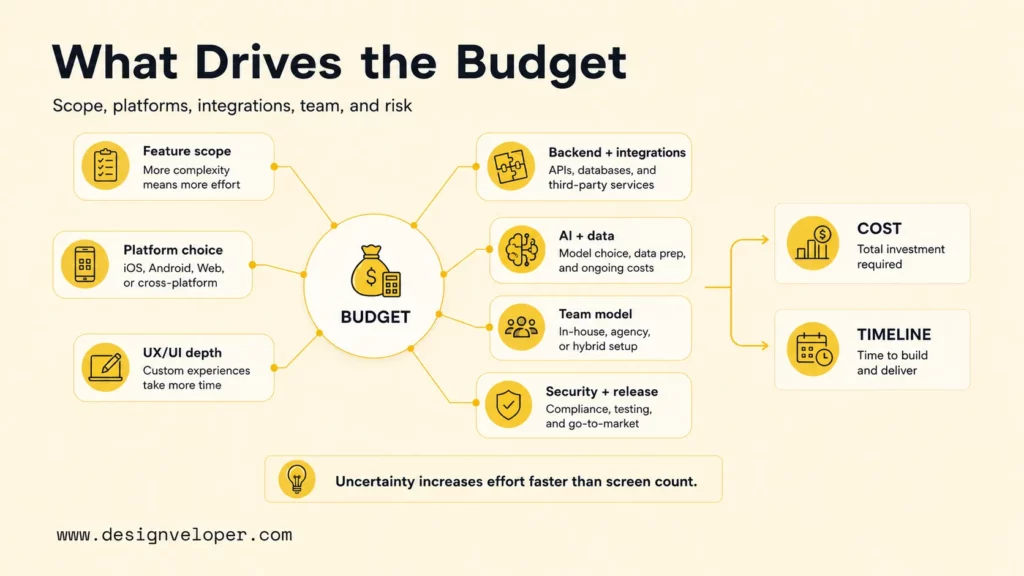
Feature scope and product complexity are the strongest cost drivers because they determine design, code, tests, data, and exceptions. Every feature should map to the primary validation goal, a required risk control, or an essential operating capability. Features that do not meet one of those tests belong in a later release.
| Cost factor | Why it affects cost | How to control it |
|---|---|---|
| Feature scope and roles | More journeys, permissions, states, and exceptions require more design, code, and QA. | Prioritize one core outcome; defer secondary roles and automation. |
| Platform | Separate native clients duplicate platform work; cross-platform still needs native release QA. | Start with the audience-dominant platform or responsive web when evidence permits. |
| UX/UI depth | Custom interaction, accessibility, localization, and design systems expand work. | Prototype the critical flow and reuse accessible components. |
| Backend and integrations | APIs, legacy systems, payments, migration, and unreliable vendors create uncertainty. | Prove the riskiest integration early; define ownership and fallback behavior. |
| AI and data | Data preparation, model behavior, evaluation, latency, safety, and usage costs add work. | Constrain task and dataset; establish baseline, rubric, fallback, and limits. |
| Team model and speed | Rates, skill mix, coordination, and decision latency affect hours and calendar time. | Name decision owners and choose relevant risk experience. |
| Security and compliance | Sensitive data requires controls, evidence, and specialist review. | Classify data early and design minimum compliant scope. |
| Operations and release | Stores, cloud, monitoring, support, and incidents continue after coding. | Include launch and first iteration in the estimate. |
Platform strategy affects more than coding. Native iOS and Android products require separate interfaces, builds, platform expertise, device testing, and release processes. Cross-platform frameworks can share substantial code, but payments, notifications, signing, vendor SDKs, platform conventions, and store review remain. A web-first MVP may be the lowest-risk path when device capabilities and store discovery are not central to validation.
Integration uncertainty should be priced explicitly. A vendor API may lack documentation, a payment webhook may produce duplicate events, a legacy database may contain inconsistent records, or an identity provider may require enterprise configuration. Build a short technical spike around the highest-risk dependency and convert unknowns into acceptance criteria before finalizing the budget.
Security is not a post-MVP luxury. Authentication, server-side authorization, encrypted transport, secret management, secure storage, audit logs, dependency review, backups, and recovery may be required even for a small test. The OWASP Mobile Application Security Verification Standard provides a useful model for mobile controls. The exact depth should match data sensitivity and consequence, not marketing labels.
The development team model changes both rate and risk. A freelancer may be economical for a bounded prototype. A small product studio can cover design and engineering. A full cross-functional team becomes more valuable when the MVP includes several platforms, backend services, QA, DevOps, and security. Compare relevant outcomes, communication, ownership, and support instead of hourly rate alone.
MVP Cost Breakdown By Development Stage
Continue reading:
- What Is JavaScript? Definition, Uses, And How It Works
- What Is TypeScript? Definition, Benefits, And How It Works
- Most Used Programming Languages In 2026: Rankings, Jobs And Use Cases
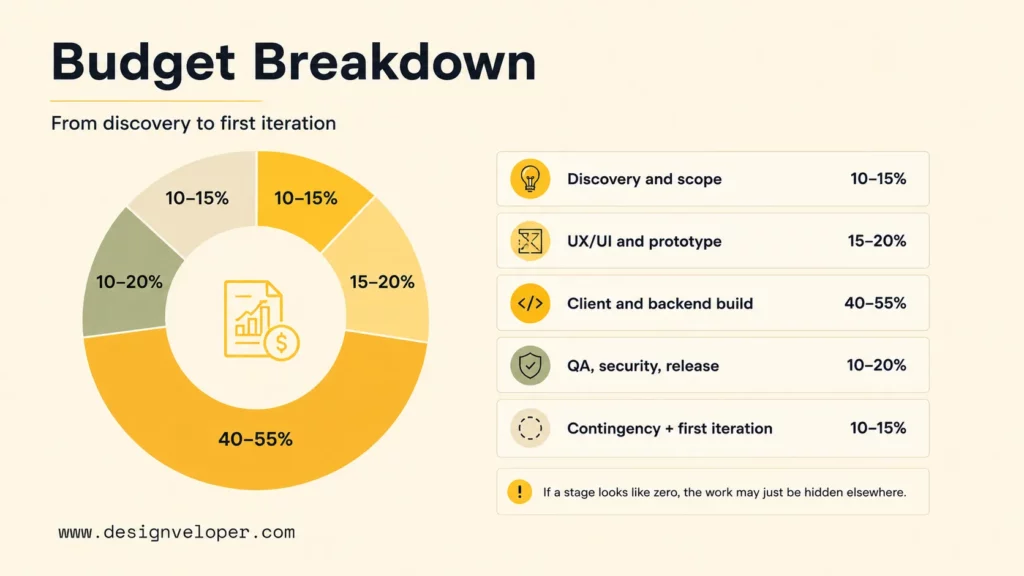
A complete MVP budget covers discovery through the first production learning cycle. Engineering is often the largest line item, but cutting discovery, testing, or monitoring usually moves risk into the most expensive stage. The allocation percentages below are planning prompts; project needs may shift them substantially.
MVP budget allocation checkpoint
Discovery and scope
UX/UI and prototype
Client and backend build
QA, security, release
Contingency and first iteration
If one box is near zero, confirm that its responsibility is genuinely unnecessary rather than silently moved to another team or after launch.
Discovery produces a problem statement, target users, journey map, success metrics, MVP boundary, assumptions, product backlog, architecture options, risk register, and estimate range. A strong discovery phase can remove features, expose integration risk, and decide whether a landing page, prototype, concierge service, no-code workflow, or custom product is the appropriate experiment.
UX/UI work translates scope into flows, wireframes, prototypes, accessible components, error states, and handoff rules. Testing a prototype with representative users is cheaper than rebuilding a coded workflow. Design should cover loading, empty, failure, permission, cancellation, and support states – not only ideal screens.
Development includes client interfaces, backend APIs, database, authentication, administration, integrations, infrastructure, analytics events, and automated tests. Integration and infrastructure work should create separate development, staging, and production boundaries where risk requires them. Secrets, permissions, backups, logs, and deployment need owners.
QA covers functional behavior, APIs, usability, accessibility, device and browser compatibility, performance, security, and failure recovery. Launch work includes domains, stores, screenshots, privacy disclosures, reviewer access, monitoring, alerts, support, and rollout. The Designveloper guide to building an MVP connects planning, prototyping, development, launch, and feedback as one product loop.
Post-launch cost begins immediately. Teams triage issues, answer users, observe funnels, monitor crashes and infrastructure, patch dependencies, and decide the next experiment. Budgeting only through code completion leaves the MVP unable to collect or act on the evidence it was built to produce.
How To Reduce MVP Cost Without Delaying Launch
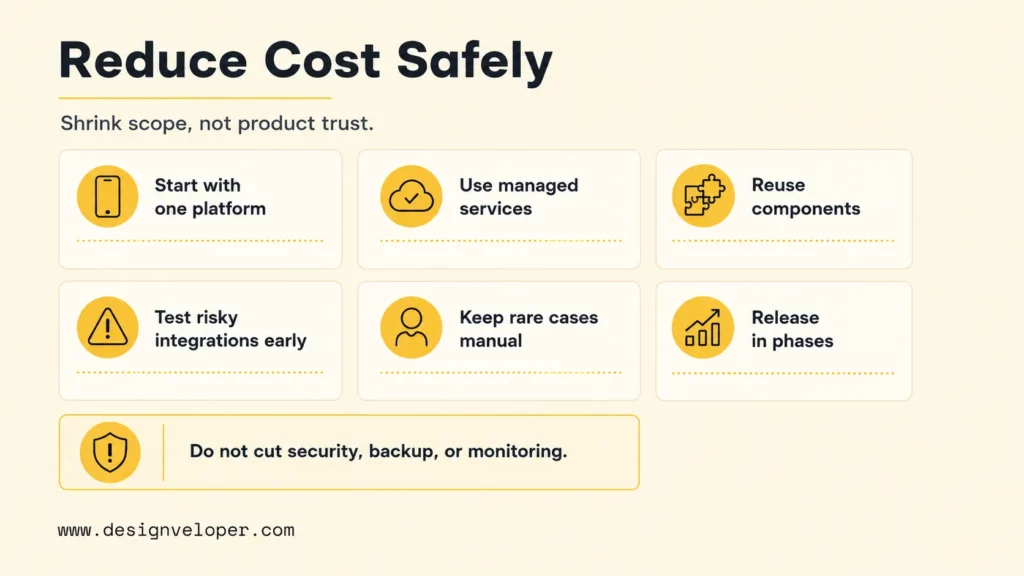
The fastest safe cost reduction is scope reduction. Keep the complete core validation flow and remove secondary journeys. A booking MVP needs discovery, availability, booking, confirmation, cancellation, and basic operations; it may not need loyalty tiers, social features, complex recommendations, or full automation.
- Start with one platform: choose responsive web, iOS, or Android based on target-user evidence before expanding.
- Use managed services deliberately: authentication, messaging, storage, analytics, and payments can reduce undifferentiated engineering.
- Reuse accessible components: invest custom design in the differentiating journey, not every standard control.
- Prove risky integrations first: a short spike can prevent weeks of work based on false API assumptions.
- Delay premature automation: operate low-volume edge cases manually while learning the real pattern.
- Release behind controls: pilot users, feature flags, and phased rollout reduce the cost of broad failure.
No-code or low-code can be the cheapest route for forms, directories, internal workflows, and concierge-style validation. Before committing, verify authentication, authorization, data export, integrations, environments, tests, performance, accessibility, usage pricing, and ownership. A low initial build price is not a saving if the product must be rebuilt before the first meaningful pilot.
Cloud and SaaS services can begin inexpensively and grow with usage. Firebase documents no-cost and pay-as-you-go plans on its current pricing page. Model reads, writes, storage, egress, functions, authentication messages, logs, and test devices can all create usage costs. Set budgets, alerts, retention, and efficient query patterns before user growth makes waste expensive.
Keep low-volume operations manual when automation is not the experiment. Staff can review a supplier application, resolve an unusual refund, or categorize an edge case while the team learns frequency and rules. Document the manual step, protect access, and measure its cost so the later automation decision is based on real evidence.
Do not reduce cost by eliminating acceptance criteria, security, backup, or monitoring. An MVP does not need enterprise scale, but it must be trustworthy enough for its test. Define the smallest valid control set based on user harm, data sensitivity, payments, regulation, and reversibility.
The cheapest MVP is the smallest trustworthy experiment, not the largest feature list built with the lowest hourly rate.
How To Estimate The Right MVP Budget And Timeline
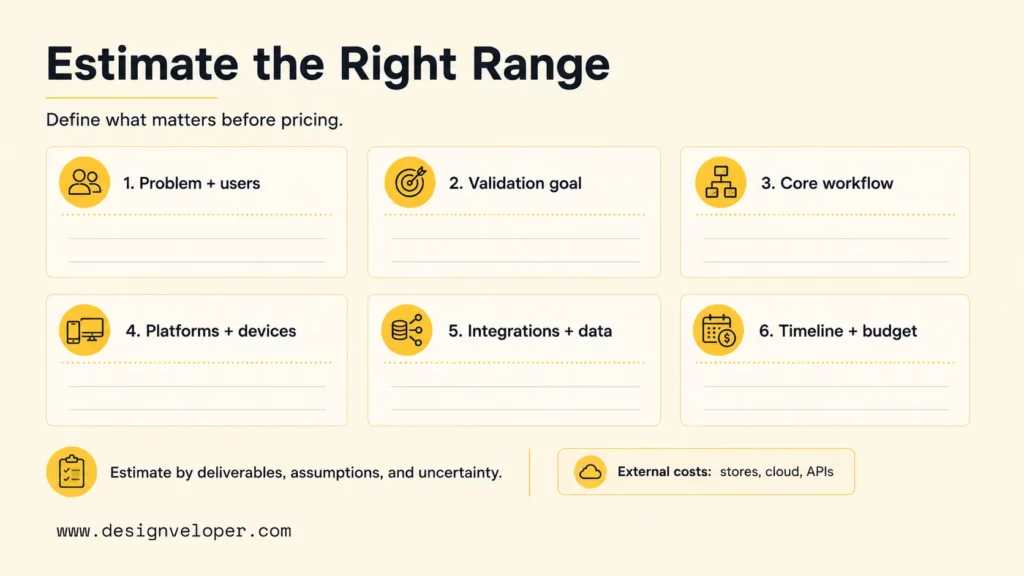
An estimate becomes useful when the requester defines the problem, target users, must-have journey, platform, integrations, compliance, deadline drivers, success metrics, and post-launch learning plan. Provide examples and constraints, but allow the delivery team to challenge features that do not support validation.
| Estimate input | Minimum detail | Why it matters |
|---|---|---|
| Problem and users | Who has the problem, current workaround, frequency, and consequence | Determines whether an app is needed and which journey matters. |
| Validation goal | One assumption, success metric, baseline, and go/no-go threshold | Prevents full-product scope from entering the MVP. |
| Core workflow | Start, steps, success, failure, cancellation, and support | Exposes real screens, states, backend, and operations. |
| Platforms and devices | Web, iOS, Android, browser or OS range, and hardware | Defines client work and QA matrix. |
| Integrations and data | API docs, owners, sample data, authentication, migration, privacy | Reveals uncertainty and security obligations. |
| Timeline and budget | Deadline reason, available range, decision cadence, and team access | Allows scope and delivery model to be shaped honestly. |
Estimate work by deliverables and uncertainty. Break the MVP into discovery, design, client, backend, integrations, QA, security, release, operations, and contingency. For each item, record assumptions, exclusions, dependencies, acceptance criteria, owner, and a low-likely-high range. Do not hide uncertainty inside one precise total.
Run a technical spike when uncertainty is material. A one-week experiment on a payment provider, offline sync, AI extraction, camera SDK, or legacy API may be the highest-return budget item. The spike should end with measured results, unresolved risks, an implementation route, and an updated estimate – not disposable demo code presented as production architecture.
Include explicit external costs. Apple currently lists the Apple Developer Program at $99 per membership year, with regional variation. Google Play lists a $25 one-time registration fee for its developer account. Also model cloud, databases, storage, email/SMS, maps, payment processing, monitoring, design tools, test devices, domain, support, and any AI API usage.
AI estimates need a unit-economics worksheet. Record model and fallback, average input and output size, calls per workflow, retries, retrieval, embeddings, storage, evaluation traffic, monitoring, and human review. Pricing changes, so use the provider’s current API pricing at estimation time and model low, expected, and high usage. Apply the NIST AI Risk Management Framework when reliability, safety, or governance materially affects the product.
At Designveloper, we help founders convert a concept into a scoped experiment, realistic range, technical roadmap, and build plan. We connect discovery, UX/UI, web or mobile engineering, backend and API work, AI evaluation, QA, DevOps, launch, and iteration. Our software development services are most useful when the MVP must validate value without creating an avoidable production dead end.
FAQs About MVP Development Cost
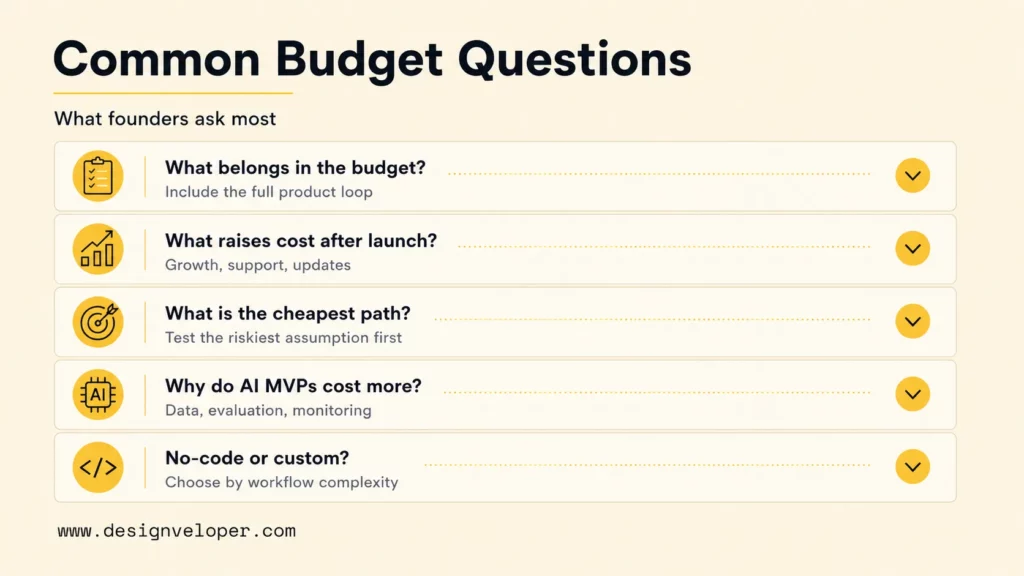
What Should Be Included In An MVP Budget?
Include discovery, product management, UX/UI, prototype testing, client and backend development, integrations, infrastructure, QA, accessibility, security, analytics, release, monitoring, documentation, support, contingency, and the first post-launch iteration. Also include external subscriptions, cloud usage, stores, payment fees, messages, maps, AI APIs, and test devices. State taxes and ongoing costs separately when relevant.
What Can Increase MVP Costs After Launch?
User growth can increase cloud, storage, database, bandwidth, messaging, monitoring, and support costs. New feature requests, defects, dependency updates, operating-system changes, app-store policies, security patches, vendor price changes, compliance findings, data migration, and weak architecture can also increase spending. Instrument usage and cost per successful core action so growth is visible before invoices become surprising.
What Is The Cheapest Way To Build An MVP?
The cheapest valid route is often a landing page, clickable prototype, concierge service, spreadsheet-backed workflow, or no-code tool that tests the riskiest assumption. If production software is necessary, use one platform, one role, one core journey, managed services, and manual handling for rare exceptions. The lowest-cost experiment is the one that produces credible evidence without building unnecessary infrastructure.
Why Do AI MVPs Cost More?
AI MVPs add data preparation, provider integration, prompt or model design, evaluation datasets, nondeterministic testing, latency and cost controls, privacy, safety, observability, fallback, and human review. A compelling demo is not proof of repeatable quality. The Designveloper AI MVP production guide explains why evaluation, monitoring, security, workflow integration, and operating ownership matter after the first demonstration.
Should I Build An MVP With No-Code Or Custom Development?
Choose no-code when the workflow is simple, speed is the main constraint, and the platform meets data, identity, integration, export, performance, and pricing requirements. Choose custom development when differentiation depends on unique logic, complex roles, payments, offline behavior, specialized devices, regulated data, custom APIs, or long-term scale. A hybrid path can validate the workflow in no-code and replace only proven constraints with custom components.
A credible MVP development cost is therefore a scoped investment range, not a universal price tag. Match the budget to one validation goal, expose the riskiest integration early, include the whole path through first learning, and protect the minimum quality required for users to trust the experiment. Better evidence – not more features – is the return an MVP should produce.
Also published on

Share post on









Related Articles


How to Build an Application Like ChatGPT: A Full Guide
How to Build an Application Like ChatGPT: A Full Guide Published July 30, 2026
What Is A Minimum Viable Product (MVP)? A Practical Guide
What Is A Minimum Viable Product (MVP)? A Practical Guide Published July 27, 2026
How AI Will Affect Software Development: What Teams Should Prepare For
How AI Will Affect Software Development: What Teams Should Prepare For Published July 27, 2026