












MVP Examples: What Founders Can Learn From 10 Cases

KEY TAKEWAYS:
- MVP examples are useful because they show how teams tested one risky assumption before investing in a full product.
- Strong MVPs collect behavioral evidence such as activation, conversion, payment, retention, task completion, and referral instead of relying only on opinions or page views.
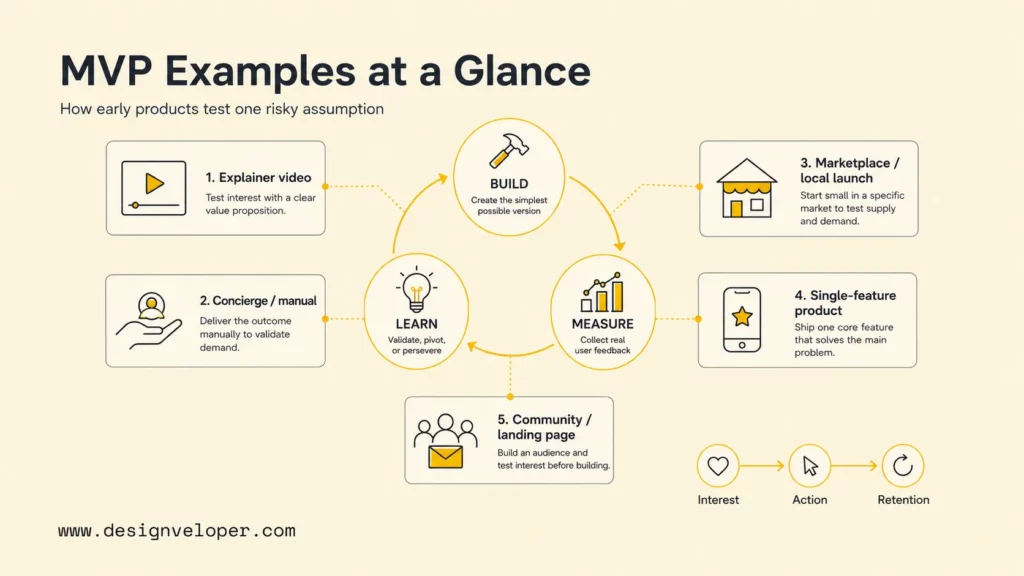
- Common MVP patterns include explainer videos, landing pages, concierge MVPs, marketplace pilots, single-feature releases, and community MVPs.
- Businesses should choose an MVP type based on the riskiest business belief, not the format used by a famous startup.
- A practical first release needs a clear assumption, target users, success metric, trust controls, and a decision rule for iterate, expand, pivot, or stop.
The most useful MVP examples are not famous because their first versions were polished. They are useful because each first release isolated a risky assumption. Dropbox tested whether people wanted seamless file synchronization before building every promised capability. Zappos tested whether customers would buy shoes online before investing in inventory and fulfillment. Airbnb tested whether strangers would pay to stay in another person’s home. The lesson is not to copy an old interface; it is to copy the discipline of testing one consequential question with the smallest credible experience.
A minimum viable product must still deliver enough value for the target user to take a meaningful action. That action might be joining a waitlist, completing a purchase, booking a ride, publishing a post, or returning to use the workflow again. Page views and compliments can be encouraging, but behavioral evidence such as activation, conversion, payment, retention, task completion, and referral is much stronger.
Quick decision guide: use an explainer video or landing page when demand is uncertain; a concierge or Wizard-of-Oz MVP when the workflow can be performed manually; a single-feature MVP when one interaction carries the value; a limited-market MVP when location, community, or supply density matters; and a marketplace MVP when the transaction between two sides is the assumption. Choose the format that tests the riskiest belief, not the format used by the most famous startup.
| If you need to learn… | Best MVP pattern | Evidence to collect | Example |
|---|---|---|---|
| Whether the promise attracts demand | Explainer video or landing page | Qualified signups, demo requests, or deposits | Dropbox or Buffer |
| Whether users will complete a transaction | Concierge or manual MVP | Purchases, completion rate, margin, and support effort | Zappos or Groupon |
| Whether a local two-sided market can work | Marketplace or limited-market MVP | Supply, demand, match rate, repeat use, and exceptions | Airbnb or Uber |
| Whether one focused behavior creates value | Single-feature MVP | Activation, frequency, retention, and referral | Instagram or Facebook |
| Whether a community ritual will repeat | Community or newsletter MVP | Submissions, opens, clicks, discussions, and return rate | Product Hunt |
Recommended for you:
- Web App Development Cost: Breakdown
- MVP in Agile: Trends, Types, and Development Guide
- What Is Quality Control? Short Guide About QC’s Responsibility
What Makes A Good MVP Example?
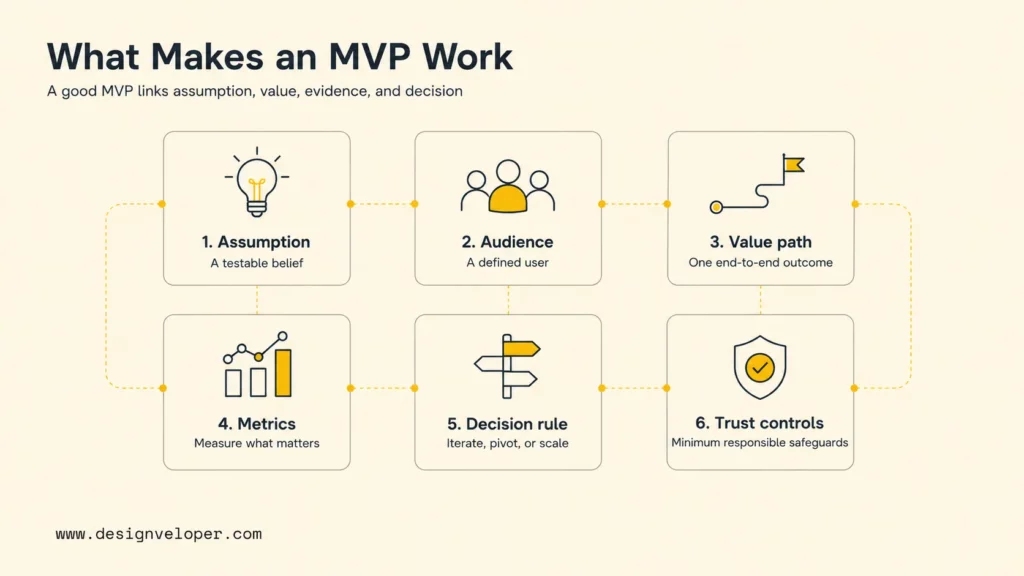
A good MVP example makes four elements visible: the assumption, the smallest usable release, the evidence, and the decision that followed. If a story only says that a founder launched quickly, it is inspiration rather than a product experiment. Teams need to know what could have proved the idea wrong and which metric would trigger iteration, expansion, a pivot, or a stop.
Explore more:
- AI In Product Development: From Concept To Market Faster
- 20 Web App Ideas: Health, FinTech, AI, E-commerce
- Best Small Business Applications For Owners And Freelancers
The word viable matters. A landing page can be a valid demand test, but it is not automatically a functioning product. A concierge service can be viable when real customers receive the promised outcome even though employees perform the hidden work. A prototype can test comprehension and usability without production reliability. Product teams should label each experiment honestly so stakeholders understand what has and has not been proven.
Strong MVPs are narrow in scope but complete across one value path. A booking MVP should let the selected user find an eligible option, understand the terms, make the booking, receive confirmation, and recover from a basic failure. Building ten disconnected screens is often less valuable than completing that one journey. The smallest release should also include the minimum trust controls demanded by the context, such as secure payment, clear cancellation, consent, or human escalation.
- One explicit assumption: write the belief in a form that evidence can challenge.
- One defined audience: identify the user group, situation, and current alternative.
- One end-to-end outcome: let users receive or experience the promised value.
- One measurement plan: define events, baseline, target, and review date before launch.
- One decision rule: state what will make the team iterate, pivot, scale, or stop.
- Minimum responsible controls: protect users, data, payments, and operations in proportion to risk.
This approach follows the build-measure-learn logic described in the Lean Startup principles. The cycle is useful only when learning changes a decision. Teams should resist adding features simply to make the release feel more substantial; each addition creates more variables and can make the result harder to interpret.
A good MVP is not the smallest thing a team can ship. It is the smallest credible test that can change a product decision.
10 MVP Examples To Learn From
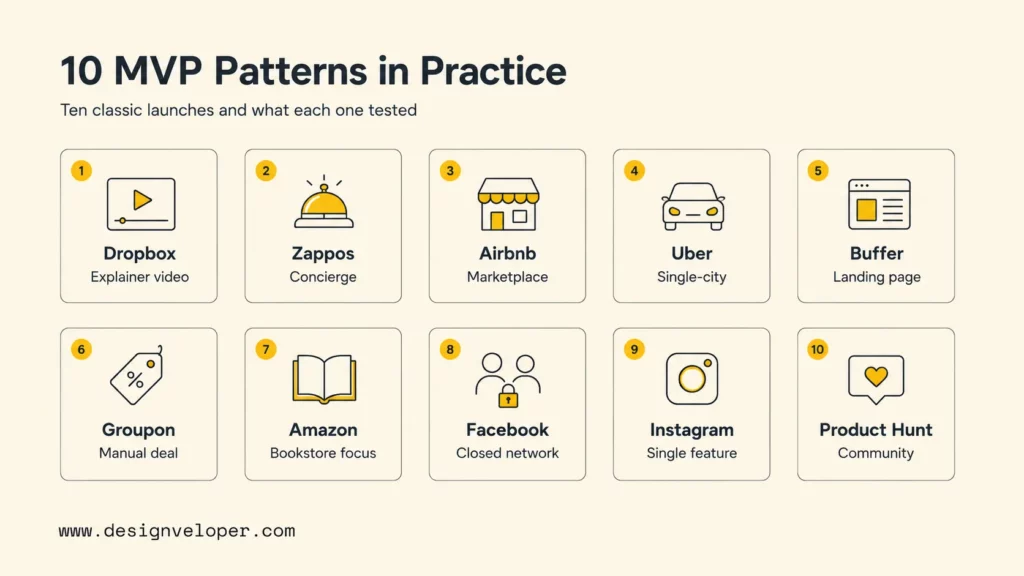
The following cases cover different uncertainty types: technical promise, online purchasing, marketplace liquidity, local operations, demand capture, manual delivery, catalog breadth, network behavior, product focus, and community habit. Some are retrospective labels rather than formal experiments designed with today’s terminology. Treat the stories as patterns, not as permission to reproduce their exact historical shortcuts.
Dropbox: Explainer Video MVP
Dropbox faced a difficult early problem: the value of reliable file synchronization was easy to describe but expensive and technically risky to demonstrate as a complete cross-platform product. Its well-known early experiment used a short product demonstration to show how the proposed experience would work. That made the core promise concrete enough for early adopters to react before the team had built every production capability.
The assumption was not merely that people stored files. Existing options already did that. The risky belief was that users wanted a simple, almost invisible synchronization experience across computers and would sign up for it. The video acted as an explainer MVP: viewers could understand the workflow, recognize their own frustration, and express demand. Dropbox’s company fact sheet records that Drew Houston and Arash Ferdowsi co-founded the company in June 2007.
Reusable lesson: when the complete technical system is costly, demonstrate the intended outcome faithfully and measure qualified intent. Do not fake capabilities in a way that misleads buyers. Use the experiment to recruit design partners, learn vocabulary, identify objections, and decide which technical risk deserves the first engineering spike.
Zappos: Concierge MVP For Online Shoe Sales
The classic Zappos story is a concierge-style test of whether people would buy shoes online. Instead of first building a warehouse, supplier network, and automated inventory platform, founder Nick Swinmurn reportedly photographed shoes at local stores, listed them online, and bought a pair from the store after a customer ordered. The customer received a real product while the founder handled fulfillment manually.
That small operation tested more than interest. A completed purchase was evidence that a customer trusted the online proposition enough to choose a style and size, submit payment, and wait for delivery. It also exposed operational questions around product availability, margins, returns, and service. The Antler MVP examples guide and the audit’s Purrweb example collection both describe the early Zappos pattern.
Reusable lesson: before automating a commerce workflow, execute a small number of transactions manually. Measure conversion, acquisition source, gross margin, fulfillment time, return reasons, support effort, and repeat purchase. Manual delivery is useful for learning, but inventory accuracy, customer communication, refund handling, and consumer protection still need clear rules.
Airbnb: Marketplace MVP For Short-Term Stays
Airbnb began with an unusually narrow marketplace: a specific location, a moment of constrained accommodation supply, and the founders’ own space. The early AirBed & Breakfast site presented a place to stay and let guests test a new kind of transaction. The official Airbnb story timeline places the first airbed-and-breakfast experiment in 2007 and shows the company developing the concept through later launches and name changes.
The core assumption was that hosts would offer space and guests would trust a booking outside conventional hotels. By supplying the first listing themselves, the founders reduced the cold-start problem and could observe the complete journey: listing presentation, guest questions, payment expectations, arrival, stay, and host effort. The test did not prove that every city would have enough supply and demand, but it showed that the unfamiliar transaction could happen.
Reusable lesson: a marketplace MVP should constrain geography, category, user profile, or event so that matching density is high enough to learn. Track active supply, qualified demand, request-to-book conversion, successful matches, cancellations, trust incidents, contribution margin, and repeat use separately. Marketplace vanity metrics can hide a low match rate.
Uber: Single-City MVP For Ride Booking
Uber’s early service focused on a limited geography and a narrow ride category rather than launching every city, vehicle type, and customer segment at once. A single-city MVP gave the team a controlled environment in which to test whether riders would request a car through an app and whether drivers could fulfill those requests reliably.
The Uber registration statement filed with the SEC explains that the company began operations in 2010 and initially offered a premium black-car service. That boundary simplified the early supply model while the team learned dispatch, pickup, payment, service quality, and local operations. City density mattered: an attractive interface could not compensate for long waits or too few drivers.
Reusable lesson: location-dependent products should start where supply and demand can be observed together. Instrument request volume, acceptance, estimated versus actual pickup, completion, cancellation, repeat use, driver utilization, support incidents, and unit economics. Expansion should follow evidence that the operating playbook works, not just a burst of downloads.
Buffer: Landing Page MVP For Social Scheduling
Buffer is a clear landing-page MVP example because founder Joel Gascoigne first tested whether the positioning attracted interest before building the basic scheduling product. The initial page explained the idea and sent interested visitors to a pricing page; when they tried to choose a plan, they could leave an email address to hear when the product was ready.
Buffer’s own history of its journey to one million users says the idea was tested without code first, then validated and built over seven weeks. The first release supported Twitter without the analytics and collaboration features added later. That sequence separated two questions: whether the promise attracted demand and whether a minimal working scheduler could convert and retain users.
Reusable lesson: a landing page should test a concrete proposition, not collect anonymous traffic. Show the audience, outcome, workflow, and price context. Measure qualified signup rate by source, demo requests, replies, willingness to pay, and the percentage of waitlist members who activate when the first product becomes available.
Groupon: Manual Deal MVP
Groupon’s early deal model can be understood as a manual or Wizard-of-Oz MVP. The customer-facing offer was simple while much of the deal preparation, merchant coordination, and distribution could be handled manually. The team could validate whether local merchants wanted customer acquisition and whether consumers would purchase a time-limited discounted offer before building a broad self-service marketplace.
Groupon’s 2011 SEC registration statement says the company started in October 2008 and initially offered one daily deal to subscribers in a market. The filing describes the featured daily deal as an email-distributed offer on behalf of a local merchant. Those operational details show the power of a focused transaction with an existing channel rather than a large feature set.
Reusable lesson: when the value chain is unclear, deliver the outcome manually and record every step. Measure merchant acquisition effort, customer purchase rate, minimum-deal threshold, refund rate, merchant economics, repeat participation, and operational minutes per deal. Automation should target repeated bottlenecks observed in real transactions.
Amazon: Simple Online Bookstore MVP
Amazon began with books instead of trying to launch the broad store associated with the company today. Books offered a large, standardized catalog with identifiers customers already understood, and online selection could exceed what a physical store carried. A focused category made it possible to test online discovery, ordering, payment, fulfillment, and service without solving every retail category at once.
In Amazon’s 1997 shareholder letter, Jeff Bezos described the company as having served more than 1.5 million customers while extending its market leadership in an increasingly competitive online commerce environment. The scale came after the narrow starting point. The early product still needed a complete purchase experience; the MVP lesson is category focus, not an incomplete checkout.
Reusable lesson: ecommerce teams should begin with a category whose data, sourcing, shipping, returns, and margins are understandable. Track search success, product-view-to-cart rate, checkout completion, fulfillment accuracy, delivery time, returns, support contacts, contribution margin, and repeat purchase. Add categories only when the operating model can absorb their differences.
Facebook: Closed-Network Social MVP
Facebook’s early release served a bounded university community. The closed network gave the product an existing identity system, concentrated social graph, and shared context. Users did not need the service to be useful to the entire world; they needed enough relevant classmates on it for profiles and connections to feel meaningful.
Meta’s Facebook twentieth-anniversary history traces Facebook from its 2004 launch at Harvard to expansion across colleges and later to broader audiences. The limited-network launch reduced one of the hardest social-product risks: an empty experience. It also let the team observe which profile and connection behaviors repeated before adding the breadth of later features.
Instagram: Feature-Focused MVP From Burbn
Instagram is often used to illustrate product focus. Its predecessor, Burbn, contained several social and location features, but the team observed stronger interest around photo sharing. The product was simplified around taking or selecting a photo, applying a filter, sharing it, and interacting through a feed. That concentrated the value into a repeatable visual habit.
This example is useful because the learning came from an earlier product, not from inventing the perfect scope in isolation. The audit’s Antler collection of minimum viable product cases discusses Instagram among the recognizable MVP stories. The exact historical interface is less important than the decision to remove competing behaviors and build around the strongest evidence.
Reusable lesson: when a broad beta has one disproportionately strong behavior, consider a focused product or workflow. Compare activation and retention by first action, identify the smallest loop users repeat, and remove steps that do not strengthen it. Then test whether the focused experience improves frequency, sharing, creation quality, and return use.
Product Hunt: Community MVP For Product Discovery
Product Hunt began as an email list for sharing new products with a small technology community. Email already provided distribution, identity, and a recurring habit, so the founder could test whether people wanted a curated product-discovery ritual before building a full community platform with voting, comments, maker profiles, and launch tools.
Product Hunt’s own story about an early product experiment notes that Product Hunt started as an email list. The channel was part of the MVP logic: it reached a defined audience in a familiar place and made curation manageable. Community feedback and repeated participation could guide which platform capabilities deserved investment.
Reusable lesson: a community MVP can begin as a newsletter, chat group, form, or manually curated directory. Measure submission quality, open and click rates, contributor return, discussion, referrals, moderation effort, and whether members independently create value for one another. Build platform features when the recurring community behavior is already visible.
Common MVP Patterns Behind These Examples
The companies differ, but the underlying patterns are reusable. Each pattern reduces a different kind of uncertainty. An explainer video tests whether a difficult promise is understandable and attractive. A concierge MVP tests whether the outcome and transaction matter before automation. A limited-market MVP creates enough density to study a local system. A single-feature MVP isolates the behavior most likely to drive retention.
Further reading:
- 10 Tech Startup Ideas Can Scale from MVP to Real Business
- 30 Profitable SaaS Ideas to Build
- App Development Project Management: Methodologies & Tools
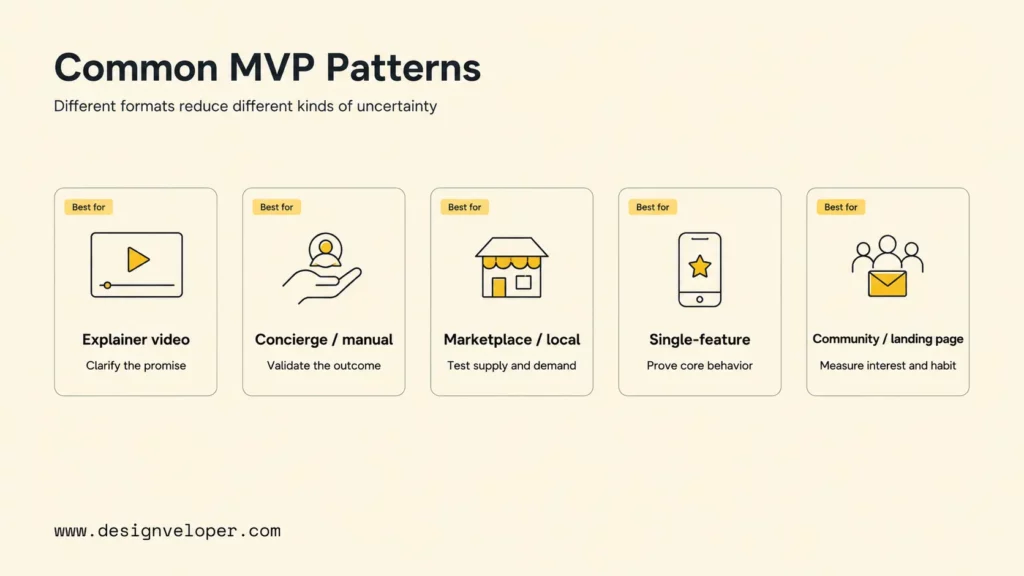
| MVP pattern | Best for | What it proves | Example |
|---|---|---|---|
| Explainer video MVP | Technically difficult or unfamiliar products | The promised outcome is understandable and attracts qualified intent | Dropbox |
| Landing page MVP | Demand, positioning, audience, or pricing tests | Visitors take a meaningful next step | Buffer |
| Concierge MVP | Services and complex workflows | Users value the outcome even when delivery is manual | Zappos |
| Manual or Wizard-of-Oz MVP | Automation-heavy operations | The front-stage experience works before back-stage automation | Groupon |
| Single-feature MVP | Products with one dominant repeatable behavior | A focused loop drives activation and return use | |
| Marketplace MVP | Transactions between supply and demand | Both sides participate and matches complete | Airbnb |
| Limited-market MVP | Location, community, or density-dependent products | The operating model works in one bounded environment | Uber or Facebook |
| Community MVP | Discovery, contribution, and network rituals | Members return and create value for one another | Product Hunt |
These patterns can be combined, but combining them increases interpretation risk. A team might use a landing page to recruit users, a concierge workflow to deliver the first outcomes, and a limited market to concentrate demand. The experiment plan should say which assumption each layer addresses and which evidence belongs to it.
The most common mistake is choosing a cheap format that cannot answer the question. A waitlist cannot prove retention. A clickable prototype cannot prove payment reliability. A manually fulfilled order cannot prove automated unit economics. An MVP produces a specific layer of evidence; the next experiment should address what remains unknown.
Copy the validation logic behind famous MVPs, not the screens, channels, or shortcuts that happened to fit their moment.
How Businesses Can Use MVPs Before Full Development
Established businesses can use MVPs for a new revenue model, internal workflow, market, platform, user segment, integration, or AI feature. The purpose is the same as in a startup: reduce uncertainty before committing to a full implementation. A company with existing customers and systems should use those assets to recruit pilots and measure a real baseline.
- Validate demand: test a specific promise with existing customers, qualified prospects, deposits, or pilot agreements.
- Test a revenue model: offer one paid tier, transaction fee, or service package and observe willingness to pay.
- Test a workflow: run the process manually or with lightweight tools before integrating every system.
- Test a market: begin with one location, customer segment, product line, or distribution partner.
- Test an internal tool: pilot with one team and compare completion time, errors, handoffs, and adoption against the current process.
- Test AI-powered software: constrain the task, dataset, permissions, and user group; measure quality, overrides, latency, and cost.
Business MVPs need an explicit comparison. If an internal workflow currently takes 40 minutes and has a 7% correction rate, the pilot can measure whether the new tool reduces both. If a sales process currently converts 12% of qualified opportunities, the MVP can compare the new offer with the baseline. Without a baseline, teams can mistake novelty for improvement.
Use a staged evidence ladder: problem interviews, message test, prototype, concierge service, limited working product, and controlled production pilot. Not every initiative needs every stage. Move forward when the current experiment answers its question and the expected value of the next evidence justifies the added cost.
Choosing The Right MVP Type For Your Business Goal
Choose the MVP type from the business goal and the riskiest assumption. If the main risk is demand, building production infrastructure first is wasteful. If demand is already proven but workflow reliability is unknown, a landing page adds little. If the product depends on network density, a broad low-density launch may create a false negative.
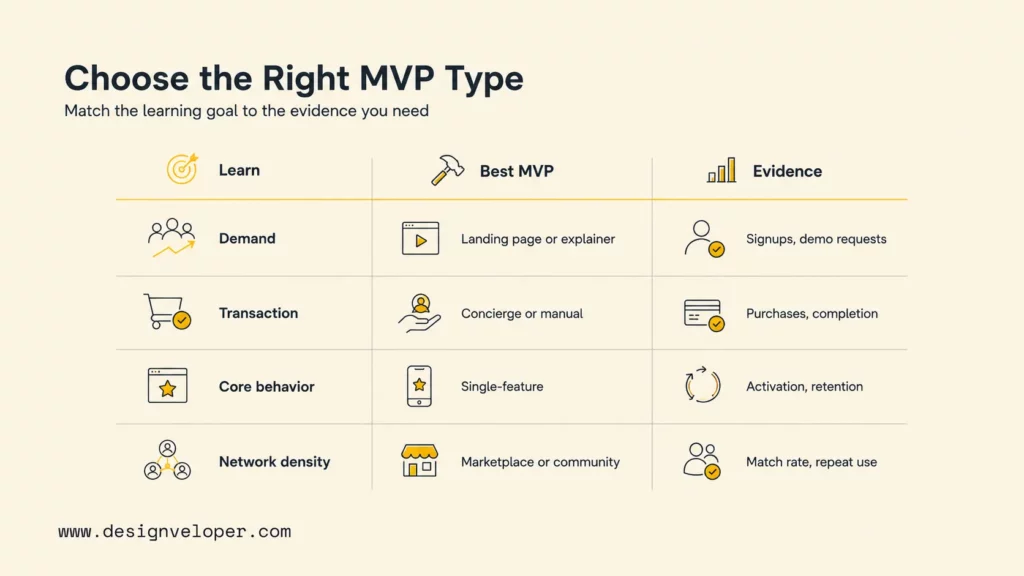
| Business goal | MVP type | What to validate |
|---|---|---|
| Test product demand | Explainer video or landing page | Qualified conversion, objections, audience fit, and willingness to continue |
| Validate an ecommerce transaction | Concierge commerce MVP | Purchase completion, margin, fulfillment, returns, and repeat behavior |
| Validate a marketplace transaction | Limited marketplace MVP | Supply, demand, match rate, trust, completion, and unit economics |
| Check whether users will pay | Paid pilot, preorder, or service-backed MVP | Payment behavior, price sensitivity, refund risk, and delivery cost |
| Improve an internal workflow | Manual, no-code, or single-workflow MVP | Adoption, cycle time, error rate, handoffs, and user satisfaction |
| Launch a SaaS product | Single-role, single-workflow product MVP | Activation, task completion, retention, support, and willingness to pay |
| Test an AI feature | Human-assisted AI MVP | Task quality, override rate, latency, safety, cost, and escalation |
| Test a dense network | Closed community or single-market MVP | Network density, interaction, match quality, return use, and abuse load |
A practical selection test asks three questions. First, what evidence would make the team stop or change direction? Second, which user action creates that evidence? Third, what is the lightest responsible system that lets the action happen? If a prototype answers the question, do not build production software. If real payment or repeat use is essential, a prototype alone is insufficient.
Budget should follow uncertainty and consequence. The MVP Development Cost: Budget Guide And Timeline explains why scope, platform, integrations, security, AI, and post-launch work change the estimate. A cheap experiment that cannot answer the decision is expensive; a focused technical spike can be economical when it removes a major feasibility risk.
Turning An MVP Example Into A Practical First Release
Begin with an assumption statement: “We believe [specific user] will [measurable behavior] in [situation] because [value], and we will reconsider if [threshold] is not reached by [date].” This format forces the team to name the audience, behavior, value, metric, threshold, and review point.
For practical examples, check out:
- 7 Stages of Mobile App Development Process
- 120+ Best Mobile App Ideas to Make Money
- How To Develop A Low-Code MVP: Step-By-Step Guide
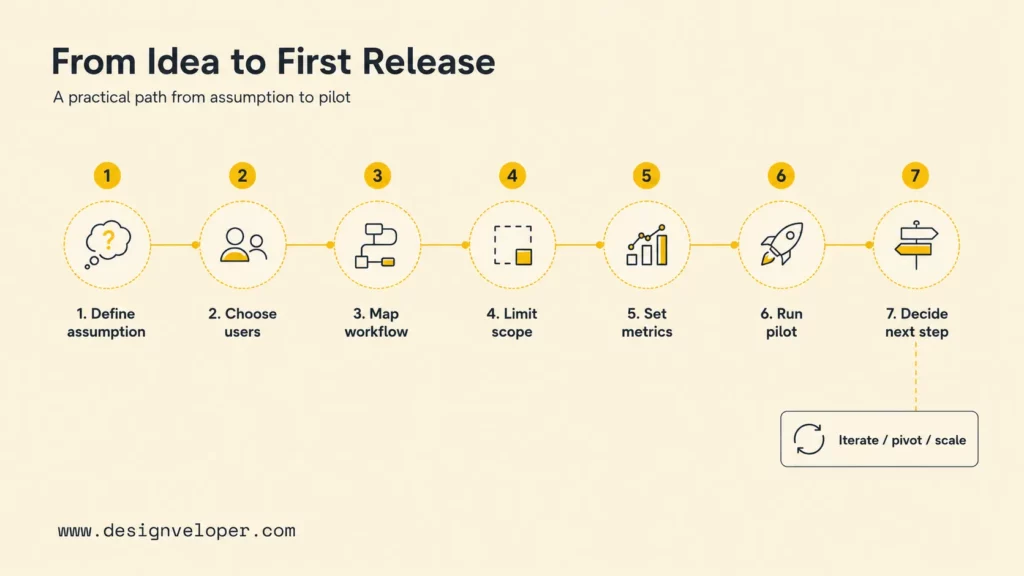
- Define the product assumption. Choose the belief with the highest combination of uncertainty and business consequence.
- Choose target users or internal users. Recruit people who genuinely experience the problem and can act on the proposed value.
- Map the core workflow. Include entry, success, failure, cancellation, support, and the operational steps hidden from users.
- Limit the first-version feature scope. Keep one end-to-end value path, required trust controls, measurement, and administration.
- Set success metrics. Define the baseline, target, guardrails, sample, event definitions, and decision date.
- Estimate budget and timeline. Include discovery, design, build, integration, QA, security, launch, support, contingency, and the first iteration.
- Choose the build approach. Select no-code, prototype, custom MVP, internal tool, or AI-assisted MVP based on evidence needs and risk.
- Run a controlled pilot. Release to the smallest group that can generate credible evidence and observe both user and operational behavior.
- Decide from the evidence. Iterate, pivot, scale, or stop; do not leave the MVP running indefinitely without a decision.
MVP evidence map: from weakest signal to strongest decision evidence
Views and visits
Signup or demo request
Deposit, pilot, or payment
Task completed successfully
User returns or repeats
Select the highest evidence level the current decision requires. Do not claim payment or retention validation from an attention-only test.
The release plan should also name non-goals. A first marketplace might exclude multiple currencies, international shipping, loyalty, recommendations, and automated dispute resolution. A first AI workflow might exclude autonomous actions, sensitive data, broad file support, and personalized memory. Non-goals protect the experiment when stakeholders see a working product and immediately request the full roadmap.
At Designveloper web application development services, we help teams move from an MVP concept to a focused first release that validates the right workflow, connects necessary systems, and leaves room to improve after launch. Our software development services cover product discovery, UX/UI, web and mobile development, backend and API integration, AI workflows, QA, DevOps, and ongoing iteration. The guide to building an MVP provides a broader view of the planning and delivery process.
A useful vendor brief includes the assumption, users, existing workaround, core journey, platforms, integrations, data classification, success metrics, deadline reason, budget range, and decision owners. Ask for a scope with assumptions and exclusions, not only a fixed feature list. If you need help shaping the experiment, contact Designveloper for a discovery and delivery discussion.
FAQs About MVP Examples
What Is A Famous Example Of An MVP?
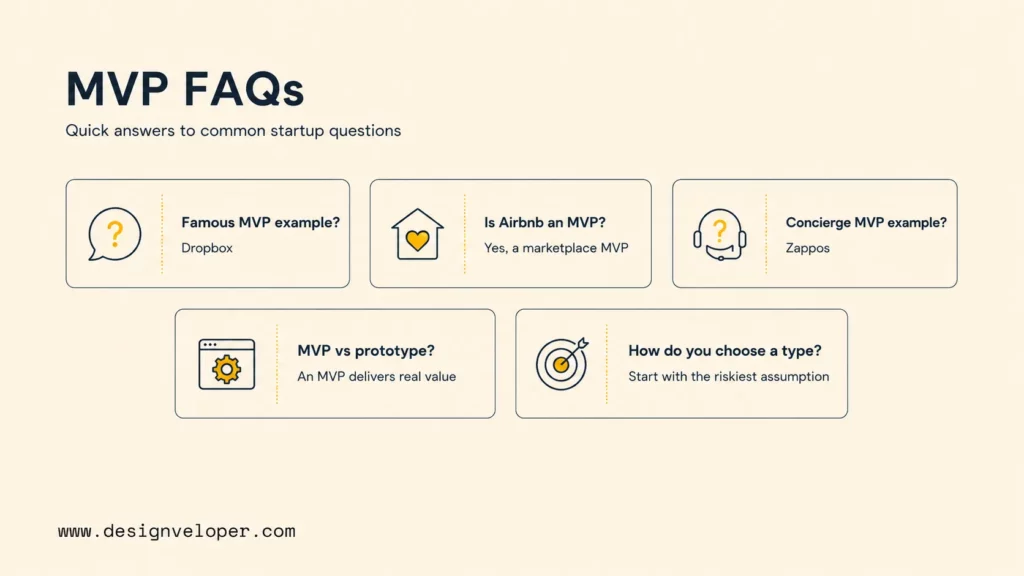
Dropbox is one of the most famous MVP examples. Its early explainer-video approach made a technically difficult synchronization promise understandable before every capability was complete. The reusable lesson is to demonstrate the target outcome faithfully and measure qualified demand. It does not mean every software idea can be validated by views alone; payment, usability, reliability, and retention may require later experiments.
Is Airbnb An MVP Example?
Yes. Airbnb’s early AirBed & Breakfast experiment is commonly treated as a marketplace MVP because it tested a real short-term-stay transaction with a narrow initial supply and audience. The founders’ own space helped address the marketplace cold start. The experiment demonstrated that the unfamiliar transaction could happen, while later expansion had to validate trust, payment, marketplace liquidity, and operations at larger scale.
What Is An Example Of A Concierge MVP?
Zappos is the classic example: shoes were presented online, and early orders could be fulfilled by purchasing the item from a local store rather than from a fully built inventory operation. The customer received the promised value while the founder learned manually. Modern concierge MVPs can test onboarding, research, matching, reporting, or recommendations before automating repeated steps.
What Is The Difference Between An MVP And A Prototype?
A prototype represents how a product could look or behave and is mainly used to test concepts, flow, and usability. An MVP is a usable first release that delivers value and collects behavioral evidence in a real or controlled operating context. The boundary can blur, but teams should state whether users can complete the outcome, whether production data or payment is involved, and what evidence the artifact can support. See the POC vs MVP vs prototype comparison for a fuller distinction.
How Do I Choose The Right MVP Type For My Startup?
Identify the riskiest assumption first. Choose a landing page or explainer video for demand, a concierge or manual MVP for workflow and transaction learning, a single-feature MVP for a focused repeatable behavior, a limited market for density-dependent operations, and a marketplace MVP for supply-and-demand matching. Define the user action and decision threshold before selecting technology.
The enduring value of these MVP examples is not that successful companies once launched small. It is that focused evidence helped teams decide what deserved the next investment. Define one assumption, create the smallest credible value path, measure real behavior, protect users in proportion to risk, and let the result change the roadmap.
Also published on

Share post on









Related Articles


Android App Development: Stack, Process, Cost, And Best Practices
Android App Development: Stack, Process, Cost, And Best Practices Published September 17, 2026
Cloud Application Development: Architecture, Process, And Cost
Cloud Application Development: Architecture, Process, And Cost Published September 14, 2026
How Gitignore Works: Rules, Patterns, Examples, And Debugging Tips
How Gitignore Works: Rules, Patterns, Examples, And Debugging Tips Published August 05, 2026