











What Is The Scaled Agile Framework (SAFe)? How It Works At Scale

KEY TAKEAWAYS:
- SAFe is a multi-team operating model, not simply Scrum with a larger backlog; it connects team delivery with shared planning and portfolio decisions.
- An Agile Release Train (ART) groups teams around a long-lived mission, while PI Planning aligns their work for the next Planning Interval.
- The current framework site presents five discipline areas; the four familiar configurations belong to the SAFe 6.0 Big Picture.
- Adopt SAFe only when recurring dependencies justify its coordination overhead, then measure a focused rollout before expanding it.
One Agile team can adjust its own backlog, but an enterprise with many teams must also coordinate shared systems, investment choices, release timing, and customer outcomes. That gap is where the Scaled Agile Framework (SAFe) can help: it connects team delivery with broader product and portfolio decisions. SAFe can make dependencies and trade-offs easier to discuss, but it cannot remove them or guarantee faster delivery. This guide explains its operating model, principles, configurations, roles, and planning cadence, then offers a practical way to decide whether the added coordination is worth it.
What Is the Scaled Agile Framework (SAFe)?
The Scaled Agile Framework (SAFe) is a framework for coordinating Lean and Agile work across multiple teams and business levels. It connects team delivery to shared product planning and, where needed, portfolio decisions through common roles, events, and work structures. Scaled Agile describes Core SAFe as an operating model for scaling Lean and Agile practices; its current framework site also presents AI-Native SAFe as an extension of that foundation.
SAFe is not Scrum made larger. Scrum defines how a Scrum Team works, while SAFe addresses coordination across teams and broader decisions about products, funding, and integrated delivery. Teams may still use Scrum or Kanban within a SAFe environment. If you need a refresher on the team-level approach, see this guide to Agile software development.
SAFe is configurable, so an organization need not adopt every role or practice. Its value depends on whether the structure solves a real coordination problem, such as repeated dependencies or a product no single team can deliver. A diagram alone does not show that agility has improved.
Related reading:
- Agile Frameworks In 2026: 10 Types And How To Choose The Right One
- Agile Methodology Sample: A Practical Project Plan
- The 12 Agile Principles And 4 Agile Values Explained For Teams
Use these topics for context, but judge SAFe by whether it helps teams resolve shared priorities, dependencies, or delivery decisions.
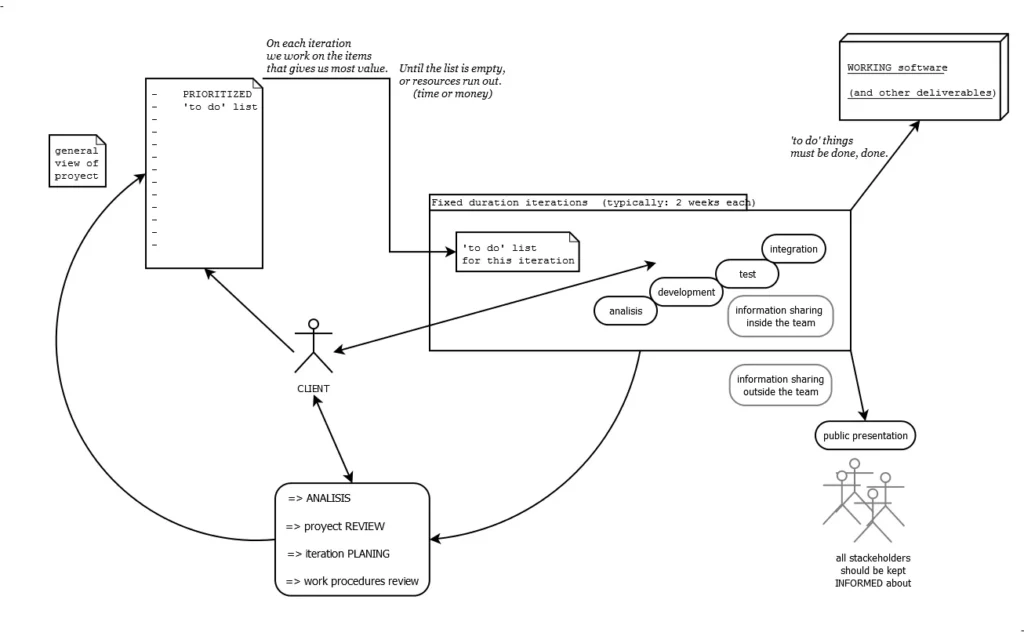
SAFe’s full range of structures is not required everywhere. Choose only those that address recurring coordination needs.
What Values and Principles Shape SAFe?
SAFe combines values and principles to keep planning focused on learning and delivery. Values guide behavior; principles help teams make choices under uncertainty.
SAFe Core Values
SAFe 6.0 names four Core Values: alignment, transparency, respect for people, and relentless improvement. The set differs from older versions; Built-In Quality is treated as a distinct practice area rather than one of these values. Check the version when comparing training material.
- Alignment: teams understand shared goals and how their work contributes to them.
- Transparency: people make progress, risks, and constraints visible so others can respond.
- Respect for people: leaders support teams and consider the people affected by change.
- Relentless improvement: teams inspect outcomes and adjust their practices over time.
Events alone do not create these behaviors. A team can meet on schedule and still hide blocked work or pursue separate targets. Values matter when they change how people make decisions.
The Ten SAFe Principles
Ten principles turn Lean and systems thinking into practical choices. They encourage teams and leaders to:
- Take an economic view when comparing options and timing.
- Apply systems thinking to the whole product and delivery system.
- Assume variability, preserve options, and learn before committing too early.
- Build incrementally and use fast, integrated learning cycles.
- Base important milestones on objective evaluation of working solutions.
- Improve flow by limiting delays, queues, and unnecessary work in progress.
- Use cadence and cross-domain planning to coordinate teams.
- Support the intrinsic motivation and capability of knowledge workers.
- Decentralize decisions when local teams have the right information.
- Organize around value rather than preserving every functional handoff.
These principles are guidance, not proof that a transformation is working. Decentralized decisions still need context and clear boundaries; leaders retain enterprise-level choices and trade-offs.
SAFe also relies on Lean-Agile leadership and continuous learning. Without changes to decision habits, copied ceremonies can add meetings without improving work flow.
Scaled Agile’s SAFe 6.0 update documents the version-specific changes to its values, principles, and terminology.
What Are SAFe’s Configurations and Current Discipline Areas?
The four familiar configurations—Essential, Large Solution, Portfolio, and Full—come from the SAFe 6.0 Big Picture. The current site presents Core SAFe and AI-Native SAFe separately and links to that 6.0 view. Check which version a guide uses.
| Configuration | What It Adds | A Possible Fit | Check Before Choosing |
|---|---|---|---|
| Essential SAFe | Core roles, events, and practices around one or more Agile Release Trains. | Teams need a shared delivery cadence but do not need extensive portfolio or large-solution structures. | A common starting point is not automatically right for every organization. |
| Large Solution SAFe | Coordination for several ARTs and suppliers building one complex solution. | Integration across products, systems, or suppliers is a recurring delivery problem. | Confirm that solution-level coordination is needed, not just more reporting. |
| Portfolio SAFe | Connections between strategy, investment choices, value streams, and governance. | Several products or value streams compete for funding and capacity. | Keep governance focused on value and decision support. |
| Full SAFe | Portfolio and large-solution structures together. | An organization has both enterprise investment needs and complex multi-ART delivery. | Do not choose the broadest configuration just because it appears complete. |
The current framework site presents five areas: Leadership and Culture; Lean Portfolio Management; Team and Technical Agility; Product Development Flow; and Large Solution Integration and Delivery. This is not a one-to-one renaming of the older seven-competency overview.
Older material may list seven core competencies. Keep that overview in context rather than map it one-to-one onto today’s areas. The SAFe framework overview shows the current navigation and links to SAFe 6.0 configurations.
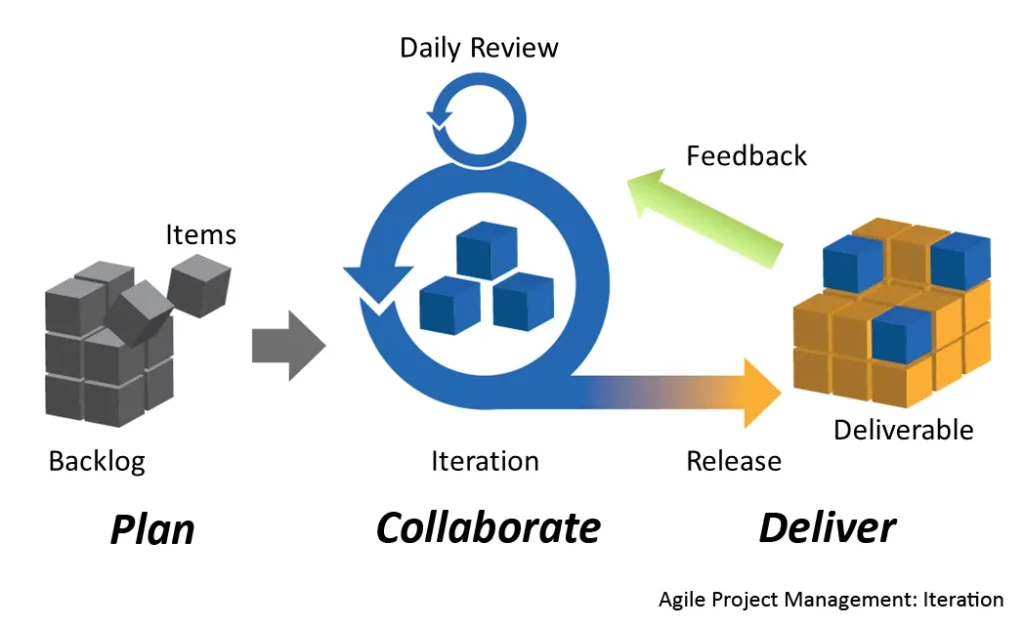
Configurations scope coordination; they are not levels every company must climb. Choose structures that address a defined problem, then check whether they help teams deliver customer value.
How Does the Scaled Agile Framework Work?
SAFe connects strategy and delivery through value streams, ARTs, shared planning, team execution, and feedback. The structure varies by configuration, but the goal is to make cross-team work visible and coordinate it.
Agile Release Trains Coordinate Teams
An Agile Release Train (ART) is a long-lived team of Agile teams that plans and delivers around a shared mission. It brings the roles and skills needed to develop and integrate a solution across functional boundaries. The ART coordinates features, dependencies, risks, and outcomes while teams retain their own work practices. Scaled Agile’s Essential SAFe guidance describes the ART as a central construct.
ARTs are not just larger project teams. They are intended to provide a durable structure for ongoing product or solution work. The team roles and structure in Agile still matter inside the train: each team needs clear ownership, the skills to complete its work, and a way to raise dependencies early.
Value streams describe how an organization delivers value, from an initial need through a usable product or service. Organizing around one can reduce handoffs, but may change team boundaries, funding, or shared services. Base redesign on evidence about delays, not a desire to redraw the organization chart.
PI Planning Aligns the Next Planning Interval
PI means Planning Interval in current SAFe terminology; older sources may say Program Increment. PI Planning aligns ART teams and stakeholders around a shared mission, dependencies, risks, and a plan for the next interval. Scaled Agile describes a typical event as two days every 8–12 weeks, not a fixed rule.
The event works best when teams prepare before they meet. Product direction, capacity, architecture needs, and known constraints should be available so people can make real trade-offs instead of filling a planning board with guesses. The event creates a plan and shared objectives; it does not remove uncertainty or guarantee that every objective will be met.
See Scaled Agile’s current PI Planning guidance for its event definition and typical cadence.
Roles Clarify Who Coordinates and Decides
SAFe assigns responsibilities across the ART and its teams. The roles are useful when they clarify ownership, but adding titles without decision rights can make accountability less clear.
| Role | Main Responsibility |
|---|---|
| Product Management | Shapes ART feature priorities and product direction. |
| Release Train Engineer (RTE) | Facilitates ART events and helps teams address flow and coordination problems. |
| System Architect | Guides technical direction and helps teams manage system-level design decisions. |
| Product Owner | Orders and clarifies the team backlog. |
| Business Owners | Provide business context and participate in decisions about solution value and fitness. |
Scrum Masters or Team Coaches support team execution, while the RTE works at the ART level. An RTE is not simply a project manager with a new title. The role facilitates ART events and improves flow; it does not assign every task to teams.
Backlogs Connect Strategy to Team Work
SAFe uses work items at different levels, but not every configuration uses every level. A simplified path can include portfolio epics, capabilities for large-solution work, features for an ART, and stories for a team. These are related work items, not a mandatory chain that every initiative must pass through.
| Level | Typical Work Item | Use It To |
|---|---|---|
| Portfolio | Epic | Describe a larger business initiative or investment opportunity. |
| Large solution, when used | Capability | Coordinate solution-level behavior across several ARTs. |
| ART | Feature | Describe a user or business outcome planned for the train. |
| Team | Story | Break a feature into work a team can build and verify. |
System demos and Inspect and Adapt events provide feedback on integrated work and the delivery process. A work tracker can record features and dependencies, but a board alone will not align priorities or resolve a decision bottleneck. For a tool-specific view, read this guide to Jira and Agile.
Related reading:
- What Is an Epic in Agile? How to Write It (Guide & Examples)
- What Are Agile Acceptance Criteria? Definition and Examples
- Agile Release Planning: Steps, Benefits, And Best Practices In 2026
These related practices help make planned work specific enough to discuss. A feature, for example, needs a clear outcome and acceptance conditions before teams can judge its size, dependencies, or readiness for a shared plan.
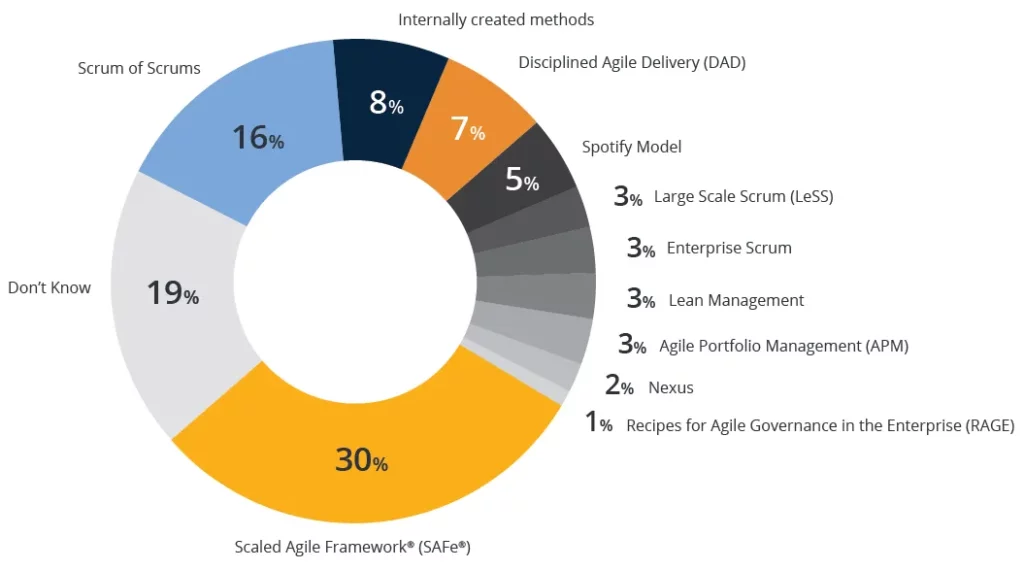
Think of the sequence as a coordination loop rather than a one-way pipeline. New customer feedback, technical constraints, or a change in priority can send work back to planning and reprioritization.
What Benefits and Trade-Offs Should Teams Expect?
SAFe offers shared planning structures for work across teams, but it does not guarantee business results. Separate its mechanisms from the outcomes an organization must measure for itself.
| SAFe Mechanism | What It Can Help With | What to Measure Locally |
|---|---|---|
| Shared objectives and planning | Make competing priorities and cross-team commitments visible. | Whether teams understand the same outcomes and resolve priority conflicts sooner. |
| ART coordination | Surface dependencies and integration risks before they become late surprises. | Dependency age, cross-team wait time, and late integration rework. |
| Portfolio practices | Connect investment decisions with value streams and intended outcomes. | Decision delays and whether funded work still matches current priorities. |
| System demos and improvement events | Create regular points to inspect integrated work and change delivery practices. | Feedback cycle time, escaped integration issues, and improvements completed. |
These are proposed evaluation signals, not official guarantees or universal benchmarks. Set a baseline before changing the operating model, then compare the same measures after teams have used the practices. Pair delivery measures with customer or business outcomes so activity is not mistaken for value.
The trade-off is coordination overhead. PI Planning, additional roles, shared backlogs, and portfolio reviews take time. They may add little value when teams can release independently, dependencies are rare, or decisions can be made close to the work. The structure can also become rigid if leaders keep the events but do not delegate decisions or respond to evidence.
A fair evaluation asks whether the coordination cost is lower than the delay and rework it replaces. If a new event does not help teams make a decision, uncover a dependency, or improve an outcome, change its format or remove it. SAFe should make work clearer, not create activity that has no owner or result.
How Can an Organization Implement SAFe?
A careful rollout begins with a coordination problem and expands only when the first scope shows useful evidence. Scaled Agile’s roadmap describes organizational changes, but each organization should adapt them to its context.
- Find the delivery problem. Map a product or value stream and identify where work waits, teams depend on one another, or investment choices conflict. Record a baseline before selecting a configuration.
- Choose a focused scope. Start with a meaningful value stream and the minimum structures needed to coordinate it. Do not assume that every portfolio, supplier, or product needs the same setup.
- Prepare leaders and teams. Clarify decision rights, product direction, architecture constraints, and team capacity. Train the people who will support the change. A SAFe Practice Consultant (SPC) can coach practices; a Lean-Agile Center of Excellence (LACE) may coordinate internal learning when the scope warrants it.
- Plan and deliver together. Establish the ART, prepare for PI Planning, make dependencies visible, and integrate work often enough to inspect a real solution rather than status reports alone.
- Review evidence before expanding. Compare the baseline with delivery flow, dependency delays, integration quality, and customer outcomes. Keep, adapt, or remove practices based on what the evidence shows before adding more trains or governance.
Consider an illustrative bank updating its customer-onboarding flow. Mobile, identity, and risk teams may need to coordinate shared data changes and compliance checks before a release. PI Planning could help them expose the dependencies and agree on objectives, but it cannot make a regulatory decision or ensure that delivery becomes faster. If those teams can release independently and rarely block one another, a lighter team-level approach may be a better first test.
The example is a decision aid, not a report of a real SAFe implementation. For official adoption guidance, review the Scaled Agile implementation roadmap and adapt its steps to the organization’s own constraints and goals.
Related reading:
- 10 Agile Development Best Practices & Templates
- Agile Methodology Testing: Lifecycle, Quadrants & Team Practices
- Agile vs Waterfall vs Scrum vs Kanban: How to Choose a Method
Expansion should follow a clear review, not a calendar milestone. If the pilot does not reduce a known coordination problem, first adjust team boundaries, decision rights, or planning inputs before introducing the same structure elsewhere.
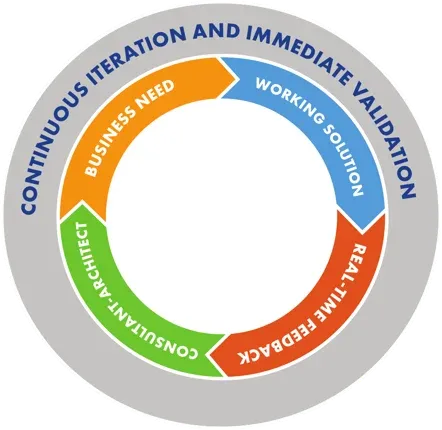
A staged rollout gives an organization a chance to stop or change direction before a process becomes difficult to unwind. Keep a named owner for the review and share both the gains and the costs of the pilot.
SAFe vs Scrum and Lighter Scaling Approaches
SAFe and Scrum answer different coordination questions. Scrum is a lightweight framework for a Scrum Team; SAFe adds structures for planning across teams and, in some configurations, portfolio or large-solution work. The choice should follow the scale of the dependency problem, not a belief that one framework is more Agile.
| Approach | Main Coordination Scope | Consider It When | Trade-Off to Check |
|---|---|---|---|
| SAFe | Multiple teams, shared planning, and optional portfolio or large-solution coordination. | Dependencies and decisions repeatedly cross team or business boundaries. | More roles, events, and governance can add overhead if the need is limited. |
| Scrum | A Scrum Team delivering value through its product work. | One product team needs a shared planning, review, and improvement cadence. | Scrum alone does not define an enterprise portfolio or multi-team operating model. |
| LeSS | Multiple teams working together on one product using Scrum as the starting point. | The organization wants to scale product work while keeping additional structure limited. | It still requires product-wide coordination and organizational change; it is not a no-process option. |
The Scrum Guide and LeSS framework introduction describe their own scopes. SAFe can include Scrum-based teams; it does not replace the team’s need for a clear product goal or sound engineering practices. For a closer look at the distinction, see Agile vs Scrum and when to use each.
An illustrative decision rule is to look for repeated cross-team blockers, shared integration work, and decisions that cannot be made within one team. If those conditions are rare, start with the simplest approach that supports the work. If they are common, test a scaling structure against a baseline and keep only the parts that improve coordination without burying teams in process.
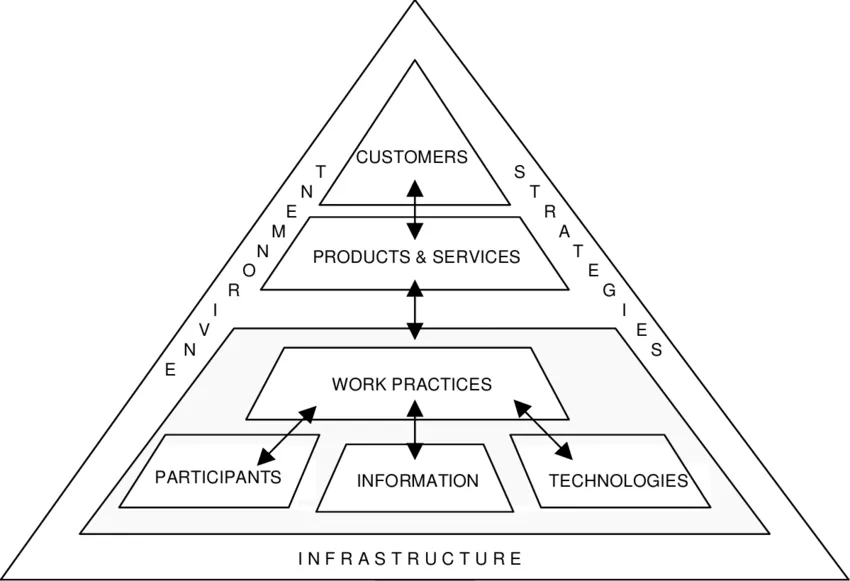
SAFe fits best when dependencies and decisions repeatedly cross team boundaries. If those needs are limited, Scrum or a lighter approach may offer enough coordination without the same overhead.
If your complex software product needs engineering support, Designveloper’s software development services can support product engineering. Decide whether SAFe fits based on your operating needs.
Also published on

Share post on









Related Articles


How Will AI Affect Software Development? Complete Guide In 2026
How Will AI Affect Software Development? Complete Guide In 2026 Published October 21, 2026
How Gitignore Works: Rules, Patterns, Examples, And Debugging Tips
How Gitignore Works: Rules, Patterns, Examples, And Debugging Tips Published October 16, 2026
What Is Velocity In Agile? Formula, Examples, And Common
What Is Velocity In Agile? Formula, Examples, And Common Published October 15, 2026