











Best AI Voice Agents In 2026: Top Platforms For Real Business Workflows

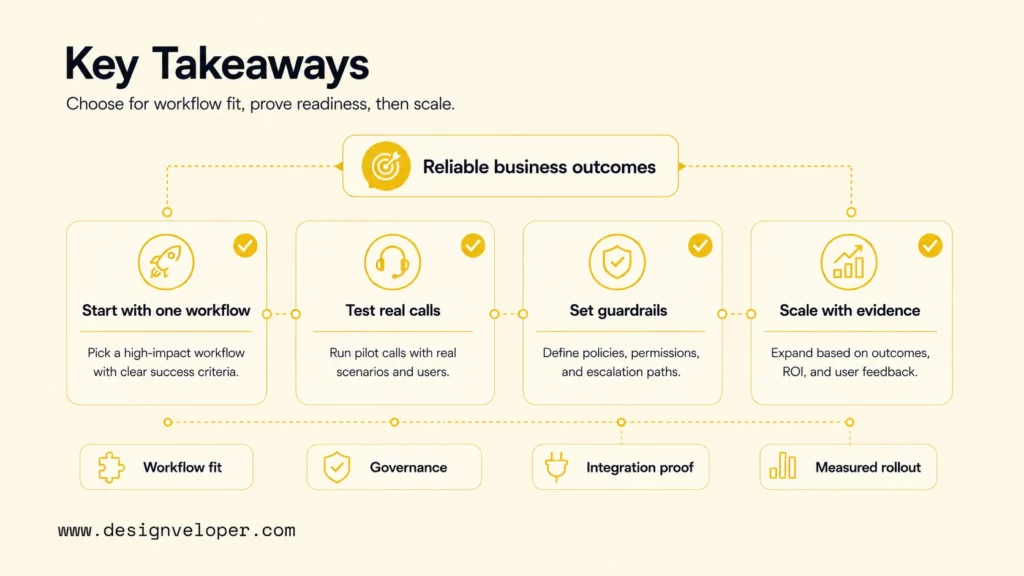
KEY TAKEWAYS:
- An AI voice agent combines speech recognition, LLM reasoning, text-to-speech, and workflow integrations so users can complete tasks through natural voice conversations.
- The best platform depends on latency, voice quality, integration depth, guardrails, pricing, and deployment fit rather than brand popularity alone.
- Voice agents are strongest in customer support, front-desk scheduling, sales qualification, and internal operations where calls follow repeatable workflows.
- Production readiness requires human handoff, QA review, security boundaries, monitoring, and clear ownership because voice automation affects real customer moments.
- Teams should pilot with one narrow workflow, measure containment, latency, call quality, escalation accuracy, and integration reliability, then expand gradually.
An ai voice agent is a software agent that can listen to a spoken caller, reason over the request, respond in a natural voice, and take workflow actions such as booking an appointment, qualifying a lead, updating a CRM, routing a support case, or escalating to a human. The best AI voice agents in 2026 are no longer simple IVR replacements. They combine speech-to-text, large language models, text-to-speech, telephony, analytics, and business integrations so teams can automate real calls without losing control over brand, compliance, or customer experience.
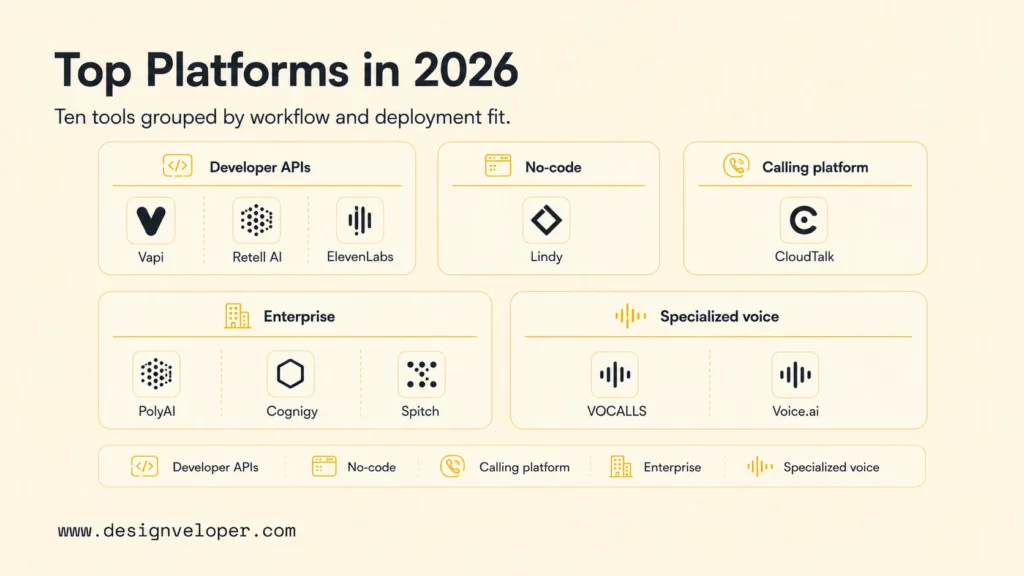
This guide compares ten strong AI voice agent platforms for business use: Vapi, Retell AI, ElevenLabs, Lindy, CloudTalk, PolyAI, Cognigy, VOCALLS, Voice.ai, and Spitch. The right choice depends on whether a team needs a developer API, a no-code phone agent, an enterprise contact center platform, regional language depth, or a full calling stack with CRM and analytics. For high-stakes phone workflows, buyers should test latency, interruption handling, handoff quality, knowledge grounding, audit logs, pricing, and deployment support before moving from pilot to production.
Explore more:
- What Is A Chatbot? Real Uses, How It Works, And What It Can Do
- AI Agent Vs Chatbot: How To Choose The Right Automation Pattern
- What Is Voice Technology? How It Works And Where It Creates Value
What Is An AI Voice Agent?
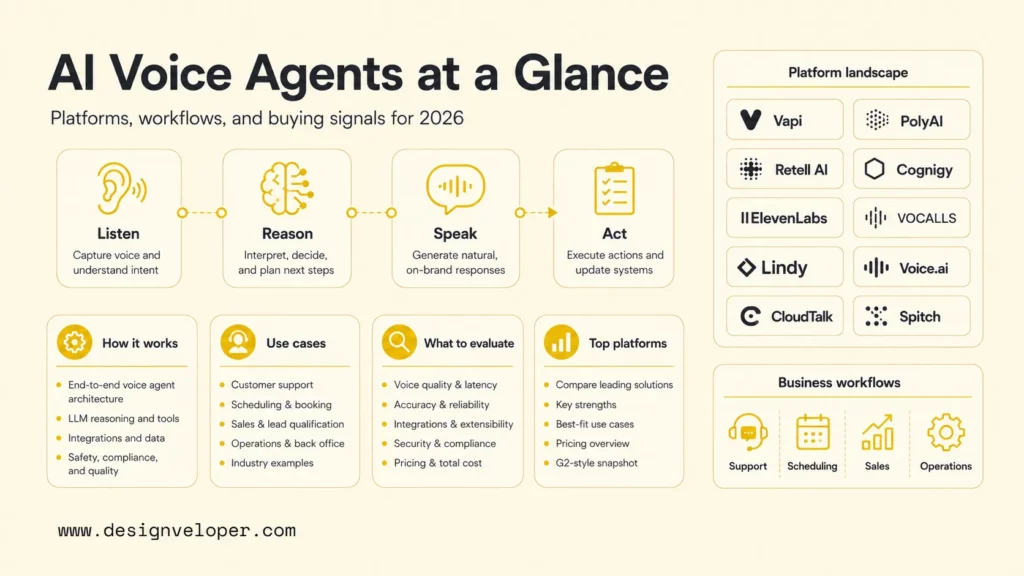
An AI voice agent is an action-oriented conversational system for spoken interactions. A traditional chatbot-and-how-does-it-work/” target=”_blank” rel=”noopener” title=”chatbot” data-wpil-keyword-link=”linked” data-wpil-monitor-id=”3967″>chatbot usually waits for typed messages, while a voice agent has to handle audio quality, accents, pauses, interruptions, silence, and real-time turn-taking. ElevenLabs Agents documentation describes a typical agent architecture as speech recognition, a language model, low-latency text-to-speech, and turn-taking logic. That stack lets a caller speak naturally while the system decides what to say or do next.
The business value comes from combining conversation with workflow execution. A voice agent can answer repetitive questions, collect structured information, authenticate a caller, search a knowledge base, book a meeting, create a ticket, update a CRM, or transfer a call with context. Retell AI’s company overview frames the category around business calls that listen, reason, and act in real time, which is a useful benchmark for judging whether a vendor is selling a demo or a deployable operational system.
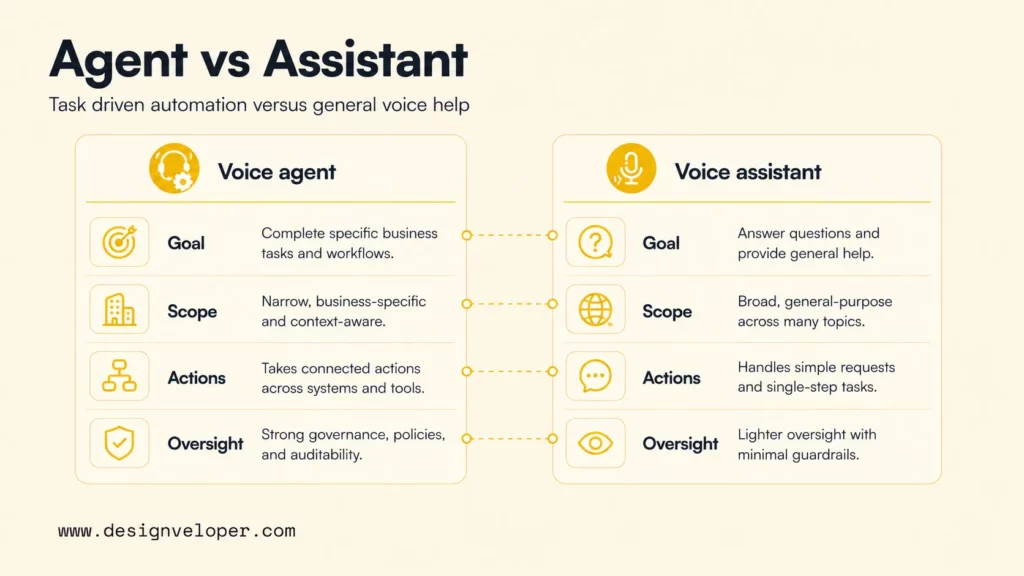
Teams should also separate voice agents from generic voice assistants. Voice assistants often handle broad consumer tasks such as reminders, weather, or device control. AI voice agents are narrower and more accountable. They are designed around one workflow, one caller journey, and one business outcome such as reducing missed calls, improving first-contact resolution, increasing speed to lead, or automating after-hours scheduling.
Recommended for you:
- Why AI Agents Need MCP: How AI Systems Connect To Tools And Data
- A Practical Guide To AI Agent Architecture With Diagrams
- Best AI Agent Frameworks For Building Smarter AI Systems
How AI Voice Agents Work
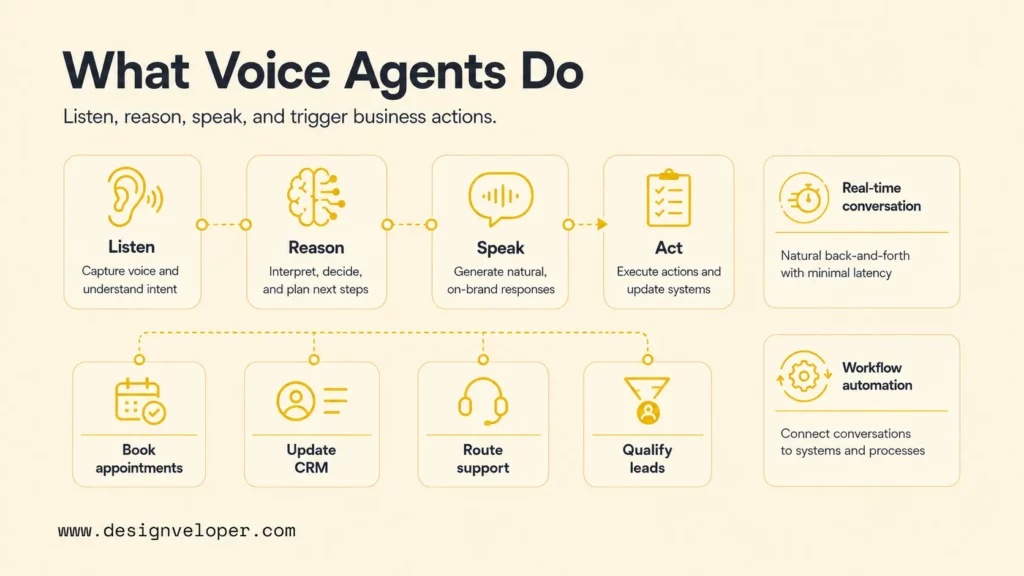
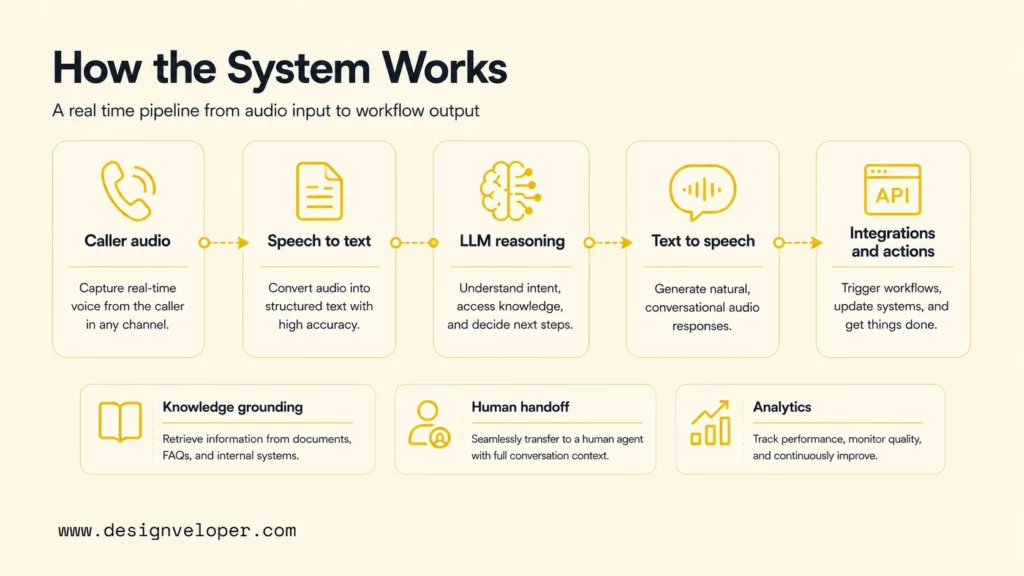
AI voice agents work by streaming caller audio through a pipeline that detects speech, transcribes words, reasons over context, chooses an action, and speaks back quickly enough for a natural call. A production system also needs phone numbers, SIP or carrier integration, business data access, analytics, fallbacks, and human escalation. The hardest part is not a single model. The hardest part is making the whole loop reliable under noisy, emotional, and unpredictable calls.
Speech-To-Text
Speech-to-text converts the caller’s audio into text that the agent can process. Quality depends on accent coverage, background-noise handling, streaming speed, endpoint detection, and domain vocabulary. Spitch voice agent documentation explains the pipeline as voice activity detection, automatic speech recognition, language processing, action taking, and text-to-speech. For business calls, speech-to-text errors can become operational errors, so teams should test real call recordings rather than only clean demo prompts.
LLM-Based Reasoning
LLM-based reasoning lets the agent interpret intent, follow instructions, use context, and decide when to call tools. A strong workflow prompt defines the agent’s role, allowed actions, escalation rules, data boundaries, and tone. Retell’s MCP documentation is a good signal of where the market is moving: voice agents are becoming operational assets that can be configured, versioned, and managed from developer and agentic tooling, not only edited in a web dashboard.
Text-To-Speech
Text-to-speech turns the agent’s chosen response into spoken audio. Naturalness matters because callers judge phone experiences quickly. However, naturalness is not enough. The voice must be fast, stable, clear, and appropriate for the brand. ElevenLabs’ architecture notes point to low-latency TTS, voice selection, multilingual support, and turn-taking as core building blocks for agents that feel responsive rather than scripted.
Integrations And Action Taking
Integrations turn a pleasant conversation into a useful workflow. A voice agent may need access to Salesforce, HubSpot, Zendesk, Calendly, Google Calendar, Stripe, a custom database, or an internal API. Voice.ai agent configuration documentation shows how agent settings can include prompts, timing controls, phone number behavior, tools, webhooks, and MCP servers. Buyers should ask every vendor which actions are native, which require custom code, and which actions are blocked for security reasons.
Core Use Cases Of AI Voice Agents
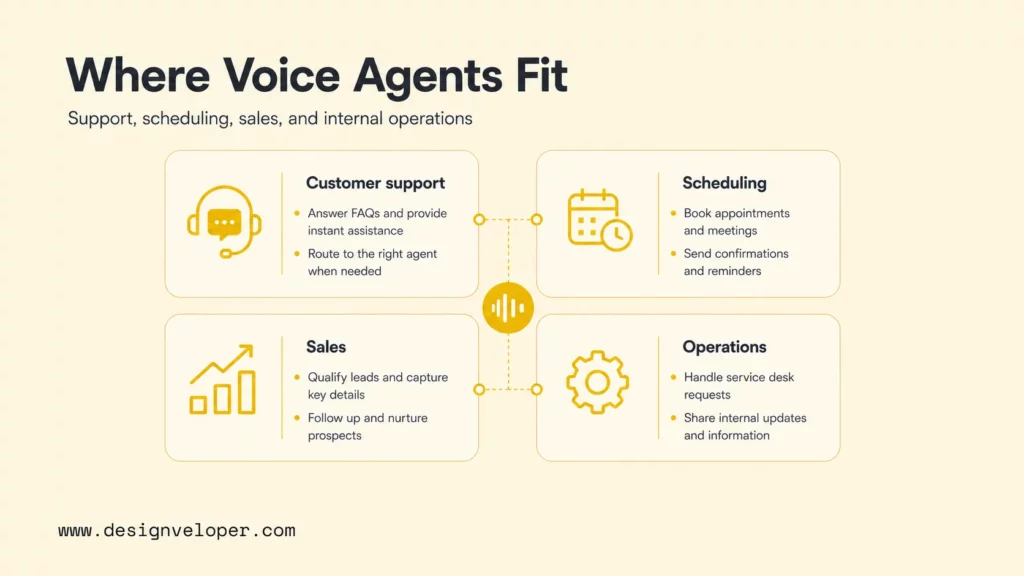
The strongest AI voice agent use cases are structured, repetitive, high-volume, and measurable. The best candidates have clear intake questions, defined outcomes, and a human fallback path. Complex disputes, emotional complaints, regulated advice, and ambiguous exceptions can still use AI support, but they need tighter guardrails and faster escalation.
Customer Support
Customer support voice agents can answer FAQs, track orders, reset passwords, route tickets, collect case details, and summarize calls for human teams. The risk is governance. A May 2026 ITPro report on Sinch-commissioned research said many customer-service AI agent rollbacks were linked to data exposure concerns, hallucinations, brand risk, and weak auditability. Support teams should therefore launch with scoped intents, monitoring, and escalation rules instead of asking an agent to solve every customer problem on day one.
Front Desk And Scheduling
Front desk and scheduling workflows are natural entry points because the agent can follow a narrow path: greet the caller, collect purpose, check availability, confirm details, and send reminders. Retell’s build guide describes appointment booking and phone-number deployment as a common path for getting a live voice workflow into production. Clinics, home services, restaurants, and local service businesses should test edge cases such as cancellations, urgent requests, duplicate bookings, and callers who change details mid-call.
Sales And Lead Qualification
Sales voice agents can respond to inbound leads, call new form submissions, qualify fit, ask budget or timeline questions, and book meetings. The most important metric is often speed to lead rather than call volume alone. A useful sales agent must integrate with the CRM, respect consent and calling rules, record outcomes, and hand off qualified prospects with enough context for a human seller to continue naturally.
Operations And Internal Workflows
Operations teams can use AI voice agents for shift confirmations, delivery updates, HR helpdesk requests, incident triage, and internal service desks. These workflows benefit from clear permissions because internal agents may touch employee records, customer records, or operational systems. Designveloper approaches this category as a product-engineering problem: discovery, workflow mapping, API review, permission design, test scenarios, monitoring, and human approval flows matter as much as the voice model itself. Our AI development services focus on custom AI software and automation that fits real business operations rather than standalone demos.
Discover more here:
- Conversational AI Platform: How To Choose The Right Foundation
- AI Business Process Automation: How AI Improves Workflows
- What Is AI Integration? A Practical Guide For Connected AI Systems
What To Look For In The Best AI Voice Agents
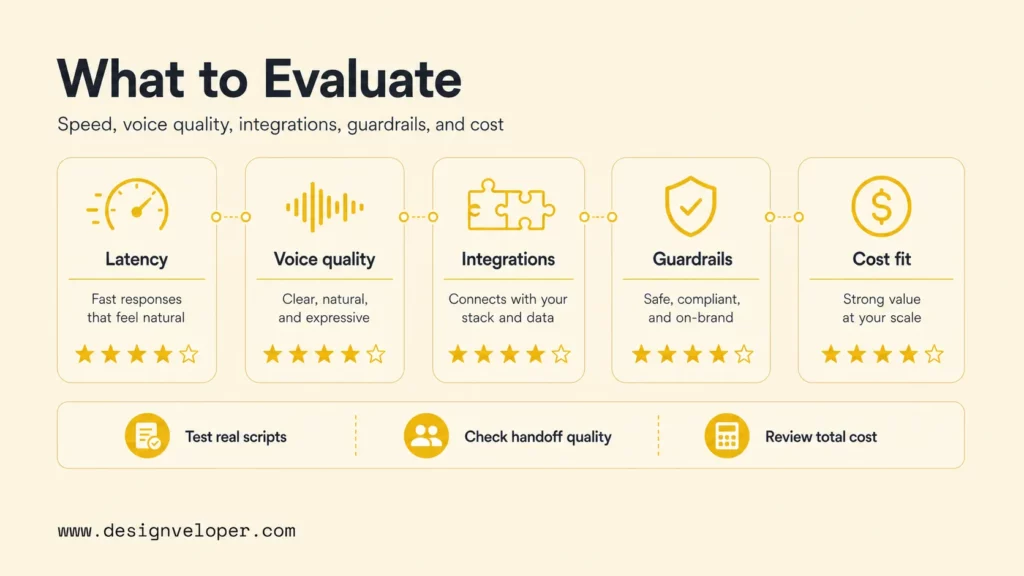
The best AI voice agents should be judged by production behavior, not a polished demo. Buyers should run test calls with real scripts, real background noise, real integrations, and uncomfortable edge cases. A practical evaluation scorecard should cover response speed, voice quality, workflow fit, reliability, governance, reporting, and total cost.
Latency And Turn-Taking
Latency is the delay between a caller finishing a phrase and the agent responding. Turn-taking is the system’s ability to know when to speak, pause, interrupt, or listen. Retell’s March 2026 changelog highlights dynamic voice speed and A/B testing, which shows how vendors are optimizing conversation feel after initial deployment. During evaluation, teams should test interruptions, long pauses, fast talkers, and callers who answer before the agent finishes speaking.
Voice Quality And Naturalness
Voice quality includes pronunciation, tone, emotion, pacing, and language support. A natural voice can reduce caller resistance, but excessive realism may create disclosure and trust questions. Businesses should decide whether the agent introduces itself as AI, how the voice reflects the brand, and whether the same voice works across support, sales, and collections. For global teams, language and accent quality should be tested with local speakers, not only vendor samples.
Workflow Integrations
Workflow integrations determine whether the agent can complete tasks. A beautiful call that cannot book, update, verify, or route is only a voice interface. The buyer should map every required action before choosing a platform: data lookup, write-back, human transfer, payment collection, calendar booking, ticket creation, and post-call summary. Custom software teams should also check webhooks, API rate limits, retry behavior, authentication, audit logs, and sandbox support.
Reliability And Guardrails
Reliability means the agent behaves correctly when speech recognition fails, data is missing, a caller asks something outside scope, or a backend API times out. Guardrails should include clear escalation rules, approved knowledge sources, blocked topics, call recording policy, data retention, and human review. PolyAI’s 2025 Agent Studio announcement is useful because it explicitly discusses enterprise-grade conversational AI, hallucination risk, and the need for tooling that manages reliability after launch.
Pricing And Deployment Fit
Pricing can include platform fees, per-minute voice infrastructure, LLM usage, speech-to-text, text-to-speech, telephony, phone numbers, call recording, analytics, premium support, and implementation services. Retell AI pricing lists pay-as-you-go AI voice agents in a per-minute range, while enterprise vendors often require custom quotes. Teams should model best-case, normal-case, and worst-case call durations before assuming a voice agent is cheaper than a human-supported workflow.
Learn more in:
- Enterprise AI Agents: How Businesses Build Reliable Agent Systems
- AI Agent Orchestration: Coordinating Systems Safely
- What Is An AI Harness & Build A Minimal One Yourself
The Best AI Voice Agents In 2026
The best AI voice agents in 2026 fall into several categories: API-first platforms for developers, no-code phone agents for teams that want speed, contact-center platforms for enterprises, and specialized voice technology” data-wpil-keyword-link=”linked” data-wpil-monitor-id=”3968″>voice technology providers for language or regional needs. The table below gives a quick decision view before the individual reviews.
| Platform | Best fit | Primary strength | Watch point |
|---|---|---|---|
| Vapi | Developer-led voice agents | Flexible API and phone/web deployment | Requires engineering ownership for production workflows |
| Retell AI | Phone automation at speed | Voice-agent builder, analytics, testing, and pay-as-you-go entry | Total cost varies by model, voice, telephony, and add-ons |
| ElevenLabs | Voice-rich multimodal agents | Expressive voices, agent tooling, testing, and SDKs | Workflow design still needs careful guardrails |
| Lindy | No-code phone agents and business automation | Easy setup for teams that already want AI assistants | Less suitable for deeply custom telephony stacks |
| CloudTalk | Sales and support teams using a calling platform | Voice agents inside a broader call center stack | Best when the team wants CloudTalk’s phone system too |
| PolyAI | Enterprise customer engagement | Voice-first dialog platform and enterprise experience | May be more vendor-led than lightweight API tools |
| Cognigy | Enterprise contact centers | Conversational IVR, orchestration, and contact-center integrations | Implementation planning is heavier than SMB tools |
| VOCALLS | Conversation intelligence plus automation | Voice-first automation now connected to CallMiner | Buyers should confirm current packaging after acquisition |
| Voice.ai | Voice API and agent builders | TTS, voice cloning, and voice-agent API controls | Evaluate governance and enterprise support for regulated use |
| Spitch | Contact-center voice automation and analytics | Virtual assistant, speech analytics, biometrics, and omnichannel modules | Confirm regional language fit because Spitch also markets African-language developer tools |
1. Vapi
Vapi is a developer platform for building voice AI agents across phone calls and web experiences. Vapi is a strong option when a product or engineering team wants to control the agent behavior, tool calls, deployment path, and integration layer. The documentation positions Vapi around customer support, sales automation, no-code dashboard setup, SDKs, and embedded voice conversations.
Best For: Engineering teams building custom inbound or outbound voice workflows, SaaS teams adding voice into a product, and agencies that need flexible client implementations.
Strengths: Vapi’s API-first posture makes it attractive for teams that want to assemble their own stack. The platform can support phone calls and web voice experiences, which is useful when a company wants the same agent logic across channels.
Limitations: API flexibility shifts responsibility to the builder. Teams still need to design prompts, integrations, monitoring, fallback paths, and human handoff. Vapi is strongest when the buyer has technical ownership, not when the buyer wants a fully managed contact-center transformation.
2. Retell AI
Retell AI is a voice agent platform for building, testing, deploying, and scaling phone agents. Its pricing page lists pay-as-you-go usage for AI Voice Agents and an enterprise plan for higher reliability, compliance, and support. Retell also publishes product updates such as A/B testing, dynamic voice speed, IVR navigation, and batch-call windows, which are practical features for teams running live phone operations.
Best For: Businesses that want to automate phone calls quickly while keeping enough control over prompts, call flows, testing, analytics, and integrations.
Strengths: Retell is strong for real phone workflows such as scheduling, qualification, routing, reminders, and service calls. The platform supports simulation testing, call analytics, transcripts, webhooks, API access, and free concurrent calls on the pay-as-you-go plan according to its pricing page.
Limitations: Retell’s per-minute range depends on LLM, TTS, telephony, and add-ons. Teams should calculate cost with realistic call lengths and failure handling. Complex regulated workflows also need careful review of data retention, consent, auditability, and fallback behavior.
3. ElevenLabs
ElevenLabs Agents is a strong choice for voice-rich conversational agents because ElevenLabs combines speech recognition, LLM choice, low-latency text-to-speech, turn-taking, SDKs, telephony integrations, widgets, analytics, experiments, and testing. ElevenLabs is especially relevant when brand voice, multilingual delivery, and expressive audio quality matter.
Best For: Teams that want polished voice experiences for web, mobile, telephony, education, support, media, or product experiences.
Strengths: ElevenLabs offers a broad developer and product surface: React, Swift, Kotlin, React Native, WebSocket, Twilio, SIP trunk, widgets, batch calls, knowledge base, tools, and conversation analysis. That breadth makes it useful for teams building beyond a simple phone bot.
Limitations: Voice quality can make weak workflows sound better than they are. Buyers still need to test knowledge grounding, tool permissions, escalation, and analytics under real customer scenarios before trusting a voice-rich agent in production.
4. Lindy
Lindy’s phone agent fits teams that want an AI assistant for calls without building the full stack from scratch. Lindy is positioned as an easy platform for creating, deploying, and managing AI agents, and the phone-agent page emphasizes fast setup for call handling.
Best For: Small and mid-sized teams that want no-code phone automation for scheduling, intake, support, and lead handling.
Strengths: Lindy works well when a business wants AI agents across phone and operational tasks, not only a voice API. The broader Lindy agent model can be helpful when call outcomes need to trigger follow-up work in calendars, inboxes, CRMs, or internal tools.
Limitations: Teams with strict telephony architecture, custom compliance requirements, or deep product embedding may outgrow a no-code-first approach. Buyers should confirm which phone behaviors, integrations, logs, and permissions are configurable before committing.
5. CloudTalk
CloudTalk VoiceAgents are AI-powered virtual agents inside CloudTalk’s calling environment. CloudTalk’s help center describes VoiceAgents as autonomous voice interactions for scaling and streamlining call workflows, and its broader platform includes calling, routing, AI dialer features, local numbers, analytics, and CRM-style workflows.
Best For: Sales, support, operations, and hiring teams that already need a business phone or call center platform.
Strengths: CloudTalk is attractive when a company wants AI voice automation inside a complete calling stack. Native call logs, routing, numbers, monitoring, and team workflows can reduce the integration burden compared with stitching together separate telephony and voice-agent vendors.
Limitations: CloudTalk may be less appropriate for teams that only want a low-level voice-agent API or that already have a mature telephony stack. The best buyer fit is a team willing to evaluate the phone platform and the AI voice agent together.
6. PolyAI
PolyAI focuses on enterprise-grade voice AI agents for complex customer conversations. PolyAI says its platform is built for dialog agents that can run, adapt, and improve in real time, and its developer materials highlight low latency, lifelike TTS, barge-in handling, ASR, and business-logic ownership.
Best For: Large enterprises, contact centers, hospitality, financial services, healthcare, utilities, and brands with high call volume and complex conversational paths.
Strengths: PolyAI’s voice-first heritage and enterprise references make it strong for teams that need more than a quick phone bot. Its materials emphasize dialog quality, guardrails, analytics, and enterprise readiness, which matter for customer-facing operations at scale.
Limitations: PolyAI can be a heavier procurement and implementation path than self-serve tools. Buyers should expect more planning around use-case design, data access, success metrics, and operational ownership.
7. Cognigy
Cognigy Voice AI Agents are aimed at contact centers that need conversational IVR, routing intelligence, and enterprise customer journeys. Cognigy documentation also covers voice previews, speech-provider setup, and AI agent development for phone interactions.
Best For: Enterprises that need conversational AI across voice and digital channels with contact-center integrations and governance.
Strengths: Cognigy is strong where contact-center orchestration matters: routing, IVR modernization, agent handoff, channel coverage, and enterprise administration. It is a better fit for structured transformation than one-off appointment bots.
Limitations: Cognigy implementation can require contact-center expertise and change management. Teams should scope the first use case carefully so the project does not become a broad platform rollout before one workflow proves value.
8. VOCALLS
VOCALLS is a voice-first conversational AI and automation platform that became part of CallMiner in 2025. CallMiner’s acquisition announcement says VOCALLS brings voice, chat, social messaging, email AI virtual agents, and task automation into CallMiner’s conversation intelligence portfolio.
Best For: Organizations that want automation connected to conversation intelligence, quality monitoring, and customer-experience analytics.
Strengths: VOCALLS is interesting because the CallMiner combination can connect automation with interaction analytics. That matters when a company wants to improve contact-center performance, not only deflect calls.
Limitations: Buyers should verify current packaging, roadmap, implementation model, and support structure after the acquisition. The strongest evaluation question is how VOCALLS capabilities now appear inside CallMiner’s product and commercial offering.
9. Voice.ai
Voice.ai offers real-time voice AI experiences, text-to-speech, voice cloning, and voice agent capabilities. Its developer documentation describes creating agents, configuring prompts, choosing models, controlling interruptions, assigning phone numbers, using webhooks, and managing knowledge bases.
Best For: Developers and product teams that want voice AI APIs, custom voices, and configurable agent behavior.
Strengths: Voice.ai gives builders direct controls for prompt, greeting, model choice, TTS parameters, interruption behavior, timing, tools, and webhooks. That can be useful for custom voice products or specialized agent workflows.
Limitations: Voice cloning and custom voice systems need strong governance. Teams should review consent, impersonation risk, disclosure, data retention, and moderation before using synthetic voices in customer-facing calls.
10. Spitch
Spitch offers a collaborative agentic AI platform for contact centers, including virtual assistants, speech analytics, voice biometrics, quality management, knowledge agents, and chat. Spitch also operates a developer platform for African-language voice AI at Spitch.app, which highlights local-language speech-to-text, text-to-speech, and voice experiences.
Best For: Contact centers that need voice automation, analytics, authentication, and multilingual or regional voice capabilities.
Strengths: Spitch is useful when a buyer wants a broader contact-center AI layer rather than a standalone call bot. Speech analytics and voice biometrics can support quality, authentication, and operational insight.
Limitations: The Spitch brand spans enterprise contact-center software and regional developer voice tooling. Buyers should confirm which product line, language coverage, hosting model, and integration package fits their market.
AI Voice Agent Vs AI Voice Assistant
An AI voice agent is usually workflow-driven, while an AI voice assistant is usually general-purpose. A voice assistant might answer broad questions, play media, take notes, or control devices. A voice agent is built to complete a business process such as appointment booking, claims intake, order tracking, lead qualification, payment reminders, or internal helpdesk routing.
- Voice assistants are often broad, user-led, and conversational. They may not own a defined business outcome.
- Voice agents are scoped, action-oriented, and accountable. They should have a measurable success metric, a data boundary, and a fallback path.
- Voice assistants can tolerate some ambiguity because the stakes are often lower. Voice agents need stronger audit logs, escalation, and error handling because the call may affect revenue, care, compliance, or customer trust.
The distinction matters during vendor selection. A team that wants an expressive product companion may prioritize voice quality and SDKs. A team that wants to automate support calls should prioritize workflow completion, handoff quality, call analytics, security, and operational support.
How To Choose The Right AI Voice Agent Platform
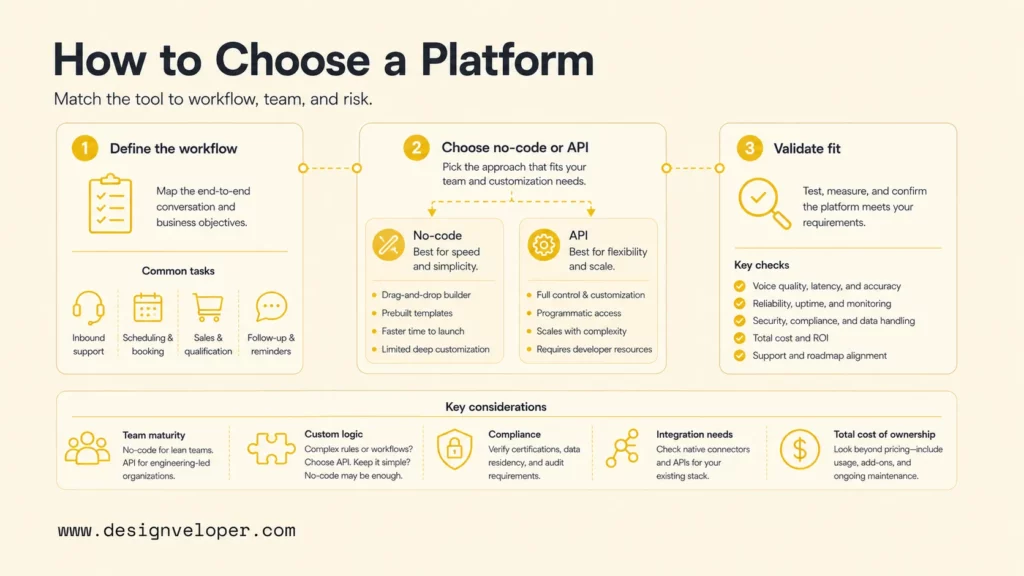
The right AI voice agent platform should match the workflow, buyer maturity, technical team, and risk profile. A small service business may need a no-code receptionist. A SaaS company may need a developer API. A bank or healthcare provider may need enterprise governance, contact-center integration, and strict auditability.
No-Code Platform Vs API
A no-code platform is best when the team wants to launch quickly and the workflow is common: answer calls, ask questions, book appointments, qualify leads, and transfer exceptions. An API platform is best when the agent needs custom product logic, proprietary data, embedded voice, unusual telephony, or CI/CD-style deployment. The practical rule is simple: choose no-code when the workflow fits the product, and choose an API when the product must fit the workflow.
Match The Platform To The Workflow
Teams should map the call journey before comparing vendors. A useful workflow map includes caller types, intents, required data, allowed actions, edge cases, human handoff triggers, success metrics, and post-call records. For example, a healthcare scheduler needs consent language, patient verification, appointment rules, escalation for urgent symptoms, and EHR or calendar integration. A sales qualifier needs lead source, CRM write-back, meeting rules, disqualification criteria, and a rep notification path.
Test Reliability, Cost, And Integration Fit
Reliable selection requires a pilot that looks like production. Teams should run at least 50 to 100 test calls across accents, background noise, interruptions, angry callers, repeated questions, missing data, API failures, and transfer scenarios. The pilot should track containment, transfer rate, booking accuracy, average call duration, tool-call errors, hallucination incidents, customer sentiment, and cost per successful outcome. Designveloper can support this stage by helping teams turn voice-agent ideas into tested workflows, integration plans, QA cases, and production-readiness checklists through our software development services.
| Decision area | What to verify | Why it matters |
|---|---|---|
| Conversation quality | Latency, interruption handling, silence, accent coverage, and tone | Callers abandon agents that feel slow, rude, or confused |
| Workflow completion | Bookings, CRM updates, ticket creation, transfers, and summaries | The agent must complete real work, not only talk |
| Governance | Disclosure, consent, audit logs, blocked topics, data retention, and escalation | Voice agents can create legal, brand, and privacy risk |
| Commercial fit | Per-minute cost, phone numbers, LLM/TTS charges, support, and implementation | Call duration and retries can change economics quickly |
For a deeper dive, read:
- Types Of AI Agents: Patterns, Uses, And Tradeoffs
- From AI MVP To Product: Why Great Demos Are Not Enough
- AI In Product Development: From Concept To Market Faster
What Successful AI Voice Agent Adoption Looks Like
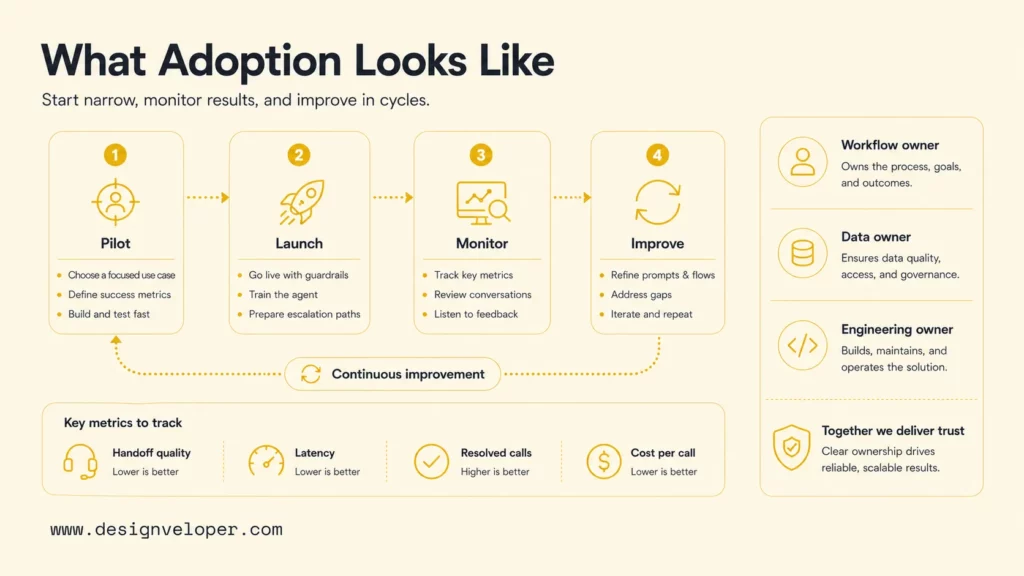
Successful AI voice agent adoption looks like a measured operations rollout, not a technology announcement. The first workflow should be narrow enough to test, valuable enough to matter, and safe enough to automate with clear supervision. A strong first release usually automates one or two intents, hands off exceptions with a summary, and gives managers dashboards for call outcomes and failure patterns.
A production-ready rollout should include a workflow owner, escalation owner, data owner, and engineering owner. The team should define what the agent may say, which systems it may access, what counts as a successful call, and when a human must take over. Monitoring should include transcripts, recordings where permitted, tool-call logs, unanswered-intent reports, customer complaints, latency metrics, cost per resolved call, and weekly prompt or knowledge-base improvements.
The healthiest teams treat voice agents as living products. Call data reveals missing policies, confusing service rules, broken integrations, and training gaps. The agent should improve through versioning, A/B tests, prompt updates, knowledge-base refreshes, and human review. The vendor should support that operating model with logs, analytics, testing tools, version control, and clear deployment controls.
FAQs About The Best AI Voice Agents
The following questions cover the decisions most teams ask before choosing a platform, piloting a workflow, or moving a voice agent into production.
What Are The Best AI Voice Agents For Business Use?
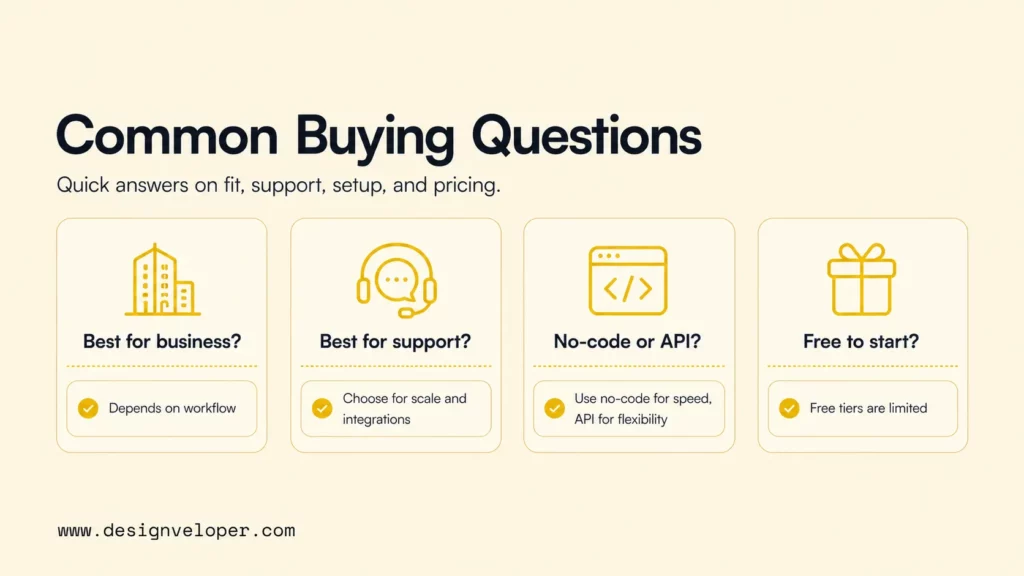
The best AI voice agents for business use depend on the workflow. Vapi is strong for developer-led custom builds. Retell AI is strong for fast phone-agent deployment. ElevenLabs is strong for expressive voice and multimodal agent tooling. Lindy is useful for no-code business automation. CloudTalk fits teams that need a calling platform with AI agents. PolyAI and Cognigy fit larger enterprise contact-center programs. VOCALLS, Voice.ai, and Spitch are worth evaluating for conversation intelligence, custom voice APIs, and specialized voice automation needs.
Which AI Voice Agent Is Best For Customer Support?
PolyAI, Cognigy, CloudTalk, Retell AI, and Spitch are strong candidates for customer support, but the best choice depends on scale and integration needs. Enterprise contact centers should start with PolyAI, Cognigy, and Spitch. Teams that need a business phone stack should evaluate CloudTalk. Teams that want quick phone automation with flexible testing and analytics should evaluate Retell AI. Any customer-support rollout should include escalation, audit logs, data controls, and a rollback plan.
Should Teams Choose A No-Code Platform Or An API?
Teams should choose a no-code platform when the target workflow is common and the team needs speed. Teams should choose an API when the workflow needs custom data access, embedded product voice, unique call routing, strict CI/CD, or complex operational logic. Many companies start no-code to validate call scripts and then move to API or custom software once the voice workflow proves value.
How To Make AI Voice Agents?
To make an AI voice agent, define one workflow, choose a platform, write the agent goal and guardrails, connect knowledge sources, configure voice and turn-taking, integrate the required business systems, test real call scenarios, and monitor production outcomes. A practical first build should include sample caller intents, allowed actions, escalation rules, fallback messages, test cases, success metrics, and a weekly improvement loop.
Is There A Free AI Agent To Talk To?
Some platforms offer free trials, free credits, demos, or self-serve test calls. Retell AI lists free credits on its pricing page, and many vendors offer public demos or sales-led trials. Free access is useful for checking voice feel, but production selection should depend on workflow reliability, integrations, data handling, and support rather than a demo conversation alone.
Final Words
The best AI voice agents in 2026 are the platforms that can turn spoken conversations into reliable business outcomes. Vapi, Retell AI, ElevenLabs, Lindy, CloudTalk, PolyAI, Cognigy, VOCALLS, Voice.ai, and Spitch each serve a different buyer profile, so the right shortlist should start with workflow requirements rather than vendor popularity. Teams should test real calls, prove integrations, model costs, and define governance before putting an agent in front of customers at scale.
Designveloper helps companies design, build, integrate, and maintain AI-powered business workflows where voice agents connect to real products, data, and operations. If your team is evaluating AI voice automation, start with one valuable call journey, one measurable outcome, and one production-readiness checklist before expanding into broader automation.
Also published on

Share post on










Related Articles



How To Build A RAG System: Step-By-Step (New Guide)
How To Build A RAG System: Step-By-Step (New Guide) Published October 19, 2026
Agentic AI Single Vs. Multi-Agent Systems: When To Use Each One
Agentic AI Single Vs. Multi-Agent Systems: When To Use Each One Published October 19, 2026
Is Vibe Coding Legal? Ownership, Copyright, and Release Risks
Is Vibe Coding Legal? Ownership, Copyright, and Release Risks Published October 16, 2026